The Definitive Guide to Industrial Cookie Maker Machines: A Strategic Investment for Your Bakery
Diverse Cookie Production: It highlights the machine's capability to produce a wide range of cookies, including wire-cut, deposited, and rotary molded varieties, showcasing its versatility.
Precision & Consistency: The content stresses the machine's ability to ensure unparalleled shape uniformity and consistent baking, which are critical for high-quality cookie output.
Description
By: [Jason Wang], Lead EngineerWith 18 years of experience in food processing automation, [our team has designed and delivered complete cookie production lines for over 150 bakeries and food factories worldwide]. Our analysis is based on real data from hundreds of projects.
I. Introduction: Beyond "Machine" to "Industrialization"
For a modern bakery or food factory, investing in an industrial cookie machine is a key strategic decision. It's about achieving large-scale production, ensuring product consistency, and unlocking a leap in operational efficiency.
When market demand soars, traditional handmade or semi-automatic methods quickly become a bottleneck. An increase in orders shouldn't come at the cost of quality, yet manual operation inherently lacks consistency, resulting in variations in weight, size, and shape.
In today's retail market, this inconsistency is fatal.
This is precisely where the industrial cookie machine comes in. It's not just a piece of equipment; it's the strategic pivot from a "workshop" to an "industrial" mindset. It's a promise that every single product delivered to your customers, distributors, and retail partners meets the exact same high standard.
This guide will dive deep into the world of industrial cookie machines, analyzing their strategic value, core types, and key purchasing factors.
More importantly, we will examine this from the unique perspectives of business owners, financial managers, procurement teams, and engineers to show how this investment can reshape your entire baking operation.
Strategy > Cost: Buying an industrial cookie machine is a strategic capital expenditure (CAPEX). Its core value lies in achieving scale, consistency, and freeing up human capital, not just in being an expense.
Dough Determines the Machine: There is no "best" machine, only the machine that is best for your dough. Depositors are for soft batters; Wire-Cut machines are for firm doughs with inclusions; Rotary Moulders are for crisp, printed doughs; and Co-Extruders are for filled products.
A Team Decision: A successful purchase is the result of cross-departmental collaboration (Finance, Engineering, Procurement, Operations). The criteria of each role (TCO, PLC brand, serviceability) are all critical.
TCO > Price: The Total Cost of Ownership (TCO)—including energy, spare parts, and maintenance—is far more important than the initial purchase price. A higher-quality, more expensive machine often delivers a far superior long-term ROI.
System Integration: The machine is not an island. It must be planned as part of a complete production line (from mixing to baking) to avoid creating new upstream or downstream bottlenecks.
II. Why This is a Strategic Investment
Investing in a commercial cookie machine creates ripple effects through every level of your business.
A. Ultimate Consistency (Brand & Quality)
This is the primary value. In the retail channel, consistency is the brand. Consumers expect the same taste, appearance, and weight every time. A professional cookie machine, through its precision servo motors and volumetric pumps, ensures the weight error of each dough piece is controlled within an astonishing range (typically less than ±1%). This consistency is the bedrock of brand trust.
B. A Quantum Leap in Efficiency
This is the most visible benefit. A skilled baker might portion a few hundred cookies per hour, while an entry-level industrial machine can process hundreds per minute. Large-scale lines deal in tens of thousands. This leap in efficiency means you can fulfill larger orders in less time, drastically shortening production cycles.
C. Optimizing Labor Costs
Automating the forming process isn't about replacing your bakers; it's about unleashing them. It liberates your valuable human resources from high-repetition, low-value, and injury-prone (RSI) manual labor. This allows your skilled bakers to focus on higher-value tasks: product R&D, process optimization, dough management, and quality control.
D. Unleashing Creativity & Product Diversity
By changing molds, nozzles, or cutting systems, you can easily produce dozens of different shapes, patterns, and sizes. Want to launch tree-shaped cookies for Christmas? This no longer requires complex staff training. You simply swap a program and a set of tools, giving you the flexibility to respond to market trends at a very low cost.
E. Precise Control Over Ingredient Costs
Expert Insight: In the baking industry, dough is money.
In manual portioning, an average "over-portioning" of 5% is common. If your dough costs $1.00 per pound and you produce 1,000 pounds a day, that 5% waste is $50 lost. That's over $18,000 in pure, lost profit every year. The precise portioning of a cookie machine virtually eliminates this waste.
F. Scalability & Future-Proofing
This is an investment in your future. When you get a massive order from a major supermarket, you need the confidence to say "yes" without scrambling to hire and train new staff. High-end models also offer modular upgrade paths. When you decide to develop a new product line (like filled or dual-color cookies), a high-spec machine can often be upgraded without doubling your staff or production lines.
III. The Core Types of Industrial Cookie Machines
Understanding the different machine types is essential. Each is suited for a different type of dough and final product.
Always remember: Your dough determines the machine.The most critical step in evaluating a supplier is taking your actual, most difficult dough recipes to their test kitchen for a live demonstration.
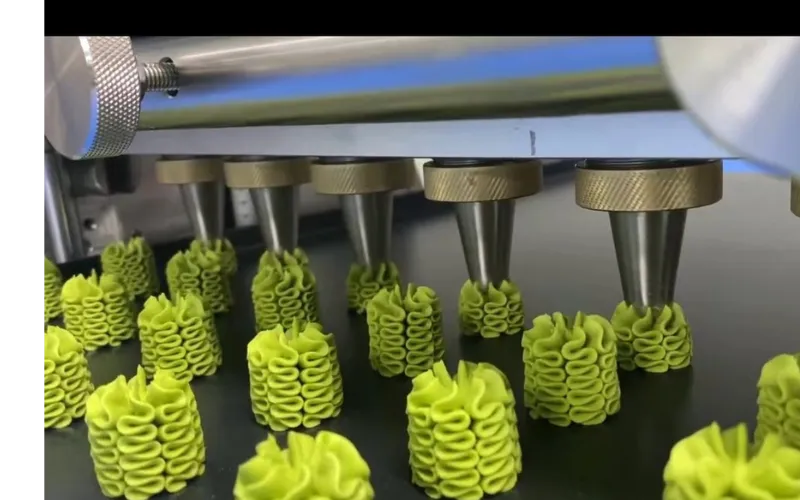
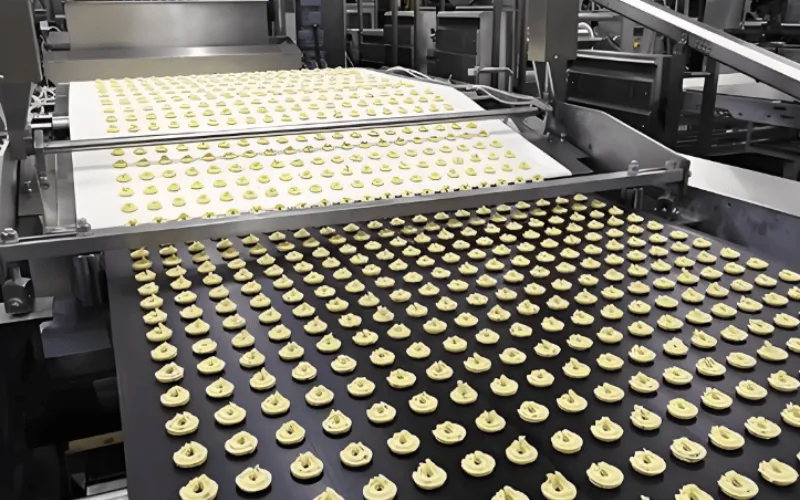
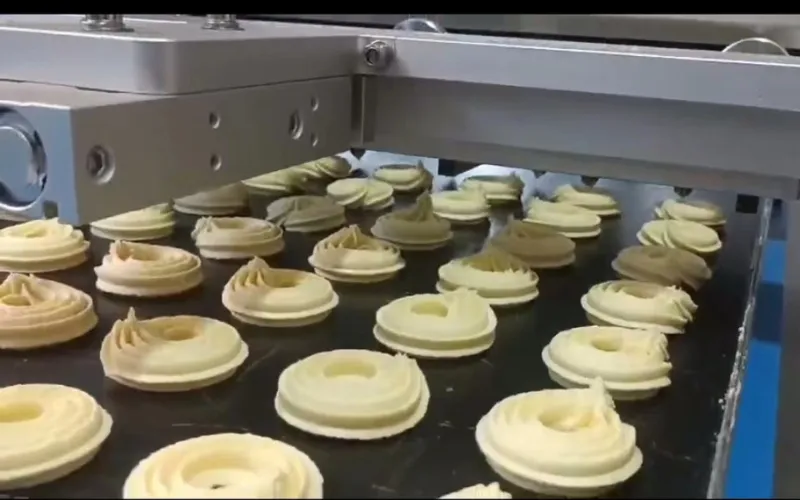
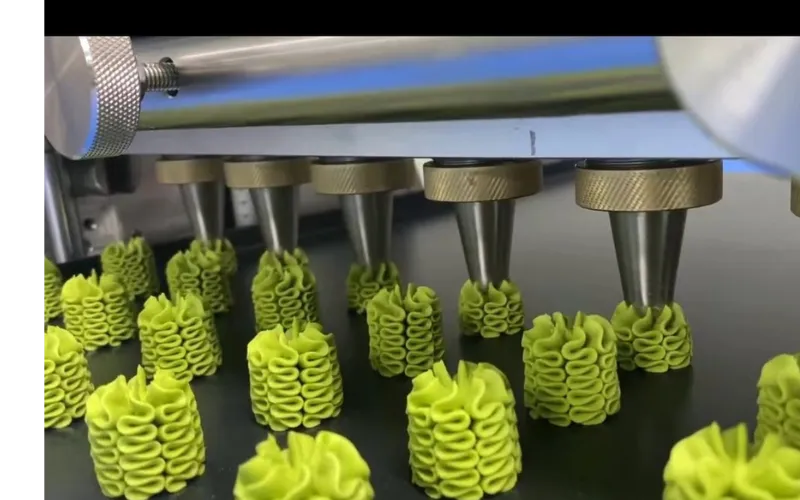
How it Works: The most versatile type. Dough (typically a softer batter) is loaded into a hopper and extruded in precise portions through nozzles (driven by gear or piston pumps) onto a baking tray or conveyor belt.
Core Tech: High-end models feature heads that can move up-and-down, side-to-side, or even rotate. In sync with the conveyor, they can "draw" complex shapes like S-curves, circles, and swirls.
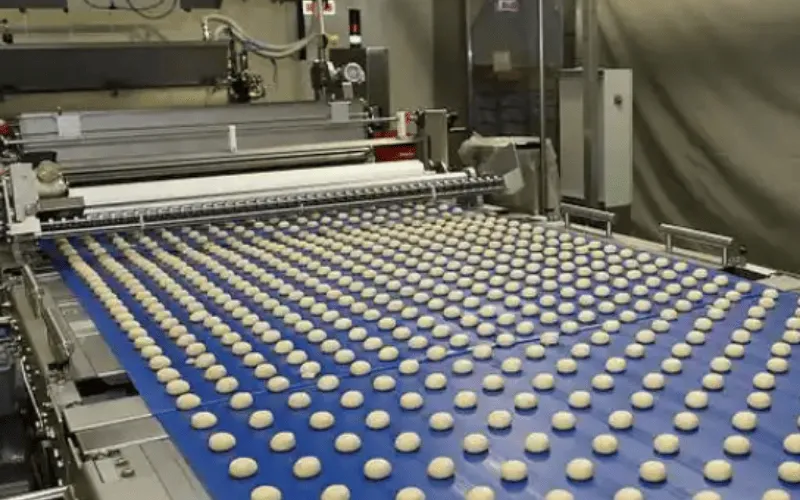
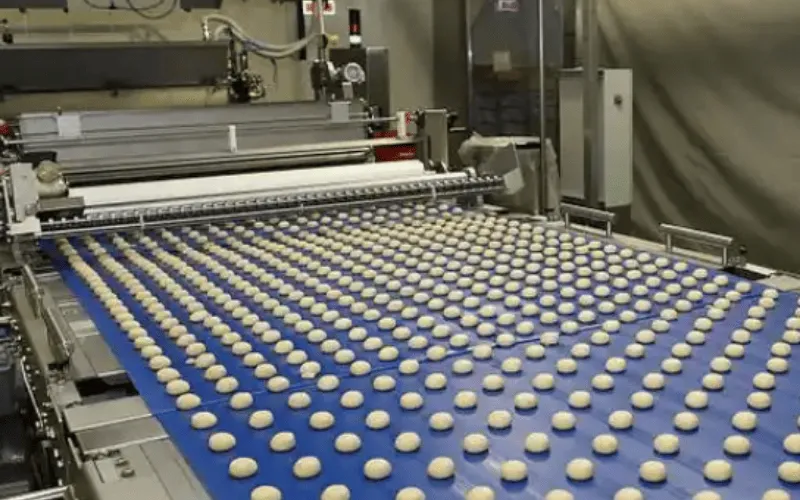
How it Works: The workhorse for high-volume production. Dough (typically medium-to-firm and often containing solids) is extruded through a die plate into a continuous slab. A fast-moving wire or blade sweeps across the opening, cleanly cutting the slab into uniform slices.
Core Tech: The perfect synchronization between the wire's oscillation frequency and the dough's extrusion speed.
Best For: Medium-firm doughs, especially those with large particulates like nuts or chocolate chunks.
C. Rotary Moulders
How it Works: The "brand-builder" for creating highly recognizable, embossed cookies. Stiff, low-moisture dough is forced into an engraved die roller (often bronze or food-grade plastic). A precise scraper knife shears off excess dough. Finally, a canvas conveyor belt lifts the perfectly formed cookie out of the mold.
Core Tech: The precision of the engraved roller and the exact fit of the scraper knife.
Best For: Stiff, low-moisture short doughs. Examples: Butter shortbread, animal crackers, and any biscuit requiring a sharp, clear logo.
D. Multi-Functional & Co-Extruders
How it Works: The frontier of innovation, most commonly as a Co-Extruder. It features two (or three) independent hoppers and pump systems that feed into a complex, concentric die, extruding multiple materials simultaneously.
Core Tech: The ability to wrap one material (the filling) inside another (the shell) in one step.
Best For: Center-filled cookies (like fig bars), energy bars, mochi, and dual-color cookies.
IV. How to Choose the Right Machine for Your Factory
A systematic process is essential when evaluating options.
A. The Critical Factor: Your Dough & Product
This is the very first question: "What are the characteristics of my dough?"
Purchasing Rule #1:Your dough and your product always decide the machine. Never the other way around. Always take your dough to a supplier's lab for a live, in-person test.
Is it a high-moisture, fluid batter? (Choose a Depositor)
Is it a dense dough with large particulates? (Choose a Wire-Cut)
Is it a stiff, short dough that needs a pattern? (Choose a Rotary Moulder)
Do you want to produce high-value filled products? (Choose a Co-Extruder)
B. Production Capacity & Scale
Evaluate your current and future volume needs. Don't just look at peak demand; look at your average daily production and your expected annual growth rate. Do you need to produce 100 pounds per hour, or 1,000? Do you need a tabletop machine for a boutique shop, or a 1.5-meter-wide industrial line that feeds directly into a tunnel oven?
C. Usability & Ease of Cleaning (Operations & Food Safety)
This is what keeps your operations manager and QA team up at night. Is the machine easy to disassemble and clean?
Does it feature a tool-less disassembly design (e.g., using quick-release clamps instead of bolts)?
Does it meet CIP (Clean-In-Place) or COP (Clean-Out-of-Place) standards?
What is the machine's IP (Ingress Protection) rating (e.g., IP65 or IP67)? This determines if it can be directly washed down with a high-pressure hose.
D. Footprint & Line Layout
Assess the available space in your facility. This machine does not exist in a vacuum. How will it connect with your upstream (mixing) and downstream (baking/cooling) equipment? How will raw materials (dough) flow in and finished goods (cookies) flow out?
E. Budget & Return on Investment (ROI)
The price tag is just the tip of the iceberg. You must calculate its Total Cost of Ownership (TCO). A decision based on price alone is shortsighted.
V. Beyond the Machine: Building a Full Production Line
A high-performance cookie machine is only the "heart" of an efficient production line. It needs a powerful "circulatory system" to support it.
A Common Reason for Failure:Buying a machine in isolation while ignoring its context (upstream and downstream) is a primary reason for project failure.
[Video of a complete industrial cookie production line, from dough feeding to cooling]
A. Upstream Integration: Mixing & Feeding
"Garbage in, garbage out." If your mixing process is inconsistent—producing dough that is sometimes soft, sometimes stiff—then even the most precise cookie machine cannot produce a consistent product.
Is your mixer capacity matched to the machine's throughput? More importantly, how do you get 500 pounds of dough from the mixing bowl to the machine's hopper? This requires an automatic feeding system, such as a dough lifter & tipper or a dough pump, to ensure the hopper remains consistently full. This prevents density changes from low dough levels, which in turn guarantees consistent portion weight.
B. Downstream Integration: Baking, Cooling & Packaging
Your cookie machine might produce 300 rows per minute, but can your oven keep up? If you are using manual rack ovens, have you calculated the manpower needed to shuffle trays?
For high-volume production, the machine typically deposits directly onto the steel band of a Tunnel Oven for a fully automated baking process. After baking, the products move onto Cooling Conveyors. They then move to a Biscuit Stacker to be oriented before entering the automated packaging system.
Remember: The bottleneck in your line determines your total output.You must ensure the "bandwidth" of your upstream and downstream equipment matches the machine.
VI. The Core: A Cross-Departmental Purchasing Decision (A Stakeholder Guide)
Buying an industrial cookie machine is a major team decision. From finance to maintenance, every department's concerns must be satisfied. This—not the price—is what ultimately determines a project's success.
A. The CFO & Owner: Focus on TCO & ROI
The owner and CFO play the long game. The acquisition cost is just one part of the TCO.
TCO Evaluation:
Energy Consumption: Does the machine use high-draw asynchronous motors, or efficient servo motors? Servos only consume peak power when moving and have extremely low idle consumption.
Spare Parts Cost: Does it use expensive proprietary parts, or easily sourced common standard parts (like SKF bearings or Siemens contactors)?
Maintenance Labor: An easy-to-maintain machine can save hundreds of maintenance man-hours per year.
A Quantifiable ROI Model: We must move beyond "feelings" and quantify the return.
Quick ROI Formula:Payback Period (Months) = Total Investment / (Monthly Labor Savings + Monthly Raw Material Savings + Monthly Added Value from New Output)
Example: A $200,000 machine saves 2 operators ($8,000/mo total), reduces 1% material waste ($2,000/mo), and creates $10,000/mo in new profit from increased capacity.Payback = $200,000 / ($8,000 + $2,000 + $10,000) = 10 months.This is an extremely attractive investment.
B. The Purchasing Manager: Focus on Supplier & Contracts
The purchasing manager isn't just buying a machine; they are entering a 10-20 year partnership.
Contracts & Compliance:
FAT (Factory Acceptance Test): Test the machine with your dough at the supplier's factory before it ships.
SAT (Site Acceptance Test): After installation at your factory, the machine must meet a standard (e.g., "stable operation for 8 hours at 200 units/min, with a 99.5% success rate") before you release the final payment.
Material Certification: The contract must require the supplier to provide food-grade material certification (e.g., SS304/316, FDA / EC 1935/2004) for all food-contact parts.
Acceptance Terms (FAT/SAT): The contract must clearly define acceptance criteria.
Service Response (SLA): Does the supplier have a local service team and parts depot in your region? Is their promised downtime response 4 hours or 48 hours?
Customer References: Demand a list of the supplier's current customers with a similar scale. A reference visit is invaluable.
C. The Engineering Team (Electrical & Mechanical): Focus on Integration & "DNA"
The engineering team must ensure the new equipment integrates into the existing technology ecosystem.
Electrical:
PLC Brand: This is a "religious" issue. What brand of PLC (Programmable Logic Controller) does the machine use: Siemens, Allen-Bradley (Rockwell), or Mitsubishi?
Expert Tip: If your factory has standardized on the Allen-Bradley platform, acquiring a Siemens-controlled machine will be a maintenance nightmare. It requires different programming software, spare parts, and training. Standardize your factory's automation platform whenever possible.
HMI (Human-Machine Interface): Is it intuitive, easy to operate, and multilingual? Most importantly, can it store and recall recipes? An operator should be able to select "Chocolate Chip Cookie" from a menu, and the machine should automatically set all parameters.
Mechanical:
Drive System: Are the critical movements (depositing, cutting, conveying) driven by servo motors, or by pneumatic cylinders / standard motors? Servos provide unparalleled precision, programmability, and reliability.
Frame & Build: Is the frame fully welded stainless steel or bolted together? A welded frame is more rigid, easier to clean, and has no crevices for bacteria to hide.
D. The Maintenance & Operations Manager: Focus on OEE
The operations manager is focused on OEE (Overall Equipment Effectiveness), and changeover time is one of the biggest killers of OEE.
Changeover & Cleaning:
Tool-less Changeover: To switch from Product A to Product B, are special tools required to change the mold, nozzles, or cutting wire? Look for "tool-less changeover" designs.
Hygienic Design: Are there "dead zones" where dough can get trapped (e.g., hollow rollers, L-brackets)? Does the conveyor have a quick-release tension mechanism so the cleaning crew can thoroughly clean under the belt?
Serviceability:
Diagnostics: Is the fault information on the HMI clear? "Fault Code 123" is useless. "Fault: Z-Axis Servo Drive Overtemp - Check Fan & Filter" is actionable.
Technical Manuals: Does the supplier provide complete, clear, bilingual electrical schematics, mechanical drawings, and maintenance manuals? This is the maintenance team's bible.
Pro Tip:During your FAT/SAT acceptance test, bring a stopwatch. Ask the supplier's technician to perform a full "Product A to Product B" changeover and a full "end-of-production deep clean." These two time values are among the most critical data points that will affect your real-world OEE.
VII. Conclusion
The industrial cookie machine is the strategic pivot for the modern food business, marking the transition from labor-intensive to technology-driven. It is no longer an isolated "machine" but a complex system integrating mechanical engineering, electrical automation, food science, and data.
Choosing the right equipment is a major team decision. Whether it's a multifunctional co-extruder, a high-speed wire-cut, or an intricate rotary moulder, the best choice must be a comprehensive assessment of your unique product needs, engineering standards, financial models, and long-term vision for scale.
This investment will set your business apart in a competitive market.
FAQ: Frequently Asked Questions
1. Q: What is the fundamental difference between a commercial cookie machine and a home-use model?A: The difference is fundamental, revolving around scale, durability, and precision.
Scale & Durability: A home model (like one from Walmart or a toy) is designed for 1 hour of intermittent use. An industrial machine is engineered for 24/7 continuous operation, built from heavy-duty food-grade stainless steel (SS304/316), not plastic.
Precision: An industrial machine uses servo motors and precision pumps for weight accuracy often within ±1%. A home model typically has no precise portion control.
Compliance: An industrial machine must meet strict food safety and hygiene standards (e.g., FDA, NSF, CE Marking).
2. Q: What is the approximate price of a professional cookie machine?A: The price range is extremely wide.
Entry-Level / Tabletop (for small bakeries): $5,000 to $20,000.
Mid-Range Commercial (standalone depositor or wire-cut): $30,000 to $80,000.
Large Industrial Line (wide-format, multi-function, or with a tunnel oven): $100,000 to $500,000+.Remember: Always compare the Total Cost of Ownership (TCO), not just the purchase price.
3. Q: Can one machine produce many different types of cookies?A: Yes, but with limits. There is no "one-size-fits-all" machine.
A Depositor is the most flexible; by changing nozzles, it can make many shapes from soft dough.
A Wire-Cut is specifically for cutting firm doughs with inclusions.
A Rotary Moulder is only for printing on stiff doughs.
You cannot use a rotary moulder to make macarons. You must identify your core product-type first.
4. Q: Should I consider a used cookie machine?A: You must be extremely careful. Buying used can save on initial cost, but it comes with enormous risks.
The Core Risk: Check the control system (PLC and servo drives). If those electronic components are obsolete (no longer in production), you are buying a pile of scrap metal. The moment one drive fails, the machine is dead forever because you cannot get a replacement.
Mechanical Wear: Check the pumps, gearboxes, and bearings for wear.Recommendation: Strongly prefer buying from a professional refurbisher who offers a limited warranty and an upgraded control system, rather than from an eBay listing or auction.
5. Q: How difficult are cleaning and maintenance on an industrial cookie machine?A: One of the core principles of modern, high-end machine design is "easy to clean." Look for machines built with Hygienic Design principles. This means:
Tool-less disassembly (clamps and hand-knobs).
Fully welded frames (no crevices).
Sloped surfaces (for water drainage).
An IP65 or higher rating (can be washed down).
An operator should be able to disassemble, clean, and reassemble a well-designed machine in under 30 minutes.
[Call to Action]
Stop the Bottleneck, Start the Growth | Get a Professional Consultation
Your cookies are first-class, but is your production capacity keeping up with your brand's reputation?
Our team consists of food technologists, mechanical engineers, and automation experts. We don't just sell equipment; we provide fully integrated solutions based on your unique dough, your factory layout, and your financial model.
Contact us today for a free "Production Line Bottleneck" assessment.
We Will Analyze: Your current dough process, TCO, and ROI models.
We Will Design: An automated solution that integrates seamlessly with your upstream and downstream equipment.
We Will Deliver: A scalable, high-efficiency production system that will support your growth for the next decade.
[Call Us Today | Schedule an Online Demo | Get a Custom-Engineered Quote]