Beyond the Price Tag: The Engineer’s Definitive Guide to Total Cost of Ownership (TCO) for Biscuit
Author: David Wang (Senior Automation Engineer) | Time to Read: 6 Minutes | Category: Business Strategy & ROI
In the biscuit manufacturing industry, every equipment purchase shapes your competitiveness for the next decade. Yet, $90\%$ of decision-makers make the same mistake: they focus exclusively on the Initial Purchase Price. They operate under the illusion that buying the "cheapest" flow wrapper means they've saved the company money.
As an engineer with $16$ years in the field, I can tell you: The "cheapest" machine is usually the most expensive asset you will ever own. It hemorrhages profits through invisible cracks: micro-stoppages, high film waste, and expensive specialized parts.
This guide breaks down Total Cost of Ownership (TCO)—the only financial metric that matters for long-term profitability.
TCO Defined: TCO is the full lifecycle cost of an asset. It is the key financial metric that moves evaluation beyond the upfront capital expenditure (CAPEX) to include all operating expenditures (OPEX) over the equipment's lifespan.
(Planning your budget? First, read our
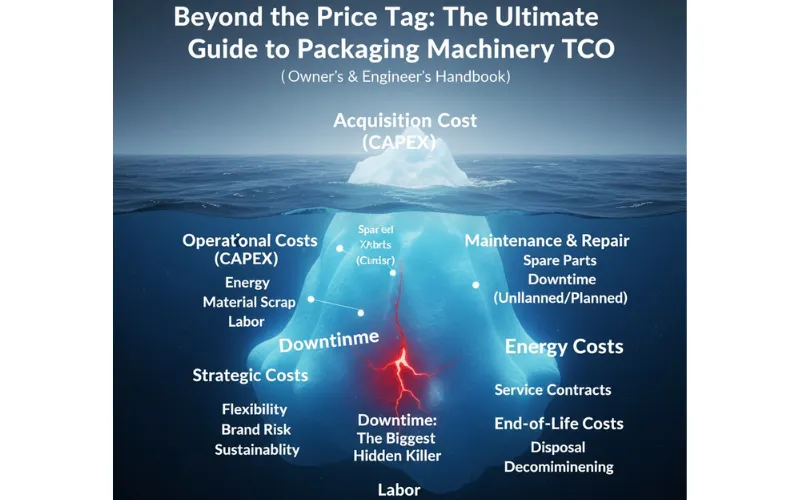
1. The TCO Iceberg: Why the Sticker Price is a Trap
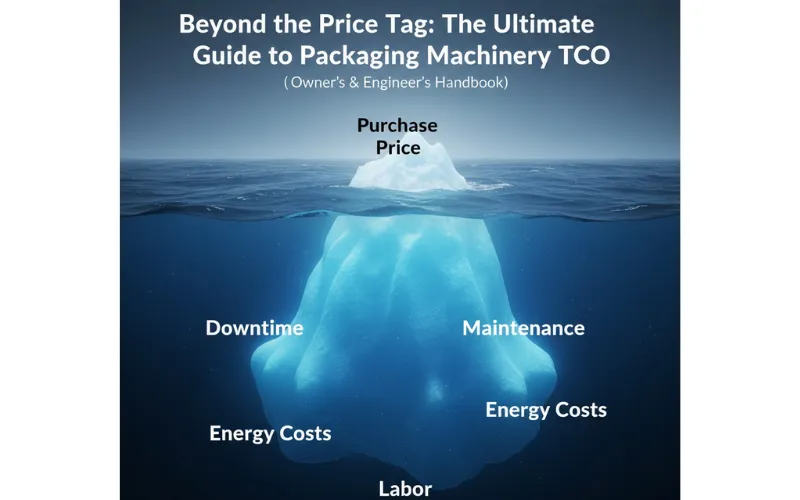
TCO is like an iceberg. The Purchase Price (CAPEX) is just the tip visible above the water (typically $30\%$ of the real cost). The dangerous mass lies below the surface (OPEX).
If you buy a budget machine for $\$30,000$ instead of a premium one for $\$45,000$, you feel like you saved $\$15,000$. But let's look at the hidden costs that hit you in Year 2:
The "Crumbs" Issue: Cheap machines often lack high-quality hygienic design. Biscuit crumbs accumulate in exposed drive belts and unreachable crevices, leading to frequent jams and catastrophic failures.
The "Integration" Tax: A standalone machine is cheap, but integrating it with a cooling tunnel is expensive. If the machine's speeds and control signals don't perfectly match the upstream and downstream equipment, you get costly bottlenecks.
See how we solve this in our guide to Biscuit Cooling & Stacking Machine Integration
See how we solve this in our guide to
2. Calculating the "Hidden" Operational Costs (OPEX)
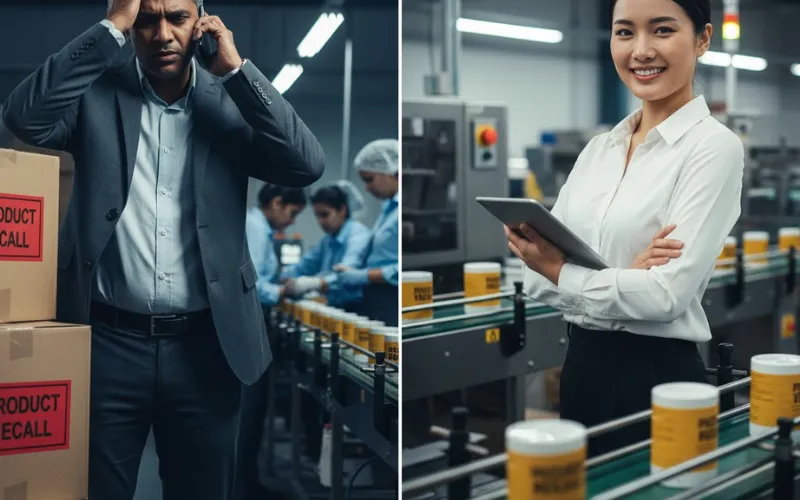
When evaluating quotes from manufacturers, your engineering team must calculate these three specific, performance-driven metrics.
A. Changeover Downtime (The Flexibility Tax)
The modern market demands flexibility. You must pack multiple products (Digestives, Cream Crackers, Mini-Cookies) on the same line.
| Scenario | Detail | Cost Impact |
| Budget Machine | Mechanical adjustments take $45$ minutes. Tools are required. | 300+ hours of lost production per year if changing products twice daily. |
| Smart Machine (Servo-driven) | Uses saved digital recipes for automatic size adjustments. Changeover takes $10$ minutes. | $75\%$ reduction in changeover-related downtime. |
Learn about our servo-driven systems:
Automatic Cookie Packaging Machines
B. Maintenance & Spare Parts (The Supply Chain Risk)
This is where the "Low Price" trap snaps shut. Many budget suppliers use proprietary "black box" controls. When a circuit board fails, you must buy their specific part at their price, waiting weeks for shipping.
The EverSmart Standard: We use open-standard components from global giants like Siemens, Schneider, and Omron.
Why it lowers TCO: You can buy a replacement sensor in your local city (Manila, Mumbai, Lagos) instantly, rather than waiting for expensive air freight from China, drastically reducing unplanned downtime.
C. Energy & Utility Efficiency
According to industry reports, energy efficiency is a top-3 buyer requirement.
Legacy motors run at full power constantly. Modern Motion Control Systems regenerate power during braking and consume zero energy during standby. Over 5 years, the savings from this electricity gap can often pay for the premium machine itself.
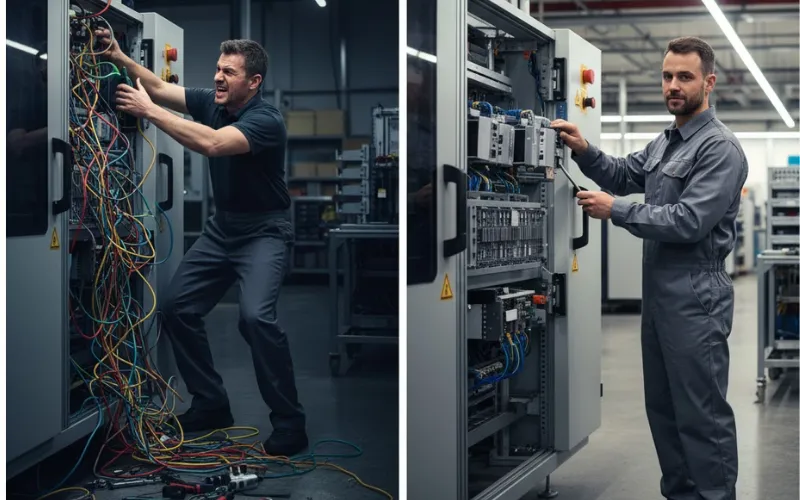
3. The Engineer's View: Hygienic Design as a Cost Saver
For food manufacturers, cleaning is downtime.
If a machine requires $60$ minutes to clean because of exposed bolts and sharp corners (where cream or chocolate accumulates), that is $60$ minutes of lost revenue every shift.
The TCO Fix: Hygienic Design Standards
Look for machines designed to meet specific hygiene standards:
IP65 or IP69K Rated Designs: Ensure the machine can withstand high-pressure, high-temperature washdowns without damaging electronics.
Cantilevered Frames: These eliminate horizontal crumb-trapping surfaces, allowing debris to fall directly through to a catch tray, reducing cleaning time to $15$ minutes.
Explore our specialized solutions for delicate products like
High-Speed Biscuit Sandwich Packaging
4. Case Study: The 5-Year TCO Comparison
Let's compare two real-world options for a Vertical Form Fill Seal (VFFS) Bagger for mini-cookies.
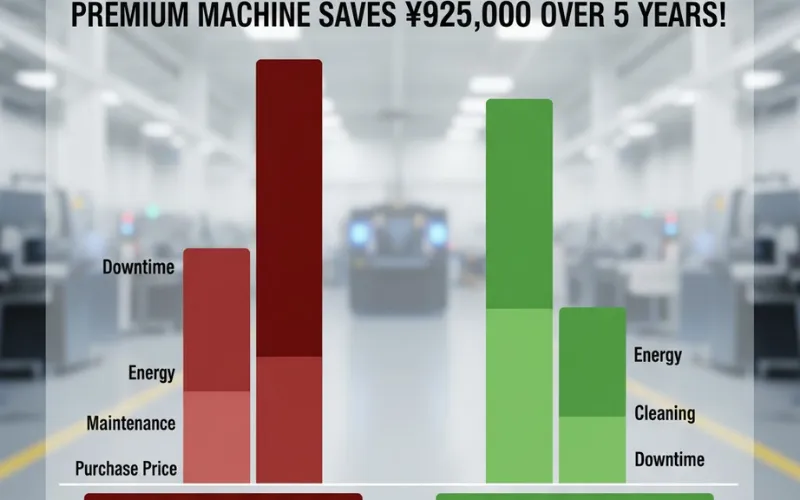
| Cost Factor (5 Years) | Machine A (The "Cheap" Option) | Machine B (EverSmart Premium) |
| Initial Price (CAPEX) | 25,000$ | 35,000$ |
| Film Waste Cost | 15,000$ (3% waste rate) | 2,500$ (0.5% waste rate) |
| Changeover Labor | 18,000$ (Manual tools) | 4,000$ (Servo recall) |
| Spare Parts | 12,000$ (Proprietary parts) | 5,000$ (Standard parts) |
| Total 5-Year Cost | 70,000$ | 46,500$ |
The Verdict: The "Cheap" machine actually cost 23,500$ MORE to own. If you purchase 2 sets or more, the hidden costs easily exceed RMB 925,000 over 5 years.
5. How to Vet a Supplier for Low TCO
A procurement manager’s job isn't to get the lowest price; it's to lower the risk. When interviewing China Biscuit Packaging Machine Manufacturers, ask these specific "TCO Questions":
Reliability: "What is the Mean Time Between Failures (MTBF) for the cutting jaw?"
Support: "Do you have local service support?" For example: EverSmart partners with Unimac Technology in the Philippines to ensure our clients there have immediate access to technical support, drastically reducing downtime costs.
Open Architecture: "Is the software open source?" (i.e., Can my internal team troubleshoot it, or are we locked out?)

Conclusion: Value Over Cost
Don't let the sticker price fool you. A machine that stops for $1$ hour a day is stealing your profit. A machine that runs seamlessly is building your brand.
To get an accurate TCO calculation for your specific production line, you need data, not guesses.
Take the Next Step:
Analyze: Whatsapp us to download our [Preventive Maintenance Checklist PDF] to see what ownership really looks like.
Consult: Send your current line efficiency data to David Wang for a free TCO Audit.
Email: [email protected]
WhatsApp: +86 137 9461 9343

Ready to start your journey toward a customized solution? Contact me directly on WhatsApp to begin the conversation.