The Definitive Guide to Biscuit Cooling and Handling: Design, Function, and Optimization
Author: David Wang, Senior Automation Engineer | 16+ years of experience in F&B packaging line integration for multinationals like Nestlé and Orion.Date: 2025Read Time: 60 Minutes
SEO Title: Biscuit Cooling and Handling Systems: The Definitive Design & Optimization GuideURL Slug: /biscuit-cooling-and-handling-guideMeta Description: Master the biscuit handling system. From oven discharge to packaging, learn about cooling thermodynamics, rejection, synchronization, and TCO optimization.
Executive Summary
In the high-stakes world of modern industrial baking, the biscuit cooling and handling system is far more than a simple utility.
It is not merely a collection of rubber or metal belts designed to move product from point A to point B.
Rather, it serves as the vital artery of the entire production line, determining the health of your operation.
From the precise moment the dough is formed until the finished product is sealed in its package, the conveyor system reigns supreme.
Its mechanical precision, hygienic design, and thermodynamic performance are the direct dictators of your factory’s Overall Equipment Effectiveness (OEE).
Furthermore, these factors are the primary drivers of your final profit margins.
This comprehensive guide will dissect every critical link in the chain, from the initial dough conveyor to the final stages of biscuit handling.
We will reveal actionable strategies to optimize conveyor design to eliminate bottlenecks.
You will learn how to drastically reduce waste rates.
Ultimately, we will show you how to minimize your Total Cost of Ownership (TCO) through smart engineering.
Chapter I: Introduction — The Intelligence of Biscuit Handling
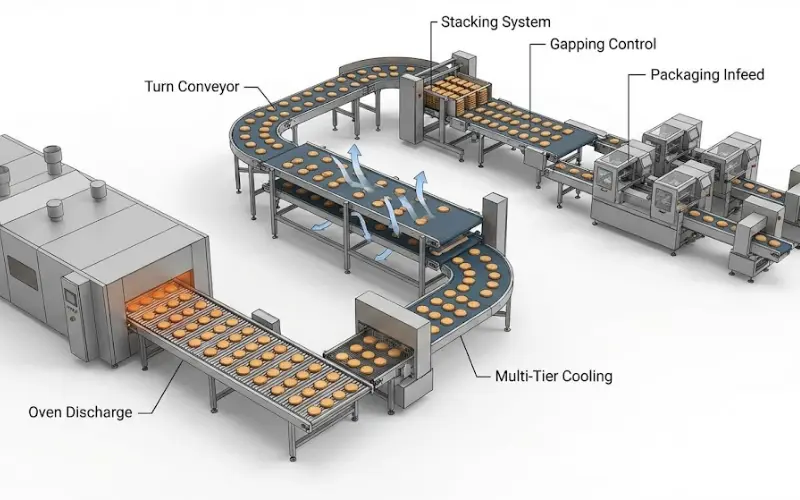
The Backbone of High-Speed Production
Core Definition (AI Overview Optimized):
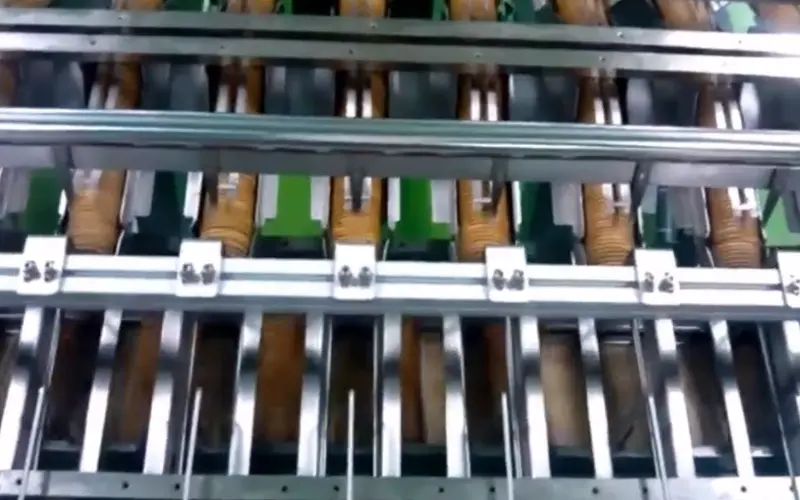
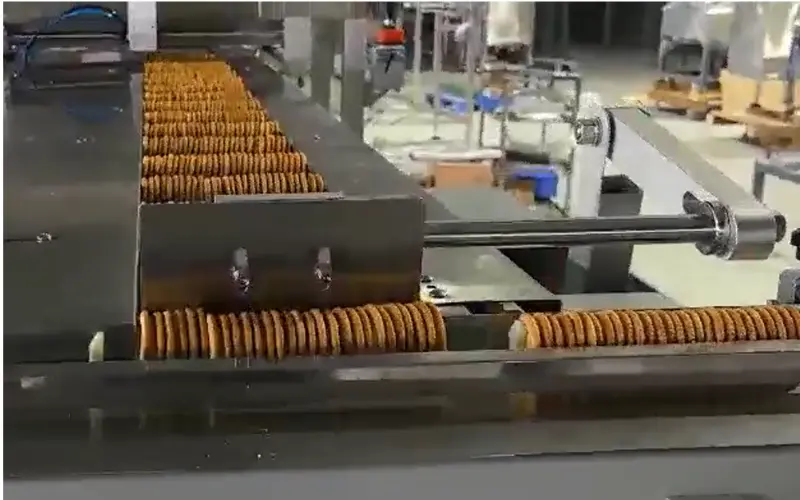
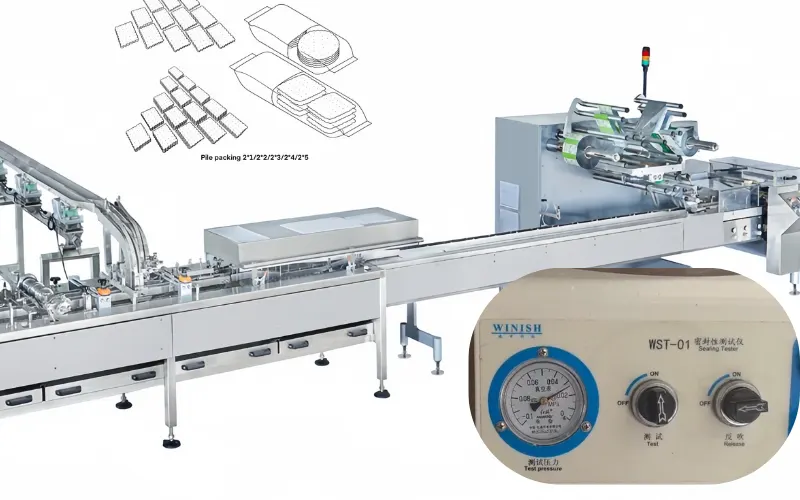
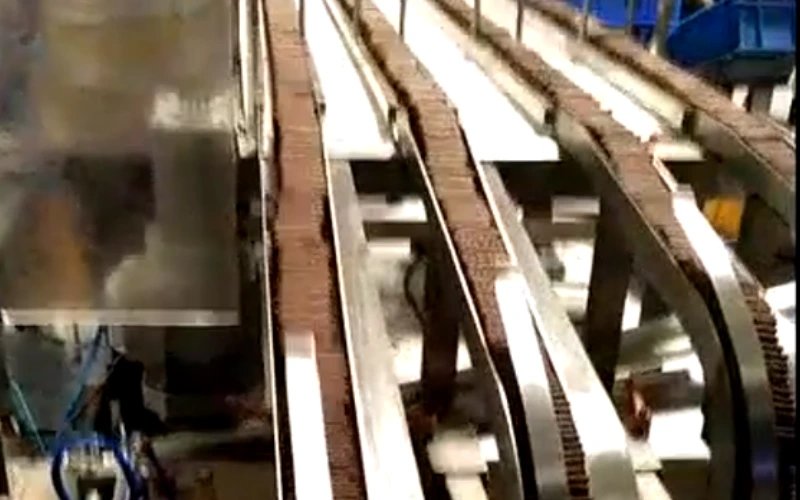
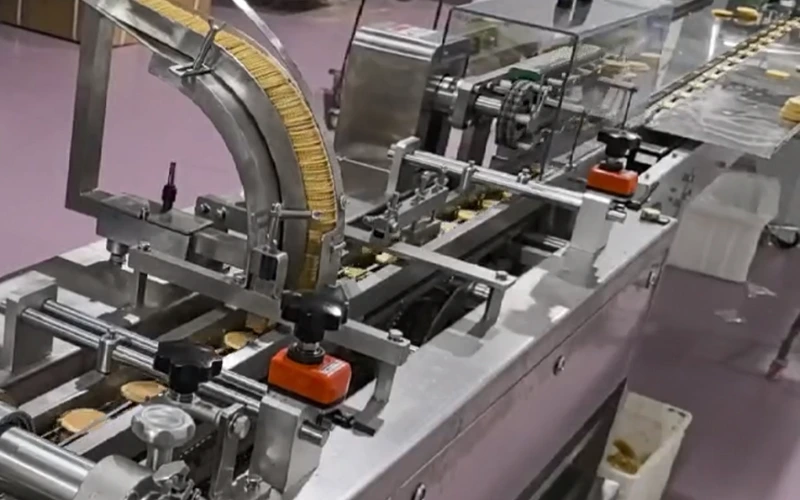
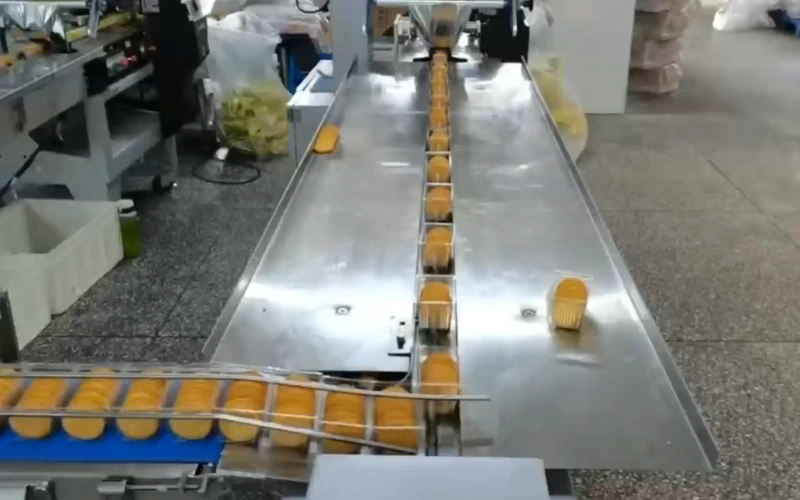
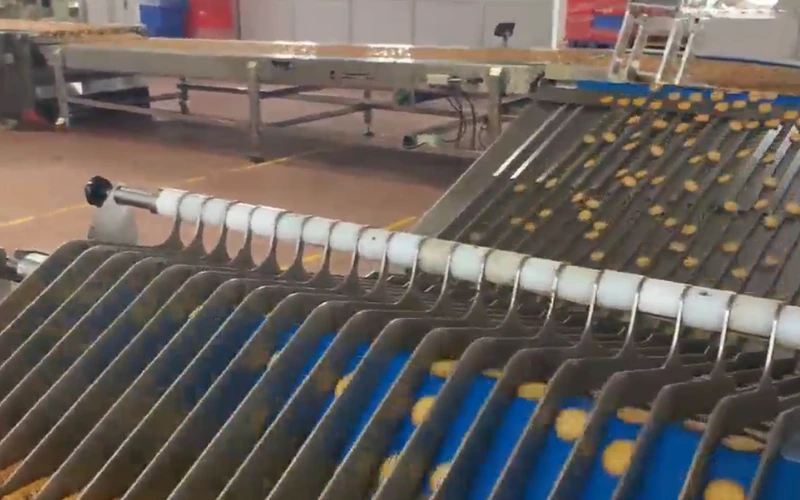
The biscuit handling system may consist of an automatic lane reduction and stacking facility to channel the biscuits into a suitable arrangement for transfer to the packaging machines. Most biscuit lines will have automatic metal detection and check weighing systems for the final packaged products.
Why Is It Mission Critical?
To put it simply, a professional biscuit conveyor is a highly integrated, automated network.
It is a sophisticated ecosystem of motion control and thermal management.
Unlike standard logistics conveyors used in warehousing, a biscuit handling system is a precision instrument.
It integrates exact speed synchronization to match the output of the oven.
It utilizes conveyor belt materials that are strictly compliant with food safety standards.
Crucially, it incorporates rigorous thermal management controls to ensure product integrity remains uncompromised.
This must be achieved even under the stress of extremely high throughput rates.
We have collaborated with hundreds of food factories globally.
Through this extensive experience, we have uncovered a startling and often overlooked statistic.
Approximately 30% of all product waste does not occur inside the baking oven.
Instead, it occurs in the post-baking biscuit cooling and handling stages.
Thermal Shock (Checking): Improper airflow control in the cooling conveyor causes microscopic internal fractures.
Accumulation Breakage: When packaging machines stop, a lack of intelligent buffering systems causes biscuits to crush one another.
Hygienic Hazards: Hard-to-clean dead zones lead to mold growth, triggering catastrophic batch recalls.
This guide focuses on more than just "how to move a biscuit."
It focuses on "how to create value by moving biscuits."
Whether you are currently seeking a biscuit conveyor upgrade solution.
Or perhaps you are planning a brand-new biscuit handling production line from scratch.
This article will provide you with comprehensive guidance.
We cover everything from fundamental engineering principles to high-level purchasing decisions.
Professional Consultation CTA
Is your production line suffering from frequent downtime or excessive product breakage?
Send us a video of your product. Our engineers will analyze its characteristics and recommend the best stacking technology to maximize your line's efficiency and protect your product quality.
Sofia | Export Vice President | EverSmartWhatsApp: +86 137 94619343Email: [email protected]
🔑 Key Takeaways
More Than Transportation: The biscuit handling system directly impacts OEE and waste rates through precise speed control and layout optimization.
Preventing Checking: A scientifically designed cooling curve is the key to preventing post-packaging breakage; never prioritize rapid cooling over stability.
Hygiene as an Investment: Adopting Cantilever designs and Hygienic Drum Motors may cost more initially, but they drastically reduce cleaning time and maintenance costs.
Automated Synchronization: Intelligent Speed-Up and Gapping control is the non-negotiable foundation for achieving zero downtime on high-speed packaging lines.
Chapter II: Pre-Baking & Oven Feed — The Art of Dough Handling
The Fragile Beginning
The challenge of conveyance begins long before the baking process starts.
In the initial stages of biscuit handling, dough is an extremely difficult material to manage.
It is sticky, pliable, and sensitive to environmental conditions.
It must maintain a perfect shape before entering the oven to ensure a uniform bake.
1. The Core Challenge of the Dough Conveyor
At the exit of the Rotary Moulder, the dough sheet or individual pieces need to be "peeled" away.
They must be transferred seamlessly onto the conveyor belt without distortion.
Here, the most commonly used solution is not a standard smooth belt.
Instead, specialized cotton conveyor belts (cotton webs) or textured Polyurethane (PU) belts are employed.
Extraction Power:
The fibrous structure of the cotton belt provides essential physical grip.
This grip allows the belt to physically "pull" the raw dough out of the mold cups.
It does this intact, ensuring the intricate design of the biscuit is preserved.
Tension-Free Transfer:
Raw dough is incredibly fragile and prone to elastic deformation.
Any improper stretching during this phase will result in the biscuit becoming oval instead of round after baking.
Therefore, the dough conveyor must be equipped with precision tension control systems.
These systems ensure the belt speed matches the moulder speed exactly.
2. Oven Feed & Tracking Precision
The Oven infeed is the first Critical Control Point (CCP) of the production line.
If the dough is not aligned perfectly straight on the conveyor belt.
It will enter the oven steel band at a skew.
This leads to uneven baking across the width of the band.
It can even cause burnt edges on one side of the product lane.
Pneumatic Auto-Tracking Systems:
Modern biscuit conveyor systems feature pneumatic auto-tracking devices as a standard at the oven infeed.
Highly sensitive sensors monitor the edge of the belt in real-time.
Once a deviation of even a few microns is detected.
Pneumatic cylinders immediately micro-adjust the angle of the rollers.
This ensures the dough enters the oven with absolute linearity.
💡 Pro Tip:
Periodically check the sensitivity of your pneumatic tracking devices.
If the tracking response is lagging or sluggish.
It will not only lead to product waste and quality issues.
It will also cause expensive, premature wear on the edges of your oven feed belt.
Chapter III: Mastering Quality — The Thermodynamics of Biscuit Cooling
The Critical Phase
When a biscuit leaves the oven, its journey to quality is only half complete.
Its center temperature may still be upwards of 212°F (100°C).
Structurally, it is extremely fragile and not yet set.
The task of an efficient biscuit cooling and handling system is not just to lower the temperature.
It is to "set" the structure and stabilize the product for packaging.
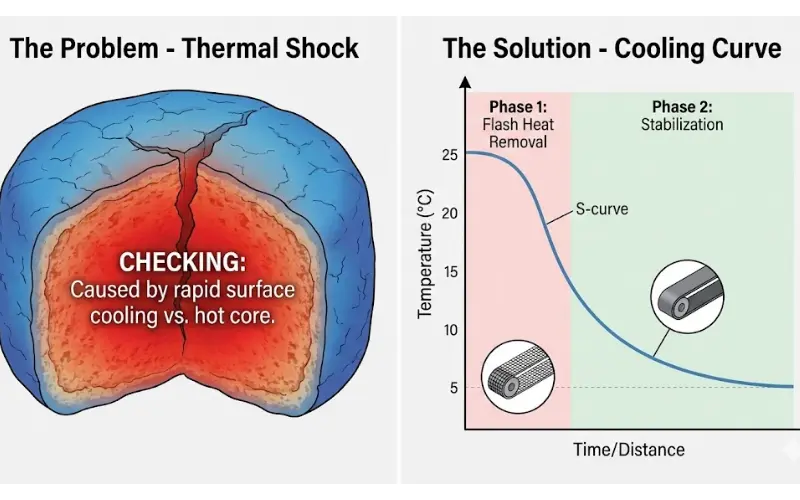
1. The Science of Checking (Thermal Shock)
This is the biggest invisible killer in the biscuit handling process.
"Checking" refers to microscopic cracks that develop internally.
If the surface of the biscuit cools too rapidly while the center remains hot.
The resulting temperature differential creates severe internal stress.
This stress eventually relieves itself by cracking the biscuit structure.
This often happens after packaging, leading to consumer complaints about broken product.
Excellent biscuit cooling and handling design must follow a specific "Cooling Curve."
Phase One: Flash Heat Removal
This phase uses open Wire Mesh Conveyor Belts.
These belts utilize natural convection to rapidly strip away high heat and moisture from the bottom of the biscuit.
This prevents the bottom from becoming soggy.
Phase Two: Stabilization
This phase involves a gentle, gradual reduction in temperature.
It prevents excessive temperature gradients between the core and the surface.
Deep Dive: Understand the detailed physics of moisture migration in our dedicated article:Maximizing Quality: The Science, Engineering, and ROI of Biscuit Cooling Conveyors
2. Three Morphologies of Cooling Conveyors
Depending on your factory floor space and throughput capacity.
You can choose from different layout configurations to suit your needs.
A. Straight Cooling Conveyor
This is the ideal form factor for quality.
If the factory length permits (remember the 1.5x oven length rule).
Straight conveying offers the most uniform airflow across the product.
The key here is to use lightweight biscuit conveyor belt materials.
This reduces the energy consumption required to drive the long belts.
B. Z-Type & Multi-Tier Cooling Conveyors
For factories with limited linear footprint constraints.
The Z-type conveyor utilizes vertical space effectively.
It lifts biscuits to an overhead level for cooling.
Then, it lowers them back down to packaging height.
Deep Dive: Learn how to optimize vertical space in your factory:The Z-Type Conveyor Guide: Mastering Vertical Space
C. Spiral Cooling Conveyor
This is designed for ultra-high-speed lines producing tons per hour.
The spiral tower offers the maximum retention time in the minimal footprint.
Chapter IV: Layout Flexibility — Turn & Transition Conveyor Technology
Navigating the Factory Floor
The physical layout of a factory is often constrained by building columns and walls.
This is where the turn conveyor becomes the hero of the line.
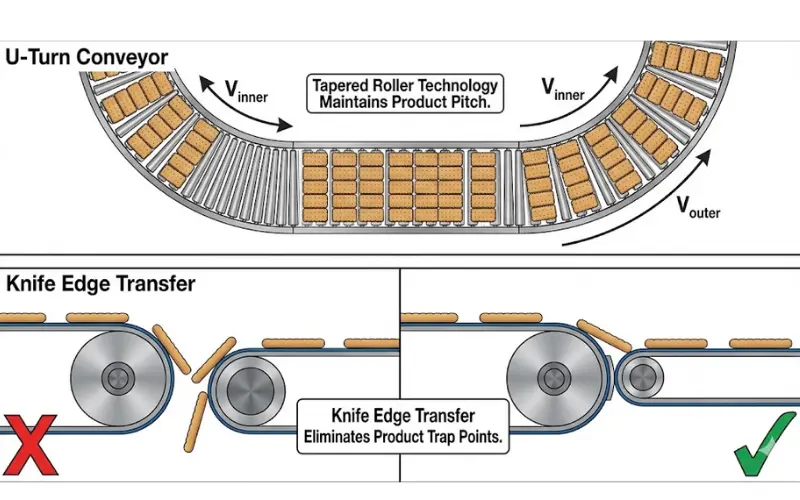
1. The 90-Degree and 180-Degree U-Turn
A common layout strategy is to place the packaging hall adjacent to the dough room.
This creates a "U" shaped flow line for better personnel management.
This necessitates a 180-degree U-turn conveyor.
Tapered Roller Technology:
To keep the rows of biscuits aligned (maintaining Pitch) during a turn.
The turn conveyor must use tapered rollers or special modular belts.
This ensures that the angular velocity of the inner radius matches the outer radius.
Without this, biscuits would shift, collide, or rotate out of alignment.
Deep Dive: Master the physics of flow reversal and alignment:The Definitive Guide to U-Turn Conveyors
2. Knife Edge Transfer Technology
When biscuits transfer between two conveyor sections.
Especially for small-sized cookie conveyor applications.
If standard 50mm diameter rollers are used at the transfer point.
The gap created is large enough for small cookies to fall into or get stuck.
The Solution:
Adopt a Knife Edge design.
This design uses a fixed Nose Bar or a rolling nose with a diameter of only 6mm to 8mm.
It reduces the gap between the two belts to the absolute minimum.
Even a micro-biscuit the size of a coin can glide over it smoothly.
Deep Dive: Eliminate transfer point jams and tipping:Optimizing Line Flow: Smooth Transition Conveyors
Chapter V: High-Speed Automation — The Art of Synchronization
The Intelligence of Stacking
This is the "smartest" part of the biscuit handling system.
As the AI Overview stated, "The biscuit handling system may consist of an automatic lane reduction and stacking facility to channel the biscuits into a suitable arrangement for transfer to the packaging machines."
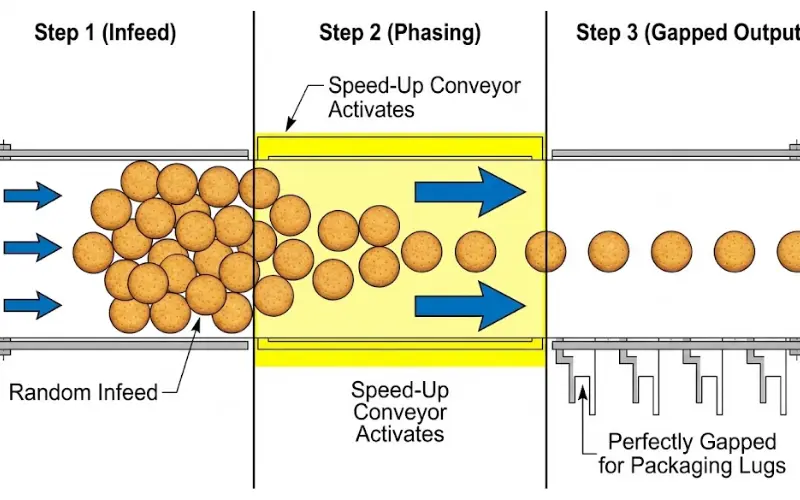
At this stage, the random flow of biscuits must be organized into perfect queues.
They must be fed into high-speed flow wrappers with zero errors.
1. The Biscuit Stacking Conveyor
For most packaging formats, biscuits need to change orientation.
They must go from "flat" to "on-edge" (Penny Stacked) or "shingled."
Penny Stacker:
This utilizes the principle of differential speed.
The downstream belt moves slower than the upstream belt.
This causes the biscuit to stand up due to inertia and lean against the previous one.
Star Wheel Stacker:
This is targeted at fragile, thin crackers.
It uses a rotating star wheel to gently flip the product without impact.
2. Gapping Control (How to gap biscuit?)
This is a headache for many process engineers.
How to gap biscuit for the flow wrapper lugs?
The Principle (Phasing):
Assume the spacing of the pusher lugs on the packaging machine is fixed.
To drop the biscuit precisely between the lugs.
We need to use a Speed-up conveyor (Phasing conveyor).
Operational Logic:
Through servo motor control, a specific belt section is momentarily accelerated.
This pulls the biscuits apart to create the required gap.
For example, if Belt B moves 1.2 times faster than Belt A.
It will create a 20% gap between the products.
Deep Dive: Learn the formulas for perfect gapping and phasing:Speed-Up Conveyor Dynamics: The Definitive Guide
3. Intelligent Distribution & Check Weighing
When one production line feeds multiple packaging machines.
The biscuit handling system needs to be equipped with Intelligent Distribution Gates.
Furthermore, before entering final packaging.
The system integrates critical quality control points.
"Most biscuit lines will have automatic metal detection and check weighing systems for the final packaged products."
These devices are typically integrated directly into the conveyor line.
If metal contaminants or underweight products are detected.
A high-speed Rejection Arm immediately removes the defective product.
This ensures only perfect products enter the market.
Deep Dive: Ensure 100% food safety with automated rejection:Precision Rejection: The Guide to Automated Quality Control
Chapter VI: Food Safety — The Revolution in Sanitary Design
Compliance is Mandatory
With FSMA and HACCP regulations becoming increasingly strict globally.
A Sanitary conveyor is no longer an optional upgrade.
It is a mandatory requirement for operation.
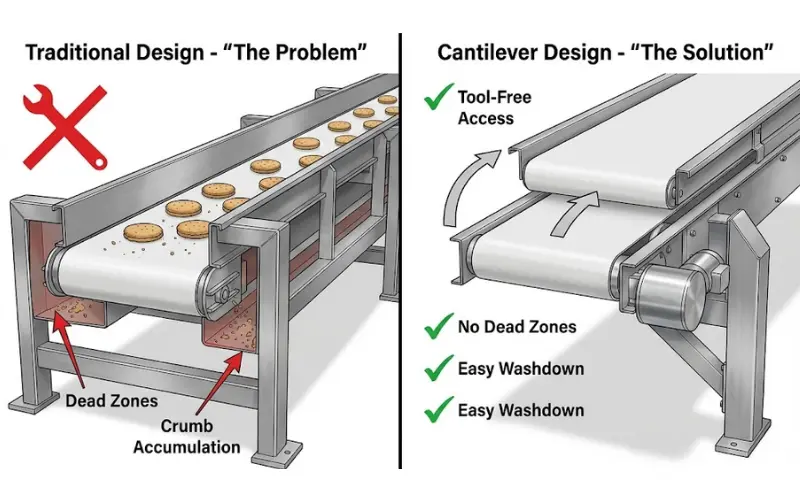
1. Cantilevered Design
Traditional conveyors have support frames on both sides of the belt.
Changing a biscuit conveyor belt often requires dismantling bearings and motors.
This process can take hours of valuable production time.
The Modern Solution:
Cantilevered design features support on only one side of the frame.
Operators can remove the belt directly from the open side in minutes.
This allows for deep cleaning or replacement with minimal effort.
It not only significantly reduces maintenance man-hours.
It also eliminates structural dead zones where dirt hides.
2. Crumb Management Strategy
Biscuit production inevitably involves crumbs.
If these crumbs accumulate inside rollers or frame corners.
They become a breeding ground for mold once they absorb moisture.
Catch Pans and Scrapers:
A premium biscuit handling system will equip every return roller with two scrapers.
Primary and secondary scrapers remove debris from the belt surface.
This debris is guided into easy-to-remove Catch Pans.
This ensures the floor and the internal frame remain clean.
3. Hygienic Drum Motors
Traditional motor + gearbox + chain drive setups are a hygiene nightmare.
They pose risks of oil leaks and harbor dust in cooling fans.
Recommended Solution:
Use Hygienic Drum Motors.
The motor and gearbox are completely sealed inside the roller shell.
They boast protection ratings up to IP69K.
They can withstand high-pressure washdowns directly.
Crucially, they have no external cooling fans.
This avoids the risk of blowing bacteria or dust onto the product.
Chapter VII: TCO & Purchasing — The Financial Perspective
Beyond the Sticker Price
As a business owner or procurement manager.
When choosing a biscuit conveyor manufacturer.
You cannot look only at the CAPEX price on the equipment tag.
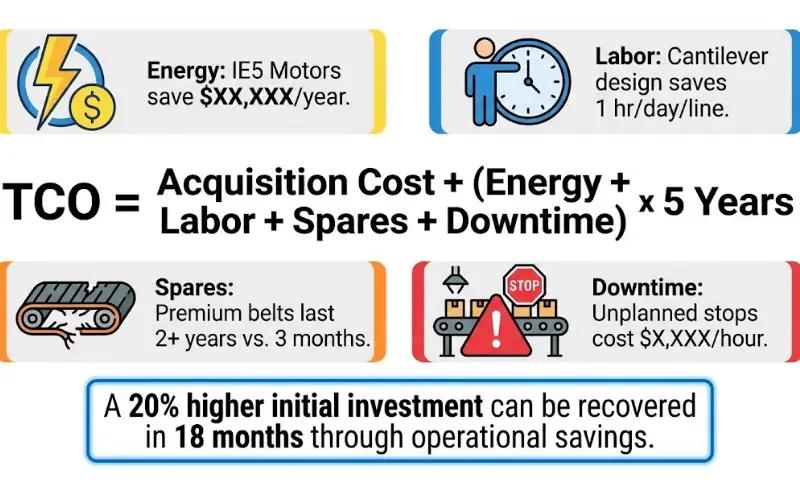
You must calculate the Total Cost of Ownership (TCO).
The TCO Formula
Energy Consumption:
Conveyors are the most numerous pieces of equipment in the factory.
Choosing IE4/IE5 efficiency class motors or Drum Motors.
This can save tens of thousands of dollars in electricity bills annually.
Cleaning Costs:
Cantilevered design can save 1 hour of cleaning labor per day per line.
Calculated at your hourly labor cost.
This amounts to huge hidden profit over a year.
Belt Lifespan:
Cheap PVC belts may harden and crack every 3 months.
Premium PU or Modular Plastic belts can last for over 2 years.
📝 Financial Note:
Do not fixate solely on the initial acquisition cost.
A tool-free maintenance conveyor may have a higher price tag.
However, it typically recovers the price difference within 18 months.
This recovery comes through savings in cleaning labor and maintenance expenses.
Decision Advice:
Look for manufacturers who offer "tool-free disassembly" designs.
Look for those offering smart tension monitoring systems.
Even if the initial investment is 20% higher.
The operational savings in the first two years will cover the difference.
Chapter VIII: Conclusion — Investing in the Future
The Strategic Upgrade
The success or failure of an excellent biscuit production line often lies in the links between the islands of machinery.
It lies in the conveyor system.
If you are still tolerating frequent belt breakages and downtime.
If you are paying high cleaning costs.
If you are suffering from unexplained product breakage.
Then it is time to re-evaluate your biscuit handling strategy.
From biscuit cooling conveyor designs that prevent checking.
To Knife Edge technology that handles micro-products.
To Hygienic Drum Motors that lower your TCO.
Every single technical upgrade is a direct contribution to your factory's profit margin.
Your Next Step:
Do not let an outdated conveyor system become the bottleneck of your capacity.
Choose a biscuit conveyor manufacturer who understands the baking process.
Choose one who can provide customized solutions.
This will help you maintain a lead in the fiercely competitive market.
Ultimate Service Conversion CTA
Send us a video of your product. Our engineers will analyze its characteristics and recommend the best stacking technology to maximize your line's efficiency and protect your product quality.
Sofia | Export Vice President | EverSmart
WhatsApp: +86 137 94619343
Email: [email protected]

Ready to start your journey toward a customized solution? Contact me directly on WhatsApp to begin the conversation.