The ROI of Biscuit Line Automation: A Financial Guide to Labor Savings and Yield
In the fiercely competitive global snack market, industrial automation is no longer an optional luxury. It has become the absolute baseline for manufacturing resilience in an era of unpredictable labor and rising costs.
For the Owner and CFO, the primary question is not whether the technology exists. The real challenge is determining how quickly a capital investment transforms into sustainable free cash flow.
As labor volatility and ingredient inflation continue to squeeze margins, automation offers a definitive solution. Shifting the production burden from human variables to millisecond-perfect industrial automation protects your long-term bottom line.
Key Takeaways for Global Stakeholders
For Owners: Automation buys you Market Agility. Rapid changeovers allow you to capture high-volume retail orders that manual lines simply cannot fulfill.
For CFOs: Focus on Yield Recovery. Beyond salary savings, automation eliminates the "Hidden Giveaway" in expensive ingredients like cream, chocolate, and fats.
For Engineering: Integrated system synchronization eliminates "human fatigue." This ensures that the production cadence at 3:00 AM is identical to the pulse at 9:00 AM.
For Maintenance: Modern systems reduce the TCO by utilizing standardized global components. This ensures long-term parts availability and lower maintenance management costs.
For Procurement: Automating the end-of-line reduces the complexity of managing a high-turnover workforce. It stabilizes your operational efficiency during peak seasonal demands.
1. Calculating Direct Labor Cost Savings: Beyond the Hourly Wage
Automation removes the primary bottleneck created by manual, repetitive tasks. It enables a complete and necessary workforce transformation for the modern age.
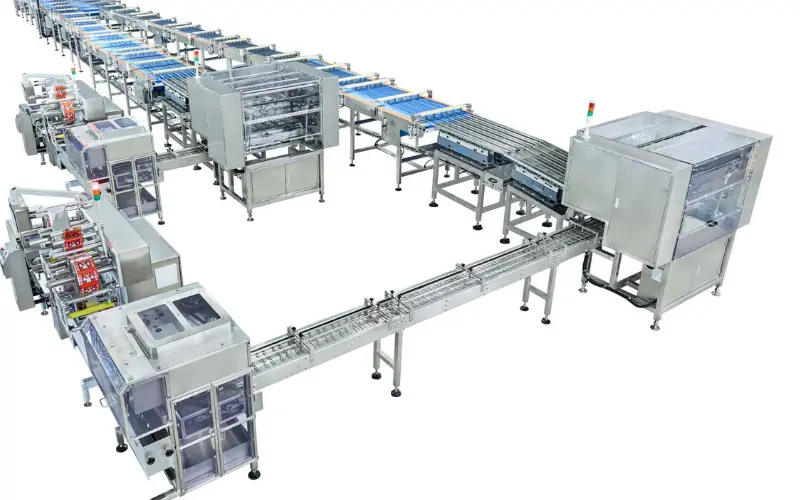
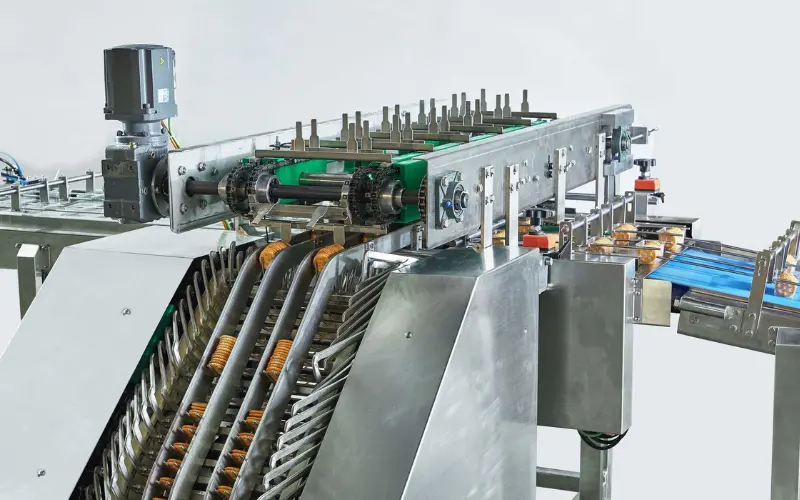
A manual sandwiching line often requires 12 to 15 workers to manage stacking, feeding, and packing. Conversely, an automated EVERSMART line operates at peak performance with only 4 to 6 specialized operators.
The True Cost of Labor
When calculating your return on investment (ROI), the Financial Manager must look beyond simple base pay. A rigorous and honest analysis must include several "hidden" factors.
Hidden Overheads: You must account for recruitment fees, onboarding time, and mandatory insurance. High-turnover roles carry an immense administrative and financial burden.
Risk Mitigation: Automated lines significantly reduce ergonomic risks and repetitive strain injuries (RSI). This directly lowers your insurance premiums and workers' compensation liability over time.
Workforce Stability: A robot doesn't call in sick or experience the inevitable "afternoon fatigue." This ensures your cycles per minute stay constant across every single shift.
Note: The "Soft ROI" of labor reduction is often found in the dramatic reduction of human error. A single contaminated batch from improper manual handling can cost more in a recall than a year of labor savings.
2. Yield Improvements: Precision as a Profit Center
In industrial baking, raw materials represent your largest and most frequent recurring expense. Even small inaccuracies in the production process lead to massive financial leaks.
"Giveaway"—the act of over-filling sandwiches by just $0.5g$—is a silent profit killer. On a high-speed line, this can bleed hundreds of thousands of dollars over a production year.
Precision Dosing and Ingredient Recovery
Automated systems provide precision dosing that manual handling simply cannot replicate. Our adaptive algorithms handle batch-to-batch ingredient variance with extreme accuracy.
Reject Reduction: Precision sensors identify and reject substandard biscuit shells before they consume expensive fillings. This protects your yield savings by preventing the waste of premium creams or chocolates.
Material Tolerance: Modern automation technologies compensate for slight variations in dough or cream viscosity. This maintains quality even when raw material price fluctuations force a shift in ingredient suppliers.
3. Operational Gains and Overall Equipment Effectiveness (OEE)
Overall Equipment Effectiveness (OEE) is the ultimate scorecard for any modern manufacturing facility. Automation improves all three OEE pillars: Availability, Performance, and Quality.
The Power of Synchronization
Unlike human-dependent lines, an automated system does not experience rhythm drift. The motion synchronization between the oven and the wrapper ensures a seamless and uninterrupted flow.
This consistency allows for accurate productivity data monitoring at all times. It provides the transparency needed for data-driven process optimization and long-term scaling.
Energy Load Leveling
Energy often accounts for up to $40\%$ of the total operating costs in biscuit manufacturing. EVERSMART designs utilize heat recovery and high-efficiency drives to achieve energy load leveling.
By coordinating motor acceleration curves, we reduce peak power demand charges on your utility bill. This often qualifies your facility for significant "Green Investment" tax credits or government grants.
Tip: When calculating ROI, always factor in the "Energy Payback." High-performance ovens with better insulation can fund 20% to 30% of their own investment cost through utility savings.
4. Total Cost of Ownership (TCO) and Lifecycle Analysis
The CFO knows that the purchase price of a machine is only the tip of the iceberg. A true ROI analysis requires a comprehensive $10$-year TCO evaluation.
Initial Investment: This includes the equipment cost, Digital Twin simulation, and professional installation. While upfront costs are high, the rapid tax depreciation benefits offer a significant offset.
Operational Costs: These cover energy usage (with heat recovery), water consumption, and various consumables. Automated lines typically operate at costs $20\%$ lower than legacy manual lines.
Maintenance: This includes predictive maintenance sensors and a lean inventory of wear parts. Investing in PdM prevents catastrophic failures that can cost over $\$100,000$ in lost production.
Manufacturing Agility: This factors in format changeover time and SKU adaptability. Faster response to high-margin retail trends allows you to capture market share before competitors can react.
5. People Also Ask: Expert Industrial ROI Q&A
Q: What is the average payback period for a high-speed biscuit sandwiching line?
Depending on production volume and local labor rates, most projects achieve a full payback in 1.5 to 2.5 years. If your facility operates on three shifts, the ROI is accelerated by the displacement of night-shift labor premiums.
Q: Should we automate the "Frontend" (Oven) or "Backend" (Packing) first?
The End-of-Line (Packing) usually provides the fastest labor-saving ROI because it is the most labor-intensive stage. However, automating the sandwiching interface provides the best yield ROI by reducing expensive ingredient giveaway.
Q: How do we justify automation in regions where labor costs are relatively low?
Focus on Yield and Quality rather than just headcount. Even in low-labor markets, the savings from reduced ingredient waste and the ability to meet export food safety standards provide a faster ROI.
Q: Does automation reduce the "Resale Value" of my factory assets?
Actually, a modern, automated line with integrated SCADA and IIoT sensors retains a much higher resale value. It represents a "Smart Asset" that is highly desirable in the global secondary market.
Q: How does "Virtual Commissioning" affect my investment risk?
By using a Digital Twin to simulate the line, we solve 90% of integration issues before the machine is even built. This reduces your startup downtime from weeks to days, protecting your initial cash flow.
6. Ready to Turn Your Estimates into Concrete Profit?
The numbers do not lie: automation is the most direct path to a higher profit margin. At EVERSMART, we specialize in high-yield, low-labor solutions that provide a measurable competitive edge.
Our team helps you transition from "ballpark estimates" to a rigorous and defensible financial model. We ensure your capital expenditure is backed by data and proven results.
Request a Custom ROI Financial Model: Let our experts build a detailed analysis based on your specific labor and material costs.
Get a TCO Benchmarking Report: See how our energy-efficient manufacturing designs compare to your current legacy assets.
Explore Turnkey Consultation: Discover how system integration can transform your manual bottlenecks into automated profit engines.
[BUTTON: START YOUR ROI ANALYSIS WITH EVERSMART TODAY]

Ready to start your journey toward a customized solution? Contact me directly on WhatsApp to begin the conversation.