Energy Efficient Tunnel Ovens: A Guide to Slashing Bakery Operating Costs | EverSmart
Powering Your Bakery: A Guide to Energy Efficiency in Industrial Tunnel Ovens
For any factory owner, financial manager, or plant engineer, the numbers on the energy bill are more than just a cost—they're a key performance indicator. In today's competitive market, where energy prices are volatile and sustainability is a growing customer demand, an inefficient industrial tunnel oven isn't just a technical problem; it's a direct threat to your profitability.
Did you know that in a typical biscuit factory, the tunnel oven alone can consume over 50% of the total energy used? That’s a staggering operational cost that eats into your bottom line every single day. But here's the good news: this cost is largely within your control. A study published on
This guide cuts through the technical jargon to give you a clear, actionable roadmap. We'll explore the real-world strategies and technologies that can transform your bakery tunnel oven from an energy hog into a model of efficiency, slashing your operating costs and future-proofing your business.
Why Your Oven's Efficiency is a Business Decision, Not Just an Engineering One
Let's be direct: the conversation about an energy-efficient cookie oven starts and ends with money. Whether you're considering a new tunnel oven for sale or optimizing your existing line, the financial implications are huge.
The True Cost of Inefficiency:
Soaring Energy Bills: Gas and electricity prices are unpredictable. An inefficient oven magnifies this financial risk.
Carbon Taxes & Compliance: Governments worldwide are implementing stricter emissions regulations. High energy consumption directly translates to higher compliance costs.
Brand Reputation: Modern consumers and B2B clients actively seek out sustainable suppliers. An inefficient operation can become a marketing liability.
Reduced Competitiveness: High operational costs mean less flexibility in pricing, making you vulnerable to competitors with more efficient setups.
Investing in efficiency isn't an expense; it's a strategic move that protects your profit margins, ensures compliance, and enhances your market position.
What is a Tunnel Oven? The Foundation of Efficient Production
Before we dive into savings, let's define the core equipment. What is a tunnel oven?
The entire baking process begins long before the oven. Once the perfect dough is prepared by a high-performance
How Tunnel Ovens Consume Energy: A Quick Primer
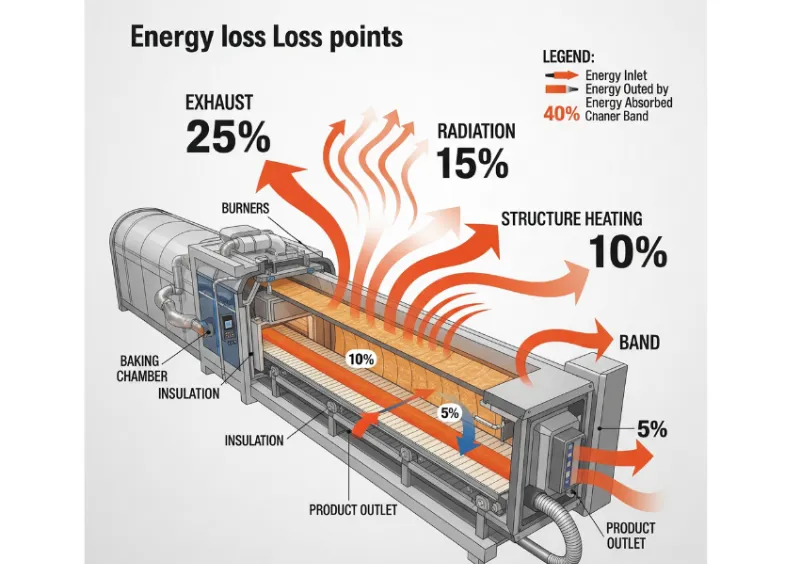
To reduce energy use, you first need to know where it goes. In any conveyor tunnel oven, energy is used for three main purposes:
Heating the Product: The essential, unavoidable energy required to bake your biscuits. This is your "useful" energy.
Heating the Oven Structure: Energy lost to heating the oven's insulation, walls, and band. This is wasted every time you heat up from cold.
Compensating for Losses: The biggest culprit. Energy lost through:
Exhaust Air: Humid, hot air is vented out to control moisture.
Radiation & Convection: Heat escaping from the oven's exterior surfaces.
Conveyor Band: Energy lost as the hot band exits the oven and cools.
An energy-efficient oven maximizes energy for #1 and minimizes losses from #2 and #3.
7 Actionable Strategies for a More Energy-Efficient Tunnel Oven
1. Embrace Advanced Insulation: Your First Line of Defense
Older tunnel ovens often use basic mineral wool insulation. Modern ovens from leading tunnel oven manufacturers use advanced materials like ceramic fiber modules with significantly higher thermal resistance.
How it Works: Better insulation keeps heat inside the baking chamber, reducing the energy needed to maintain temperature and protecting your workforce from external heat.
The Benefit: A well-insulated oven can reduce surface heat loss by up to 40%, creating a safer work environment and a significantly lower energy burden.
2. Implement Intelligent Heat Recovery Systems
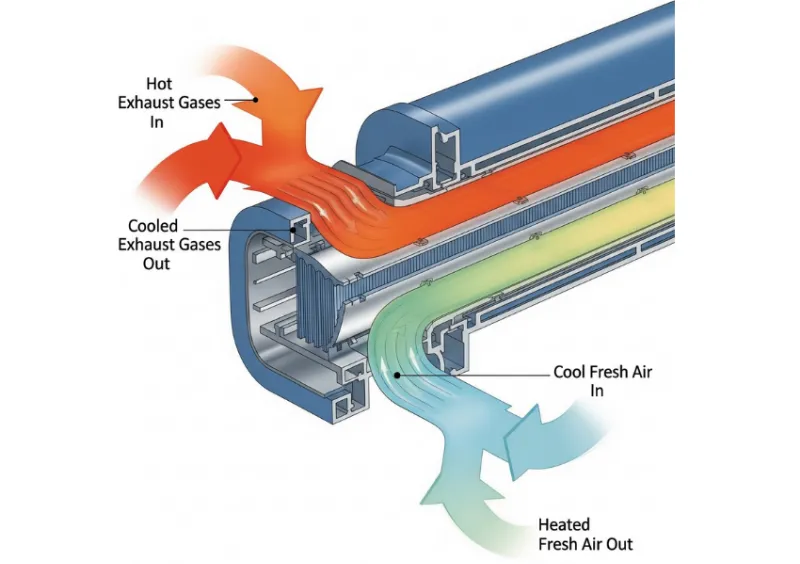
This is arguably the biggest opportunity for savings. Instead of blowing hot, moist exhaust air outside, a heat recovery system captures that energy and reuses it.
How it Works: Heat exchangers transfer energy from the hot exhaust air to the fresh, incoming air. This pre-heats the combustion air (in gas ovens) or the make-up air, drastically reducing the energy required to bring it up to temperature.
The Benefit: As confirmed by research, these systems can recover 60-80% of the heat from exhaust gases, leading to dramatic fuel savings and a rapid return on investment.
3. Optimize Your Burners and Combustion (For Gas Ovens)
Not all combustion is created equal. Old, clogged, or poorly tuned burners are incredibly wasteful.
How it Works: High-efficiency, low-NOx burners and precise electronic combustion controls ensure the perfect air-to-gas ratio. This means all fuel is burned completely and efficiently, with minimal excess air carrying heat up the exhaust.
The Benefit: Perfect combustion improves thermal efficiency, reduces gas consumption by up to 15%, and lowers emissions, helping you meet environmental regulations.
4. Utilize Variable Frequency Drives (VFDs) on Fans
Your oven's convection fans don't always need to run at 100% power. VFDs are like a dimmer switch for electric motors.
How it Works: VFDs intelligently adjust the fan speed based on real-time temperature data, slowing them down when full power isn't needed.
The Benefit: This can reduce the electricity consumption of your fans by 30-50%, which is a significant saving since these are some of the largest motors in the plant.
5. Choose the Right Heat Source: Gas vs. Electric
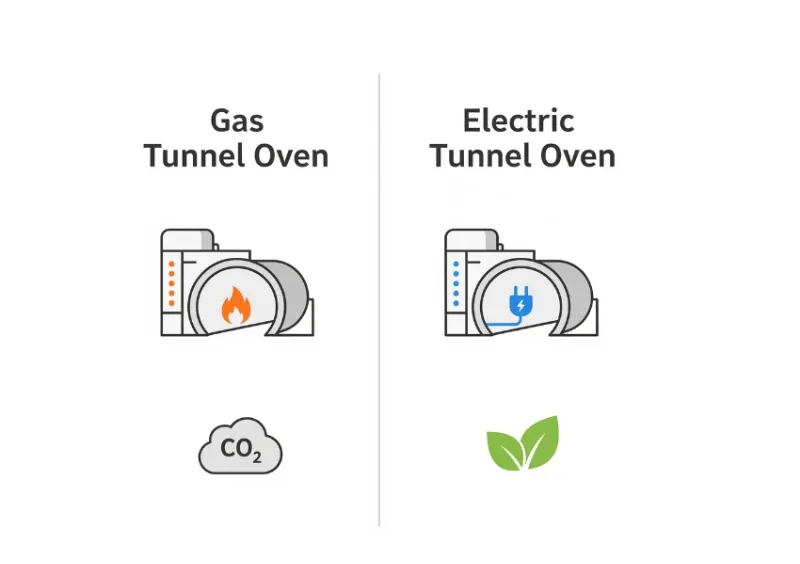
The debate between a gas tunnel oven and an electric tunnel oven is central to efficiency planning.
Gas Tunnel Oven:
Pros: Traditionally lower energy cost per unit in many regions. Excellent for browning and high-temperature baking. Faster heat transfer.
Cons: On-site emissions (CO2, NOx), requires ventilation, combustion efficiency losses.
Electric Tunnel Oven:
Pros: 100% efficient at point of use—almost all energy goes into heat. Zero on-site emissions. Precise, zonal temperature control. Often easier to maintain. Can be powered by renewable energy sources.
Cons: Electricity is often more expensive per unit of energy than gas. Power grid dependency.
The Verdict: The "most efficient" choice depends entirely on your local utility costs, sustainability goals, and product mix. Electric tunnel ovens are gaining massive popularity due to their precision, cleanliness, and the global shift towards electrification. But more and more customers appreciate the hybrid tunnel ovens to get more categories of food.
6. Automate with Smart Controls and Data Monitoring
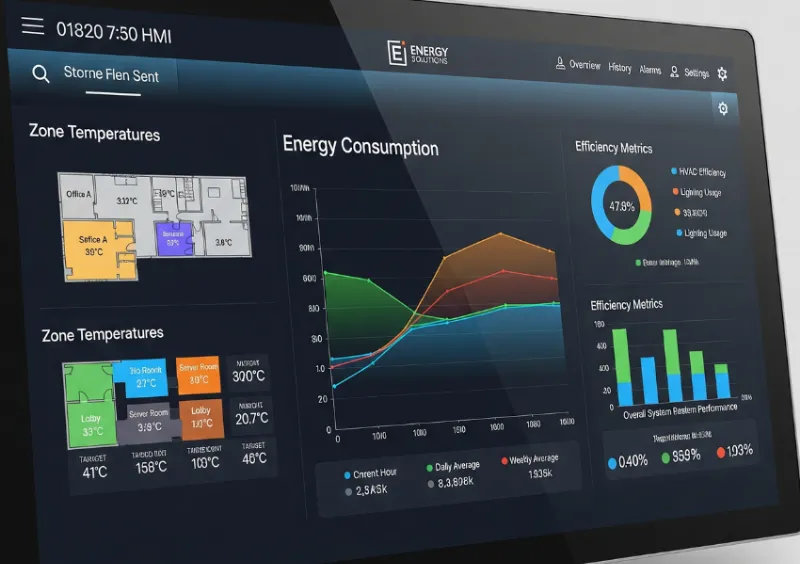
You can't manage what you don't measure. Modern PLC controls are the brain of an efficient operation.
How it Works: These systems do more than just set temperatures. They continuously monitor energy consumption, oxygen levels in exhaust (for gas ovens), and zone temperatures, making micro-adjustments for optimal performance. They can also manage complex baking curves and automated start-up/shutdown sequences to avoid idle energy waste.
The Benefit: This data-driven approach eliminates human error and guesswork, ensuring the oven always operates at its peak efficiency point.
7. Don't Neglect Maintenance: The Low-Cost Saver
An poorly maintained oven will never be efficient. This is the simplest and most overlooked strategy.
Seals and Gaskets: Worn door and panel seals let precious heat escape. Regular inspection and replacement are cheap and effective.
Clean Heat Exchangers: Soot buildup on heat exchangers acts as an insulator, dramatically reducing efficiency.
Calibrated Sensors: A faulty temperature sensor can cause the oven to overheat or underheat, wasting energy and ruining product.
The EverSmart Advantage: Engineering Efficiency into Every Oven
At EverSmart, we don't add efficiency features as an afterthought—we engineer them into the core of our commercial bakery tunnel ovens. A key part of this is our deep expertise in managing
Entrance Zone (Zones 1 & 2): We apply high top heat and extremely strong bottom heat. This intense bottom heat provides the initial thermal shock needed for rapid expansion, creating the perfect layered, flaky structure in products like soda crackers. It also sets the dough surface quickly to prevent unwanted spread.
Middle Zones (Zones 3 & 4): Here, the temperature is moderately reduced. Our ovens focus on continuous moisture removal and thoroughly baking the interior. By controlling the ratio of top to bottom heat, we carefully induce the Maillard reaction for ideal color and aroma development.
Exit Zone (Final Zone): The temperature is further lowered for the final, critical stage of uniform coloring and dehydration. Our precise control systems ensure the final moisture content is perfect (typically ≤4%) for that ultimate crispy texture.
This mastery of heat application, often using advanced Double Impingement systems for uniform airflow, is how our design philosophy translates into direct savings and superior products for your operation. Here’s a summary of our key engineered features:
Our small tunnel oven and large-scale industrial tunnel oven models are all built with this principle: maximum output for minimum energy input.
Financial Analysis: The ROI of an Energy-Efficient Oven
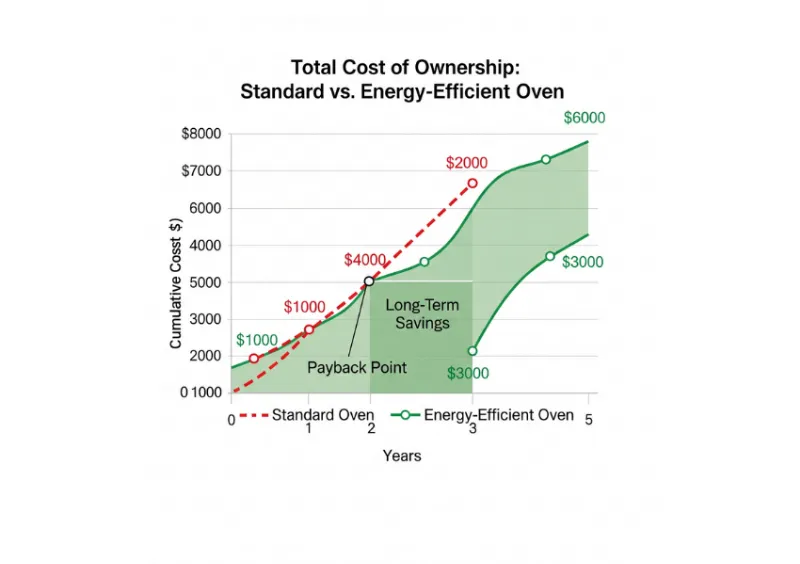
Let's talk numbers. While a high-efficiency industrial tunnel oven may have a higher upfront cost, the operational savings create a compelling financial case.
Consider this simplified scenario:
Standard Oven: Energy cost = $100 per hour of operation
EverSmart Efficient Oven: 30% reduction = $70 per hour of operation
Savings: $30 per hour
With a 24/5 operation:
Weekly Savings: $30/hr * 24 hrs * 5 days = $3,600
Annual Savings: $3,600 * 50 weeks = $180,000
This means the efficiency premium on a new oven can often be paid back in a remarkably short time, after which the savings drop straight to your bottom line. This makes an efficient oven not just an operational upgrade, but a smart financial investment.
Frequently Asked Questions (FAQ)
Q: How can I reduce my oven's power consumption?A: Start with maintenance: ensure all seals are tight, burners are clean, and sensors are calibrated. Then, explore operational changes like optimizing exhaust damper settings. For significant savings, consider retrofits like heat recovery systems or upgrading to a modern, high-efficiency oven.
Q: Is an industrial tunnel oven energy efficient?A: It depends on the age and technology. Older models can be very inefficient. However, modern tunnel ovens, engineered with features like heat recovery and advanced insulation, are significantly more efficient, drastically reducing the energy cost per kilogram of product.
Q: How to save energy with an oven?A: The most effective strategies are: 1) Installing a waste heat recovery system, 2) Upgrading to high-efficiency burners or electric elements, 3) Using VFDs on convection fans, and 4) Implementing automated controls to optimize performance.
Q: Can ovens be energy efficient?A: Absolutely. Through the engineering strategies outlined in this guide, modern commercial bakery tunnel ovens can be highly energy efficient, often exceeding 80% thermal efficiency when waste heat recovery is utilized.
Q: Does using the oven take a lot of energy?A: Yes, industrial baking is energy-intensive. However, the key metric isn't total energy use, but energy use per kilogram of product. A modern, efficient tunnel oven can be up to 40% more efficient per kg than a decade-old model, dramatically lowering your cost of production.
Conclusion: Efficiency is the Future of Baking
Choosing an energy-efficient tunnel oven for bakery production is no longer a niche consideration—it's a business imperative. It’s a direct path to lower operating costs, reduced environmental impact, and a stronger, more competitive brand.
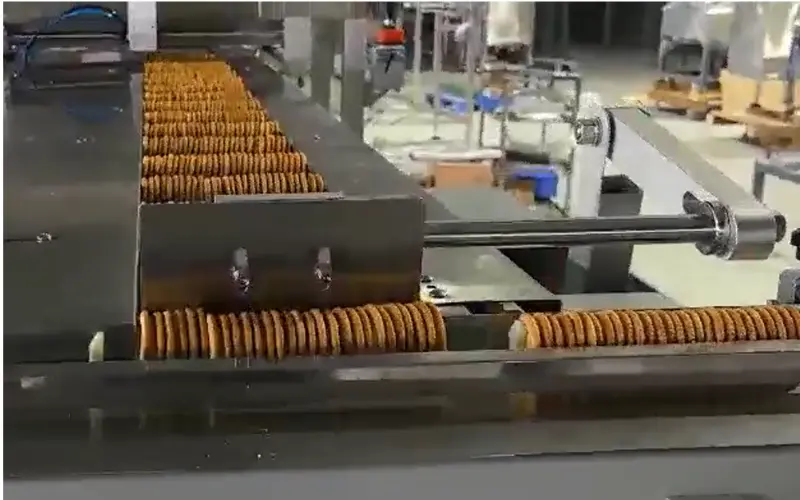
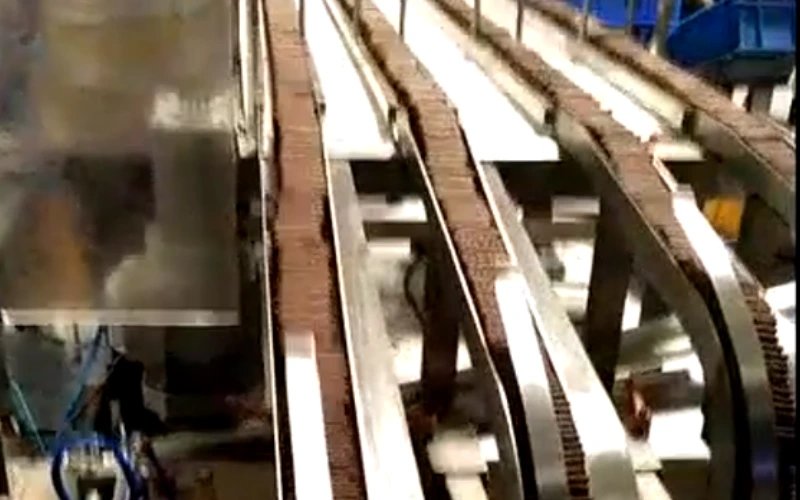
As soon as products exit the tunnel, they are transferred onto a
The technology to dramatically cut your energy bill exists today. The question isn't if you should upgrade, but when.
Ready to See Exactly How Much You Can Save?
Stop guessing about your energy costs. Schedule a Free Energy Audit with our Engineering Team.
We'll analyze your current operation, utility bills, and production goals to provide you with a personalized report showing:
Your potential annual energy savings.
The ROI of upgrading to a modern, efficient EverSmart oven.
A clear path to reducing your carbon footprint.
Contact us today to book your audit and start powering your bakery smarter. Whatsapp +86 13794619343 or Email: [email protected]

Ready to start your journey toward a customized solution? Contact me directly on WhatsApp to begin the conversation.