High-Precision Deposit Technology: Mastering Weight Consistency and Clean-Cut Separation
In the high-speed world of industrial biscuit manufacturing, the depositing system is far more than a simple mechanical component. It serves as the pulse of the sandwiching process, where your most significant operational expenses are converted into finished value.
Achieving accurate portioning while maintaining speeds exceeding 100 rows per minute is a complex mechanical and rheological challenge. This stage directly impacts both your final product quality and your bottom-line profitability.
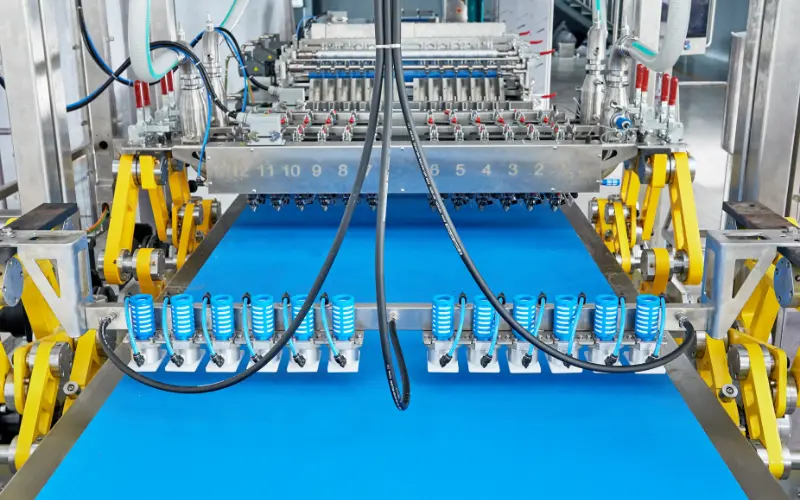
High-precision deposit technology, utilizing PLC-controlled servo systems and advanced intelligent nozzles, ensures uniform weight accuracy. This precision guarantees that every biscuit meets strict weight standards while delivering clean cutting and zero-tailing.
Key Takeaways for Global Stakeholders
For Owners: Precision depositing prevents "oozing," which ensures clean packaging seals and protects long-term brand reputation.
For CFOs: Reducing over-filling by just 0.1g per biscuit can recover over $45,000 in annual material costs per line.
For Engineering: Servo-driven technology provides a CPK > 1.33, eliminating the mechanical drift found in legacy cam-driven systems.
For Maintenance: Sanitary stainless steel construction and tool-free disassembly reduce sanitation downtime (COP) by up to 50%.
For Quality Control: Maintaining uniform size and consistent aeration ensures the sensory profile remains identical across every batch.
1. The Strategic Importance of Weight Consistency (CPK)
For a Financial Manager, weight standards are not merely quality metrics; they are the foundation of your Return on Investment (ROI). In the snack industry, "giveaway"—the amount of product over the labeled weight—is a direct hit to net profit.
If a line produces $800$ sandwiches per minute, over-depositing by a fraction of a gram results in massive cumulative raw material waste. Managing this variance is the most effective way to reclaim lost margins without increasing production speed.
Understanding Deposit Weight CPK
Achieving high deposit weight CPK (Process Capability Index) ensures that your process is not just hitting the average. It ensures your output stays consistently within the narrowest possible range to minimize waste.
A process with a high mean but a wide standard deviation still results in significant "giveaway" costs. Utilizing product weight monitoring and real-time automation controls, modern systems effectively eliminate under-fills while slashing over-fills.
The Physics of Mixture Handling
Maintaining consistency requires mastering the nuances of mixture handling and fluid dynamics. The temperature of the fats and sugars in the cream must be regulated strictly to maintain a stable viscosity.
Even a minor 2 fluctuation can alter the flow characteristics of the cream significantly. This causes the piston and cylinder depositors to draw inconsistent volumes, leading to weight drift.
Note:CPK is the ultimate truth in depositing. A system that can hit high speeds but has fluctuating weights will eventually cost more in wasted ingredients than the profit generated by the extra speed.
2. Advanced Cutting and Anti-Tailing Technology
"Tailing" or dripping occurs when the filling does not break cleanly from the nozzle at the end of the stroke. This does more than just waste expensive product; it contaminates your conveyor systems and the biscuit shells.
If cream drips onto the "capper" biscuit, it leads to misaligned sandwiches and aesthetic defects. Furthermore, stray cream on the product surface can eventually cause the flow wrapper to jam.
The "Suck-Back" Motion Profile
Modern servo-driven technology allows for a customizable motion profile that mechanical cams simply cannot match. EVERSMART's intelligent nozzles utilize a specialized "Suck-back" feature to ensure a clean break.
At the end of the deposit stroke, the piston reverses slightly within the cylinder. This pull-back creates a negative pressure zone at the nozzle tip, snapping the filling tail back into the manifold for perfect clean cutting.
Intelligent Nozzle Design
Different fillings require unique geometries to ensure the best separation results. Anti-drip shut-off nozzles for high-viscosity peanut butter look very different from those used for aerated marshmallow or fruit jams.
Utilizing interchangeable, specialized nozzles ensures that you can switch recipes without sacrificing portion control. This flexibility is vital for manufacturers running a diverse SKU portfolio.
Tip: "Tailing" is often the leading cause of seal failure in primary packaging. A clean-cut deposit ensures the sandwich is stable and the packaging film remains free of cream contamination.
3. Core Components of a High-Precision System
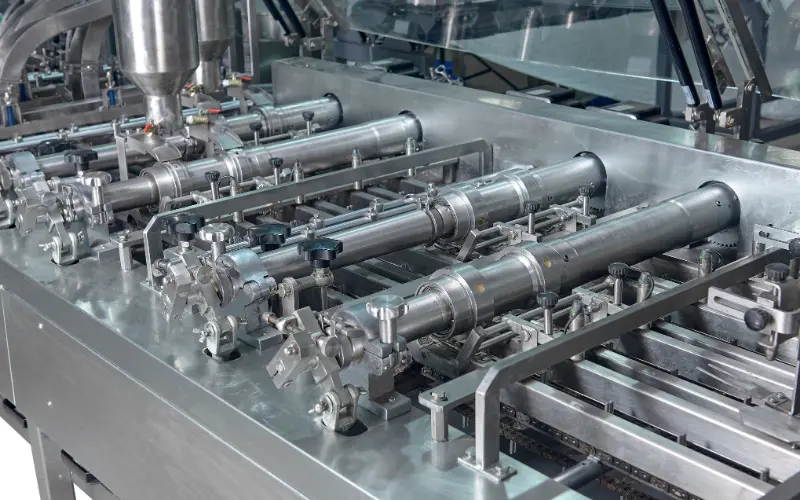
To achieve consistent quality across millions of production cycles, every component of the depositing manifold must be engineered for balance. Mechanical symmetry is the prerequisite for uniform weight across a multi-lane line.
Jacketed Hoppers: Maintaining filling temperature is critical for effective viscosity control. Jacketed hoppers with PLC-controlled heating ensure the cream remains in a "flowable" state even during production pauses.
Balanced Manifold Design: A custom manifold design ensures the pressure at the first nozzle is identical to the pressure at the last. Without this balance, "lane-to-lane" variance becomes a major source of ingredient waste.
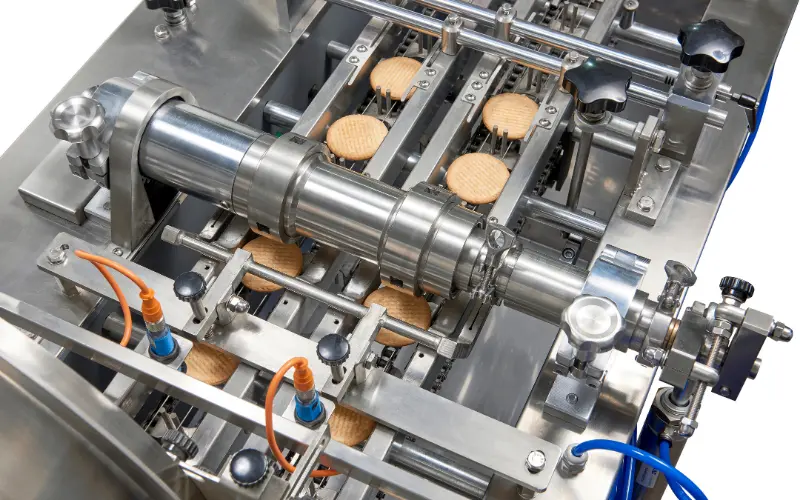
Industrial Pistons: High-accuracy piston depositors are the gold standard for high-viscosity materials. They offer superior volumetric depositing compared to gear-pump systems, which often struggle with aerated or delicate mixtures.
4. Smart Controls and Industry 4.0 Integration
For the Electrical Engineer, the focus is on the "Brain" of the depositor. Moving away from mechanical linkages to PLC-controlled servo systems provides a level of data transparency never before seen in the baking industry.
Closed-Loop Quality Control
Advanced systems now integrate AI-powered visual monitoring to catch errors before they escalate. If a camera detects a missing biscuit shell, the system signals the specific nozzle in that lane to skip the deposit.
This prevents cream from fouling the conveyor belt and saves raw materials instantly. This type of "no-product, no-fill" logic is essential for high-speed, high-efficiency operations.
Digital Recipe Management
Switching from a "Heavy Cream" recipe to a "Low-Fat Jam" filling used to take hours of manual adjustment. With digital controls, operators can select a pre-programmed recipe on the HMI and start production immediately.
The servo-driven parameters, suction-back speed, and deposition pressure adjust themselves automatically. This reduces human error and significantly lowers the time required for product changeovers.
5. Hygienic Engineering and Maintenance
Downtime is the enemy of profit in any industrial setting. In confectionery production, fats and sugars act as magnets for microbial activity, requiring frequent and thorough cleaning.
Tool-Free Disassembly: EVERSMART systems feature sanitary stainless steel components designed for quick removal. They can be stripped for Clean-Out-of-Place (COP) in under 15 minutes by a single operator.
Low-Shear Design: Excessive mechanical friction can "break" the aeration in creams, leading to a dense and oily texture. Our low-shear piston designs protect the mixture handling integrity to ensure a high-end sensory profile.
Note: Maintaining the "Overrun" (aeration) in your cream is a massive cost-saving measure. If your depositor "crushes" the air out of the mixture, you will need more cream by weight to fill the same volume.
6. People Also Ask: Expert Industrial Q&A
Q: How do we improve our deposit weight CPK on an older production line?
Accuracy begins with professional fluid handling and pressure management. First, ensure your manifold design provides equal pressure to all nozzles across the entire width of the line.
If you are using an older mechanical cam system, consider a servo-driven technology retrofit. This eliminates the mechanical "play" and timing drifts that erode weight consistency over time.
Q: What is the best way to handle "sticky" fillings like fruit jam or caramel?
These materials are notoriously prone to tailing and messy operation. The solution is a combination of heated anti-drip shut-off nozzles and a high-speed "suck-back" motion profile.
By reversing the industrial piston slightly at the end of the stroke, you create a clean break. This prevents contamination of the conveyor and ensures a professional-looking final product.
Q: How do we prevent "Oozing" when the top biscuit is applied to the cream?
Oozing is usually a result of over-depositing or the cream being too soft due to a lack of temperature control. Check your portioning settings and ensure your cream is at the correct set-point.
Additionally, ensure your cooling channels are properly setting the bottom biscuit before it reaches the depositor. A stable base prevents the cream from spreading too far when compressed.
Q: Can the system handle fillings with particulates, such as fruit pieces or nuts?
Yes, but it requires specialized piston and cylinder depositors with hardened shearing edges. These nozzles are designed to cut through small particulates without clogging or leaking.
This ensures you can maintain product integrity and weight standards even for premium recipes. It allows you to expand your product range without purchasing entirely new machinery.
Q: What is the ROI of switching from stenciling to volumetric depositing?
While stenciling is excellent for ultra-high speed, volumetric depositing offers vastly superior portion control. This is especially important for products with expensive fillings or aerated creams.
For premium products, the reduction in "giveaway" and rejects usually pays for the equipment in under $18$ months. It is a strategic investment in long-term material efficiency.
7. Ready to Eliminate Waste and Increase Precision?
Stop losing your profit to over-filling and messy production lines. At EVERSMART, we specialize in high-speed portioning and integrated control solutions that turn precision into profit.
Our engineering team is ready to help you analyze your current deposit variance. We focus on finding the "hidden losses" in your line to boost your overall efficiency.
Request an Accuracy Audit: Let our engineers calculate your potential savings by reducing deposit variance.
Download the TCO Analysis: See how our precision systems pay for themselves through raw material recovery.
Consult on Custom Nozzles: Get a tailored solution for your specific recipe's rheology and mixture handling needs.
[BUTTON: CONTACT AN EVERSMART PRECISION ENGINEER TODAY]

Ready to start your journey toward a customized solution? Contact me directly on WhatsApp to begin the conversation.