Hygienic Design for Biscuit Lines: Mastering FDA Compliance & Operational Safety
In the high-stakes world of industrial food production, the transition from the oven to the shelf represents the most vulnerable phase. For the Owner and Quality Manager, hygienic construction is not merely a bureaucratic requirement for passing an audit.
It is a fundamental pillar of brand reputation and the most effective insurance policy against catastrophic product recalls. As global snack consumption rises, so does the scrutiny from regulatory bodies like the FDA and EHEDG.
In 2026, simply using stainless steel is no longer enough to claim sanitary standards. True food safety management requires a proactive engineering philosophy that eliminates biological, chemical, and physical hazards at the source.
Key Takeaways for Global Stakeholders
For Owners: Sanitary design is a strategic defense mechanism, shielding your net profit from the astronomical costs of allergen-related litigation.
For CFOs: Tool-less belt removal and "Zero-Crevice" designs can reduce daily sanitation labor costs by over 50%.
For Engineering: Adhering to FDA 21 CFR and FSMA frameworks ensures total regulatory compliance and seamless entry into North American and European markets.
For Maintenance: Poka-Yoke reassembly features ensure that machines return to peak precision immediately after cleaning without manual re-calibration.
For Quality Control: Establishing clear hygienic zoning and mastering dry cleaning methodologies are essential for managing microbiological levels.
1. Understanding Hygienic Design in Biscuit Secondary Processing
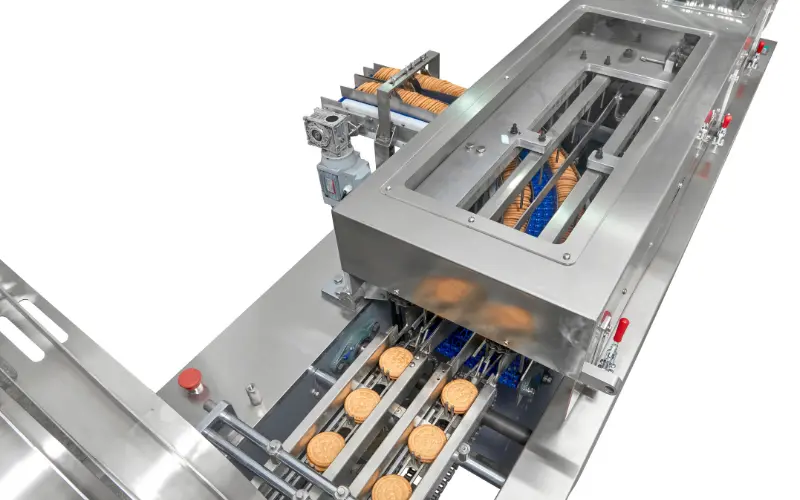
In the "Open Product Zone"—where biscuits move through cooling, sandwiching, and primary packaging—product integrity is at its highest risk. Unlike the closed environment of the oven, secondary processing involves exposed fillings, mechanical handling, and potential human interaction.
Secondary Processing Risks
Managing the "open product" zone requires a deep understanding of microbiological levels and environmental variables. Even though biscuits are low-moisture, the presence of fats and sugars in creams provides a potential nutrient source for pathogens.
Hygienic construction acts as the first line of defense in preventing these risks from becoming systemic failures. It ensures that the environment remains hostile to bacteria while remaining friendly to sanitation teams.
Hygienic Fabrication Requirements
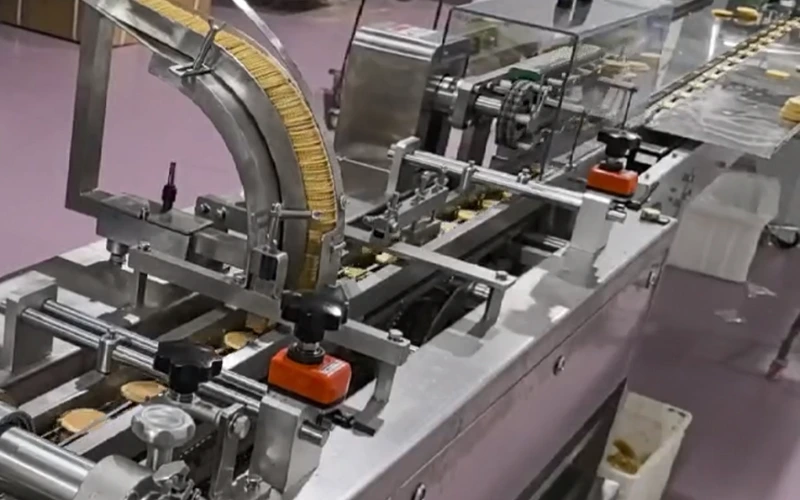
Moving beyond basic assembly, sanitary standards demand a shift toward specialized, high-precision fabrication. This includes the total elimination of lap joints, pop rivets, and unsealed threads that can harbor organic matter.
At EVERSMART, we treat every weld as a potential food-safety variable. We ensure that all joints are ground smooth and polished to prevent the microscopic trapping of debris.
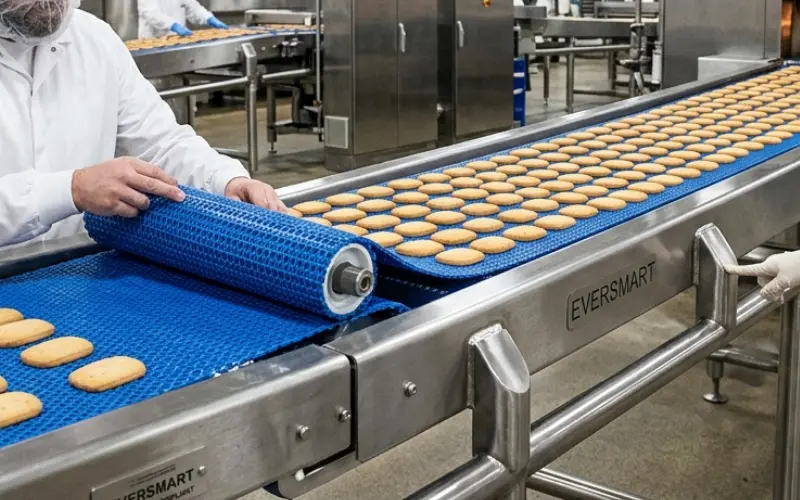
Note: Proper hygiene starts with the "Visible Path." If an operator or inspector cannot see a surface, they cannot verify its cleanliness. Our designs prioritize 100% visual access to all internal components.
2. Core Principles of Hygienic Equipment Design
For an Engineering Manager, cleanability is a direct and measurable function of machine geometry. If a machine is designed correctly, it should effectively "shed" debris rather than "capture" it.
Sanitary Stainless-Steel Construction
We utilize non-porous materials like 304 and 316L stainless steel for all critical structures. These materials are chosen for their resistance to corrosion and their ability to withstand harsh chemicals.
Every food contact surface is finished to a specific Ra value to minimize product adhesion. This ensures that sugar and cream residues do not bond permanently to the metal.
Eliminating Accumulation Zones: "No Dead Space"
"Dead spaces," crevices, and sharp corners are the primary enemies of industrial food safety. These are known as harbourage areas—places where crumbs and cream can hide, ferment, and breed bacteria.
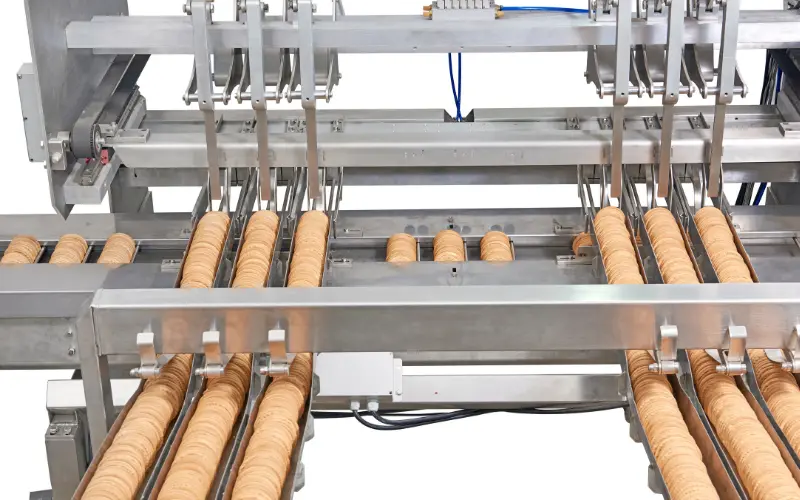
EVERSMART's "Zero-Crevice" design philosophy ensures that all joints are continuously welded. All frames are designed as open structures rather than hollow tubes to prevent internal contamination.
Rounded Edges and Sloped Surfaces
Horizontal surfaces are magnets for dust and moisture in a busy factory environment. Our designs feature rounded edges and sloped surfaces to ensure they are self-draining.
This prevents moisture from settling in product-contact areas and reduces the "dusting" effect of flour and sugar. Gravity becomes an ally in keeping the production line clean.
3. Meeting FDA, FSMA, and Global Industry Standards
Regulatory compliance is more than a label; it is a risk-management framework that protects your business. Failing to meet these standards can lead to heavy fines or total plant shutdowns.
FDA 21 CFR and cGMP
We strictly adhere to Current Good Manufacturing Practice (cGMP) for all equipment construction. This includes ensuring that all polymers, gaskets, and lubricants are FDA-certified for incidental food contact.
FSMA and PCAF Requirements
Under the Food Safety Modernization Act (FSMA), manufacturers must implement Hazard Analysis and Risk-Based Preventive Controls (HARPC). EVERSMART equipment simplifies this process by providing machines that are inherently easier to monitor.
Hygienic Zoning and ISO 7 Standards
Establishing clear boundaries between raw, processed, and packaged areas is vital for food safety. For highly sensitive environments, our equipment can be designed to meet ISO 7 standards for air and surface purity.
4. Hygienic Design for Dry Processing Environments
Biscuits are low-moisture products, which makes moisture management a unique and difficult challenge. In a dry plant, the introduction of water can actually increase biological risk significantly.
Crumb Management and Active Sequestration
A major challenge is managing dry particulates and flour dust throughout the shift. We integrate strategic airflow control and vacuum-based exhaust systems directly at the point of origin.
Allergen Management and Cross-Contamination
Preventing cross-contamination is critical when running multiple product recipes on the same line. Our automated cleaning systems and tool-less belt removal features allow for a total line swap in under 20 minutes.
The "Dry Cleaning" Advantage
In biscuit manufacturing, vacuuming and brushing are far superior to traditional wet cleaning methods. We call this the dry cleaning advantage, as it prevents moisture-triggered mold growth.
Tip: In low-moisture environments, water is a hazard. Focus on high-powered HEPA vacuuming and specialized dry-wiping to maintain a sterile line without the risks of humidity.
5. Specific Hygienic Components for Biscuit Lines
Every bolt and cable must be scrutinized under the lens of food safety. Even the smallest component can become a site for bacterial growth if ignored.
Washdown-Rated Machinery: We provide sealed electrical enclosures and IP69K-rated motors for extreme durability.
Hygienic Fasteners: We eliminate exposed threads and bolts in the product zone. These are replaced with polished, permanent joints and continuous welding.
Poka-Yoke Reassembly: Our components are designed with precision indexing pins. This means that after cleaning, the machine can only be reassembled in the correct orientation.
6. People Also Ask: Expert Industrial Q&A
Q: What is the difference between dry cleaning and wet cleaning in a biscuit plant?
Dry cleaning involves vacuuming and wiping and is the standard for low-moisture environments to prevent bacterial growth. Wet cleaning is reserved for high-risk zones like cream preparation and requires specialized sanitary design to ensure rapid drying.
Q: How does hygienic design affect my Total Cost of Ownership (TCO)?
While the initial investment in sanitary standards equipment is higher, the TCO is significantly lower. You save through 50% faster cleaning cycles and a dramatically lower risk of expensive product recalls.
Q: What does "No Dead Space" mean in conveyor design?
It refers to the elimination of lap joints and unsealed threads where debris or moisture can hide. Open-frame construction is a key feature of EVERSMART’s equipment, allowing for 360-degree cleaning access.
Q: How do you manage allergen cross-contamination during product changeovers?
We use tool-less belt removal and "quick-swap" manifolds to prevent cross-contact. This allows operators to remove product-contact surfaces and replace them with sanitized sets in minutes.
Q: Can hygienic design really improve our OEE (Overall Equipment Effectiveness)?
Yes, by reducing the "Sanitation" component of your downtime through sanitary fabrication and easy-access designs. Faster cleaning directly equals more hours of sellable production per shift.
7. Benefits of High-Standard Hygienic Construction
Implementing sanitary design isn't just about passing a government audit; it is about protecting your brand reputation. By reducing the risk of contamination, you guarantee product integrity from the first biscuit to the last.
At EVERSMART, we don't just build machines; we engineer confidence for our global partners. Our commitment to Good Manufacturing Practices ensures that your facility remains a world-class leader in safety.
Take the Next Step Toward Compliance
Download the Hygienic Design Checklist: Audit your current line against FDA/EHEDG standards.
Request a Sanitary Design Review: Let our engineers identify the "Harbourage Areas" on your existing equipment.
Calculate Your Sanitation ROI: See how much you can save by reducing your cleaning downtime by 50%.
[BUTTON: CONTACT AN EVERSMART HYGIENE EXPERT TODAY]

Ready to start your journey toward a customized solution? Contact me directly on WhatsApp to begin the conversation.