The Science of Biscuit Stability: Mastering Cooling Conveyors to End Stress Cracking
In the high-speed world of industrial biscuit manufacturing, the cooling stage is often the most misunderstood phase of the production flow chart. While many operators view cooling as a simple pause between baking and packaging, it is actually a critical period of material transformation.
For the Mechanical Engineer and Quality Manager, this phase determines the structural destiny of the product. If the cooling process is mismanaged, two devastating phenomena occur: stress cracks (checking) and moisture condensation.
These issues do not merely affect the aesthetics of the biscuit. They directly impact your Overall Equipment Effectiveness (OEE) and bottom-line profitability.
Key Takeaways for Stakeholders
For Owners: Reducing the "checking" rate by just 1% can recover tens of thousands of dollars in annual yield.
For CFOs: Energy-efficient manufacturing designs, such as VFD-controlled fans, can slash utility costs in the cooling zone by 25%.
For Engineering: Managing the Dew Point is as critical as managing temperature to prevent "rain" inside the tunnel.
For Maintenance: Automatic belt tracking and modular crumb management systems reduce daily downtime by 40%.
For Quality Control: Proper post-baking moisture migration is the only way to ensure the perfect "snap" and long-term shelf life.
1. The Strategic Importance of Professional Cooling
When biscuits exit the bake-off, they are structurally fragile and chemically active. The starches and proteins are still setting, while the fats remain in a semi-liquid state.
Maintaining Product Integrity and Texture
Uniform cooling allows these components to stabilize at a controlled, predictable rate. If the surface cools significantly faster than the core, the resulting temperature gradient creates dangerous internal tension.
For the Maintenance Engineer, this manifests as product "shattering" further down the line. This breakage usually occurs at the biscuit stacking machines or the packaging infeed.
Preparing for the Packaging Interface
Sending biscuits to a sealed package while they are still releasing latent heat is a recipe for disaster. The resulting moisture condensation creates a micro-environment for mold growth and ruins product crispness.
Proper packaging preparation requires the product to reach an equilibrium temperature before wrapping. Usually, this means getting the biscuit within 5°C of the ambient packaging room temperature.
Note: The cooling stage determines the success of all downstream automation. A warped biscuit will jam a high-speed auto feeder system, leading to cascading OEE losses.
2. The Physics of "Checking": Understanding Stress Cracks
"Checking" is the spontaneous cracking of a biscuit that occurs after it has been baked and cooled. This is arguably the most expensive "invisible" problem in the baking industry.
The Impact of Rapid Temperature Fluctuations
When a biscuit is subjected to rapid cooling, the outer surface contracts quickly. However, because the core is still warm, it remains expanded and pushes outward.
This difference in volume creates a high-tension thermal stress profile. If this stress exceeds the mechanical strength of the biscuit's crumb structure, the product shatters.
Post-Baking Moisture Migration
During the temperature reduction phase, moisture migrates from the high-humidity center to the dry surface. This movement must be managed carefully to maintain structural balance.
If airflow optimization is too aggressive, the surface dries into a "crust" too quickly. This traps moisture in the core, leading to warping and delayed checking hours later.
Tip: For high-fat recipes like shortbread, the cooling curve must be exceptionally gentle. Slow cooling ensures the crystalline structure of the fats sets uniformly across the biscuit.
3. Strategies for Airflow Optimization and Humidity Control
Managing the Dew Point and Condensation
In high-output manufacturing facilities, the air inside a cooling tunnel becomes saturated with moisture. If this air hits a cold machine frame, it reaches its dew point and condenses.
To prevent this, exhaust systems must be strategically balanced with airflow optimization. You are not just moving air; you are managing a complex mass-transfer process.
Cross-Flow vs. Counter-Flow Air Distribution
Counter-Flow Cooling: Air moves in the opposite direction of the product flow. This ensures that the coolest air hits the coolest biscuits, providing a gentle temperature gradient.
Cross-Flow Cooling: Air moves across the width of the conveyor belt. While efficient for rapid cooling of thin crackers, it requires precision baffling to ensure uniform results.
4. Engineering for Space and Performance
Multi-Pass Design and Floor Space Optimization
In many food processing operations, floor space is the ultimate premium. A single-pass cooling conveyor can be excessively long and inefficient.
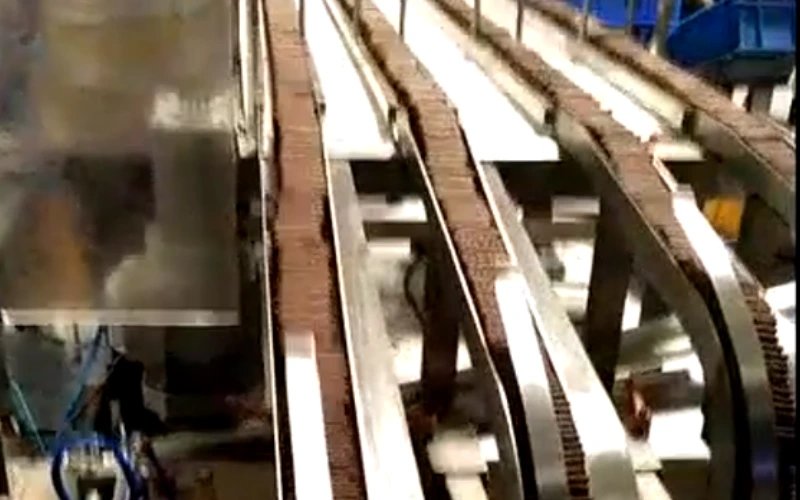
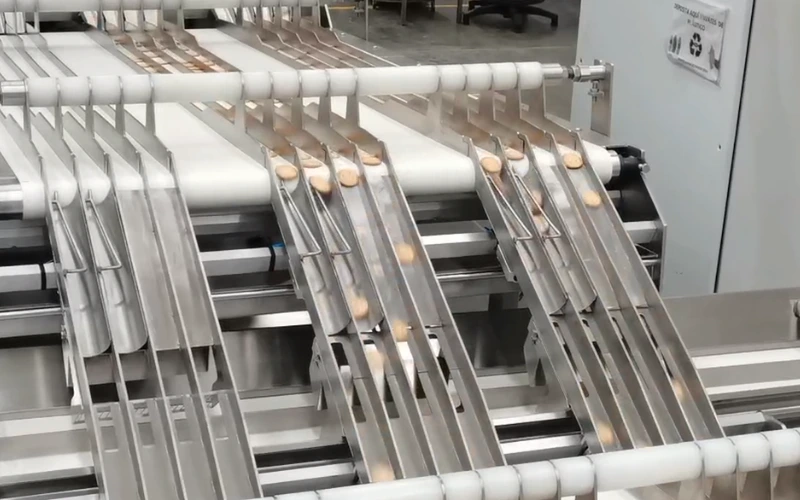
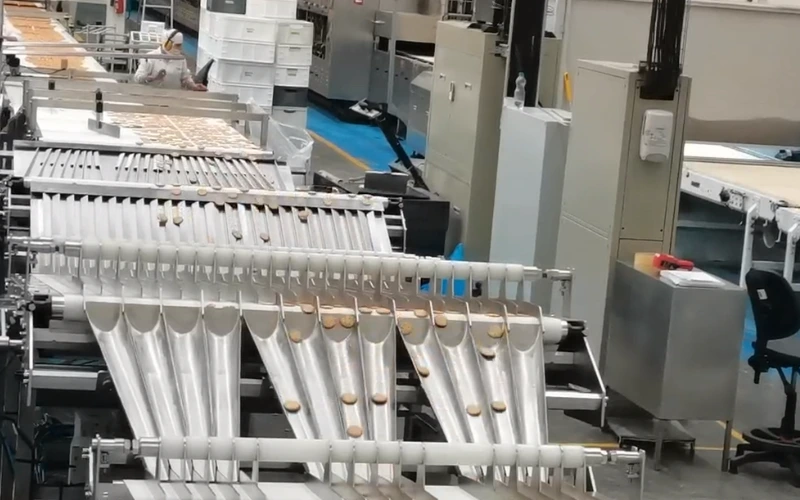
Modular conveyor systems with multi-pass (3-tier or 5-tier) layouts allow for the necessary dwell time. This engineering achieves maximum cooling within a fraction of the physical footprint.
Adaptive Synchronization and Belt Tracking
For the Electrical Engineer, the cooling line must be a digital extension of the oven. Using encoder system integration, the belt speed must perfectly match the oven's output.
Furthermore, EVERSMART's cooling lines feature automatic belt tracking technology. This eliminates the manual nightmare of adjusting tensioning bolts and prevents expensive belt edge wear.
Note: Proper belt tensioning doesn't just protect the equipment. It ensures that fragile biscuits aren't subjected to vibrations that could trigger latent stress cracks.
5. Maintenance and Crumb Management
Advanced Sanitary Construction
Biscuits are high-fat, high-crumb products that leave behind significant debris. Without a robust crumb management system, this debris creates fire hazards and sanitation risks.
Open-Frame Design: Utilizing sanitary stainless-steel construction ensures that crumbs fall through to collection trays.
Tool-Less Cleaning: Our systems allow for easy cleaning (COP) via removable trays and quick-release guards.
6. People Also Ask: Expert Industrial Q&A
Q: Why do my biscuits look perfect at the packing station but arrive broken at the supermarket?
This is a classic case of checking (stress cracks). The internal stresses caused by improper post-baking moisture migration only "relieved" themselves after the product was packaged.
Increasing your dwell time and switching to a counter-flow cooling system will stabilize the product. This ensures the biscuit is structurally sound before it hits the wrapper.
Q: How can I prevent "rain" or condensation from forming inside my cooling tunnel?
This occurs when your exhaust systems are inadequate for the production volume. You must monitor the dew point of the air inside the tunnel actively.
By using IIoT sensors to link fan speed to ambient humidity, you remove moisture effectively. This prevents water from condensing on cold surfaces and dripping on your product.
Q: What is the optimal temperature for biscuits to enter the flow wrapper?
Ideally, biscuits should be within 5°C of the ambient packaging room temperature. Entering at 40°C or higher risks moisture condensation inside the film.
This condensation leads to a soggy texture and significantly reduced shelf life. It can also trigger mold growth in certain high-moisture recipes.
Q: Is a mesh belt or a solid plastic belt better for cooling?
For maximum heat dissipation, a stainless steel mesh belt is the superior choice. It allows for 360-degree air distribution, cooling the bottom of the biscuit as fast as the top.
Solid belts can "trap" heat on the bottom surface. This often leads to warping as the top and bottom contract at different rates.
Q: How can we reduce energy costs in the cooling zone?
Implement variable frequency drives (VFDs) on all circulation and exhaust fans. Many factories run fans at 100% regardless of the actual oven throughput.
By using PID control to link fan speed to actual product volume, you save energy. Most facilities realize energy savings of up to 25% with this upgrade.
7. The EVERSMART Difference: Why Engineering Matters
At EVERSMART, we apply CFD (Computational Fluid Dynamics) to every cooling line we design. We do not guess where the air goes; we simulate it to ensure perfection.
This scientific approach ensures that your material transformation is controlled and predictable. We focus on Total Cost of Ownership (TCO) and long-term yield recovery.
By using hygienic and food-safe construction materials, we ensure your maintenance costs stay low. Our modular components mean your manufacturing productivity stays consistently high.
8. Ready to Reclaim Your Lost Profit?
Stop losing your yield to "checking" and condensation issues. Let our team of mechanical engineers conduct a professional audit of your current cooling zone.
Take the Next Step Toward Efficiency
Request a CFD Airflow Audit: See exactly how air moves across your product and identify "hot spots."
Calculate Your Yield ROI: See how much a 1% reduction in breakage can impact your annual profit.
Explore System Integration: Learn how our cooling lines synchronize perfectly with our [High-Speed Sandwiching Lines].
[BUTTON: CONTACT AN EVERSMART COOLING SPECIALIST TODAY]

Ready to start your journey toward a customized solution? Contact me directly on WhatsApp to begin the conversation.