How to Seamlessly Integrate Custom Packaging Solutions Into Your Automated Production Line
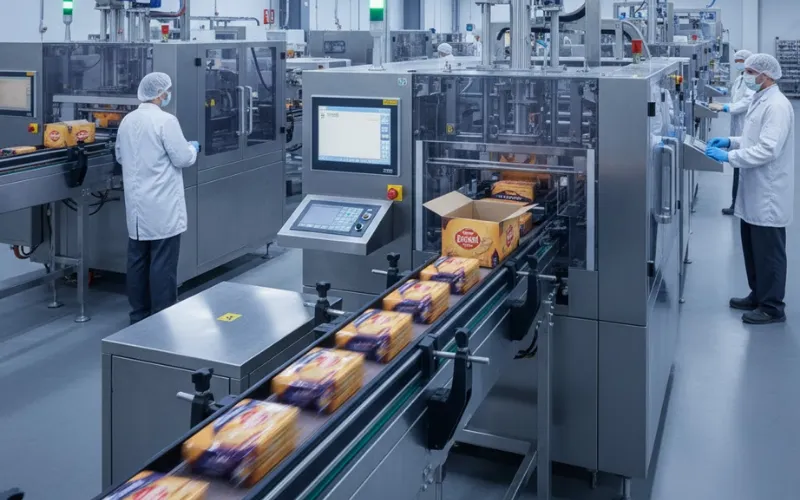
Successfully integrating custom packaging solutions into your automated production line hinges on treating package design, mechanical function, and data flow as one unified ecosystem, all driven by meticulous planning, a unified control platform, and seamless physical conveyance.
For a biscuit factory, this is more than a technical issue; it's a strategic weapon. The real challenge is this: will your line integration become a bottleneck, or will it empower you to switch from standard packaging to a "Seasonal-Limited" custom box in 48 hours, allowing you to capture the market and crush the competition?
Many manufacturers invest millions in top-tier baking lines and formers, only to watch their perfect biscuits pile up at the "last 20 meters" of the line. They make the critical mistake of treating production (upstream) and packaging (downstream) as two separate, independent units.
This separation inevitably leads to bottlenecks, downtime, and inefficiency—especially when introducing unique custom packaging.
This article will dive deep into every critical layer, from strategic planning and financial modeling to engineering and maintenance. We will ensure your integration project is engineered for profitability, agility, and long-term reliability from day one.
Key Takeaways
The True Meaning of Integration: Successful integration is not just connecting machines. It's creating a single, organic system controlled by a central brain (PLC) for unified recipe management and fault handling.
The "Custom" Challenge: The unique materials, irregular shapes, and tight tolerances of custom packaging are the primary reasons for integration failure. These engineering challenges must be anticipated in the design phase.
Strategic Value (Owner's View): A superior integration enables "High-Mix, Low-Volume" production. This gives a factory the market agility to switch limited-edition packaging in 48 hours, which is more valuable than speed alone.
The Financial Key (CFO's View): You must look beyond "purchase price" and evaluate the project based on TCO (Total Cost of Ownership). The biggest hidden costs are often slow product changeover times and excess spare parts inventory.
The Engineering Core (Engineer's View): A Buffering System is used to "decouple" the line for maximum OEE. An Open Platform (like PackML) simplifies communication. And Design for Maintainability (DfM) determines your long-term operational costs.
The Procurement Shield (Buyer's View): Your contract must include a "Single Point of Responsibility" clause. You must also define clear FAT/SAT acceptance criteria using your most difficult packaging materials, not the supplier's perfect ones.
What is Packaging Line Integration? (And Why "Custom" Makes it More Challenging)
Beyond Physical Connection: The True Meaning of Integration
First, integration is not simply connecting Machine A's exit conveyor to Machine B's entrance conveyor.
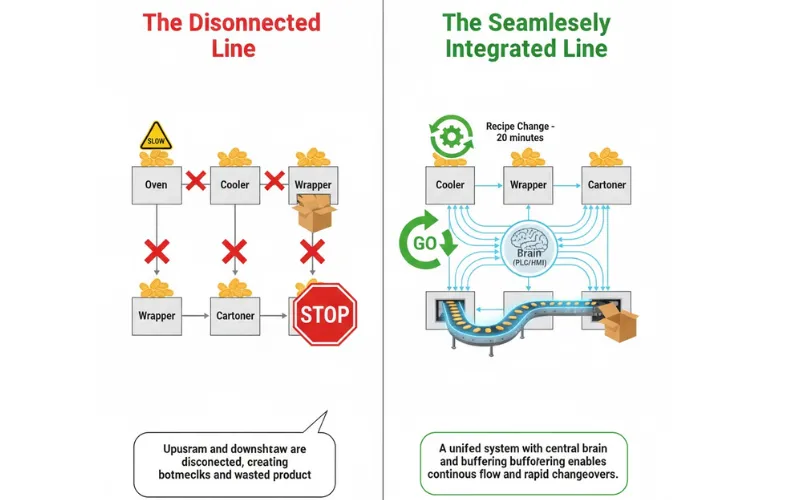
A truly integrated system is a single, organic whole. This means all machines—from the biscuit stacker and feeder, to the flow-wrapper, to the cartoner and case packer—operate in perfect harmony through a central brain (PLC).
They share a unified HMI (Human-Machine Interface), enabling one-touch start/stop, synchronized speed adjustments, recipe management, and intelligent fault handling.
When you press "Start," the entire line comes to life in a precise, pre-programmed sequence. When the downstream case packer jams, the upstream flow-wrapper and biscuit feeder automatically enter a "buffer" mode instead of catastrophically continuing to feed product, which would cause a pile-up and crushed goods.
The Unique Challenges of "Custom Packaging"
Integrating standard packaging (like a simple pillow pack) is already complex. Integrating custom packaging solutions increases the difficulty tenfold.
Why? Because "custom" implies "variability" and "unpredictability."
Material Challenges: Your custom food packaging solutions might use a new matte-finish, compostable film. This film's elasticity, friction coefficient, and heat-sealing window are completely different from standard BOPP film. An un-optimized integration might tear the film at high speeds or fail to create a strong seal due to improper temperature control.
Shape Challenges: Your custom package might be a unique hexagonal carton or a shaped pouch with a die-cut window. These irregular shapes have terrible stability on high-speed conveyors. They are prone to tipping over, rotating, or jamming.
Tolerance Challenges: Biscuits themselves are fragile. Custom packaging, driven by aesthetics, often has tighter internal tolerances, like a form-fitting plastic tray. This demands that upstream robots or feeding systems place the biscuit with sub-millimeter precision. Any slight misalignment will result in broken biscuits or a machine jam.
Therefore, a successful custom packaging integration project must anticipate these challenges in the design phase, not try to patch them after installation.
Note: The vast majority of integration failures originate in the package design phase. A beautiful box designed in a "vacuum" (without an engineer's collaboration) is often the number one cause of line downtime.
Strategic Planning: From Business Goals to Engineering Reality
An integration project must be a business project before it becomes an engineering one.
Step 1: Audit Your Current Line and OEE Bottlenecks
Before you buy any new equipment, answer this: where is your bottleneck right now?
Don't guess. You need data. Measure your line's OEE (Overall Equipment Effectiveness).
Are you stopping because of inconsistent upstream flow, like biscuits not cooling long enough? Or is your downtime caused by a downstream packaging machine that jams constantly?
Understanding the true bottleneck ensures your new investment is spent solving the biggest problem, not just "improving" a section that is already efficient.
Step 2: Plan for Agility and Growth (The Owner's View)
This is the strategic differentiator that owners and marketing directors must focus on.
Traditional integration thinking is about "Efficiency": how many products per minute (PPM) can we run. Modern integration thinking is about "Agility."
Your competitor launches a Christmas-themed custom gift box and captures the high-margin premium market. You want to respond, but your line requires a three-week shutdown to change tooling, reprogram, and debug.
By the time you're ready, Christmas is over. That is a strategic integration failure.
An exceptional custom packaging solutions integration must support "High-Mix, Low-Volume" production. This means your line must be able to switch between diverse products and packaging styles with minimal downtime.
This agility allows you to react instantly to market trends, launching seasonal, promotional, or even personalized custom packaging, which in turn delivers higher profit margins.
Step 3: Financial Modeling (The CFO's View)
The Chief Financial Officer's (CFO) job is to see through the fog of "purchase price" and focus on TCO (Total Cost of Ownership).
TCO = Initial Investment (Capex) + Long-Term Operating Costs (Opex)
An integrator with a lower quote might end up "eating" all your profits over the next five years through sky-high Opex.
Beware of these "Hidden Costs" in your TCO model:
Training Costs: If the integrator uses a niche, closed control system (a "black box"), your team will need expensive, specialized training. Using an industry-standard system (like Siemens or Rockwell) means your engineers are likely already familiar with it.
Spare Parts Inventory Costs: Integrating machines from 5 different suppliers means you must stock 5 different sets of spare parts (servo motors, sensors, pneumatic cylinders...). A "single-source" integrator who standardizes components (e.g., using the same brand of servo drive across the entire line) will dramatically reduce your inventory burden and tied-up capital.
Ineffective Acceptance Costs: This is the biggest trap. If the acceptance criteria (FAT/SAT) in your contract are vague, you could waste weeks of valuable production time on-site debugging, all of which is pure cost.
Case in Point: A Biscuit Manufacturer's Testimonial
"We thought integration was just about line speed. But the real win was agility. Our new integrated line, with its 20-minute changeover, allowed us to launch a seasonal shortbread line in 10 days. That single product run paid for 30% of the capital investment in its first quarter."
— Plant Manager, Regional Bakery
[Table illustrating a TCO comparison between a low-price integrator and a high-value TCO-focused integrator, showing costs for Capex, Training, Spares, and Downtime]
Tip (CFO's View): The biggest hidden cost is usually not spare parts; it's the line downtime caused by slow product changeovers. In your TCO model, the loss from one hour of downtime (including missed output, labor, and energy) should be precisely quantified.
The Core Technical Components of Integration (Physical & Data)
A successful integration system must be seamless on two levels: the "Physical" and the "Data."
Physical Integration: Ensuring Smooth Product Flow
This is the Mechanical Engineer's (ME) domain. The flow of products must be as smooth as water.
Throughput Matching: This is the most basic requirement. The peak output of your upstream biscuit line (continuous motion) must be matched to the average throughput of your downstream packaging machines (which may be intermittent motion).
Buffering & Accumulation: This is the most valuable physical component in an integration project. Imagine this: your downstream cartoner needs 15 seconds to change over to a new carton blank.
On a traditional line, the entire upstream biscuit line must stop, causing a full line stoppage.
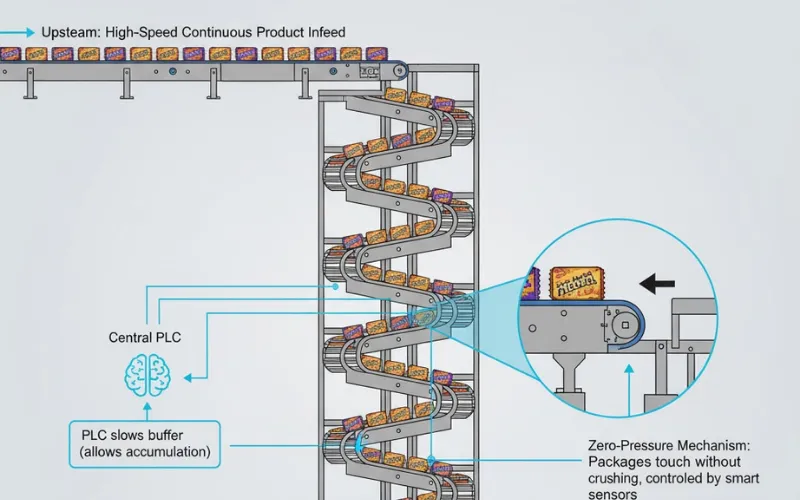
A "zero-pressure" or "minimum-pressure" buffer system (like a serpentine accumulation tower or a multi-lane accumulation conveyor) solves this problem.
How it works:
This buffer system "decouples" your upstream production from your downstream packaging. This ensures your expensive upstream assets (like ovens) can run continuously at their peak OEE, which is the key to maximizing your plant's total output.
The downstream cartoner's HMI sends a "carton-low" signal.
The central PLC receives this signal and automatically slows the buffer conveyor, allowing product to "accumulate" safely.
The cartoner stops for 15 seconds to perform its change.
During these 15 seconds, the upstream biscuit production line does not stop. It continues to run at 100% speed, feeding biscuits into the accumulating buffer system.
The cartoner change is complete. The PLC automatically speeds up the buffer system, clearing the accumulated product and resuming normal, synchronized speed.
Note: A buffering system is the heart of line "decoupling." It allows your expensive upstream equipment (like the baking line) to run at 100% efficiency, unaffected by the normal, intermittent micro-stops of downstream packaging machines.
The ME's Challenge: Designing for Rapid Changeover (SMED)
An SMED-enabled integration line can cut changeover time from 3 hours to 15 minutes. This is a decisive advantage for running "high-mix, low-volume" custom food packaging solutions.
For any line handling multiple types of custom packaging, the Mechanical Engineer's biggest nightmare is the product changeover.
Bad Integration: A changeover takes 3 hours. A mechanic needs a wrench, relies on "tribal knowledge" to adjust guide rails and change tooling, and needs a dozen test runs to get it right.
Excellent Integration (Applying SMED - Single-Minute Exchange of Die principles):
HMI Recipe Recall: The engineer selects "Product B" on the touchscreen. All servo-driven guide rails, feeders, and even the sealing jaw height on the wrapper automatically adjust to their pre-set positions.
Visual-Aided Tooling: Key formats and tools use "quick-lock" handles or "Poka-Yoke" (mistake-proofing) designs. They can be changed in 3 minutes without tools.
Digital and Physical Scales: All manual adjustment points have clear digital or physical rulers. The operator follows an SOP (Standard Operating Procedure) to set them, removing the "guesswork."
Data & Control Integration: The "Brain" of the Line
This is the Electrical Engineer's (EE) domain. If physical integration is the skeleton, data integration is the nervous system.
Sensors & Vision Systems: On a high-speed automated line, the human eye is unreliable. You must rely on machine vision.
What must it check?
Seal Integrity: This is critical. The system must check for crumbs, sugar dust, or film wrinkles trapped in the seal area. This is the #1 cause of shortened shelf life and customer complaints.
Print Quality: Is the "Best By" date code clear and legible?
Label & Positioning: Is the custom package label straight? Is the artwork centered?
Product Integrity: Is a biscuit broken? Is a package missing a biscuit (e.g., only 11 in a 12-pack)?
The EE's Challenge: Open Platforms & Virtual Commissioning
Open Platform vs. "Black Box": This is the EE's biggest concern. If a custom packaging manufacturer provides a line built on a closed, proprietary "black box" (using their own niche PLC and servos), you are "handcuffed." Your engineers can't optimize it, and spare parts are only available at a premium from them.
A superior integration must be built on an Open Platform (like Rockwell/Allen-Bradley or Siemens), which your team can easily modify and maintain.
PackML (The Language of Packaging Machines): Why is this industry standard so important? PackML (ISA-TR88) defines a standard set of machine states and data tags for all packaging equipment, regardless of brand.
When your Supplier A's flow-wrapper and Supplier B's cartoner both "speak" PackML, they can communicate "plug-and-play." This dramatically cuts down on integration and debugging time.
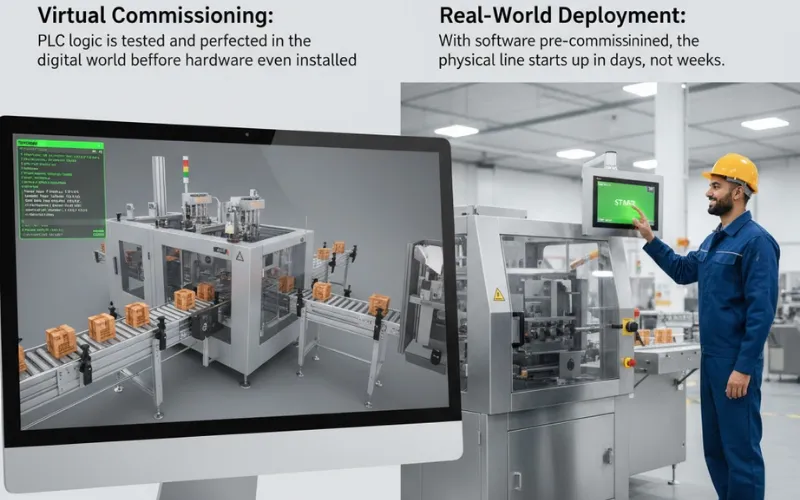
The Differentiator: Digital Twin / Virtual Commissioning: This is the cutting-edge of custom industrial packaging solutions. Instead of spending weeks on your factory floor debugging the PLC logic, we build a 1:1 "Digital Twin" of your line in a computer while the machines are still being built.
We test and optimize all the PLC logic for your custom packaging on this virtual line. When the physical machines arrive at your plant, the software is already 95% commissioned. This can shrink your on-site startup and commissioning time from weeks to just days.
The 5 Common Integration Pitfalls (And How to Avoid Them)
We have summarized these costly mistakes from countless projects:
Pitfall: Incompatible Communication Protocols
The Mistake: Supplier A's machine uses Modbus. Supplier B's uses EtherNet/IP. Supplier C's uses Profinet. They can't communicate efficiently.
The Fix: Create a "Controls Specification" before purchasing, mandating all suppliers to use your plant's single, standard protocol (e.g., EtherNet/IP).
Pitfall: Ignoring Upstream/Downstream Bottlenecks
The Mistake: You buy a 300 PPM (packs-per-minute) flow-wrapper, but your upstream biscuit feeder can only handle 250 PPM. You paid for 50 PPM you can never use.
The Fix: Conduct a full OEE Line Analysis during the planning phase. Accurately identify and match the "Rated Speed" and "Actual Speed" of every component.
Pitfall: Underestimating Custom Material Impact
The Mistake: You saw a beautiful, matte compostable film at a trade show but never tested it on your machines. You discover it has severe static issues at high speed, causing film drift and seal failures.
The Fix: You must conduct long, high-speed tests with your actual materials at your integrator's facility (see FAT section).
Pitfall: Bad Physical Transfer Points
The Mistake: Products are transferred between conveyors using passive guide rails. Your irregular custom boxes tip over and jam.
The Fix: Use active, servo-driven transfers (like side-grip belts or smart robotic sorters) at critical points. This ensures products are "controlled" through the transition, not "bounced."
Pitfall: Lack of a Single Point of Responsibility
The Mistake: The line stops. The wrapper supplier blames the cartoner. The cartoner supplier blames the upstream feeder. You, the customer, are trapped in the middle.
The Fix: See the next section.
Integrating for the Full Lifecycle: Procurement & Maintenance
Integration doesn't end the day the machine turns on. It's just beginning.
The Purchasing Manager's View: "Single Point of Responsibility" & Clear FAT/SAT
For a Purchasing Manager, two clauses in the contract are more important than any other:
"Single Point of Responsibility"
This is the most critical non-technical clause you must fight for. It means that no matter what part of the line fails, you make one phone call.
This "General Contractor" (whether it's a systems integrator or a full-line custom packaging manufacturer like EverSmart) is contractually obligated to coordinate all other vendors and solve the problem.
This clause liberates you from the endless "blame game."
How to Define a Clear FAT/SAT (Factory/Site Acceptance Test)
This is the "shield" that protects your investment. Do not accept vague language like "runs well."
A Strong FAT/SAT Acceptance Checklist:
Must test using the client's "worst-case" custom packaging materials, not the integrator's "perfect" materials.
Must simulate a real production shift. For example, the line must run at 95% OEE for a continuous 4-hour (or even 8-hour) period.
Must include product changeover tests. Measure and record the time to switch from Product A to Product B. It must meet the contracted time (e.g., 20 minutes).
Must include all fault recovery tests. (e.g., simulate an E-Stop and prove the system can be safely recovered in under 1 minute).
Tip (Purchasing View): Never, ever sign off on an acceptance test (FAT) that uses the supplier's "golden sample" materials. You must use your own, real-world, "most-difficult-to-run" custom packaging (e.g., your thinnest film, your most easily-jammed carton) and run it for hours at full speed. This will expose 90% of all latent problems.
The Maintenance Engineer's View: "Design for Maintainability" (DfM) & Rapid Diagnostics
For the Maintenance Engineer who has to "live with" the line, their concerns are all about what happens on a Friday at 4:00 PM when a machine goes down.
DfM (Design for Maintainability):
Is the machine easy to access? Does a mechanic have to remove 8 bolts to change one sensor?
Open-Frame Design: Avoid hollow-tube frames (which can harbor bacteria). Ensure biscuit crumbs and dust can fall through to a collection tray, not build up inside the machine.
Transparent Safety Guards: Allow operators to visually monitor the machine's internals and spot potential issues before they become jams.
MTTR (Mean Time To Repair):
When the machine alarms, what does the HMI screen say?
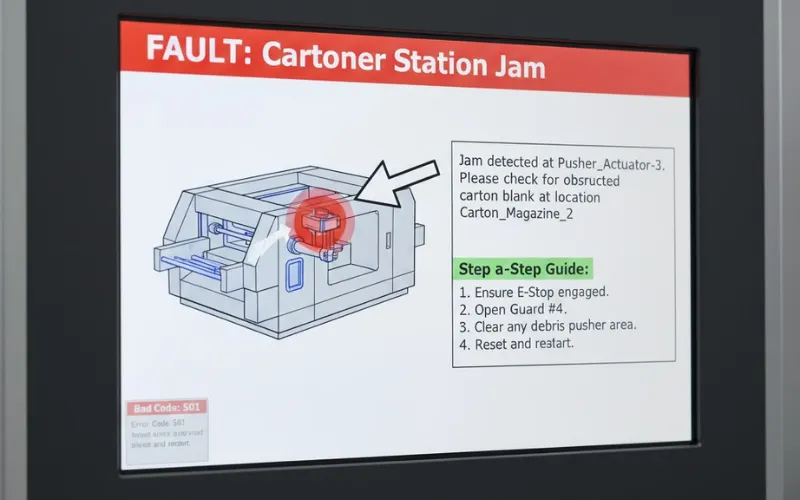
Bad HMI: A vague "Fault Code 501 - System Error." The mechanic has to dig out a thick manual.
Excellent HMI: "Intelligent Fault Diagnostics." The screen instantly displays: "Fault: Drive 3 Overload. Check cartoner pusher at location [X,Y,Z] for product jam." This cuts MTTR from 30 minutes to 3 minutes.
Remote Support:
Does your integrator offer secure AR (Augmented Reality) or remote VPN diagnostics?
When your EE can't solve a PLC logic problem, the supplier's expert can log in via VPN and fix it in 30 minutes—instead of making you wait 2 days for an engineer to fly to your site.
Tip (Maintenance View): The "Intelligent Fault Diagnostics" feature on an HMI is far more valuable than the machine's "Top Speed." A system that tells you exactly which sensor is dirty, versus a "black box" that just alarms, will save you thousands of hours of precious troubleshooting time.
Conclusion: Integration is the Key to Turning Your Automation Investment into Profit
A successful custom packaging solutions integration project is not a simple collection of machines.
It is a complete, closed loop that starts with Strategy (Owner), is justified by Finance (CFO), protected by Procurement (Purchasing), built by Engineering (ME/EE), and sustained by Maintenance.
It is a single, organic system. It allows you to lower your TCO and reduce waste, all while gaining the strategic agility to respond to a rapidly changing market. This is what transforms your biscuit factory into a more competitive, modern enterprise.
Professional Consultation & Services (CTA)
Is your custom packaging ready to be seamlessly matched with a high-speed automated line?
One wrong integration decision can cost you millions in lost profits over the next five years. At EverSmart, we don't just sell machines; we provide full-line integration solutions built on deep, expert knowledge of the biscuit industry.
Contact our integration specialists today for a "TCO & Rapid Changeover Potential Assessment" for your line.
We will help you analyze:
Your current OEE bottlenecks.
How much time your line is wasting on custom packaging changeovers.
How an optimized custom packaging solution will shorten your payback period.
Frequently Asked Questions (FAQ)
Q1: We are a small business. Is it too early to integrate an automated packaging line?A1: This is a question of "timing," not "scale." If you face these issues, it's the perfect time: 1) Your orders are starting to outpace your manual packing capacity. 2) You are struggling with profitability due to rising labor shortages or costs. 3) Your major customers (like retail chains) are demanding higher, more consistent quality in your packaging.
Integration is the necessary path to solve these "growth pains." It can start small by automating a single bottleneck station and then be expanded over time.
Q2: What is the single biggest challenge in packaging line integration?A2: The biggest challenge is not the technology; it's the "People and Process." The technical challenges (like machine communication) are known and solvable. The biggest failures come from: 1) A lack of a "Single Point of Responsibility" (suppliers blaming each other, as mentioned above). 2) Insufficient planning (not testing your worst packaging materials on the machines). 3. Team resistance to change (not providing thorough training for operators and maintenance staff).
Q3: How long does it take to get a Return on Investment (ROI) from an integrated custom packaging line?A3: This depends entirely on your specific situation, but a typical payback period is between 12 and 36 months. The speed of your ROI is driven by a few key factors: 1) Labor Displacement (how many manual shifts did the machine replace?). 2) OEE Improvement (how much did your line speed and stability increase?). 3) Waste Reduction (how much product are you saving from bad seals or package breakage?). Our TCO analysis can help you calculate this number precisely.
Q4: Can I integrate machines I bought at different times from different manufacturers?A4: Yes, but it is more challenging. This is the core job of a "systems integrator." The key is whether the "brains" (PLCs) of those machines use open communication protocols. If your older machine uses a closed or obsolete control system, we may need to perform a "brain transplant" (i.e., upgrade its PLC and HMI) so it can "speak the modern language" before integrating it with new machines. This is often more costly than planning a full line from the start, but it is still very feasible.
Q5: Is an integrated line harder to maintain than standalone machines?A5: On the contrary. A well-designed integrated line should be easier to maintain. Why? 1) Standardized Parts: A good integrator will use the same brand of servo motors, sensors, and pneumatic components across the entire line, reducing your spare parts inventory. 2) Smart Diagnostics: As mentioned above, the integrated HMI pinpoints the exact location of a fault instead of making you guess. 3) Predictive Maintenance: The integrated system can track the "cycle count" of every component. It can automatically alert you to service a motor before it fails, turning "reactive maintenance" into "proactive maintenance."

Ready to start your journey toward a customized solution? Contact me directly on WhatsApp to begin the conversation.