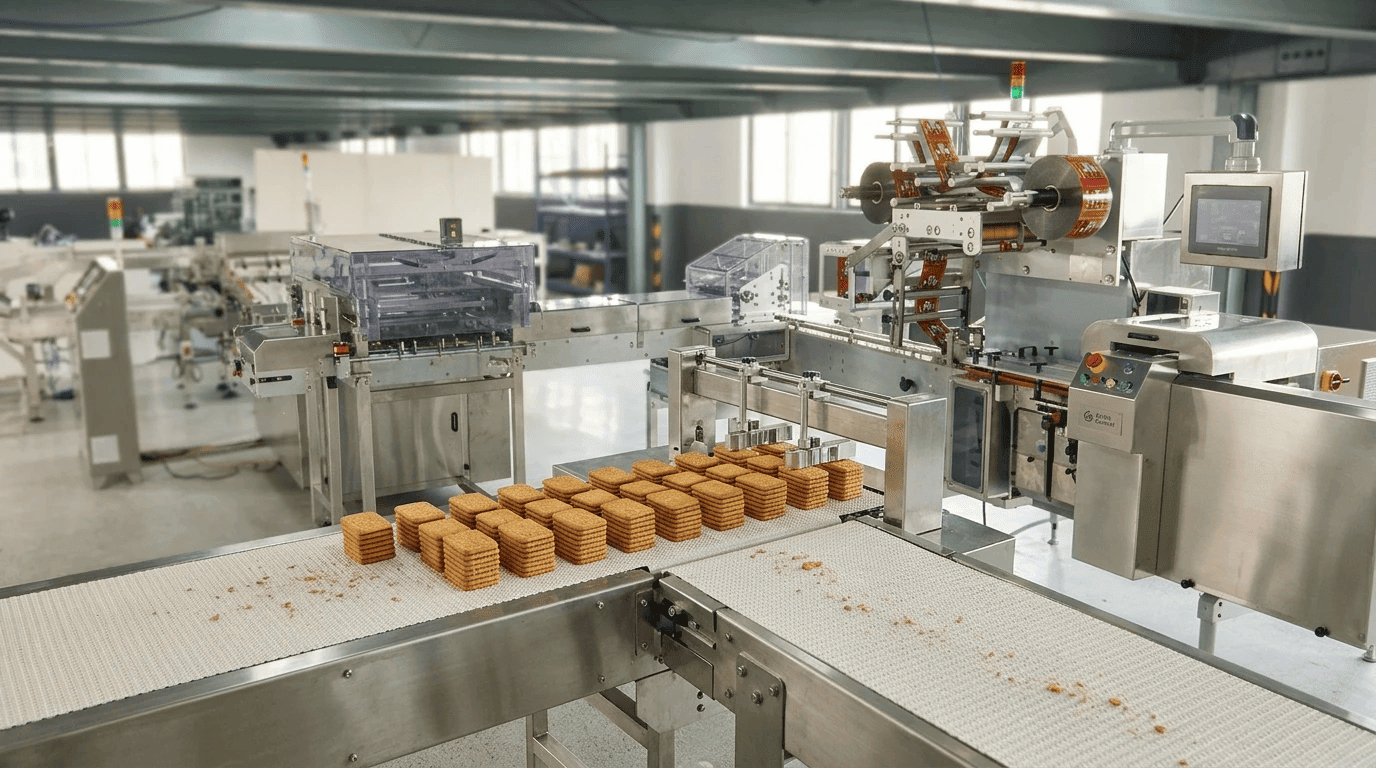
What Is a Soda Cracker? Industrial Saltine Manufacturing and Production Line Guide
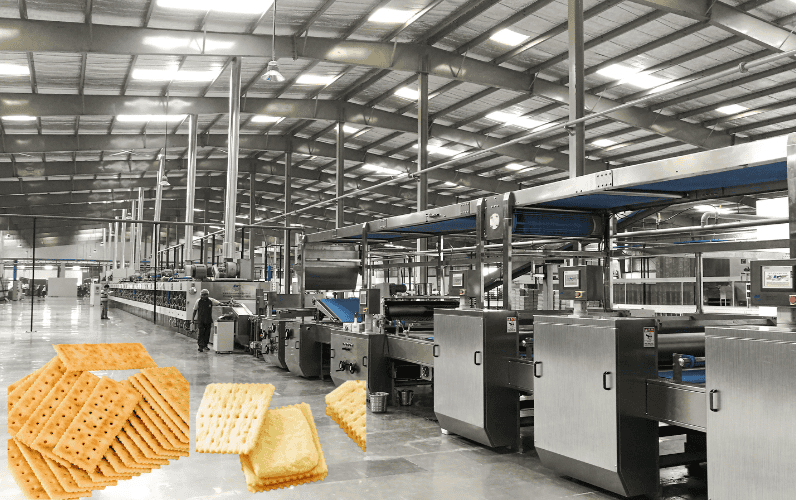
Many plant engineers still treat a saltine line as a hard-dough biscuit line with a salt topper bolted on after a 60-metre oven, and they size it by oven band width alone. That is the wrong starting point. The soda cracker manufacturing process is paced by long fermentation and repeated lamination, so line design has to begin at the dough troughs. The sections below cover each stage, its control points and the defects that follow when those points drift.
A soda cracker, also called a saltine, is a thin fermented cracker made by yeast fermentation followed by a sodium bicarbonate addition. Industrial output depends on fermentation holding capacity, lamination accuracy and a zoned tunnel oven working as one system. If you are planning or upgrading a soda cracker machine line, size fermentation first.
What Is a Soda Cracker? A Fermented Cracker That Behaves Nothing Like a Quick-Mix Biscuit
A soda cracker is a thin, layered cracker leavened by yeast fermentation and then partly neutralised with sodium bicarbonate. The result is an open, flaky crumb and a plain, lightly salted profile. On a production line it behaves like a slow, biologically active dough, so it needs very different mixing, resting and forming equipment from a quick-mix biscuit dough.
Wikipedia describes a soda cracker as a thin, usually square cracker made from white flour, yeast and baking soda, with most varieties lightly sprinkled with coarse salt. That definition covers the product. It says little about what the process requires.
Soda crackers belong to the fermented-cracker family, so they cannot be run through equipment built for hard-dough (developed, elastic) or short-dough (fat-rich, rotary-moulded) biscuits without changes to mixing, resting and forming. A rotary moulder made for short-dough cookies has no role here. A hard-dough line can share the oven and some of the sheeting hardware, but it usually lacks fermentation holding, a laminator with enough laps, and the docking needed to control a dough that is still producing gas.
Why "soda": bicarbonate corrects the acidity that fermentation builds up
"Soda" refers to baking soda, sodium bicarbonate. During a long sponge fermentation, yeast and the bacteria carried with it produce organic acids. In conventional practice the sponge often falls to a pH in the low 4s. Bicarbonate is added at dough-up to neutralise much of that acid, which releases carbon dioxide that opens the crumb and brings the finished cracker back toward neutral.
The chemistry leaves little room for error. Too little bicarbonate gives a sour, pale cracker. Too much gives a soapy taste, yellowish colour and excess browning. Because acid build-up depends on fermentation time and temperature, three variables have to be held together: bicarbonate dose, dough pH and fermentation time. If one drifts and the others stay fixed, the result is off-colour, flat or rejected product. Many plants measure dough pH at dough-up as a routine release check before the dough moves to the laminator.
The Soda Cracker Manufacturing Process Is Paced by Fermentation, Not by the Oven
Ask how saltine crackers are made industrially and most answers start with the oven. The oven is the most visible machine on the floor and the most expensive single item. It rarely sets the real throughput, though. A tunnel oven bakes crackers in a few minutes. The dough feeding it may have spent most of a day in fermentation troughs. To keep the oven band full, the plant needs enough sponge and dough in progress to cover the full fermentation time at oven rate. That holding volume, in troughs, fermentation-room floor area and trough-handling equipment, is what drives the building footprint and much of the capital plan.
One way to see it is as a pipeline. The oven is the tap at the end, and fermentation is the length of pipe. Doubling oven speed does nothing if the pipe holds only half a shift of dough. Lines are therefore usually balanced backwards. The target output and band width fix the dough mass per hour. Fermentation time multiplies that into the trough count. Room climate control is then sized for that trough count. Sheeting, laminating and docking come after that, sized to deliver a continuous sheet at the oven's band speed without stretching the dough. Cooling, oil spraying and packing are sized last to take everything the oven produces.
This also explains why scheduling matters as much as hardware. A fermented line cannot be stopped and restarted the way a short-dough line can. Sponges set hours earlier keep fermenting whether or not the oven is running, so an unplanned stoppage downstream turns into over-fermented dough upstream.
Six stages between the flour silo and the sealed pack
The table lists the stages in sequence. The fermentation row explains why holding capacity, not oven length, usually limits output.
| STAGE | PURPOSE | TYPICAL DURATION OR PARAMETER | CORE MACHINE |
|---|---|---|---|
| Dosing and mixing | Weigh ingredients, form sponge or dough | Minutes per batch; dough temperature tightly held | Automatic dosing system, horizontal mixer |
| Fermentation and resting | Build acidity, flavour and gas cells | Sponge often about 16–20 h; dough roughly 4–6 h | Troughs in climate-controlled fermentation room |
| Sheeting, laminating, docking | Build layers, set gauge, pin dough | Commonly 4–8 laps before final gauging | Laminator, gauge rolls, docking cutter |
| Tunnel baking | Set rise, colour and moisture | Typically about 3–5 min through zones | Zoned tunnel oven |
| Cooling, oiling, salting | Stabilise moisture, finish surface | Cool close to ambient before packing | Cooling conveyor, oil sprayer, salt topper |
| Stacking and packaging | Stack, sleeve or tray, wrap | Speed matched to oven output | Stacker, flow wrapper |
Line terms you will see on drawings and quotes
Equipment drawings and quotations for fermented-cracker lines use a small set of process terms that are worth agreeing on before a specification is signed:
Sponge: the first-stage mix of flour, water and yeast fermented for many hours.
Dough-up: adding remaining flour, fat, salt and bicarbonate to the fermented sponge.
Lapping (laminating): folding the dough sheet repeatedly to build the thin layers in the bake.
Docking: pinning holes through the sheet so steam escapes and large blisters cannot form.
Checking: hairline cracks appearing after baking, caused by uneven internal moisture stress.
Oven zone profile: the set of temperature, airflow and humidity settings along each oven zone.
If a supplier's quote uses a different name for one of these, ask what it means. "Lapping" in particular can refer to quite different machine designs.
"Soda Cracker" and "Saltine" Name the Same Product, So the Spec Sheet Matters More Than the Label
The two names describe one product. "Saltine" is the usual term in the United States, and "soda cracker" is common in Canada, the UK and much of Asia. In US FDA guidance, saltines are grouped with fermented crackers, which reflects the process (yeast fermentation and bicarbonate neutralisation) rather than the salt topping.
For equipment planning, the name tells you almost nothing. Two products sold as "soda crackers" in different markets can differ in piece size, thickness, fat content, number of laps, docking pattern and whether salt goes on top or into the dough. Each of those changes the laminator, cutter, oven profile and stacker.
A line should be specified from a product specification sheet. That sheet should give piece dimensions and weight, target moisture, layer count, docking pattern, topping, and packed-unit format. With that document, a supplier can size the line. With only a product name, the supplier is guessing, and the guess usually shows up later as a tooling change order.
A Saltine Cracker Production Line Can Run Several Cracker Types Only If the Forming Section Allows It
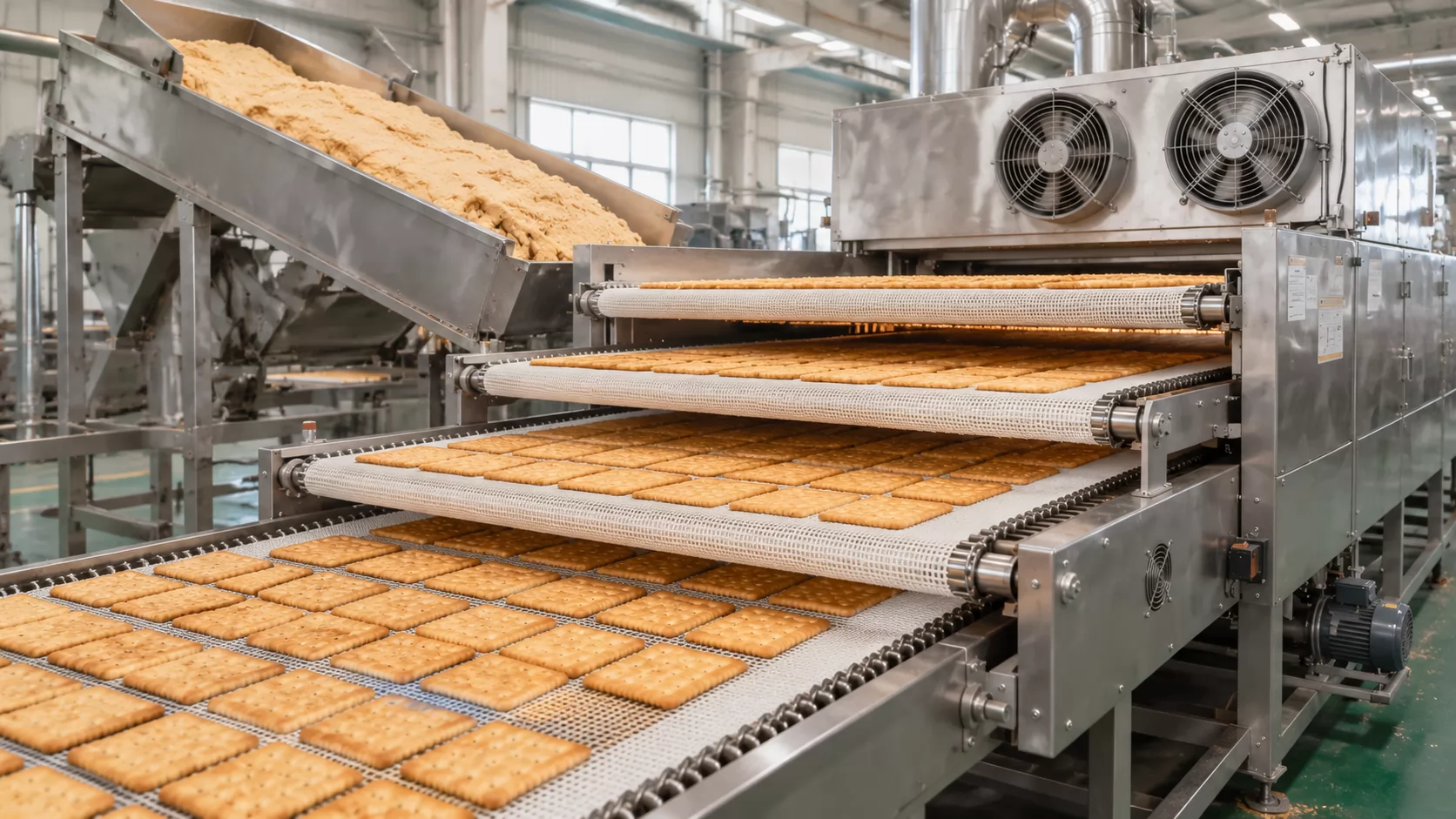
The fermentation and baking sections of a saltine cracker production line are fairly flexible. Most fermented crackers need similar trough capacity and a zoned tunnel oven. The limits on product range usually sit in the forming section: how many laps the laminator can make, whether fat or filling can be added between laps, and which cutting and docking tooling can be changed quickly.
Club-style crackers are a good example. They are laminated with a fat-rich dough or a fat layer between laps, so the laminator needs a fat depositing or sandwiching unit and tighter dusting control, because surplus flour blocks the layers from bonding. Oyster crackers need a small rotary cutter, and their size and shape change both bake time and how they behave on the cooling conveyor. Whole-grain formulations absorb more water and ferment differently, so dosing and fermentation settings change more than the forming hardware does.
Cracker type comparison
Saltine, traditional soda and whole wheat crackers can usually share one fermented-dough line with recipe and cutter changes. Club and oyster crackers generally need extra laminating or cutting tooling.
| CRACKER TYPE | CORE FORMING FEATURE | INDUSTRIAL APPLICATION |
|---|---|---|
| Saltine Crackers | Classic fermented soda cracker, thin square, perforated surface | Mass-market retail snack |
| Club Crackers | Butter-rich laminated cracker | Higher-margin retail cracker line |
| Oyster Crackers | Small round cracker | Soup-matching bulk cracker |
| Traditional Soda Crackers | Larger size, fewer perforations | Private label bulk production |
| Whole Wheat Crackers | Whole-grain formulation | Health-focused brand production |
Dosing and Mixing: Dough Temperature Control Matters More Than Mixer Speed
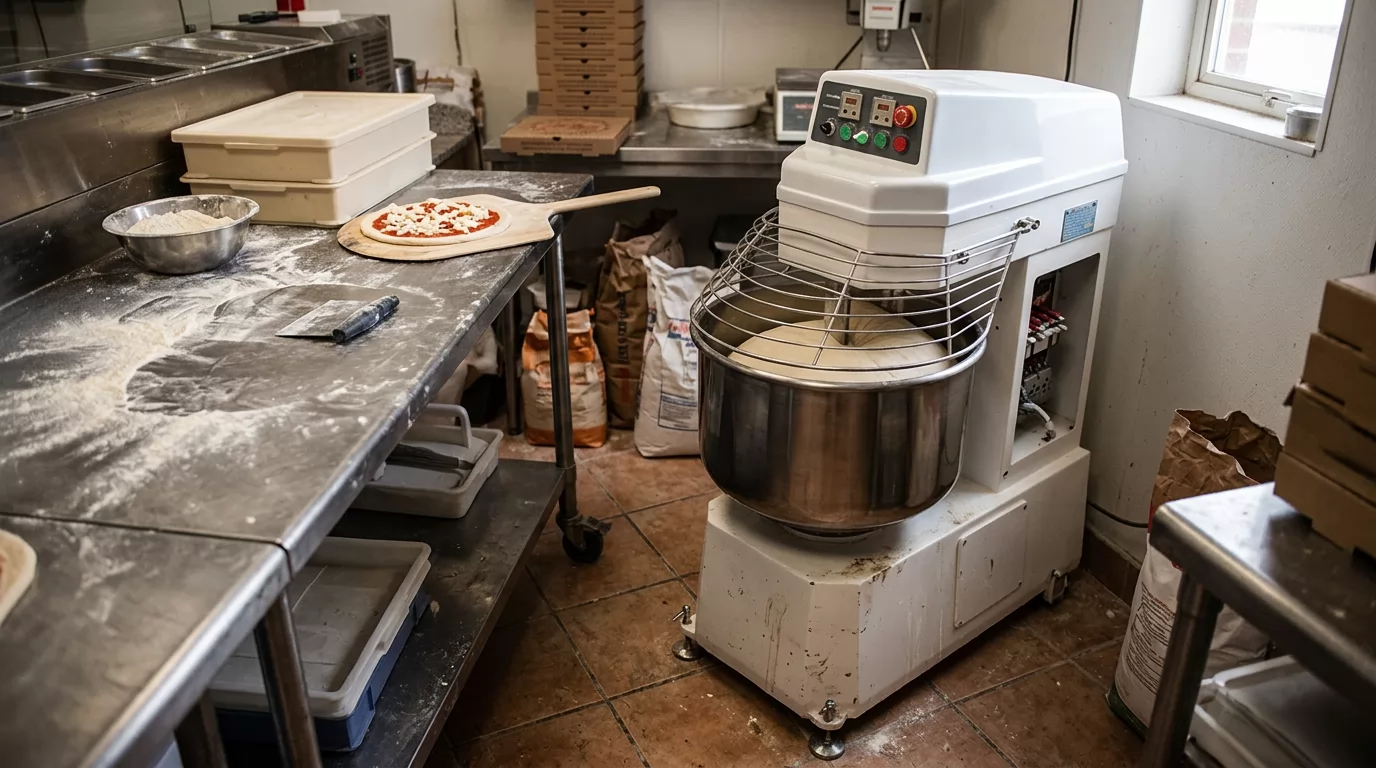
Mixing for a fermented cracker does not aim at full gluten development the way a bread dough does. The sponge only needs to be mixed until the ingredients are evenly incorporated. The dough-up mix has to distribute bicarbonate, fat and salt evenly without overworking a dough that has already been softened by hours of acid and enzyme activity. Mixer speed and agitator design matter less than many quotes suggest.
Temperature matters much more. Fermentation rate depends strongly on temperature, so a sponge that leaves the mixer one or two degrees warmer than the last one will ferment faster for the whole hold period, and the acidity, flavour and gas content at dough-up will be different. Water dosing is the main lever. Automatic systems usually meter water by mass and blend chilled and ambient water to reach a calculated target dough temperature, adjusting for flour temperature and the friction heat the mixer adds. A jacketed mixer bowl adds further control in warm plants.
Automatic weighing of flour, water, yeast, bicarbonate and fat removes the most common source of batch-to-batch scatter, which is manual addition of the minor ingredients. Bicarbonate is a small fraction of the dough mass but has a large effect, so it is often weighed on a separate high-resolution scale, or dosed as a solution, rather than scooped. Logging the actual weights and the final dough temperature for each batch gives the fermentation team the data it needs when a defect appears hours later.
Dough Fermentation Is the Control Point Most Soda Cracker Lines Underbuild
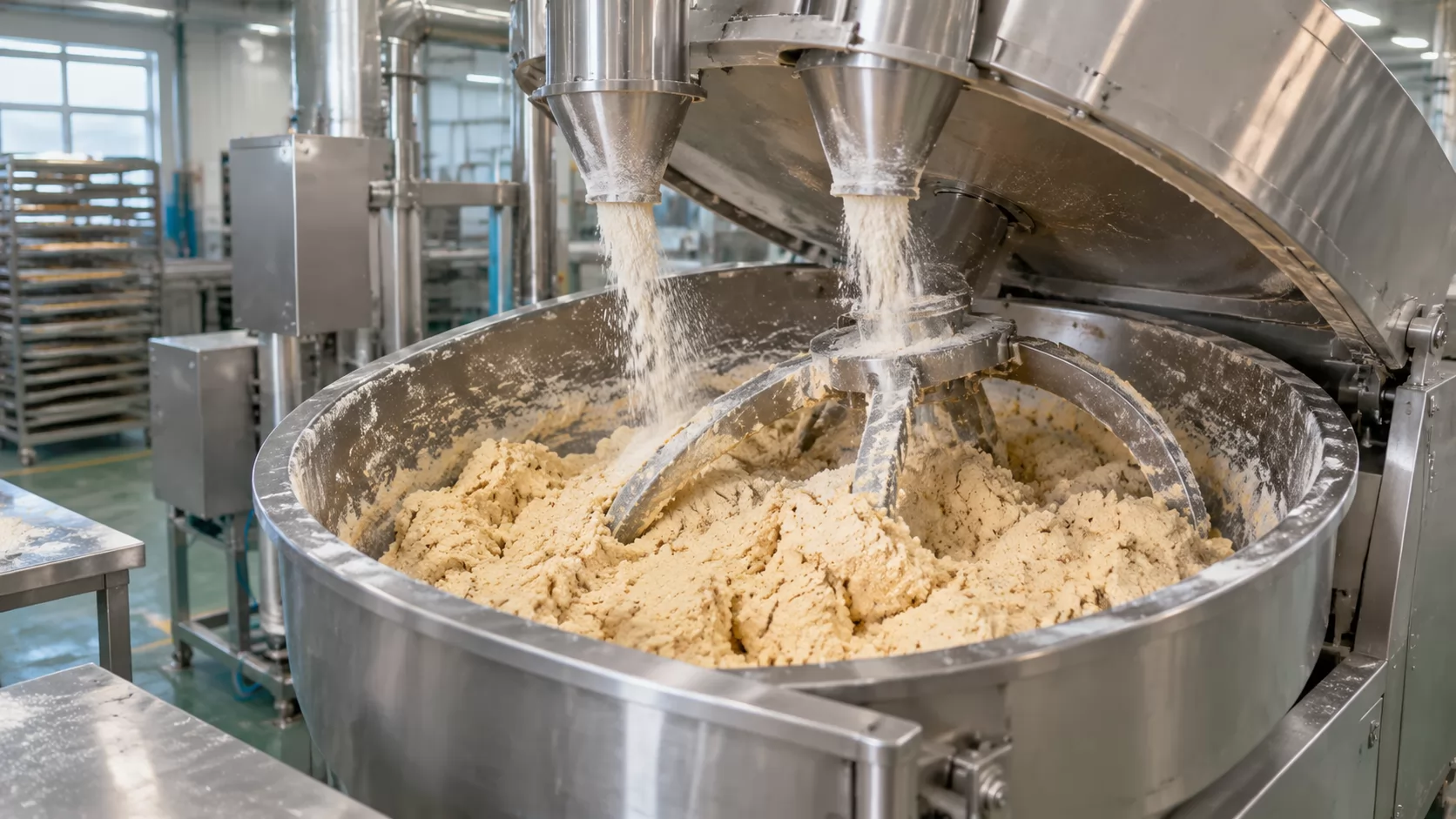
Soda cracker dough fermentation decides most of what the customer notices: the flaky layering, the slight tang, the open crumb and much of the colour. It is also the stage most often undersized, because fermentation troughs and rooms look like simple, cheap infrastructure next to an oven.
Two approaches are in use. In the sponge-and-dough method, a sponge of most of the flour, water and yeast ferments for a long period, often in the range of 16–20 hours in conventional practice. It is then mixed with the remaining flour, fat, salt and bicarbonate and rests again for roughly 4–6 hours. The long sponge produces the acids, flavour compounds and enzyme activity that give a traditional soda cracker its character and its soft, extensible dough. Single-stage or shortened processes ferment all ingredients together over a much shorter time, sometimes with added enzymes or acidulants to imitate the effect of a long sponge. These methods need less holding capacity and floor space. The trade-off is flavour depth and some layer quality, and the closer a product has to match an established saltine, the harder those shortcuts are to justify.
Whichever method is used, the fermentation environment has to be controlled. Rooms are usually held at a fixed temperature, typically somewhere in the high 20s °C, with high relative humidity so the dough surface does not dry and skin. Trough contents are tracked by set time, and dough is used in strict first-in, first-out order. Larger plants increasingly use mechanised trough handling (hoists, tipping units, conveyorised trough tracks) so every trough is handled the same way and on the same timetable.
Capacity matching closes the loop. The number of troughs in fermentation at any moment has to equal oven dough consumption per hour multiplied by total fermentation time, plus a margin for changeovers and stoppages. If that number is too small, the oven runs short or the fermentation time gets cut. If a downstream stoppage has no buffer, troughs over-ferment and are scrapped. Planning the room, troughs and climate system together with the oven is what lets a soda cracker machine line run at its rated speed.
Sheeting, Laminating and Docking Decide Layer Structure Before the Dough Sees Heat
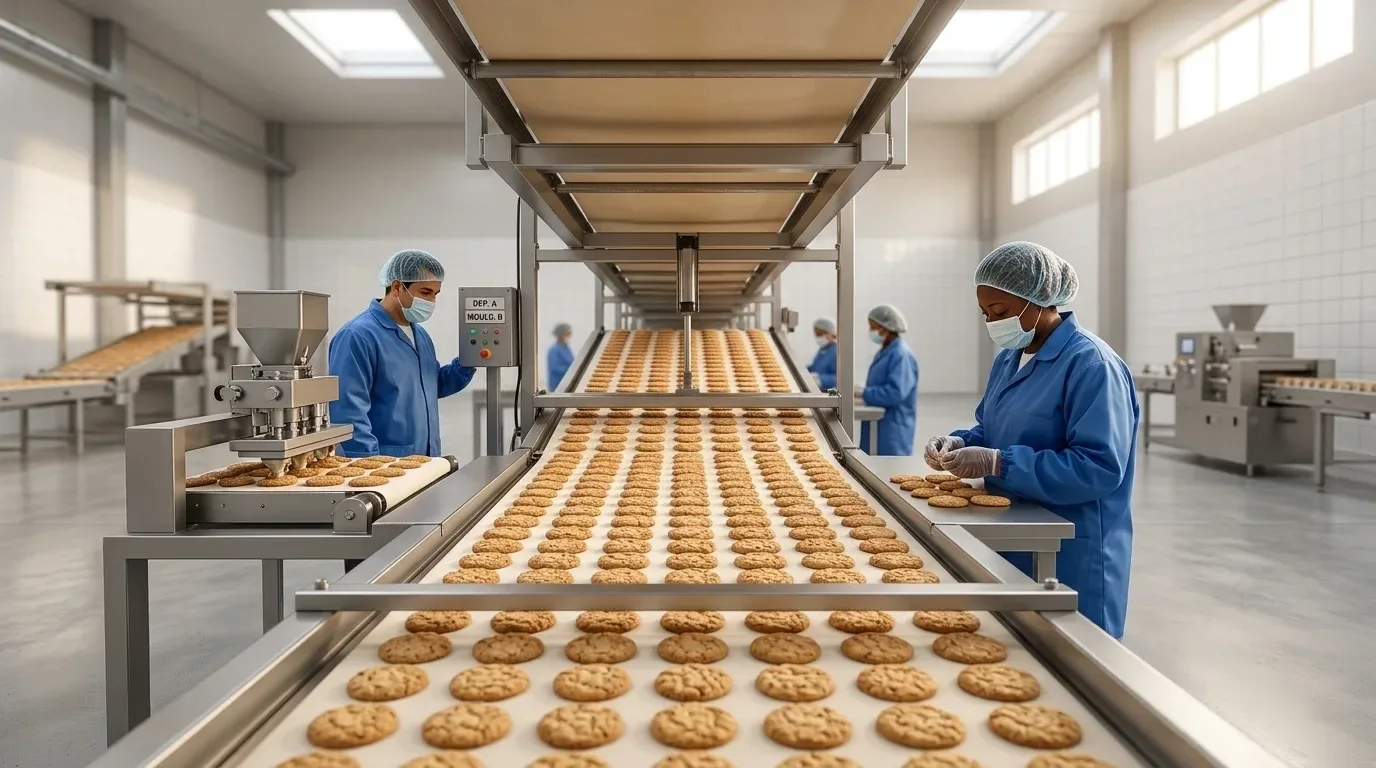
Fermented dough reaches the forming section soft, gassy and extensible. Pre-sheeting rolls first form it into a continuous band of even thickness. The cracker laminating and sheeting machine then lays that band back and forth across a slower conveyor (lapping) or cuts and stacks it, building a stack of thin dough layers. A typical soda cracker uses several laps, commonly in the range of four to eight. Between laps, a duster may apply a controlled film of flour, or fat in club-style products, so the layers stay separate enough to flake after baking.
The laminated stack is then reduced through a series of gauge rolls, each set to a smaller gap, to reach the final sheet thickness. Reductions have to be gradual. Large steps tear the layers and pull the dough lengthwise, which then shrinks back after cutting and gives distorted pieces. Docking follows. A roller fitted with pins perforates the sheet, often while cutting it, so steam can escape in the oven. Without docking, the layers separate into large blisters (pillowing). With too much docking, the cracker comes out dense and flat.
Uneven sheet thickness is the most common upstream cause of bake defects. A sheet that is thicker on one side bakes paler and wetter on that side, checks more after cooling and packs at a different stack height. These faults appear at the oven exit, but the cause is in the gauge rolls.
What to check on a laminator
When you assess a new or existing laminator, these points usually tell you the most about consistency:
Number of laps it can make, and whether lap count can be changed without a mechanical rebuild.
Sheet-width stability across the full band during long runs.
Dusting control: even, adjustable flour application with recovery of surplus flour.
Gauge-roll adjustment accuracy, roll parallelism and repeatable gap settings.
Speed synchronisation between laminator output and the oven band.
A test run with your own dough shows more than a datasheet. Measure sheet thickness across the band at several points.
Tunnel Baking: The Zone Profile, Not the Peak Temperature, Fixes Colour and Checking
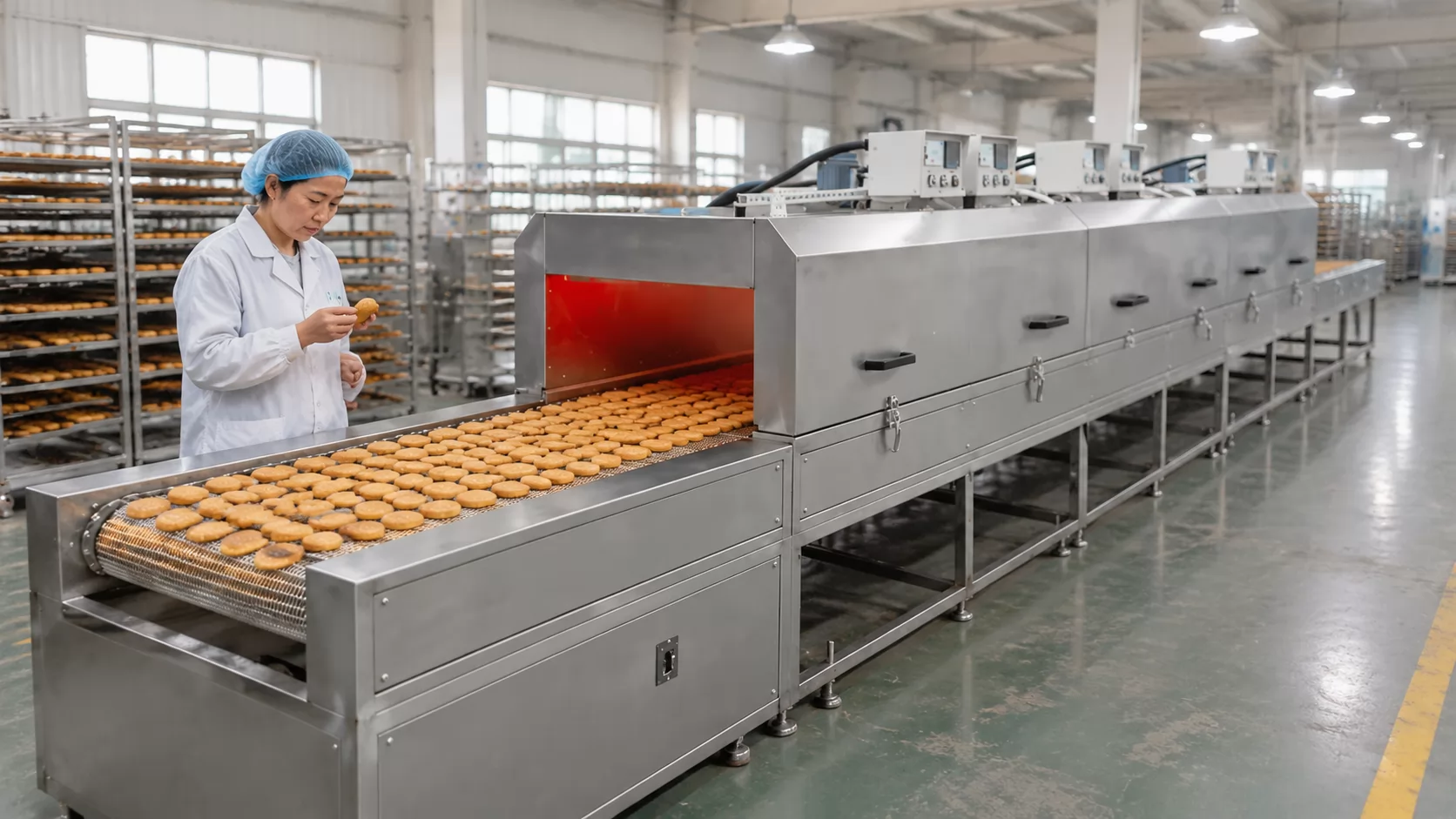
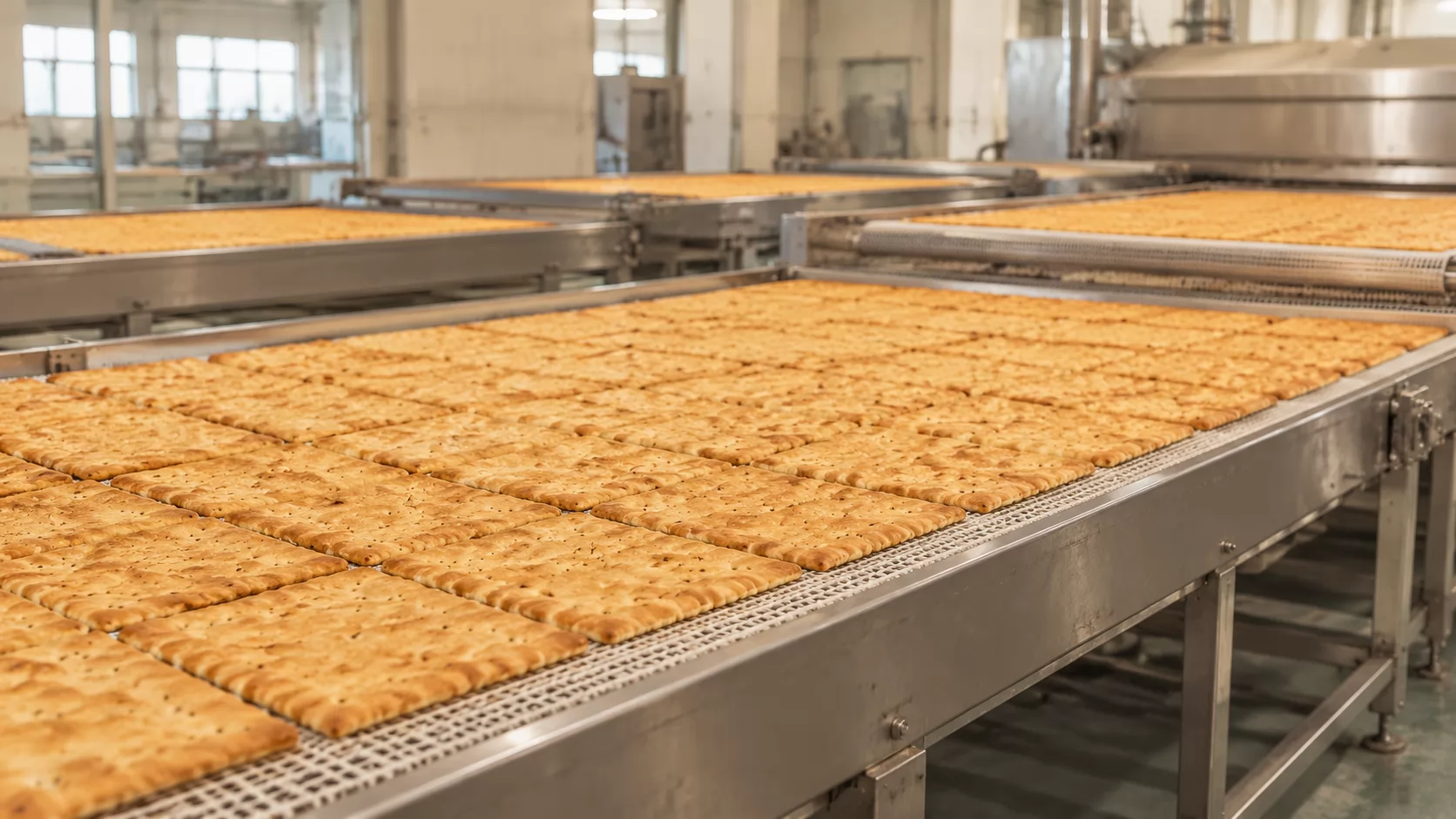
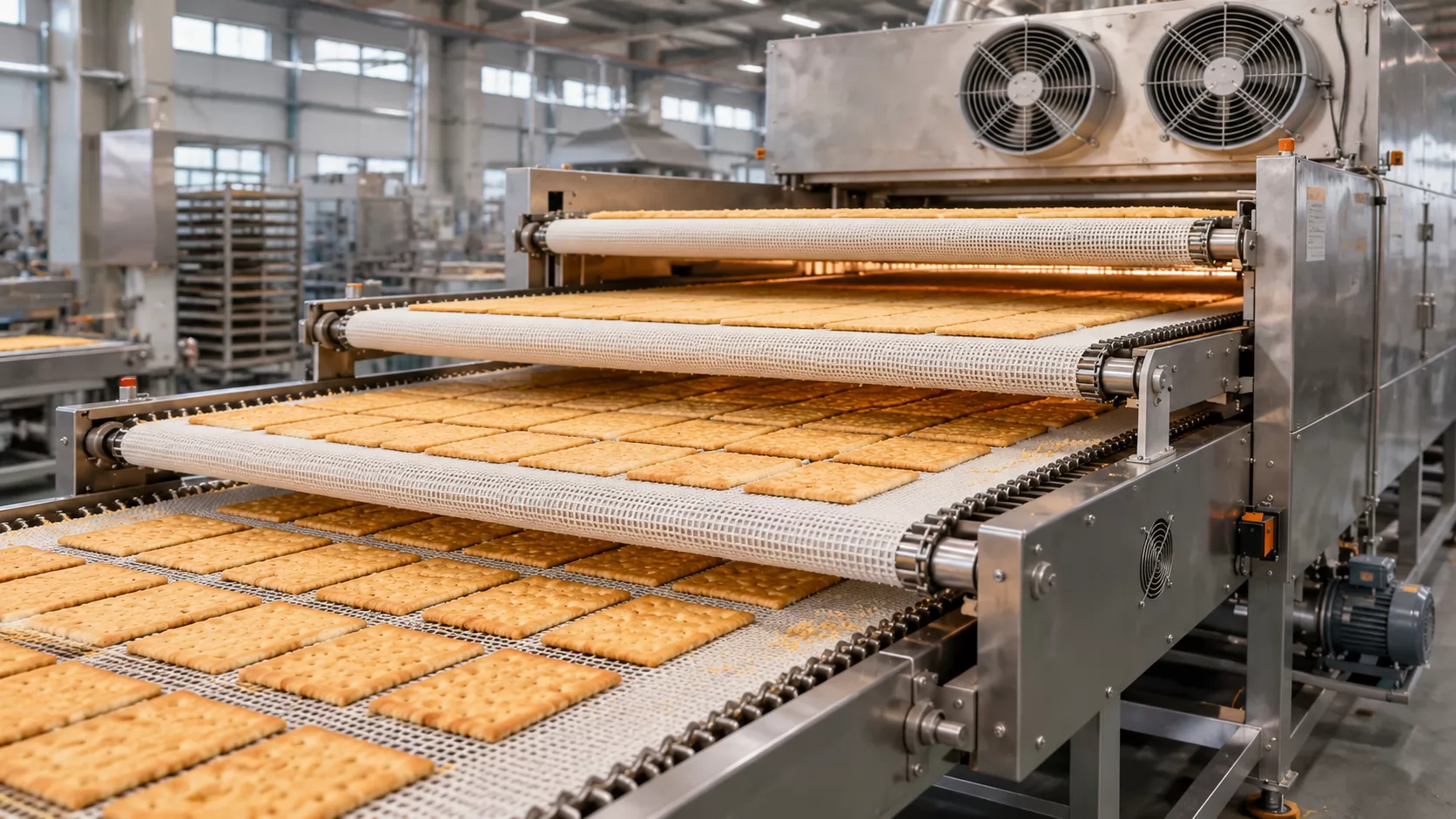
An industrial biscuit baking oven for crackers is a long tunnel divided into separately controlled zones, usually with a wire mesh band so the base bakes evenly and steam can escape. The bake is short, typically a few minutes, and each zone does a different job.
The front zones supply strong bottom and top heat so the gas and steam in the dough expand quickly and set the layered structure. Many cracker ovens use direct-fired gas in these zones for fast heat transfer. The middle zones finish the structure and develop colour through Maillard browning, which bicarbonate and dough pH strongly affect. The final zones mainly dry the product, using convection airflow and damper settings to remove moisture down to the low level a crisp cracker needs.
Peak temperature is a weak indicator on its own. Two ovens with the same maximum setting can produce different colour and moisture if heat and humidity are distributed differently along the zones. Cross-band balance matters as well. Uneven heat across the band width produces colour stripes that look like a fermentation problem but are not one.
Checking (hairline cracking after baking) is closely tied to the final zones. If the outside of a cracker is very dry while the centre still holds moisture, moisture moves outward after baking, the outer surface expands and the centre contracts, and cracks form. That can happen hours later, sometimes in the pack. A gentler drying profile and controlled cooling reduce that moisture gradient. Turning down peak heat usually does not.
Cooling, Oil Spraying and Surface Salting Must Be Sized Together, Not Bolted On
Crackers come out of the oven fragile, hot and still releasing moisture. The cooling conveyor has to give them enough time, at controlled airflow, to approach ambient temperature and let internal moisture equalise. Cooling too fast with strong forced air can cause checking. A conveyor that is too short sends warm crackers to the packer, where condensation and breakage follow.
Oil spraying is usually done soon after the oven, while the surface can still absorb oil. Even coverage across the band affects appearance and how much the crackers slide or stick at the stacker. Topping salt for saltines is often applied to the docked sheet before the oven so it sets into the surface. Some products receive salt after oiling instead. Either way, an even salt layer depends on a stable band speed and an even product spread.
These units share one conveyor and one band speed, so they should be specified together with the oven. An oil sprayer added later to a cooling conveyor that is already too short usually solves one problem and creates another.
Conveying, Stacking and Saltine Cracker Packaging Are Where Breakage Costs Add Up
After cooling, crackers are turned on edge or stacked into rows, counted and formed into sleeves or placed in trays, then flow-wrapped. Saltine cracker packaging is often a stack of crackers in a sleeve, with several sleeves packed into a carton. Every transfer between conveyors can chip edges or break pieces. That loss happens after the product has already used up flour, fermentation time, oven energy and oil.
Breakage mostly comes from mechanics. Drop heights at transfers should be minimal. Belt speeds at each handover should be matched so pieces neither pile up nor get pulled apart. Stacker settings have to suit the actual product thickness, which depends on lamination and bake consistency. A buffer between the oven and the packer absorbs short wrapper stoppages without forcing the oven to stop, which matters more on a fermented line than on most others.
The packaging film format also affects the line. Sleeve dimensions, film structure, seal type and the speed of the flow wrapper set the downstream capacity. Agree on them with the packing team and the film supplier while the line layout is still being drawn.
The Production Problems That Cost Soda Cracker Plants the Most Can Be Traced to a Few Settings
Most recurring losses on fermented-cracker lines fall into four groups. Unstable fermentation shows up as variable flakiness, flavour and colour, and usually traces back to dough temperature or uneven time in the troughs. Uneven lamination causes thickness variation, blisters and pieces that do not stack, and usually comes from the gauge rolls, dusting or lap control. Colour variation and checking come mainly from the oven zone profile and the cooling regime, with bicarbonate dose as a frequent hidden factor. Capacity mismatch between stages (too little trough capacity, a short cooler, a slow wrapper) forces operators to shorten fermentation or slow the oven, and each of those causes its own defects.
Defect, likely cause and where to check
Use the table as a first diagnostic pass. Most defects seen at the oven exit started at an earlier stage.
| DEFECT | LIKELY CAUSE | STAGE AND SETTING TO CHECK |
|---|---|---|
| Variable flakiness and flavour | Sponge temperature or time drift | Fermentation: room temperature, trough time log |
| Pale, sour crackers | Bicarbonate too low for acidity | Dosing: bicarbonate weight, dough-up pH |
| Large blisters | Weak docking or thick sheet | Docking: pin depth; gauge-roll gap |
| Thickness varies across band | Gauge rolls out of parallel | Laminator: roll gap, dusting rate |
| Colour stripes along band | Uneven heat across band width | Oven: burner balance, zone settings |
| Checking after packing | Steep moisture gradient, fast cooling | Final oven zones; cooling airflow |
Commissioning and recipe trials on the actual line
Settings that work in a pilot bakery rarely carry over unchanged to a full-scale line, because trough volumes, room climate and oven heat transfer all differ. EverSmart Food Equipment supports process commissioning and recipe set-up when a fermented-cracker line is installed, so dosing targets, fermentation times, lap counts and oven profiles are tuned on the production equipment with your own flour.
FAQ: Planning and Buying a Soda Cracker Line
What capacity range does a soda cracker production line usually cover?
It depends on configuration rather than following a single standard figure. Output is set by oven band width and length, together with how much dough the fermentation room can hold. Give a supplier your target output in kilograms per hour and your product spec, and the line should be sized backward from those numbers.
Can one line make both saltines and other fermented crackers?
Yes, within limits. Saltine, traditional soda and whole-wheat crackers usually need only recipe, cutter and docking-roller changes. Club-style crackers generally need a fat-depositing unit on the laminator, and oyster crackers need dedicated small-piece cutting tooling.
What industrial cracker production line equipment does a complete line need?
A complete line includes automatic dosing, a mixer, fermentation troughs with a climate-controlled room, a laminator, gauge rolls, a docking cutter and a zoned tunnel oven. After the oven come the oil sprayer, salt topper, cooling conveyor, stacker and flow wrapper.
Is recipe support and factory layout design available with the line?
It should be, so ask for both in writing. Request a layout drawing showing fermentation room size and trough flow, plus commissioning trials using your own recipe and flour, with defined acceptance criteria for output and product quality.
What lead time should you plan for a complete soda cracker line?
Lead time varies with configuration, oven length and factory acceptance testing, so there is no fixed figure. Ask for a dated schedule covering manufacturing, testing, shipping, installation and commissioning, and build fermentation-room construction into your own plant plan.
A Simple Cracker Still Needs a Tightly Controlled Line, So Start With Your Capacity and Product Spec
Consistent soda crackers depend on controlled fermentation, accurate lamination and a well-set oven profile, all sized to the same output. If you are planning a new plant or upgrading an existing line, talk to Sofia at EverSmart Food Equipment about a capacity plan, layout drawing, quotation, commissioning and technical guidance. Before that conversation, write down three numbers: target output in kilograms per hour, piece size and weight, and the fermentation time your recipe needs.

Ready to start your journey toward a customized solution? Contact me directly on WhatsApp to begin the conversation.