The Ultimate Wafer Production Line Guide: Automation, ROI, and Smart Technology
The EverSmart Wafer Biscuit Production Line stands out with its automated batter correction for consistent sheet texture, dual-plate baking technology enabling perfect thin wafers, precise cream layering for even filling, and high-speed, clean-edge cutting that ensures every wafer is market-ready. Its modular, easy-clean design minimizes downtime between recipe changes, boosting productivity and flexibility for evolving market demands.
Description
1. Introduction: What is a Wafer Production Line and Why is it Essential?
A wafer production line is an automated industrial process for manufacturing wafer biscuits. It involves stages like mixing ingredients to make batter, baking sheets, spreading cream, layering, cutting, and packaging.
These lines can be customized for different wafer types, such as flat, hollow, or spherical shapes. They are controlled by microcomputers for unparalleled efficiency and precision.
In modern food manufacturing, this high degree of automation is the engine of large-scale production. It is the only way to guarantee product quality, consistency, and cost-effectiveness across millions of units.
This technology transforms a traditional, hands-on craft into a precise, continuous, and highly efficient industrial process. It's how the industry meets the ever-growing global demand for wafer biscuits.
Consumer demand for snack foods is not just growing; it's evolving. Shoppers are actively seeking diverse, high-quality, and novel wafer products.
For the owner of a food factory or biscuit plant, investing in an automatic wafer production line is no longer just an option. It has become a competitive necessity.
The heart of this production line—the baking oven, the cream spreader, and the cutting system—dictates everything. Its efficiency and stability directly control the final product's taste, texture, appearance, and, most importantly, its production cost.
This comprehensive guide will deconstruct every facet of a modern wafer biscuit production line. We will journey from the fundamental process flow all the way to investment returns, providing a 360-degree view for your most critical business decisions.
Key Takeaways
Fully Automated Process: A modern wafer biscuit production line is a complete, closed-loop system. It handles every step from batter preparation, baking, cooling, and cream spreading to layering, cutting, and final packaging.
The 7 Core Stages: Successful wafer manufacturing depends on the perfect synchronization of seven key stages. These are batter mixing, wafer sheet baking, sheet cooling, cream spreading and layering, book cooling, cutting, and packaging.
TCO & ROI Are the Core Metrics: For factory owners and financial managers, the decision goes far beyond the initial price tag. The real metrics are Total Cost of Ownership (TCO) and Return on Investment (ROI). This includes a detailed analysis of baking heat sources (gas vs. electric), labor cost savings, and waste reduction.
Smart Tech & Service Are the Differentiators: An advanced line uses smart PLC controls, recipe management, and remote diagnostics to achieve peak efficiency. The manufacturer's full-lifecycle support—from layout design to technical training and spare parts—is what unlocks long-term value.
Product Defines the Production Line: Your final product dictates the required machinery. Flat, hollow, or spherical wafers each require different types of baking and forming equipment. A chocolate enrober is a popular and powerful optional module for maximizing product value.
2. The Core Process: 7 Key Stages from Batter to Final Product
A complete wafer biscuit production line is a sophisticated piece of systems engineering. It seamlessly connects multiple physical and chemical transformations, including mixing, baking, cooling, and emulsification.
Here are the seven core stages that turn raw ingredients into a finished, packaged wafer biscuit.
1. Stage One: Batter Mixing & Preparation
This is the foundational step that determines the "skeleton" and final crispness of the wafer sheet.
Precise Formulation: Ingredients like flour (for structure), starch (for crispness), vegetable oil (as a release agent), water, lecithin (an emulsifier), and leavening agents are combined. This is done in a high-speed Batter Mixer according to a strict, pre-programmed recipe.
High-Speed Mixing: The mixer typically operates at 1,500 to 3,000 RPM. This intense speed ensures all wet and dry ingredients are homogenized into a smooth, lump-free batter in a very short time.
The final viscosity of the batter is a critical control point. It directly impacts how the batter flows onto the baking plates and determines the final thickness of the wafer sheet.
Batter Aeration: In some high-end processes, the mixed batter is pumped into an aeration system. Here, a precise amount of air or nitrogen is injected into the slurry.
This step creates finer, more uniform micro-bubbles within the batter. The result is an exceptionally light and crispy texture in the final baked wafer.
Transfer and Storage: The finished batter is pumped into an insulated holding tank, which is often equipped with a slow-moving agitator. This tank keeps the batter homogenous and at a stable temperature.
It waits for the PLC system's command before being automatically fed through pipes to the baking oven's injection system.
Process Deep Dive: Batter & Mixing
Critical Control Point: The batter temperature must be strictly controlled, ideally remaining below 30°C (86°F).
Why it Matters: Higher temperatures can cause the batter to prematurely ferment or spoil, creating an undesirable sour taste. It can also cause the baked sheets to become brittle and crack during the cooling phase.
Troubleshooting: If the batter is lumpy or fermented, check the mixing time and speed. You must also verify that the cooling water jacket on the mixer is functioning correctly.
2. Stage Two: Wafer Sheet Baking
This is the most technologically complex and energy-intensive stage of the entire production line.
Quantitative Injection: The batter is automatically and precisely injected onto continuously moving baking plates via a high-precision pump.
These baking plates are cast from a special iron alloy. Their surfaces are engraved with the fine patterns—like squares or diamonds—that give the wafer sheet its classic appearance.
High-Temperature Baking: The large-scale Tunnel Wafer Baking Oven is the heart of the entire line. The baking plates travel in a closed-loop circuit, passing through a baking chamber that can be dozens of meters long.
The Heat Source Decision: This is the first major decision point for owners and financial managers.
Gas (GAS/LPG): This option offers high thermal efficiency and heats up quickly. Its operational costs are often significantly lower than electricity. The open flame is also believed by many to impart a superior "baked" flavor.
Electric: This option provides exceptionally precise temperature control. It allows for multiple, independent "zones" of heat within the oven and is clean, with no emissions. However, the initial investment and the unit cost of energy may be higher, depending on local utility prices.
Baking & Formation: At a high temperature of approximately 160°C - 180°C (320°F - 356°F), the water in the batter flashes into steam. This process takes only a few minutes.
During this time, the starch gelatinizes and the proteins denature. This forms a thin wafer sheet of a specific thickness (usually 2-3 mm) and a very low moisture content (around 1-2%).
Process Deep Dive: Baking
Critical Control Point: The baking temperature (160°C-180°C) and the total baking time are paramount.
Why it Matters: Uneven color or sticking to the molds is a common problem. This is often caused by inconsistent temperatures across the baking plate or an improper release agent application.
Troubleshooting: Check the mold temperature and closure precision. Ensure the release agent sprayers are clean and functioning.
Tip: The choice between gas and electric heating is the first major decision that impacts your Total Cost of Ownership (TCO). Gas generally has lower operating costs, while electricity offers more precise control and is cleaner.
3. Stage Three: Wafer Sheet Cooling
A wafer sheet fresh from the oven is over 100°C (212°F) and full of thermal stress. It is extremely fragile and prone to breaking.
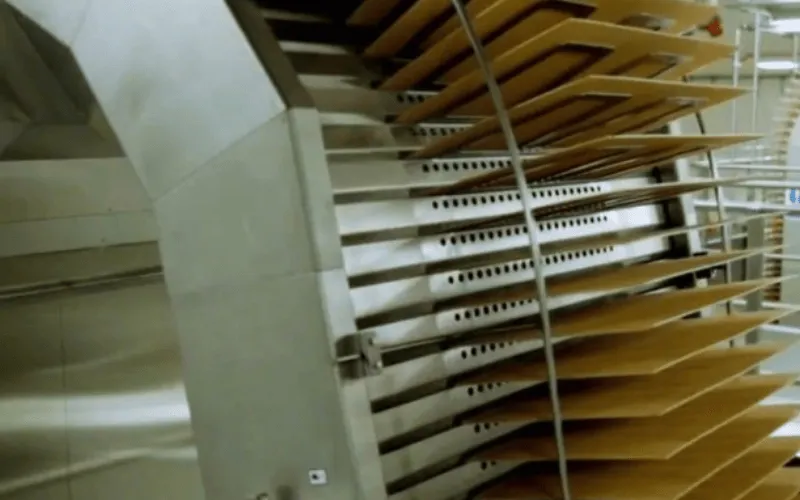
Natural Cooling: After being automatically demolded from the baking plates, the hot sheets are immediately transferred to an Arch-type Sheet Cooler.
The "arch" design is intentional. It allows the sheet to gently flex under its own weight, which effectively releases the internal stresses built up during baking.
Preventing Fracture: This stage strictly prohibits forced-air or "flash" cooling. The sheets must be cooled slowly and naturally via ambient air convection.
This "tempering" process is essential to prevent the sheets from warping or cracking during the subsequent, more aggressive stages of cream spreading and cutting.
Process Deep Dive: Sheet Cooling
Critical Control Point: The cooling time and the ambient humidity of the cooling area.
Why it Matters: Sheets that are cooled too quickly or in a very dry environment will become brittle and shatter.
Troubleshooting: If sheets are deforming or cracking, check the cooling conveyor speed. Ensure there are no drafts of cold air (e.g., from an AC unit) hitting the hot sheets.
4. Stage Four: Cream Spreading & Layering
This is the stage where the wafer biscuit's "soul"—its flavor and character—is added.
Spreading Technology: The cooled wafer sheets, which have now regained their flatness and a slight bit of flexibility, enter the Cream Spreading Machine.
There are two primary methods for applying the cream, depending on its viscosity and ingredients:
Contact System: A coating roller directly touches the wafer sheet, "rolling" the cream onto its surface. This is ideal for thicker, high-viscosity creams.
Film System: The cream is extruded through a precise slit, creating a perfect "curtain" or film of cream. The wafer sheet passes underneath without contact, and the cream is deposited onto it. This is superior for more delicate, aerated, or particle-heavy creams (like a chocolate sauce in a chocolate wafer production line).
Critical Process Points:
Sugar Fineness: The fineness of the sugar in the cream directly impacts the "mouthfeel." Granulated sugar must be pre-milled into a fine powder that can pass through a 100-120 mesh screen. This ensures a silky-smooth texture with no grittiness.
Oil-to-Sugar Ratio: The ratio of sugar to oil is typically slightly greater than 1:1. This balance is crucial to prevent the filling from being too thin or "runny," which would cause it to squeeze out during cutting.
Sheet-to-Cream Ratio: The weight ratio of the wafer sheet to the cream filling is generally controlled at around 1:3. This is considered the "golden ratio" for balancing crispness and flavor, ensuring the product is neither too dry nor too rich.
Automatic Layering (Book Building): The PLC system precisely controls mechanical "hands" or stacking units. It alternates between cream-coated sheets and uncoated sheets to build a multi-layered "wafer book."
Flexible Settings: The number of layers (e.g., 2, 3, or 5 layers) and the precise gram-weight of cream on each layer can be easily adjusted. This is all controlled via the HMI (Human-Machine Interface) touch screen to meet the specs for different products.
Process Deep Dive: Creaming & Layering
Critical Control Point: Cream temperature, application thickness (1:3 ratio), and sugar fineness (100-120 mesh).
Why it Matters: Uneven cream distribution is a frequent issue. This leads to inconsistent product weight and a poor customer experience.
Troubleshooting: Recalibrate the gap on the spreading roller or the film system. Check the cream's temperature and viscosity to ensure it's flowing correctly.
5. Stage Five: Wafer Book Cooling (Maturation)
A freshly-built "wafer book" is unstable. The cream, which is primarily fat and sugar, has not yet solidified.
Forced-Air Cooling: The layered wafer books are transferred into a large vertical or horizontal Cooling Tunnel (or Cabinet).
These cooling tunnels contain refrigeration units and powerful circulating fans. The internal temperature is precisely maintained between 5°C - 10°C (41°F - 50°F).
Solidification & Maturation: The books spend 10 to 15 minutes in this cold environment. This allows the fats in the cream to fully crystallize, solidifying the entire book into a single, stable block.
This step is absolutely critical for the next stage: cutting. If the cream is even slightly soft, it will ooze out during cutting. This gums up the cutting blades, creates messy, smeared edges, and contaminates the equipment.
Process Deep Dive: Book Cooling
Critical Control Point: The cooling cabinet temperature (5-10°C) and the total cooling time (10-15 minutes).
Why it Matters: The most common problem is "sticky cutting." This is almost always caused by insufficient cooling.
Troubleshooting: If you experience sticky blades or smeared cuts, the solution is simple: increase the cooling time or lower the cabinet temperature.
Tip: The secondary cooling of the wafer book is the key to a high-quality cut. Insufficient cooling will cause the cream to smear on the blades or wires, resulting in an unclean cut and forcing costly downtime for cleaning.
6. Stage Six: Cutting & Sizing
The cooled, hardened wafer book is now a solid block, ready for precision processing.
Cutting Technology: The Cutting Machine typically employs one of two methods:
Wire-Cut: This method uses high-speed, tensioned steel wires. The wire cuts through the block using high-frequency friction, which generates localized heat to melt its way through. This produces an exceptionally smooth, clean, and glossy cut surface, especially for creams with high fat or sugar content.
Blade-Cut: This method uses sharp, heavy-duty mechanical blades, often in a guillotine-style "chopping" motion.
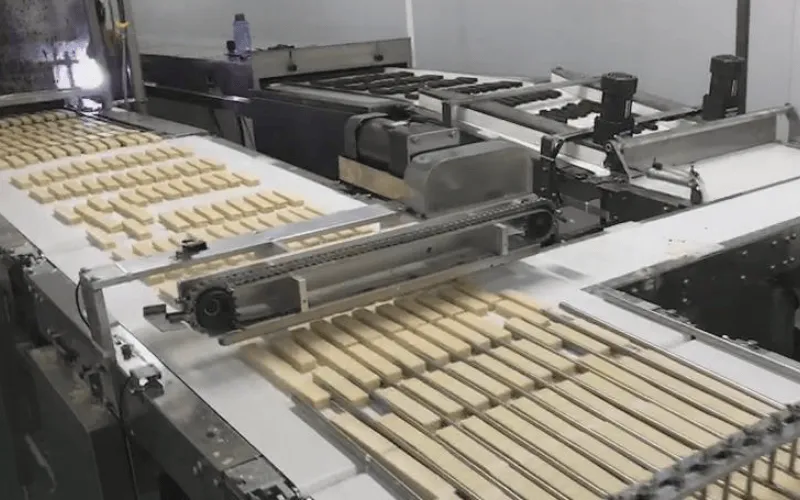
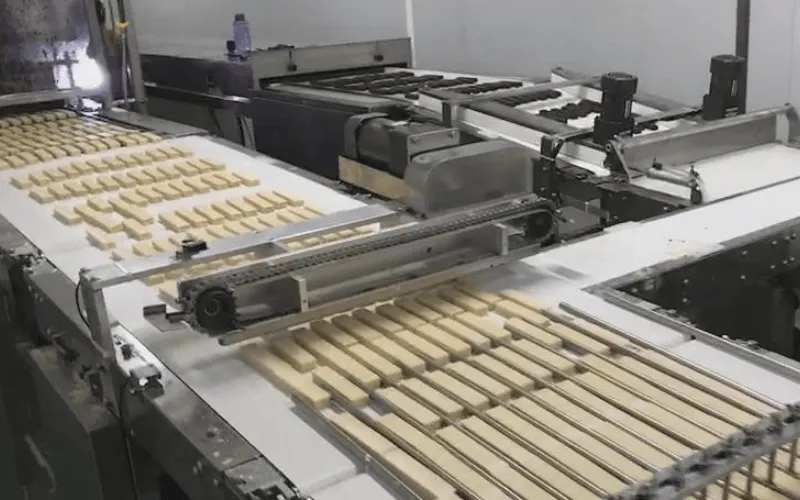
Two-Directional Cutting: The wafer book first passes through a set of longitudinal (lengthwise) cutters or wires. This slices the large book into long, continuous bars.
The bars are then turned 90 degrees (either automatically or via a cross-conveyor). They then pass through a second set of transverse (widthwise) cutters to be cut into their final, marketable size (e.g., small rectangles, squares, or fingers).
Process Deep Dive: Cutting
Critical Control Point: The cutting dimensions and the sharpness of the blades/wires.
Why it Matters: Rough or chipped edges are a sign of a problem. This can be caused by a book that is too cold (making it brittle) or, more commonly, dull blades or loose wires.
Troubleshooting: Check for and replace any dull blades or worn wires. If the product is shattering, slightly increase the cooling cabinet temperature to make it less brittle.
7. Stage Seven: Distribution & Packaging
This is the final stage of the process. It's where the product is prepared for its journey to the customer, ensuring food safety and shelf appeal.
Automatic Distribution: The finished, cut wafer biscuits are organized by a distribution system. This system aligns the biscuits into neat rows and channels, often using vibratory conveyors.
This stage may also include a final quality check, rejecting any broken or incomplete pieces.
Downstream Integration: The organized rows of biscuits are fed directly into an automatic packaging line. The most common machine used here is a Flow Wrapper (or Pillow Pack Machine).
This machine individually seals each biscuit in its own airtight package. From there, they are often automatically collated into multi-packs, placed in display boxes, and finally packed into shipping cartons, ready for the warehouse.
For a modern bakery, an integrated turnkey packaging solution is essential. It ensures a seamless, high-speed transition from production to packaging.
An effective automated packaging solution must be custom-designed. It needs to account for the product's specific characteristics and the factory's marketing goals to maximize overall efficiency.
3. Key Components of the Line
A modern wafer production line is a system comprised of the following 10 highly integrated sub-systems:
1. Batter Mixer and Feeding System: This unit prepares the liquid batter and pumps it to the oven. It includes the high-speed mixer, holding tanks, and automated pumps.
2. Tunnel Wafer Baking Oven: The heart of the line. This massive, gas or electric-powered machine bakes the liquid batter into solid wafer sheets.
3. Wafer Sheet Cooler / Cooling Tower: This is typically an arch-shaped conveyor. It gently cools the hot sheets using ambient air to release thermal stress and prevent cracking.
4. Cream Spreading Machine: This machine applies a precise, uniform layer of cream or chocolate filling onto the cooled wafer sheets.
5. Wafer Book Cooling Tunnel / Cabinet: A large, refrigerated tunnel. It solidifies the cream-filled "wafer books" to prepare them for cutting.
6. Wafer Cutting Machine: This unit uses high-speed wires or blades to cut the large, solid wafer books into their final, individual product size.
7. (Optional) Wafer Crushing System:[Finance / Owner Focus]This is a vital, high-ROI module. It collects all the edge trimmings and off-cuts, grinds them into a fine powder, and allows that powder to be recycled back into the cream base, dramatically reducing raw material waste.
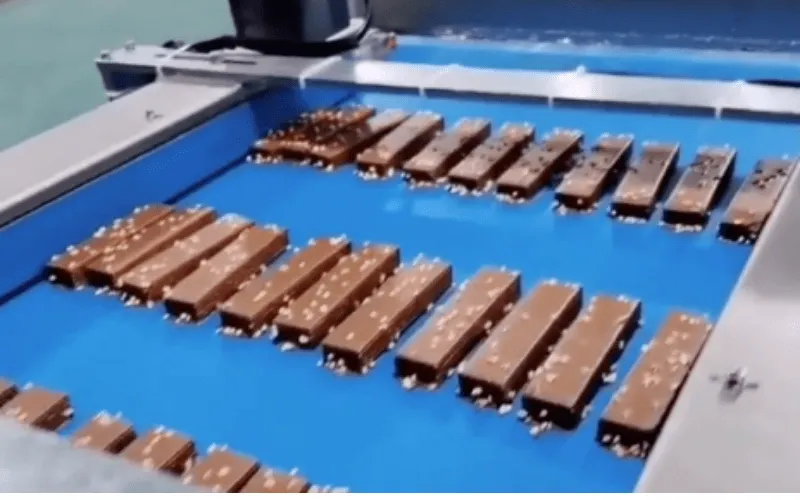
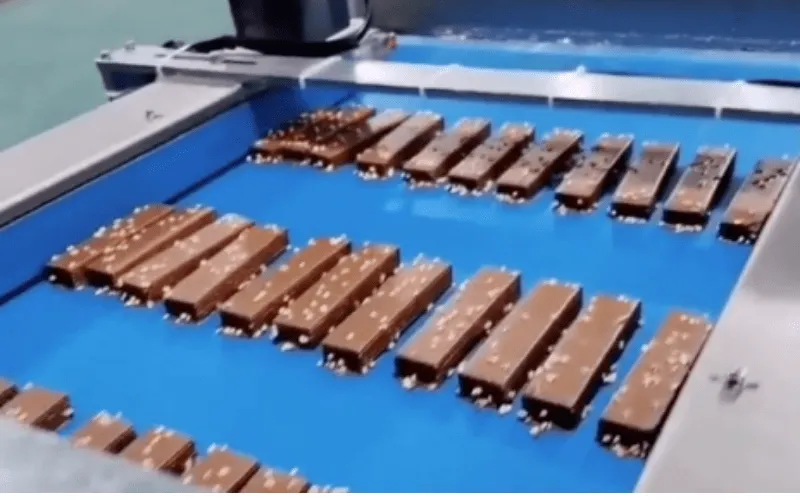
8. (Optional) Chocolate Enrober:[Owner Focus]This is a powerful value-add machine. After cutting, the biscuits pass through a "waterfall" of molten chocolate, completely coating them. This significantly increases the product's premium feel and retail price.
9. Automatic Packaging System: This is the downstream system that takes the finished biscuits and automatically wraps them. Finding a system from one of the top global food packaging manufacturers that can integrate seamlessly is key.
10. Central Control System (PLC): This is the "brain" of the entire line. It's a central computer (PLC) with a touchscreen (HMI) that coordinates the speed, temperature, and timing of all the other components.
4. Types of Wafer Production Lines and Their Applications
Wafer production lines are highly specialized. The technology changes significantly based on the final product's shape and design.
Flat Wafer Production Line:
Application: This is the most common and dominant type on the market. It's used to produce the standard, layered, cream-filled wafer biscuits we all know and love.
Characteristics: Its core technology is the "bake-cool-spread-layer-cool-cut" process detailed in Section 2.
Hollow Wafer Production Line:
Application: This line produces wafers with unique, three-dimensional shapes. Examples include hollow sticks (like Pirouettes), seashell shapes, or even animal shapes.
Characteristics: The baking oven is completely different. It uses "book-style" molds that open and close. Batter is injected, the mold closes, and it bakes a hollow 3D shape. This often requires a "filling" (injection) station rather than a "spreading" (coating) station. It is related to, but distinct from, a wafer roll production line.
Spherical / Ball Wafer Production Line:
Application: This is a highly specialized line for producing premium, round wafer products. The most famous example is the hollow wafer sphere inside a Ferrero Rocher chocolate.
Characteristics: This is the most complex technology. It uses "split-half" spherical molds to bake two separate hemispheres. After baking, the halves are cooled, often filled with a nut-cream, and then precisely joined together to form a perfect, hollow ball.
Add-On: The Chocolate Enrobing (Coating) Process:
This is not a separate type of line, but rather a powerful "value-add module."
It can be added to the end of a flat wafer line, just before the packaging system. The cut biscuits travel on a wire mesh belt through a "curtain" of liquid chocolate, coating them completely. They then pass through a long cooling tunnel to set the chocolate, emerging as a high-value premium product.
5. Core Advantages & Design Highlights
When a decision-maker evaluates a wafer production line, they must look beyond the brochure. The true value is found in these four dimensions, which directly impact engineers, procurement managers, and owners.
High Capacity & Efficiency:
[Owner Focus]Capacity is the most direct measure of investment value. Modern lines are specified by the "number of baking plates" (e.g., 30, 60, or 90 plates). A large-scale, 90-plate line can produce hundreds of kilograms of finished product per hour.
[Finance Focus]True efficiency is found in energy management. An advanced oven with superior insulation (like high-density ceramic wool) and a hot-air recycling system will maximize the thermal efficiency of every unit of gas or electricity. This directly lowers your daily operating costs.
Materials & Hygiene Standards:
[Procurement / Mechanical Engineer Focus]All components that touch food must be made of food-grade stainless steel. This typically means SUS304 at a minimum. If your cream fillings are acidic or salty, you must upgrade to the more corrosion-resistant SUS316L.
[Mechanical / Maintenance Engineer Focus]Hygienic Design is not just about the material. The equipment must be designed to be cleaned easily (CIP/SIP capable). This means no 90-degree corners, smooth, polished welds, and components that are easy to disassemble and reassemble. This is a non-negotiable requirement for passing international food safety audits like GMP and HACCP (Hazard Analysis and Critical Control Points).
Flexibility & Customization:
[Owner / Procurement Focus]Every factory floor plan (layout) is different. A superior wafer production line manufacturer must provide custom design services. They should be able to make the line fit your physical space perfectly, whether it requires a U-shape, L-shape, or straight-line configuration.
[Mechanical Engineer Focus]Quick Changeover capability is critical. Market demands change constantly. The line must support rapid product switches. This includes changing the cutting blades for a new size, or simply calling up a new recipe on the HMI that automatically adjusts oven temp, cream thickness, and cutting dimensions. This entire switch should be completed with minimal downtime.
Stability & Durability:
[Procurement / Engineer Focus]A production line is only as strong as its weakest link. During procurement, you must scrutinize the brand of all key drive and electrical components.
Seeing names like SEW or Nord (for motors), SKF or FAG (for bearings), and Siemens or Schneider (for electronics) is a very good sign. It means a lower failure rate, a longer service life, and globally available spare parts. This is your primary insurance policy for a low Total Cost of Ownership.
Note: When evaluating stability, always check the brands of key components (motors, PLCs, bearings). Using top-tier international brands may slightly increase the initial cost, but it dramatically reduces long-term maintenance costs and catastrophic downtime. This is a classic TCO decision.
6. ROI & Total Cost of Ownership (TCO)
This is a differentiated module that directly addresses the core concerns of Owners and Financial Managers.
Buying a wafer biscuit production line is a major capital expenditure (CAPEX). Smart owners and CFOs are not focused on the initial purchase price. They are focused on the full-lifecycle "Total Cost of Ownership" (TCO) and "Return on Investment" (ROI).
TCO (Total Cost of Ownership) Analysis:
Energy Costs (Electric vs. Gas): This is the largest single component of your TCO. A good manufacturer will provide a detailed energy consumption comparison. For example, a gas oven may have a slightly higher initial cost (due to piping and safety systems), but its unit-of-heat cost can be 50% less than electricity, depending on your region. Advanced insulation and smart-burner technology can save you tens of thousands of dollars in energy costs every single year.
Labor Costs: A highly automated line—one that integrates from batter mixing all the way to final case-packing—may only require 3-5 operators per shift. These operators simply monitor the system, add raw materials, and handle packing logistics. A low-automation line could require 15-20 people. If your all-in labor cost is $25,000 per person, a smart line saves you hundreds of thousands of dollars annually in labor alone.
Waste Rate & Material Cost: Stable PLC control keeps the product waste rate below 2%. But more importantly, the Wafer Crushing System takes that "waste" (edge trimmings, etc.) and grinds it into a powder. This powder can be added back into the cream base (at a set percentage) without affecting taste, achieving a near-0% waste rate for your most expensive raw materials.
Maintenance Costs (MRO): This is the TCO trap of cheap equipment. Frequent downtime, expensive proprietary spare parts, and long waits for service will consume your profits. A line built with high-quality, non-proprietary components has a much lower long-term MRO cost than a "cheaper" machine.
Tip: The Crushing System is an ROI accelerator. It turns an unavoidable cost (waste) into a reusable raw material (cream filler). It can shorten your payback period significantly.
ROI (Return on Investment) Estimation:
The Framework:ROI = (Annual Cost Savings [Labor + Energy + Materials] + Annual New Profit [Increased Capacity]) / Total Initial Investment
Case Study (New vs. Used): Consider a "used wafer production line for sale." The initial investment might be 50% lower. But its energy consumption could be 30% higher, its waste rate 5% higher, and it comes with no warranty or technical support. Its TCO will almost certainly surpass the cost of a new machine within 24 months.
Market Opportunity: A high-capacity, high-quality line allows you to say "Yes" to large OEM contracts from major retailers (like Walmart, Costco, or Aldi). The efficiency and stability of your line are your entry ticket to winning those high-volume contracts.
This is a differentiated module that directly addresses the concerns of Electrical and Mechanical Engineers.
A modern wafer line is not a "dumb" machine. It is a smart, integrated piece of equipment that runs on advanced control technology.
Central Control System (PLC & HMI):
[Electrical Engineer Focus]The "brain" of the line is its PLC (Programmable Logic Controller). An excellent wafer production line manufacturer will offer a choice of mainstream PLC brands (like Siemens, Allen-Bradley (Rockwell), or Omron). This is critical to ensure the new line can be seamlessly integrated into your factory's existing control standards and network architecture (e.g., Profinet, Ethernet/IP).
[Electrical / Mechanical Engineer Focus]A large (15-inch or more) high-definition touchscreen HMI is standard. It must have:
Multi-Language Support: For diverse operator teams.
Recipe Management: Allows you to change products with one touch. The PLC automatically calls up all relevant parameters (speed, temp, weights).
Real-Time Diagnostics: When a sensor (photocell, limit switch) fails, the HMI must instantly display a clear alarm (e.g., "#3 Cooling Fan Overload"). This cuts troubleshooting time from hours to minutes.
Historical Data Logging: For quality control and production traceability.
Smart Factory & Industry 4.0 Integration:
Data Acquisition (OEE): The line must be able to output key performance data in real-time. This includes production counts, uptime, and downtime, allowing you to automatically calculate your OEE (Overall Equipment Effectiveness). This data provides an objective basis for continuous improvement.
Remote Access & Diagnostics: This is a dividing line between modern and obsolete service. When your line has an electrical or programming fault, your Maintenance Engineer (with authorization) can allow the manufacturer's engineer—even one in China—to securely access the PLC via VPN. They can perform live diagnostics and even modify code remotely. This can turn a three-day service-call-wait into a two-hour fix.
Predictive Maintenance: Advanced lines install vibration and temperature sensors on critical components (like main drive motors and bearings). The system analyzes this data, detects trends, and can predict a failure before it happens. This allows you to schedule maintenance during a planned stop, avoiding a catastrophic mid-production breakdown.
Digital Twin: The most forward-thinking manufacturers are beginning to offer a "Digital Twin." This is a complete, 1-to-1 virtual model of your physical production line. It can be used to simulate new recipes, optimize the production rhythm, or train new operators without ever stopping your real line.
System Integration: The line must have a standard data interface (like OPC-UA). This is essential for future integration with your factory's MES (Manufacturing Execution System) or ERP (Enterprise Resource Planning) software, enabling fully automated, order-driven production.
Note: Remote Access & Diagnostics is a game-changer for maintenance teams. It allows the manufacturer's best engineer to be "on-site" virtually in minutes, not days. This should be a key feature on your checklist.
8. Service, Support, & Partnership
This is a differentiated module that directly addresses the concerns of Procurement Managers and Maintenance Engineers.
When you buy a production line, you are not buying a machine. You are choosing a long-term technical partner. How to choose a reliable food machinery supplier is a decision just as important as the equipment itself.
Pre-Sale & Solution Design:
[Procurement Focus]Reject any "standard quote." A professional supplier will first ask for your factory layout drawings and your product goals. They will then provide a customized 3D layout proposal showing exactly how the line will fit, including utility (power, water, gas) connection points. This prevents "surprises" during installation.
Installation, Commissioning, & Training:
[Maintenance Engineer Focus]Delivery is not the end; it's the beginning. The supplier must provide multi-level training:
The line's true value is only unlocked when your own team is empowered to maintain it.
After-Sales Service & Response:
[Procurement Focus]Get the warranty terms in writing. A clear policy is essential (e.g., 1 year on the full line, 2 years on key components like motors/PLCs).
[Maintenance Engineer Focus]Spare Parts are critical. A responsible manufacturer will include a "Critical Spare Parts List" with the initial quote and recommend you purchase it with the machine. This ensures that when a bearing or heating element fails, you can replace it in an hour, not wait three weeks for international shipping. That downtime is far more expensive than the part itself.
Response Mechanism: The supplier must offer a 24/7 technical support hotline. You need to know you can reach an expert at any time. This same logic applies when evaluating packaging machinery suppliers.
Tip: Procurement Managers should mandate that a "Critical Spare Parts List" is included in the final contract. The cost of a $10,000 production stoppage while waiting for a $200 heating element is a massive, unforced error.
9. Conclusion: Automation is the Future of the Wafer Industry
A wafer biscuit production line is the culmination of decades of food engineering technology. It has fundamentally changed how wafers are made, using automation, precision control, and high efficiency.
For the manufacturer looking to expand, improve quality, and control costs, the decision cannot be focused on price alone. You are choosing an asset that must create value for the next 10 to 15 years.
The key is to select a line that is not just technologically advanced, but one that excels in Total Cost of Ownership (TCO). This means superior performance in energy use, labor costs, maintenance, and waste reduction.
Choose a partner, not just a supplier. Find a manufacturer who delivers full-lifecycle value—from custom 3D layout design to remote-access diagnostics. This is the only way to secure a long-term, dominant position in a highly competitive market.
Frequently Asked Questions (FAQ)
1. Q: What is a wafer machine?A: A "wafer machine" most often refers to the core component of a wafer production line: the Wafer Baking Oven. This is the critical machine that bakes liquid batter into solid wafer sheets. In a broader context, "wafer machine" can also be used to describe the entire automated production line.
2. Q: How are wafers manufactured in a factory?A: The factory manufacturing of wafers is a continuous, automated process:
Mixing: Flour, water, oil, and other ingredients are blended into a smooth batter (kept under 30°C / 86°F).
Baking: The batter is injected onto hot (160-180°C) baking plates to form thin wafer sheets.
Cooling (1st): The hot sheets are cooled naturally to release stress.
Spreading & Layering: Cream (with 100-120 mesh sugar) is spread on the sheets. They are then stacked into "wafer books" at a ~1:3 sheet-to-cream ratio.
Cooling (2nd): The "books" are sent through a cooling tunnel (5-10°C) to solidify the cream.
Cutting: The solid, cold books are cut by wires or blades into their final size.
Packaging: The finished biscuits are automatically sorted and sealed in flow-wrappers.
3. Q: How long do wafers spend in the production line?A: This depends on the line's length and configuration, especially the cooling times. A typical, complete process—from the moment liquid batter enters the oven until it emerges as a cut, finished product (before packaging)—takes approximately 20 to 30 minutes.
The baking itself is fast, about 2-3 minutes.
The first (sheet) cooling takes about 3-5 minutes.
The second (book) cooling is the longest stage, typically requiring 10-15 minutes to ensure the cream is perfectly solid for cutting.
4. Q: What is the difference between a flat wafer line and a wafer roll production line?A: The primary difference is in the baking and forming stages:
Flat Wafer Line: Bakes flat sheets, which are then cooled completely. After cooling, cream is spread on them, and they are layered (stacked).
Wafer Roll Line: Bakes an extremely thin, pliable sheet. It is not cooled. While still hot and flexible, it is immediately rolled around a metal spindle (mandrel) to form a hollow tube. It is only cooled after it has been rolled into its final shape.
5. Q: Why choose a wafer production line manufacturer from China?A: Choosing a wafer production line China manufacturer is a strategic decision often based on three key advantages:
Exceptional Cost-Performance: Due to a mature supply chain and economies of scale, Chinese manufacturers can offer technologically advanced, stable, and reliable equipment at an extremely competitive price point.
Proven Technological Maturity: China has the world's largest and most demanding food market. Equipment from top-tier Chinese manufacturers has been battle-tested in 24/7, high-output factories. This has forged a level of stability and reliability that meets and often exceeds international standards.
Complete Service Chain: Leading manufacturers in China provide true end-to-end, turnkey project services. This includes custom factory layout design, equipment manufacturing, installation, commissioning, local operator training, and global after-sales support with a rapid spare parts supply.
Get Your Custom Project Analysis
Are you planning to upgrade an existing line or build a new wafer biscuit factory from the ground up?
Before you make a major capital investment, a single unexamined detail can lock in high operating costs for years to come.
We are more than just a wafer production line manufacturer; we are your production partner. Our expert team—including mechanical engineers, electrical engineers, and food technologists—is ready to support your project.
Contact us today for a free, no-obligation consultation:
Free TCO & ROI Analysis: We will help you calculate your total cost of ownership and project your investment payback period based on your capacity goals and local energy costs.
Free Factory Layout Design: Our engineers will create a custom 3D layout proposal based on your factory's blueprints to optimize space, workflow, and efficiency.
1-on-1 Technical Consultation: Discuss your exact product needs (flat, hollow, spherical, chocolate-coated) with our experts to identify the perfect technological solution.