How to Vet and Select a Food Packaging Machinery Supplier: A Cross-Functional Guide
Introduction: A Decision That Shapes Your Future
In the competitive food industry, your packaging line is the backbone of your operation. It directly impacts efficiency, cost, and brand reputation.
Selecting the right machinery supplier is therefore a critical strategic decision, not a simple purchase. A poor choice leads to relentless downtime, exorbitant repair bills, and frustrating production bottlenecks.
The right partner, however, becomes a strategic asset. For a broader context, the U.S. Food and Drug Administration (FDA) provides extensive resources on Good Manufacturing Practices (GMPs) which underpin all food packaging operations.
Our Core Methodology: A Cross-Functional Approach
The most common mistake is evaluating a supplier from a single perspective, such as procurement or engineering alone.
True success requires a collaborative effort that integrates diverse expertise from across your organization.
Key Takeaways
Start with precise internal needs. A quantified User Requirement Specification (URS) is your foundational document. Our guide on Key Food Packaging Machinery Specifications helps you define them.
Conduct a cross-functional "Technical Deep Dive." Integrate the perspectives of your engineers, procurement, and maintenance teams. This approach is central to our Complete Pillar Page on Manufacturers.
Let TCO be your financial compass. The true investment is revealed by the Total Cost of Ownership. We explain how to calculate it in our Guide to Understanding TCO.
Treat service agreements as your lifeline. Post-sales support and a formal Service Level Agreement (SLA) are critical. This is a key part of our Ultimate Maintenance Guide.
Aim for a strategic partnership. Evaluate the supplier's innovation capabilities and cultural fit to secure a partner for future growth.
Phase 1: Laying the Foundation — The Internal Discovery
Before contacting any suppliers, internal alignment is your most critical step.
Assemble a core team from production, engineering, maintenance, and procurement to create a detailed User Requirement Specification (URS).
Define Your Product, Packaging, and Output
Your product's characteristics are the primary driver for selecting the appropriate packaging technology.
Precisely describe its form (liquid, powder, solid), viscosity, fragility, and any sensitivity requiring special handling like nitrogen flushing or vacuum sealing.
Your choice of packaging material is equally crucial and must be compatible with the machine's capabilities.
Determine the types you plan to use—whether laminated roll film, pre-made pouches, glass jars, or plastic containers—along with their specific thicknesses and dimensions.
Quantify your production goals with clear, unambiguous data to determine the required machine speed.
Avoid vague terms like "high-speed"; instead, specify targets such as "a minimum of 80 packs per minute at 250 grams net weight" while planning for 10-20% capacity redundancy.
Outline Technical and Operational Requirements
Hygiene and safety are non-negotiable red lines in the food industry.
Mandate that all product-contact surfaces use food-grade stainless steel (typically 304 or the higher-grade 316L) and that the design is easy to clean, preferably supporting CIP or SIP protocols. The American Society of Mechanical Engineers (ASME) covers important standards for such equipment in their Food, Drug, and Beverage Packaging section.
A packaging machine is not an isolated island; it is a critical node within a larger production system.
Clearly define how the new equipment must integrate physically and communicate electronically with upstream and downstream equipment, a process detailed in our guide on Packaging Line Optimization and Integration.
Note for Project Managers: The final URS is the single source of truth for all subsequent evaluation, negotiation, and acceptance activities. Its requirements must be as quantified and specific as possible to prevent scope creep and misunderstandings.
Phase 2: The Technical Deep Dive — A Joint Audit
With a clear URS in hand, your technical and commercial teams can begin the supplier screening process.
This phase is a rigorous due diligence exercise, requiring you to look beyond company brochures and delve into the heart of the equipment.
Assess Supplier Reliability and Reputation
Prioritize suppliers with a long-standing, positive reputation specifically in food packaging.
Their depth of industry experience often allows them to foresee and mitigate challenges you might overlook.
Do not rely solely on supplier-provided testimonials.
Actively seek out independent user feedback and insist on speaking directly with reference clients who have similar products and production volumes to validate claims about stability and service responsiveness.
The Core Module: The Cross-Functional Audit Checklist
This stage separates exceptional suppliers from mediocre ones.
Your team must act as auditors, using the following specialized checklists to uncover the truth.
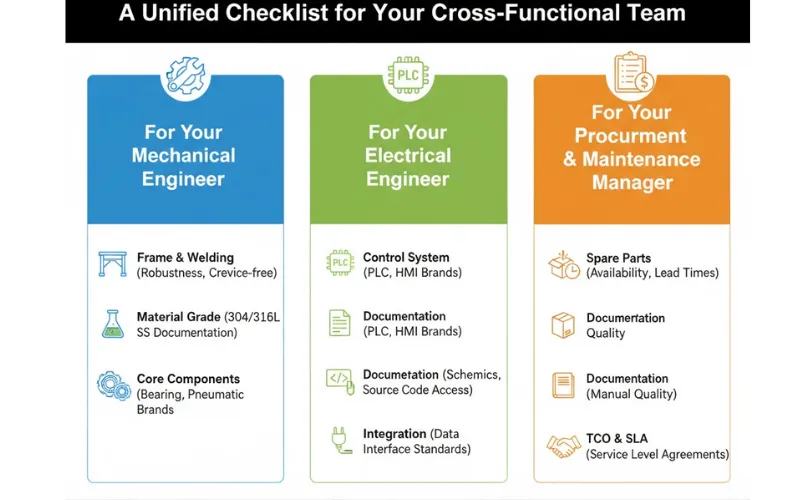
For Your Mechanical Engineer
Scrutinize the machine's frame for robust construction and rigid design.
Examine weld seams for smoothness and absence of crevices, and insist on documentation confirming the grade of stainless steel used for all product-contact parts.
The quality of key components is a powerful indicator of long-term reliability.
Ask for the brands of critical mechanical parts like bearings (e.g., SKF, NSK), pneumatic components (e.g., SMC, Festo), and vacuum pumps. Understanding these components is part of a robust Food Packaging Equipment Maintenance strategy.
For Your Electrical Engineer
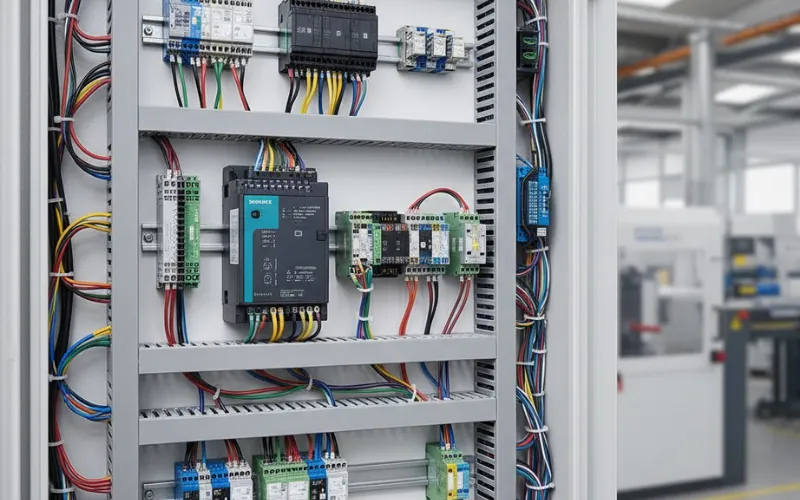
The control system is the machine's brain and nervous system.
Identify the brands of the PLC (e.g., Siemens, Allen-Bradley), servo drives, and HMI (Human-Machine Interface), as these dictate stability and future integration potential.
Demand openness and access to critical technical documentation.
Confirm that the supplier will provide fully annotated electrical schematics and PLC source code upon delivery, as this is essential for future troubleshooting and upgrades. The International Society of Automation (ISA) provides resources on industrial automation and control systems that govern these technologies.
For Your Procurement & Maintenance Manager
Probe the supplier's spare parts strategy and logistics.
What is the local availability of critical spare parts, and what are the standard lead times for the most crucial components that could halt your production?
Evaluate the quality of the technical documentation before you buy.
Request sample manuals to ensure they are well-illustrated, logically structured, and available in your team's language, as good documentation can resolve over 70% of common issues without a service call.
Demand a Material-Fed Demonstration
Insist on a live demonstration using your actual products and packaging materials.
Do not settle for a short, scripted run; request a continuous 30-minute operation at the rated speed.
Carefully observe the machine's stability, the consistency of the final package seal, and the overall reject rate during this extended test.
This is your best opportunity to see the equipment perform under real-world conditions.
Supplier Technical Capability Comparison Table
| Evaluation Dimension | Supplier A | Supplier B | Supplier C |
|---|---|---|---|
| Mechanical Structure | Excellent (unibody weld) | Good (bolted assembly) | Excellent (heavy-duty) |
| Control System Brand | Siemens | Domestic Brand | Rockwell Automation |
| Key Components | Premium Brands | Mixed Brands | Premium Brands |
| Data Interface | Standard OPC UA | Optional | Standard EtherNet/IP |
| Demo Reject Rate | < 0.5% | ~1.2% | < 0.8% |
| Maintenance Accessibility | 8/10 | 6/10 | 9/10 |
Phase 3: Analyzing Business Value & Lifetime Cost
After navigating the technical details, you must assess the commercial sustainability and long-term value of the partnership.
This requires a sharp financial and operational perspective.
Calculate the Total Cost of Ownership (TCO)
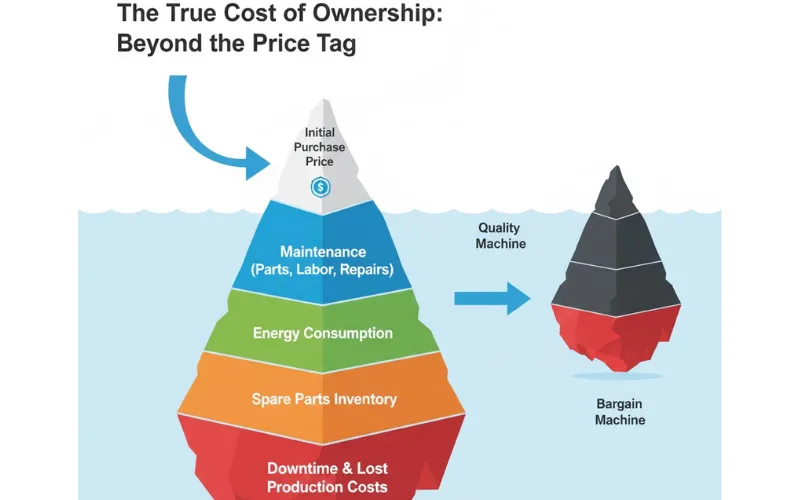
The initial purchase price is merely the tip of the financial iceberg.
A shrewd decision-maker uses the Total Cost of Ownership model to evaluate all related expenses over a 5-10 year horizon, a concept we break down in our dedicated guide to Understanding TCO for Packaging Machinery.
Key TCO Components include:
Initial Costs: Purchase price, taxes, shipping, and installation.
Operational Costs: Energy consumption, compressed air, and operator labor.
Maintenance Costs: Preventive maintenance contracts, expected spare parts consumption.
Risk Costs: The profound financial impact of unplanned production downtime.
Evaluate the After-Sales Support Ecosystem
Even the best equipment requires a powerful service backbone.
This is often the second key differentiator between suppliers.
From a maintenance manager's view, remote diagnostic capabilities are a game-changer.
Can the supplier's engineers securely access the machine remotely to diagnose and often fix software or electrical issues, dramatically reducing downtime? This is a feature of modern Industrial Packaging Machinery focused on maximizing uptime.
From a procurement manager's perspective, a detailed Service Level Agreement (SLA) is your safety net.
Negotiate and codify specific metrics, such as "2-hour response time for critical support calls" and "48-hour maximum for on-site technician dispatch," into the contract.
Note for Procurement: A machine with a low purchase price but high energy use, frequent failures, and expensive spare parts can have a significantly higher 5-year TCO than a more reliable, higher-initial-investment alternative. Always decide based on TCO.
Phase 4: Project Management & Acceptance — Ensuring Delivery
The journey from a signed contract to a commissioned machine is a formal project management exercise.
A superior supplier acts as a reliable project partner, not just a manufacturer.
Establish Joint Project Governance
Immediately after contract signing, demand a detailed project Gantt chart from the supplier.
This chart should clearly mark all key milestones, including design review, factory acceptance, shipping, and site installation.
Establish an efficient communication protocol to ensure transparency.
Confirm a single point of contact from both teams and schedule regular progress update meetings to synchronize and resolve issues promptly.
Define the Acceptance Criteria: FAT & SAT
Acceptance testing is your final barrier to ensure you receive what was promised.
It must be executed with rigor and precision. The International Organization for Standardization (ISO) offers standards like ISO 9001 which outlines frameworks for quality assurance that should govern these processes.
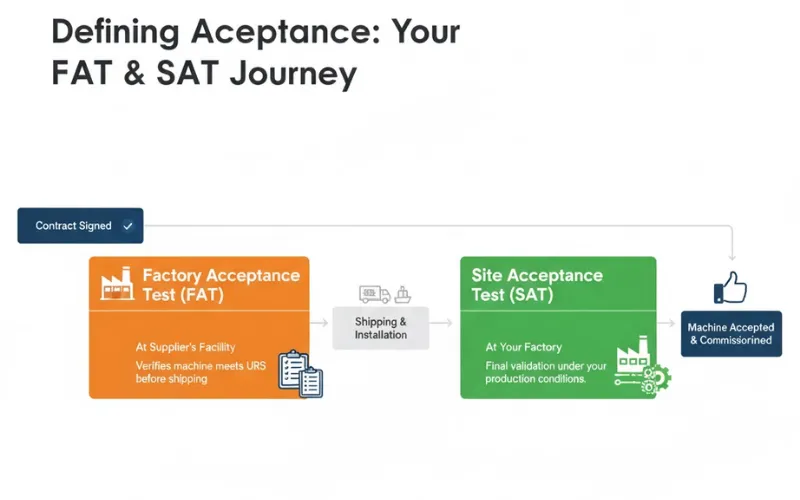
The Factory Acceptance Test (FAT) is conducted at the supplier's facility before shipment.
Your team must witness and verify that the machine meets all URS requirements through extended material-fed runs, speed tests, and changeover simulations.
The Site Acceptance Test (SAT) occurs after installation in your factory, under your actual production conditions.
This final validation confirms the machine works seamlessly with your entire line, and it is the true benchmark for successful delivery.
Tip for Maintenance Managers: Participating in the FAT is your best opportunity to learn the machine's anatomy and logic from the experts who built it. This knowledge is invaluable for future maintenance and will drastically reduce your learning curve.
Phase 5: The Final Decision — From Vendor to Partner
With the technical, commercial, and project management assessments complete, leadership must make the final choice from a strategic altitude.
This is where you transition from buying a machine to selecting a partner.
Conduct Site Visits and Finalize Negotiations
If possible, visit the shortlisted suppliers' manufacturing and R&D facilities.
A firsthand view of their operations, quality control, and corporate culture provides invaluable insights no document can match.
In the final negotiation, work closely with your legal and procurement teams.
Scrutinize every clause, clearly defining payment terms, delivery schedules, performance guarantees, warranty scope, and the detailed SLA.
The Strategic Value Assessment
This is the ultimate question for business owners: What can this supplier do for my enterprise over the next 5 to 10 years?
Discuss innovation and R&D with the supplier's leadership.
What is their view on industry trends, and do they have a clear technology roadmap that aligns with your future product development and smart manufacturing goals? Our analysis of Latest Technological Innovations can help frame these discussions.
Consider the potential for a true collaborative partnership.
Will they act as a strategic advisor, helping you design packaging for new products or optimize processes, thereby adding value far beyond the initial transaction? This aligns with understanding Manufacturer Specialties.

Conclusion
Selecting a food packaging machinery supplier is a complex, multi-dimensional challenge with significant strategic implications.
By rigorously following this "Requirements → Deep Dive → Business Analysis → Project Management → Strategic Decision" framework, you transform this critical investment into a powerful engine for business growth.
Remember, your ultimate goal is not to find a simple equipment vendor, but to secure a long-term partner you can trust with your production efficiency and market competitiveness for the next decade. For a market overview, start your research with our list of Top 10 Food Packaging Machinery Manufacturers.
Frequently Asked Questions
We are a startup with a limited budget. How should we balance cost and quality?
Adopt a "core first, phase later" strategy. Prioritize spending on reliability in core functions like sealing and accuracy, even if it means opting for less automation initially. You can often plan with the supplier to add features as your business grows.
What is the main difference between servo-driven and pneumatic-driven packaging machines?
Servo-driven systems offer superior precision, speed, energy efficiency, and control, making them ideal for high-value products and high-output scenarios. Pneumatic systems are simpler and more cost-effective upfront but are less precise, slower, and consume more energy. The choice depends on your product requirements and ROI calculation.
How should we weigh domestic suppliers against international ones?
Avoid a "country of origin" bias and apply the same rigorous assessment framework to all. While top-tier European suppliers may still lead in ultra-high-speed and precision applications, many domestic suppliers offer exceptional value, reliability, faster service response, and easier spare parts access. Let the evaluation, not the geography, guide your choice.
What is the most common mistake companies make when evaluating suppliers?
The top three mistakes are: 1.) Focusing only on the initial purchase price while ignoring the Total Cost of Ownership. 2.) Failing to create a precise, quantified URS, which leads to buying mismatched or over-specified equipment. 3.) Underestimating the importance of post-sales support and service ecosystem, assuming a quality machine will never break.
Are a supplier's promises of "lifetime free software upgrades" trustworthy?
Approach such claims with caution. First, define "upgrade" in the contract—does it mean bug fixes or new features? Second, investigate the supplier's R&D track record and financial stability. A company without sustained R&D investment cannot realistically provide meaningful updates for the life of the machine.
Get Expert Help & Tailored Solutions
Selecting the right packaging machinery is a complex undertaking. If you need guidance or want expert analysis tailored to your specific products and factory layout, our team is ready to assist.
We offer confidential, one-on-one consultations to help you navigate this critical process.
Download Our Exclusive Toolkit
Get our Packaging Machinery Supplier Evaluation Kit, complete with technical audit checklists, a dynamic TCO calculator, and an SLA negotiation template.Schedule a Free Expert Consultation
Book a 30-minute, no-obligation session with our cross-functional experts (including former engineers and procurement directors).See the Performance Difference
Schedule a Live Demo using your own materials at our technical center to see high-performance packaging in action.Learn from Peer Success Stories
Access our in-depth case studies to see how we've helped similar companies solve their packaging challenges.Assess Your Strategic Options
Book a Strategic Workshop to analyze the long-term partnership potential of your top supplier candidates.
Copyright & Updates
This document is for informational purposes only and should not be the sole basis for your procurement decision. We recommend conducting a comprehensive analysis based on the latest market information. All rights reserved. Reproduction prohibited. Last Updated: [Date].

Ready to start your journey toward a customized solution? Contact me directly on WhatsApp to begin the conversation.