Automated Cooling Conveyors: Your Secret to Bakery Quality & ROI
Why Automated Cooling Conveyors Are Your Secret Weapon for Quality
The Invisible Threat: How Post-Bake Instability Erodes Profitability
In the high-volume, precision-driven world of industrial baking, success is measured in consistency, quality, and efficiency. Millions are invested in state-of-the-art mixers and
It is a common and frustrating scenario: a seemingly perfect batch of biscuits or crackers leaves the production line, passes initial quality checks, and is shipped with confidence. Days or even weeks later, reports filter back from distributors and consumers—the products are broken, cracked, and unsalable. This phenomenon, a latent defect that manifests long after the product has left the factory, represents a significant drain on profitability and brand equity.
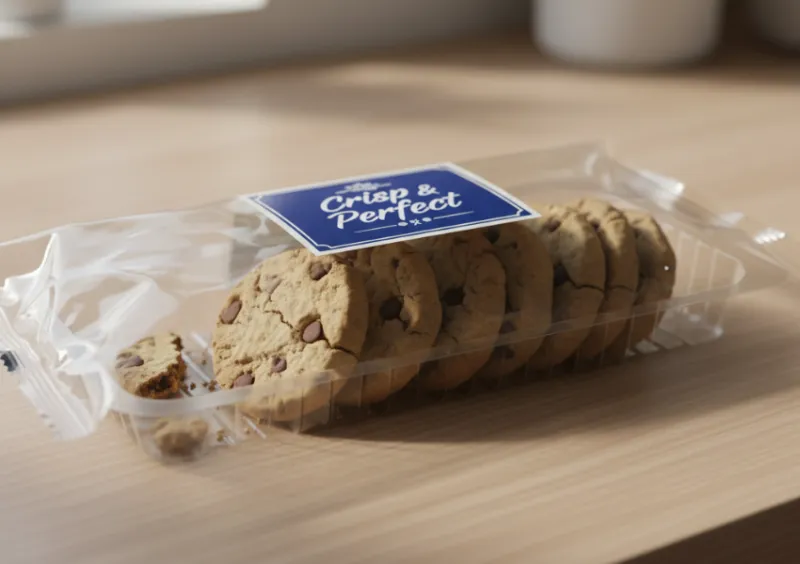
The primary culprit is "checking"—the appearance of small, hairline cracks in baked goods. These are deep structural flaws that can diminish a biscuit's physical strength by as much as 50%, rendering it extraordinarily fragile. A consumer opening a package to find fragments instead of whole biscuits is a breach of the brand's promise of quality.
What makes checking so insidious is its delayed onset, often appearing 24 hours to several days post-production. Standard end-of-line inspections are fundamentally incapable of detecting a problem that has not yet occurred. The factory may be shipping pallets of products that are, for all intents and purposes, ticking time bombs of structural failure.
This leads to a significant financial impact. The entire value chain of production is invested in each unit. When a product is rejected, this entire investment is lost. Studies have shown that this "negative product" can constitute over 25% of the total cost to produce a batch. Neglecting the post-bake phase is a strategic vulnerability that leaves your bottom line and reputation exposed.
The Science of the Snap: Deconstructing the Causes of Product Failure
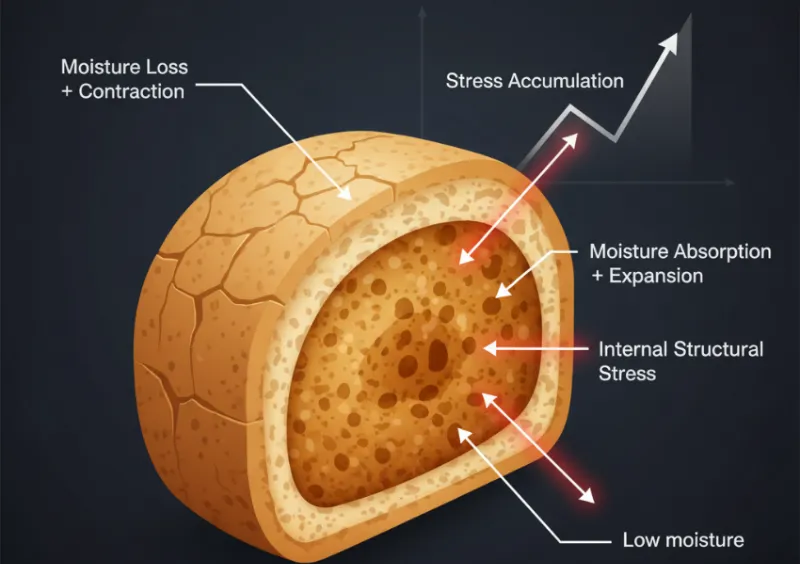
To effectively combat checking, it is essential to understand the precise scientific mechanisms at play. For decades, the problem was often attributed to "thermal shock"—the idea that rapid temperature changes cause cracking. However, this is an incomplete explanation. Biscuits typically cool within an hour, yet checking can occur days later. The true cause is a more complex interplay of moisture, mass transfer, and mechanics.
The core culprit is the presence of significant moisture gradients within the product immediately after baking. The intense heat of the oven creates a dry, low-moisture outer region, while the core remains relatively moist. This differential creates a state of internal instability.
The physics of this failure involve two powerful and opposing forces:
Expansion at the Rim: The very dry outer rim of the biscuit begins to absorb moisture from the ambient air, causing it to swell and expand.
Contraction at the Core: Simultaneously, the wetter core of the biscuit begins to lose moisture, causing it to shrink and contract.
The result is a biscuit being torn apart from the inside. This dynamic generates immense internal stresses that strain the product's structure to its breaking point. The environment in which the product cools is a critical accelerator. A low relative humidity (RH) environment is particularly dangerous because it aggressively pulls moisture from the core while the dry rim continues to absorb what little moisture is available, dramatically increasing the internal stresses.
Finally, as the biscuit cools, its structure sets and it becomes hard and rigid, losing its initial plasticity. From this point forward, any ongoing strain from moisture migration cannot be relieved by deformation. Instead, the stress accumulates until it surpasses the material's tensile strength, and a crack forms. The cooling phase is not merely about reducing temperature; it is a complex stabilization process where the final quality and integrity of the product are ultimately decided.
The Cooling Conundrum: Where Traditional Methods Fall Short
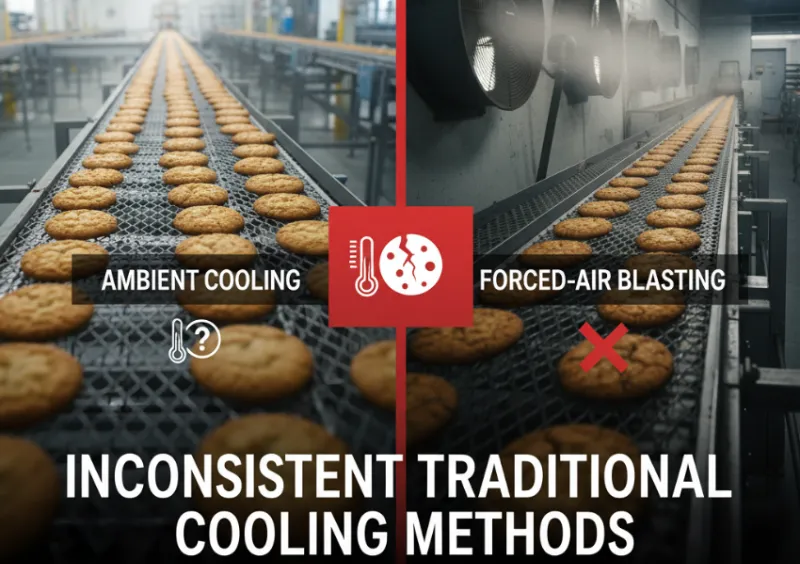
Given the complex science of moisture migration, the post-bake cooling process is a delicate and critical control point. Unfortunately, the methods traditionally employed in many industrial bakeries are often uncontrolled, turning this crucial phase into a high-stakes gamble.
The most prevalent yet flawed approach is simple "ambient" cooling. In this setup, products travel along extended, open-air conveyors, exposed to the general factory environment. This method surrenders the product's fate to fluctuating conditions. The temperature and, more critically, the relative humidity can vary dramatically depending on the season or time of day. This lack of control makes consistent, repeatable results impossible.
Recognizing the slowness of ambient cooling, some operations turn to aggressive forced-air cooling, using powerful fans to blast products with chilled air.This intuitive solution, however, is often the direct cause of the problem it aims to solve. Blasting a hot, moist product with a high volume of cold, dry air rapidly desiccates the surface, creating a hard "skin" that traps moisture within the core. This action dramatically steepens the moisture gradient and magnifies the destructive expansion-versus-contraction stresses that cause the product to fracture.
Ultimately, the failure of these traditional methods lies in their inherent inconsistency. Without the ability to precisely control the temperature, humidity, and airflow, a bakery cannot produce a consistently high-quality product.
The Automated Solution: A Taxonomy of Modern Cooling Conveyors
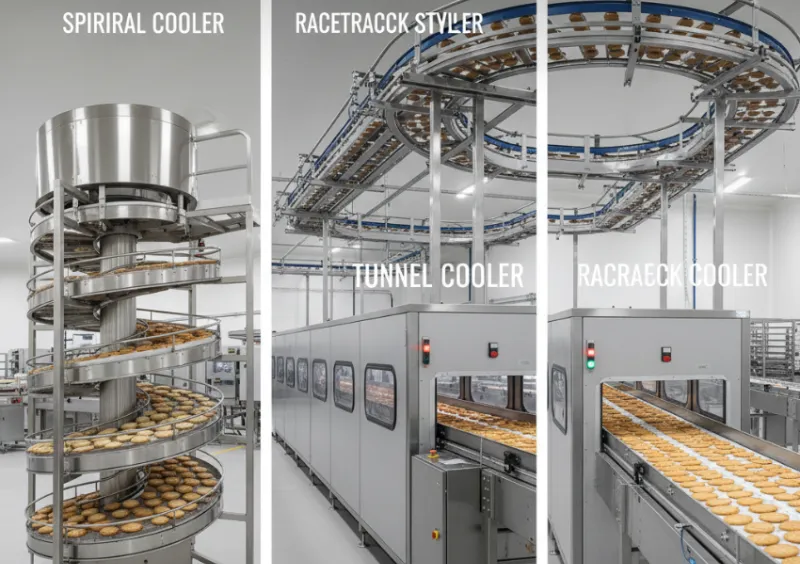
To overcome the limitations of uncontrolled cooling, the industry has developed sophisticated automated cooling conveyor systems. These are engineered environments designed for the precise and repeatable atmospheric conditioning of products. The choice of system depends heavily on the specific product, production volume, and facility constraints.
Spiral Coolers
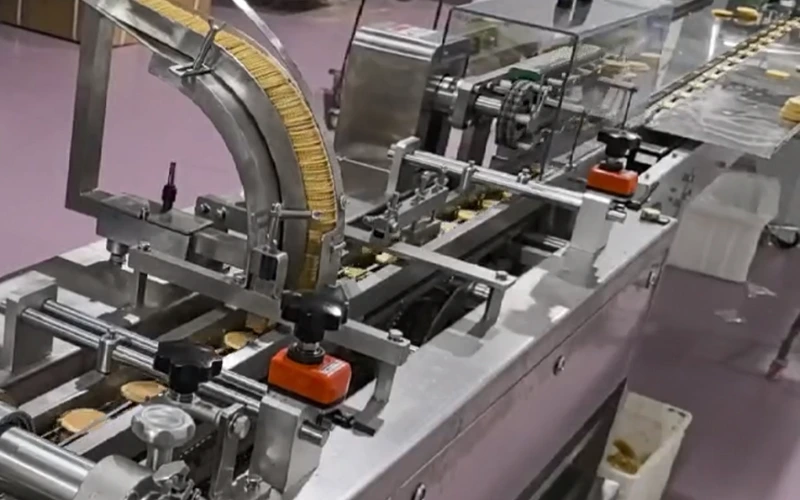
Spiral coolers utilize a continuous conveyor belt that travels in a helical path. This vertical design is their defining advantage, allowing them to accommodate a very long cooling time within a remarkably small horizontal footprint, making them ideal for facilities where floor space is at a premium. The gentle, continuous motion makes them well-suited for delicate baked goods like cakes, pastries, and biscuits.
Tunnel Coolers
Tunnel coolers offer a linear approach, transporting products through a long, enclosed tunnel. While they require a larger linear footprint, their design offers advantages in simplicity and integration. A key feature is the ability to create multiple distinct climate zones along the length of the tunnel, allowing for a programmed cooling "profile" to be established.
Racetrack and Other Conveyor Systems
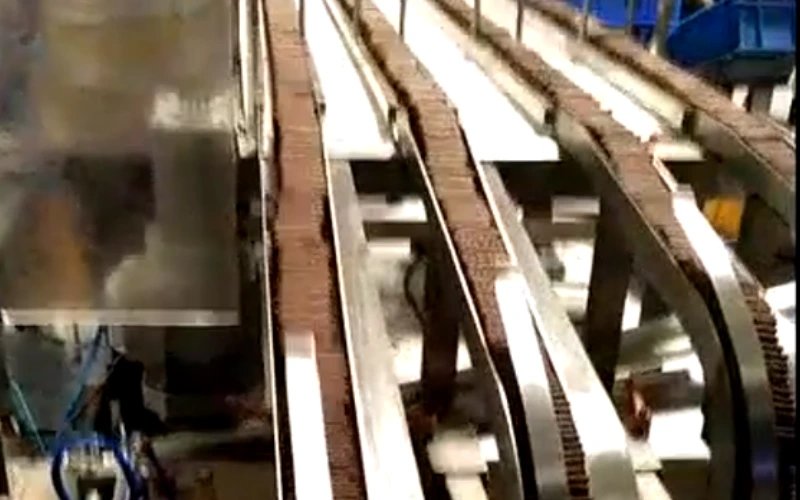
Racetrack cooling conveyors offer a compromise, using long, looping paths that are often configured to utilize the open vertical space above other equipment. The layout can be customized into various shapes to fit specific building constraints. By elevating the majority of the conveyor path, they free up valuable floor space while still providing the extensive travel distance required for gentle cooling.
| Feature | Spiral Cooler | Tunnel Cooler | Racetrack Cooler |
| Footprint | Very Small (Vertical) | Large (Linear) | Moderate to Large (Configurable, Overhead) |
| Throughput Capacity | High | High | High |
| Product Handling | Gentle; ideal for delicate/uneven items | Best for flat, uniform products | Good for robust products, often in-pan |
| Dwell Time Flexibility | High (longer retention time possible) | Moderate (limited by tunnel length) | High (long travel paths) |
| Maintenance Complexity | More complex due to spiral design | Simpler, more accessible | Moderate, depends on layout complexity |
Engineering for Perfection: The Core Features of a High-Performance System
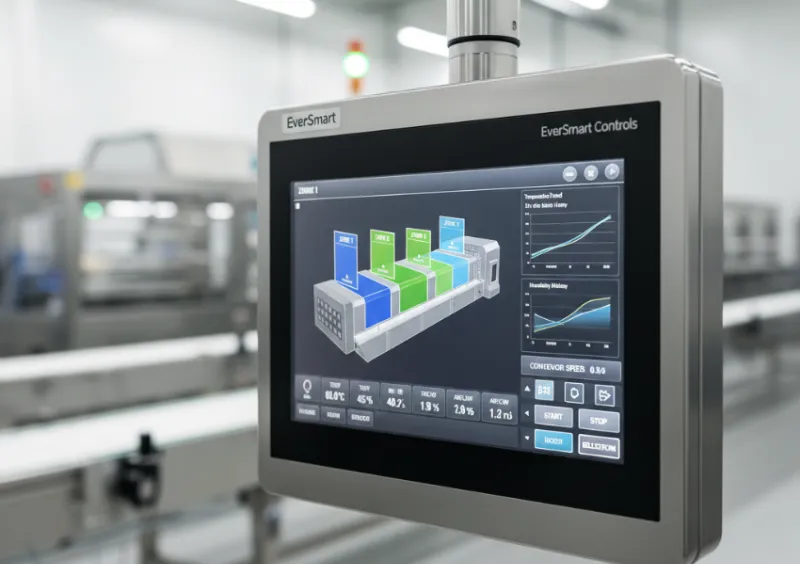
The effectiveness of an automated cooling conveyor is determined by the sophistication of its underlying technology. A high-performance system is an integrated piece of process equipment engineered for precision, hygiene, and flexibility.
The Brains of the Operation: Advanced Process Control
The true power of a modern cooling system lies in its ability to create and maintain a precisely defined environment.
Multi-Zone Climate Management: Advanced systems are segmented into multiple independent zones. Each zone can be programmed with its own specific setpoint for temperature, relative humidity, and airflow velocity. This zoned approach is the most effective method for managing the moisture gradients that cause checking.
Integrated Sensors: High-performance systems are equipped with an array of robust, industrial-grade sensors that continuously monitor temperature and humidity, feeding this data back to the system's central Programmable Logic Controller (PLC). This closed-loop feedback ensures the cooling profile is maintained with high precision.
Variable Speed Control: The ability to speed up or slow down the conveyor allows operators to precisely adjust the "dwell time"—the amount of time a product spends within the cooling environment.
The Brawn: Mechanical and Sanitary Excellence
While process control is paramount, the physical construction of the conveyor system is equally important for ensuring reliability, safety, and efficiency.
Optimized Airflow System: A well-engineered system uses carefully designed plenums and baffles to deliver a uniform, laminar flow of conditioned air across the entire product zone. This eliminates "dead spots" and ensures every product on the belt experiences the exact same cooling conditions.
Hygienic by Design: This is a non-negotiable requirement. Adherence to established guidelines, such as those from Food Safety, is a hallmark of high-quality equipment. Key principles include construction from food-grade stainless steel, smooth surfaces free from crevices, and designs that are easy to disassemble and clean.
Modular and Adaptable Design: Modern systems are often constructed from pre-engineered modules that can be configured to fit specific plant layouts and provide a pathway for future expansion.
Unlocking Production Velocity: The Link Between Controlled Cooling and Throughput
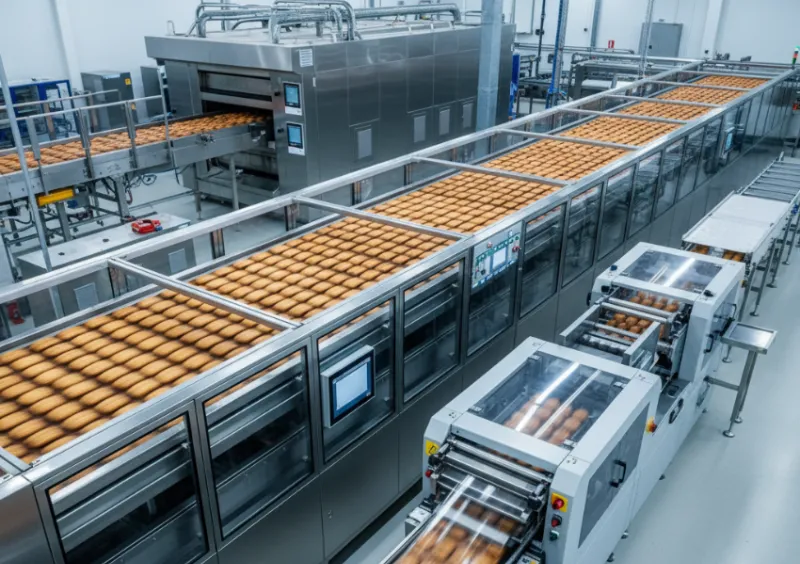
In any manufacturing process, the overall output is dictated by its most significant bottleneck. In many industrial bakeries, that bottleneck is the cooling phase. Traditional cooling methods cannot keep pace with high-speed ovens, forcing the entire production line to slow down and capping the plant's total throughput.
An automated, high-efficiency
A product that is too warm is a non-starter for two critical reasons:
Structural Integrity: The structure of a baked good is not fully set until it has cooled sufficiently. A warm loaf of bread or a batch of biscuits is soft, pliable, and extremely fragile. Attempting to push such a product through a high-speed slicer or wrapper would result in crushing, tearing, and damage.
Moisture Control: Packaging a warm product traps residual heat and moisture within the sealed wrapper. As the product continues to cool, this trapped moisture condenses, leading to a soggy crust, compromised texture, and a drastically shortened shelf life due to mold growth.
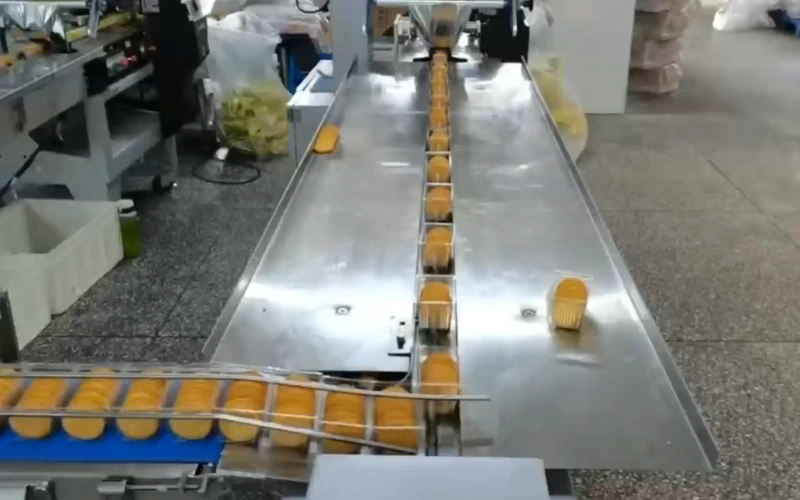
By solving these issues, an automated cooling conveyor enables a truly continuous production flow. It transforms the cooling stage into a seamless, automated, "First In, First Out" (FIFO) system. This creates a fluid and synchronized link between the oven and the packaging line, allowing the entire plant to operate at a higher, more consistent velocity. The impact on throughput can be dramatic, with advanced cooling technologies slashing cooling times from hours down to a few minutes.
The Financial Analysis: Calculating the ROI of Your "Secret Weapon"
The acquisition of an automated cooling conveyor represents a significant capital expenditure. However, a comprehensive Return on Investment (ROI) calculation allows decision-makers to quantify the substantial value this technology brings to the operation.
A crucial first step is to calculate the "Cost of Doing Nothing." The current, inefficient cooling method carries significant hidden costs, including daily financial losses from product waste, excessive labor hours, and the opportunity cost of lost production due to the cooling bottleneck.
Quantifying the Gains (The "Return")
The financial benefits of an automated cooling system are tangible and can be modeled with a high degree of accuracy.
Reduced Product Waste: By implementing precise process control that minimizes checking and other defects, the spoilage rate can be drastically reduced. Given that waste can account for a significant percentage of total production costs, even a modest reduction yields substantial savings.
Increased Throughput and Revenue: This is often the largest component of the financial return. By eliminating the cooling bottleneck, the system allows the plant to produce and sell more units in the same amount of time. An ROI model must calculate the value of this additional capacity. For example, automation can lead to a 15-20% increase in saleable units per shift.
Labor Cost Savings: Automation reduces or eliminates the manual labor associated with transporting products on racks. More significantly, the superior sanitary design of modern systems dramatically cuts down on cleaning time. Case studies have documented reductions in sanitation labor hours of over 90%.
Energy Efficiency: Modern cooling systems are engineered for energy savings. The use of high-efficiency motors and Variable Frequency Drives (VFDs) contribute to lower electricity consumption.
Analyzing the Costs (The "Investment")
The investment side of the equation includes the Capital Expenditure (CapEx) for the equipment, Installation and Integration Costs, and ongoing Operational and Maintenance Costs (OpEx).
Putting It All Together: The ROI Calculation
With the gains and costs quantified, the ROI can be calculated. The two most common metrics are:
Simple ROI:
Payback Period:
For many industrial equipment investments, a payback period of under two to three years is considered highly attractive. Beyond these metrics, it is crucial to consider the powerful
Intangible Benefits, such as enhanced brand reputation from higher quality and improved food safety, which, according to the FDA , is paramount.
Conclusion
The post-bake cooling phase, long treated as a passive necessity, is one of the most critical control points in modern industrial baking. The costly problem of "checking" is the direct and predictable result of uncontrolled cooling processes that fail to manage the complex hydro-mechanical stresses inherent in a freshly baked product.
The definitive solution lies in the implementation of automated cooling conveyors. These systems—whether spiral, tunnel, or racetrack configurations—are sophisticated process control instruments. Equipped with multi-zone climate management, integrated sensor networks, and advanced airflow systems, they provide the precision necessary to guide a product through its critical cooling journey, ensuring structural stability and final quality.
By eliminating the post-oven bottleneck, these systems unlock the full potential of the entire production line, from the initial
Ultimately, an automated cooling conveyor is more than just an equipment upgrade. It is a strategic imperative that provides a decisive competitive advantage. It is the secret weapon that ensures the quality promised in the mixing bowl is the quality delivered to the consumer, protecting brand equity, enhancing profitability, and building a more resilient and efficient operation.
Stop hesitation, contact us today for a customized consultation:
Sofia Export
Vice President | EverSmart
📞 WhatsApp: +86 137 94619343
📧 Email: [email protected]

Ready to start your journey toward a customized solution? Contact me directly on WhatsApp to begin the conversation.