The Definitive Guide to Post-Oven Bakery Automation & ROI
The Definitive Guide to Integrated Post-Oven Bakery Automation: From Process Physics to Profitability
Executive Summary
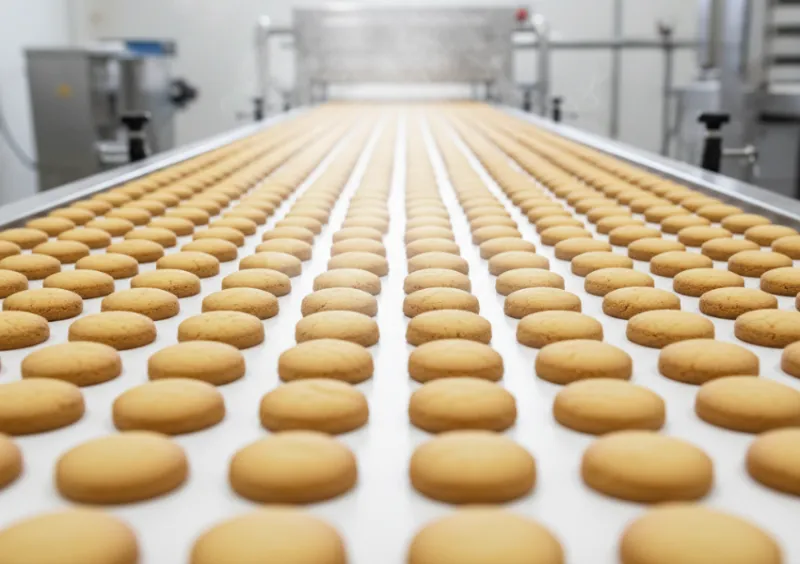
The journey of a baked product from the heat of the oven to its final package is the ultimate test of a modern industrial bakery's efficiency, quality control, and profitability. This critical post-bake phase is not merely a series of logistical steps but the final, decisive stage of quality assurance and value creation.
Traditional, manual, or fragmented post-oven processes represent the single greatest source of product damage, production bottlenecks, inconsistent quality, and ultimately, lost revenue. This report provides a definitive technical and business analysis of integrated post-oven automation as the strategic imperative for achieving competitive advantage in the contemporary bakery market.
The analysis begins by establishing the fundamental scientific principles that govern post-bake product integrity. Immediately upon exiting the oven, products like biscuits, cookies, and crackers are in a state of maximum vulnerability—structurally weak, hot, and possessing significant internal moisture and thermal gradients. Uncontrolled handling at this stage is the primary cause of costly scrap and rework. The report delves into the physics of two critical failure modes: thermal shock, which leads to the latent defect of "checking" (micro-cracking), and uncontrolled moisture migration, governed by the principles of water activity (aw), which dictates final texture and shelf life.
Building on this scientific foundation, the report architecturally deconstructs the solution into three core technological pillars:
Controlled Conditioning & Stabilization: The evolution from passive ambient cooling to active, multi-zone automated cooling tunnels that precisely manage temperature and humidity to prevent defects and engineer the desired product characteristics.
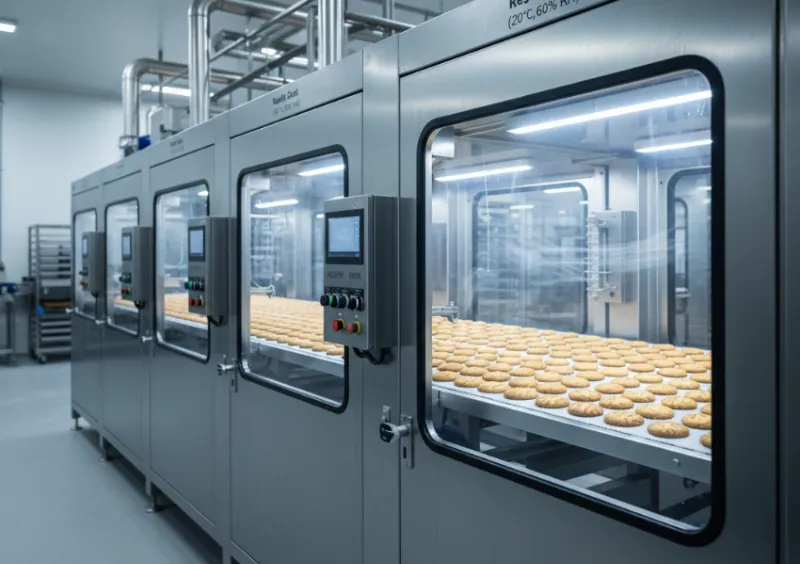
Precision-Driven Value Addition: The application of high-speed, high-accuracy automated systems for depositing, sandwiching, and enrobing, which minimize the waste of high-cost ingredients while maximizing throughput for premium products.
High-Speed Automated Packaging: The integration of primary (flow wrappers), secondary (cartoners), and tertiary (robotic palletizers) packaging systems to protect the product, enhance brand presentation, and eliminate end-of-line bottlenecks.
The report argues that the true value of these pillars is only unlocked through seamless integration. It examines the pervasive problem of "islands of automation"—disconnected machines that create manual hand-offs and data silos—and presents the solution: a cohesive digital ecosystem built on a hierarchical control structure of Programmable Logic Controllers (PLCs) and Supervisory Control and Data Acquisition (SCADA) systems, communicating via modern industrial protocols.
Finally, a comprehensive framework for calculating the Return on Investment (ROI) is presented. This framework moves beyond simplistic labor savings to quantify the total cost of inefficiency, including material waste, unplanned downtime, quality-related expenses, and opportunity costs. By translating the technical benefits of an integrated "oven-to-pallet" system into clear financial metrics—reduced waste, increased throughput, labor optimization, and new market access—this report provides the definitive business case for investing in post-oven automation as a cornerstone of modern, profitable, and sustainable bakery production.
Part I: The Unseen Science of Post-Bake Product Integrity
The moments immediately following the baking process are the most critical and least understood phase in industrial bakery production. While the oven transforms dough into a recognizable product, it is the post-oven environment that solidifies its quality, determines its texture, and dictates its shelf life.
Failure to manage this transition with scientific precision is the root cause of the most significant and often hidden costs in a bakery operation, from scrap rates to customer complaints. This section dissects the fundamental physics and material science that govern post-bake product integrity, establishing the non-negotiable "why" behind the need for integrated automation.
1.1 The Moment of Maximum Vulnerability: The Post-Oven Transition
As biscuits, cookies, or crackers emerge from the intense heat of the
The product is structurally at its weakest point; it is hot, soft, and contains significant internal moisture gradients, with a drier crust and a more humid core. This inherent fragility is the primary reason why manual handling or poorly designed, fragmented conveyance systems are a principal source of product breakage, scrap, and lost revenue.
The financial impact of this vulnerability is not confined to the cost of the raw materials in a broken biscuit. Each fractured product represents a loss of the total invested energy, labor, and oven time. Furthermore, broken pieces can contaminate downstream equipment, leading to jams in sandwiching machines or flow wrappers, causing unplanned downtime that ripples through the entire production schedule.
The core challenge, therefore, is not merely to move the product from point A to point B, but to do so in a manner that respects its delicate physical state. Any attempt to accelerate handling or processing before the product has been properly stabilized will inevitably lead to higher scrap rates and lower Overall Equipment Effectiveness (OEE). The initial moments post-bake are thus the highest leverage point for quality control, reframing the objective of post-oven automation from a simple "materials handling" problem to a critical "product stabilization" imperative.
1.2 The Physics of Failure: Thermal Shock and "Checking"
One of the most insidious and costly defects in biscuit and cracker production is "checking." This phenomenon is characterized by the appearance of small, hairline cracks that often extend from the center of the product towards the periphery.
A critical challenge with checking is that it is a latent defect; the cracks may not become visible for several hours, or even up to three days, after baking and packaging. This latency means that standard end-of-line quality inspections are often ineffective at detecting the problem. The defect manifests long after the product has been shipped, typically when a consumer opens a package to find broken biscuits. This hidden "quality time bomb" directly impacts profitability and erodes long-term brand reputation.
The root cause of checking is a classic engineering phenomenon known as thermal shock, a transient mechanical load imposed on an object when it is subjected to a rapid and drastic change in temperature. This sudden change causes different parts of the object to expand or contract at different rates, creating immense internal stress.
In a freshly baked biscuit, the conditions are perfect for thermal shock. The exterior surface, exposed to cooler ambient air, begins to cool and contract rapidly. The interior, however, remains hot and moist, contracting at a much slower rate. This differential in contraction creates a stress gradient within the biscuit's structure. As it cools and becomes rigid, the accumulated stress can no longer be relieved by plastic deformation, and microscopic cracks begin to form. This makes proactive, controlled cooling a non-negotiable risk mitigation strategy for any high-quality biscuit or cracker operation.
1.3 The Dynamics of Texture: Moisture Migration and Water Activity (aw)
The final texture of a baked good—whether it is the satisfying snap of a cracker or the crispness of a biscuit—is governed by the complex science of moisture dynamics. The critical parameter is water activity (aw), a thermodynamic measure of the energy state of water within a product. Water activity, measured on a scale from 0 (bone dry) to 1 (pure water), dictates the direction and rate of moisture migration.
A fundamental physical law states that water will always move from an area of high water activity to an area of low water activity until equilibrium is reached, regardless of the total moisture content. This principle explains numerous common product failures, such as a crisp cookie becoming soft when placed next to a high jam filling.
Controlled cooling is the primary industrial process for managing water activity.
For Crisp Products: To achieve the desired crispness, moisture must be allowed to escape from the product during cooling. Placing hot cookies on a cooling rack with ample airflow facilitates this evaporation, lowering the final water activity. If these products are packaged while still warm, the evaporating moisture becomes trapped, resulting in a soggy texture.
For Shelf Life: Water activity is also the single most important factor for determining shelf life. All microorganisms have a minimum water activity level below which they cannot grow. Controlling the final
aw is therefore essential for preventing microbial spoilage.
Mastering moisture migration through precisely controlled cooling is the key to engineering the desired consumer sensory experience and ensuring product integrity throughout its intended shelf life.
Part II: The Architectural Pillars of Post-Oven Automation
Addressing the complex scientific challenges of post-bake product integrity requires a systematic, engineered approach. The solution is an integrated system built upon three distinct but interconnected architectural pillars: stabilizing the product, enhancing its value, and protecting its quality through packaging.
2.1 Pillar 1: Controlled Conditioning & Stabilization
The first and most crucial step after the oven is to bring the product from its state of maximum vulnerability to one of stability. This is the role of controlled conditioning systems, which represent the direct engineering solution to the destructive forces of thermal shock and uncontrolled moisture migration.
Technology Breakdown:
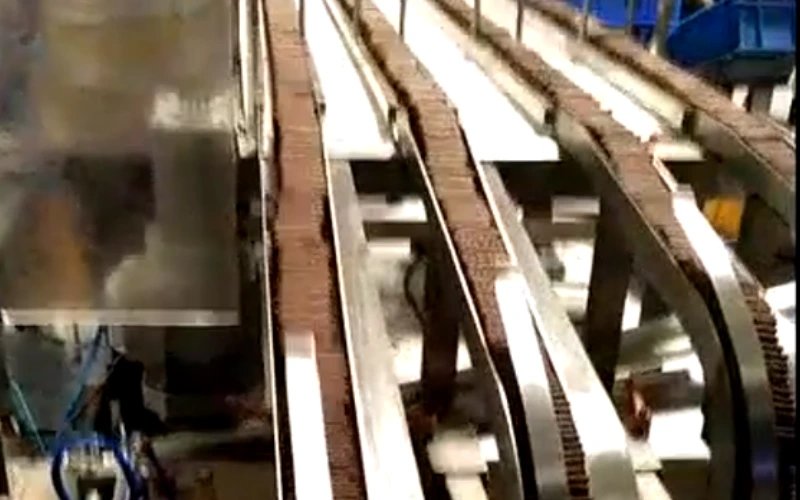
Ambient Cooling Conveyors: The most basic approach involves transporting products on long, open-air
biscuit cooling conveyors Forced Air Ambient Cooling Conveyors: This represents an incremental improvement, utilizing fans to draw ambient air over the product surface. However, it still lacks precise control and can sometimes exacerbate the internal stress that leads to checking.
Automated Cooling Tunnels: This is the state-of-the-art solution. A cooling tunnel is a fully enclosed, modular conveyor system designed for precise, programmable control over the product's environment. These systems feature multiple, independent zones, each with its own controls for temperature, humidity, and airflow. This multi-stage approach allows for the creation of an ideal cooling profile, reliably preventing checking and stabilizing the product's structure.
The transition from open conveyors to enclosed tunnels is fundamental to enabling the high-speed, high-quality, and consistent production demanded by the modern market. For a deeper dive into this specific technology, explore our guide on why-automated-cooling-conveyors-prevent-product-breakage.
Table 1: Comparison of Post-Oven Cooling Technologies
| Technology | Cooling Principle | Typical Cooling Time | Footprint Requirement | Relative Capital Cost (CapEx) | Relative Operating Cost (OpEx) | Control Precision (Temp/Humidity) | Best Suited For |
| Ambient Conveyor | Natural convection; radiation to ambient environment | Very Long (30-60+ min) | Very Large | Low | Low | None; subject to factory conditions | Robust, low-value products where space is not a constraint and quality variation is acceptable. |
| Forced-Air Conveyor | Forced convection using ambient air | Moderate (15-30 min) | Large | Low-Medium | Low | Minimal; uncontrolled air quality and humidity | Products requiring faster cooling than ambient, but where precise control over final moisture and texture is not critical. |
| Multi-Zone Cooling Tunnel | Forced convection with conditioned air (heated/cooled, humidified/dehumidified) | Short (5-15 min) | Compact / Modular | High | Medium-High | High; programmable profiles for temperature, humidity, and airflow per zone | High-value, delicate, or coated products (biscuits, crackers, confections) requiring prevention of checking, precise moisture control, and consistent quality for high-speed automated packaging. |
2.2 Pillar 2: Precision-Driven Value Addition
Once a product has been properly conditioned, it is ready for value-added processing. This pillar encompasses the automated systems that apply fillings, coatings, and toppings, transforming a simple base biscuit into a premium, higher-margin product.
2.2.1 Depositing and Filling
Modern depositing systems are feats of precision engineering, designed to dispense a wide variety of materials with exceptional accuracy and speed, from smooth batters to viscous fillings with large particulates. The core of many high-performance systems is the
servo-driven depositor, which provides precise, programmable control over the depositing cycle, enabling volumetric accuracies of up to ±2%. This level of precision is critical for cost control and product consistency.
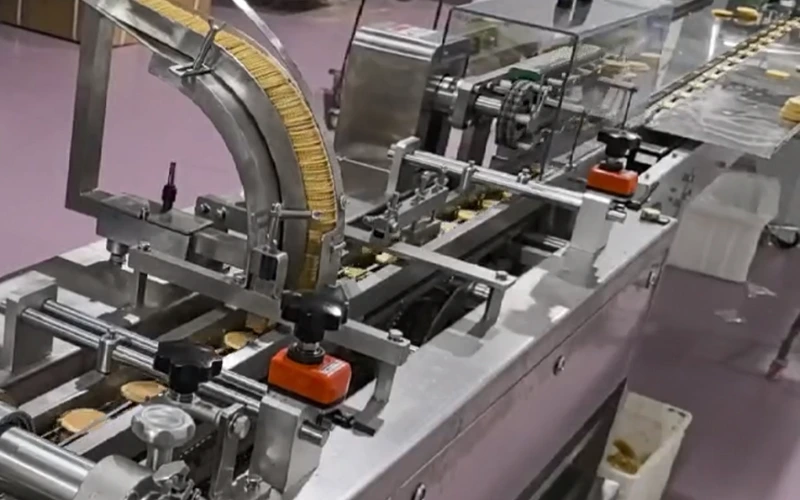
2.2.2 High-Speed Sandwiching
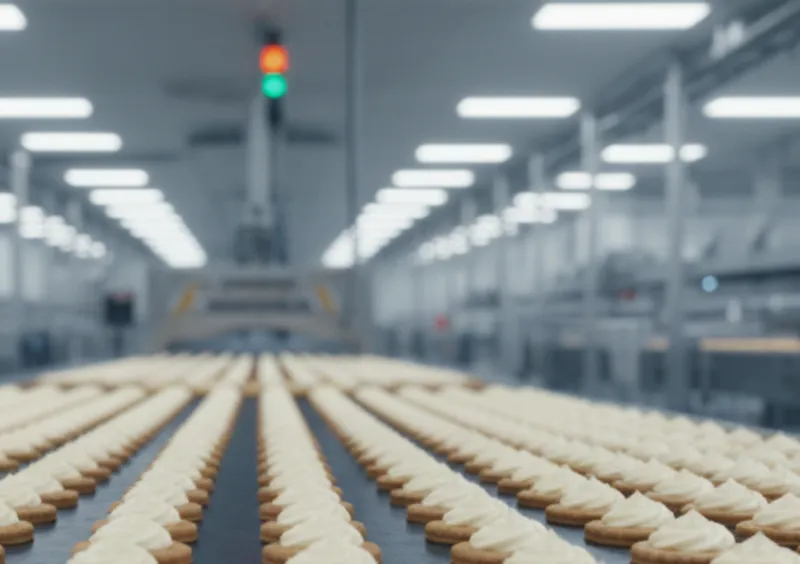
Modern sandwiching machines are capable of assembling products at astonishing rates, with some multi-lane systems producing up to 4,800 or more finished sandwiches per minute. This requires a perfectly synchronized sequence of biscuit feeding, alignment, cream depositing, and capping to achieve maximum throughput.
2.2.2 High-Speed Sandwiching
Modern sandwiching machines are capable of assembling products at astonishing rates, with some multi-lane systems producing up to 4,800 or more finished sandwiches per minute.
2.2.3 Enrobing and Coating
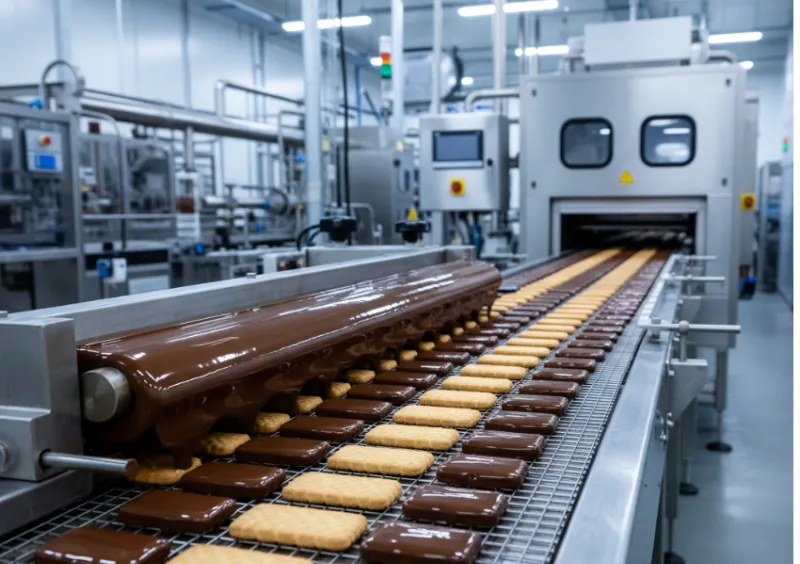
Applying a uniform layer of chocolate is a complex, multi-stage process. The quality of the final enrobed product—its gloss, snap, and shelf stability—is entirely dependent on the precise control of each step.
Tempering: Chocolate must be precisely heated and cooled to encourage the formation of stable cocoa butter crystals, which gives it a glossy finish and satisfying snap.
Application: Stabilized products are transported through a continuous "waterfall" of tempered chocolate, ensuring complete coverage.
Excess Removal: An adjustable blower removes excess chocolate from the top surface, while a vibratory mechanism smooths the surface and a detailer rod removes "tails" from the bottom edge.
Cooling: The freshly enrobed product moves immediately into a multi-zone cooling tunnel specifically designed for setting chocolate, locking in the temper and ensuring a perfect finish.
This entire sequence functions as a single, continuous, and integrated system, enabling the high-volume production of premium coated bakery products.
2.3 Pillar 3: The Final Frontier - Automated Packaging Systems
The final pillar is the
2.3.1 Primary Packaging (HFFS Flow Wrappers)
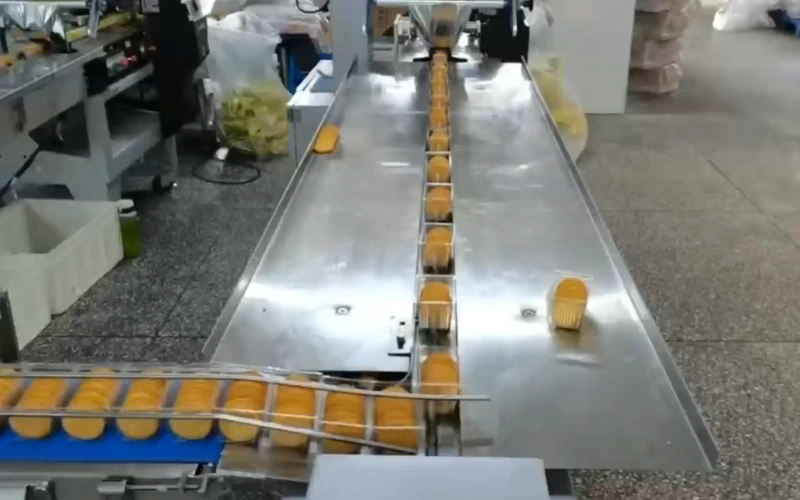
For biscuits and cookies, the dominant technology is the Horizontal Form-Fill-Seal (HFFS) machine, or flow wrapper.
Modified Atmosphere Packaging (MAP) capabilities, flushing the package with a protective gas to significantly extend shelf life.
2.3.2 Secondary Packaging (Cartoners & Case Erectors)
Secondary packaging involves grouping primary packs into multi-packs or retail cartons. Automated cartoning machines streamline this process by erecting cartons, collating products, loading them, and sealing the final package.
2.3.3 Tertiary Packaging (Robotic Palletizing)
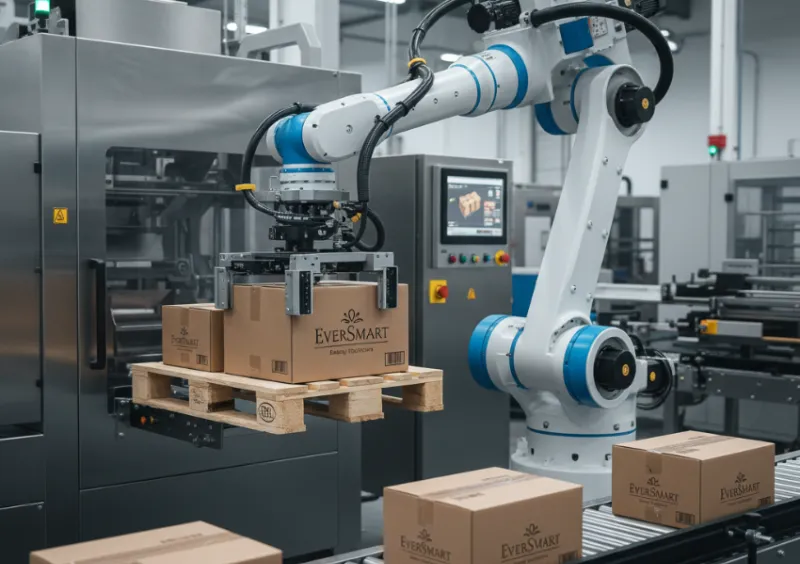
Tertiary packaging prepares sealed cases for bulk transport. Robotic palletizing provides a robust, efficient, and safe automated solution to the physically demanding task of stacking boxes on a pallet.
Part III: The Integration Imperative: From Islands of Automation to a Cohesive Digital Ecosystem
The true competitive advantage in modern bakery production is unlocked not by the performance of individual machines, but by their ability to function as a single, intelligent, and cohesive system. Investing in state-of-the-art equipment without connecting it is a recipe for systemic inefficiency.
3.1 The Problem of Disconnection: "Islands of Automation"
The term "islands of automation" describes a production line composed of highly efficient, yet disconnected, automated cells.
This fragmentation leads to systemic problems:
Production Bottlenecks: Manual hand-offs create chokepoints that starve downstream equipment.
Data Silos: Valuable process data remains trapped within each machine's local controller, preventing system-wide optimization.
Increased Labor and Error: Manual intervention increases labor costs and reintroduces the risk of human error and product damage.
Lack of Flexibility: Product changeovers become a complex series of individual machine adjustments, leading to excessive downtime.
3.2 Building the Digital Bridge: The Automation Hierarchy (PLC & SCADA)
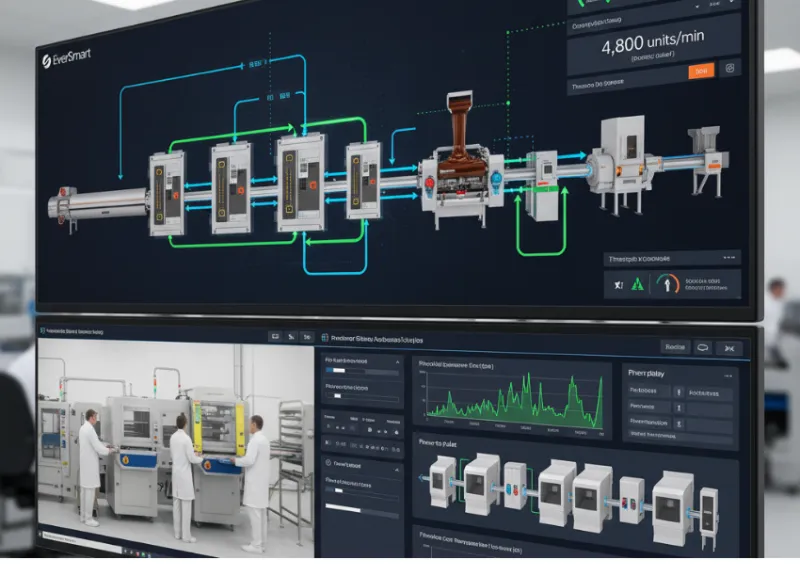
Creating a unified system requires a structured control architecture. The two foundational components are Programmable Logic Controllers (PLCs) and Supervisory Control and Data Acquisition (SCADA) systems.
Programmable Logic Controllers (PLCs): A PLC is a ruggedized, industrial computer that serves as the dedicated "brain" for an individual machine.
Supervisory Control and Data Acquisition (SCADA): A SCADA system operates at a higher, supervisory level, acting as the central "control room" for the entire production line.
This PLC-SCADA relationship forms a two-tiered nervous system, coordinating all machines into a single, goal-oriented production organism.
3.3 The Language of Machines: Industrial Communication Protocols
For PLCs and SCADA systems to communicate, they must speak the same language, defined by an industrial communication protocol.
Key protocols in modern food manufacturing include:
EtherNet/IP: A leading protocol in North America that uses standard networking hardware, simplifying integration between the factory floor and enterprise business systems.
PROFINET: A dominant protocol in Europe designed for high-performance, deterministic data exchange, ideal for high-speed synchronized motion control.
OPC UA (Open Platform Communications Unified Architecture): Rapidly becoming a global standard, OPC UA is a platform-independent architecture from the
OPC Foundation known for its built-in security, complex data modeling, and seamless communication from sensor to cloud, making it ideal for Industry 4.0.
Table 2: Industrial Communication Protocol Selection Guide
Part IV: The Economic Justification: A Comprehensive Framework for Automation ROI
The decision to invest in a fully integrated post-oven automation system is a significant capital expenditure. A successful justification requires moving beyond a narrow focus on direct labor savings to build a comprehensive Return on Investment (ROI) framework.
4.1 Beyond Labor Savings: Identifying the Total Cost of Inefficiency
The most common mistake in evaluating an automation project is to underestimate the true cost of the status quo. A comprehensive ROI analysis must begin by quantifying these hidden costs:
Material Waste: The value of all raw materials, energy, and labor invested in products that are ultimately discarded due to breakage, "checking," or inconsistent portioning.
Unplanned Downtime: The direct loss of potential revenue caused by jams, slow manual changeovers, and bottlenecks between machines.
Quality-Related Costs: Expenses incurred from rework, customer returns, and financial penalties from retailers for out-of-spec products.
Labor Inefficiency and Risk: Costs extending beyond wages to include recruitment, training for high-turnover positions, and ergonomic injuries.
Opportunity Costs: Potential revenues lost due to the inability to bid on large contracts or enter new markets because of insufficient capacity or short shelf life.
4.2 Quantifying the Gains of Integration
Once the total cost of inefficiency is understood, the next step is to quantify the financial benefits of an integrated automated system.
Reduced Waste (Direct Cost Savings): Automation can lead to a 10-20% reduction in raw material waste, a direct saving that drops straight to the bottom line.
Increased Throughput (Revenue Growth): By eliminating bottlenecks, automation can deliver a 10-15% increase in overall throughput, and often much more, without expanding the factory footprint.
Labor Optimization (Cost Reallocation): Automation can reduce direct labor expenses by 40-60% in the post-oven area, allowing personnel to be reallocated to higher-value roles like quality assurance and maintenance.
Enhanced OEE (Efficiency Gain): Integrated automation directly improves all three components of Overall Equipment Effectiveness: Availability, Performance, and Quality.
New Market Access (Strategic Growth): Extended shelf life achieved through better moisture control and MAP packaging can open up previously inaccessible export markets.
Energy Savings: Modern equipment is engineered for efficiency, leading to a 15-25% reduction in energy consumption.
4.3 The Payback Calculation: A Practical Guide
The final step is to consolidate all costs and benefits into standard financial metrics: Return on Investment (ROI) and Payback Period.
Calculate Total Investment (Initial Cost): This includes the purchase price of the equipment plus all associated costs like system design, installation, and training.
Calculate Annual Net Gain: This is the total annual financial benefit, calculated as
(Sum of Annual Savings + New Revenue) - (New Annual Operating Costs).Calculate Simple ROI:
ROI (%) = (Annual Net Gain / Total Investment) * 100Calculate Payback Period:
Payback Period (Years) = Total Investment / Annual Net Gain
The following table provides a hypothetical but realistic example of an ROI calculation for an integrated oven-to-pallet line.
Table 3: Sample ROI Calculation for an Integrated Oven-to-Pallet Line
Conclusion: Your Partner for Post-Oven Excellence
The modern bakery landscape is defined by intense competition, tight margins, and a persistent labor shortage. In this environment, operational excellence is not a luxury; it is a prerequisite for survival and growth. An investment in a seamlessly integrated, automated post-oven system is therefore not an incremental upgrade but a transformative business decision.
The science is unequivocal: a freshly baked product is at its most vulnerable, and failure to manage this state with precision leads to defects, waste, and inconsistency. The solution lies in a holistic system built on three pillars: Controlled Conditioning, Precision Value-Addition, and High-Speed Packaging.
The true power of this system is realized through integration. By creating a cohesive digital ecosystem, bakeries can move beyond inefficient "islands of automation" to achieve a state of continuous, optimized flow.
At EverSmart, our commitment extends beyond providing machinery. We are engineering partners dedicated to designing, building, and implementing robust, efficient, and seamlessly integrated "oven-to-pallet" solutions. Our expertise lies in translating the fundamental physics of your product into a production system that maximizes quality, throughput, and profitability, from the initial
Call to Action
Schedule a Free Line Assessment: Optimize Your Post-Oven Production Today!
Download Our Comprehensive Oven-to-Packaging Integration Checklist.
FAQ Section
Q1: What are the primary benefits of automating the post-oven process?The primary advantages include:
Improved Product Quality and Consistency: Controlled cooling prevents thermal shock and "checking," while precise handling minimizes breakage.
Reduced Operational Costs: Automation significantly reduces material waste, lowers labor costs, and decreases energy consumption.
Increased Throughput: Eliminating manual bottlenecks allows for higher production speeds and greater output.
Enhanced Food Safety: Reducing manual handling minimizes the risk of cross-contamination and ensures full traceability for regulatory compliance with agencies like the FDA).
Extended Shelf Life: Precise control over moisture and the use of technologies like Modified Atmosphere Packaging (MAP) can extend product freshness.
Q2: How does automated cooling prevent product damage?Automated cooling tunnels prevent product damage by precisely managing the rate of temperature and moisture change. This controlled environment directly counteracts:
Thermal Shock: By gradually lowering the product's temperature, an automated tunnel minimizes the thermal gradient between the product's surface and its core, eliminating the root cause of "checking" or micro-cracking.
Moisture-Related Defects: The ability to control humidity allows for optimal management of moisture migration, ensuring crisp products achieve their desired texture without becoming soggy.
Q3: What role does integration play in an automated bakery line?Integration transforms a collection of individual machines into a single, high-performance production system. It eliminates "islands of automation" by creating a seamless flow of both product and data.
Q4: Can automated systems handle various product types and sizes?Yes, modern automated systems are designed for flexibility. Key features include:
Programmable Recipes: Control systems allow operators to store and recall recipes that automatically adjust machine parameters for different products.
Adjustable and Quick-Change Tooling: Many machines feature adjustable guides and tool-less changeover parts to accommodate different product shapes and sizes with minimal downtime.
Servo-Driven Technology: The use of servo motors allows for precise, software-controlled adjustments, making it easier to adapt a machine's operation to a new product.
Q5: How can I calculate the ROI for investing in post-oven automation?A comprehensive ROI calculation involves these steps:
Calculate Total Investment: Sum the full cost of equipment, installation, integration, and training.
Identify and Quantify Current Costs: Audit your existing process to determine the annual costs of material waste, unplanned downtime, quality-related issues, and total labor costs.
Quantify Automation Benefits: Project the annual savings from reduced waste, increased throughput, labor optimization, and energy efficiency.
Calculate Annual Net Gain: Subtract any new annual costs (e.g., maintenance) from the total annual benefits.
Determine ROI and Payback: Use the formulas
ROI (%) = (Annual Net Gain / Total Investment) * 100andPayback Period = Total Investment / Annual Net Gain.
Q6: What makes EverSmart's post-oven solutions unique?EverSmart's uniqueness lies in our holistic, engineering-first approach to creating seamlessly integrated "oven-to-pallet" solutions. We focus on:
Seamless Integration: We ensure all machines communicate flawlessly, eliminating bottlenecks and maximizing line OEE.
Process-First Engineering: We engineer the system around your specific product, ensuring optimal quality and minimal damage.
Robust, Hygienic Design: Our equipment is built for the demanding 24/7 environment of an industrial bakery, with a focus on durability, reliability, and ease of sanitation.
End-to-End Partnership: We act as a single-source partner, managing the project from initial concept through installation, commissioning, and long-term support.
Are you looking to custom your current line for automation upgrading? Our technical team specializes in tailoring for you.
Sofia|Export Vice President | EverSmart 📞 WhatsApp +86 137 94619343 📧 [email protected]

Ready to start your journey toward a customized solution? Contact me directly on WhatsApp to begin the conversation.