The Buffer Zone: Why You Need Accumulation Between Sandwiching and Packing
Introduction: The "Coupled" Nightmare
In a perfectly synchronized world, your Tunnel Oven, Sandwich Machine, and Flow Wrapper would all run at exactly 3,000 biscuits per minute, forever. In the real world, Flow Wrappers stop.
They stop for film splices (30 seconds), jammed products (2 minutes), or code-dater ribbons (1 minute).
The Engineering Problem:
Your Oven cannot stop. If you stop a 100-meter tunnel oven full of biscuits for 2 minutes, you burn 500kg of product. Therefore, if the Wrapper stops, the Sandwicher must stop. And if the Sandwicher stops, the Oven output hits a wall.
The Solution:
You need a system that "buys time" by storing products temporarily. This system is called an Accumulation Buffer.
This guide explores the physics of LIFO (Last-In-First-Out) and FIFO (First-In-First-Out) buffering, helping you calculate the exact storage capacity needed to protect your OEE.
🚀 Key Takeaways
Decoupling: Buffers break the rigid link between the Oven (Continuous) and Packaging (Intermittent).
The 3-Minute Rule: Most packaging stops are under 3 minutes. Your buffer must handle at least this duration.
Chicane vs. Vertical: Use Chicane Conveyors for gentle, high-speed accumulation. Use Vertical Towers for space saving.
The "Catch-Up" Rule: Your wrapper must be 20% faster than your oven to empty the buffer.
System Context: Buffer logic is part of total line integration. See our
. Industrial Biscuit Sandwich Machine Guide
The Physics of "Micro-Stops"
Efficiency loss rarely comes from one big breakdown. It comes from "Death by a Thousand Cuts."
The OEE Calculation
Imagine your line runs at 2,000 ppm.
Film Splice: 30 seconds every 45 minutes.
Jaw Jam: 60 seconds every 2 hours.
Labeler Refill: 2 minutes every 4 hours.
Without a buffer, every stop forces the Oven to "Dump" product. Over an 8-hour shift, these micro-stops can add up to 45 minutes of lost production (nearly 10% capacity).
External Resource: Understand the impact of
(Availability Loss). Six Big Losses in OEE
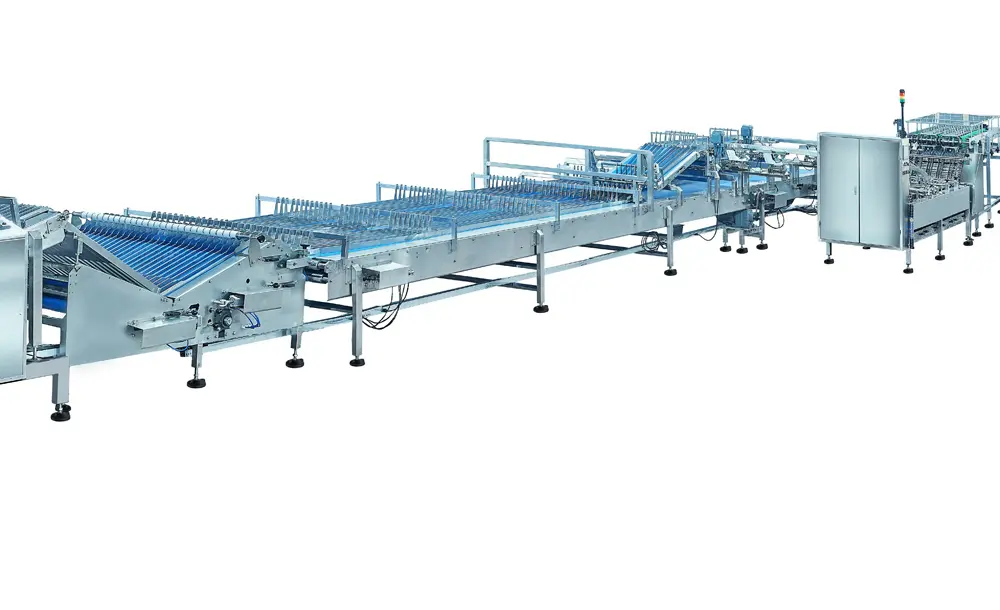
Technology A: The Chicane (Loop) Conveyor
This is the standard for high-speed sandwiching lines.
The "Expanding Belt" Concept
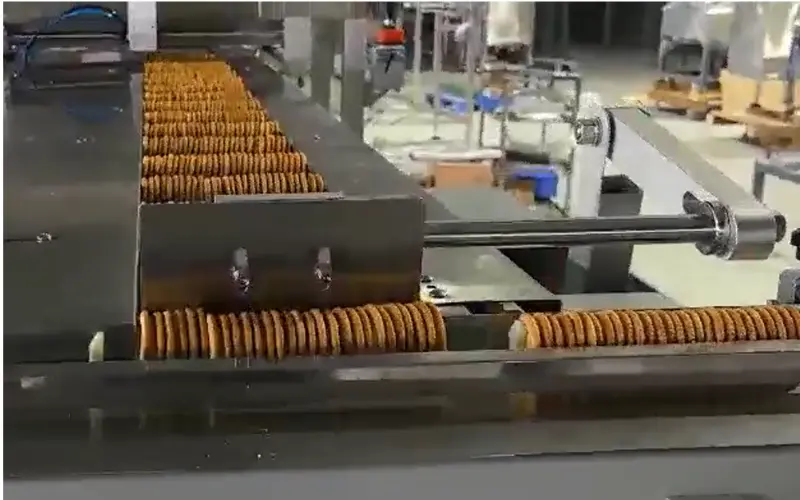
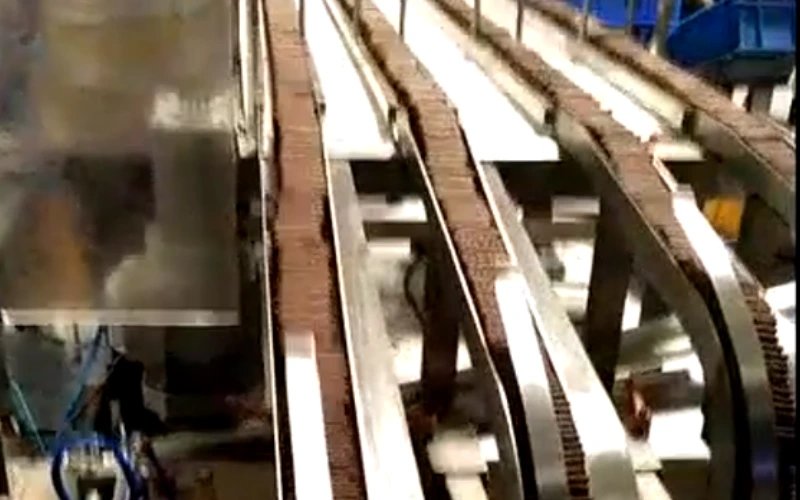
Imagine a conveyor belt that can stretch. A Chicane Buffer consists of a belt loop running around a moving carriage.
Normal Run: Carriage is at inlet (Short path).
Accumulation: Wrapper stops. Carriage moves back (Long path). Biscuits flow onto this "new" length.
Discharge: Wrapper restarts. Carriage moves forward, pushing stored biscuits out.
Pros: FIFO (First-In-First-Out). Critical for maintaining cooling sequence.
Cons: Requires significant floor length.
Layout: Check if you have space with our
Biscuit Factory Layout Optimization Guide
Technology B: The Vertical Buffer (Tower)
If you don't have floor space, you go up.
The "Alpine" or "Paternoster" System
Mechanism: The conveyor belt spirals up a tower and down again.
Logic: Usually LIFO (Last-In-First-Out). Wrapper stops $\rightarrow$ Divert to Tower. Wrapper restarts $\rightarrow$ Merge back.
Pros: Small Footprint (2m x 2m). High Capacity.
Cons: More transfer points = Higher breakage risk.
Sizing Your Buffer (The Math)
Do not guess. Calculate.
The "3-Minute" Standard
Most stops take less than 3 minutes.
Line Speed: 2,000 biscuits/minute.
Target Buffer: 3 minutes.
Capacity Needed: 6,000 biscuits.
Linear Length Calculation:
Pitch (Space): 60mm.
Belt Length Needed: 6,000 x 0.06m = 360 meters.
Wait... 360 meters? That is too long for one belt.
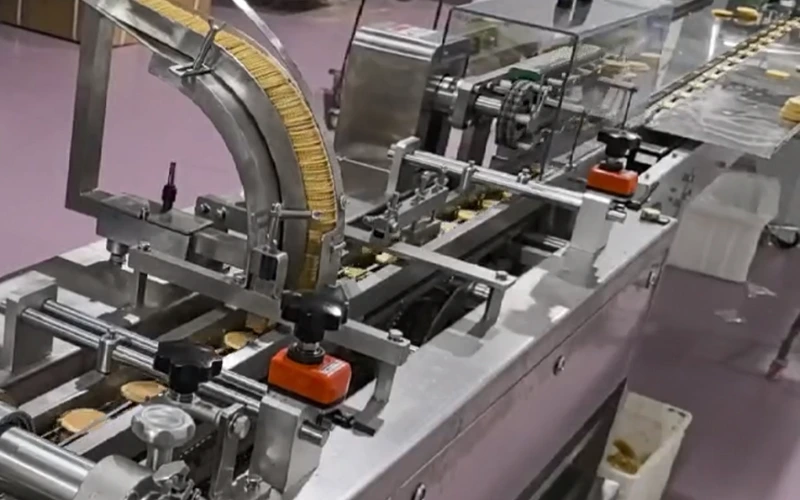
The Fix: Stack biscuits (Penny Stacker) before the buffer to store "On-Edge" slugs. This reduces length requirement by 10x.
The "Catch-Up" Speed
Having a buffer is useless if you can't empty it.
If your Sandwicher produces 2,000 ppm and your Wrapper runs at 2,000 ppm, the buffer will never empty after the first stop.
The Golden Rule: Your Packaging Machine must be 20% faster than your Sandwich Machine.
Sandwicher: 2,000 ppm.
Wrapper: 2,400 ppm.
Logic: When the wrapper restarts, it runs at 2,400 ppm. It consumes the 2,000 ppm from the oven PLUS 400 ppm from the buffer, draining it for the next stop.
Syncing: Learn how to manage this speed ramp in
Biscuit Sandwicher & Flow Wrapper Synchronization 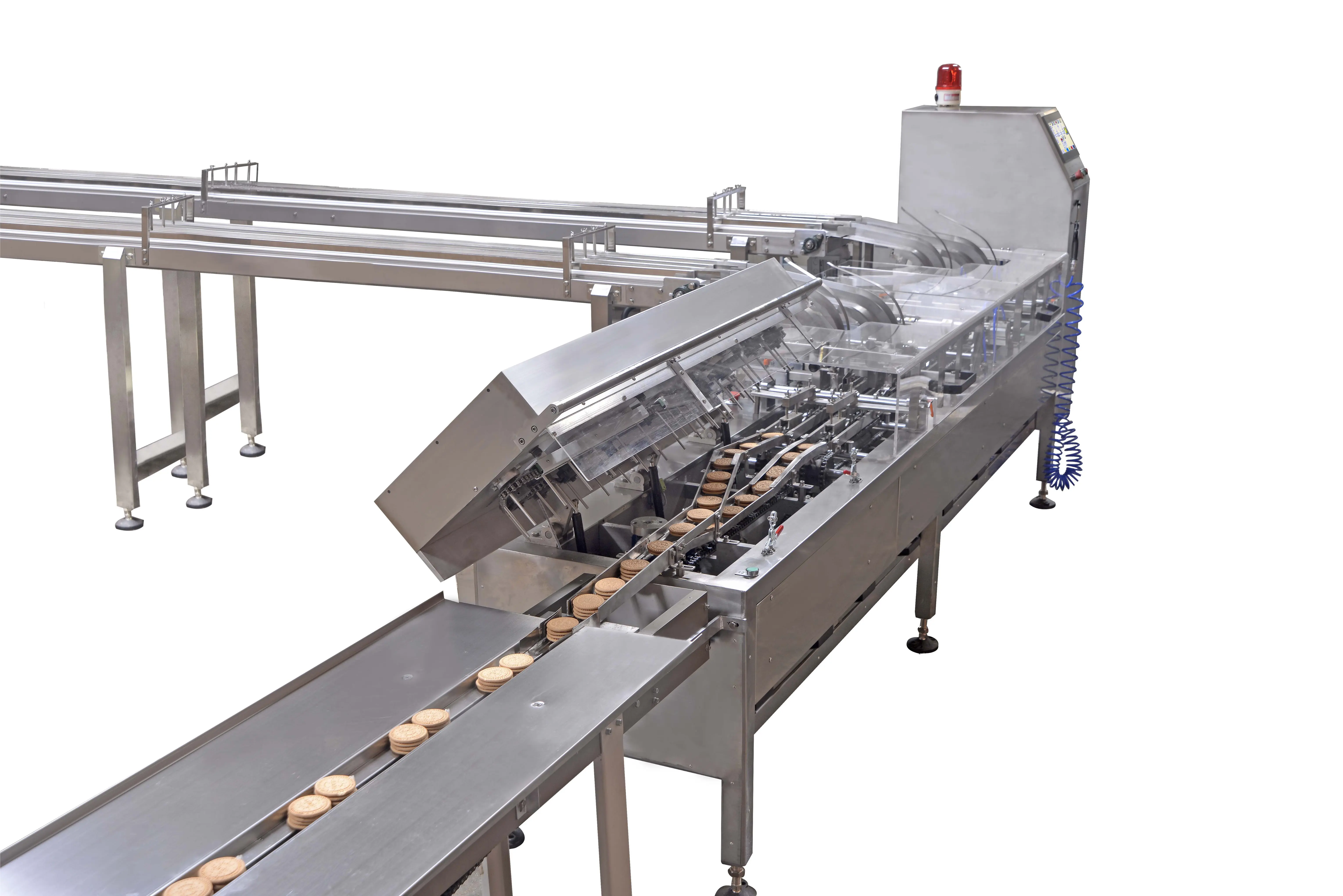
Troubleshooting Buffer Issues
| Symptom | Probable Cause | Corrective Action |
| Biscuits Sliding | Acceleration too fast. | Reduce "Catch-Up" ramp rate in PLC. |
| Buffer Full Alarm | Wrapper too slow. | Increase Wrapper max speed to drain buffer. |
| Product Crushing | LIFO merge pressure. | Adjust sensor logic on re-entry gate. |
| Belt Tracking | Tension fluctuation. | Check pneumatic tensioners on carriage. |
FAQ: Line Control
Q1: Where should the buffer go?
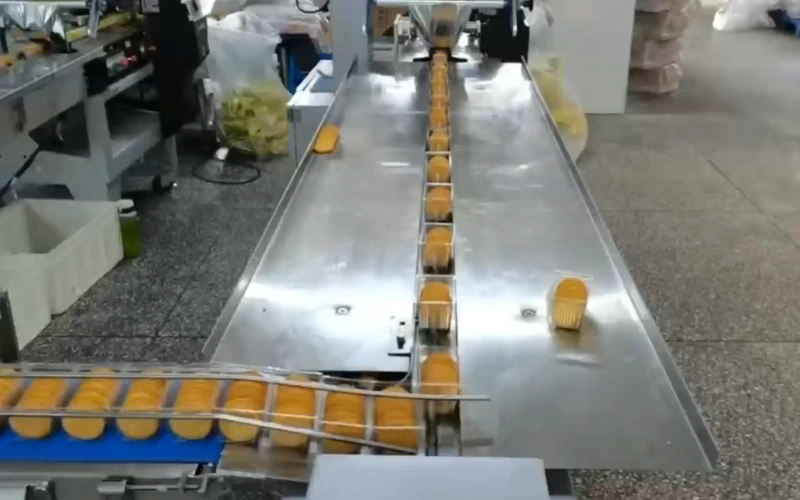
A: Ideally after the Sandwicher and before the Wrapper. This protects the Sandwicher from stopping.
Q2: Can I use a simple "Dead Plate" table?
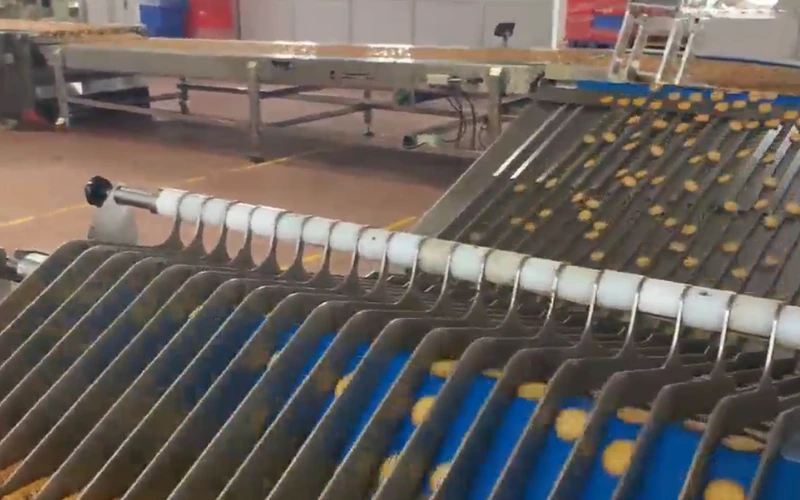
A: Only for manual packing. For high-speed automation, static tables cause shingling. You need active belts.
Q3: How much does a buffer cost?
A: A Chicane system costs roughly $40k - $80k. Compare that to burning 500kg of biscuits once a week. ROI is usually < 12 months.
Conclusion: The Insurance Policy
A Buffer System is an insurance policy for your OEE. By decoupling your critical asset (The Oven) from your volatile asset (The Wrapper), you ensure that a 30-second film change doesn't turn into a $1,000 waste event.
The EverSmart Advantage: Our Smart-Flow Logic integrates the Buffer controls directly into the Sandwicher HMI, giving operators a visual "Time Remaining" countdown.
Stop the Stops.
Calculate how much production you lose to micro-stops.
[CTA Button]Whatsapp us today for :
Size Your Buffer System
Input your line speed. Get the engineering specs.

Ready to start your journey toward a customized solution? Contact me directly on WhatsApp to begin the conversation.