How to Integrate a Biscuit Flipper with Your Sandwiching Machine: An Engineer's Guide
By: Marcelo Vargas, Senior Project Engineer at EverSmart
With over 12 years of experience in bakery automation, Marcelo has managed the successful installation of over 150 biscuit production lines, specializing in servo synchronization and line balancing.
A successful integration is the final, critical step in implementing a successful
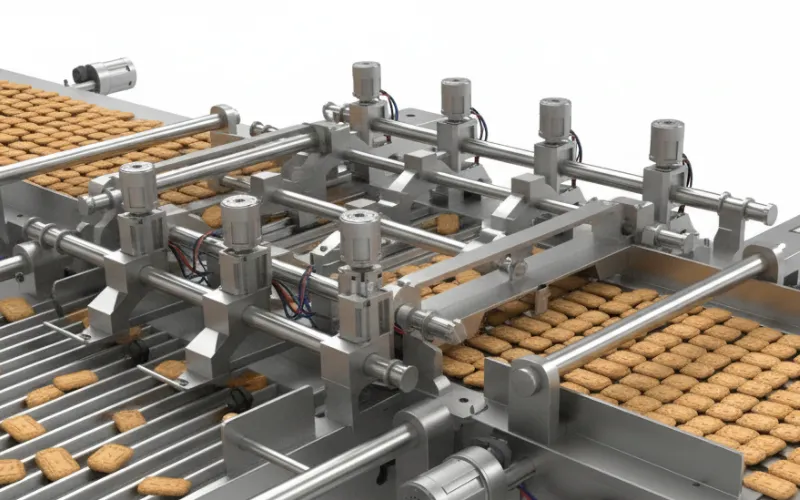
This guide provides a technical, step-by-step framework for engineers and project managers to achieve a seamless, high-speed integration that maximizes reliability and product quality.
Pre-Installation Audit: The Foundation of a Successful Integration
Rushing the planning phase is the number one cause of integration failure. Before physical installation begins, a thorough audit is non-negotiable.
The 5-Point Pre-Installation Checklist
[ ] 1. Spatial & Structural Analysis: Verify floor plan, ceiling height, and confirm the floor can support the machine weight.
[ ] 2. Upstream & Downstream Line Analysis: Audit the cooling conveyor and the sandwiching machine's infeed mechanism. Document the make and model for compatibility.
[ ] 3. Utility & Service Requirements: Confirm power, compressed air, and network connectivity are available at the point of use.
[ ] 4. Control System Compatibility: Identify the PLC and HMI models of all machines and plan the communication protocol.
[ ] 5. Product Specification Confirmation: Finalize the exact dimensions, weight, and fragility of all biscuit varieties to be run.
⚙️ Pro Tip: A successful integration project directly impacts your financial returns. Planning for minimal downtime is a key part of the
ROI calculation for your biscuit flipper .
The 3-Phase Integration Methodology: Mechanical, Control, & Process
A structured approach prevents overlooked details.
Phase 1: Mechanical & Spatial Integration
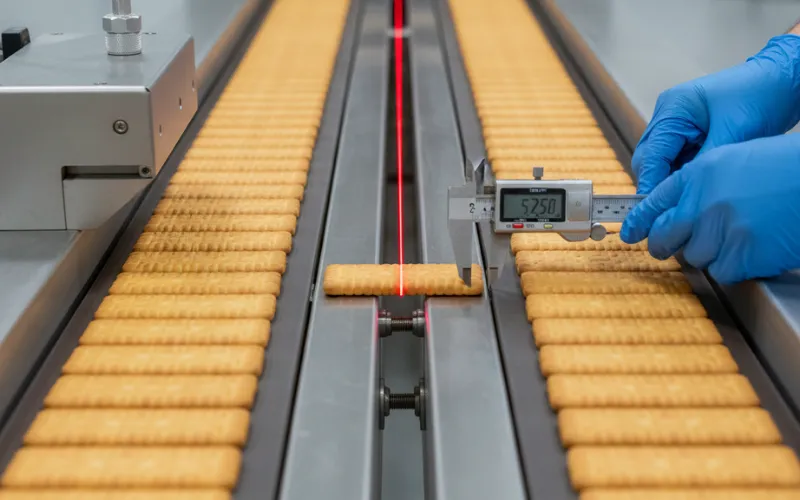
Achieving Perfect Centerline Alignment: Use laser alignment tools to ensure the discharge of the flipper and the infeed of the sandwiching machine share an exact centerline.
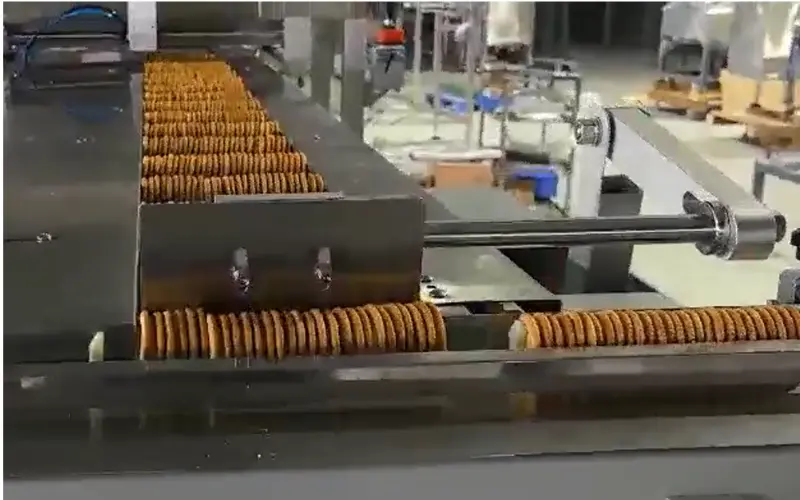
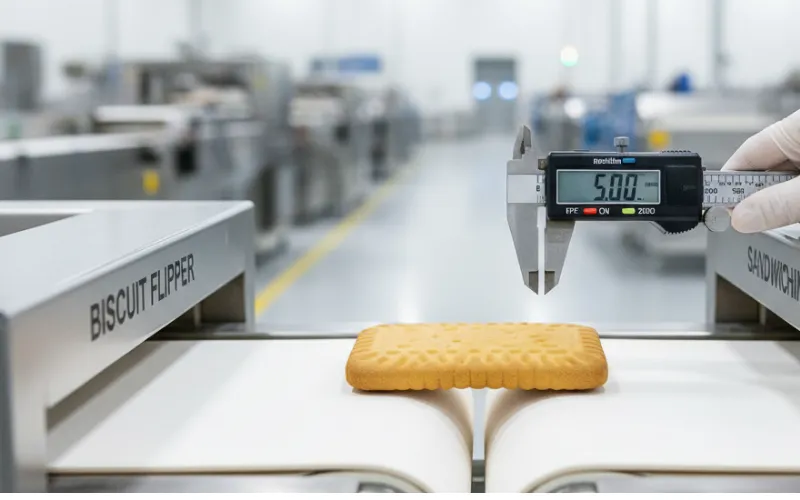
"Transfer Gap" Optimization: The physical gap between conveyors must be minimal (typically 3-5mm) to prevent biscuits from dropping or tipping.
Phase 2: Control System & Synchronization
This is the "nervous system" of your integrated line.
Master-Slave Configuration: Typically, the sandwiching machine acts as the Master, providing a speed reference signal to the flipper as the Slave.
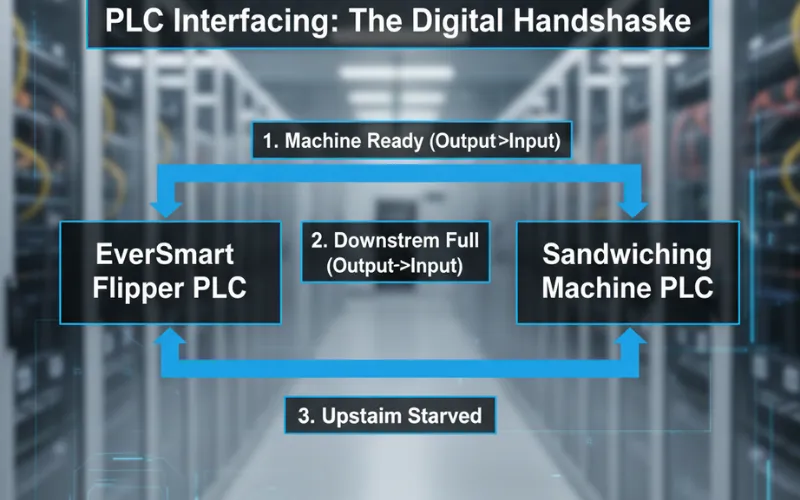
The Digital "Handshake": The PLCs must communicate constantly via I/O interfacing for three essential signals:
Machine Ready: The flipper is ready to send product.Downstream Full: The sandwiching machine tells the flipper to pause.Upstream Starved: The flipper detects a lack of biscuits and signals standby.
Phase 3: Commissioning & Process Validation
"Dry-Run" Synchronization: Run the line without product to validate the mechanical and control system integration.
Product Testing: Use test biscuits to validate the flip and transfer at low speed, then gradually ramp up. This is especially critical for small, high-volume products, as seen in the
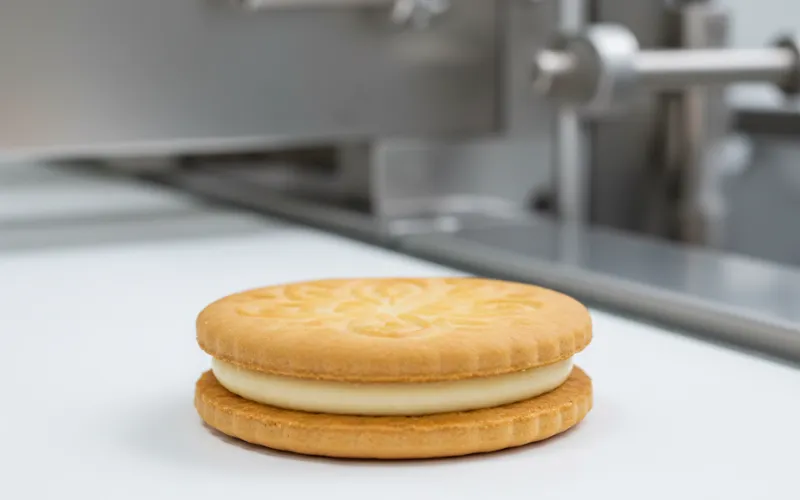
Mini Oreo manufacturing process .Fine-tuning for Cream Spread: A poor cream spread can often be traced back to a misaligned biscuit entering the creaming head, indicating a need for final fine-tuning.
Troubleshooting Common Integration Challenges
Problem: Biscuits are misaligned entering the sandwiching machine.
Solution: Re-check and laser-align the centerline, then adjust the guide rails. For persistent issues, see our
Biscuit Flipper Troubleshooting Guide .Problem: Biscuits break during the transfer.
Solution: This is often a "hard transfer." Fine-tune the speed match between the machines. For delicate products, our guide on
Flipping Delicate Biscuits Without Breakage is essential.
FAQ: Answering Critical Integration Questions
1. Can you integrate a new flipper with an older, non-servo sandwiching machine?
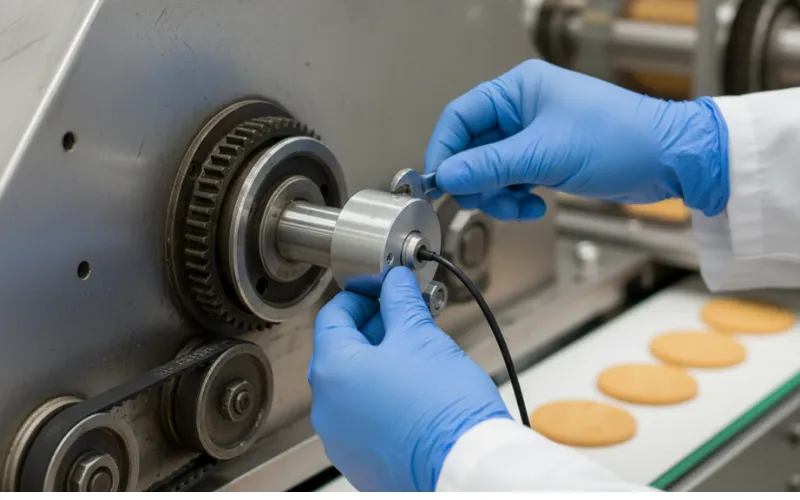
Yes, but it requires retrofitting an encoder on the older machine's main drive shaft to provide the necessary speed reference signal to the new, servo-driven flipper.
2. What is the single most important factor for a successful integration?
Precision alignment. Every other control system adjustment is built upon a foundation of perfect mechanical alignment.
3. How long does a typical integration project take?
For a standard line in a factory in Brazil or elsewhere, allow 3-5 days for mechanical and control integration, plus 1-2 days for product validation and fine-tuning.
Conclusion: Integration is a Partnership
Integrating a biscuit flipper is a precise engineering discipline. By following a rigorous methodology, you can transform this critical handoff from a potential bottleneck into the most reliable section of your production line.
To learn more about the specific technology being integrated, explore our main
For the broader strategic context, we invite you to return to our central pillar page:
Ready to plan your integration? Our project engineering team can provide a free integration audit of your line.
Sofia | Export Vice President | EverSmart
WhatsApp: +86 137 94619343
Email: [email protected]

Ready to start your journey toward a customized solution? Contact me directly on WhatsApp to begin the conversation.