The Mini Oreo Flipping Problem: A Smart Semi-Auto Solution for Small Manufacturers
Small Cookies, Big Strategy: How Small & Medium-Sized Factories Can Win the Mini Oreo Production Game
Introduction: The Challenge of Going Small
In the fiercely competitive snack market, OREO has become more than just a cookie. It is a global cultural icon.
Within this empire, the Mini Oreo has successfully carved out new consumer scenes and markets. It has done so thanks to its convenient size, shareability, and lower single-serving calories.
However, for many ambitious small and medium-sized (SMB) biscuit factories, entering this lucrative market isn't blocked by a secret recipe or basic baking techniques.
The barrier is the "flipping problem"—a seemingly simple but operationally critical step in the assembly process.
Traditional vibrating feeders on sandwiching machines are practically useless for a cookie just 25 millimeters in diameter.
Meanwhile, manually sorting the cookies by front and back is a non-starter, failing on every metric of cost, efficiency, and sanitation.
The key to breaking through is a specialized, semi-automatic sandwiching machine integrated with machine vision.
This solution brilliantly combines "recognition, flipping, and capping" into one powerful piece of equipment.
It empowers SMB factories to precisely conquer the core technical challenge of Mini Oreo production with a reasonable investment, achieving efficient, high-quality, semi-automated manufacturing.
Key Takeaways
The Core Bottleneck: The ultimate challenge for SMBs in Mini Oreo production is the 25mm "flipping problem." Traditional vibratory bowl feeders and manual sorting are economically and logistically unviable.
The Technical Breakthrough: A specialized capper integrating machine vision (with >99.5% recognition) and precision mechatronics is the only efficient, semi-automatic solution that enables "dump-and-run" production.
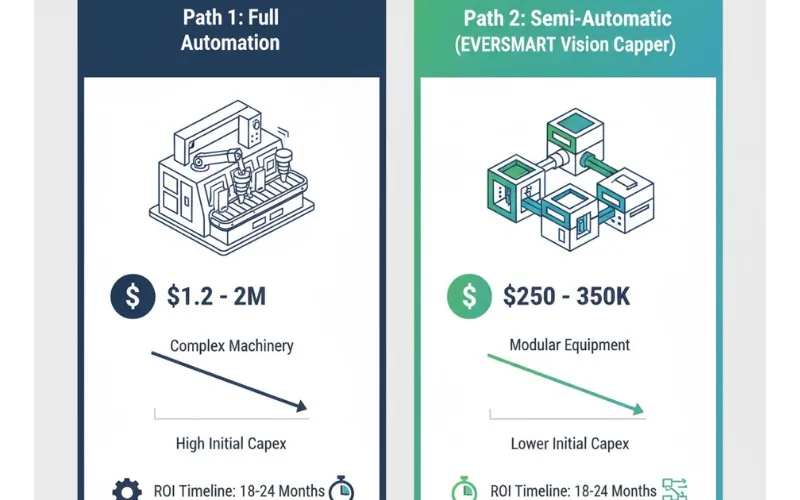
The Financial Advantage: The "smart semi-automatic" approach slashes initial investment (Capex) to 1/5th to 1/4th of a fully automated line. It offers a clear path to profitability with a 18-24 month ROI and manageable risk.
Quality Assurance: By establishing MES Quality Control Points on the line, this system ensures product consistency—from pre-production (material inspection) to in-process (secondary vision checks).
The Strategic Path: This solution allows factories to bypass heavyweight competition. It opens up lucrative niche markets like food service and private-label branding, leveraging a "low-volume, high-mix" production flexibility.
1. Opportunity vs. Challenge: Why Mini Oreos are a "Strategic High-Ground" for SMB Factories
1.1 The Unignorable Niche Market
The success of the Mini Oreo was no accident.
It perfectly meets modern consumer demands for "portion control," "on-the-go snacking," and "social shareability."
Compared to the standard OREO, it's more easily consumed as a casual snack.
It is also more frequently used as an ice cream inclusion (like in the OREO McFlurry and Dairy Queen OREO Cookie Blizzard) and as a baking ingredient (like in no-bake Mini OREO cheesecakes).
This diverse range of applications opens up an expansive market.
For factories interested in how to start a Mini Oreo bakery business, this means they don't have to compete head-to-head with industry giants on mainstream supermarket shelves.
Instead, they can penetrate niche markets, such as supplying local restaurants, ice cream parlors, and bakeries with customized or private-label products.
Note: The market opportunity isn't just in retail bags. It's in supplying the B2B food service market, an area where SMB factories can quickly build a strong competitive advantage.
1.2 The Unique Dilemma for Small Factories
Despite the promising market, small factories face two core difficulties when trying to enter.
The Capital Barrier: A fully automatic, end-to-end Mini Oreo production line is a massive engineering project. It involves precision rotary molding, climate-controlled baking, and high-speed capping and packaging, making the investment enormous and technically complex.
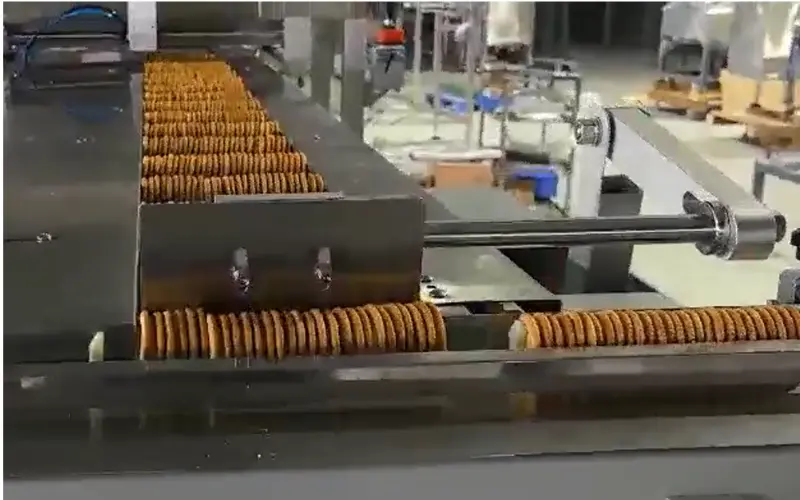
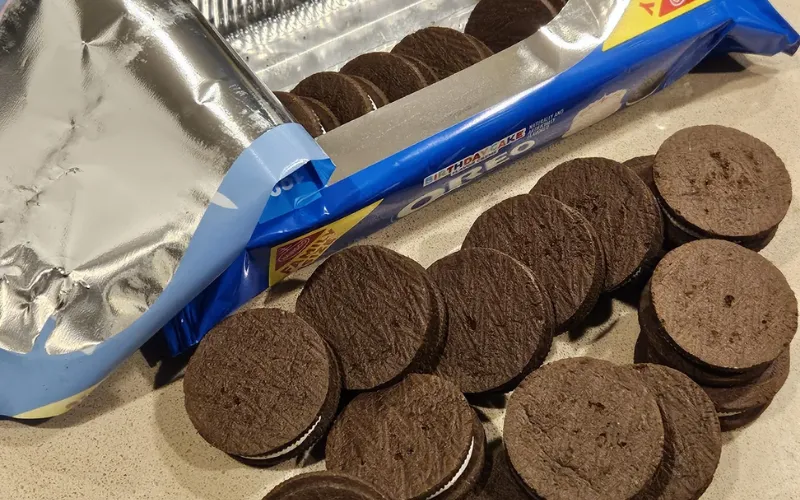
The Core Bottleneck: The 25mm "Flipping Problem": This is the most specific and difficult technical hurdle. During the sandwiching process, both cookies must have their embossed (patterned) side facing out, with the flat side facing in to hold the cream.
For standard-sized cookies, a traditional vibrating feeder can sort them by their physical properties, or they can even be managed by hand.
But at a tiny 25mm diameter, manual sorting is completely unrealistic from an efficiency standpoint and guarantees high rates of breakage.
Simultaneously, traditional sorting methods fail because the cookies are too small and light. This leads to jamming, incorrect sorting, and inaccurate flipping, which in turn causes a massive number of defects.
This is the exact production-floor origin of the consumer complaint you see on Reddit: "Every single OREO in my package came with the bottoms flipped the wrong way."
The only viable answer to this problem is a highly efficient biscuit orientation automation technology.
Tip: When evaluating project feasibility, don't just focus on the baking process. The "assembly success rate" must be treated as a primary KPI, as it directly determines the project's profitability and your product's reputation.
2. The Breakthrough: An Intelligent Solution to the "Flipping Problem"
2.1 The Limits of Traditional Approaches and Their Costs
Faced with the "flipping problem," factory owners typically see two traditional paths.
The first is to invest in a complete, fully automated line, which creates excessive financial pressure for an SMB.
The second is to try and modify existing equipment or rely on manual labor, which inevitably leads to low efficiency and inconsistent quality.
Neither option strikes an acceptable balance between cost and performance.
2.2 The EVERSMART Semi-Automatic Vision Capper: A Tailor-Made Answer
Targeting this exact market gap, the EVERSMART Mini Oreo Capper was engineered.
It doesn't chase full "lights-out" automation. It focuses on solving the single most critical bottleneck, making it the perfect transitional solution for achieving flexible production and intelligent upgrades.
Technical Deep Dive: Core Parameters and Workflow
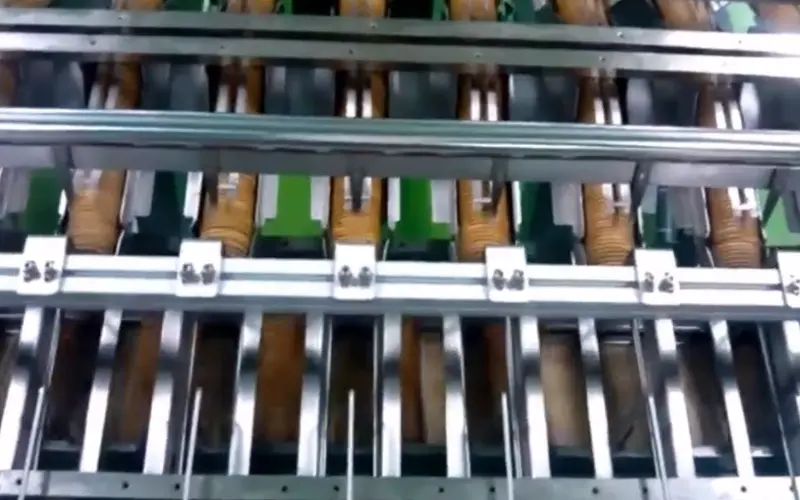
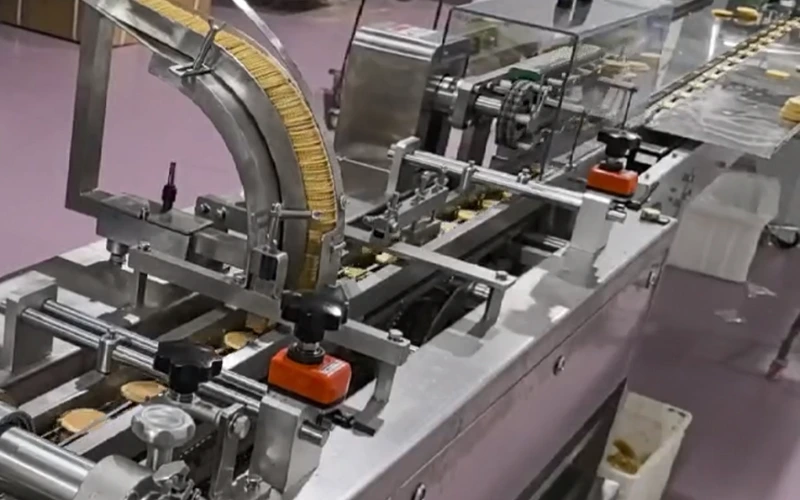
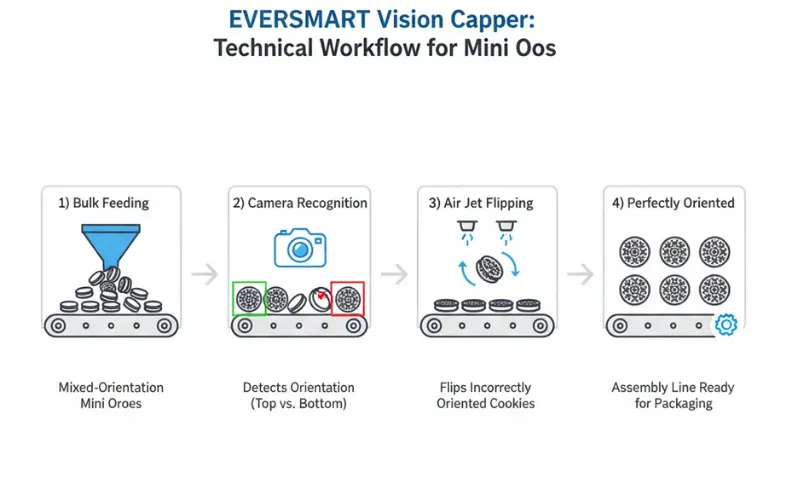
The heart of the EVERSMART solution is a specialized sandwiching machine integrating a high-speed machine vision system with a precision mechatronic execution module.
Its workflow and key performance indicators (KPIs) are as follows:
Visual Recognition: The system uses industrial-grade CCD sensors from top-tier brands like Keyence or Cognex, featuring a 1280x1024 resolution. It acquires images at a rate of 3,000 to 3,500 cookies per minute. The system compares the image of each cookie against a pre-stored "correct/frontal pattern" template.
Intelligent Decision-Making & Flipping: Image processing is handled by an integrated PLC (Programmable Logic Controller), which makes a "front" or "back" judgment in under 50 milliseconds. If a cookie is identified as "inverted," the system instantly triggers a high-frequency piezoelectric valve (Piezo Valve). This valve releases a precise pulse of air, flipping the specific cookie in 2-5 milliseconds with an accuracy rate exceeding 99.5%.
Precision Capping (Assembly): The correctly-oriented cookies then move to the depositing station. A servo-driven positive displacement pump ensures the cream deposit is controlled within an exceptionally tight tolerance of 0.07-0.15 grams.
Case Study: Transformation of a Southeast Asian Bakery Supplier
A factory in Vietnam, which primarily supplied bulk biscuits to local dessert shops, had abandoned its Mini Oreo product line after failing to solve the flipping problem.
After integrating the EVERSMART Vision Capper, the factory achieved a true "Dump and Run" production model.
Their single-shift output increased to 120 kg per day.
More importantly, the product defect rate (mainly visual defects like flipped cookies) plummeted from an initial attempt of over 30% down to less than 3%.
This success allowed them to win contracts with new, emerging coffee shop and bakery chains.
Note: The core value of this equipment is its "decision-execution" capability. It replaces the human eye with machine vision and the human hand with precision mechatronics. Its speed, accuracy, and endurance far exceed manual labor, making it a classic "machine-for-human" application with a very high ROI.
3. Building a Semi-Automatic Mini Oreo Line Around the "Smart Capper"
Owning a smart sandwiching machine is the key.
But you unlock its maximum value by integrating it into a coordinated production line.
3.1 Upstream (Front-End): The Foundation
This part of the line includes dough preparation (mixing flour, sugar, cocoa), rotary molding (using a mould engraved with the classic OREO pattern), and baking and cooling.
The good news for SMB factories is that this equipment is relatively standard.
Furthermore, it is fully compatible with the EVERSMART Vision Capper.
This allows factories to often upgrade or utilize their existing baking equipment, effectively controlling the initial investment.
3.2 The Core (Mid-Stream): The Brain and Heart
The EVERSMART Vision Capper is, without question, the "brain" and "heart" of the entire line.
It receives the baked cookies from upstream, performs the critical task of recognition and assembly, and sends the finished product downstream.
Its stability and efficiency directly determine the final output speed and quality.
This machine is, in essence, a highly specialized biscuit capper machine.
But its technical sophistication is far beyond that of a standard capper, thanks to its integrated vision and intelligent flipping capabilities.
3.3 Downstream (Back-End): Packaging and Final Product
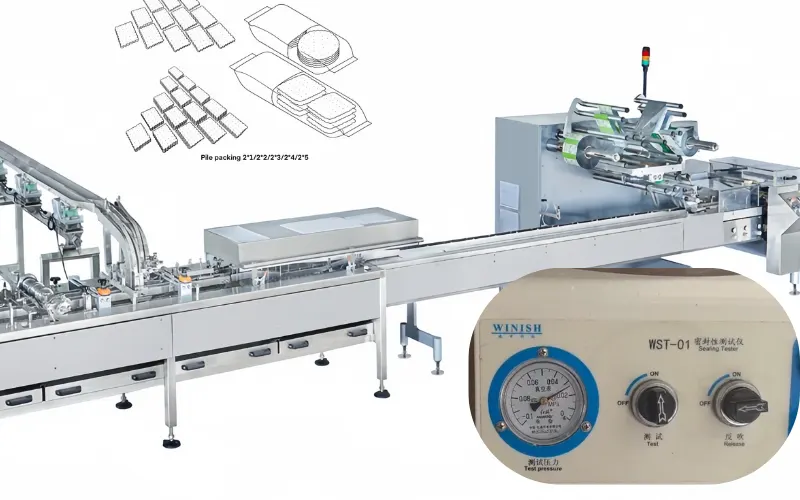
After the Mini Oreos are sandwiched, they can be fed into a semi-automatic packaging solution, such as a vertical form-fill-seal (VFFS) machine.
Factories can choose packaging equipment with varying levels of automation based on their capacity needs and budget.
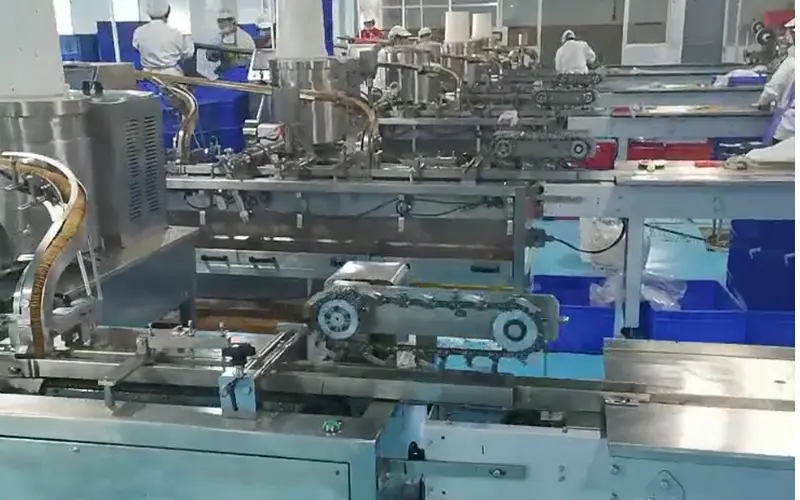
This creates a complete, coherent, and highly cost-effective production line from raw materials to the final sealed product.
A Multi-Role Perspective: The CFO on Investment & ROI
For a Chief Financial Officer (CFO), choosing the "smart semi-automatic" path is fundamentally an exercise in lean investment.
Initial Investment (Capex) Analysis:
A fully automated, end-to-end Mini Oreo line typically costs between $1.2 million and $2.0 million USD.
In contrast, building a medium-capacity line (150-200 tons/year) centered around the EVERSMART Vision Capper can control the initial investment to between $250,000 and $350,000.
This budget primarily covers the mixer, moulder, oven, the EVERSMART Vision Capper, and semi-automatic packaging equipment.
Operating Costs (Opex) and Break-Even Point:
Direct Labor: A semi-automatic line requires a crew of 4-5 operators. This is a controlled, predictable cost and far leaner than a manual workshop.
Overall Equipment Effectiveness (OEE): Factoring in changeovers, cleaning, and minor stops, a semi-automatic line can realistically achieve an OEE of 65%-75%. This is a highly economical and profitable rate for a "low-volume, high-mix" production model.
Break-Even Point: Based on current market costs for commodities (cocoa, sugar, fats), a typical semi-automatic line can achieve its break-even point and pay back the investment within 18 to 24 months. This is a very acceptable payback period.
Risk Control (The Modular Advantage):
Another key financial benefit of this solution is its modularity.
A factory can first conquer the core "capping" process, handling the final packing manually or semi-automatically.
Once sales volume is proven and cash flow is positive, they can easily invest in upgrading the downstream high-speed packaging.
This enables a phased investment strategy and dramatically lowers upfront risk.
Tip: We strongly recommend a phased investment strategy. First, conquer the core capping process to get your product from "0 to 1." Once the market is proven and cash flow is established, you can then upgrade your baking and packaging lines to scale from "1 to 10."
A Multi-Role Perspective: The QC Engineer on Total Quality Management
Quality Control (QC) must shift from "post-production inspection" to "in-process prevention."
Using a modern Manufacturing Execution System (MES), we can achieve this by establishing digital Quality Control Points (QCPs).
Incoming Material Inspection (Pre-Production):
Flour & Cocoa: Monitor protein content, moisture, and fineness (particle size). We establish a Measurement QCP to sample and test every incoming batch, ensuring its rheological properties meet the standard.
Packaging Film: For the FFS packaging process, we set a Pass/Fail QCP. We periodically test the film's heat-seal strength and opacity to ensure it can withstand high-speed packaging.
In-Process Quality Control (Production):
Baking: Temperature sensors are placed in the multiple zones of the tunnel oven. This data is fed back to the control system in real-time, triggering an alert if the temperature fluctuates more than ±3°C.
Capping (Assembly): The EVERSMART vision system can be upgraded to perform a secondary quality check after flipping. It can inspect the cream deposit volume, its concentricity (is it centered?), and the cookie's integrity (is it broken?). Any product that deviates from the standard is automatically rejected.
Final Inspection & Traceability:
We conduct periodic sampling of the final product. A Randomized QCP can be set to test, for example, 3% of the finished goods for net weight, water activity, and sensory evaluation.
All quality data is logged, creating a complete traceability chain.
If a customer complaint occurs, management can instantly pinpoint the exact batch and review all associated production data.
4. Beyond Technology: A Differentiated Strategy for Small Factories
Mastering the production technology just gets you in the game.
To stand out, small factories must leverage their key advantage: being nimble.
Flexible Production and Rapid Innovation:Large-scale, fully automated lines are designed for one thing: producing a single product, at high speed, for a long time. Changing a mold or a recipe is a costly, time-consuming event.
A semi-automatic line, however, has natural flexibility.
A factory can easily use the same line to produce different Mini Oreo flavors.
They can develop specialty tastes like strawberry or matcha, or even experiment with inclusions in the cream filling, allowing them to respond to niche trends almost instantly.
The Perfect Balance of Quality and Cost:By using a smart vision capper, the factory can guarantee a high qualification rate (typically >99.5%) for its product's appearance.
At the same time, by automating the most skilled part of the process, it reduces dependency on trained labor, stabilizes quality, and controls overall production costs.
The Dual-Wheel Drive: OEM to Brand:Owning this production capability opens two strategic doors.
On one hand, the factory can take on OEM/ODM contracts from restaurants, hotels, and snack brands, becoming a critical part of the supply chain.
On the other, and more importantly, the factory can use this as an opportunity to build and nurture its own biscuit brand.
Note: The core of a differentiated strategy is not being the cheapest. It's about being uniquely valuable. The ability to quickly deliver small, customized batches is the most powerful weapon an SMB can wield against a giant.
5. Conclusion
In the race to produce Mini Oreos, small and medium-sized factories don't need to engage in a head-to-head capital battle with industry giants.
The strategic key is to use intelligent, high-leverage equipment to solve the single most critical technical bottleneck.
The EVERSMART Vision Capper provides more than just an engineering solution to the "flipping problem."
It provides a gateway for SMBs to enter a high-value-added product market.
This is a pragmatic, efficient, and highly competitive path forward. It makes "small-batch, smart-made" a profitable reality and is a powerful engine for any factory's transformation and growth.
Frequently Asked Questions (FAQ)
1. Q: I saw a complaint on Reddit that "every single OREO in my package came with the bottoms flipped the wrong way." How does this happen in production?A: This is a classic "orientation failure" at the sandwiching stage. On a high-speed line, it means the mechanical sorter failed. On a semi-automatic line, it's what happens when you rely on tired or inconsistent manual sorting. It highlights the critical need for a high-precision biscuit orientation automation system, like the EVERSMART vision solution, which virtually eliminates this defect.
2. Q: How much does a semi-automatic line like this cost?A: The investment varies based on configuration and capacity. However, a semi-automatic line built around the EVERSMART Vision Capper is a fraction of the cost of a fully automated line, often only 1/5th or less. For a more detailed breakdown of the costs involved, we recommend reading this guide on starting a Mini Oreo bakery business.
3. Q: Do Mini Oreos taste different from standard OREOs?A: Yes, there are subtle differences. Because of its smaller size, the Mini Oreo has a different surface-area-to-volume ratio during baking, which often results in a crispier texture. The cookie-to-cream ratio is also different, which can make each bite feel more concentrated or balanced, depending on personal perception.
4. Q: Besides eating them plain, what are some creative uses for Mini Oreos?A: Mini Oreos are a fantastic dessert ingredient. They are commonly used to make no-bake cheesecakes, as a mix-in for ice cream (like the McFlurry or Blizzard), to top mousse cups, or even as an inclusion inside a chocolate bar, adding texture and flavor.
5. Q: My factory space is limited. Does this equipment have a large footprint?A: The EVERSMART Semi-Automatic Vision Capper is designed to be compact, specifically to save space in SMB factories. The entire semi-automatic line (from feeding to packing) can be flexibly planned to fit your workshop's layout. The core biscuit capper machine module itself is compact but incredibly powerful.
Professional Consultation (CTA)
Are you looking for an upgrade path for your biscuit factory to capture the Mini Oreo market opportunity?
Our engineering team specializes in customized production solutions for small and medium-sized food enterprises.
We can support you with everything from evaluating your current equipment to providing targeted investment advice, ROI analysis, and detailed technical specifications (like camera accuracy and flipping speed).
Take action to intelligently upgrade your production line today.
Contact us to receive detailed technical data on the EVERSMART Vision Capper, explore more case studies, and get a preliminary, customized proposal for your factory.
Let's work together to turn your great idea into a great product.

Ready to start your journey toward a customized solution? Contact me directly on WhatsApp to begin the conversation.