The Engineering Guide to Industrial Wafer Production: Process, Efficiency & ROI
Introduction

Wafer cookies are made from a thin, fluid batter of flour, fat, sugar, and leavening, baked between hot plates into crisp sheets, then layered with sweet, flavored creams (like vanilla, chocolate) and cut to size, creating their signature light, crispy texture and layered structure. The process involves mixing batter, baking thin sheets, applying creamy fillings, stacking layers, and finally cutting into individual cookies.
But for the plant manager or process engineer, the definition goes much deeper.
It is a high-stakes balancing act of thermodynamics and fluid mechanics.
In an industry where a 1% scrap rate reduction can mean thousands of dollars in monthly savings, understanding the nuance of every process step is not just technical—it is financial.
Unlike standard biscuit production, wafers do not rely on gluten development.
They rely on steam pressure.
The transformation from a liquid pumpable batter to a rigid, airy solid in under three minutes is a marvel of modern food engineering.
This guide moves beyond basic recipes.
We will dissect the industrial production line from the perspective of efficiency, machine longevity, and profit maximization.
📋 Key Takeaways for Industry Leaders
Physics Over Chemistry: Wafers rely on mechanical "closed baking" and steam pressure, not yeast or gluten.
Viscosity is Currency: Precise water/flour ratios prevent "short sheets" and ensure consistent weight control.
Profit in the Air: Aerating cream filling reduces density, significantly lowering your Cost Per Unit (CPU).
Waste is Value: An integrated Rework System turns trim waste into flavor enhancers, aiming for zero material loss.
Climate Control: Humidity is the enemy; HVAC control is the deciding factor between a crisp product and a chewy failure.
The Science of Batter: Rheology & Preparation
The foundation of any high-yield wafer line is the batter.
We are not dealing with a dough; we are dealing with a complex suspension.
The goal is to create a homogeneous liquid.
It must flow through fine nozzles without clogging.
It must spread instantly across a hot metal plate before gelatinization begins.
The Critical Role of Viscosity
For the Process Engineer, viscosity is the primary variable to monitor.
If the batter is too thick, it will not flow to the edges of the baking plate.
This results in "short sheets" or incomplete corners, which become immediate scrap.
If the batter is too thin, it may flash-boil violently.
This creates large, uneven "blowholes" that weaken the structural integrity of the sheet.
Weak sheets break during transport, clogging the cooling tower.
Why Mixing Technology Matters
Standard planetary mixers are insufficient for industrial wafer production.
They cannot hydrate the flour fast enough to prevent lump formation.
Lumps are disastrous for production speed.
They block dosing nozzles and cause uneven baking.
To solve this, modern lines utilize
These turbomixers create a powerful vortex.
They pull dry ingredients into the liquid instantly.
This ensures a smooth, lump-free emulsion that is ready for the oven in minutes.
Water Quality & Temperature
Water is your largest ingredient by volume in the batter stage.
Its quality is often overlooked.
Hard water can lead to mineral deposits on your baking plates.
These deposits cause sticking issues over time.
Furthermore, batter temperature must be strictly controlled.
We recommend using chilled water (15-18°C).
This prevents premature gluten activation in the holding tank, keeping the batter fluid.
The Heart of the Line: Tunnel Oven Physics
The baking stage is where the magic happens.
It is also where your highest energy costs occur.
A standard industrial setup involves a continuous chain of 40 to 120 pairs of heavy cast-iron tongs.
These tongs circulate through a massive gas-heated chamber known as the
The Thermodynamics of "Closed Baking"
Understanding "closed baking" is essential.
The batter arm deposits a strip of liquid onto the bottom plate.
The top plate immediately closes and locks mechanically.
The batter contains roughly 150% water relative to flour.
When it hits the 170°C plates, that water turns to steam instantly.
Because the plates are locked, pressure builds up inside the mold.
This internal pressure forces the batter to expand.
It fills the geometric reed or check pattern of the mold perfectly.
This is why wafer sheets are so light.
They are essentially a fossilized foam structure created by steam.
Venting: The Escape Route
Every baking plate has small channels on the edges called "vents."
These are critical for the Maintenance Engineer to inspect.
They allow excess steam to escape in a controlled manner.
If these vents are blocked by carbon buildup, pressure exceeds the locking force.
This leads to "flashing," where batter spurts out the sides of the plates.
Flashing creates dirty chains and wasted raw materials.
Sheet Release Mechanics
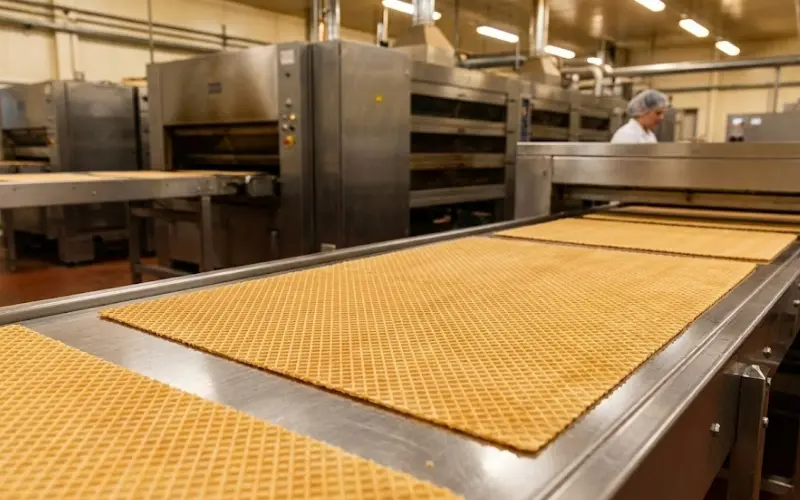
At the oven exit, the plates unlock and open.
The wafer sheet must detach effortlessly.
If it sticks, it will jam the take-off unit.
This is often a sign that the plates need cleaning or "seasoning."
A proper carbon layer on the plate acts as a natural non-stick coating.
💡 Engineering Tip: The Damper System
Modern tunnel ovens feature adjustable dampers.
These allow you to control the humidity inside the baking chamber.
Keep the dampers slightly closed to retain some moisture during the first half of the bake.
This aids in flow and expansion.
Open them in the second half to dry the sheet out for maximum crispness.
Conditioning & Cooling: Stress Relief
A freshly baked wafer sheet is a paradox.
It is bone dry (1.0% moisture) but extremely pliable due to the heat.
As it cools, it becomes glass-like and brittle.
The Arching Phenomenon
If a sheet cools unevenly, it will warp.
We call this "arching."
An arched sheet is a nightmare for the downstream cream spreader.
It will crack under the pressure of the application roller.
To prevent this, sheets travel over an "Arch Cooler."
This curved transport frame allows ambient air to circulate on both sides simultaneously.
Moisture Equilibrium
In high-speed lines, a conditioning phase is sometimes added.
This involves exposing sheets to a controlled humid environment.
The goal is to raise moisture content slightly to about 2.5%.
This re-humidification releases internal tension.
A conditioned sheet is less likely to shatter during the cutting process.
Creaming: The Profit Center
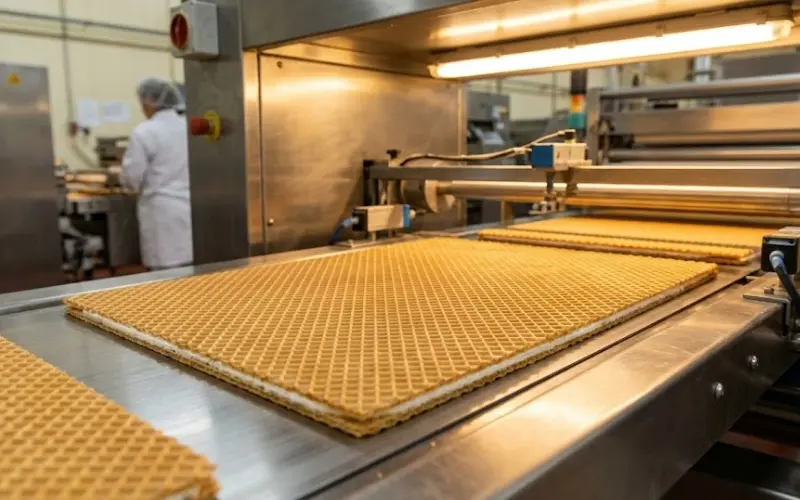
The wafer sheet provides the structure.
The cream provides the flavor and the profit margin.
Whether using vanilla, chocolate, or hazelnut, the engineering principles remain the same.
Fat Systems & Melting Points
The cream is a suspension of sugar and solids in fat.
The choice of fat is critical for mouthfeel.
It must have a steep "N-line" melting curve.
It needs to be solid at room temperature to hold the layers together.
However, it must melt instantly at body temperature (37°C).
If the melting point is too high, the wafer will taste waxy.
Aeration and Density Control
For the factory owner, this is the most important metric.
You sell wafers by volume (package size).
You buy ingredients by weight.
By injecting nitrogen or air into the cream, you lower its specific gravity.
Reducing specific gravity from 1.0 to 0.75 means you use 25% less cream mass to fill the same volume.
This directly improves your bottom line.
It also results in a lighter, more premium texture for the consumer.
Application Precision
There are two main methods for applying cream: contact and film.
Contact spreading involves the wafer passing directly under a rolling drum.
Film spreading forms a precise layer on a roller first.
The film is then transferred to the wafer.
Film spreading is superior for fragile sheets as it applies less mechanical pressure.
The Stack: Layering & Calibration
This is where individual components become a product.
The sequence is typically: Sheet -> Cream -> Sheet -> Cream -> Sheet -> Top Sheet.
The Compression Belt
Once stacked, the "wafer book" enters a compression belt.
This machine applies gentle, uniform pressure.
It bonds the cream to the wafer sheets.
Note: Calibration here is a delicate balance.
Too little pressure causes delamination, where layers fall apart.
Too much pressure crushes the porous structure of the wafer.
Automatic Check-Weighing
Advanced lines utilize inline check-weighers at this stage.
They measure the cream-to-wafer ratio in real-time.
If the weight drifts, a signal is sent back to the cream spreader.
The spreader automatically adjusts the gap to correct the weight.
This automation prevents "giveaway" of expensive cream.
Cooling Tunnel: Crystallization
You cannot cut a warm wafer book.
The fat in the cream is still semi-liquid.
The books must pass through a cooling tunnel.
This usually takes 10 to 15 minutes at 10°C-12°C.
Why Crystallization Matters
This process is not just about lowering temperature.
It is about fat crystallization.
The fat must form a stable crystal lattice.
This lattice acts as the cement that holds the layers together.
The Dew Point Danger
Engineers must monitor the Dew Point inside the tunnel.
If the tunnel is too humid, condensation forms on the cooling pipes.
Water dripping onto wafers spells disaster.
It ruins the texture instantly and creates microbiological risks.
Cutting Technology: Wire vs. Saw
The final shaping determines the visual appeal of the product.
Large "wafer books" are cut into retail-ready sizes.
Wire Cutting
Thin, high-tension steel wires are pushed through the wafer book.
Pros:
Zero material loss.
No dust generation.
Hygienic and quiet.
Cons:
Only works for smooth creams.
Cannot handle inclusions like nuts or caramel.
Saw Cutting
High-speed circular saw blades slice through the book.
Pros:
Can cut through anything (nuts, dense caramel).
Creates clean, sharp edges.
Cons:
Generates "sawdust" or trim waste.
Requires a dust extraction system.
Rework: The Secret Ingredient
In a generic overview, waste is just trash.
In a professional factory, waste is "Rework."
Edge trims and broken sheets are collected automatically.
They are ground into a fine powder.
Flavor Enhancement
This powder is not just filler.
It has a roasted, caramelized flavor profile.
Manufacturers mix this powder back into fresh cream (up to 10%).
It adds depth and color to the filling.
Cost Recovery
By utilizing a sanitary rework system, you achieve near 100% material usage.
This is a massive contributor to the overall ROI of the production line.
🛠️ Troubleshooting Matrix (QA Perspective)
| Defect | Probable Cause | Engineering Solution |
| White Spots on Sheet | Batter too cold or un-mixed water pockets. | Check mixer homogenization; verify water temp. |
| Delamination | Cream too hard or insufficient pressing. | Adjust cooling tunnel temp; increase belt pressure. |
| Soft / Chewy Texture | High humidity in packing area. | Check HVAC positive pressure; test packaging seal. |
| Weight Variation | Pump wear or aeration fluctuation. | Re-calibrate cream density; service stator pumps. |
| Burnt Edges | Oven burner profile uneven. | Adjust gas train modulation; check side dampers. |
🛑 Maintenance Checklist for Longevity
To keep your line running 24/7, follow this brief schedule:
Daily Checks:
Check cream level sensors.
Inspect wire cutter tension.
Clean batter drip trays.
Weekly Checks:
Inspect oven tong rollers for wear.
Check mixer seals for leaks.
Calibrate check-weighers.
Monthly Checks:
Check baking plates for carbon buildup.
Inspect cooling tunnel compressor belts.
Test safety interlocks and emergency stops.
🚀 Optimize Your Production Line Today
Are you struggling with high scrap rates on your wafer line?
Or perhaps you are planning to upgrade from semi-auto to a fully automated high-capacity tunnel oven?
EverSmart Food Equipment understands the engineering behind the biscuit.
We know that a wafer machine isn't just about baking.
It is about precision, energy efficiency, and maximizing your ROI.
Consulting: Let our engineers analyze your current batter rheology.
Upgrades: Switch from saw-cut to wire-cut with our retro-fit solutions.
Turnkey Projects: From silo to packaging, we design lines that fit your footprint.
[Contact EverSmart Engineering Team] for a free consultation on optimizing your wafer production process.
❓ Frequently Asked Questions (FAQ)
Why do my wafer sheets split or crack immediately after baking?
This is usually a "stress" issue. If the thermal shock is too great when leaving the oven, the sheet cracks. Ensure your "stripping" (take-off) is smooth. Also, check if your batter formula has enough binding agents. High sugar content can also make the sheet more brittle upon cooling.
What is the difference between a wire-cut and a saw-cut wafer machine?
It depends on your filling. If you are producing wafers without inclusions (just smooth cream), wire cutting is superior because it creates no dust. However, if your recipe involves hazelnut pieces or toffee, you must use a saw cutter.
How do factories keep wafers crispy in high-humidity climates?
This is an HVAC engineering challenge. The packaging room must be kept at a positive pressure with controlled relative humidity (RH), typically below 40%. Additionally, the packaging film must have a high Moisture Vapor Transmission Rate (MVTR) barrier.
Can we use the same oven for flat wafers and hollow wafers (like Kinder Bueno style)?
The oven structure is similar, but the plates are completely different. Hollow wafers require deep molds and a more precise "locking" mechanism. You generally cannot swap plates easily on a running line; dedicated lines are recommended.
Who invented wafer cookies and how has the technology changed?
While the concept dates back to medieval "wafer irons," industrial wafer production began in the late 19th century with the gas-fired tunnel oven. Modern advancements focus on energy recovery and automatic vision inspection systems.
How are wafer cookies made from scratch in an R&D lab versus the main line?
R&D uses single-head manual tongs. However, results often fail to scale because manual tongs don't replicate the cumulative heat of a continuous 60-plate oven. Engineers must adjust water content when scaling up.

Ready to start your journey toward a customized solution? Contact me directly on WhatsApp to begin the conversation.