The Lane Multiplier: Scaling from Oven Band to 6-Lane Sandwicher
Introduction: The "Speed vs. Space" Problem
Your production line has two speed conflicts:
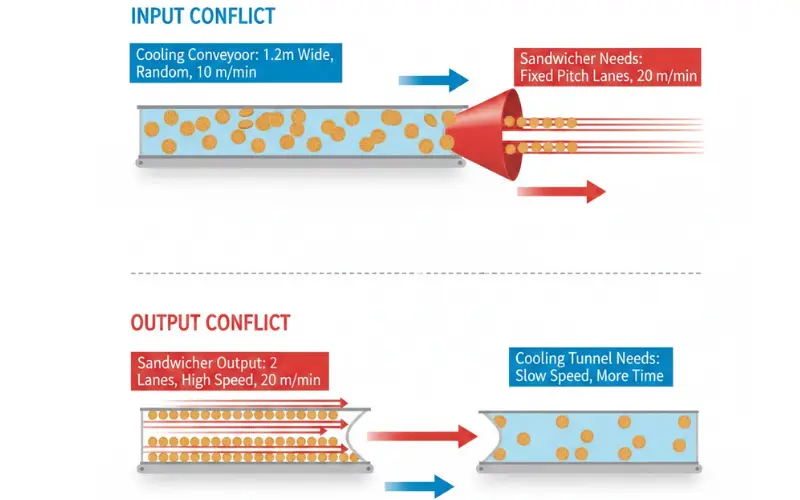
The Input Conflict: Your oven band is wide (1.2m) and chaotic, but your sandwicher needs narrow, straight lanes.
The Output Conflict: Your sandwicher shoots out product at high speed, but your cooling tunnel needs time to set the warm cream.
Most engineers only use Lane Multipliers for the first problem. But the "Pro Move" is using them for the second.
This guide explains the physics of high-speed biscuit sorting and spreading. We compare Vibratory Channels vs. Smart Belt Diverters and reveal how to use this technology to triple your cooling residence time without expanding your factory footprint.
🚀 Key Takeaways
The Geometry Mismatch: Converting a random 1200mm spread into fixed pitch lanes (e.g., 60mm centers).
The Cooling Hack: Use a Multiplier after the sandwicher to spread 2 lanes into 6. This drops belt speed and increases cooling time.
Vibration vs. Belts: Use Vibratory Channels for hard biscuits; use Diverter Belts for soft/sticky products.
Starvation Logic: The multiplier must communicate with the sandwicher to prevent gaps.
The Input Geometry: Feeding the Machine
To an engineer, a biscuit line is a flow problem.
The Input: A Cooling Conveyor moving at 10 meters/minute with random distribution.
The Output: A Sandwicher Chain moving at 20 meters/minute with rigid 100mm pocket spacing.
The "Funnel" Effect
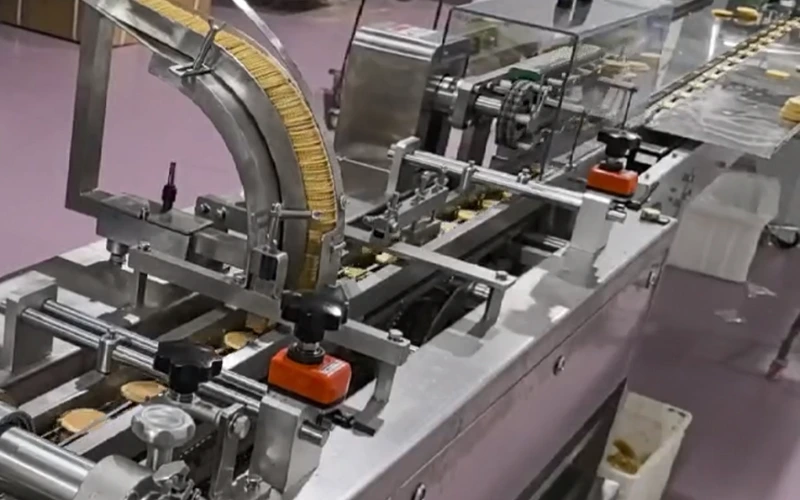
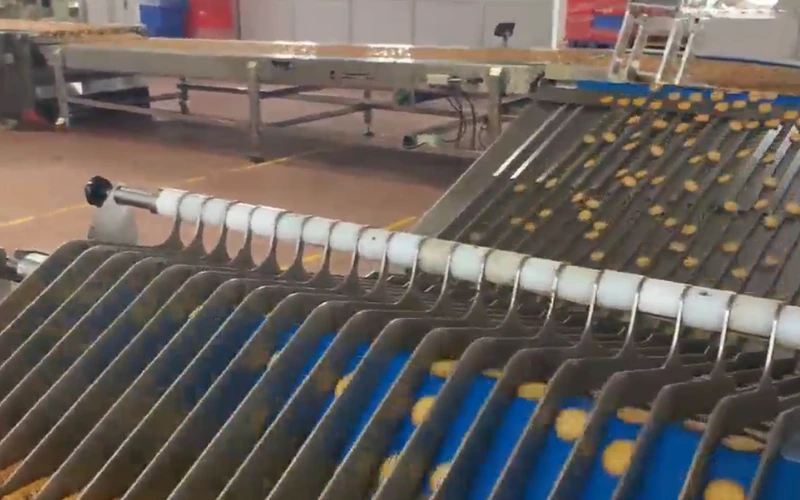
You cannot simply force biscuits into a lane with static guide rails. They will bridge and jam (the "arch" effect), blocking the flow completely. A Lane Multiplier acts as a dynamic funnel. It gently teases the biscuits apart laterally while accelerating them longitudinally.
The Cost of Failure:If your multiplier is 95% efficient, that sounds good. But at 3,000 SPM, a 5% failure rate means 150 empty slots per minute. That is 9,000 missing sandwiches per hour—pure lost revenue.
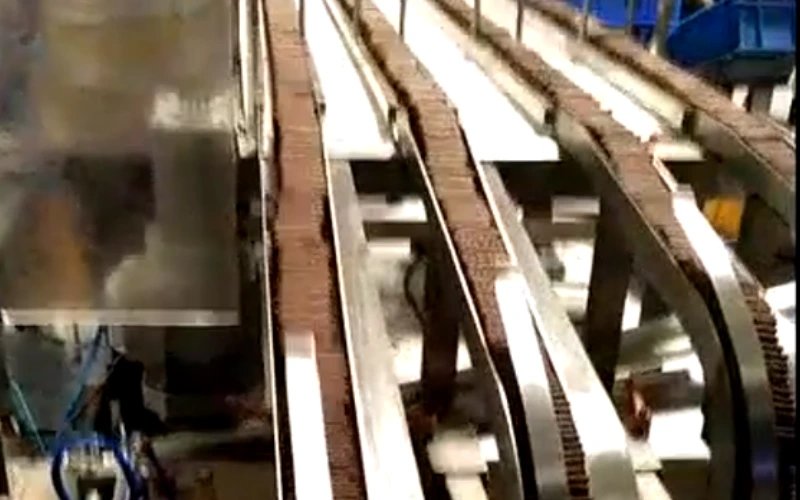
Technology A: The Vibratory Channel
This is the industry standard for Hard Dough biscuits (Oreo, Marie, Petit Beurre).
How it Works
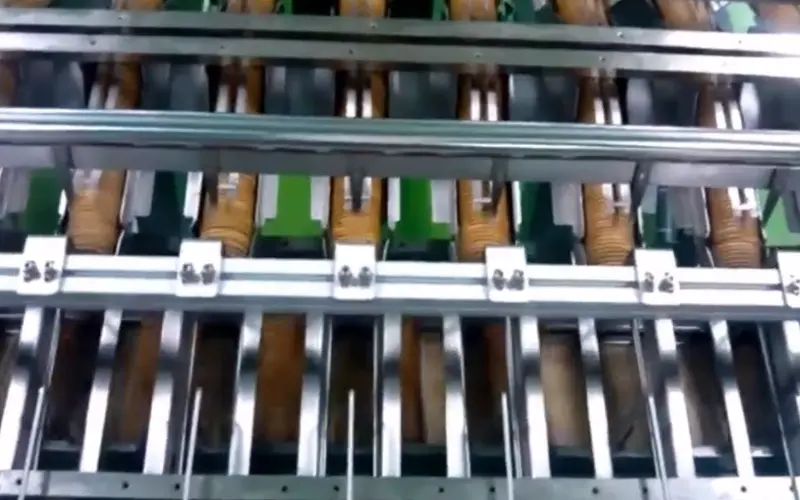
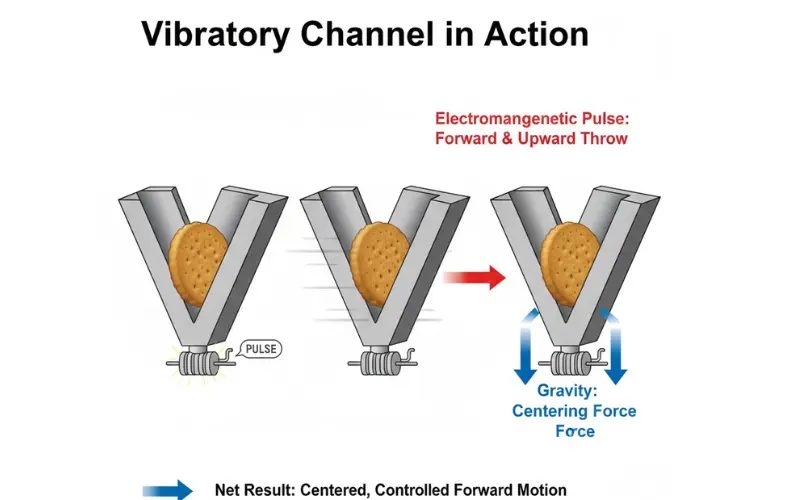
The biscuits drop from the cooling conveyor onto a stainless steel bed divided into channels. The bed does not use a belt. It sits on electromagnetic coils.
The Physics: The coils vibrate the bed at a high frequency (e.g., 50Hz). The biscuit is thrown forward and upward micro-millimeters, thousands of times a second.
Self-Alignment: Because the channel is slightly V-shaped or W-shaped, gravity pulls the biscuit to the center of the lane as it moves forward.
Pros and Cons
Pros: Extremely sanitary (no belts to clean). Very gentle on hard biscuits (no friction/rubbing). Low maintenance.
Cons: Cannot handle soft/sticky products (they absorb vibration).
Deep Dive: Learn more about electromagnetic drives in our
Vibratory Biscuit Feeding Guide
Technology B: The Smart Belt Diverter
If you are running Soft Cookies or delicate Crackers, vibration doesn't work. The soft dough absorbs the energy, and the biscuit just sits there vibrating without moving. You need a Smart Belt System.
The "Chicane" Method
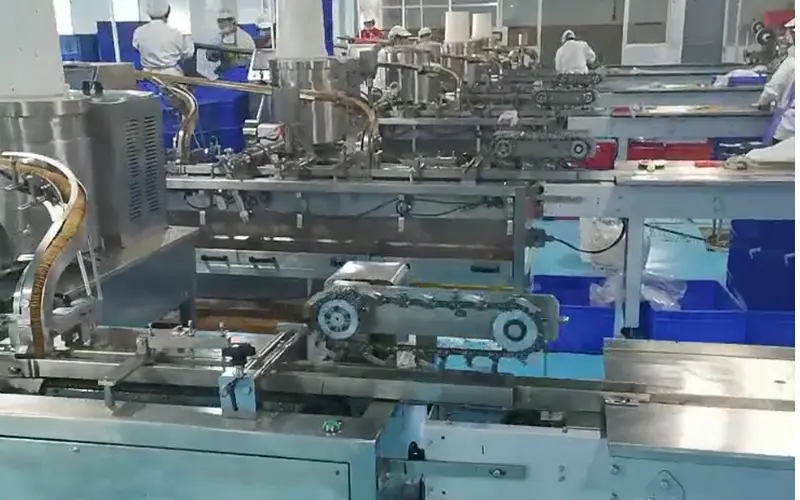
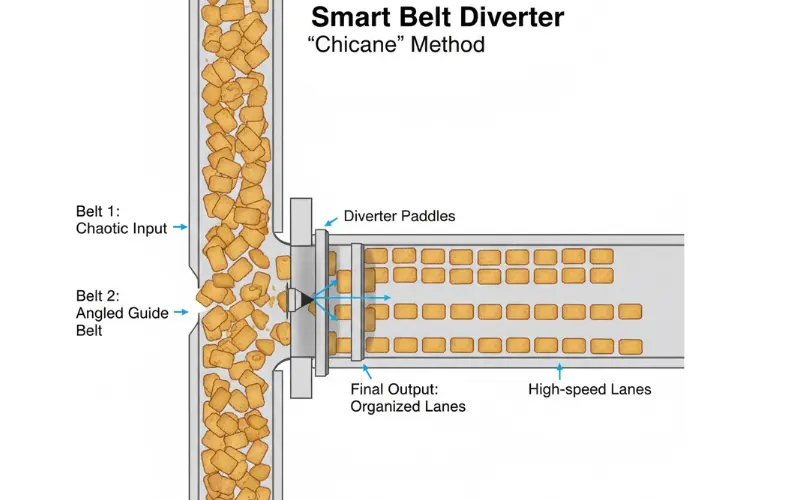
This system uses a series of spreading conveyor belts.
Belt 1: Receives the bulk flow.
Belt 2: Runs slightly faster to pull products apart.
Diverter Paddles: Rows of vertical belts or plastic paddles gently guide the stream left and right into lanes.
The Physics: It relies on friction. The belt pulls the biscuit forward while the guide rail pushes it sideways.
Post-Sandwiching: The "Slow-Down" Strategy
This is the most overlooked application of the Row Multiplier.
When a biscuit leaves the sandwich machine, the cream is chemically unstable. Friction in the pump and nozzle heats the cream or jam, making it fluid and prone to sliding ("telescoping"). You need to cool it down to solidifying temperature (e.g., 22°C) before packaging.
The Physics of Deceleration
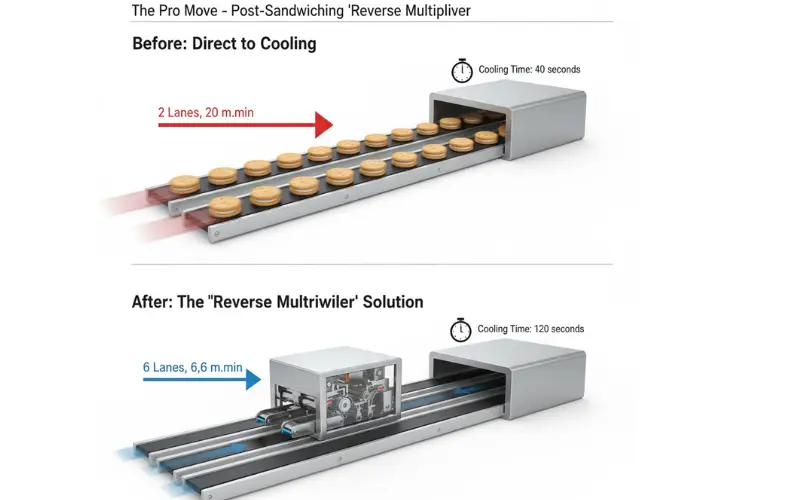
If your sandwich machine runs 2 Lanes at 20 meters/minute, the biscuits are flying. If you send them straight into a cooling tunnel at that speed, the tunnel needs to be 40 meters long to get 2 minutes of cooling time. Most factories don't have that space.
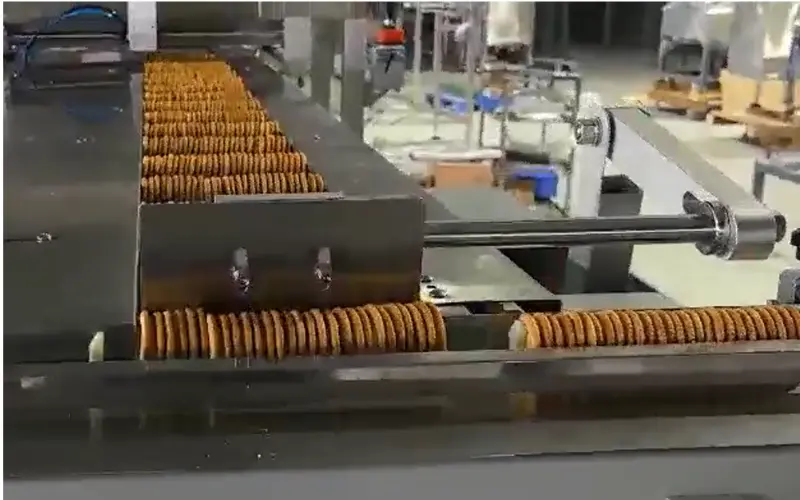
The Solution: The Reverse MultiplierWe install a Lane Multiplier (Row Distributor) immediately after the sandwich machine exit.
Input: 2 Lanes (High Speed: 20m/min)
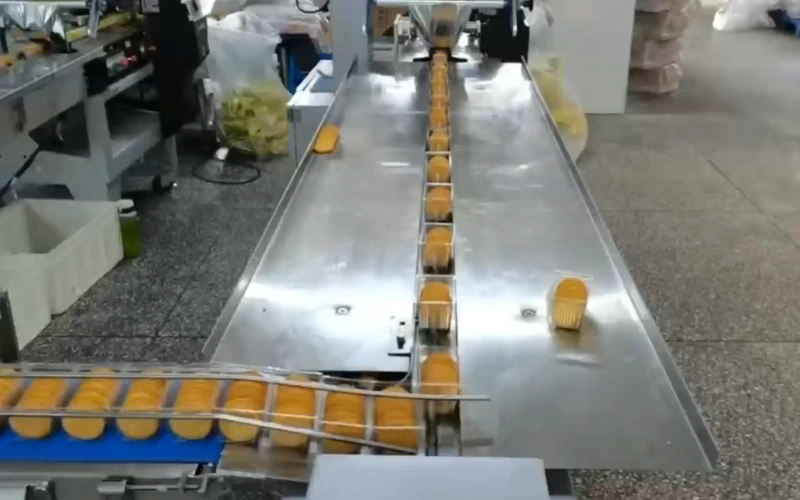
Action: The Multiplier spreads the flow into 6 Lanes.
Output: 6 Lanes (Low Speed: 6.6m/min)
The ROI of Spreading
By tripling the number of lanes (2 to 6), you reduce the linear belt speed by 66% while maintaining the same total throughput (Biscuits Per Minute).
Result:
Residence Time: You gain 3x the cooling time in the same length tunnel.
Cream Setting: The slow movement allows the cream to crystallize without vibration-induced sliding.
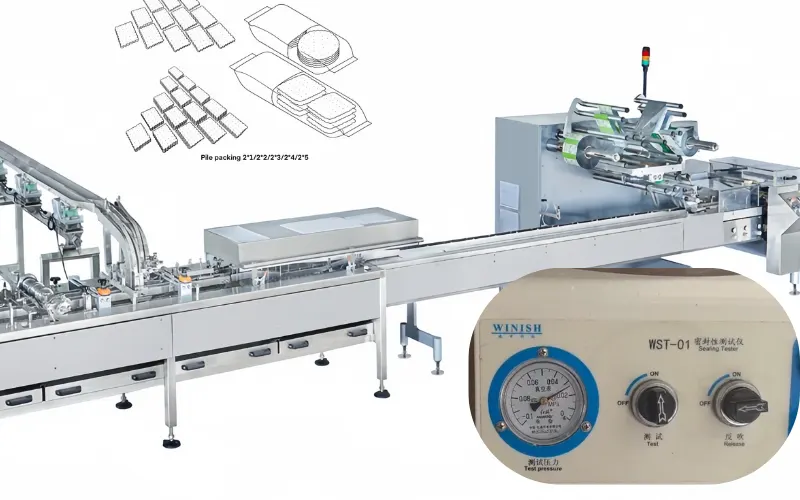
Packaging Feed: Most flow wrappers require multiple feed lanes anyway. This system pre-sorts the product for the packaging distribution system.
⚠️ Engineering Note: Never use Vibratory Distribution after a sandwich machine if the cream is soft. The micro-vibrations will cause the top biscuit to slide off the wet cream. Always use Smart Belt Diverters for post-sandwich spreading.
The Control Logic: Avoiding "Starvation"
A dumb machine just runs. A smart machine communicates. The Lane Multiplier must be the "Brain" of the feeding section.
The Accumulation Buffer
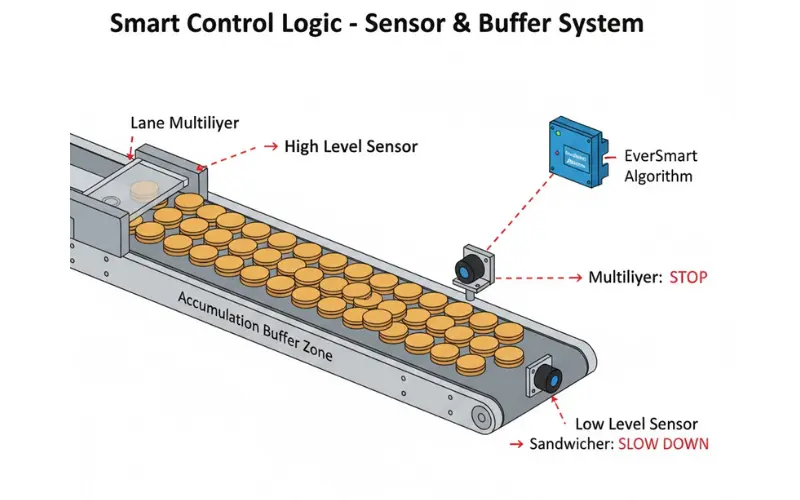
You never want to feed the sandwicher directly from the oven speed. You need a buffer. The Lane Multiplier typically runs 10% faster than the sandwich machine. This ensures there is always a "queue" (backlog) of biscuits waiting to enter the sandwicher.
Resource: Learn how to size your buffers in our
Biscuit Production Buffer Systems Guide
Sensors and Speed Modulation
We install Photo-Eye Sensors on each lane of the multiplier:
Low Level Sensor: "I am running out of biscuits." -> Signal Sandwicher to slow down.
High Level Sensor: "I am full." -> Signal Multiplier to stop vibrating to prevent crushing.
The EverSmart Algorithm: Our PLC uses Independent Lane Logic. If Lane 1 is full but Lane 4 is empty, the vibratory bed can bias the intensity (on advanced models) or use a "Lane Balancer" paddle upstream to direct more flow to Lane 4.
Handling The "Shingle" (Overlap)
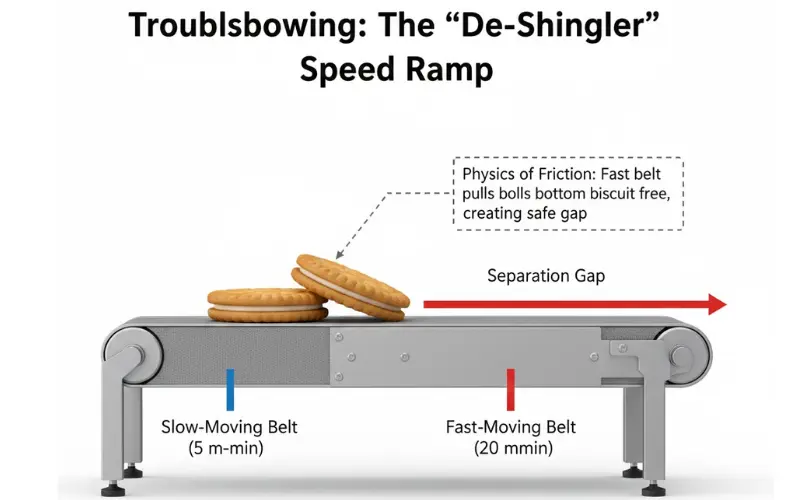
The nightmare of feeding is Shingling. This is when one biscuit rides up on top of another, creating a double stack. If a double stack enters the sandwich machine, it jams the pusher finger and smashes the stencil head.
The Speed Ramp (The "De-Shingler")
Before the biscuits hit the lanes, we use a Speed Ramp. We transfer the biscuits from a Slow Belt to a Fast Belt.
Physics: The bottom biscuit grips the fast belt and shoots forward. The top biscuit has less friction and lags behind. This naturally separates the stack into a single file line.
Troubleshooting Feeding Issues
FAQ: Automation Engineering
Q1: Can one multiplier handle different biscuit sizes?A: Yes. Vibratory channels are typically "V" shaped, so they naturally center different diameters (e.g., 40mm to 60mm). However, for drastic changes (e.g., Round to Rectangle), you may need to swap the channel pans.
Related:
Biscuit Machine Quick Changeover Guide
Q2: How loud are vibratory feeders?A: Old mechanical eccentric drives were loud (clack-clack). Modern Electromagnetic Drives are hum-based and very quiet (<75dB).
Q3: How long should the Multiplier be?A: Length equals Buffering Capacity. A standard unit is 2 to 3 meters long, providing about 30 seconds of buffer time.
Conclusion: Efficiency Starts (and Ends) with Flow
You can have the most expensive Stencil Sandwich Machine in the world. But if you cannot feed it reliably, or if you rush the cooling process, you are losing money.
The Lane Multiplier is the versatile workhorse of the line:
At the Front: It converts oven chaos into order to protect the sandwicher.
At the Back: It converts high-speed output into gentle, slow-cooling flow to protect the cream structure.
The EverSmart Advantage: We calculate the specific Friction Coefficient of your biscuit to tune the vibration frequency perfectly, ensuring smooth flow without breakage.
Is your line starving? Or is your cream sliding?Don't let flow issues kill your OEE.
[CTA Button]Get a Flow System Assessment by whatsapp us. Send us a video of your current line layout. We will propose a retrofit solution to optimize both feeding and cooling.

Ready to start your journey toward a customized solution? Contact me directly on WhatsApp to begin the conversation.