Tunnel Oven Integration: The Project Manager's Guide to Avoiding a $1M Bottleneck
Executive Summary: The Core Risk
A new tunnel oven's ROI is only realized through flawless integration. Overlooking upstream feed capacity or downstream cooling can create a bottleneck that erases all financial gains. This guide provides the 5-step methodology to de-risk your project, ensuring your investment delivers promised throughput from day one.
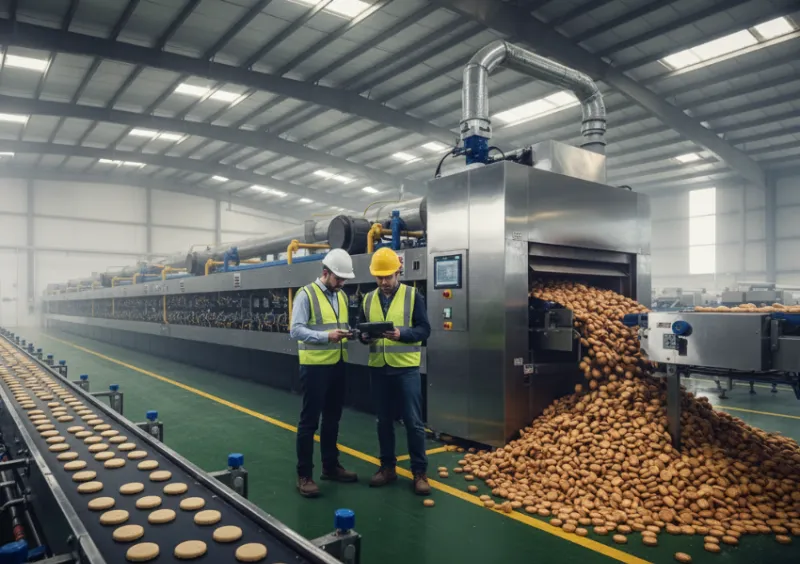
Introduction: The Integration Imperative: From Capital Expense to Competitive Advantage
A new, high-capacity industrial tunnel oven represents a significant capital investment, promising a transformative leap in productivity and efficiency for any industrial bakery. However, the physical asset is only one part of the equation. Industry data reveals a stark reality: a significant percentage of major capital projects suffer from implementation delays and budget overruns, frequently stemming from unforeseen integration challenges [^1]. When a new oven is mismatched with the existing production line, it fails to deliver on its potential. It doesn't just create a minor inefficiency; it becomes the world's most expensive bottleneck, actively eroding the very return on investment (ROI) it was purchased to generate.
Successful integration is not an installation task; it is a multi-disciplinary project management discipline. It demands a holistic, data-driven approach that meticulously balances the new asset's capacity with the proven capabilities of your existing upstream biscuit making machine, downstream cooling tunnel, and automated packaging system, and the physical and utilitarian constraints of your facility. A seamless integration transforms a capital expense into a sustainable competitive advantage. This blueprint provides the comprehensive methodology to de-risk your investment and ensure your new oven delivers on its promise of enhanced throughput and quality from day one.
To establish a framework of rigor and credibility, this guide is built upon established project management principles and adheres to critical industry standards for safety and sanitation. The methodologies and recommendations herein are aligned with the recognized benchmarks for equipment design, construction, and operation, including ANSI/ASB Z50.1 (Safety Requirements), ANSI/ASB Z50.2 (Sanitation Requirements), and NFPA 86 (Standard for Ovens and Furnaces). Adherence to these standards is non-negotiable for ensuring operator safety, food safety, and operational excellence.
The journey begins with selecting the right technology. If you haven't finalized your choice, our buyer guide for tunnel oven will help you specify the perfect model based on heating method, product type, and throughput requirements.
EverSmart's Experience: A Story from the Factory Floor
At EverSmart, we don't just theorize about integration; we live it. Our methodology was forged through projects like one with a major biscuit manufacturer in Southeast Asia. They had purchased a high-speed oven from another supplier, but the project was failing. The new oven was installed, but it was constantly starved for product because their existing biscuit making machine couldn't feed it consistently. When it did run, it overwhelmed their manual packaging line, creating chaos and product waste. Their multi-million-dollar investment was sitting idle.
They called us in for a rescue mission. Our engineers didn't just look at the oven. We conducted a full-line audit, just as outlined in Chapter 1. We identified the upstream feeder as the critical bottleneck and specified a compatible high-capacity model. Downstream, we designed and installed a custom cooling tunnel extension and an automated biscuit stacker and lane system to feed their packaging machines evenly.
Within a planned 10-day shutdown, we integrated the new equipment, synchronized all the PLCs, and commissioned the line. The result? The line achieved its target output of 1,200 kg/hr, a 60% increase, with zero manual intervention at the packaging stage. The project's success wasn't about the oven alone; it was about making the entire system sing in harmony. This hands-on experience is baked into every integration plan we create.
Chapter 1: The Pre-Installation Audit: A Data-Driven Foundation for Success
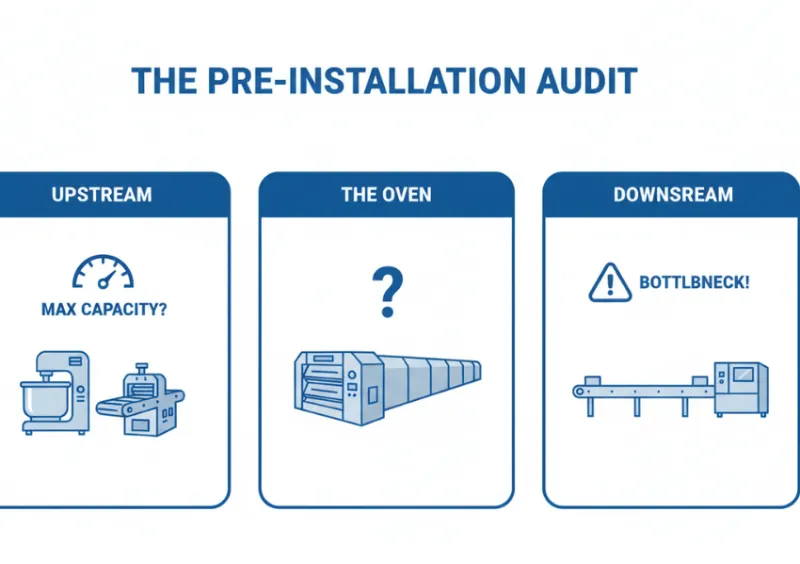
The pre-installation audit is the single most critical risk mitigation activity in the project lifecycle. It is the formal, non-negotiable project stage where assumptions are replaced with hard data, forming the bedrock of the entire integration plan. Failures in this phase are the root cause of most downstream problems, including the budget overruns and extended downtime that project managers fear most. This comprehensive audit is divided into three critical domains: upstream capacity, downstream capability, and facility readiness.
Upstream Analysis: Can You Feed the Beast?
A new, faster oven demands a faster, yet equally consistent, supply of dough. The upstream audit is designed to answer one fundamental question: can your existing makeup equipment meet this demand without compromising quality or mechanical integrity?
Quantifying Capacity
The core task is to measure the maximum sustainable output, typically in kilograms per hour (kg/hr), of all upstream equipment. This analysis must encompass every machine involved in dough preparation, from silos to the oven infeed. Key equipment to audit includes:
Mixers: What is the maximum batch output and cycle time? Can the mixing schedule keep pace with the oven's continuous demand?
Dough Handling Equipment: This includes dough pumps, chunkers, and trough lifts that transport the bulk dough to the next stage.
Dividers, Rounders, and Moulders: These machines are often the primary rate-limiting step. It is essential to determine their maximum pieces-per-minute output while maintaining product specifications. (This can be reviewed alongside our range of
biscuit making machines ).
The audit must determine if this equipment can consistently supply the new oven without being pushed beyond its designed operational limits, a condition that can lead to premature wear and catastrophic mechanical failures.
Quality at Speed
Throughput is meaningless if product quality degrades. The audit must also assess the ability of the makeup line to maintain strict quality parameters at the higher speeds required to feed the new oven. Can the divider maintain precise piece weight accuracy? Can the moulder consistently shape the dough without tearing or creating imperfections? Inconsistent dough feed is a primary cause of uneven baking, non-uniform color, and ultimately, a higher rate of rejected product, which directly impacts yield and profitability.
Downstream Analysis: Can You Handle the Output?
The most common, and often most costly, integration failure point is an under-capacitated downstream system. A new oven producing 20-30% more product per hour will inevitably overwhelm cooling and packaging systems that were sized for the previous equipment. This creates a bottleneck that negates the entire investment in the new oven.
Cooling Conveyor Calculation
Proper cooling is not just a matter of logistics; it is a critical control point for product quality and shelf life. The audit must verify that the cooling conveyor system has sufficient length and residence time to allow the product to reach the correct temperature and moisture level for packaging. This involves a clear calculation based on the new, higher volume and the increased thermal load exiting the oven. If the existing footprint is limited, creative solutions such as adding vertical, tiered, or spiral conveyors can provide the necessary cooling time while saving valuable floor space. We often recommend our efficient
Packaging Line Capacity
The entire packaging line must be audited via a time-study to identify its true maximum throughput. This includes every component, from product stackers and laners to flow wrappers, baggers, and final case packers. The analysis must confirm that the packaging system can handle the sustained surge of product from the new oven without creating jams or requiring manual intervention, which drives up labor costs and risks product damage. The capacity of each, including the
Facility & Utilities Audit: Is Your Plant Ready?
Beyond the production line itself, the physical plant and its utility infrastructure must be prepared to accommodate the new asset. Overlooking these elements can lead to significant and costly delays during the installation phase.
Physical Footprint & Logistics
This assessment goes beyond simply measuring the final installation space. It involves meticulously mapping the entire logistical path from the delivery truck's arrival at the loading dock to the oven's final position on the production floor. Every doorway, hallway, and corner must be measured to ensure adequate clearance. This was a critical challenge in a notable case study where a bakery needed to increase capacity by 30% without expanding the oven's existing footprint, a feat achieved through careful planning and technology selection.
Structural Integrity
A new industrial tunnel oven is a heavy piece of equipment. A structural engineering assessment of the concrete floor is necessary to verify that it can support the static weight and any dynamic loads of the new oven without risk of cracking or subsidence. The manufacturer's specifications will provide the necessary load data for this evaluation.
Key Takeaway: The audit transforms abstract ROI into a concrete financial plan. Discovering a 20% downstream gap isn't a problem; it's a required line item for a new wrapper, ensuring your budget is accurate and your project succeeds.
Utility Verification (The "Hidden" Project Killers)
Insufficient utility capacity is a frequent and disruptive surprise during installation. The audit must rigorously verify the following:
Gas Supply: The existing gas line's diameter and supply pressure (PSI) must be confirmed to ensure it can meet the higher British Thermal Unit (BTU) requirements of the new oven without starving other gas-fired equipment on the same line.
Electrical Service: The main electrical panel and the local circuits must have sufficient amperage and the correct voltage and phase to power the oven's control systems, conveyor motors, circulation fans, and any electric heating elements. This often requires consultation with a licensed industrial electrician.
Ventilation & HVAC: A larger, higher-capacity oven will generate more ambient heat and require more exhaust capacity for products of combustion. The audit must confirm that the existing HVAC and exhaust systems can handle this increased thermal load. This is not only a matter of employee comfort but also a critical safety requirement governed by standards like OSHA 1910.263, which mandates proper ventilation to prevent the buildup of heat, steam, and vapors.
The data gathered during the pre-installation audit serves a dual purpose. While its primary function is technical verification, its ultimate value lies in transforming an abstract ROI projection into a concrete, defensible financial plan. By quantifying a 20% capacity gap in downstream packaging, the audit directly translates this operational reality into a required capital expenditure for a new wrapper. This cost must be incorporated into the project's financial model before the oven is purchased. This process forces a systemic view of the project, preventing the common mistake of a "siloed" purchase that fails to account for the necessary ancillary upgrades to achieve the desired outcome.
Chapter 2: Upstream Synchronization: Mastering the Infeed
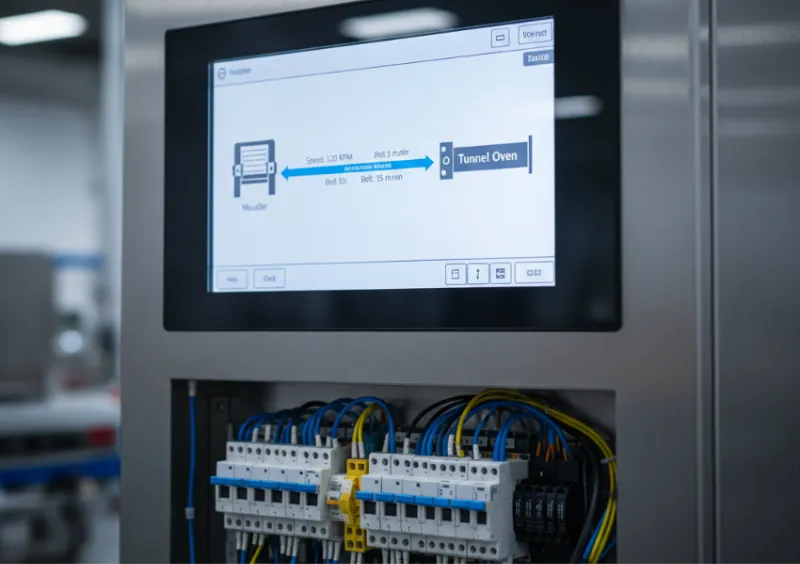
Once the pre-installation audit has confirmed the viability of the project, the focus shifts to the precise engineering of the production line. A high-performance tunnel oven is a precision instrument; its effectiveness is entirely dependent on the quality and consistency of the product it receives. The principle is simple: garbage in, garbage out. A state-of-the-art oven cannot correct for inconsistencies created upstream. Gaps, overlaps, or misshapen dough pieces entering the oven lead directly to wasted energy, inconsistent bake quality, and increased scrap rates, undermining the entire investment.
Mechanical Solutions: Buffering and Transfer
Achieving a seamless flow from the makeup equipment to the oven belt often requires dedicated mechanical transfer systems. These systems act as the physical handshake between distinct production stages.
Intermediate and Retractable Conveyors: These conveyors are essential for ensuring a smooth, gentle hand-off of delicate dough pieces from the moulder or extruder onto the oven's main conveyor belt. Retractable or "nose-bar" conveyors can pull back as product is deposited, minimizing the drop distance and preventing damage or misalignment.
Specialized Dough Handling: The trend toward artisan-style products introduces new challenges. High-hydration, or "soft," doughs can be particularly sticky and difficult to process on standard equipment. Integrating specialized equipment, such as flour dusters or belts with non-stick coatings, may be necessary to prevent jams and ensure the oven is not starved for product. These are often part of the ancillary systems we provide with our
Control System Integration: The Digital Handshake
The most sophisticated and reliable method for synchronizing a production line is through the integration of its control systems. This "digital handshake" allows machines to communicate and adjust their performance in real-time, creating a single, cohesive production unit.
PLC Integration: The Programmable Logic Controller (PLC) is the brain of modern industrial machinery. In an integrated line, the new oven's PLC is networked with the PLCs of the upstream equipment, such as the divider and moulder. This communication allows for automated, proportional speed adjustments. For example, if an operator increases the oven's belt speed by 10%, the oven's PLC sends a signal to the upstream machines, which automatically increase their operating rates by 10% to maintain perfect, consistent product spacing on the belt.
Sensors and Vision Systems: To achieve an even higher level of precision, advanced sensor technology can be deployed. Photo-electric sensors (photo-eyes) placed along the infeed conveyor can detect gaps or pile-ups in the product flow. This data is fed back to the PLC, which can make micro-adjustments to conveyor speeds to correct the spacing. Advanced vision systems, such as LeMatic's AutoEye®, use cameras and image-processing software to provide even more granular control, ensuring precise alignment and orientation of products as they enter the oven.
Key Takeaway: Modern tunnel oven automation relies on PLC integration for a "digital handshake," ensuring your new oven is fed a consistent, perfectly spaced product stream, which is the foundation of baking quality.
Retrofit vs. Upgrade: A Critical Decision Point
The pre-installation audit will reveal whether the existing upstream equipment can meet the new demand. This leads to a critical decision for the project manager: is a retrofit sufficient, or is a full upgrade required?
Retrofitting: In many cases, existing equipment can be enhanced to meet higher capacity demands. This is often a cost-effective solution. Examples include retrofitting an existing mixer with a modern refrigeration jacket to improve dough temperature control , adding a servo drive to a divider for more precise portioning at higher speeds , or upgrading a moulder's pressure board assembly. Many original equipment manufacturers (OEMs) offer a range of upgrade kits and retrofitting services to modernize older assets.
Upgrading: If the audit reveals a significant capacity gap—for instance, if the existing divider is already operating at 100% of its mechanical limit—a retrofit will not suffice. In this scenario, attempting to push the old equipment harder will only lead to breakdowns and failure to supply the new oven. The only viable long-term solution is to invest in new upstream equipment that is correctly sized for the new oven's capacity. This decision must be made early and factored into the overall project budget to realize the full potential of the new oven.
Chapter 3: Downstream Management: Preventing the Post-Oven Bottleneck
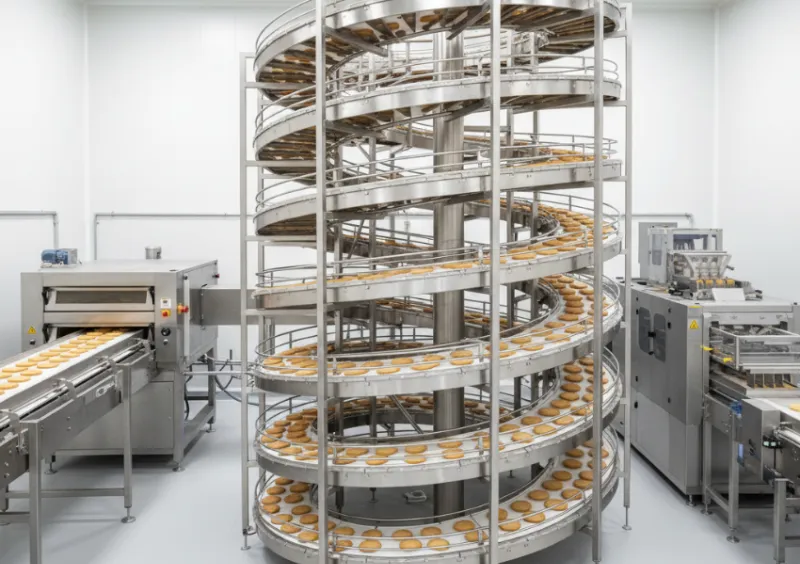
While upstream synchronization is about consistency, downstream management is about capacity. The challenge can be described as a "product deluge." A high-capacity oven will discharge a continuous, high-volume stream of hot product that can quickly overwhelm undersized cooling and packaging systems. The result is chaos: perfectly baked products piling up at the end of a conveyor, jamming packaging machines, forcing line stoppages, and requiring frantic manual intervention. This not only increases labor costs and risks product damage but also completely negates the throughput gains from the new oven.
Cooling Conveyor Solutions
Effective cooling is a critical processing step that directly impacts final product quality and shelf life. The downstream system must be engineered to handle the increased thermal load and physical volume from the new oven.
Capacity Expansion: If the pre-installation audit identifies a cooling time deficit, several engineering solutions are available. The most straightforward is to physically extend the existing cooling conveyor. However, when floor space is at a premium, more creative solutions are required. These include adding a parallel conveyor line, installing a multi-tiered "race-track" conveyor system, or implementing a high-density spiral cooler, which uses vertical space to achieve a very long cooling path within a small footprint.
Ambient vs. Forced Air Cooling: For many products, cooling on an open-mesh conveyor at ambient room temperature is sufficient. However, for products with high moisture content or when dealing with the massive thermal load from a high-speed oven, a forced-air cooling tunnel may be necessary. These enclosed tunnels use circulation fans to pass filtered, ambient, or even chilled air over the products, significantly accelerating the cooling process and ensuring they reach the target temperature for packaging more quickly.
Packaging Line Synchronization
The transition from the cooling conveyor to the packaging machinery must be seamless. This often requires intermediate systems to buffer the product flow and automated equipment to manage its distribution.
Accumulation Tables and Buffers: A key strategy to de-couple the oven from the packaging line is the installation of an accumulation table. This is a large, slow-moving conveyor (often bi-directional) that acts as a temporary holding area. If a downstream packaging machine experiences a brief stoppage (e.g., for a film roll change), the product can be diverted onto the accumulation table. This allows the oven and cooling conveyors to continue running uninterrupted. When the packer comes back online, product is fed back into the main flow from the table. This buffering capacity absorbs minor fluctuations and prevents micro-stoppages from halting the entire production line.
Automated Lane Distribution: For high-volume lines that feed multiple packaging machines, an automated distribution system is essential. This typically involves a series of diverters, gates, or robotic arms that intelligently route the product flow to available packaging lanes, ensuring all machines are utilized efficiently and preventing backups.
System Integration: As with the upstream equipment, the most robust solution involves PLC integration. The packaging equipment must be able to communicate its status upstream. For example, a wrapper's PLC can send a signal indicating an imminent film change. This signal can trigger the accumulation table to begin accepting product, ensuring a smooth transition with no disruption to the oven's output.
Key Takeaway: A downstream bottleneck doesn't just cause jams; it traps heat and moisture, leading to soggy products and mold growth. Proper cooling capacity is a non-negotiable food safety and quality control issue.
A failure to properly engineer the downstream system has consequences that extend far beyond logistical jams; it directly impacts the final product quality and the company's brand reputation. The primary function of a cooling conveyor is to bring the product's internal temperature and moisture level to a stable point for packaging. If a line's speed is increased to handle higher volume from a new oven, but the cooling time is not proportionally extended, products will be packaged while they are still warm and contain excess moisture. This trapped heat and moisture creates condensation inside the package, a condition that drastically reduces shelf life, promotes the growth of mold and other microbes, and compromises product texture, turning crisp biscuits and crackers into soggy, unsaleable goods. This demonstrates a direct causal link between a mechanical engineering decision (conveyor length) and a critical business outcome (product quality and food safety).
Chapter 4: The Financial Case: Calculating the True ROI of an Integrated Upgrade
For the project managers, engineering managers, and plant owners who constitute the primary audience for this guide, a capital project's success is ultimately measured by its financial return. Justifying a significant investment requires a comprehensive and realistic financial analysis that goes far beyond the initial purchase price of the oven. This chapter provides a framework for building a defensible business case, calculating the true ROI of a fully integrated system upgrade.
Beyond the Sticker Price: Total Cost of Investment (TCI)
A common pitfall in project budgeting is underestimating the total cost of investment by focusing solely on the price of the main asset. A robust financial plan must account for all associated hard and soft costs.
Hard Costs:
These are the tangible, direct expenses of the project. A comprehensive list includes:
The purchase price of the tunnel oven.
The cost of any required ancillary equipment (e.g., new upstream moulder, extended cooling conveyor, higher-speed packaging machine).
Freight and shipping costs.
Rigging and crane services for offloading and positioning heavy equipment.
Installation labor, including mechanical and electrical contractors.
Costs for necessary utility upgrades, such as running a larger gas line or upgrading an electrical panel.
Soft Costs:
These are the indirect, but equally real, expenses associated with the project. They include:
Internal engineering and project management man-hours.
Operator and maintenance team training on the new equipment.
Permitting fees required by local authorities.
The cost of planned production downtime required for the installation and commissioning process.
Quantifying the Gains: A Multi-faceted Approach
The "return" side of the ROI equation is derived from multiple sources of value created by the new, integrated line.
Increased Throughput: This is often the primary driver for the investment. The financial gain is calculated by the value of the additional units produced per hour, shift, or day.
Labor Savings: A properly automated and synchronized line reduces the need for manual intervention, particularly in downstream packaging where employees are often needed to manage jams or transfer product. These labor hours can be quantified and translated into direct cost savings.
Energy Efficiency: Modern tunnel ovens, particularly those using advanced technologies like air impingement or hybrid heating systems, can be significantly more energy-efficient than older models. This reduction in gas or electricity consumption per unit of product produced translates into lower utility costs. Our guide on energy-efficient tunnel oven design details how these savings are achieved.
Waste Reduction: A perfectly synchronized line minimizes product damage from jams and pile-ups. Furthermore, the consistent heat transfer in a modern oven reduces scrap from under- or over-baked products. This reduction in waste directly improves yield and profitability.
The Value of a Single-Vendor Solution
Managing an integration project involving multiple equipment suppliers adds significant complexity and risk. When the oven, mixer, and packager come from different companies, coordination fails, and blame games begin when issues arise. This is why EverSmart advocates for a integrated line approach. By providing or sourcing compatible equipment like the
The Integrated ROI Formula
With all costs and gains identified, the Return on Investment can be calculated. The formula provides a clear percentage that represents the annual return relative to the total investment.
ROI (%) = / Total Cost of Investment * 100
This formula provides a clear, data-driven metric for evaluating the project's financial viability. The payback period, which is the time it takes for the net annual gains to equal the initial investment, can also be easily calculated from these figures.
A simplistic ROI calculation that considers only the oven's benefits is dangerously misleading. It creates an unrealistic expectation and sets the project up for financial failure when the unbudgeted costs of necessary ancillary equipment emerge. The following table illustrates the critical difference between a siloed financial view and a comprehensive, integrated analysis. This provides project managers with a powerful tool to build a realistic and defensible business case for senior leadership, demonstrating an understanding of the financial pressures and positioning the project for success.
Chapter 5: The EverSmart Integration Methodology: A Case Study in De-Risking Your Investment
Successful integration is not the result of chance, but of a disciplined, methodical process. This chapter outlines a proven, 5-step methodology for executing a complex tunnel oven installation. This is not simply a list of services; it is a systematic approach designed to eliminate uncertainty, mitigate risk, and guarantee that the project's technical and financial goals are met. This process is modeled on successful, real-world projects, such as the Babbco case study, where a complex oven replacement was completed in under six days by leveraging meticulous planning and pre-fabrication.
Step 1: Virtual Line Modeling & Simulation
Before any steel is cut or equipment is ordered, the proposed production line is built in a virtual environment. Using advanced Computer-Aided Design (CAD) and process simulation software, we create a "digital twin" of your future line. This dynamic model allows us to:
Validate Layouts: Test different equipment configurations to optimize footprint and product flow.
Identify Bottlenecks: The simulation runs at the proposed production rate, immediately highlighting potential choke points in the system, such as insufficient accumulation time or slow transfer points.
Optimize Flow Dynamics: We can analyze and fine-tune conveyor speeds, transfer timings, and buffer logic to ensure a smooth, uninterrupted flow of product.
This virtual commissioning is the modern answer to mitigating the risks identified during the pre-installation audit, allowing for data-driven design decisions before committing to capital expenditure.
Step 2: Phased Installation & Downtime Minimization Planning
The primary fear of any plant manager is unscheduled downtime. This methodology is built around minimizing operational disruption. Based on the validated virtual model, a detailed, hour-by-hour project plan, often in the form of a Gantt chart, is developed. We specialize in executing the main installation activities during pre-scheduled plant shutdowns, such as long weekends or holiday breaks. This phased approach ensures that the core production schedule is protected, directly addressing the audience's most significant concern.
Step 3: Pre-Fabrication & Factory Acceptance Testing (FAT)
To minimize complex and time-consuming work on the customer's plant floor, we pre-fabricate and pre-assemble integration components whenever possible. This includes custom transfer conveyors, support structures, and control panels. Crucially, this allows for a Factory Acceptance Test (FAT). Before the equipment ships, the customer's project team can visit our facility to witness the components running and verify that they meet all performance specifications. This process offers two key advantages: it confirms the equipment is built correctly, and it dramatically reduces the time required for on-site installation, debugging, and troubleshooting.
Step 4: On-Site Supervision, Installation & Commissioning
Our involvement does not end when the equipment is delivered. Our expert engineers are on-site not just as installers, but as dedicated project managers. They oversee the entire execution phase, including:
Supervising Rigging: Managing the safe and efficient offloading and positioning of the new oven.
Coordinating Trades: Working seamlessly with your internal maintenance teams and third-party electrical and mechanical contractors.
Ensuring Compliance: Verifying that all installation work adheres to critical safety standards, including ANSI Z50.1 and NFPA 86.
Commissioning: Managing the entire process from the initial mechanical and electrical hookups through the first power-up and the critical first test bakes to ensure perfect synergy between the oven and the rest of your
production line .
Step 5: Site Acceptance Test (SAT) & Team Training
The project is not complete until the integrated line is performing to specification and your team is empowered to run it effectively.
Site Acceptance Test (SAT): Once the line is running with actual product, we conduct a formal SAT with your project team. This is a data-driven process where we verify that the system meets all the agreed-upon Key Performance Indicators (KPIs), such as throughput (kg/hr), product quality specifications, and operational uptime.
Comprehensive Team Training: A new system is only as good as the people who operate it. We provide comprehensive, hands-on training for both your line operators and your maintenance staff. This training covers standard operating procedures, safety protocols, cleaning and sanitation, and basic troubleshooting, empowering your team to run the line efficiently and prevent common operational errors. This final step is crucial for ensuring the long-term success and sustained ROI of the project.
Chapter 6: The Installation Playbook & FAQ
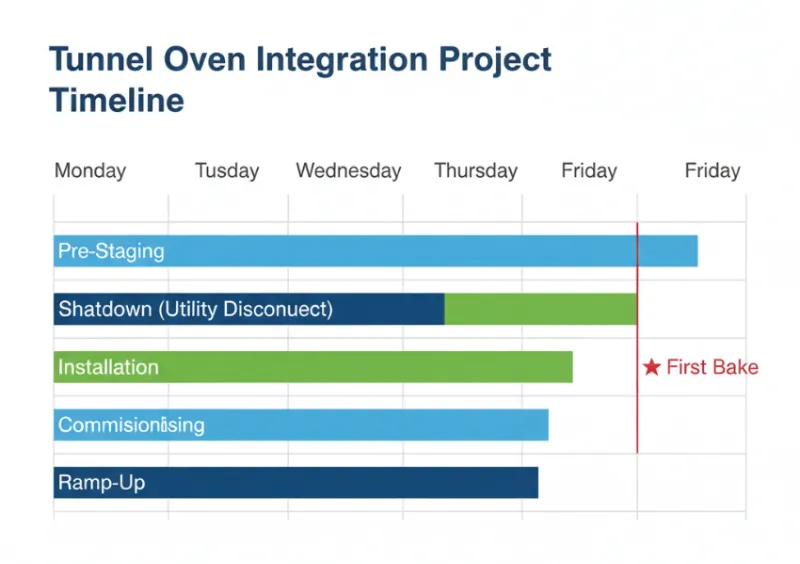
This final chapter provides practical, actionable tools and answers to the most pressing questions that managers face during the execution of an oven integration project. It translates the methodology from the previous chapter into a tangible playbook and a clear risk management framework.
The Phased Installation Playbook
A successful installation over a tight shutdown window requires military-like precision. This playbook outlines the critical sequence of events.
Pre-Staging: This is the preparatory phase. All new equipment, tools, rigging gear, and installation hardware must be delivered to the site and staged in a designated area near the final installation point before the planned shutdown begins. This eliminates delays caused by waiting for deliveries or searching for components.
The Shutdown Sequence: This is the core execution phase, following a strict, pre-determined schedule:
Safety First: Implement full Lockout-Tagout procedures on all affected equipment to ensure zero energy state.
Disconnection: Systematically disconnect all utilities (gas, electric, water, exhaust) from the old equipment.
Removal: Rig and remove the old oven and any other equipment being replaced.
Preparation: Clean and prepare the installation area.
Positioning: Rig the new oven into its final position.
Anchoring: Level the oven and securely anchor it to the floor as per manufacturer specifications.
Reconnection: Connect all mechanical and utility services to the new oven.
Initial Power-Up: Conduct initial safety checks and power up the control systems.
The First Bake & Ramp-Up: The period immediately following installation is critical for fine-tuning. The first production runs are used to debug the system, make minor adjustments to control parameters, and validate the bake profile. It is important to plan for a gradual ramp-up to full production capacity, as it often takes several shifts to fully optimize a new, complex integrated line.
Key Takeaway: A meticulously planned 72-hour shutdown is achievable. The key is pre-staging all components and having a minute-by-minute execution plan to ensure the line is ready for the first bake on Monday morning.
A project manager's primary role is to anticipate and mitigate risk. The following matrix provides a powerful tool for identifying potential integration challenges and linking them to the specific mitigation strategies outlined in this guide. This framework moves the conversation from "what if something goes wrong?" to "here is our plan to prevent things from going wrong," building confidence among all project stakeholders.
Frequently Asked Questions
How long does it take to install a new industrial oven?
The on-site installation timeline can vary significantly based on project complexity and the level of pre-planning. For a well-managed project utilizing pre-fabrication and a phased approach, the core installation can often be completed within a 6-day window, as demonstrated in the Babbco case study. A more typical project might require 1-2 weeks of on-site work. However, projects with poor planning can take much longer, with delays often caused by unforeseen utility or facility issues that should have been identified in an audit.
Can I upgrade my oven without changing my makeup equipment?
This is possible, but it depends entirely on the data gathered during the Upstream Audit. If your existing makeup equipment has sufficient surplus capacity—for example, if it is currently running at only 70% of its maximum rate to feed your old oven—then an upgrade may not be necessary. However, if the audit shows that your equipment is already operating at or near its mechanical limit, a new, faster oven will only be starved for product. In this case, you will not see the expected return on investment, and an upgrade of the limiting upstream machine is essential.
What is the single most common problem when adding a new oven?
The most frequent and costly oversight is overwhelming the downstream cooling and packaging lines. Plant managers often focus intensely on the new oven's capacity but fail to adequately plan for the increased volume of product it will produce. The new oven's output capacity must be matched by the downstream system's ability to cool, handle, and package that product efficiently. Failure to do so creates a bottleneck that renders the oven investment ineffective.
How much downtime should we expect for an oven installation?
With a meticulously planned, phased installation methodology, the goal is to contain the primary physical installation within a scheduled plant shutdown, typically a long weekend (72-96 hours). The keys to achieving this are thorough pre-planning, having all equipment and tools pre-staged on-site before the shutdown begins, and utilizing a dedicated, expert installation team that can execute the plan efficiently and safely.
Do you provide turn-key installation services?
Yes. A turn-key installation service provides a comprehensive, end-to-end solution managed by a single expert partner. This service covers every phase of the on-site project, from managing the rigging and crane work to overseeing all utility hookups, commissioning the integrated line—which includes ensuring the biscuit packaging machine is perfectly synced—and training your personnel. These projects are managed by factory-trained technicians to ensure a seamless, high-quality installation that adheres to all safety and performance standards.
Conclusion: Integration is the Key to Unlocking Your ROI
A new industrial tunnel oven is a significant investment in your bakery's future, but its financial return is not guaranteed by the hardware itself. The true value and projected ROI of this capital asset are only realized through flawless, expert-led integration. A well-planned, data-driven integration project transforms a major capital expense into a lasting competitive advantage, boosting throughput, improving product quality, and enhancing operational efficiency.
Conversely, a poorly planned installation—one that fails to account for the systemic impact on upstream, downstream, and facility infrastructure—can erase all potential financial benefits. Such projects are often plagued by costly delays, chronic production problems, compromised product quality, and an ROI that never materializes. The performance of your new oven depends entirely on the quality of its integration into your production ecosystem.
Your new oven's performance depends on the quality of its integration. Don't leave your investment to chance. Contact EverSmart today for a complimentary Line Integration Pre-Audit. Our project management experts will help you develop a data-driven plan to minimize disruption and maximize your return on investment.
SofiaExport Vice President | EverSmart📞 WhatsApp +86 13794619343📧 [email protected]

Ready to start your journey toward a customized solution? Contact me directly on WhatsApp to begin the conversation.