Automated Food Packaging Systems: Beyond the Machine—Your Complete Guide to Maximizing Biscuit Line
I. Introduction: Why Is Your Packaging Machine Always "Waiting"?
Automated food packaging systems are machines and equipment that handle the food packaging process without constant human intervention. They streamline the entire workflow, from wrapping and sealing to labeling, and preparing food items for distribution.
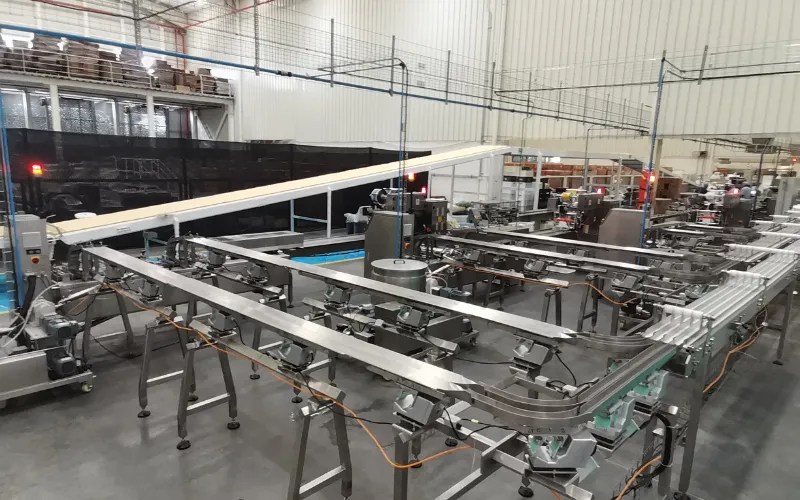
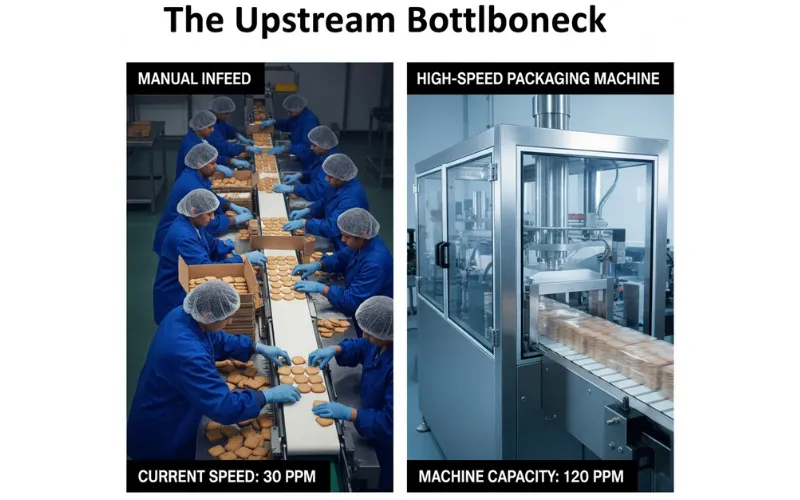
However, in food factories, especially high-output automatic biscuit factory operations, a common pain point is crystal clear. A factory spends a fortune on a high-speed packaging machine rated for 120 packs per minute (PPM), but the line's actual output often hovers around 80 PPM.
The machine's indicator light flashes, showing it's "waiting"—waiting for products from upstream.
Where is the problem?
The answer is: You bought a machine, not a system.
In today's food production, a standalone packaging machine is just an "automation island." If the biscuit infeed, cooling, sorting, stacking, and buffering systems can't keep up, that machine's potential will never be realized.
You didn't invest in its 120 PPM capability; you invested in its 80 PPM bottleneck.
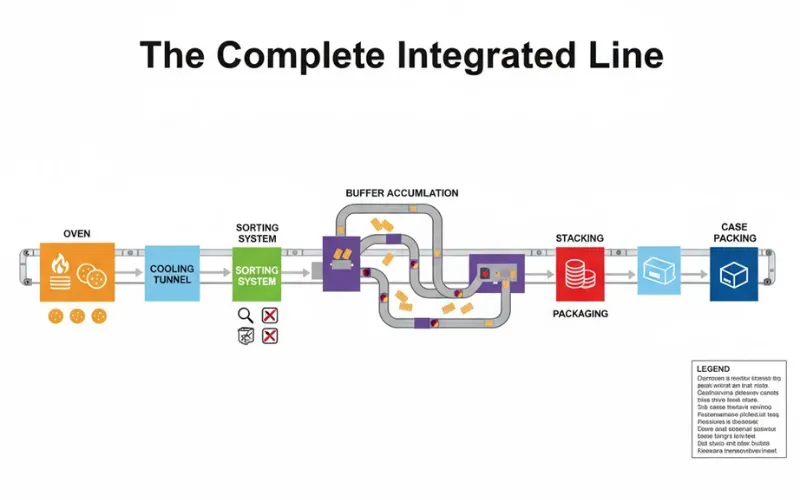
The purpose of this guide is to break free from the limitations of a single device. We will analyze how to build a truly efficient, seamlessly integrated automatic biscuit packaging systems—not just another machine that's "always waiting."
We will do this from every critical perspective: the CEO's strategic growth, the CFO's return on investment, the Procurement Manager's supply chain, and the daily operations of your Engineers (Electrical, Mechanical, and Maintenance).
Key Takeaways
The Bottleneck is Upstream: The core reason for low packaging efficiency is usually not the packer itself. It’s the infeed, sorting, and buffering systems upstream that can't keep up.
Look Beyond Machine Cost: Evaluating an automation investment must start with "Total Cost of Ownership (TCO)" and "Return on Investment (ROI)." This includes factoring in reduced scrap rates and increased throughput, not just the sticker price.
Agility is Your Competitive Edge: The true value of a modern automation system lies in its "market agility." This is the ability to rapidly switch between different products and packaging formats.
Biscuits Have Special Needs: The fragile, irregular, and orientation-dependent nature of biscuits makes their upstream integration (sorting, stacking) more complex and critical than for many other foods.
Choose a "Partner," Not a "Supplier": Your goal is to find a systems integrator who understands your entire line, from the oven to the case packer. Don't just buy an "automation island" from a machine vendor.
II. [The CFO View]: Cracking the Financial Code of Packaging Automation (ROI vs. TCO)
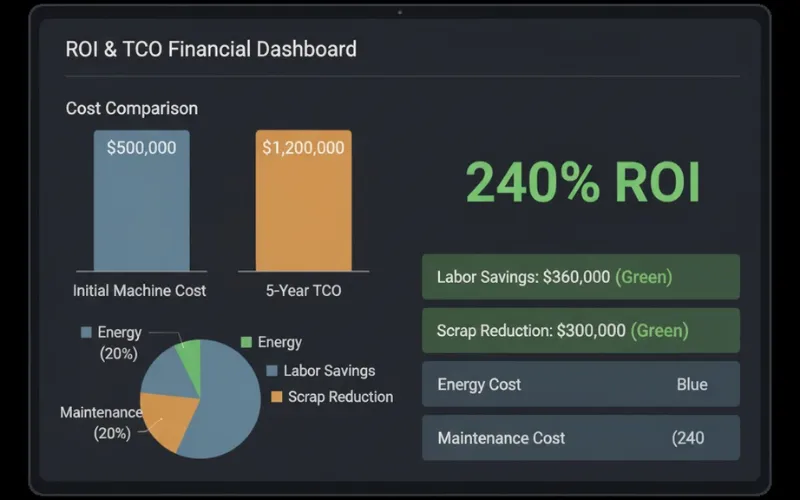
For a financial decision-maker, any investment in food packaging automation must be justified by the numbers.
The question is no longer "Should we automate?" It is "How much will it return, and how quickly?"
A. ROI (Return on Investment): Moving Beyond "Labor Savings"
Many people mistakenly equate ROI with labor savings alone. This is a serious error that drastically underestimates the true value of automation.
The Gains:
Quantifiable Throughput Increase:
(New Output PPM - Old Output PPM) x 60 min x 8 hours/shift x Operating Days x Profit per Pack = New Annual Profit. This is the core value.Quantifiable Scrap Reduction:
(Old Scrap % - New Scrap %) x Total Production x Material Cost = Annual Savings. In automated cookie packaging, cutting breakage of fragile products by even 0.5% is a significant sum.The Savings:
Direct Labor Costs:
(Number of Reduced Workers x Average Hourly Wage x Shifts x 365).Indirect Costs: Reduced risk of repetitive stress injuries, lower insurance premiums, and the recurring costs of hiring and training (e.g., see this cost analysis of manual vs. automatic biscuit sandwiching).
B. TCO (Total Cost of Ownership): The Iceberg You Don't See
The sticker price of an automated packaging system is just the tip of the iceberg. A savvy CFO focuses on the TCO.
The CapEx Traps: Beyond the price tag, you must account for:
Installation & Commissioning Fees: These are not free.
Upstream Integration Costs: The cost to connect the packer to your existing cooling lines and sorters.
Operator Training Fees: High-end equipment requires well-trained operators.
The OpEx Hazards:
Energy Consumption: A full-servo system may have a slightly higher initial cost but consumes far less energy than a pneumatic system. This results in lower long-term OpEx.
Spare Parts: What is the annual consumption cost of critical wear parts like end-seal knives, heater bands, and Teflon tape?
Maintenance: The man-hours required for preventive maintenance.
Tip (For the CFO): When evaluating quotes, TCO is more important than the initial purchase price. A system with lower energy use, more durable parts, and easier maintenance will often overtake its initial price "disadvantage" within 2-3 years through OpEx savings.
C. The Hidden Costs of Not Automating
CFOs must also calculate the inverse: What is the price of maintaining the status quo?
Cost of Injury: Manual, repetitive packing tasks are a primary source of costly ergonomic and repetitive stress injuries. A single worker's compensation claim can rival the down payment on a new machine.
Cost of Lost Opportunity: This is the biggest hidden cost. When a major retailer (like Costco or Walmart) offers a massive contract, can your manual-labor-constrained line scale up to meet the demand?
Saying "no" to that one contract is often more expensive than the entire automation project itself.
Cost of Brand Damage: Manual processes lead to inconsistent seals, inaccurate labeling, and a higher risk of foreign object contamination. A single product recall can destroy brand trust far more than automation ever costs.
D. The Financial Decision: Optimizing Cash Flow
Finally, consider leasing options. This can convert a large, one-time capital expenditure (CapEx) into a predictable, lower monthly operational expenditure (OpEx).
This strategy allows you to start realizing the returns from automation immediately, without tying up your company's valuable cash flow. For high-growth companies, this OpEx model is often preferable as it preserves capital for R&D, marketing, or facility expansion.
III. [The CEO View]: How Automation Drives Strategic Growth & Market Agility
As the leader of the business, the CEO focuses on how automation helps win market share, secure the brand, and enable scalable growth.
A. Meeting Compliance & Protecting Brand Reputation
Hygiene & Safety: Automated food packaging systems minimize direct human contact with the product. This isn't just for efficiency; it's for compliance.
It helps your factory easily pass strict audits from major retailers and comply with federal standards like the FDA's cGMP (Current Good Manufacturing Practices).
Brand Consistency: Automation ensures every seal is strong and clean, and every date code is clear and accurate. It eliminates consumer complaints from poor packaging—like stale biscuits from a bad seal—which is the foundation of brand trust.
B. The Core Competency: Market Agility
This is perhaps the single greatest strategic advantage of automation. Imagine this scenario:
Your marketing department gets an urgent order from a major convenience store chain. They need one million individually-wrapped biscuits delivered in two weeks. But your current line is set up for family-size packs.
How long will it take your line to switch over? Three days? Or three hours?
That is agility. A modern automated packing system allows you to call up pre-set recipes from the HMI (Human-Machine Interface).
Mechanical parts like the forming box can be swapped out quickly. This ability to provide custom packaging solutions is how you win those urgent, high-margin orders and beat your competition.
Note (For the CEO): Your line's agility translates directly into your speed to market. In the fast-moving consumer goods (FMCG) industry, getting a new package format on the shelf one week before a competitor can mean winning the entire season's contract.
C. Automation as a Talent & Retention Strategy
In a tight labor market, relying on a large pool of manual labor is a high-risk strategy. Automation flips the script.
Upskilling, Not Replacing: You aren't "firing" manual packers. You are "promoting" them.
You re-skill your most reliable floor staff to become machine operators, quality technicians, and line supervisors. This creates a clear career path, boosts morale, and dramatically increases employee retention.
Attracting New Talent: A modern, clean, automated factory is a far more attractive workplace for the next generation of talent than a loud, chaotic, labor-intensive one. Your investment in technology signals that your company is stable, growing, and a "winner."
D. Data-Driven Decisions (OEE)
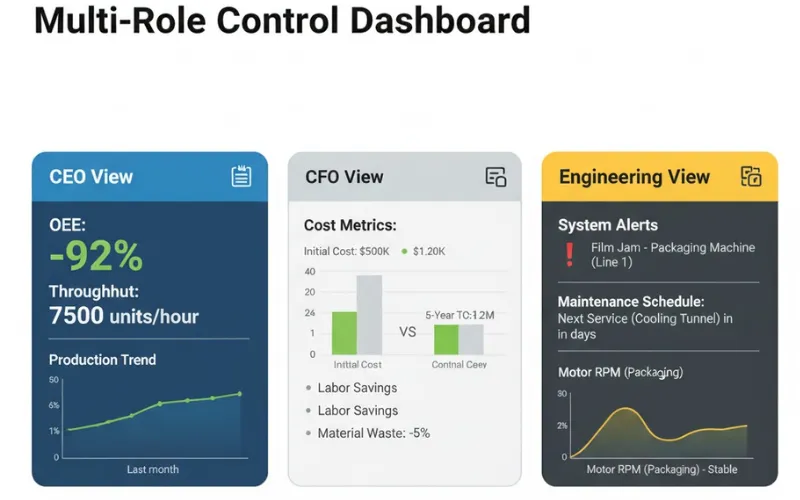
The OEE (Overall Equipment Effectiveness) dashboard on your packaging machine's HMI isn't just for engineers. It should be the CEO's strategic dashboard.
OEE tells you the truth. Is your factory struggling at 60% efficiency (idle equipment, frequent stops, high defects), or is it profiting at a world-class 85%?
This data will guide your most critical decisions: when to add a second shift, or when you must invest in a second production line. It can even inform product development when it reveals that one specific biscuit shape has a 5% higher jam rate than all others.
IV. [The Engineer's View]: Deep in the "Engine Room" (Mechanical & Electrical)
Engineers are the foundation for making it all work. They focus on reliability, maintainability, and integration.
A. [The Mechanical Engineer]: Focus on Structure, Hygiene & Changeover
Hygienic Design: In the food industry, this is never optional.
Checkpoint 1: Does the machine use a cantilevered frame? This completely isolates the cleaning (product contact) zone from the drive (gears, belts) zone.
Checkpoint 2: Does it avoid hollow-body tubing where water can pool? Are all surfaces easy to clean and angled for runoff?
Checkpoint 3: Can conveyors be quick-released (without tools) for full sanitation and washups? This is a must.
Mechanical Rigidity: When the machine runs at >100 PPM, is the frame stable and vibration-free? A weak, fabricated frame will vibrate, leading to misaligned seals and rapid knife wear.
The Changeover:
Goal: A skilled operator should complete a full changeover from biscuit A to biscuit B in 15 minutes.
Key Tech: Are tools required? (The ideal is tool-less or single-tool). Are there digital position indicators or servo-driven positioning? (This eliminates "trial and error" adjustments).
Tip (For Engineers): Changeover time is one of the biggest killers of OEE. When evaluating a machine, ask the supplier to perform a full changeover in front of you. With a stopwatch.
B. [The Electrical Engineer]: Focus on the "Brain" & the "Handshake"
Control Platform (PLC): This is the machine's "brain." Is it an open platform your team already knows (like Siemens, Rockwell, Omron)? Or is it a proprietary "black box" that you can't service and are locked into the supplier for?
Insist on an open platform. Your team must be able to troubleshoot and modify the code without calling (and paying) the vendor.
Drive System: Is it a full-servo system? Servo motors—controlling the film pull, end seals, and infeed—are the foundation for high precision, high speed, and changeover flexibility.
Avoid cheaper "servo-hybrid" or stepper motor systems. The long-term cost in lost flexibility and maintenance headaches is not worth the small initial savings.
The Integration Protocol (The "Handshake"):
How does this machine "talk" to the upstream biscuit stacker? Does it support standard protocols (like PackML, EtherNet/IP, or OPC-UA)?
Is the "No Product, No Bag" and "No-Gap, No-Seal" logic robust and reliable? This saves a massive amount of packaging film and prevents product jams at the knife.
C. Safety Systems, Risk Assessments & Compliance (The Non-Negotiables)
An engineer's first job is to ensure the system is safe. A machine that isn't safe is just a liability.
Guarding & Interlocks: All moving parts must be fully guarded. Are the guards robust, or are they flimsy plastic?
Do the access doors use modern, category-3 (or higher) non-contact safety interlocks? Or do they rely on old, easy-to-defeat mechanical switches?
Risk Assessment: Ask the supplier for their detailed Risk Assessment (RA) document for the machine. This proves they have systematically identified and mitigated hazards according to global standards like ISO 12100 (Safety of machinery).
If they can't provide one, this is a massive red flag.
Emergency Stops (E-Stops): Are E-stops logically placed at all operator stations and potential hazard zones? Does the HMI clearly state which E-stop was pressed, or does it just show a generic "E-Stop Fault"?
The difference is 30 seconds of downtime versus 30 minutes of "fault-finding."
V. [The Differentiator]: Stop Buying "Islands"! The Real Biscuit Bottleneck is Upstream
This is the core of this guide. You may be searching for the best automatic biscuit packaging systems, but the best machine is useless if the infeed can't keep up.
In an automatic biscuit factory, the biggest challenge is often before the packaging machine.
A. Why Is Biscuit Packaging So Special?
Fragility: Shortbread and wafer biscuits are extremely delicate. Any rough drop, collision, or push will spike your scrap rate.
Irregularity: Biscuits fresh from the oven may not be perfectly uniform in size or thickness (a problem closely related to tunnel oven integration). This can cause jams in standard infeed lanes.
Orientation: Sandwich biscuits or products from a cookie capper must be fed "on-edge." Chocolate-coated biscuits may not be flipped over.
B. The Solution: A Seamlessly Integrated Infeed System
A true automatic biscuit packaging systems must be one continuous process.
Step 1: Automatic Sorting—From "Chaos" to "Order"
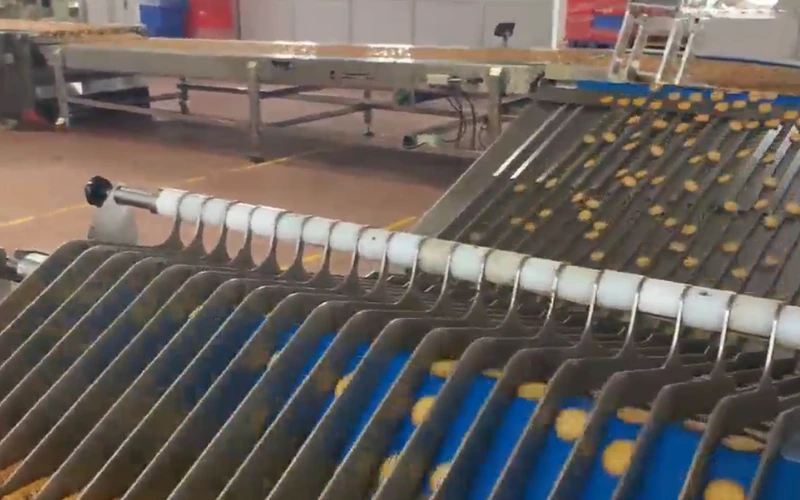
The Challenge: Biscuits arrive "chaotically" from a wide cooling conveyor or cooling tunnel.
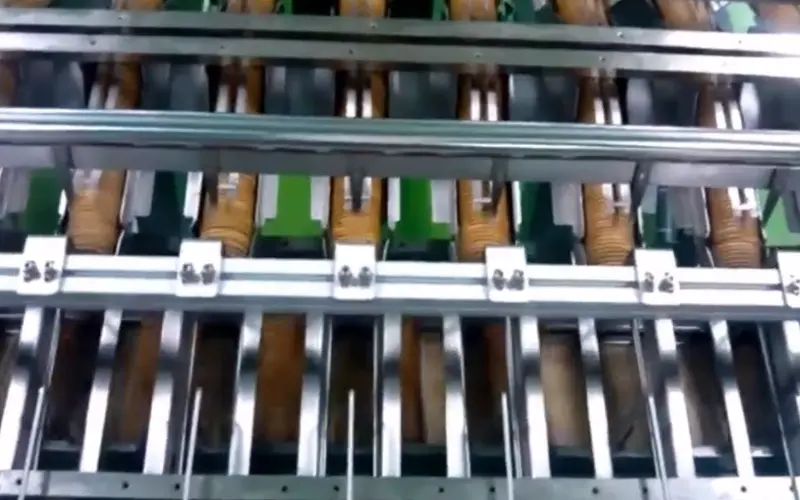
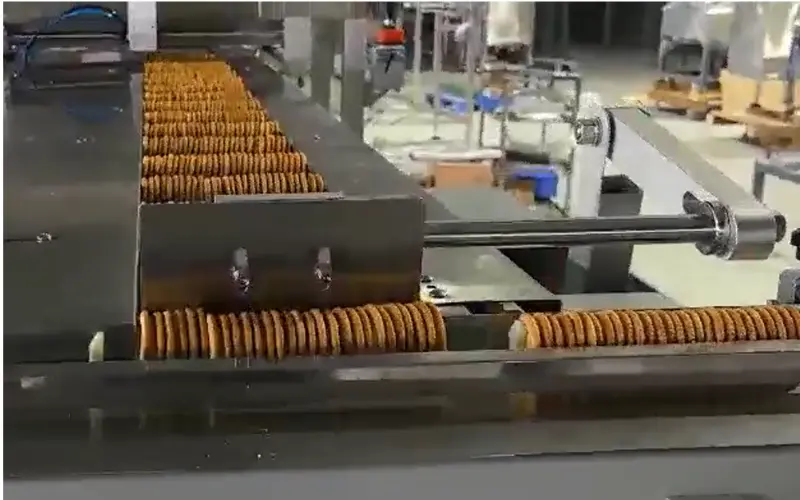
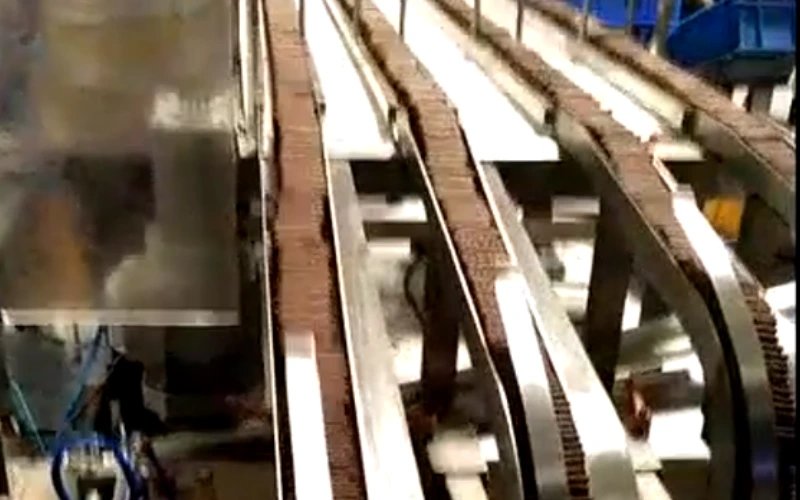
The Solution: An automatic feeding system (like a vibratory lane feeder or centrifugal sorter) gently separates and aligns the biscuits into neat, single-file or multi-file lanes.
Step 2: Stacking/Counting—Creating the Pack Format
The Challenge: A pillow pack (HFFS) often needs the biscuits "on-edge" and grouped in fixed counts (e.g., 3 or 5).
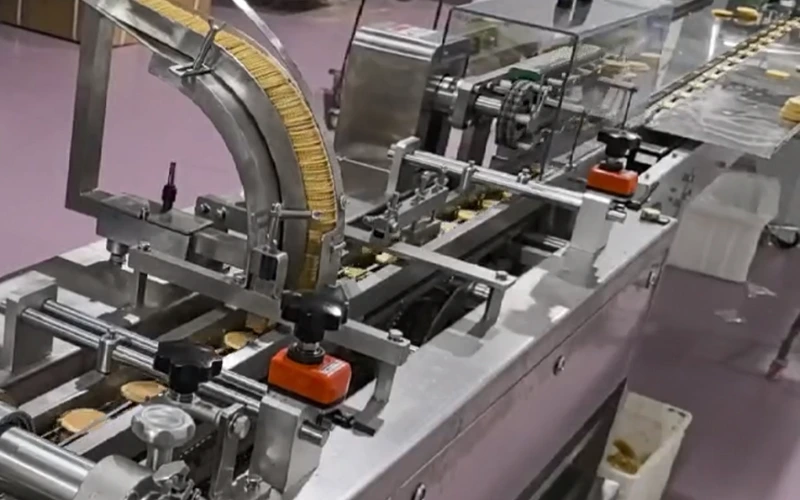
The Solution: A dedicated biscuit stacker or counter. This unit, sometimes paired with a 180-degree flip machine, automatically turns flat-lying biscuits, counts them, and creates the "slugs" ready for wrapping.
Step 3: Smart Buffering—The Key to OEE
The Pain Point: The packaging operator stops the machine for 3 minutes to change a roll of film. Does the upstream oven have to stop? If it does, the entire line's output is devastated.
The Solution: Install an automatic buffering system (like a "first-in, first-out" accumulation belt) between the sorter and the packaging machine.
The Value: When the packer stops, the buffer automatically "stores" the incoming biscuits. When the packer restarts, the buffer feeds from its stored supply first. This one feature can increase a line's OEE by 10% to 15%.
Note (The Core Takeaway): "Smart Buffering" is the only way to "decouple" the oven (which must run continuously) from the packaging machine (which will inevitably stop intermittently). Without a buffer, your line's OEE will almost certainly never rise above 70%.
C. Case Study: The Wafer vs. The Hard-Baked Cookie
Why is a custom infeed solution so critical? Because the "perfect" feeder for one biscuit is a disaster for another.
The Wafer Scenario: Wafers are light, fragile, and often have a cream filling. They cannot be dropped, pushed with force, or vibrated aggressively.
The Solution: A wafer-specific system uses gentle, low-friction belts. It might use vacuum arms or extremely low-pressure side-guides to sort and stack, ensuring the delicate layers aren't crushed and the cream filling doesn't smear.
The Hard-Baked Cookie Scenario: A round, hard-baked cookie is durable and can withstand more robust handling.
The Solution: This product is a perfect candidate for a centrifugal feeder, which uses rotational force to quickly separate and channel cookies into a single lane. This would destroy a wafer but is the fastest possible method for a durable cookie.
A "one-size-fits-all" vendor will try to sell you one of these. An integration partner will first ask, "What is the product?"
D. Our Promise: A Complete Line Solution
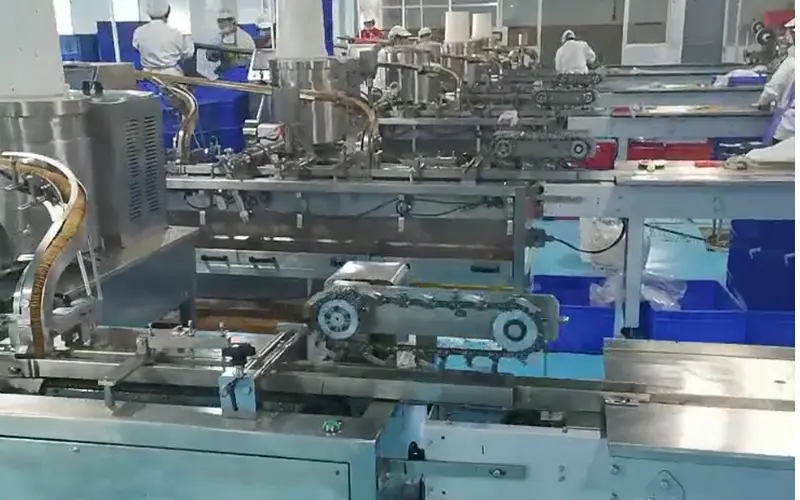
We don't just sell an automatic packaging system. We provide a complete, integrated production line solution—with a guaranteed output—from your oven exit to your case packer entrance.
We understand the unique properties of biscuits. We solve your upstream bottlenecks.
VI. [The Procurement & Maintenance View]: Choosing a "Partner," Not Just a "Vendor"
A. [The Procurement Manager]: Terms You Must Specify in Your RFQ
Acceptance Criteria (FAT/SAT): Do not accept vague promises. Define the Factory Acceptance Test (FAT) and Site Acceptance Test (SAT) performance metrics in the contract.
Example:
"The system must run Client's Product A and Product B for 1 continuous hour at 110 PPM with a finished pack acceptance rate of >99%."Lead Time: Be clear that this is the lead time for the entire integrated system, not just the standalone packaging machine.
"Critical Spares Package": Demand that a "First-Year Critical Spares Package" be itemized and costed separately in the quote. This prevents you from paying high-priority freight for a single knife blade three months later.
Small System Considerations: If you are looking for small automatic biscuit packaging systems, focus even more on a supplier's ability to provide a compact, multi-functional, and quick-changeover solution.
Tip (For Procurement): A clearly defined SAT (Site Acceptance Test) is your single most powerful negotiating tool. It transforms a vendor's promise of "speed" into a contractual obligation for "output."
B. The "One-Throat-to-Choke" Principle
Procurement managers often try to save money by "piecemealing" a line: buying the feeder from Vendor A, the stacker from Vendor B, and the wrapper from Vendor C.
This is almost always a financial disaster.
When the line fails (and it will), Vendor A blames Vendor B, who blames Vendor C. You are trapped in the middle, while your line is down and OEE plummets.
The only smart move is to source the entire integrated line from a single partner. This "one-throat-to-choke" principle means one company is 100% responsible for the line's guaranteed output. The savings in integration headaches and downtime will dwarf any small-percentage savings you thought you gained by piecemealing.
C. [The Maintenance Engineer]: The After-Sales Support You Actually Need
Preventive Maintenance (PM) Checklists: The supplier should provide clear, simple, daily/weekly/monthly PM checklists. You need this, not a thousand-page technical manual.
Remote Diagnostics (VPN): A modern automated package systems must have VPN remote access capability. 60% of software and parameter issues can be solved via remote diagnosis in 10 minutes, instead of waiting 24 hours for a technician to fly in.
Troubleshooting Guides: Ask for video-based, simple-to-follow guides for common faults (e.g., film tracking issues, bad seals, cooling line problems, product jams at the knife).
Building an In-House Champion: Does the supplier's training plan just "check a box"? Or will they spend a full week, post-installation, training your best operators and maintenance staff to be true "Automation Champions"?
This in-house expert is your first line of defense and is more valuable than any service contract.
VII. Future Trends: Smarter, More Flexible, More Sustainable
The future of automated food packaging systems is already here.
Collaborative Robots (Cobots): Using cobots for flexible automated box packaging systems (case packing) and palletizing at the end of the line. They are safer and easier to program than traditional industrial robots, especially in tight spaces.
Predictive Maintenance (IoT): Your machine sends a spare part request to the maintenance department before the heating element fails (based on analyzing its resistance data), not after it causes downtime.
Sustainable Packaging: This is the biggest trend. Consumers and regulations, like those tracked by the Sustainable Packaging Coalition, are pushing for thinner films, mono-materials, or paper-based materials. Has the equipment you're about to buy been proven to run these more-difficult materials at high speed?
Ask for video proof or a live demo. These materials are far less forgiving than standard plastics.
Digital Twins & Virtual Commissioning: The most advanced suppliers can build a complete 3D "digital twin" of your proposed line.
We can load your product's 3D model into this virtual environment and run a full production simulation, identifying bottlenecks and optimizing the design before a single piece of metal is cut.
AI-Driven Quality Control: The next generation of vision systems does more than just check for "presence."
They use AI to check for bake color consistency, subtle cracks or chips, and the precise alignment of frosting or sandwich cream. This data can be fed back to the oven or sandwicher to make micro-adjustments in real-time.
VIII. Conclusion: Invest in "Output," Not "Machinery"
Let's return to our original question: Why is your packaging machine always "waiting"?
The answer is clear. You may have bought an excellent "machine," but you neglected to build an efficient "system."
An automatic packaging system is a commodity. But a seamlessly integrated automatic biscuit packaging systems—one that solves your upstream bottlenecks, connects your data, and is backed by a true partner—is a genuine competitive advantage.
Stop paying for "packaging speed." It's time to invest in "actual output."
IX. Take Action: Get Your Custom Line Diagnosis
Is your packaging line being held hostage by its infeed speed?
Is your OEE stuck below 70%?
Are you frustrated by high scrap rates and frequent downtime?
Contact our team of experts today for a free, no-obligation "Line Integration Diagnosis."
We are not the typical machine vendor. Our analysis doesn't start at our packaging machine; it starts at your oven.
We specialize in providing complete custom packaging solutions to ensure every single biscuit you produce makes it to your customer, efficiently and intact.
[Click Here to Schedule Your 30-Minute Free Line Assessment]
X. Frequently Asked Questions (FAQ)
1. What type of packaging is used for biscuits?Biscuit packaging is very diverse, and automation can handle most types:
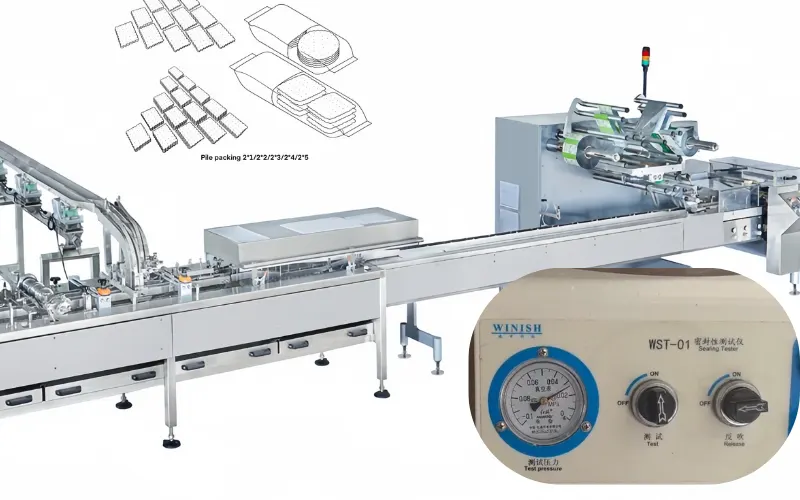
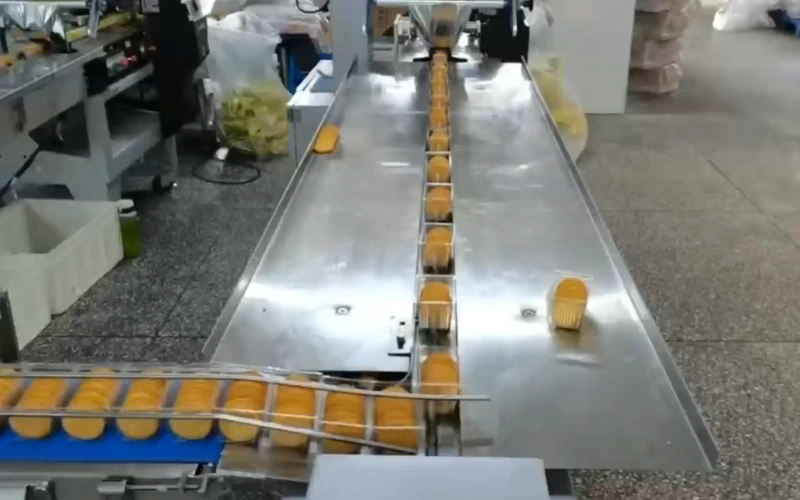
Pillow Packs: The most common form, using a Horizontal Form-Fill-Seal (HFFS) machine to wrap single or stacked biscuits.
Vertical Bags: Uses a Vertical Form-Fill-Seal (VFFS) machine, common for bulk-packed mini-biscuits or cookies.
Tray and Flow-wrap: For delicate biscuits (like wafers), which are first placed in a plastic tray and then pillow-packed.
Roll Packs: Common for round soda crackers, where biscuits are stacked into a cylinder and wrapped.
Automated Cartoning: Groups of the packs above are then automatically loaded into a paperboard box.
2. What is the automated packing process?A complete automated packing process typically includes these steps:
Infeed: Product (biscuits) arrives from the production line (e.g., cooling belt).
Sorting: Automatically aligns chaotic products into neat lanes.
Counting/Stacking: Groups or stacks products into pre-set quantities.
Buffering: Temporarily stores products to balance the speed differences between upstream and downstream equipment.
Wrapping/Bagging: Product is fed into the packaging film, which is then formed and sealed.
Coding/Labeling: Printing of production dates, batch codes, etc.
End-of-Line: Automatic case packing and palletizing, preparing the products for shipment.
3. How do they package biscuits?For the most common pillow-packed biscuits, the automated process is as follows:
Biscuits come off the cooling belt and are aligned into lanes by a sorting feeder.
They are fed into a stacker, which groups them into a "slug" of a set count (e.g., 4 biscuits).
The slug is gently pushed into the lug chain of the packaging machine (HFFS).
Film is fed from above or below, forming a "tube" around the biscuit slug.
The longitudinal sealers seal the bottom (or top) of the film tube.
The cross sealers and knife simultaneously seal the end of one pack and the start of the next, cutting them apart. One pack is now complete.
4. What are the disadvantages of automatic packing?This is a very realistic question. The primary "disadvantages" or challenges include:
High Initial Cost: Automation, especially high-quality, full-servo systems, is a significant capital investment.
Complexity & Maintenance: Highly automated systems require more skilled technicians for maintenance and troubleshooting.
Lack of Flexibility (in older systems): Some old or low-end automation might be "hard-tooled" for only one product, making changeovers extremely time-consuming.
However, these "disadvantages" can all be mitigated with the right strategy:
Solve for Cost: Use TCO and ROI analysis (as shown in Section II) to prove the long-term return far outweighs the initial cost.
Solve for Maintenance: Choose a supplier-partner who provides excellent training, clear PM schedules, and fast remote diagnostics (as shown in Section VI).
Solve for Flexibility: Invest in modern, full-servo systems (as shown in Section IV) that are designed for fast, tool-less changeovers.
5. How do I integrate a new packaging machine with my existing oven and cooling line?This is the most critical question and the biggest challenge.
Speed Matching: First, you must ensure the packer's actual speed matches the oven's stable output.
Buffering is Mandatory: As detailed in Section V, you must install a buffering/accumulation system between the cooling line exit and the packer entrance. This "decouples" the oven from the packer, allowing the packer to stop briefly (for a film change) without stopping the oven.
Feeding & Sorting: You need an automatic sorting system that can take the biscuits from the cooling belt and format them correctly (e.g., single lanes, on-edge stacks) for the packer.
Seek an Integrator: Do not try to piece this together yourself. You need a "systems integrator," or a company like us that understands both upstream (biscuit production) and downstream (packaging), to provide a complete custom packaging solution.
6. How does automation handle allergen cross-contamination?This is a critical E-E-A-T point. Superior hygienic design is the key.
Tool-less Disassembly: Systems designed for allergen control (e.g., peanuts vs. plain biscuits) feature tool-less disassembly of conveyors, guides, and feeders. This allows for rapid, thorough washdowns and visual inspection.
Eliminating Harbor Points: There are no hollow tubes, hidden crevices, or flat surfaces where product dust (the allergen) can accumulate. All designs are angled for runoff.
Dedicated Components: For high-risk allergens, a "partner" integrator will suggest dedicated, color-coded, and swappable components (like feeders or stackers) to ensure zero cross-contact.
7. What is the typical footprint (size) of an automated packaging line?This varies dramatically. A simple, small automatic biscuit packaging systems might only be 15-20 feet (5-7 meters) long.
However, a high-speed, fully integrated line with sorting, multi-lane feeding, buffering, and stacking before the wrapper can easily be 80-100 feet (25-30 meters) long. The "smart buffering" (Step 3 in Section V) is often the component that requires the most floor space, but it's also what delivers the highest ROI.
A good integrator will design the line to fit your floor space, often using U-turns or vertical accumulation to be more compact.
8. Can one system handle multiple biscuit sizes and shapes?Yes, this is the entire point of "Market Agility" (Section III).
Modern, servo-driven systems are designed for this. Changing from a 2-inch round cookie to a 3-inch square one is handled by:
HMI Recipe: The operator selects the "Square Cookie" recipe on the touchscreen.
Auto-Adjustments: The servo motors automatically adjust the infeed lane guides, the stacker count, and the pack cut-off length.
Quick-Change Parts: The operator may need to perform a fast, tool-less swap of the "forming box" (which shapes the film tube).
This entire process, on a well-designed line, should take under 15 minutes, which is a core part of the "Changeover" discussion (Section IV).
Ready to start your journey toward a customized solution? Contact me directly on WhatsApp to begin the conversation.