How to Choose the Right Food Packaging Machine for Your Factory: The 2025 Strategic Guide
By David Chen, Senior Automation Engineer | 16+ years of experience in multinational F&B packaging line integration.
Introduction
Selecting the ideal food packaging machine demands a careful balance of technical specs, operational costs, and production flexibility.
This strategic guide provides engineering and procurement teams with a systematic framework to evaluate equipment beyond basic specifications.
Building on our overview of
KEY TAKEAWAYS
Prioritize Architecture Over Specs: The machine's core drive technology and control system openness determine long-term flexibility more than any performance metric.
Quantify Total Cost of Ownership: Calculate a 5-year operational budget including energy, maintenance, and potential downtime.
Validate Real-World Performance: Always insist on Factory Acceptance Testing using your actual products under realistic conditions.
Assess Supplier Support Capabilities: Technical response time and spare parts availability are non-negotiable for long-term uptime.
Plan for Integration and Future Needs: Ensure the machine fits your existing line and can adapt to sustainable materials and new regulations.
Chapter 1: The Technical Foundation – Evaluating Performance Beyond the Spec Sheet
1.1 Drive System Selection: Precision vs. Speed vs. Flexibility
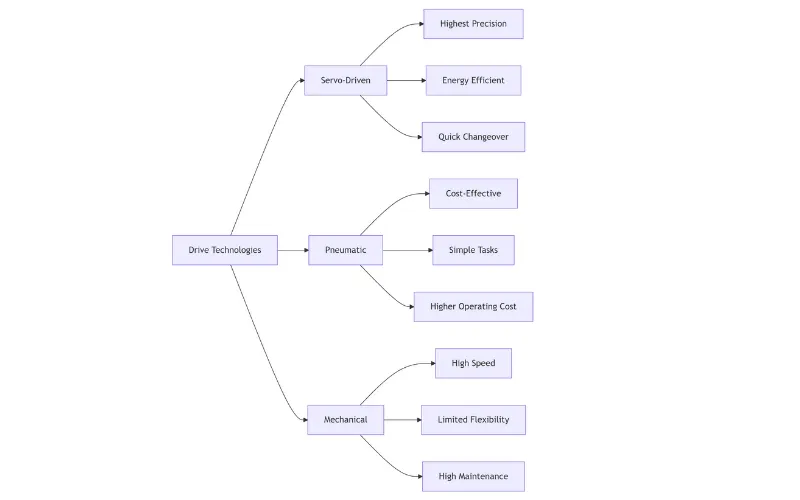
Servo-driven systems provide unparalleled flexibility for production lines running multiple products. Their precise acceleration profiles prevent delicate items from cracking while enabling quick changeovers.
Pneumatic systems offer cost-effective solutions for simple, high-speed tasks. However, they lack precision control for fragile products and incur higher energy costs.
Note: Servo systems can consume 25-35% less energy than mechanical drives. The
U.S. Department of Energy's Motor Systems confirms optimizing motor systems is key for industrial energy savings.
1.2 Control System Architecture: Your Future Integration Lifeline
Modern packaging lines require robust distributed control architectures using EtherCAT or PROFINET networks. These industrial protocols ensure precise synchronization between stations while simplifying maintenance.
Critical Requirement: Insist on OPC UA data interfaces for seamless MES integration. The
Tip: Ask suppliers not just "What brand of PLC?" but also "What is the native data interface?" This reveals true system openness and future-proofing.
1.3 Operational Accessibility: Maintenance Efficiency Matters
Evaluate how quickly your team can perform common maintenance tasks. Can they replace a sealing element or clear a jam in under ten minutes?
These daily operations impact Overall Equipment Effectiveness more than theoretical maximum speeds. Proper design aligns with our
Case Study: Real-World Impact of Drive System Selection
Company: Crunchy Snacks Co.
Challenge: Needed to package delicate crackers at high speed without breakage.
Solution: Upgraded to a fully servo-driven vertical form-fill-seal machine.
Results:
Product breakage reduced from 15% to 0.5%
Changeover time decreased from 45 to 2 minutes
Energy consumption dropped by 30%
ROI achieved in 14 months
Chapter 2: Financial Analysis – Calculating True Ownership Costs
2.1 The Total Cost of Ownership Framework
Move beyond purchase price to include installation, training, and initial spare parts. These often represent 25-40% of first-year costs that companies overlook.
Our dedicated
2.2 Operational Expense Drivers
Energy consumption varies dramatically between drive technologies. Servo systems typically reduce power costs by 30% while providing superior process control.
Maintenance planning should include both preventive schedules and predictive technologies. These forecast failures before they cause production stoppages.
Visualizing 5-Year Total Cost of Ownership
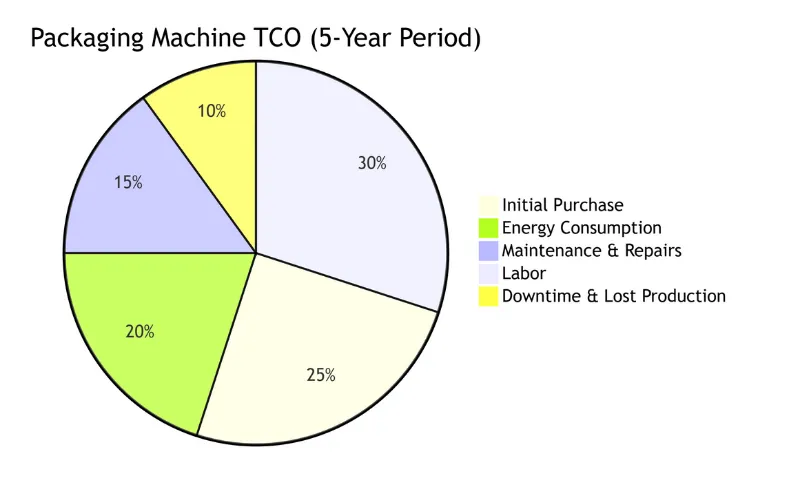
Note: A 15-20% higher initial investment often yields 150-200% greater lifetime value. Focus on cost per unit produced, not just purchase price.
Chapter 3: Implementation Strategy – From Selection to Operation
3.1 Technical Specification Development
Create detailed User Requirements Specifications including OEE targets and changeover limits. Our
This proactive approach prevents most post-installation issues. It forces rigorous verification of components and capabilities.
3.2 Supplier Evaluation & Validation
Apply rigorous technical checklists during supplier evaluation. This diligent verification prevents the majority of installation problems.
Tip: Require suppliers to list their top 5 spare parts and their global delivery lead times. This simple question reveals supply chain robustness and your potential downtime risks.
3.3 The Factory Acceptance Test (FAT) Protocol
Insist on testing with your actual products under real production conditions. This validates performance claims before the equipment ever ships.
Never underestimate seeing your products run on the machine before purchase. It is the ultimate and most reliable test of its capabilities.
3.4 Operational Integration Planning
Plan meticulously for staff training, documentation, and spare parts inventory. These elements determine how quickly you achieve target performance levels.
This planning transforms a simple purchase into a strategic upgrade. It is a core component of
Chapter 4: Future-Proofing Your Packaging Investment
4.1 Sustainable Packaging Compatibility
The market shift to mono-material films and paper-based composites requires different machine handling characteristics. You must verify compatibility with your company's sustainable packaging roadmap.
Note: Never accept a verbal assurance on material compatibility. Demand video evidence or, better yet, conduct FAT tests using the exact materials from your future supply chain.
4.2 U.S. Market Compliance: FCC Certification
FCC certification is mandatory for machinery with wireless capabilities or significant electronic controls. Regulations for 2025 have tightened considerably.
FCC SDoC: Required for machines with PLCs and motor drives.
FCC ID: Mandatory for any wireless equipment (Wi-Fi, Bluetooth).
Labeling: Requires permanent FCC ID marking with specific height requirements.
Non-compliance risks include customs seizure, fines up to $150,000 per violation, and market removal orders. These regulations cannot be ignored for equipment operated in the United States.
4.3 Industry 4.0 Data Accessibility
Modern equipment must provide comprehensive data access for monitoring, quality tracking, and maintenance planning. OPC UA interfaces enable seamless MES integration without custom programming.
This accessibility represents the future of smart manufacturing. It's among the
4.4 Regulatory Compliance Preparedness
Upcoming extended producer responsibility regulations will require detailed packaging material reporting. Ensure your equipment can automatically track and report this data.
The
Drive System Technology Comparison
Frequently Asked Questions
What is the most common mistake factories make when selecting packaging machinery?
Focusing solely on the initial purchase price and maximum speed. This approach neglects the Total Cost of Ownership, which includes energy, maintenance, and downtime costs over the machine's lifespan.
How critical are control system protocols in the selection process?
Extremely critical. Proprietary protocols can create supplier lock-in and make future integration costly, while open standards like OPC UA ensure long-term flexibility and data accessibility.
For the U.S. market, what certifications should we prioritize?
Beyond UL/CE for safety, prioritize FCC compliance for all electronics, NSF/3-A certification for food contact surfaces and sanitary design, and documented FDA compliance for all food-contact materials used in the machine's construction.
Next Steps
This guide provides the framework for making an informed, strategic packaging machine investment. The right choice successfully balances technical capability with long-term operational efficiency.
Ready to move forward with confidence?
Download our Technical Specification Checklist for comprehensive supplier evaluations.
Get a professional assessment from our engineering consultants for an unbiased second opinion.
Explore our complete resource library on
Packaging Fundamentals .

Ready to start your journey toward a customized solution? Contact me directly on WhatsApp to begin the conversation.