The Ultimate Guide to Food Packaging Equipment Maintenance: Transforming Cost Center to Competitive

(Author: David Chen, Senior Automation Engineer | ISO 55001 Asset Management Certified | 16+ years of experience in multinational F&B packaging line integration and maintenance.)
Introduction
Maintaining food packaging machinery requires a multifaceted approach. It involves daily cleaning and lubrication, regular inspections of high-wear components like belts and seals, and periodic checks of electrical, pneumatic, and control systems.
In today's competitive food processing industry, viewing equipment maintenance as mere "repair work" is a dangerous oversimplification. Evolving beyond reactive fixes to establish a proactive, predictable asset management strategy is a critical business decision that directly impacts your bottom line.
Key Takeaways
Proactive Beats Reactive: Adopting Preventive (PM) and Predictive (PdM) maintenance strategies dramatically reduces the immense costs of unplanned downtime, far surpassing the "run-to-failure" model.
Structure is Central: Establishing and rigorously adhering to a multi-tiered maintenance schedule—covering daily, weekly, and monthly/quarterly tasks—is the key to transforming maintenance from chaotic to controlled.
Data-Driven Decisions: Linking maintenance activities to core production metrics like OEE (Overall Equipment Effectiveness) and utilizing tools like a CMMS for record-keeping and analysis form the foundation for intelligent maintenance and continuous improvement.
Systematic Troubleshooting: Employing a structured diagnostic approach—from parameters to mechanics, then to electrical systems—during downtime can drastically reduce your Mean Time To Repair (MTTR).
People are Pivotal: Training operators in "autonomous maintenance" and fostering a strict safety culture, including Lockout-Tagout (LOTO), are indispensable for building a world-class maintenance system.
Core Maintenance Strategies: From Reactive to Proactive
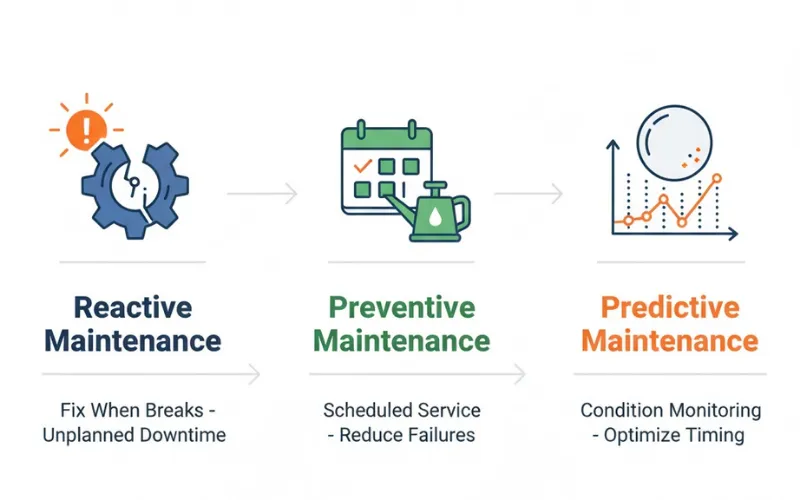
Selecting the right maintenance strategy is the foundational first step in building an efficient system. Different strategies represent distinct management philosophies, each with unique costs, risks, and returns.
A. Reactive Maintenance (Run-to-Failure)
This is the most basic strategy, operating on a straightforward "fix it when it breaks" principle. While its logic appears simple, the hidden costs are staggering and often devastating to production timelines.
Imagine a critical vertical form-fill-seal machine's film feed belt snapping during peak production hours. The true cost encompasses far more than just a replacement belt.
B. Preventive Maintenance (PM)
As the cornerstone of any effective maintenance program, PM is built on the philosophy of "prevention is better than cure." This time-or usage-based strategy involves scheduled inspections, lubrication, cleaning, and replacement of components with predictable lifespans, like bearings and seals.
The starting point for any PM plan is always the manufacturer's OEM manual. The real challenge, and opportunity, lies in dynamically adapting the schedule's frequency and tasks based on your equipment's actual age, operating environment, and production intensity to maximize cost-effectiveness.
C. Predictive Maintenance (PdM)
This represents a more advanced, data-driven, and lean approach. PdM's core principle is "condition monitoring," deciding when to maintain based on the asset's actual health rather than a predetermined schedule.
By deploying IIoT sensors on critical components, you can collect real-time data on parameters like motor vibration spectra, bearing temperature, and main drive current. Sophisticated algorithms then analyze this data to accurately predict the window for a potential failure, allowing for precise, just-in-time intervention.
PdM is one of the latest technological innovations in food packaging systems. It enables a crucial leap from being "preventive" to being "predictive," thereby minimizing unnecessary maintenance tasks and spare parts inventory.
D. The Ideal Approach
For the vast majority of food packaging operations, the most pragmatic and effective strategy is a hybrid model. This approach builds a robust foundation of Preventive Maintenance to cover 80-90% of your plant's equipment, ensuring general operational stability.
You then layer Predictive Maintenance technologies on top, focusing them exclusively on your production line's bottleneck equipment or high-value machinery. This targeted application maximizes your return on investment by safeguarding your most critical assets. For a broader perspective on equipment selection, consider how to choose the right food packaging machine for your factory.
Note: Transitioning from a reactive to a preventive model is the first and most critical inflection point for any company seeking to lower operational costs and enhance production stability. The initial investment in planning and training will pay for itself many times over through drastically reduced downtime.
Advanced Troubleshooting: A Rapid Path from Problem to Solution
Nothing demonstrates a maintenance engineer's value more than the ability to rapidly diagnose and resolve a sudden equipment failure under production pressure. A systematic troubleshooting methodology is absolutely essential.
The following section provides a structured path for diagnosing some of the most common failures on a packaging line, aiming to slash your Mean Time To Repair (MTTR).
Problem Symptom | Potential Root Causes (Mechanical / Electrical) | Engineer's Diagnostic Steps |
|---|---|---|
Poor Seal Integrity (Weak seals, wrinkles, burn-through) | Mechanical: Uneven, worn, or contaminated seal jaws; worn Teflon cloth; unstable cylinder action.Electrical: Incorrect or faulty temperature controller setting; aging/damaged heating element; failed Solid-State Relay (SSR). | * Confirm Parameters: Check the temperature setpoint against the HMI's displayed actual temperature, then use an IR thermometer or contact thermocouple to physically verify the jaw surface temperature for controller drift. * Clean & Inspect: Thoroughly clean carbon buildup and debris from the seal jaws, while meticulously inspecting the Teflon cloth for integrity and smoothness, replacing it if any damage is found. |
Film Tracking Issues (Web wandering or wrinkling) | Mechanical: Misaligned film roll; improper tension control; dirty or worn guide rollers.Electrical: Dirty or misaligned photoelectric eye (registration sensor). | * Re-center the Web: Fully loosen and re-center the film roll on its shaft, ensuring it aligns perfectly with the machine's film path centerline before retensioning. * Tension System: Inspect and properly adjust the film tension controller, such as a dancer arm or electronic tension sensor, to ensure smooth and consistent tension is maintained. |
Product Jamming | Mechanical: Incorrect feed timing; worn guides or conveyors; improper product orientation at the infeed.Electrical: Faulty or mispositioned detection sensor. | * Verify Synchronization: Examine the mechanical timing, checking cams or servo positioning parameters to confirm the product arrives precisely when the machine is in the correct cycle position. * Inspect the Path: Look for wear on conveyors and guides, ensuring they are smooth and unobstructed with correct width settings that match your product's dimensions. |
Filling Inaccuracy (For weighers & fillers) | Mechanical: Product "bridging" in hopper; worn measuring cups or augers; leaking pneumatic valves.Electrical: Drift in load cell calibration; incorrect control system parameters. | * Ensure Product Flow: Confirm that hopper agitators or vibrators are operating as set to resolve any material flow issues causing air pockets or bridging. * Inspect for Wear: Disassemble and meticulously inspect the metering components for significant wear, as is a primary cause of progressive accuracy loss over time. |
Tip: After resolving a complex fault, invest five minutes to document the root cause, diagnostic steps, and final solution. This creates an invaluable knowledge base for your team, potentially saving hours of future troubleshooting on repeat issues.
The Master Maintenance Plan: An Executable Framework
A superior maintenance plan must be clear, specific, and actionable. It should be adapted from the manufacturer's OEM guidelines and tailored to your factory's unique operating environment and product characteristics.
Daily Maintenance Checklist (Operator-Led)
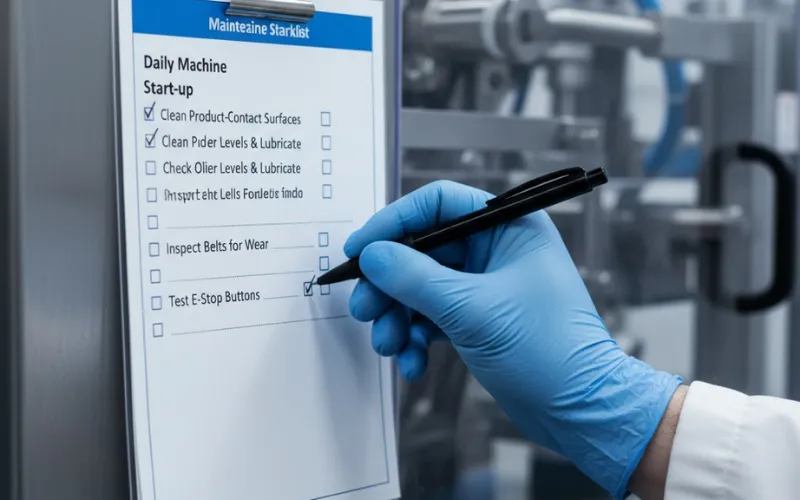
Perform thorough cleaning of all product-contact surfaces, sensor lenses, and areas prone to material accumulation using food-safe cleaning agents.
Check oiler levels and lubricate key points like chains and bushings according to the OEM's specific guidance and schedule.
Conduct a visual inspection for loose fasteners, exposed or frayed wiring, and signs of belt aging or visible damage.
Stay alert for any abnormal fluid leaks on the floor and listen for unusual operational noises like grinding or high-pitched squealing.
Before each shift start-up, functionally test all safety guards, interlocks, and emergency stop buttons to ensure they work perfectly.
Remain vigilant during operation for any subtle performance changes or minor, recurring stoppages that might indicate a developing problem.
Weekly Maintenance Checklist
Systematically inspect and use proper tools to re-torque critical mechanical fasteners, bolts, and screws that are prone to vibration-induced loosening.
Check the tension of drive chains and conveyor belts against the OEM's specification, adjusting them if they are too loose or excessively tight.
Inspect the pneumatic system's FRL units, draining water from filters and checking lubricator oil levels to ensure clean, dry, and lubricated air.
Use a soap solution to check air line connections for leaks and verify that pressure regulators are maintaining their correct and consistent settings.
Monthly & Quarterly Checklist
Use professional calibration tools and certified weights to validate the accuracy of sensors, scales, and temperature controllers, which is vital for product quality.
Replace filter elements in pneumatic and hydraulic systems to protect sensitive components and maintain optimal system efficiency and cleanliness.
With power safely locked out, open electrical panels to check for loose terminal connections, signs of wire insulation aging, and general contamination.
Use a low-pressure vacuum or blower to carefully remove dust and debris from inside electrical cabinets, which can cause overheating and component failure.
Schedule and perform a comprehensive deep cleaning of the machine's internal components, drives, and hard-to-reach areas to prevent material buildup.
This is also the ideal time for a more thorough inspection and any minor repairs identified during the previous weeks' more cursory checks.
Leveraging Technology and Data for Smarter Maintenance
Connecting your maintenance activities directly to core production metrics is the ultimate way to demonstrate the department's value. Superior maintenance is a core methodology for maximizing industrial packaging machinery efficiency.
Maintenance and OEE (Overall Equipment Effectiveness)
Availability is directly increased by minimizing unplanned downtime through proactive interventions that prevent catastrophic failures.
Performance is enhanced by keeping equipment running at its nameplate speed, which is only possible with well-lubricated and adjusted mechanical systems.
Quality rates are improved by ensuring machine precision and repeatability, thereby reducing the amount of scrap and rejected product generated.
Tracking OEE provides a clear, quantifiable link between disciplined maintenance practices and tangible financial improvements for the entire operation. This directly contributes to understanding the total cost of ownership for packaging machinery.
Maintenance Tools & Technologies
A CMMS is highly recommended for systemizing work orders, managing spare part inventories, and analyzing historical maintenance data for trends.
This collected data becomes the fundamental foundation for continuous improvement, allowing you to move from reactive fixes to proactive, strategic planning.
For specialized maintenance teams, advanced diagnostic tools like thermal imaging cameras can instantly locate electrical hot spots and motor issues.
Similarly, vibration analyzers are powerful predictive tools that can identify imbalances and bearing defects in rotating equipment weeks before total failure occurs.
Note: For a deeper dive into the specific characteristics and benefits of various food packaging machinery types and applications, understanding how different designs impact maintenance needs is crucial.
Tip: If implementing a full CMMS seems daunting, do not abandon data collection. Start with a simple, well-structured Excel spreadsheet to log every repair. Recording the device, date, fault, cause, and time spent creates a priceless starting point for future analysis and plan optimization.
Best Practices for a World-Class Maintenance System
Smart Spare Parts Management
Categorize your spares clearly into critical, consumable, and general parts, applying distinct inventory strategies to each category for better control.
Critical parts are high-value, long-lead-time items whose failure would halt production, requiring strategic stocking to mitigate significant downtime risk.
Establish scientific min/max inventory levels for all stocked items, ideally managed through a CMMS or detailed spreadsheet for easy tracking and reordering.
This data-driven approach effectively balances the capital tied up in inventory against the very real and often costly risk of production stoppages.
Evaluate and qualify reliable non-OEM part suppliers for certain consumables, which can reduce costs without sacrificing performance or equipment reliability.
When selecting new packaging machinery suppliers, always consider the long-term availability, cost, and lead times of their spare parts as a critical factor. For a comprehensive overview, consult our packaging machinery specifications guide.
The Importance of Training & Documentation
Empower and train your machine operators to perform an "autonomous maintenance" role, encompassing daily cleaning, inspection, and basic lubrication tasks.
These operators serve as the invaluable first line of defense, often spotting early warning signs long before they escalate into major failures.
Meticulously document all maintenance activities, from simple inspections to complex repairs, creating a comprehensive history for each asset.
These records are indispensable for performing effective root cause analysis, ensuring compliance during food safety audits, and enabling faster future troubleshooting.

Instilling a Safety-First Culture
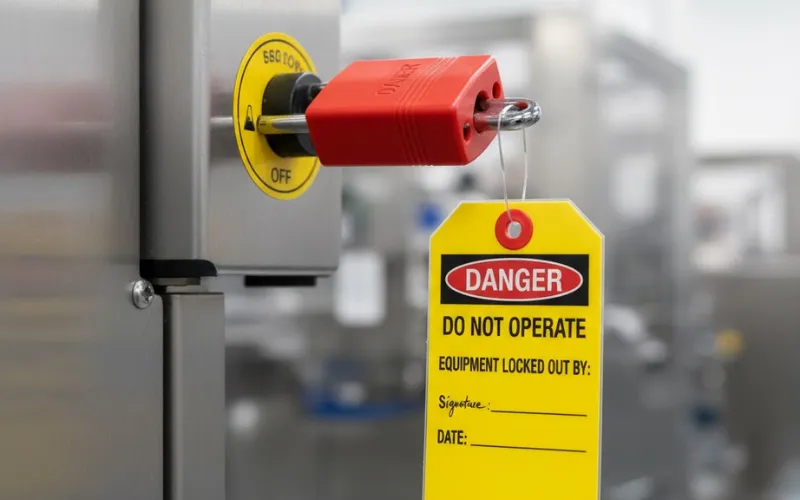
Mandate strict adherence to a Lockout-Tagout procedure before ANY maintenance task begins, ensuring all energy sources are verifiably isolated.
This non-negotiable practice protects your team from the severe risks of unexpected energization, startup, or release of hazardous energy.
Always emphasize that the manufacturer's original operation and maintenance manual is the final authority for all procedures, settings, and technical specifications.
Cultivate a culture where safety protocols are never bypassed for convenience, reinforcing that no production goal justifies compromising personal safety.
Note: A Lockout-Tagout procedure must never be skipped or simplified. A single, convenient shortcut could result in a catastrophic incident with consequences far outweighing any perceived production benefit. Safety is not the priority; it is the prerequisite.
Frequently Asked Questions (FAQ)
Q: How often should our packaging machine undergo a major overhaul?A: There is no universal answer, as it depends on the OEM's recommendation, the equipment's age and condition, its operational intensity, and the products it runs. A thorough professional assessment is recommended for machines after 5-7 years of service.
Q: What is the real-world difference between Preventive and Predictive Maintenance?A: Think of Preventive Maintenance as changing your car's oil every 5,000 miles regardless of its condition. Predictive Maintenance is like analyzing the oil first and only changing it when the analysis shows it's necessary. One is time-based; the other is condition-based and more efficient.
Q: How can we realistically lower maintenance costs without increasing downtime risk?A: Start by training operators in basic autonomous care to free up skilled technicians. Then, fix compressed air leaks to save energy and strategically manage spare parts inventory. Finally, analyze maintenance data to find and permanently fix recurring problems through root cause analysis.
Q: What are the clear warning signs that a packaging machine needs immediate attention?A: Be alert for unusual noises like grinding or banging, frequent minor jams, declining product quality, overheating motors or electrical cabinets, and sluggish pneumatic cylinder movement. Any of these symptoms warrant an immediate inspection.
Q: Does the product we package affect our maintenance needs?A: Absolutely. Corrosive or abrasive products accelerate wear on components. Dusty products can contaminate sensors and pneumatics. In these cases, you must increase cleaning frequency and inspect seals and bearings more often.
Turn Your Maintenance Challenges into a Competitive Edge
Effective maintenance is far more than just fixing broken equipment. It is a core business function that optimizes production, guarantees product quality, and controls operational costs.
Many companies, however, face significant challenges. These include understaffed maintenance teams, a lack of advanced diagnostic tools, and the difficulty of creating and executing an effective maintenance plan.
Our specialized engineering services team is here to help you overcome these hurdles. We provide the expertise and support to transform your maintenance operations.
Our professional engineering services team can help. We provide:

Comprehensive Equipment Health & OEE AuditsWe conduct in-depth diagnostics of your packaging lines to identify efficiency bottlenecks and uncover hidden failure risks.
Customized Preventive Maintenance PlansWe design tailored, executable PM schedules based on your specific equipment and unique production environment.
Advanced Diagnostics & Repair ServicesOur veteran engineers deliver rapid resolution for complex mechanical and electrical failures, minimizing your downtime.
Contact us today to schedule a complimentary 30-minute online consultation. Let's work together to elevate your equipment maintenance strategy and unlock new levels of operational excellence.
Conclusion: Transform Maintenance into a Competitive Advantage
A successful maintenance program stands on several key pillars: a proactive strategy, a structured and executable plan, intelligent spare parts management, and a well-trained, safety-conscious team. For a holistic view, explore our insights into various food packaging machine manufacturers and their specialties and how they impact maintenance.
Truly effective maintenance is never a passive expense or a necessary evil. It is a strategic investment that directly drives operational efficiency, slashes production costs, and staunchly protects corporate profitability.
Just as you would conduct a comprehensive manufacturer comparison before selecting new equipment, prioritizing long-term maintainability and diligently practicing superior maintenance throughout the asset's life will deliver the greatest long-term return. This also ties into optimizing your packaging line from single machin

Ready to start your journey toward a customized solution? Contact me directly on WhatsApp to begin the conversation.