Cookie & Biscuit Baking Science: How Your Oven Controls Texture & Flavor | EverSmart
For the product development manager perfecting a new recipe, the quality assurance technician battling inconsistency, or the factory owner receiving complaints about a batch that's too hard, too pale, or too soft, the question is eternal: "Why did this happen?"
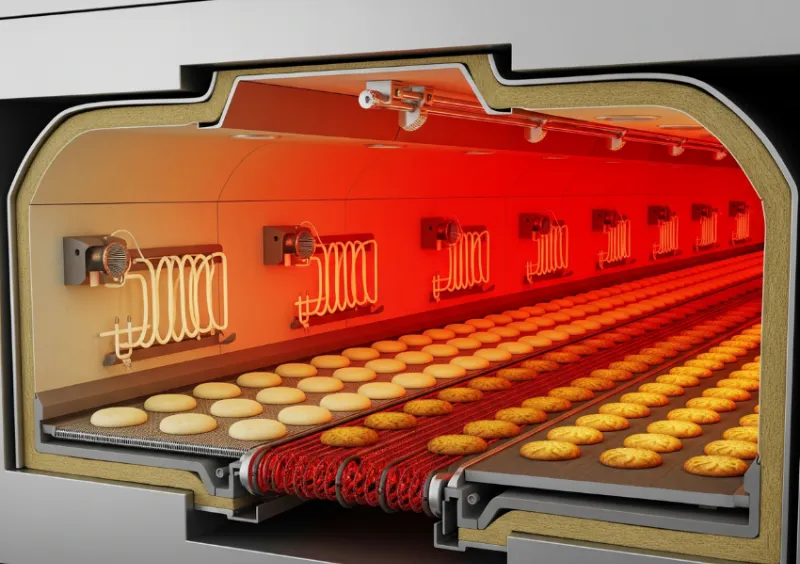
The answer, more often than not, lies not in the mixing bowl, but in the oven. In a commercial bakery, the industrial tunnel oven is not merely a heating chamber; it is the most precise and critical instrument in your entire production line. It is a controlled biochemical reactor where the foundational elements of your product—texture, flavor, color, and structure—are finalized.
While ingredients provide the potential, it is the oven's mastery over heat, time, and humidity that unlocks a product's ultimate quality. As outlined in foundational food science research, the baking process is a complex interplay of thermodynamics and chemistry that dictates final product attributes. This article moves beyond operational manuals into the applied food science of baking, providing a technical blueprint for understanding and controlling your most valuable asset.
Before delving into the science, a firm understanding of your equipment is essential. Our comprehensive guide on
The Three Levers of Control: Temperature, Humidity, and Airflow
Every decision you make about your oven settings for cookies and biscuits manipulates one of three fundamental variables. Understanding these is the first step toward mastery.
Temperature
The primary driver of reaction kinetics. It controls the rate of every chemical process, from protein denaturation to the Maillard reaction. The difference between a soft, chewy cookie and a crisp, crunchy biscuit often boils down to a matter of degrees.
Humidity
The unsung hero of oven baking quality with cookie texture and flavor. The amount of moisture in the oven's atmosphere dictates the rate of water evaporation from the product's surface. This is the key to controlling crust formation, oven spring, and the final moisture content—the ultimate determinant of cookies texture.
Airflow (Convection)
The mechanism for efficient and uniform heat transfer. Proper airflow ensures every product on the belt receives identical thermal treatment, eliminating hot and cold spots that are the root cause of inconsistent biscuit texture description and color.
The Alchemy of Flavor & Color: Maillard and Caramelization
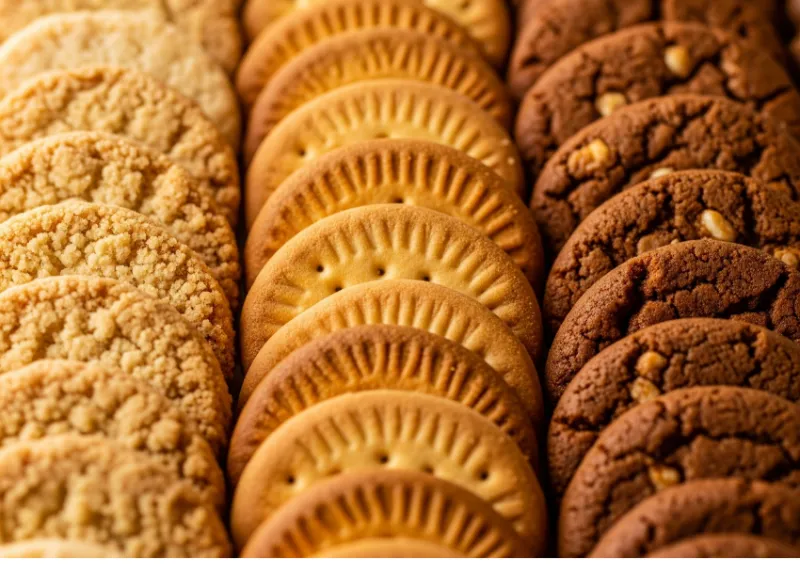
The transformation from pale dough to a golden-brown, aromatic finished product is governed by two legendary chemical reactions.
The Maillard Reaction: The Flavor Maestro
What it is: A complex chemical reaction between amino acids (from proteins) and reducing sugars (e.g., glucose, fructose) when exposed to heat.
What it creates: This reaction is responsible for the vast majority of the rich, savory, roasted, and nutty flavor compounds and the beautiful golden-brown color we associate with baked goods. It is not merely "browning."
How to control it: The Maillard reaction requires specific temperature ranges (typically 140-165°C / 284-329°F) and moderate moisture levels. The multi-zone capability of a
tunnel oven
Caramelization: The Sweetness Amplifier
What it is: The pyrolysis, or thermal decomposition, of sugar molecules. Unlike Maillard, it does not require proteins.
What it creates: Caramelization produces sweeter, nuttier flavors and a darker brown color. It is responsible for the deep, rich notes in products with very high sugar content.
How to control it: This process occurs at higher temperatures than Maillard (> 180°C / 356°F). The final zones of an oven are often dedicated to controlling the degree of caramelization to achieve the perfect hue and depth of flavor without burning.
The Science of Texture: Engineering Mouthfeel from Soft to Snap
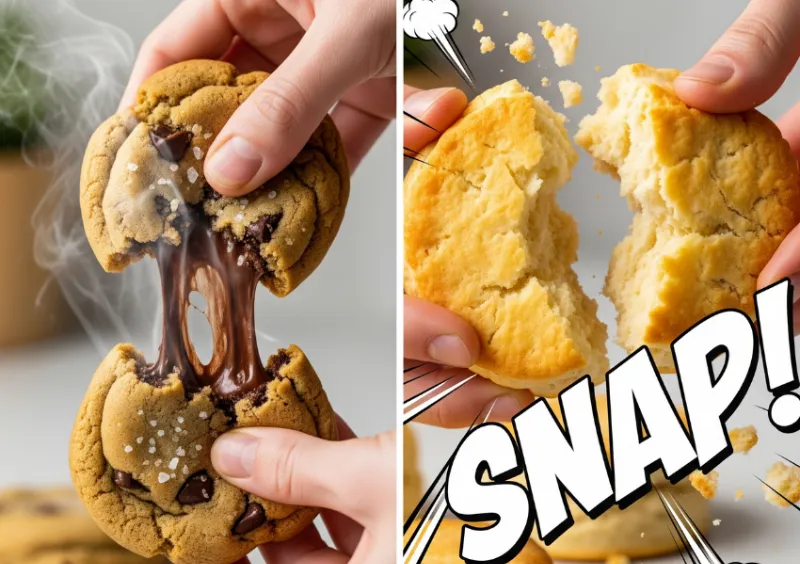
What makes cookies crunchy or soft? The answer lies almost entirely in the oven's control over moisture and heat. The final texture of a biscuit is a direct function of its water content and how its structure sets.
The Role of Moisture Evaporation
The baking time and temperature profile determine the rate and extent of water loss.
Low & Slow Baking: A longer bake cookies in oven time at a moderately low temperature allows for gradual moisture removal. This can result in a more uniform, tender crumb or a thoroughly dried, hard texture, depending on the formula.
High & Fast Baking: A high temperature cookies oven temperature causes rapid moisture expulsion and swift setting of the structure. This often creates a crisp exterior with a chewier interior if the center retains moisture.
Starch Gelatinization & Protein Denaturation
This is the moment the cookie "sets." As the dough heats, starch granules absorb water and swell (gelatinization), while proteins unfold and form a solid network (denaturation). The oven's heat profile dictates the nature of this solid matrix—whether it's delicate and soft or rigid and crisp.
Mapping the Science to Oven Zones: A Practical Guide for Every Product
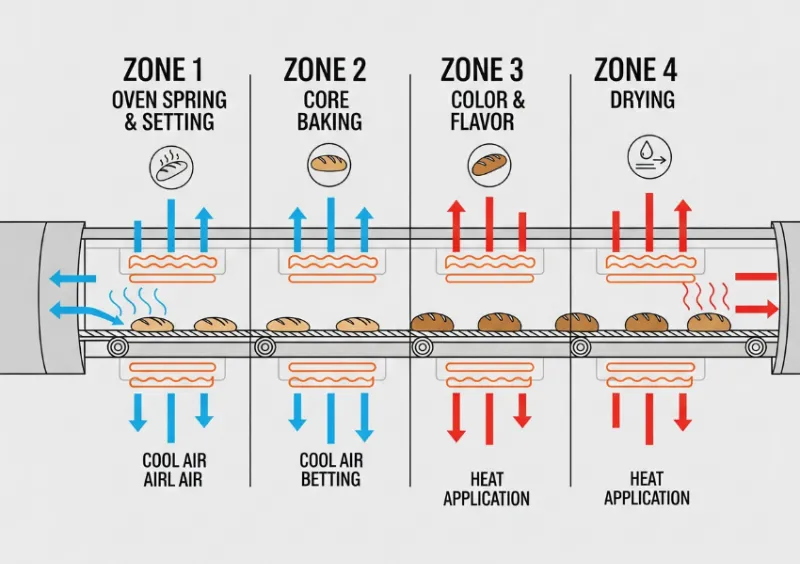
This is where theory meets practice. The true power of an industrial tunnel oven is its zonal control, allowing you to create a custom thermal roadmap for each product. Here’s how the scientific reactions map to specific zones:
Zone 1 (Dough Entry - High Humidity)
Objective: Maximize oven spring and control spread.
Science: Introducing steam or controlling exhaust maintains a humid environment. This keeps the dough surface pliable, allowing gases from leavening agents to expand fully before the crust sets. This is critical for achieving the desired volume and shape.
Zone 2 (Core Baking - Convective Heat)
Objective: Set the product's core structure.
Science: Intense, uniform heat ensures complete starch gelatinization and protein denaturation. The Maillard reaction begins in earnest here. The airflow must be perfectly calibrated to ensure even heat transfer for a consistent cookie texture.
Zone 3 (Color Development - Radiant/Convective Heat)
Objective: Develop the perfect flavor and color.
Science: This zone is fine-tuned to optimize the Maillard reaction and initiate caramelization. Precise temperature control here is what separates a perfectly golden biscuit from a pale or burnt one.
Zone 4 (Drying - Low Humidity)
Objective: Achieve the target final moisture content.
Science: With exhaust dampers open, this zone removes the last traces of moisture to "lock in" the texture. This is where you ensure your product is crisp throughout or retains a specific softness, determining its shelf life and mouthfeel.
EverSmart's Technical Guide: Baking Profiles for Different Product Types
The following principles, honed over decades of field experience, illustrate how we tailor oven profiles to specific dough types. This is the applied science that guarantees perfect biscuit making in oven and cookie production.
1. Short Dough Biscuits (e.g., Butter Cookies, Shortbread)
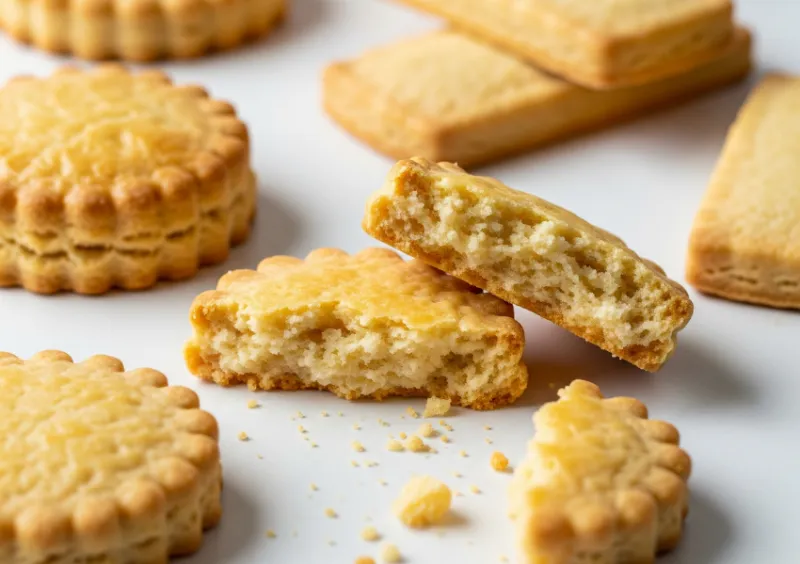
Dough Characteristics: High fat & sugar, low water, minimal gluten.
Core Baking Principle: High Temperature, Short Time. This quickly sets the structure before the high fat content causes excessive spread.
EverSmart Profile: Zone 1 uses high top/bottom heat (~250-300°C) for rapid setting. Zones 2 and 3 gradually reduce heat (~220-200°C) to develop color without burning the high sugar content. This profile is essential for achieving the delicate, crumbly texture of a biscuit that defines this category.
Internal Link: For manufacturers, achieving this requires precision. Our
Cookie Maker Machine
2. Hard Dough Biscuits (e.g., Marie Biscuits, Animal Crackers)
Dough Characteristics: Lower fat/sugar, higher water, strong gluten network.
Core Baking Principle: Lower Temperature, Longer Time. This ensures the tough gluten network and higher water content are fully dried out.
EverSmart Profile: Zone 1 uses high bottom heat (~280°C) for lift but low top heat to prevent blistering. Zone 2 inverts this, with high top heat to dehydrate and set the structure. This controlled process is key to a strong, crunchy snap.
Internal Link: This dough requires robust handling. Explore our
Hard Biscuit Machine
3. Soda Crackers
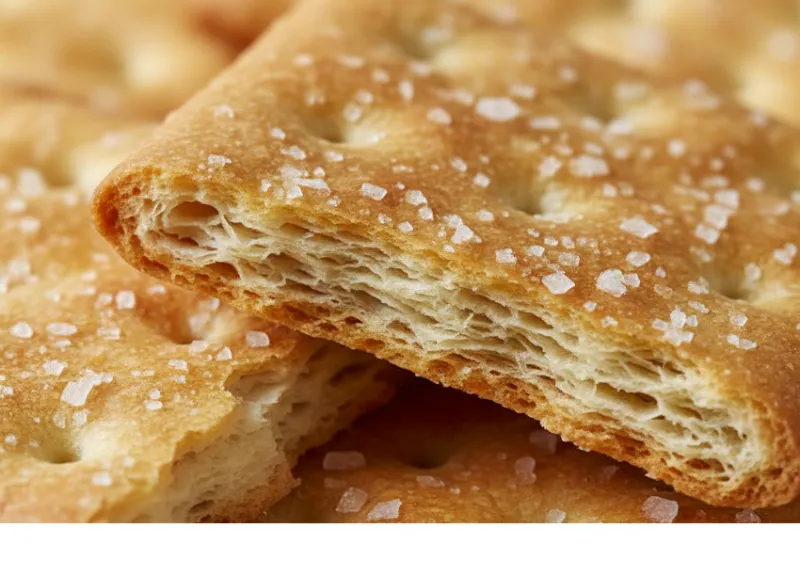
Dough Characteristics: Fermented, laminated, very high water content.
Core Baking Principle: Reverse Profile. This is unique and critical for the famous "lift" and flaky layers.
EverSmart Profile: Zone 1 demands extremely high bottom heat (330-350°C+) and low top heat. The intense bottom heat creates explosive steam lift from the layers. Subsequent zones then invert the profile to dry and color the cracker without collapsing it. This specific technique is what creates the signature light, airy, and crisp structure.
Internal Link: Cracker production is a specialty. Our
Soda Cracker Machine
Troubleshooting Through a Scientific Lens
Common quality issues are often a failure to control a scientific variable in the oven.
Problem: Pale Color
Scientific Cause: Insufficient time within the Maillard reaction temperature range (140-165°C).
Solution: Increase temperature in Zone 3 or reduce conveyor speed.
Problem: Burnt Edges or Bitter Taste
Scientific Cause: Temperature too high in final zones, causing excessive caramelization or burning.
Solution: Reduce temperature in Zones 3 and 4.
Problem: Too Hard/Too Soft
Scientific Cause: Incorrect final moisture content due to improper time/temperature/humidity balance.
Solution: Adjust exhaust dampers in Zone 4 to control humidity and/or fine-tune overall baking time. A harder biscuit in oven requires longer, drier baking.
Problem: Excessive Spread (Thin, Flat Cookies)
Scientific Cause: Temperature in Zone 1 is too low, allowing the dough to spread before it sets.
Solution: Increase bottom heat in Zone 1 to set the structure faster.
For a full list of operational fixes, our comprehensive guide on
Frequently Asked Questions (FAQ)
Q: Does oven temp affect chocolate chip cookie texture?
A: Absolutely. It is the primary factor. A lower temperature (e.g., 325°F / 163°C) will result in a softer, cakier cookie with more spread. A higher temperature (e.g., 375°F / 191°C) will set the structure faster, creating a thicker, chewier cookie with less spread. In an industrial setting, this is controlled via zonal profiles.
Q: What makes cookies crunchy or soft?
A: The final moisture content. Crunchy cookies are baked longer and/or at a lower temperature to remove almost all moisture. Soft cookies are baked for a shorter time and/or at a higher temperature to retain more moisture in the center. Humidity control in the oven is critical for managing this.
Q: What type of oven is best for cookies?
A: For consistent, high-volume production, an industrial tunnel oven is unmatched. Its precise multi-zone control allows manufacturers to perfectly execute the specific temperature and humidity profiles required for each cookie variation, something impossible with batch ovens.
Q: Does baking time have an effect on the texture of a biscuit?
A: Profoundly. Baking time directly determines the final moisture content. A shorter time yields a softer biscuit (e.g., a soft
Q: How do you achieve the perfect cookie texture?
A: It requires a holistic approach: 1) A formulated recipe, 2) Consistent dough mixing, and 3) Most importantly, an oven with precise
Conclusion: Baking as Applied Science
Achieving the perfect biscuit or cookie is not magic; it is applied food science. Consistent, high-quality products are the direct result of understanding and meticulously controlling the biochemistry and thermodynamics within your oven.
For R&D teams, this knowledge provides the blueprint for innovation. For production and quality managers, it offers the diagnostic tools to solve any consistency problem. For owners and financial controllers, it underscores that a modern, precise industrial tunnel oven is not an expense, but an investment in product quality, reduced waste, and brand reputation.
If you are looking to solve a texture problem, perfect a new recipe, or achieve flawless batch-to-batch consistency, the solution lies in mastering your oven.
Are you an R&D or Quality Manager looking to apply this science? Our technical team specializes in tailoring oven profiles to specific recipes.
SofiaExport Vice President | EverSmart 📞 WhatsApp +86 137 94619343 📧 [email protected]

Ready to start your journey toward a customized solution? Contact me directly on WhatsApp to begin the conversation.