Maximizing Quality: The Science, Engineering, and ROI of Biscuit Cooling Conveyors
Author: David Wang, Senior Automation Engineer | 16+ years of experience in F&B packaging line integration for multinationals like Nestlé and Orion.Date: 2025Read Time: 45 Minutes
SEO Title: Biscuit Cooling Conveyors: Science, Engineering & ROI GuideURL Slug: /biscuit-cooling-conveyor-science-engineering-roiMeta Description: Stop biscuit checking and waste. Master the thermodynamics of cooling conveyors, from dew point control to cantilevered design, for maximum ROI.
I. Introduction: The Hidden Profit Center
For the home baker, the process is romantic and simple.
You pull a tray of golden-brown cookies from the oven.
You place them on a simple wire rack.
You wait ten to fifteen minutes for the aroma to fill the kitchen.
Nature does the rest.
But in the high-stakes world of industrial food production, this simplicity is a dangerous illusion.
When you are producing 5,000 kilograms of product per hour, "nature" is not enough.
You are fighting physics. You are battling thermodynamics. And you are racing against the clock.
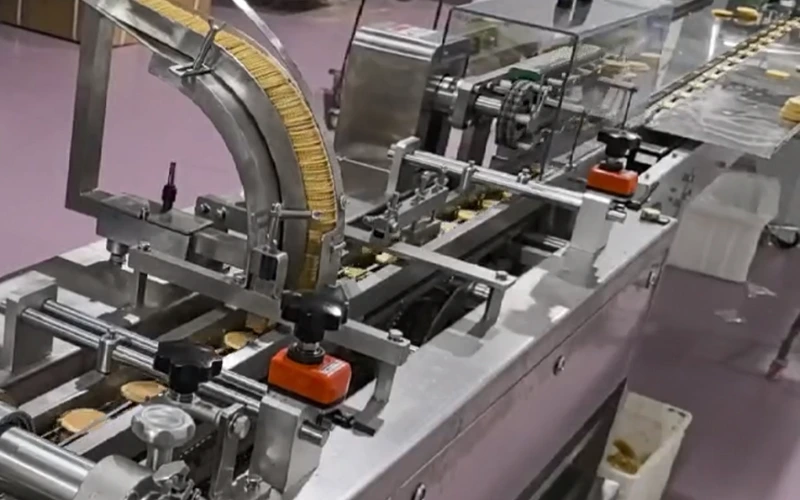
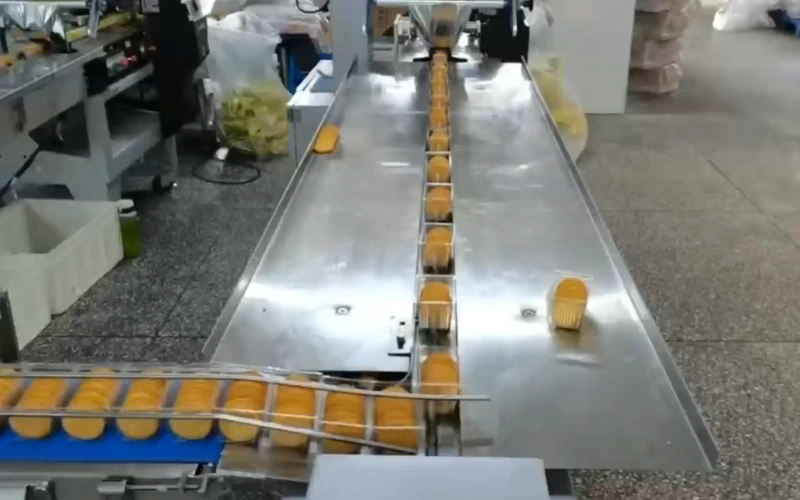
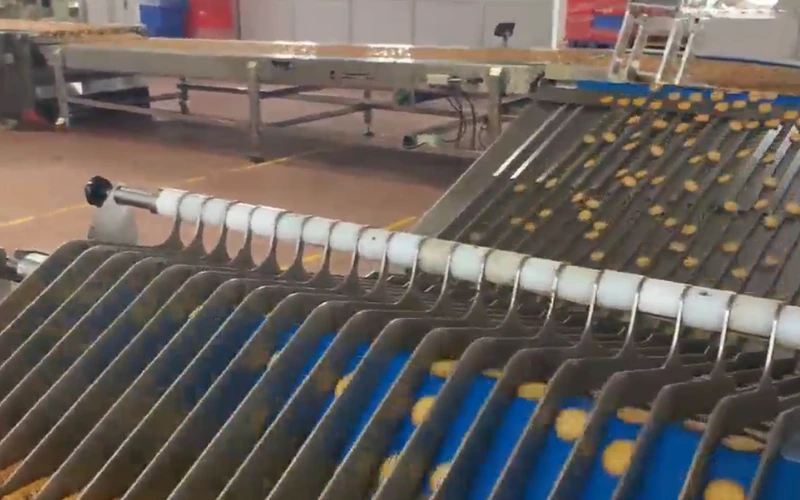
The industrial biscuit cooling conveyor is not merely a transportation device.
It is a dynamic thermodynamic processing unit.
It is the critical bridge between the high-heat intensity of the Biscuit Tunnel Oven and the high-speed precision of the packaging hall.
It is often the most undervalued asset on the factory floor.
Factory owners obsess over the oven profile. They scrutinize the packaging speed. But the cooling conveyor is often treated as just "connecting equipment."
This is a costly mistake.
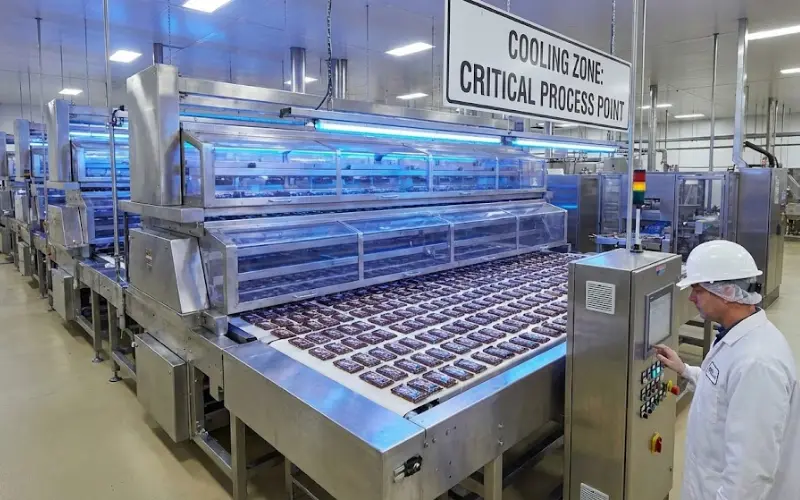
The cooling tunnel is where your product's final texture is locked in.
It is where shelf life is determined.
It is where profit is either secured or lost to waste.
A biscuit exiting the oven is physically unstable.
It carries core residual heat ranging from 100°C to over 180°C (212°F - 350°F).
Its structure is soft, pliable, and vulnerable.
Its moisture content is unevenly distributed.
If you mismanage this critical window, the consequences are severe.
Cool it too fast, and you shatter the internal structure.
Cool it too slow, and you bottleneck the entire plant.
Cool it unevenly, and you invite mold and spoilage.
This white paper is written for the decision-makers.
We are speaking to the Plant Managers, the Chief Engineers, and the Financial Controllers.
We will strip away the marketing fluff.
We will dive deep into the science of checking.
We will dissect the engineering of tracking systems.
And we will calculate the real Return on Investment (ROI) of a properly engineered cooling system.
Key Takeaway
The cooling conveyor is not just a moving belt; it is a thermal processing machine that dictates the final yield (OEE) and quality of your entire production line.
II. The Thermodynamics: The Physics of "Checking"
Before we discuss motors and belts, we must understand the product.
A biscuit is a complex matrix of starch, protein, sugar, and fat.
Cooling is not simply about lowering the temperature.
It is about stabilizing this matrix without breaking it.
1. The Glass Transition Phase ($T_g$ )
When a biscuit leaves the oven, the sugars inside are in a rubbery, amorphous state.
The fats are liquid. The gluten structure is set, but pliable.
As the temperature drops, the sugars undergo a physical phase change known as the Glass Transition.
They transform from a rubbery state to a hard, "glassy" state.
This is what gives a biscuit its "snap" or "crunch."
The Critical Window:
This transition typically occurs between 60°C and 80°C (140°F - 176°F), depending on the recipe's sugar-to-fat ratio.
If the product is mechanically disturbed during this phase—say, by a bumpy transfer or a vibrating belt—the structure can collapse.
The biscuit will warp. The texture will be compromised.
The Retrogradation of Starch:
Simultaneously, the starch molecules begin to retrograde.
They recrystallize and expel water.
This process hardens the crumb structure.
It is a time-dependent reaction that cannot be rushed.
Note:If you package a biscuit before it completes its glass transition, it will be soft. Worse, it will likely deform inside the wrapper, leading to consumer complaints.
2. The Moisture Gradient and Stress Fractures
This is the single biggest cause of hidden waste in the biscuit industry.
It is called "Checking."
It is the silent killer of brand reputation.
The Mechanism of Failure:
When a biscuit exits the oven, it is not uniform.
The surface is extremely dry (often <1% moisture).
The center, however, remains moist (3% to 6% moisture).
Nature hates gradients. Immediately, moisture begins to migrate from the wet center to the dry surface.
This is Fick’s Law of Diffusion in action.
The Danger of Rapid Cooling:
If you blast the hot biscuit with freezing cold air, the surface cools instantly.
It contracts. It hardens into a rigid shell.
But the center is still hot. The center is still swollen with moisture.
As the center eventually cools and loses moisture, it tries to shrink.
But the rigid outer shell will not allow it.
Huge internal tensile stresses build up inside the biscuit.
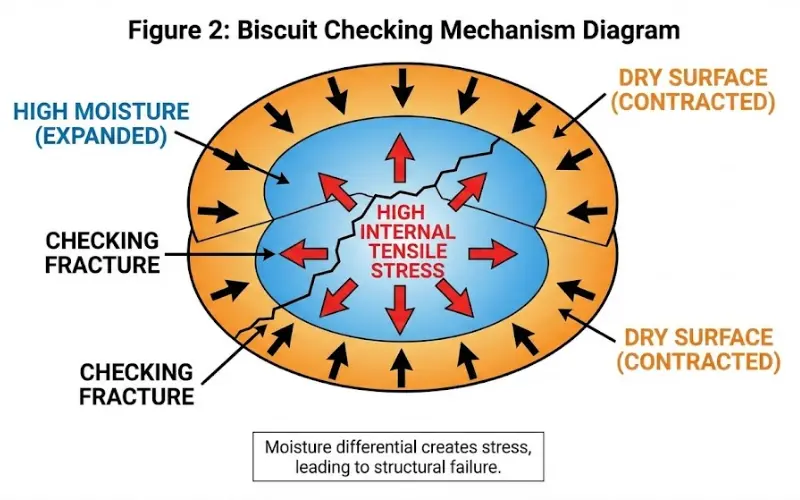
The structure is literally pulling itself apart from the inside out.
The Delayed Reaction:
The scary part? You won't see the crack immediately.
The biscuit looks perfect on the conveyor. It looks perfect at the packaging station.
But 24 to 48 hours later—while the product is sitting in a warehouse or on a supermarket shelf—the stress exceeds the material strength.
Snap.
A hairline crack forms. The consumer opens the pack and finds broken crumbs.
The 1.5x Rule:
To prevent this, we must respect the "Residence Time."
Industry best practice dictates a golden ratio.
Cooling Time ≈ 1.5 x Baking Time.
If you bake for 5 minutes, you must cool for 7.5 minutes.
This allows the moisture to equilibrate while the temperature drops, keeping internal stress below the fracture point.
Tip:Never try to "speed up" production by cranking up the cooling fans to maximum. You are merely trading capacity for checking. Speed kills quality.
3. Dew Point Management: The Invisible Threat
Most engineers watch the dry bulb temperature.
Smart engineers watch the Dew Point.
In humid climates—like Florida in July or Southeast Asia year-round—this is critical.
Your cooling tunnel pulls in ambient air.
If that air is humid, and your biscuits are cooling down, you face a risk of condensation.
The Physics of Spoilage:
If the surface temperature of the biscuit drops below the dew point of the air in the tunnel, water will condense on the product.
You might not see droplets. It might be microscopic.
But that thin film of water destroys the surface texture.
It makes the biscuit soggy.
Worse, it increases the Water Activity (
The Solution:
Advanced biscuit cooling machines are equipped with Dew Point Sensors.
The control logic monitors the ambient humidity.
If the risk of condensation is detected, the system automatically engages heating elements or desiccant wheels to lower the relative humidity of the cooling air.
It maintains a safety buffer (usually 2°C to 3°C) above the dew point.
III. Core Mechanical Engineering: Precision in Motion
We have covered the physics. Now, let’s look at the machine itself.
Moving thousands of fragile items per minute requires mechanical excellence.
1. Belting Technology: The Universal Standard
Why do we almost universally use Wire Mesh Belts? Why not solid rubber or PVC?
Heat Dissipation Efficiency:
A solid belt acts as an insulator. It traps heat at the bottom of the biscuit.
This leads to "soggy bottoms"—a defect where the bottom of the cookie remains soft while the top is crisp.
A wire mesh belt (often called an Enrober belt or Balanced Weave) has an open area of 70% to 85%.
It allows air to flow freely through the belt.
It exposes the bottom surface of the biscuit to ambient air.
This ensures 360-degree cooling.
Exceptions to the Rule:
Soft Cookies / High Fat Content: If you are producing a soft-baked cookie with 25% fat content, a hot wire mesh can be problematic. The dough might flow into the mesh. Or the wire might leave deep pressure marks.
In these specific cases, we use PU (Polyurethane) Belts or Cotton Webbing.
However, these systems often require "Cold Slab" technology—water-cooled plates underneath the belt to conduct heat away from the bottom.
Deep Dive: Compare the hygienic properties of different belts in our guide:Conveyor Belts 101: The Ultimate Material Guide
2. The Nose Bar Transfer: Handling the Fragile
Imagine a conveyor roller with a diameter of 50mm (2 inches).
Now imagine two of them side-by-side.
The gap between them is significant.
If you are making a small product—like a mini-cookie or an animal cracker—it will fall into that gap.
Or it will tip over and jam.
The Engineering Fix:
We replace the large roller with a Nose Bar.
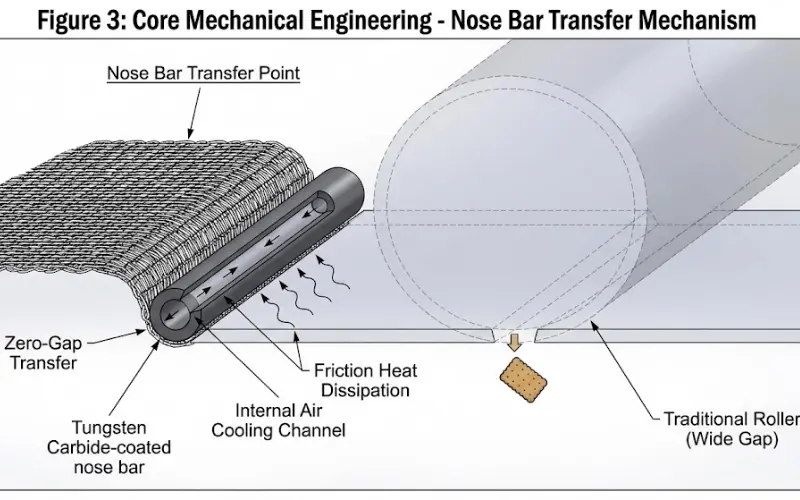
This is a static, non-rotating bar with a very small radius edge (typically 6mm to 10mm).
The belt wraps tightly around this sharp edge.
This reduces the transfer gap to almost zero.
The Challenge:
Friction. Running a belt over a static steel bar generates heat.
It wears out the belt. It wears out the bar.
The Solution:
High-end systems use nose bars coated with Tungsten Carbide or made from specific low-friction ceramics.
They also design air-cooling channels inside the nose bar to dissipate friction heat.
Deep Dive: Learn more about smooth handoffs in:Optimizing Line Flow: Smooth Transition Conveyors
3. Pneumatic Auto-Tracking: The Maintenance Saver
A cooling conveyor can be 100 meters (300 feet) long.
Keeping a belt straight over that distance is a nightmare.
Mechanical guide rollers damage the belt edges.
Manual adjustment relies on operator skill (which is variable).
The Modern Standard:
We use Pneumatic Auto-Tracking Systems.
Sensors: Inductive or optical sensors monitor the belt edge continuously.
Logic: If the belt drifts 2mm to the left, the sensor signals the PLC.
Actuation: A pneumatic cylinder gently adjusts the angle of the tracking roller.
Result: The belt "steers" itself back to center automatically.
This is a "set it and forget it" system.
It doubles the lifespan of your expensive wire mesh belts.
It prevents the belt from rubbing against the frame and creating metal shavings (a major foreign object risk).
4. Hygienic Architecture: The Cantilever Revolution
Old conveyor designs use a "Tabletop" or "H-Frame" structure.
Legs on both sides. Bearings on both sides.
To change an endless belt, you have to disassemble the entire drive shaft.
You have to remove the legs on one side.
It is a downtime catastrophe. It takes 8 to 12 hours.
Enter the Cantilever Design:
The frame is supported entirely from one side.
The other side is open (or has easily removable spacers).
The drive motor and bearings are all mounted on the support side.
The Benefit:
When you need to change a belt, you simply relax the tension.
You slip the old belt off the open side.
You slide the new belt on.
Total time: 1 to 2 hours.
For a plant running 24/7, reducing maintenance downtime by 80% is a massive financial win.
IV. Space Optimization: Vertical Engineering
Factory floor space costs money. Cooling takes time.
If you need 10 minutes of cooling for a high-speed line, you might need 150 meters (500 feet) of conveyor.
Most buildings simply aren't that long.
Trading Height for Length:
The solution is the Multi-Tier Cooling Conveyor.
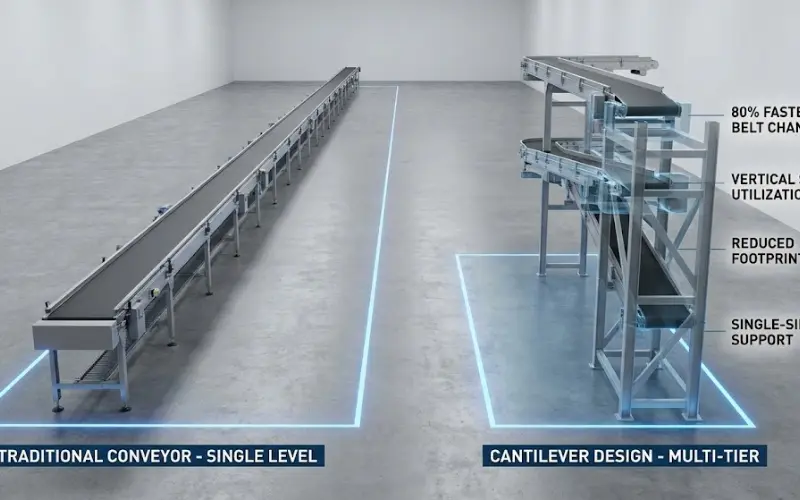
By stacking belts on top of each other, we multiply the effective path length without expanding the footprint.
The Z-Shape Configuration:
The most common design is the Z-shape or "Overhead" system.
Incline: Biscuits are elevated immediately after the oven.
Overhead Run: They travel back towards the mixing room, high above the other equipment (utilizing "dead" air space).
Decline: They gently descend to the packaging level.
Deep Dive: For specific vertical solutions, read:The Z-Type Conveyor Guide: Mastering Vertical Space
The Spiral Cooler:
For extreme space constraints, we use Spirals.
A continuous belt winds up or down a central drum.
Pros: Maximum density. You can fit 500 meters of belt in a 5x5 meter box.
Cons: High tension. Complex mechanics. Difficult to clean.
Spirals are generally reserved for products that need very long cooling times (20+ minutes) or freezing.
V. Smart Control: The "Master Clock" Strategy
In the era of Industry 4.0, a conveyor is no longer dumb hardware.
It is an intelligent node in your network.
1. The Master Clock Philosophy
The cooling conveyor is the longest machine in the line.
It holds the most product.
Therefore, it should act as the synchronization master.
The Master Clock signal dictates the speed of the entire line.
The Oven: Follows the cooling conveyor to ensure consistent spacing.
The Packaging Machines: Follow the cooling conveyor to match the inflow rate.
2. Intelligent Cascade & Accumulation
What happens when a flow wrapper jams?
It happens every day. A film roll needs changing. A sensor trips.
The packaging machine stops for 2 minutes.
The Old Way:
The operator hits "E-Stop" on the cooling conveyor.
The belt stops. The biscuits inside the cooling tunnel stop.
The biscuits in the oven... they burn.
Or, you keep the oven running and dump good product into the garbage bin because there is nowhere for it to go.
The Smart Way: Non-Contact Accumulation:
We use VFDs (Variable Frequency Drives) and smart logic.
The cooling system is divided into logical zones.
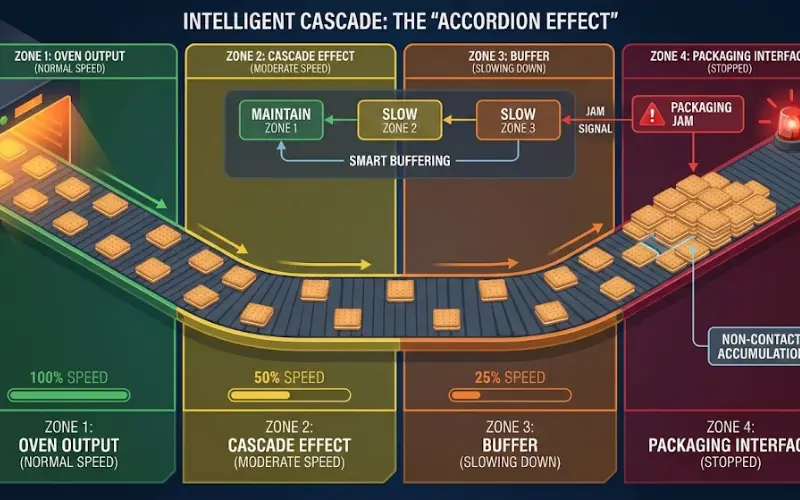
Packaging stops.
Zone 4 (End): Stops immediately.
Zone 3: Slows down to 10% speed.
Zone 2: Slows down to 20% speed.
Zone 1: Continues receiving product from the oven.
The biscuits bunch up. They get closer together. But they do not touch. They do not overlap.
This "accordion effect" creates a buffer.
You can buy yourself 3 to 5 minutes of buffer time.
Enough time to change a film roll. Enough time to clear a jam.
Zero waste. Zero stops.
Deep Dive: Understand the control logic behind VFDs:Conveyor Synchronization Guide: VFDs & Sensors
3. Closed-Loop Feedback
Seasons change.
Winter morning: Factory ambient is 18°C (64°F).
Summer afternoon: Factory ambient is 35°C (95°F).
If your fans run at a fixed speed, your winter biscuits will be frozen, and your summer biscuits will be mushy.
The PID Loop:
We install thermal cameras or IR pyrometers at the tunnel exit.
They read the actual biscuit temperature.
This data feeds into a PID loop in the PLC.
The PLC adjusts the VFD frequency of the cooling fans automatically.
Target: 32°C.
Actual: 34°C -> Action: Increase Fan Speed by 5%.
This ensures consistent quality, 365 days a year.
VI. The Business Case: TCO & ROI Analysis
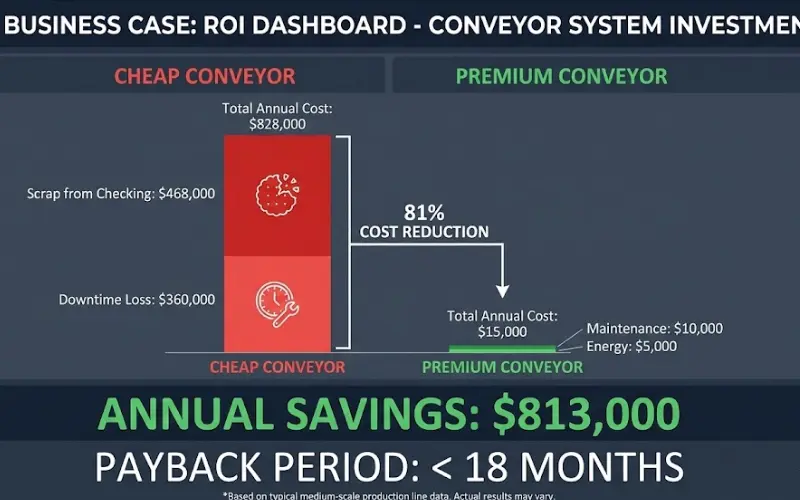
Let’s talk dollars and cents.
High-end cooling systems cost more upfront. Are they worth it?
1. The Cost of "Checking" (Scrap Rate)
Let’s assume a standard production line.
Throughput: 2,000 kg/hr (4,400 lbs/hr).
Sales Value: $3.00 per kg.
Operating Hours: 20 hours/day, 300 days/year.
Annual Revenue Potential: $36,000,000.
Scenario A: Cheap Conveyor. Poor airflow. No dew point control.
Scrap Rate due to Checking: 1.5%.
Annual Loss: $540,000.
Scenario B: Premium Conveyor. Zoned airflow. Dew point control. Gentle cooling curve.
Scrap Rate due to Checking: 0.2%.
Annual Loss: $72,000.
The Delta:$468,000 per year in pure profit saved. This savings alone pays for the entire premium cooling system in roughly 12 to 18 months.
2. The Maintenance Dividend
Let’s look at the Cantilever design vs. Traditional H-Frame.
Belt Change Frequency: Once every 2 years.
Cleaning Frequency: Deep clean once per week.
Traditional:
Belt Change: 4 technicians x 10 hours = 40 man-hours.
Weekly Clean: Difficult access adds 2 hours/week = 100 hours/year.
Downtime Cost: If the line is down for maintenance, you aren't making biscuits. At $3,000/hr revenue loss.
Cantilever:
Belt Change: 2 technicians x 2 hours = 4 man-hours. (90% savings).
Weekly Clean: Easy access saves 2 hours/week.
Uptime Gain: You gain back roughly 120 hours of production time per year.
Value: 120 hours x $3,000/hr = **$360,000 additional revenue capacity.**
Note:When you combine the scrap reduction and the uptime gains, the Total Cost of Ownership (TCO) of a "cheap" conveyor is actually astronomically higher than a premium engineered solution.
VII. Conclusion: Investing in Reliability
The biscuit cooling conveyor is not a commodity. It is not simple hardware.
It is a sophisticated thermal management system.
It is the guardian of your product quality.
It protects the texture you worked so hard to create in the oven.
It ensures the structural integrity required for high-speed packaging.
When you choose your next system, look beyond the price tag. Look at the engineering.
Does it have Dew Point Control to prevent mold?
Does it utilize Nose Bar Transfers to handle small products gently?
Is it a Cantilever Design that respects your maintenance team’s time?
Does it have Smart Accumulation logic to save you from packaging jams?
In the modern food factory, reliability is the ultimate currency.
Invest in science. Invest in engineering. And the ROI will take care of itself.
VIII. Frequently Asked Questions (FAQ)
We have curated the most common questions from real-world production engineers and plant managers.
Q1: Do biscuits harden when cooling, and why does it matter?A: Yes, absolutely. This is due to the glass transition of sugars and the retrogradation of starches. Upon exiting the oven, the sugar is in a rubbery, molten state. As it cools below roughly 70°C, it crystallizes into a glassy state. This phase change is what transforms a soft, fragile disk into a rigid, crispy biscuit. If you disturb the biscuit before this hardening is complete, you will permanently deform the product.
Q2: How long do biscuits take to cool properly?A: The industry "Golden Rule" is 1.5 times the baking time. If your bake time is 4 minutes, plan for 6 minutes of cooling. While you can force cool them faster with high-velocity air, you drastically increase the risk of thermal shock and subsequent cracking (checking). Patience pays off in yield.
Q3: What causes "Checking" (hairline cracks) after packaging?A: Checking is caused by a moisture gradient. If the surface cools and dries too fast, it forms a rigid shell while the center remains hot and swollen with moisture. As the center eventually cools and contracts hours later, it pulls against the rigid outer shell until the stress exceeds the material's tensile strength, causing a snap. The solution is gentler, zoned cooling that allows moisture to migrate evenly.
Q4: Can I use a standard PVC belt for cooling?A: Generally, no. PVC belts trap heat. They act as an insulator for the bottom of the biscuit, leading to "soggy bottoms" where the moisture cannot escape. Wire mesh belts are the standard because they allow 360-degree airflow. The only exception is for very soft or high-fat cookies that might sink into a wire mesh; in those cases, specialized PU belts with bottom cooling plates are used.
Q5: How can I save factory floor space with a long cooling requirement?A: Do not cut the cooling time. Instead, go vertical. Use a Multi-Tier (Z-Shape) cooling conveyor. By stacking the belt runs on top of each other, you can fit 100 meters of cooling path into a 15-meter footprint. Spiral coolers are another option for extreme density, though they are harder to maintain.
Q6: What is "Dew Point Control" and do I need it?A: If your factory is located in a region with high humidity, or if you don't have full air conditioning in your plant, you absolutely need it. It prevents microscopic condensation from forming on the biscuit surface during cooling. Without it, you risk soft biscuits and potential mold growth inside the package.
IX. Professional Consultation & Services
Is your cooling line a bottleneck or a profit leak?
If you are battling high scrap rates, unexplained breakage, or packaging jams that burn product in the oven, your cooling strategy needs an upgrade.
We specialize in high-efficiency thermal processing solutions. Our services include:
Thermal Audits: We measure your current moisture gradients and dew point risks.
Layout Optimization: Custom engineering for Z-Shape and Multi-Tier systems to fit tight layouts.
Control Upgrades: Retrofitting existing lines with VFD Cascade Logic and Auto-Tracking systems.
Stop letting profit evaporate.
Ultimate Service Conversion CTA
Send us a video of your product. Our engineers will analyze its characteristics and recommend the best stacking technology to maximize your line's efficiency and protect your product quality.
Sofia | Export Vice President | EverSmart
WhatsApp: +86 137 94619343
Email: [email protected]

Ready to start your journey toward a customized solution? Contact me directly on WhatsApp to begin the conversation.