Conveyor Synchronization Guide: VFDs, Sensors & Virtual Master Logic
I. Introduction: The Nervous System of the Production Line
In the landscape of modern
These components must mesh together like the gears of a Swiss watch. However, in the
Core Definition:Line Synchronization is the process of utilizing
It involves the real-time, dynamic coordination of multiple conveyor sections. Its core mission is to establish a unified "Virtual Master" signal. This ensures that from the oven discharge to the packaging infeed, every transition point maintains a constant gap and relative velocity. This prevents the three killers of efficiency: Product Pile-ups, Tensile Breakage, and Empty Packages.
Why Synchronization is the Soul of the Biscuit Line
When asking "What are conveyors used in food industry?", a layperson might simply answer: "To move products." However, in the specific context of biscuit manufacturing, conveyors are actually machines that manage Time and Space.
The Physical Challenge:A comprehensive biscuit production line is rarely a single belt. It typically consists of 10 to 20 independent conveyor sections. These include forming belts, oven feed belts,
Consider the physics of this chain. If the fifth section of the
The Key to OEE:Only a flawlessly synchronized system can balance the flow of the factory. It must reconcile the "Continuous Flow" of the front-end oven with the "Intermittent Flow" of the back-end packaging machines. Synchronization maximizes
🔑 Key Takeaways
The Virtual Master Strategy: Abandon the legacy "Daisy Chain" logic; adopt a system where every conveyor follows a software-defined "Virtual Master" for zero-latency synchronization.
Electronic Gearing Power: Utilize software to define speed ratios, enabling "One-Touch Changeovers" that reduce product switchover times from hours to minutes.
Closed-Loop Necessity: Relying solely on VFD frequency is insufficient; you must use encoders to measure the actual belt speed to compensate for physical slippage.
Energy ROI: High-end VFDs with regenerative braking capabilities can convert kinetic braking energy back into electricity, significantly lowering OPEX.
II. The Business Case: TCO and Flexibility
Before diving into the technical question of "What is the drive system of a conveyor?", we must first address the financials. For Factory Owners and CFOs, what is the actual value of investing in a premium Servo or High-End VFD synchronization architecture?
1. The High Cost of Desynchronization
In high-speed manufacturing, microscopic speed fluctuations amplify into macroscopic financial losses.
The Hidden Waste:Let us assume a production line outputs 2,000 biscuits per minute. If the conveyor speed fluctuates, the Biscuit Pitch (the distance between product centers) will drift. To prevent the cross-seal jaws from cutting into the product, packaging engineers will add a "Safety Margin" of 5mm film. For a factory producing hundreds of millions of packs per year, this translates to hundreds of kilometers of wasted packaging film annually.
For a detailed calculation on these hidden costs, refer to our
. ROI Engineering Guide
2. Energy Economics
Regenerative Braking:In distribution conveyors that start and stop frequently, or in
III. The Hardware Ecosystem
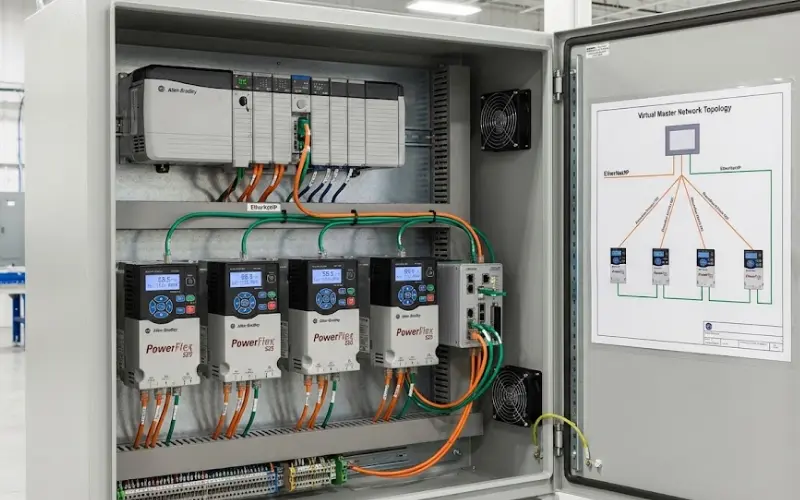
To fully grasp "What is a VFD on a conveyor?", we must view it as part of a larger, interconnected hardware ecosystem.
1. Variable Frequency Drives (VFDs / Inverters)
The Muscle:The VFD manipulates the frequency (Hz) and voltage (V) supplied to the motor to precisely control rotational speed and torque.
Safety Integration (STO):
2. Sensors and Feedback Loops
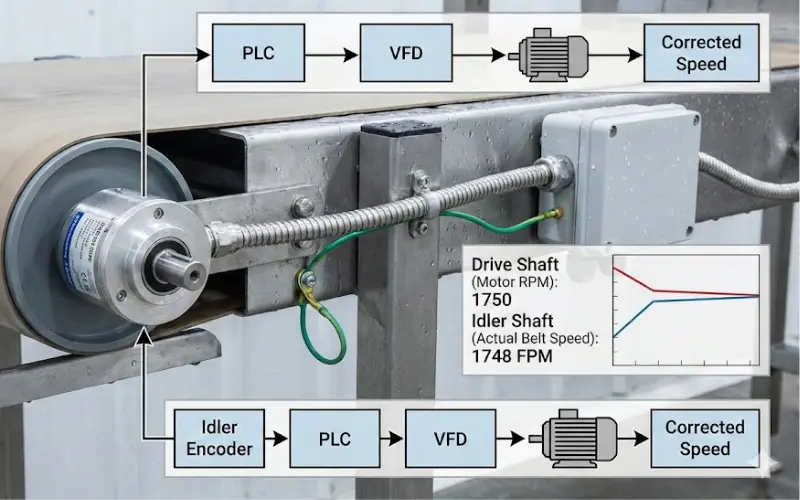
Rotary Encoders (The Proprioception):Encoders are the heart of closed-loop control. In budget systems, designers rely on the VFD's calculated frequency to estimate speed. However, for high-precision applications, you must install incremental or absolute encoders.
Crucial Installation Detail:You must install the encoder on the Idler Roller (Non-Driven Shaft), not the Drive Shaft.
Drive Shaft: Tells you how fast the motor is spinning.
Idler Shaft: Tells you the True Physical Velocity of the belt. If the drive pulley slips, the idler encoder catches the error immediately.
3. The Controller (PLC)
The Brain:Modern vfd conveyor systems utilize industrial Ethernet protocols such as
IV. Advanced Control Strategies: Electronic Gearing and Virtual Masters
This section delineates the difference between a "dumb" conveyor line and a "smart" synchronization system.
1. The Virtual Master Topology
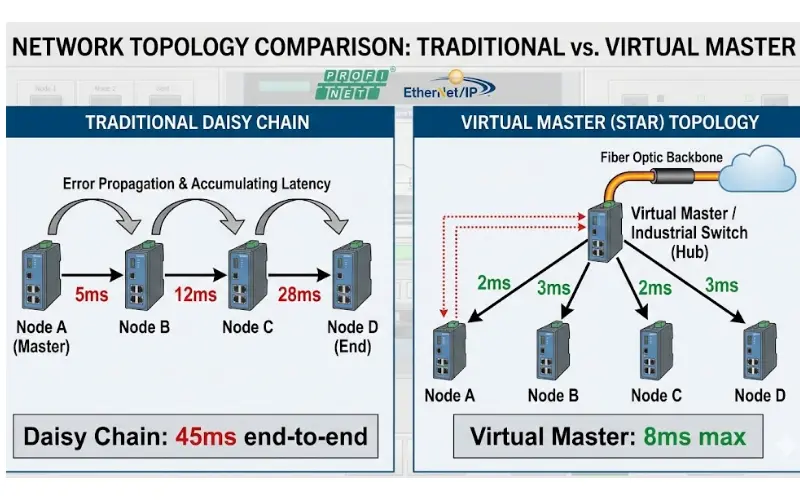
Traditional synchronization logic often relies on a "Cascading" or "Daisy Chain" approach (Conveyor B follows A, C follows B).The Flaw: Errors accumulate. If Conveyor A jitters, Conveyor J at the end of the line oscillates wildly.
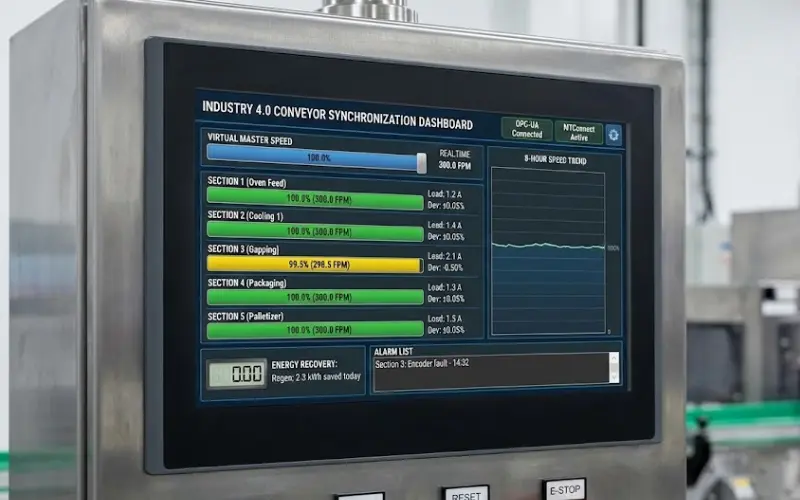
The Solution: The Virtual Master:We create a "Virtual Master" signal inside the PLC software code. This is a mathematical representation of the line speed.
Global Subscription: Conveyors A, B, C, and D all independently "subscribe" to this Virtual Master signal. If Conveyor A faults, the Virtual Master executes a controlled ramp-down, ensuring all belts stop in perfect unison.
2. Electronic Gearing
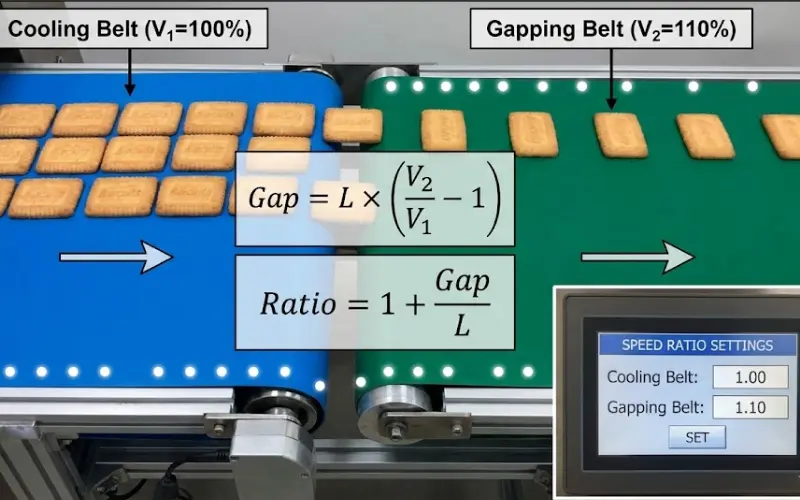
Replacing Mechanical Shafts:In electronic synchronization, we define a "Gear Ratio" in the software.
Application:If you need to create a 10% gap between biscuits on the
3. Cascade and Accumulation Logic
Handling Micro-Stops:When the downstream packaging machine pauses, the discharge VFD decelerates. Simultaneously, upstream conveyors switch to "Accumulation Mode," utilizing the full length of the belt as buffer storage before triggering the emergency dump.
V. Critical Synchronization Scenarios in Biscuit Production
Every section of a biscuit conveyor has unique physics and synchronization requirements.
1. Oven Discharge: Stripping and Tension
The Challenge:The steel oven band expands and contracts with heat. If the
The Strategy:The VFD must be set with a precise "Over-speed" (typically 0.5% to 1.0% faster than the oven band) to create microscopic tension that peels the biscuit off gently.
2. Curve Conveyors: Angular Velocity Matching
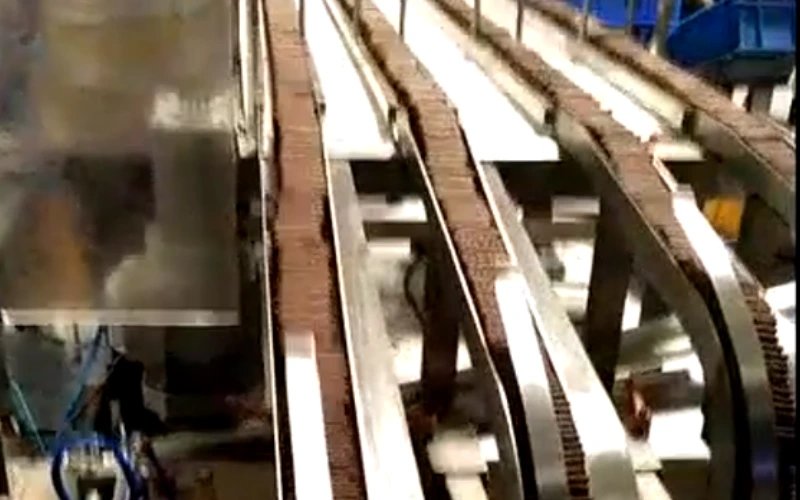
The Challenge:When a straight conveyor feeds into a
The Strategy:You must calculate the speed based on the Centerline of the curve belt. For wide mesh belts, advanced algorithms compensate for the velocity differential to maintain row alignment.
3. Penny Stacker Infeed
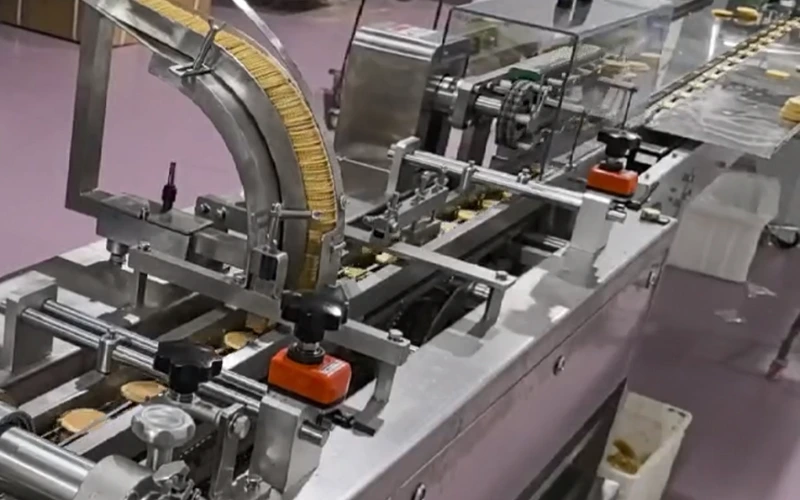
The Challenge:Flipping flat biscuits into a vertical stack requires a violent burst of acceleration.
The Strategy:Standard VFDs often lack the reaction time. We recommend using Servo Drives or High-Performance Closed-Loop Vector VFDs to ensure the
VI. Troubleshooting and Optimization
1. Speed Jitter (Hunting)
The Symptom: The conveyor belt surges rhythmically.The Cause:
PID Tuning: The
Proportional Gain (P) Coupling Slip: Loose encoder coupling.
Noise: Electromagnetic interference on the encoder line.
2. Belt Slippage
The Symptom: VFD shows correct RPM, but the belt is moving slow.The Cause: Worn rubber lagging on the drive pulley.The Fix: This proves why Idler Shaft Encoders are mandatory. The PLC detects the slip via the idler encoder and commands the VFD to over-speed the motor to compensate.
VII. Buyer's Guide: Maintenance Friendly Design
1. Automatic Device Replacement (ADR)
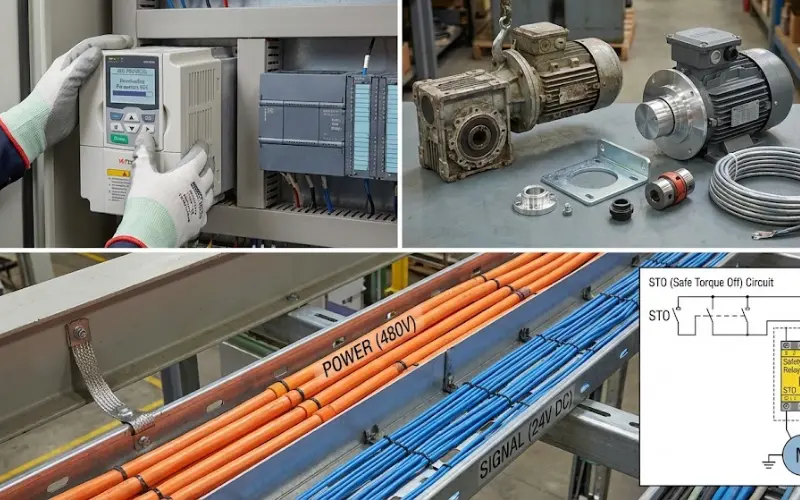
The Pain Point: A VFD burns out at 3:00 AM.The Solution: Specify drives that support ADR (like Rockwell PowerFlex). The Master PLC stores the configuration. When a blank drive is plugged in, the PLC automatically downloads the parameters. MTTR drops from hours to minutes.
2. Selection Checklist
Network Protocol: Does it support EtherNet/IP or Profinet?
Environmental Hardening: Do boards have Conformal Coating to resist conductive flour dust?
Overload Rating: Is the drive sized for "Heavy Duty" (150% starting torque)?
VIII. Frequently Asked Questions (FAQ)
Q1: What is the practical difference between a VFD and a Servo for synchronization?A: VFD excels at Velocity Synchronization (Speed). Servo excels at Position Synchronization (Phase). If you need to align a biscuit with a specific lug on a wrapper, you must use a Servo.
Q2: How do you eliminate cumulative error across a long line?A: Abandon "Cascading" logic. Implement a "Virtual Master" topology where every conveyor follows the same virtual reference signal.
Q3: Why does my encoder signal drop out intermittently?A: Likely noise. Use shielded twisted-pair cabling and ground the shield only at the drive end to prevent ground loops. Segregate low-voltage encoder cables from high-voltage motor cables.
Q4: Can we retrofit an old conveyor line for synchronous control?A: Yes. Replace motors with Inverter-Duty rated units, install idler encoders, and network them via a central PLC.
IX. Conclusion: The Future of Smart Synchronization
In the age of Industry 4.0, Synchronizing the Line is no longer just about making belts turn. It is about creating a cohesive, intelligent neural network that binds your mechanical assets together.
By adopting Virtual Masters, Electronic Gearing, and closed-loop feedback, we move beyond simply preventing piles-ups. We unlock the door to Predictive Maintenance, where algorithms detect failing bearings weeks before they seize.
Do not let your production line bleed profit through desynchronization. Upgrade your control architecture and ensure every biscuit flows precisely to its destination.
Professional Services CTA
Is your production line constantly stopping due to speed mismatches?
Whether you are planning a greenfield facility or retrofitting a legacy line, our Automation Experts are ready to assist.
👉
Click Here to Schedule Your Free Line Synchronization Audit

Ready to start your journey toward a customized solution? Contact me directly on WhatsApp to begin the conversation.