Conveyor Belt Materials 101: The Definitive Guide to HACCP & TCO
Core DefinitionPolyvinyl chloride (PVC) and polyurethane (PU) conveyor belts are commonly used in industries that require high flexibility, light weight, and a smooth surface. These belts are made from synthetic materials, offering excellent resistance to chemicals, oils, and greases.
However, in the high-stakes world of food manufacturing—specifically within the biscuit and bakery sectors—material selection is far more complex than basic flexibility.
Correct conveyor belt material selection is the precise intersection of food science and mechanical engineering. It is a strategic decision designed to ensure strict HACCP (Hazard Analysis Critical Control Point) compliance while maximizing your Return on Investment (ROI).
I. Introduction: Where Food Science Meets Engineering
In the ecosystem of a modern food processing plant, the conveyor belt is often the most undervalued asset. Yet, it represents the largest single surface area of "Food Contact Material" (FCM) in the entire facility.
It is not merely a logistics tool that moves product from point A to point B. It is a dynamic surface that interacts physically and chemically with your product for hours every single day.
Therefore, the selection of belt material is a critical line of defense for food safety. It is the primary barrier against physical contamination (foreign materials), chemical contamination (plasticizer migration), and biological contamination (pathogen growth).
As a responsible Plant Manager or Process Engineer, you are tasked with balancing three competing dimensions:
Polymer Inertness: To prevent chemical leaching into high-fat products like buttery cookies.
Physical Surface Properties: Balancing cleanability with the
friction coefficients Thermodynamic Performance: Ensuring the belt can survive the thermal shock from a 200°C oven discharge to a refrigerated
cooling tunnel
Only by precisely matching food grade conveyor belt material—whether it be TPU, Modular Plastic, or Stainless Steel—to the specific process stage can you achieve success. This alignment is the only way to satisfy
The Business and Compliance Challenge: The Cheap Belt Paradox
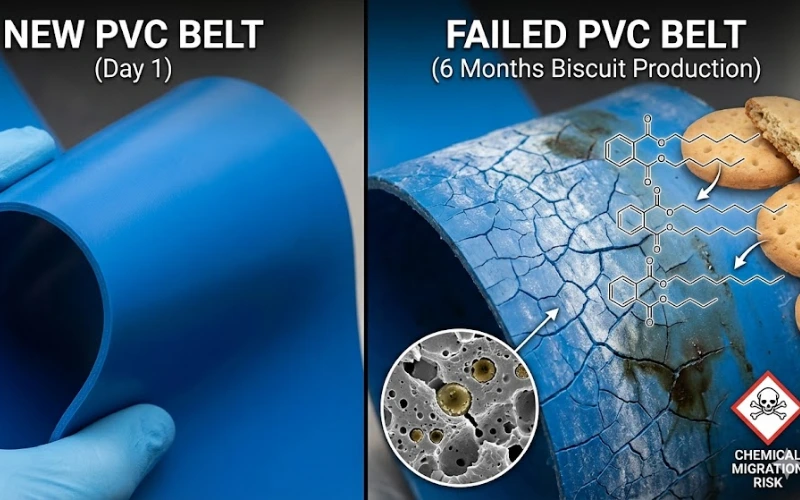
When sourcing conveyor belt material, many organizations fall into a dangerous financial trap called "The Cheap Belt Paradox."
The Phenomenon:Procurement departments, driven by short-term budget constraints, often default to the lowest bidder, selecting low-cost pvc conveyor belt material.
The Consequence:While the upfront CapEx (Capital Expenditure) might be 20% lower, the operational reality is grim. Standard PVC is not engineered for high-fat environments. After three months of exposure to biscuit oil, plasticizers leach out. The belt becomes brittle, leading to Delamination and Cracking.
The TCO Reality:When you run a 3-year lifecycle cost analysis, the math changes. A premium heat resistant conveyor belt material (like TPU) may cost more initially. However, due to its longevity and reduced maintenance needs, its total cost is typically 200% lower than the "cheap" PVC alternative.
For a deeper dive into calculating these costs, see our guide on
. Conveyor ROI Engineering
🔑 Key Takeaways
Selection is Compliance: Your choice of belt material is a core pillar of HACCP; the wrong polymer introduces chemical migration and microbial risks.
Reject Hidden Costs: Do not be fooled by the sticker price; the frequent replacement of cheap PVC belts destroys your operational budget.
Specific Materials for Specific Zones: There is no "universal" belt; use Cotton/PU for extraction, Steel for baking, and PU/Positive Drive for hygiene.
The Details Matter: Features like blue contrast coloring and anti-static formulation are essential for detection and stability.
II. Deep Dive: The Big Four Material Types
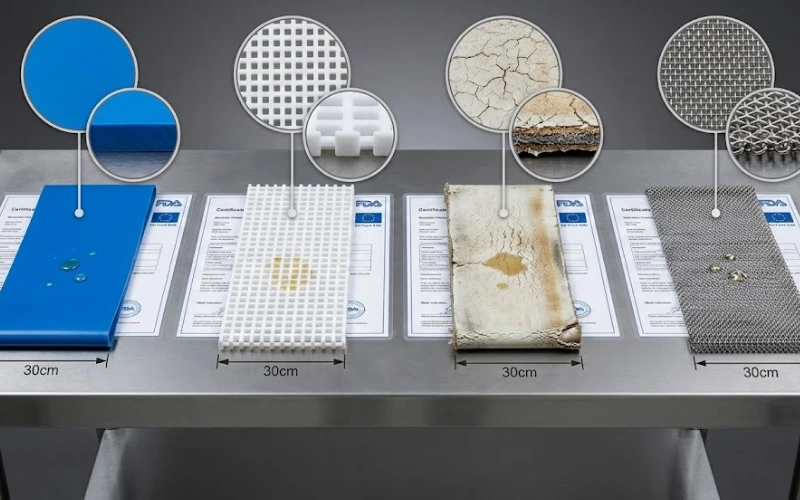
Understanding the nuances of types of conveyor belt material is the foundation of engineering decision-making.
1. Thermoplastic Polyurethane (PU / TPU) — The King of Hygiene
Characteristics and Chemistry:Thermoplastic Polyurethane (TPU) is the gold standard for biscuit conveyor belt applications. Unlike PVC, TPU derives its flexibility from its intrinsic molecular structure, meaning it does not contain liquid plasticizers.
Core Advantages:
Oleophobic Properties: Fats simply sit on the surface and do not penetrate.
Non-Porous Surface: Bacteria and biofilms have no anchor points to colonize.
Hydrolysis Resistance: Engineered to withstand hot water and steam washdowns.
Best Applications:TPU is the mandatory choice for dough handling,
2. Polyvinyl Chloride (PVC) — The Economy Trap
Characteristics:The PVC conveyor belt relies on chemical plasticizers to be flexible. In the food industry, this is a double-edged sword.
Weaknesses and Risks:
Plasticizer Migration: When exposed to fats, plasticizers migrate out, causing the belt to crack.
Poor Thermal Tolerance: In freezing tunnels, PVC becomes brittle and shatters.
Appropriate Scenarios:PVC is suitable for non-food contact zones like Case Packing (boxes) or Ambient Logistics. Be wary of belts labeled "General Purpose"; standard industrial PVC contains
3. Modular Plastic Belting (PP / PE / POM) — Cooling and Flexibility
Characteristics:Constructed from injection-molded plastic bricks (modules) linked by hinge pins. Common materials include Polypropylene (PP) and Acetal (POM).
Core Advantages:
Positive Drive: Driven by sprockets, eliminating slippage.
Airflow: The "Open Grid" design provides massive open area, making it the best choice for
cooling tunnels
The Weakness: The Hygiene TrapModular belts contain thousands of hinge points. These are perfect hiding places for allergens.
💡 Tip:If your budget permits, invest in "Belt Lifters." These physically lift the belt off the wear strips during sanitation, exposing the underside where Listeria often hides.
4. Stainless Steel Wire Mesh — The Heat Pioneer
Characteristics:When you have extreme requirements for heat resistant conveyor belt material, metal is the only viable option. Engineered to withstand temperatures exceeding 300°C (572°F).
Best Applications:The
III. Invisible Engineering: Hidden Properties
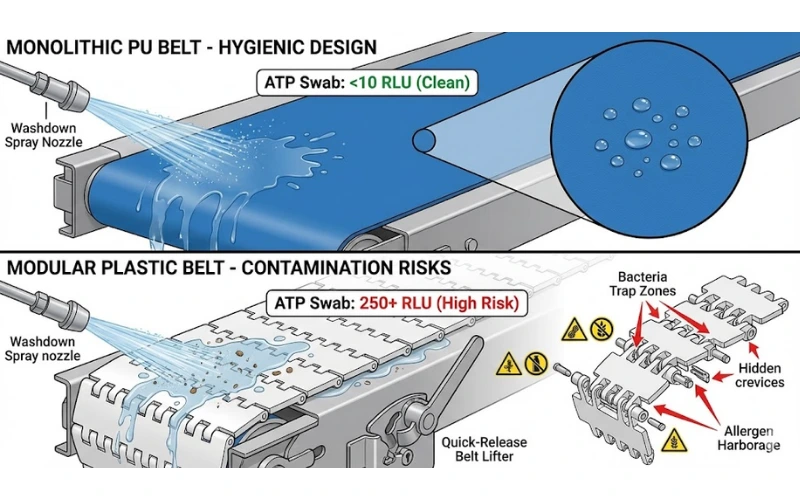
In the science of conveyor belt material selection, the polymer base is just the beginning.
1. The Power of Blue
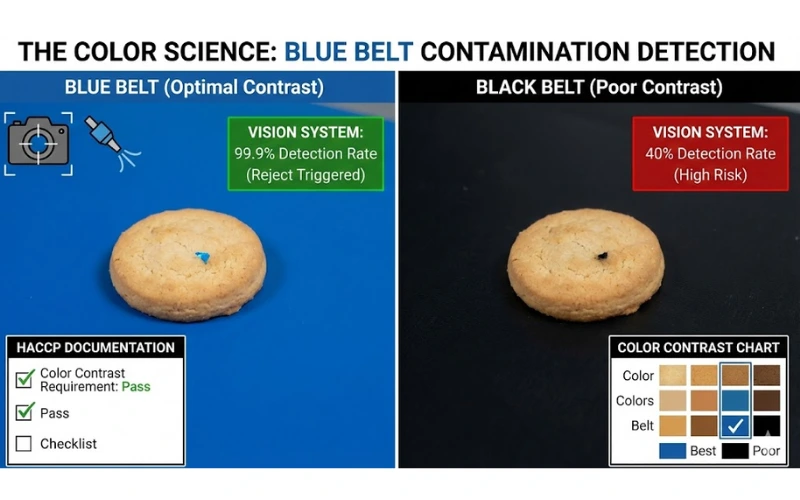
Have you ever noticed that almost all modern conveyor belt material in food plants is blue? This is a risk management strategy.
Visual Contrast:Blue is a color that rarely exists in natural food products. If a blue belt suffers catastrophic damage and a piece chips off, the shard is immediately visible against the brown biscuit or yellow dough. Automated
2. Static Control Management
In environments filled with flour or sugar powder, the conveyor belt acts like a
The Solution:You must specify belts with Anti-Static formulations containing conductive carbon black. This dissipates charge to the ground, preventing dust explosions (ATEX compliance) and protecting sensitive electronics.
3. Friction Engineering
Top Side (Product Contact):
Sticky Dough: Requires "Rice Grain" texture to release product.
Inclined Transport: Requires "Inverted Pyramid" texture for
Z-Type Conveyors
Bottom Side (Machine Contact):
Accumulation: Requires low-friction fabric backing.
Power Transmission: Requires high-friction rubber or positive drive teeth.
4. Positive Drive Monolithic — The Modern Hybrid
This combines the hygiene of a solid PU belt with the reliability of a modular belt. It is an extruded, solid homogenous belt with drive teeth molded onto the back. It eliminates the hygiene trap of hinges and the tracking headaches of flat belts, making it the ideal partner for
IV. Application-Specific Selection Strategy
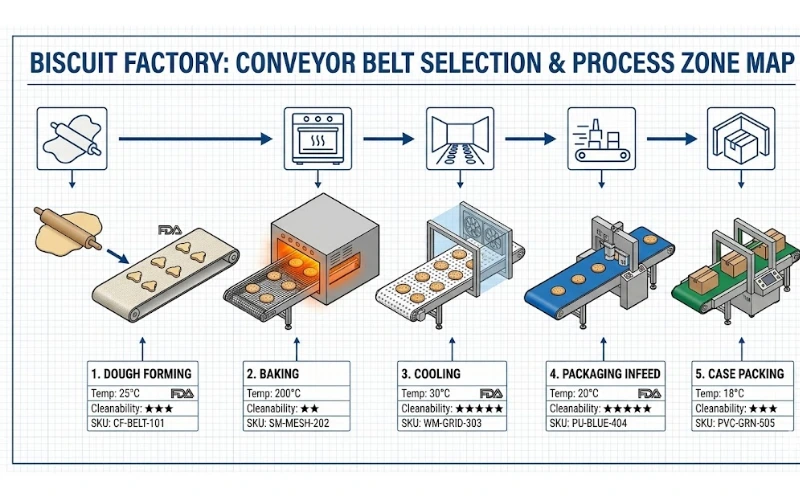
To assist conveyor belt material suppliers and plant engineers, we have mapped the ideal materials to specific biscuit production stages.
| Process Stage | Recommended Material | Critical Engineering Reason |
| Forming (Rotary Moulder) | Cotton Web or Textured PU | Extraction of raw dough requires high "Grip" and moisture absorption. |
| Baking (Tunnel Oven) | Solid Steel Band or Wire Mesh | Must withstand 200°C-300°C. Steel bands provide a flat bottom. |
| Stripping (Oven Exit) | Specialized Thin PU ( | Requires a tiny nose bar radius. Belt must be incredibly thin and heat resistant. |
| Cooling (Ambient) | Modular Plastic (Open Grid) | Maximizing airflow is the goal. Ideal for long lengths. |
| Turning (Curves) | Side-Flexing Modular or PU Curve | Must handle lateral forces. See our |
| Packaging (Infeed) | Smooth PU or Positive Drive | Highest hygiene zone. Surfaces must be easy to wipe down. |
| Case Packing | PVC or Rubber | Non-food contact zone. Durability and low cost are key. |
V. Maintenance, Compliance, and Inventory Strategy
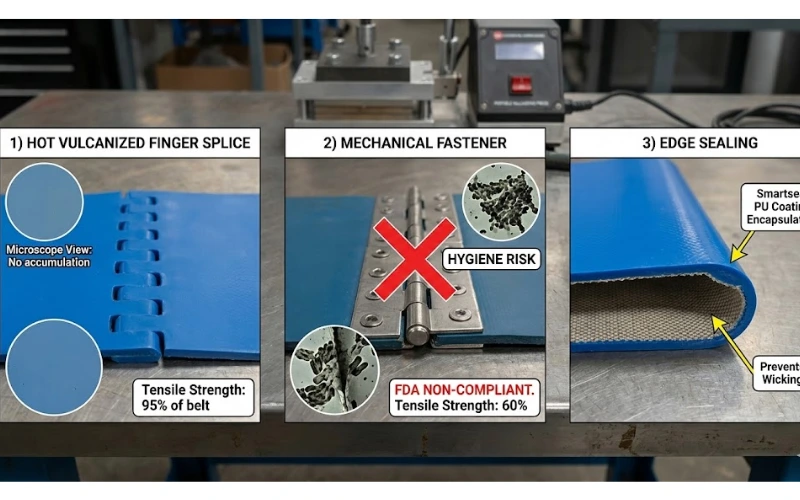
1. Splicing and Edging Technologies
Finger Splice (Hot Vulcanization):The ends of the belt are die-cut into interlocking fingers and melted together. This creates a seamless, flat joint. It is the only acceptable splice for direct food contact.
Mechanical Fasteners (Metal Clippers):Metal hooks lace the belt ends together. While they allow for rapid repairs, they create a massive hygiene risk and foreign material hazard. Strictly forbidden in food contact zones.
Edge Sealing:Specify "Smartseal" technology to cap the cut edges of the belt with solid PU. This prevents the internal fabric from acting like a wick for oil and bacteria.
2. Inventory Standardization
A large biscuit factory might have 50 different conveyors. If every machine uses a different belt specification, your spare parts inventory will be a disaster.
The Strategy:Standardize belt widths (e.g., 300mm, 600mm, 1000mm) and settle on a single high-performance PU specification. This reduces SKUs by 50% and increases buying power.
VI. Frequently Asked Questions (FAQ)
Q1: How to choose the right conveyor belt?A: Follow the "4C" Framework:
Composition: Oil/Heat presence?
Conditions: Knife Edge or Incline?
Cleanability: Wash down frequency?
Compliance: FDA/EC certificate available?
Q2: What are the safety requirements for conveyor belts?A: Food Safety (non-toxic), Operational Safety (guarding), and Fire Safety (flame-retardant/anti-static).
Q3: Is PVC conveyor belt food grade?A: Not automatically. Only PVC belts specifically formulated and certified to FDA/USDA/EC standards are food grade. Standard industrial PVC contains toxic plasticizers.
Q4: Which is better: PU or PVC conveyor belt?A: For direct food contact, PU (TPU) is superior due to oil resistance and hygiene. PVC is for non-food contact zones (packaging cases).
Q5: What are the three types of conveyor belts?A: Flat Belts (General Transport), Modular Belts (Cooling/Drainage), and Cleated Belts (Z-Type Elevation).
VII. Conclusion: Building the Defensive Line
Conveyor belts are not simple consumables to be bought from the cheapest catalog. They are the first physical line of defense for your food safety program and the hidden foundation of your factory's efficiency.
Selecting the right material—using Cotton to extract dough, Steel to survive the oven, and PU to ensure hygiene—is the perfect intersection of Food Science, Mechanical Engineering, and Financial Management.
Do not let a cheap PVC belt become the "Achilles' Heel" of your factory.
Ultimate Service Conversion CTA
Is your factory facing frequent belt failures or struggling with hygiene audits?
Whether you are sourcing specialized green conveyor belt material or looking for a diy conveyor belt material repair strategy.
👉
Click Here to Schedule a Full-Plant Belt Audit & Standardization Consultation

Ready to start your journey toward a customized solution? Contact me directly on WhatsApp to begin the conversation.