Smooth Transition Conveyor Guide: Eliminating Micro-Stops & Optimizing Line Flow
Executive Summary
In the landscape of a modern biscuit or bakery plant, your major equipment often functions like isolated islands. You have the high-capital assets: the mixer, the rotary moulder, the massive
Each of these primary machines represents a significant capital expenditure. Plant managers often obsess over the individual speed of these assets. However, the
Core Definition:Smooth Transition Conveyors are precision-engineered transport systems designed to bridge the critical gaps between major production units. By utilizing technologies like Knife Edge transfers, Nose Bars, and Live Transfers, they eliminate the physical conveyor transition points where gaps, drops, and speed mismatches occur. Their primary mission is to prevent Product Breakage, Tipping, and Jamming, acting as the invisible backbone of biscuit conveyor efficiency.
I. Introduction: Bridging the Islands of Automation
1. Why the "Transition" Dictates Success
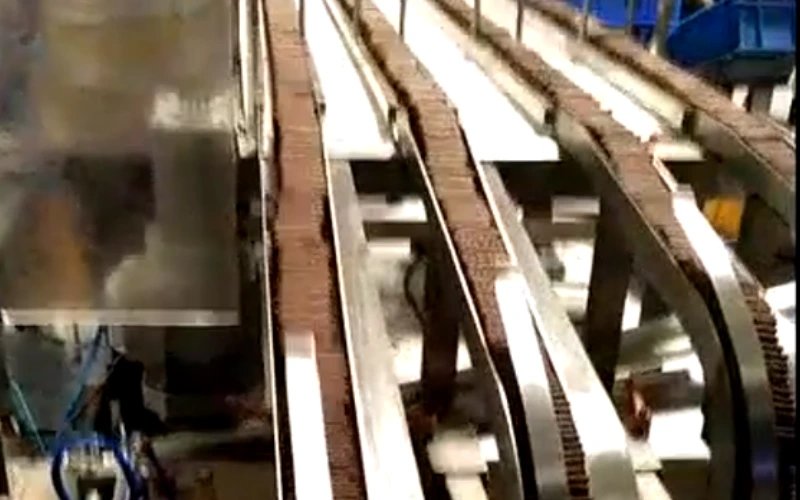
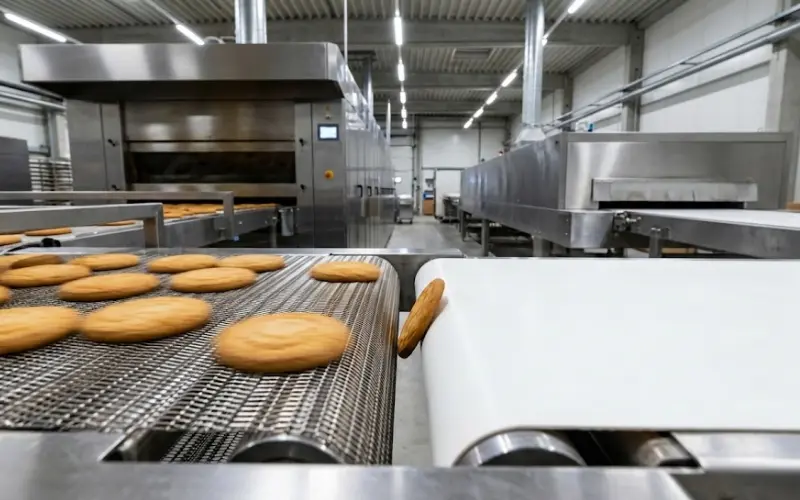
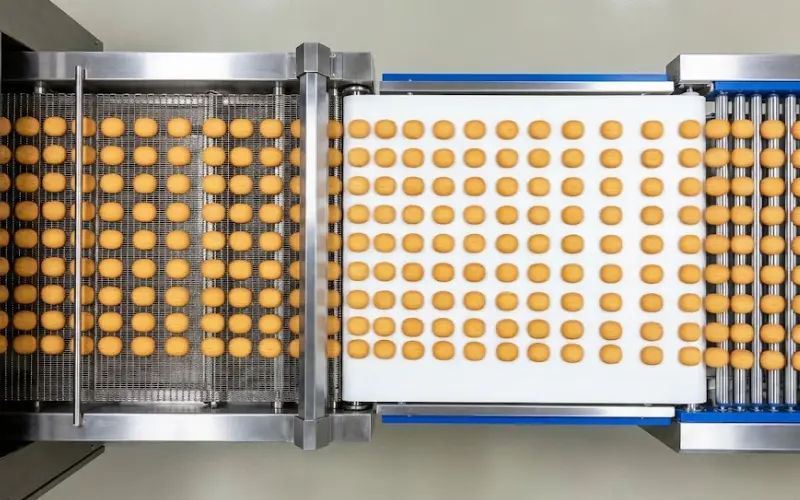
Imagine the physics of your production line for a moment. You have tens of thousands of cookies on conveyor belt traveling at speeds exceeding 30 meters per minute. They are rushing from the heated oven mesh onto the solid
Now, consider the connection point between these two massive systems. If there is even a 5-millimeter gap at this conveyor belt transition, the consequences are drastic.
For a large, robust cookie with a diameter of 40mm, this gap might register as a minor bump. But for a delicate, 20mm mini-biscuit or a uniquely shaped product, this gap is a canyon. It is large enough to cause the product to nose-dive, flip over, or become completely wedged.
In the engineering design of a cookie conveyor, the Transition Point is often the "Bermuda Triangle" of the factory floor. It is where directional stability is compromised and waste is generated.
2. The Economics of Micro-Stops
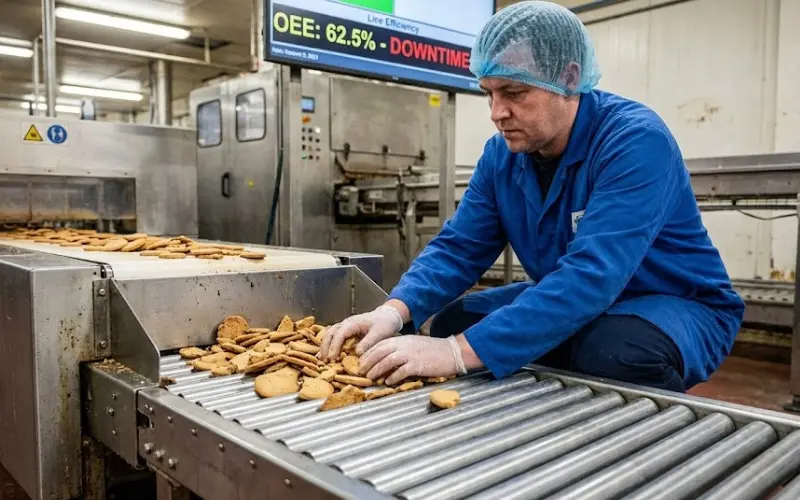
There is a hidden financial killer in manufacturing that many factory owners and CFOs overlook. It is not the catastrophic breakdown that stops the line for eight hours. It is the "Micro-stop."
Management often accepts the reality of "three jams per hour, requiring an operator to intervene for 30 seconds." It seems negligible in the moment. However, let us construct a realistic financial model to reveal the true cost.
The Scenario:Consider a high-speed biscuit conveyor line producing 500 biscuits per minute.
The Reality of Micro-Stops:Assume the line experiences an average of 5 minor jams per hour at a specific transition point. Each jam requires the line to pause or slow down for 1 minute.
The Loss Calculation:Every hour, you lose 5 minutes of production capacity.
The Annual Impact:If the line runs for 20 hours a day, over a standard 300-day operational year, the cumulative loss reaches a staggering 15,000,000 biscuits.
This number represents more than just lost revenue. It represents wasted energy running ovens for zero output and the "frustration factor" for operators. Investing in a high-performance transition conveyor system is a strategic financial decision with an
🔑 Key Takeaways
Eradicate Micro-Stops: Smooth transitions are the only way to prevent the accumulation of minor jams that destroy 5-8% of your annual capacity.
The Geometry Rule: The diameter of your transfer roller must be strictly matched to your product size; usually, the roller diameter must be less than 1/3 of the product length.
Thermodynamics Matter: On high-speed lines, static nose bars generate immense heat; you must implement ceramic coatings or air cooling.
Intelligent Synchronization: Using VFDs to precisely control the speed differential (typically 5-10%) is the physical foundation for preventing product pile-ups.
II. The Physics of Transfer: Gaps, Speed, and Heat
To engineer the perfect transition system, one must first conquer three distinct physical challenges: the geometry of the gap, the conservation of momentum, and the thermodynamics of friction.
1. The Gap Trap
When two cylindrical rollers are placed side-by-side, geometry dictates that a triangular void must exist between them. We call this void "The Gap Trap."
The Geometry Principle and Roller Diameter Rule:To ensure a product moves smoothly across this void, you must adhere to a golden rule of engineering.The product length must be greater than 2 times the transition gap, and ideally greater than 3 times the roller diameter.
If you are using standard conveyor transition rollers, the diameter is typically 50mm or larger. When two 50mm rollers are placed tangent to each other, the "Dead Space" between their crests can easily exceed 30mm.
Consider a soft dough ball on a cookie dough conveyor belt. As it crosses this threshold, gravity takes over. The leading edge of the product will dip into the gap and strike the vertical wall of the downstream roller. This physical reality is why, for small products, you must abandon standard rollers entirely and switch to Nose Bar technology.
💡 Pro Tip:Watch your product as it crosses a transition point. If you see the product "nod" or dip its front edge even slightly, your roller diameter is too large. This "nod" is the precursor to a jam.
2. Speed Synchronization and Impact
When a product transfers from one transition belt conveyor to the next, even a microscopic difference in speed creates significant physical forces.
Momentum Transfer & Pulling a Gap:To ensure flow, the downstream transition belt is almost always programmed to run 5% to 10% faster than the upstream belt. This utilizes momentum to physically "pull" the product away from the pack, instantly creating a safety gap between items.
For
3. The Heat Factor — The Invisible Killer
This is perhaps the most overlooked failure mode in conveyor transition plate design.
The Problem:When you replace a rolling bearing with a fixed Static Nose Bar, you introduce sliding friction. The conveyor belt must slide over the tip of the bar under high tension.
The Thermodynamic Consequence:On a high-speed cookie conveyor belt, the temperature at the tip of the nose bar can easily exceed 100°C (212°F).
For the Belt: This heat accelerates material degradation, leading to cracking and delamination.
For the Product: The hot metal bar acts like a branding iron, scorching the bottom of biscuits during pauses.
The Solution:You must tackle this
III. Core Transition Technologies and Selection
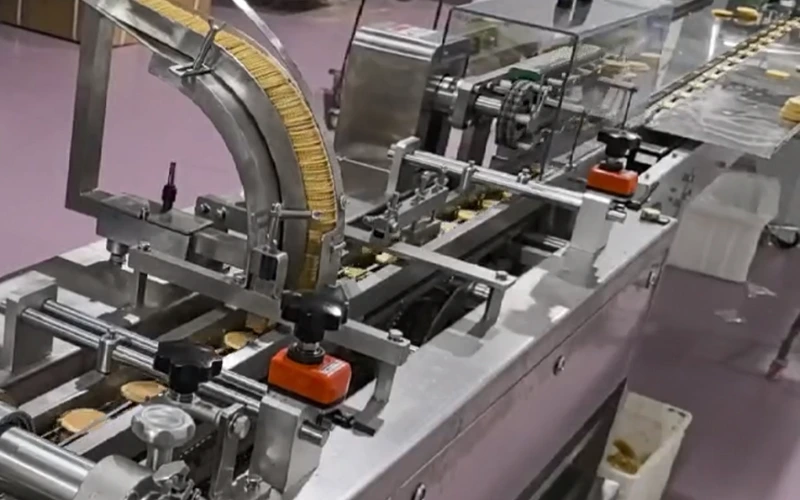
Depending on the characteristics of your product and the location of the transition point conveyor, different mechanical solutions are required.
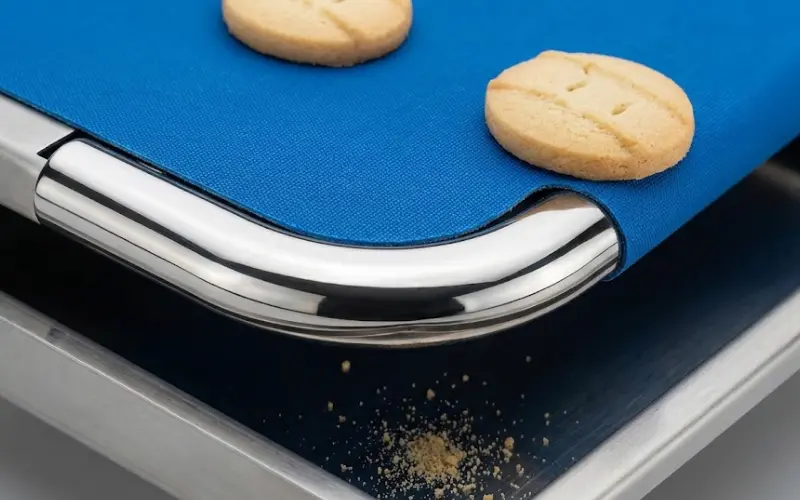
1. Knife Edge Transfers (Nose Bar)
This is the gold standard for handling small, fragile, or sticky products.
The Principle: It replaces the rotating roller with a static metal bar featuring an extremely small radius, typically 6mm to 15mm. This allows the conveyor belt transition gap to be reduced to mere millimeters.
Material Science: High-speed applications require Ceramic Nose Bars to manage the coefficient of friction.
Applications: Essential at the exit of a cookie conveyor oven and for transferring soft dough shapes.
2. Live Roller Transfers
When the product size is large enough, or when a Knife Edge belt is not feasible due to tension limits, the Live Roller is the best alternative.
The Principle: Engineers embed a series of small-diameter power rollers (e.g., 15mm) directly into the gap between the two main conveyor transition points. These rollers are "Live," meaning they are actively driven.
Ideal Scenarios: Perfect for rigid cookies, crackers, or trays after packaging.
3. Retracting / Shuttle Conveyors
This represents the intelligent, dynamic tier of transition technology.
The Principle: The nose bar at the discharge end of the conveyor is mounted on a servo-driven carriage. It can physically extend and retract (shuttle) back and forth.
Intelligent Applications: This is often used as a high-speed
rejection system
4. Waterfall Transfers
The Principle: Utilizing gravity where the upstream conveyor is higher than the downstream one.
Risks: For fragile items, engineers must design a slide plate coated with Teflon or dimpled stainless steel to buffer the impact.
5. The End of Dead Plates
In the modern, high-efficiency factory, the "Dead Plate" (a simple static strip of metal) should be considered obsolete technology. The gap creates a static crevice that is a hygiene nightmare and a friction trap. Wherever possible, upgrade Dead Plates to Knife Edge or Live Roller transfers.
IV. Electrical Integration: Smart Gapping Logic
Hardware provides the capability, but software provides the reliability. The smoothness of conveyor transitions is highly dependent on the
1. The Mathematics of Pulling a Gap
To prevent products from colliding and stacking up after a transfer, we must apply precise speed control logic via VFDs (Variable Frequency Drives).
The Control Formula:
Vout: The speed of the downstream (receiving) conveyor.
Vin: The speed of the upstream (feeding) conveyor.
Gap %: The desired percentage of empty space between products.
2. Closed-Loop Control Strategy
Anti-Stacking Logic:A photo-eye sensor is installed immediately downstream. If the beam is broken for longer than the expected product length, the PLC triggers an immediate reaction: micro-adjusting the downstream VFD to accelerate, or triggering a "Cascade Stop" upstream.
V. Hygiene and Maintenance: Lowering TCO
1. Quick-Change Design Engineering
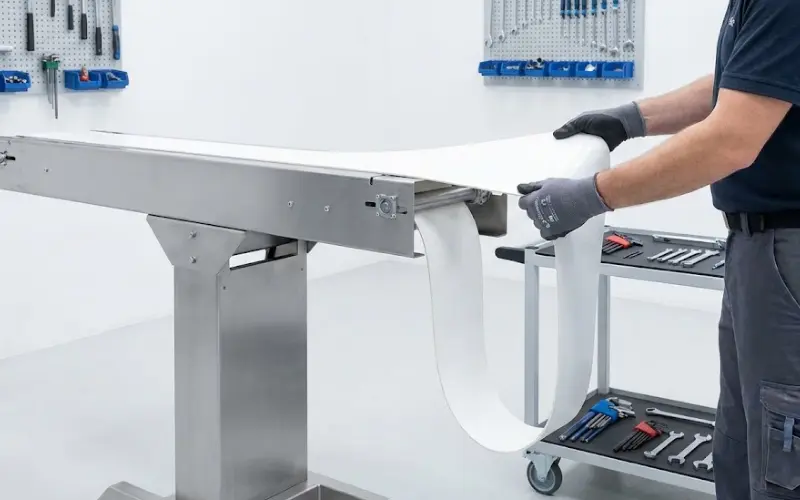
Traditional Knife Edge designs suffer from a fatal flaw: Belt replacement can take 4 hours, requiring full disassembly.
The Solution: Cantilevered DesignModern systems utilize a Cantilevered frame architecture supported from only one side. To change a belt, the operator releases tension and slides the belt off the open side. This reduces changeover time to under 20 minutes, significantly lowering
2. Crumb Management & Tracking
Catch Pans: Every transition point must be equipped with a dedicated, slide-out catch pan to capture crumbs generated by friction.
V-Guide Technology:Small diameter nose bars have little grip. To prevent the belt from wandering and fraying (a contamination risk), you must specify belts with a V-Guide strip welded to the underside, running in a machined groove on the roller.
VI. Buyer's Guide: The Selection Checklist
For procurement managers and project engineers, use this 5-point checklist to interrogate potential suppliers:
Nose Bar Cooling: Does the nose bar have passive heat sink features or active air cooling ports for speeds >20m/min?
Maintenance Access: Is the transition belt conveyor a cantilevered design?
Speed Interface: Does the control cabinet have a pre-wired VFD interface for line synchronization?
Directional Logic: If the layout involves a
90 degree turning conveyor Regulatory Compliance: Do all materials meet FDA CFR 21 or EC 1935/2004 standards?
VII. Frequently Asked Questions (FAQ)
Q1: What is the absolute minimum diameter for a Knife Edge transfer?A: The physical limit is typically around 6mm (0.24 inches). Going smaller compromises the structural integrity of the nose bar and places excessive bending stress on the belt. For most industrial biscuit conveyor applications, a radius between 6mm and 10mm is the standard sweet spot.
Q2: How do I solve the problem of belts overheating at the transition?A:
Reduce Tension: Run at the lowest tension possible.
Belt Selection: Use thin, lightweight belts specifically engineered for knife edges.
Active Cooling: Pump compressed air through a hollow nose bar.
Q3: Why do my small cookies always get stuck between two conveyors?A: This is a classic sign of an incorrect transfer method. You are likely using standard rollers or dead plates with a gap that is too large. You must upgrade to a Knife Edge transfer.
Q4: When should I use a "Dead Plate" versus a "Live Transfer"?A: Dead Plates are only acceptable for large, hard products moving at low speeds. For a modern, efficient cookie conveyor oven line, Live Transfers (Knife Edge/Roller) are mandatory to maintain OEE.
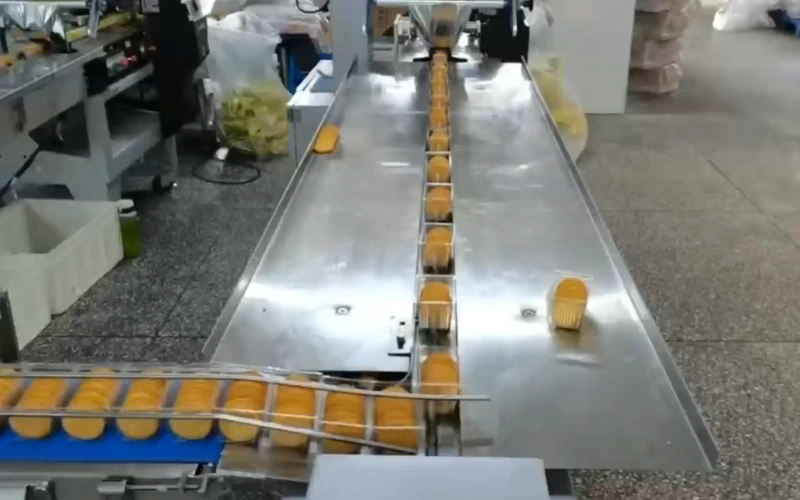
Q5: What is a Herringbone Transition Conveyor?A: This is a specialized roller conveyor where the rollers are angled in a "Herringbone" pattern. It is typically used in the packaging phase to automatically center products.
VIII. Conclusion: Flow is Money
In the world of biscuit production, profit does not just come from the recipe. It comes from the Flow. A production line equipped with perfect transition point conveyor designs is like a highway with no traffic lights.
It eliminates micro-stops. It protects the structural integrity of the product. It drastically reduces maintenance costs.
Do not let the innocent-looking 50mm gap between your conveyors be the culprit stealing 5% of your annual capacity. Choose the right technology—whether it is a Knife Edge, a Live Roller, or a Smart Shuttle.
Ultimate Service Conversion CTA
Are you ready to eliminate "Micro-Stops" from your production line?
Whether you are sourcing spare parts for a cookie conveyor belt oven or optimizing a roller conveyor transition in your packaging hall, our expert team is here.
👉
Click Here to Get Your Free Production Line Connectivity Audit Connect your islands of automation into a single, efficient continent of production.

Ready to start your journey toward a customized solution? Contact me directly on WhatsApp to begin the conversation.