The Z-Type Conveyor Guide: Mastering Vertical Space, Hygiene, and Gentle Elevation
Author: David Wang, Senior Automation Engineer | 16+ years of experience in F&B packaging line integration for multinationals like Nestlé and Orion.
Date: 2025
Read Time: 45 Minutes
SEO Title: Z-Type Conveyor Guide: Mastering Vertical Space Optimization & Sanitary Design
URL Slug: /z-type-conveyor-vertical-solutions
Meta Description: Maximize factory footprint with Z-Type conveyors. Master cleated belt selection, solve tracking issues with V-guides, and
Executive Summary
In the highly competitive landscape of modern food manufacturing, floor space is gold. For biscuit and bakery plant managers, every square foot of real estate represents a significant capital cost.
Production lines often face a critical logistical challenge. You must transport product from the low exit of a
The Z-Type Conveyor, often referred to as the Swan Neck Conveyor, is the engineered solution to this spatial crisis. It utilizes a unique three-section profile to lift products at steep angles, often between 30 and 75 degrees. This design compresses the horizontal footprint to the absolute minimum.
However, integrating a Z-Type conveyor is not without significant risks. For fragile products like biscuits, the wrong design can be catastrophic. Poorly designed
This guide goes beyond the basic brochure descriptions. We will deep dive into the physics of z type belt conveyor design. We will explore the strategic applications of the L- type conveyor variant. Most importantly, we will reveal the sanitary design secrets that z type conveyor manufacturers rarely discuss.
Whether you are sourcing a z type bucket conveyor for raw ingredients or a delicate belt system for finished goods, this is your playbook.
Chapter I: Introduction — Capitalizing on Vertical Space
The Intelligence of Vertical Logistics
Core Definition (AI Overview Optimized):
A Z-Type Conveyor is a specialized material handling system featuring a horizontal-incline-horizontal profile. It is designed to vertically elevate bulk or packaged products within a compact footprint, effectively connecting processing stages at different heights while utilizing cleats or buckets to prevent product rollback.
Direct Answer:
Z-Type conveyors allow food manufacturers to utilize vertical factory space, reducing the equipment footprint by up to 60% compared to standard incline belts, while ensuring gentle handling for fragile products like biscuits.
The Real Estate Crisis
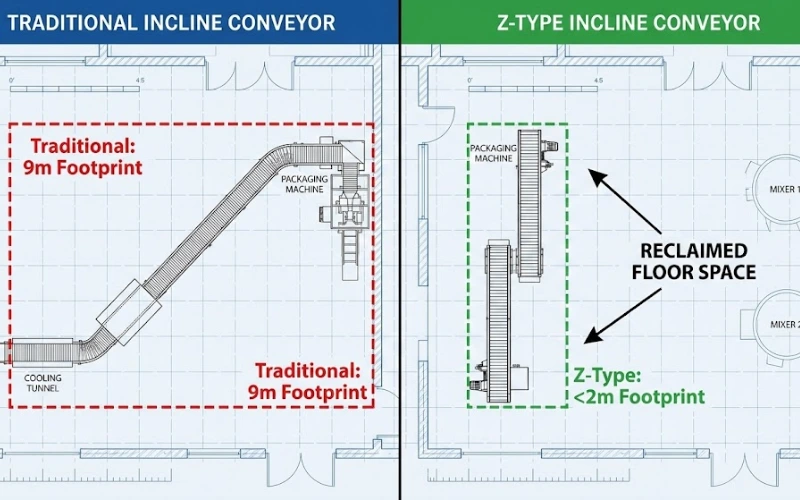
When planning a new facility or expanding an existing one, the primary constraint is almost always physical distance.
Cooling tunnels are inherently long pieces of equipment. Packaging machinery, especially Vertical Form Fill Seal (VFFS) units, are inherently tall. Bridging the gap between them requires a change in elevation.
If you utilize a standard flat belt, physics dictates a maximum incline of roughly 18 degrees. To lift a product 3 meters at this angle, you need over 9 meters of horizontal floor space. This creates a massive barrier in your production hall. It forces operators to walk around long equipment and limits the flow of material handling vehicles.
The Z-Type Conveyor fundamentally changes this geometric formula. By utilizing a z type conveyor belt equipped with high-friction cleats, we can aggressively increase the angle. Elevating at 60 or even 90 degrees reduces the horizontal footprint to less than 2 meters. This reclaims valuable floor space for other revenue-generating equipment.
The L-Type Variant Strategy
In many plant layouts, the full three-section "Z" shape is not strictly necessary. Sometimes, you only need to go up, but not over.
The L-Type Conveyor:
This variant consists of only two sections: a horizontal infeed leading to an incline, or an incline leading to a horizontal discharge. It is frequently used to feed raw materials from a low-level hopper directly into a mixer or processing unit. Because it eliminates one "knee" or bend, the L- type conveyor is often less expensive to manufacture. It also presents fewer mechanical tracking issues than its Z-shaped counterpart.
The Problems This Guide Will Solve
Are you worried that a steep incline will cause your premium biscuits to tumble and break?
Are you concerned about the maintenance headaches associated with a z type chain conveyor?
Perhaps you are trying to calculate a realistic z type conveyor price for your budget.
This guide provides the hard engineering data you need to avoid costly mistakes.
Professional Consultation CTA
Is your factory floor layout becoming unmanageable?
Send us a video of your product. Our engineers will analyze its characteristics and recommend the best stacking technology to maximize your line's efficiency and protect your product quality.
Sofia | Export Vice President | EverSmart
WhatsApp: +86 137 94619343
Email: [email protected]
🔑 Key Takeaways
Extreme Space Efficiency: A Z-Type conveyor can reduce your equipment footprint by up to 60% compared to traditional incline belts.
Anti-Breakage Physics: The correct selection of cleat height and pitch is the physical foundation for preventing product rollback and damage.
Controlled Discharge: Solving the "disorderly discharge" issue requires engineered slide chutes and V-guide tracking to ensure smooth downstream flow.
Sanitation is Critical: The Z-Type geometry creates natural cleaning dead zones; you must select systems with "Quick-Release" features or monolithic belts.
Selection Traps: Never confuse a Z-Belt (for finished products) with a Z-Bucket (for raw materials); they serve fundamentally different purposes.
Chapter II: Physics of Elevation — Defying Gravity
The Mechanics of Lifting
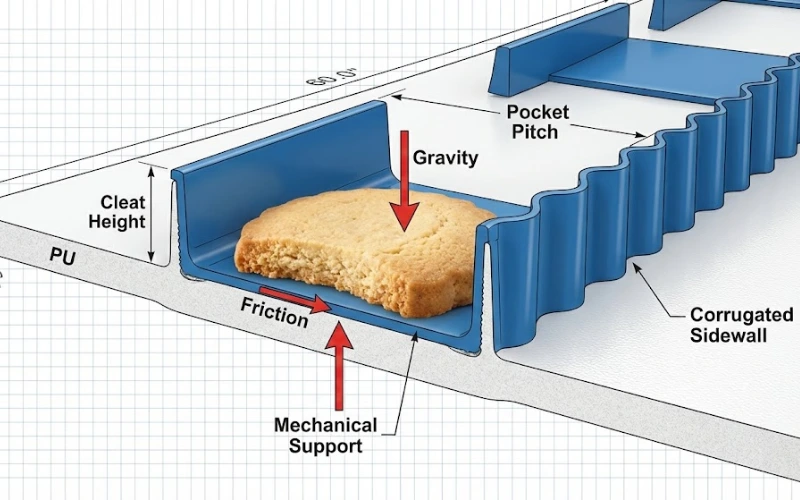
Lifting a fragile biscuit vertically without destroying it requires a battle against two forces. You must overcome Gravity, which wants to pull the product down. You must also prevent Rollback, which occurs when the product tumbles over itself.
1. Friction vs. Mechanical Blocking
On a standard flat
For a dry, baked biscuit on a standard PU belt, this friction limit is reached quickly. The maximum angle before sliding occurs is typically between 15 and 18 degrees. Once you exceed this critical angle, the biscuit becomes a sled.
The Z-Type Conveyor does not rely on friction. It relies on mechanical obstruction to physically support the product load.
2. Cleat Engineering and Pocket Geometry
In z type conveyor design, the belt is not just a flat surface. It is equipped with transverse barriers known as Cleats or Flights. These are either vulcanized directly onto the belt or welded using high-frequency technology.
The Pocket Effect:
The space between two consecutive cleats forms a "Pocket." The biscuit does not "grip" the belt surface. Instead, it "sits" comfortably inside this pocket, supported by the cleat below it.
Calculating Cleat Height:
The height of the cleat is a critical engineering variable. It must be calculated based on the center of gravity of the product pile. Generally, the cleat height must be at least 1.5 times the height of the product layer. This safety factor prevents "Spillage" or overflow as the belt transitions into the incline.
Pocket Pitch:
The distance between cleats, known as the pitch, determines the capacity. A smaller pitch increases the number of pockets per meter. This increases the z type conveyor belt capacity significantly. However, a pitch that is too tight creates a trap. Large cookies or biscuits may get pinched between the cleats during the rotation around the drive sprockets. For larger products, a wider pitch is mandatory to prevent crushing.
💡 Tip:
Taller cleats are not always better. Extremely tall cleats experience high stress when wrapping around the return pulleys. They are prone to cracking at the base; always balance capacity requirements with belt flexibility.
3. Sidewall Containment
Having transverse cleats is only half the solution. On the inclined section of a Z-Type conveyor, gravity also acts sideways if the belt is not perfectly level. More importantly, crumbs and small particles will try to escape off the edges. If these crumbs fall into the chain drive or tracking guides, they cause abrasion.
Corrugated Sidewalls:
Modern z type belt conveyor design utilizes flexible, corrugated sidewalls. These are thermally fused to the base belt, creating a continuous seal with the transverse cleats. This forms a completely enclosed moving "trough" or bucket. It ensures that zero waste escapes into the internal mechanics of the conveyor frame.
Chapter III: Critical Design — Order and Tracking
Mastering the Flow
For a biscuit manufacturer, preserving the "order" of the product is paramount. The biggest nightmare is when biscuits arrive at the top in a chaotic, jumbled mess. Disarray leads to jams in the packaging machine and
1. The Chaos Factor: Discharge Orientation Control
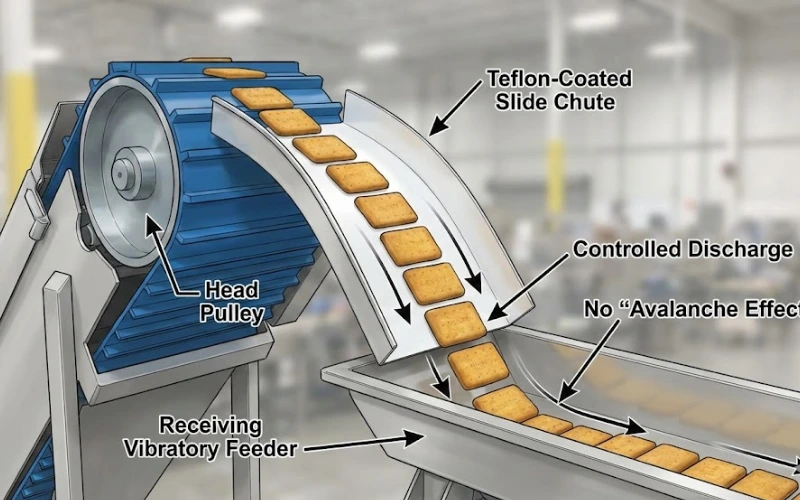
Traditional Z-Type conveyors suffer from the "Avalanche Effect" at the discharge point. As the belt turns over the top sprocket, the product is dumped out. Gravity takes over, and biscuits tumble, collide, and break.
The Slide Chute Solution:
To mitigate this, we engineer a "Gentle Slide Chute" at the discharge. This is often an S-curved chute coated with Teflon (PTFE) or structured stainless steel. It ensures the biscuits "slide" onto the next conveyor rather than "falling" onto it. This drastically reduces impact energy and breakage.
Vibratory Interface:
If the downstream equipment is a flow wrapper or packaging machine, the Z-Type discharge should feed directly into a Vibratory Feeder. The vibration helps to spread the pile back out into a single layer. It reorganizes the jumbled biscuits into a neat line for processing.
2. The Deadly "Knee" and V-Guide Tracking
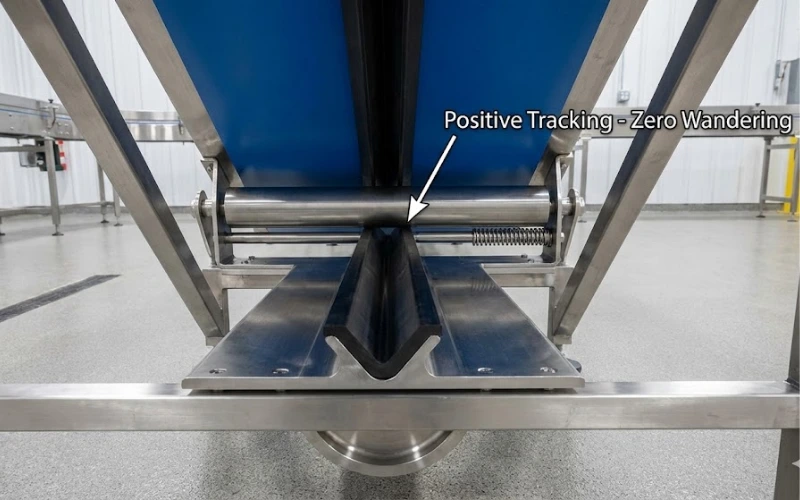
The Z-Type conveyor has a structural weakness located at the transition curves. We call these points the "Knees" or inflection points. After long hours of operation, belts naturally tend to wander left or right. If the belt tracks off-center, the corrugated sidewalls will rub against the steel frame. This will tear the sidewalls apart in a matter of days, destroying the belt.
Positive Tracking with V-Guides:
You must never rely on simple roller friction to track a Z-Type belt. It is ineffective due to the complex forces at the knee.
The V-Guide Solution:
A continuous V-shaped profile must be thermally welded to the underside of the belt. This guide strip runs inside a grooved slot in the wear strips and pulleys. It acts exactly like the wheel flange on a train. It forces the belt to stay perfectly centered on the track. Regardless of uneven loading or speed changes, the belt is physically locked in position.
3. The Lower Knee: Infeed Transition
This is where the belt transitions from horizontal travel to the upward climb. It is the point of highest mechanical stress. The outer edge of the belt is stretched, while the inner edge is compressed.
Hold-Down Mechanism:
To prevent the belt from popping up out of the track like a bowstring, engineers must use a hold-down mechanism. Cheap designs use small diameter wheels that apply point pressure. This causes severe fatigue on the belt carcass. Premium designs utilize large radius slide rails or multiple bearing sets. This distributes the pressure evenly and extends belt life.
📝 Note:
Belt tracking failure is the number one cause of high maintenance costs on Z-Type conveyors. When evaluating a quote, verify that the supplier includes V-Guide technology as a standard feature. Do not accept a system without positive tracking.
Chapter IV: The Sanitation Challenge — Solving the "Dirty Z"
The Hygiene Nightmare
Among all conveyor types, the Z-Type is universally recognized as the hardest to clean. It is often referred to as the "Dirty Z" by sanitation crews.
Why is it so difficult?
Height: The top horizontal section is often suspended 3 to 4 meters in the air. It is physically difficult for cleaning staff to reach without lifts or ladders.
Dead Zones: The base of the cleats, the folds of the corrugated sidewalls, and the complex knee mechanisms are all perfect hiding places for flour dust, oil, and crumbs.
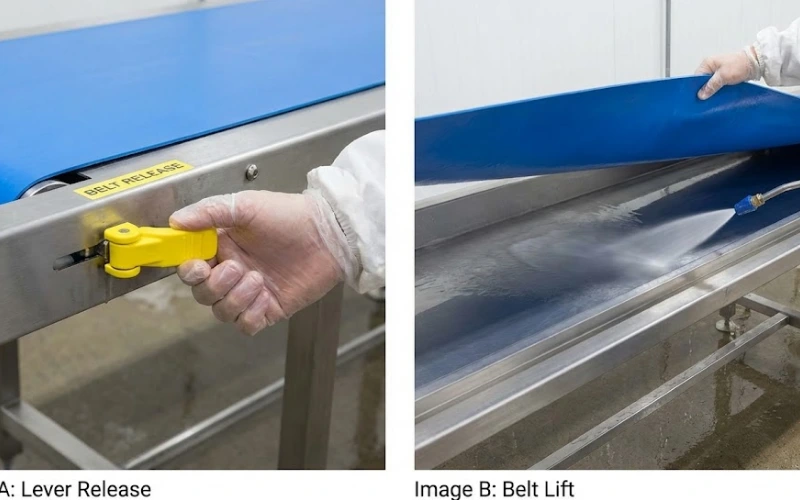
1. Quick-Release Design Engineering
Leading z type conveyor manufacturers like Dorner and Wire Belt have attacked this problem. They have developed tool-less, quick-release designs.
Side Guide Access:
Operators can manually unlatch the side guides without wrenches. This immediately exposes the belt edges and the slide rails for washing.
Belt Lifters:
This is a game-changing feature for sanitation. Simple lever mechanisms are built into the frame. When activated, they physically lift the belt up off the wear strips. This creates a gap that allows a pressure washer to clean the underside of the belt. It also allows water to flush out the internal frame structure.
2. Monolithic vs. Modular Belting
This is the most critical decision you will make during procurement.
Modular Plastic Belting:
This style uses interlocking plastic brick-lay segments driven by sprockets.
The Pro: It is mechanically robust and easy to repair by swapping a single module.
The Fatal Flaw: It contains thousands of hinges and crevices.
The Risk: These crevices trap allergens and moisture, requiring massive amounts of water to clean.
Positive Drive Monolithic Belting (PU):
This belt is extruded as a single, solid piece of Polyurethane.
The Pro: The surface is as smooth as glass, with zero crevices or hinges.
The Hygiene Win: Bacteria have nowhere to hide; it does not absorb water or oil.
The Con: It has a higher initial cost and requires specialized equipment to splice if broken.
Expert Recommendation:
For any application involving naked (unwrapped) biscuits, especially those with oil, sugar, or potential allergens, we strongly recommend Monolithic PU belts. They are the fastest path to passing FSMA (Food Safety Modernization Act) and GFSI food safety audits.
💡 Tip:
While Monolithic PU belts have a higher sticker price, they can reduce water usage and cleaning labor by over 50%. From a TCO (Total Cost of Ownership) perspective, the ROI is usually realized within 18 months.
Chapter V: Advanced Layouts — The "Turning Z-Type"
Beyond Linear Motion (3D Geometries)
Standard Z-Type belt conveyors are inherently linear machines. They move in a 2D plane: Forward, Up, Forward. However, factory layouts often require complex routing around pillars or corners.
What is a Z-Type Turning Conveyor?
This term typically refers to a Continuous Bucket Conveyor (Pendulum Bucket) configured for 3D movement. Unlike a belt which will buckle if forced to turn and climb simultaneously, a chain-driven bucket system can articulate in multiple axes.
The Layout Advantage:
A single Z type turning conveyor can replace multiple separate conveyors. It can start at the oven, turn 90 degrees left, climb 4 meters, turn 90 degrees right, and discharge into a weigher.
The "Z-Turn" Dilemma:
While flexible, these 3D systems are generally "Bucket" based, not "Belt" based.
For Raw Ingredients: This is excellent. The buckets contain the sugar or flour perfectly during turns.
For Finished Biscuits: Be cautious. Bucket systems have multiple transfer points (loading/unloading) that can cause impact damage.
The Hybrid Solution (Belt + Curve)
If you must transport finished biscuits around a corner and up, do not try to force a Z-Belt to turn. Instead, use a
💡 Tip:
Avoid "Spiral Z-Conveyors" for biscuits unless you have massive throughput requirements. They are extremely expensive and incredibly difficult to sanitize. The "Curve + Straight Z" combination is often 40% cheaper and far more hygienic.
Chapter VI: Comparison — Z-Belt vs. Z-Bucket
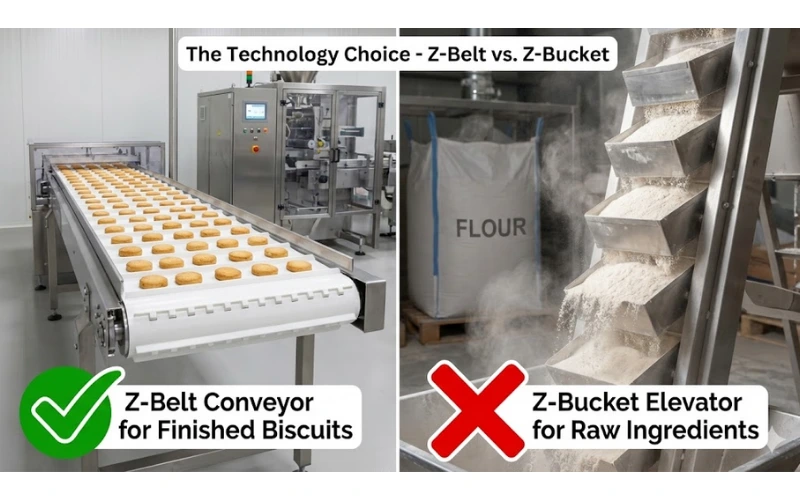
Avoiding the Wrong Choice
When searching for a z type bucket conveyor, many buyers confuse the two main technologies. They look similar from the outside, but their internal mechanics are radically different. Here is the definitive comparison to ensure you buy the right machine.
| Feature | Z-Belt Conveyor | Z-Bucket Elevator |
| Carrying Medium | Continuous Belt + Cleats | Individual Plastic/Metal Buckets |
| Primary Application | Finished Biscuits, Fragile Items | Raw Ingredients (Sugar, Flour, Nuts) |
| Gentleness | ⭐⭐⭐⭐⭐ (Excellent, No Motion) | ⭐⭐⭐ (Impact at Infeed/Discharge) |
| Cleaning Difficulty | ⭐⭐⭐ (Requires Design) | ⭐ (Extremely Hard, buckets must be removed) |
| Product Type | Irregular shapes, large items | Granular, free-flowing bulk solids |
| Noise Level | Low (Silent Operation) | High (Chain and bucket clatter) |
The Verdict:
If you are transporting baked, finished biscuits, you must choose the Z-Belt. The Z-Bucket is strictly for the ingredient mixing room. Using a bucket elevator for finished biscuits will result in unacceptable breakage levels.
Chapter VII: The Smart Z-Conveyor (Electrical Perspective)
Intelligence Integration for Engineers
Differentiation for Electrical Engineers:
A conveyor is only as good as its control system. Z-Type conveyors are prone to jamming if the downstream machine stops.
Essential Sensors:
Zero Speed Switch: Detects if the belt has snapped or the motor has stalled, cutting power instantly to prevent motor burnout.
Drift Switches: Located at the "Knee" sections to detect if the belt is tracking off-center before it hits the frame.
Discharge Blockage Eye: A photo-eye at the top chute to detect backing up product, often linked to a
precision rejection system
Control Logic:
The Z-Type must be integrated into the line's Conveyor Synchronization logic.
If the Multihead Weigher faults, the Z-Type must stop immediately. If the Z-Type stops, the Vibratory Feeder feeding it must stop. This prevents product piling up at the transfer points, which leads to crushing.
Chapter VIII: TCO & Purchasing — The Strategic Scorecard
The Real Cost of Ownership
Many procurement managers make the mistake of focusing solely on the z type conveyor price. They look at the initial quote and choose the lowest bidder. This is a strategic error that costs the factory money in the long run.
1. Price Composition Factors
A standard food-grade Z-Type conveyor has a wide price range ($5,000 - $50,000).
Material:
304 Stainless Steel Belting: High-end PU belts cost 5x more than PVC but last 5x longer and are food-safe (no plasticizers).
Drive: Hygienic Drum Motors cost more but eliminate chain maintenance and safety guards.
2. The Vendor Scorecard (For Procurement)
Use this checklist to evaluate potential suppliers:
Sanitary Design: Do they offer tool-less belt lifters? (Yes/No)
Tracking Guarantee: Do they use V-Guide tracking on the belt? (Yes/No)
Spare Parts: Are the bearings and motors standard ISO sizes or proprietary?
FAT (Factory Acceptance Test): Will they run your specific product on the machine before shipping to prove gentle handling?
📝 Note:
The value of a Z-Type conveyor lies not just in "moving product." It lies in "creating space." When calculating ROI, always include the value of the reclaimed factory floor or the avoided expansion costs.
Chapter IX: Frequently Asked Questions (FAQ)
Real World Engineering Solutions
We have curated high-frequency questions from PPA (Google People Also Ask) and the
Q1: What is the difference between a C-Type and Z-Type conveyor?
A: The difference is purely in the shape profile.
A Z-Type extends in different directions (Infeed -> Lift -> Discharge forward).
A C-Type extends in the same direction (Infeed -> Lift -> Discharge backward).
Mechanically, they use the exact same components and design principles. The C-Type is often used when the product needs to be returned to an overhead line above the start point.
Q2: Can I design a Z conveyor using a standard flat belt?
A: Absolutely not. A standard flat belt lacks Transverse Rigidity. At the knee transition, a flat belt will buckle, fold, and wrinkle. Z-Type machines must use a specially reinforced Base Belt. This belt contains stiff cross-fibers or rigid layers to maintain its shape across the width. Check z type conveyor grabcad models to visualize this specific belt structure.
Q3: What is the maximum angle for a Z-Type conveyor?
A: Theoretically, you can go up to 90 degrees (Vertical). However, in the biscuit industry, we recommend staying between 30 degrees and 75 degrees. If the angle is too steep, the product tumbles backward inside the pocket. Steeper angles also require much taller cleats, which reduces the effective volume of product you can carry.
Q4: How do I calculate the capacity of a Z-Type conveyor?
A: The capacity formula is straightforward engineering.
Note: The Fill Factor is critical. Usually, you assume a 60% to 70% fill factor. You cannot fill the pocket to the brim, or product will spill out during the incline transition.
Q5: Why is my Z-conveyor belt tracking poorly?
A: Tracking issues almost always occur at the "Knee" section. The causes are usually: 1. Uneven pressure on the hold-down rollers. 2. A twisted or unlevel frame installation. 3. High friction between the sidewall and the slider bed. To prevent this, you must use V-Guide tracking. This forces the belt to run in a groove. If you are using a flat belt without a guide strip on a Z-conveyor, wandering is inevitable.
Q6: Are Z-Type conveyors suitable for sticky dough?
A: We generally do not recommend them for sticky dough. The dough will adhere to the corners of the cleats and the bottom of the pockets. Gravity alone is often insufficient to discharge sticky material at the top. For elevating dough, we recommend a Vertical Sandwich Conveyor or a traditional incline belt with scrapers.
Chapter X: Conclusion — The Intelligence of Going Up
The Strategic Upgrade
In the strategic planning of a biscuit plant, the Z-Type Conveyor is the bridge between 2D planning and 3D reality.
It is far more than just a lifting device.
It is a Space Magician: It releases valuable floor space that can be used for higher-value production equipment.
It is a Product Bodyguard: Compared to bucket elevators, it gently cradles every fragile biscuit, preserving value.
It is a Sanitation Challenge: But only if you choose the wrong design.
By selecting cantilevered frames, quick-release guides, and monolithic belts, you can master the hygiene challenge. Do not let outdated flat-floor layouts restrict your production capacity.
Ultimate Service Conversion CTA
Send us a video of your product. Our engineers will analyze its characteristics and recommend the best stacking technology to maximize your line's efficiency and protect your product quality.
Sofia | Export Vice President | EverSmart
WhatsApp: +86 137 94619343
Email: [email protected]

Ready to start your journey toward a customized solution? Contact me directly on WhatsApp to begin the conversation.