Solving the "Cream Overflow" Crisis: Troubleshooting Leaky Sandwiches
Introduction: The "Messy Pack" Problem
A sandwich biscuit should be clean. The cream should be perfectly centered, with a 2mm clear margin from the edge of the biscuit. When cream leaks (overflows) onto the edge, it creates a cascade of problems:
Packaging Jams: Sticky cream gums up the sealing jaws, forcing line stops. (Read how to prevent this in our
Biscuit Sandwicher & Flow Wrapper Synchronization Guide Consumer Rejection: Messy biscuits look cheap and unappetizing.
Microbial Risk: Exposed cream on the outside of the pack can pick up mold spores.
The Diagnostic Challenge:When leakage happens, operators often blame the pump: "Turn down the weight!" But often, the weight is correct. The problem is Rheology, Temperature, or Synchronization.
This guide is a troubleshooting manual for Process Engineers. We break down the three enemies of a clean deposit: Heat, Slide, and Squash.
🚀 Key Takeaways
The Temperature Limit: If your biscuit shell is >30°C, the cream will melt on contact. Cooling is critical.
The "Squash" Factor: If you press the top biscuit too hard, you squeeze the cream out. Adjust the "Capping Height" to leave a 2mm gap.
Synchronization: If the top biscuit lands while traveling slower than the bottom one, it acts like a brake, smearing the cream forward.
Viscosity Drift: Cream gets softer as it works. You need Jacketed Hoppers to maintain consistency.
System Check: Ensure your upstream
is calibrated before adjusting the cream. Industrial Biscuit Sandwich Machine
Root Cause A: Temperature (The Melt)
This is the #1 cause of leakage in tropical climates or short factories.
The "Hot Shell" Effect
Fat-based creams (fillings) have a melting point of roughly 32°C - 35°C. If your biscuit shell comes out of the cooling tunnel at 40°C, it acts like a frying pan.
Deposit: Cream lands on the hot bottom biscuit.
Melt: The bottom layer of cream turns to liquid oil.
Slide: Friction drops to zero. The cream slides off the biscuit during the next turn (e.g., at the
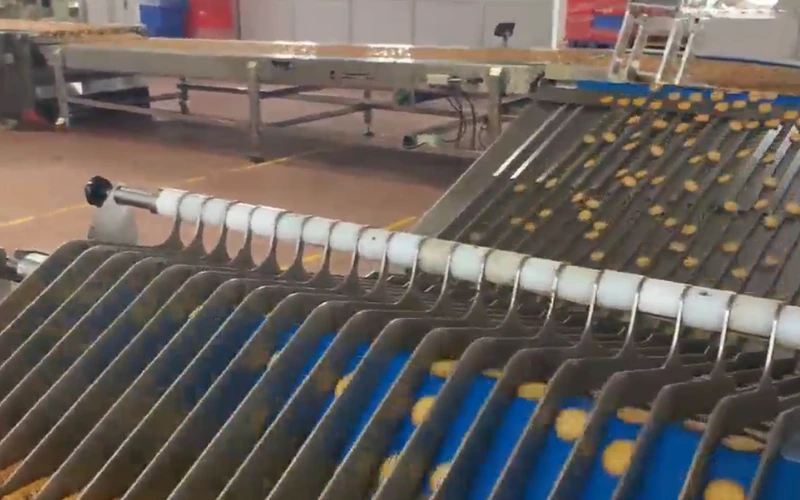
Lane Multiplier
The Fix: Measure the Shell Temperature at the sandwicher infeed using an IR gun. Target < 30°C (Ideal: 25°C). If too hot, increase cooling tunnel airflow.
The "Work-Softening" Effect
Cream is Thixotropic. The more you pump it, the thinner it gets. If your machine stops often due to micro-stops (see
External Resource: Understanding
(ScienceDirect). Thixotropy in Food Systems
The Fix:
Use Water-Jacketed Hoppers and Pipework.
Set the chiller to 24°C to counteract the friction heat from the pump.
Deep Dive: For detailed settings, read our
Biscuit Filling Viscosity Guide 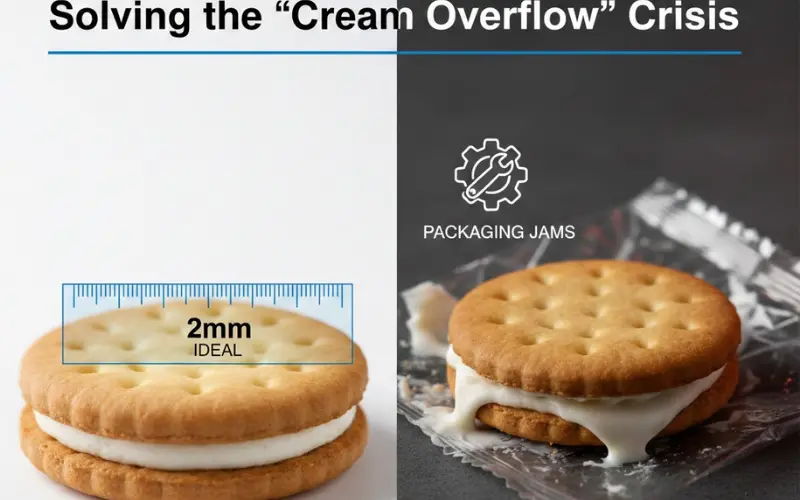
Root Cause B: Synchronization (The Slide)
Leakage often looks like "Smearing" in one direction. This indicates a kinetic energy problem.
The "Top Biscuit" Brake
When the top biscuit is dropped onto the cream, it must be traveling at the exact same forward speed as the bottom biscuit.
Scenario: Top biscuit is dropped slightly slower.
Result: It lands and drags backward relative to the bottom biscuit.
Symptom: Cream smears out the Back of the sandwich.
The "Capper" Timing
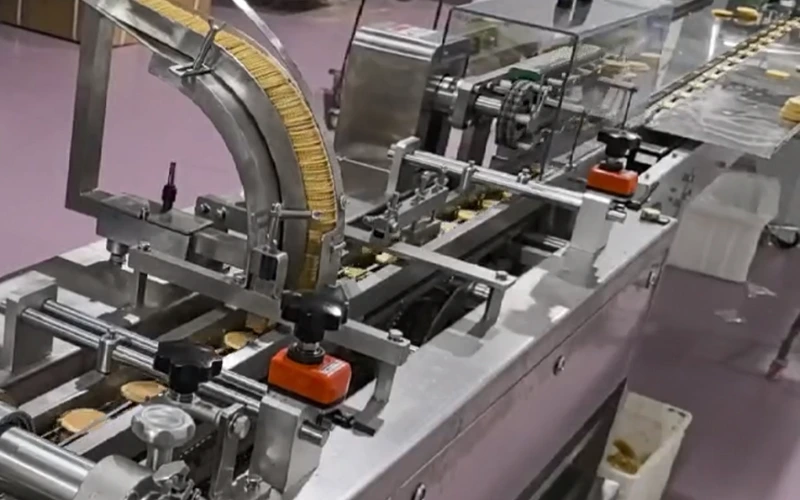
On a stencil machine, the top biscuit is pushed down a gravity chute. The timing of the "pusher finger" on the top chain is critical.
The Fix: Adjust the Phase Offset of the top chain servo.
Smear on Front: Top chain is too fast. Retard the phase.
Smear on Back: Top chain is too slow. Advance the phase.
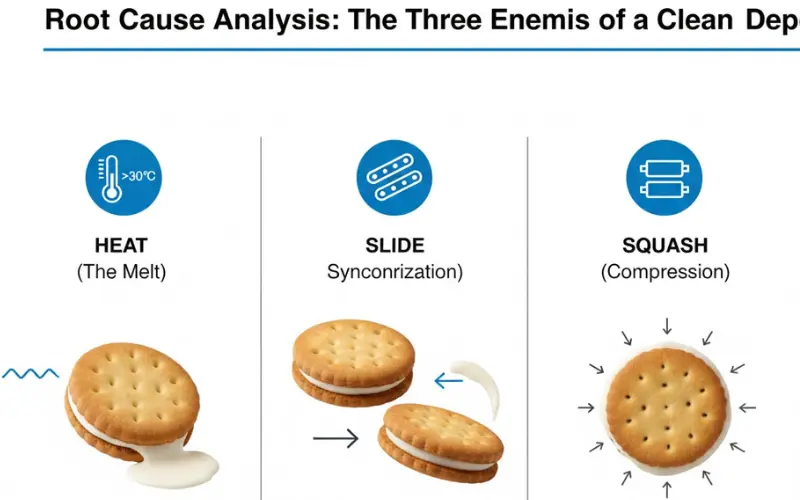
Root Cause C: Compression (The Squash)
Sometimes, the machine simply crushes the sandwich.
Capping Height / Roller Pressure
After the top biscuit drops, the sandwich passes under a Compression Roller to bond the layers.
Risk: If set too low, it squeezes the sandwich like a hydraulic press. The fluid cream has nowhere to go but Out.
The Setup Rule: Calculate theoretical stack height (
Bottom + Cream + Top). Set the roller gap to Height - 0.5mm. This provides bond without the "Squash Effect."
Biscuit Thickness Variation
If your oven baking is inconsistent, an 8mm biscuit entering a 6mm gap will explode.
The Fix: Use Spring-Loaded Compression Rollers that can "breathe" (lift up) for thick biscuits.
Root Cause D: Stencil Wear
If the leakage looks like a "String" or "Tail," look at the tooling.
The Wire Cut
The stencil wire must cut the cream cleanly. If the wire is loose, it bows in the middle. Instead of cutting, it drags the cream.
Symptom: A long string of cream trails behind the biscuit.
The Fix: Tighten the wire tensioner or replace the wire every 50 hours.
Learn More: See maintenance tips in our
Industrial Biscuit Stencil Creaming Guide
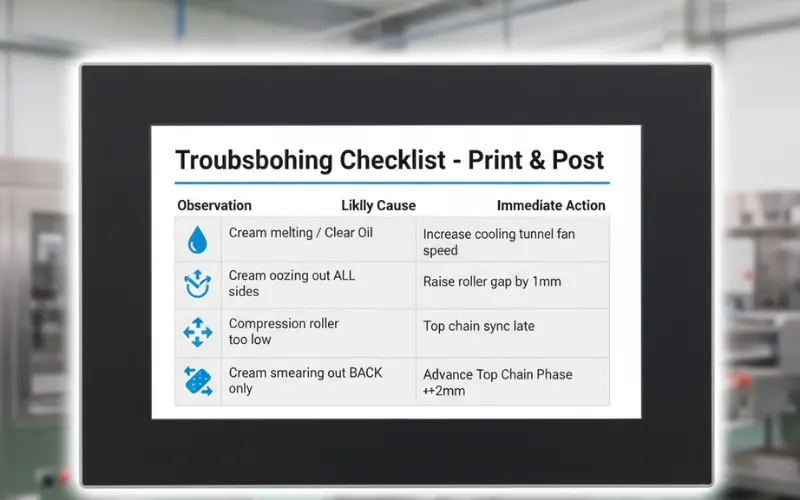
The Troubleshooting Checklist
Print this and stick it on your HMI.
| Observation | Likely Cause | Immediate Action |
| Cream melting / Clear Oil visible | Biscuit too hot (>32°C). | Increase cooling tunnel fan speed. |
| Cream oozing out ALL sides | Compression roller too low. | Raise roller gap by 1mm. |
| Cream smearing out BACK only | Top chain sync late. | Advance Top Chain Phase (+2mm). |
| Cream smearing out FRONT only | Top chain sync early. | Retard Top Chain Phase (-2mm). |
| Cream dripping between biscuits | Wire broken or loose. | Stop machine. Replace wire. |
| Cream weight varies wildly | Hopper level low. | Refill hopper to maintain head pressure. |
FAQ: Quality Control
Q1: What is the ideal cream temperature?A: Generally 24°C to 26°C. Below 23°C, it becomes too stiff to pump. Above 28°C, it loses structure.
Q2: Can I use "Aerated Cream" to stop leakage?A: Yes. Aerating the cream (adding nitrogen) makes it stiffer ("Short" texture). It resists squashing better.
Q3: Why does leakage happen only at the start of the shift?A: Cold Start Issues. The machine metal is cold, but the cream might be warm from the mixer. Always run "Hopper Recirculation" for 10 minutes before starting.
Conclusion: Precision prevents Mess
Leakage is not a "fact of life." It is a symptom of lost control. By stabilizing your Temperatures, synchronizing your Servos, and calibrating your Gap Settings, you can achieve the perfect "Oreo" finish—clean, crisp, and dry on the edges.
The EverSmart Advantage: Our machines feature "Active Gap Control", allowing operators to fine-tune the Compression Roller height from the touchscreen while the machine is running.
Is your line messy?Upload a photo of your leaking biscuit. Our engineers can usually diagnose the root cause (Heat vs. Sync) just by looking at the smear pattern.
[CTA Button]Get a Free Leakage Diagnosis by whatsapp us. Upload a photo. Get a fix.

Ready to start your journey toward a customized solution? Contact me directly on WhatsApp to begin the conversation.