From Aerated Marshmallow to Dense Chocolate: Pumping Difficult Fillings
Introduction: The "Standard Cream" Myth
Most
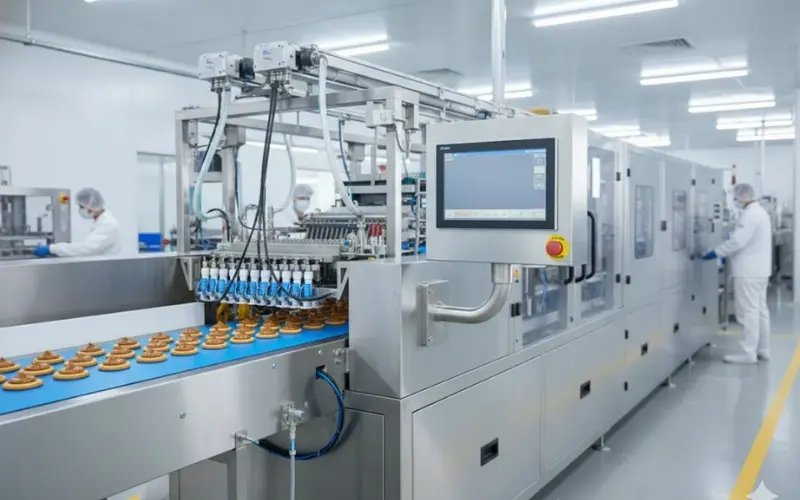
But marketing teams rarely want "Standard." They want Marshmallow (Aerated), Caramel (Stringy), Real Chocolate (Temperature Sensitive), or Fruit Jam (Particulates).
The Problem: If you put Marshmallow into a standard gear pump, the gears crush the air bubbles, turning fluff into goo. If you put cold Chocolate into a lobe pump, the motor burns out.
The Engineering Reality: The "Pump" must match the Rheology (flow behavior) of the filling.
This guide explains which pump technology to choose for your specific filling to prevent density loss, stringing, and machine failure.
🚀 Key Takeaways
Shear Sensitivity: Aerated fillings (Marshmallow) require Lobe Pumps to protect bubbles.
Gear pumps destroy them. Temperature Control: Chocolate is "Thermoplastic." It needs fully Jacketed Hoppers to stay liquid.
The Stringing Factor: Sticky jams need Suck-Back technology to break the tail.
Particulates: If your cream has nuts, you cannot use a Gear Pump. Use a Single-Lobe or Auger.
Viscosity Drift: A 2°C drop in chocolate temp can double its viscosity.
The Aeration Challenge (Marshmallow)
Marshmallow is a foam, roughly 50% sugar syrup and 50% air (Nitrogen).
The "Bubble Crushing" Risk
Standard Gear Pumps work by mashing fluid between metal teeth.
Input: Specific Gravity 0.5 (Fluffy).
Output: Specific Gravity 0.9 (Dense).
Result: You lose texture and give away 40% more product by weight.
The Solution: Rotary Lobe Pumps
We use Lobe Pumps (Roots Blower style).
Large Cavities: The lobes scoop large pockets of fluid without compressing them.
Low Shear: The fluid moves gently around the outside of the casing.
Engineering Spec: Set rotor clearance to "High Viscosity" (>0.2mm) to minimize friction heat.
The Temperature Challenge (Chocolate)
Real chocolate (Cocoa Butter based) is a solid at room temperature.
The "Cold Plug"
If your machine stops for 10 minutes, chocolate in the nozzle tip solidifies. When restarted, the pump pushes against a solid plug, blowing seals.
The Jacketed Solution
You cannot just heat the hopper. You must heat the entire path:
Jacketed Hopper: Water circulation.
Jacketed Pump Head: Hollow steel housing.
Heated Nozzle Block: Even the stencil head must be heated.
Deep Dive: Chocolate requires specific handling logic. Read our
for details on PID loops and thermal shock. Industrial Tart Injection Engineering Guide
External Resource: Understanding
(ScienceDirect). Crystallization in Chocolate Processing
The "Stringy" Challenge (Caramel & Jam)
Caramel and Jam are "Long Flow" fluids with high surface tension.
The "Spider Web" Effect
When a stencil machine cuts caramel, it stretches into a thin thread. This drags across the biscuit, creating a mess.
Troubleshooting: Seeing smears? Check our
Biscuit Cream Leakage Troubleshooting Guide
The Solution: Temperature + Speed
Heat it up: Higher temp = Lower viscosity = Less stringing.
Suck-Back: If using a piston, use aggressive retraction to snap the string.
Wire Tension: For stencils, use a Twisted Piano Wire. The rough texture saws through the sugar strand.
Handling Particulates (Nuts & Chips)
Adding hazelnut pieces or choc chips destroys standard pumps.
The "Crunch" Factor
Gear Pumps: Will grind nuts into paste.
Stencil Wire: Will hit a nut and snap.
The Fix:
Pump: Use a Single-Lobe Rotor or Progressive Cavity Pump (Mono Pump).
Depositor: Do NOT use a Stencil Machine. You must use a Capper or Piston Depositor.
Comparison:
Stencil vs. Cookie Capper vs. Tart Injection 
Troubleshooting Viscosity Issues
FAQ: Fluid Dynamics
Q1: Can I pump two different fillings (Jam + Cream) with one pump?A: No. The runny jam will flow faster than the stiff cream. You need two separate pumps.
Learn More:
Engineering Guide to Bi-Color Co-Extrusion
Q2: How do I clean sticky caramel?A: Hot Water Flush. Connect a CIP (Clean-In-Place) line at 80°C.
Standard:
Hygienic Design Biscuit Sandwicher Guide
Q3: What viscosity range can a stencil machine handle?A: Stencils like High Viscosity (Paste/Toothpaste thickness). If it pours like milk, it will leak.
Reference:
Industrial Biscuit Stencil Creaming Guide
Conclusion: Respect the Rheology
You cannot cheat physics. If you force delicate marshmallow through a high-pressure gear pump, you will fail. Matching the Pump Technology to the Filling Characteristics is just as important as the machine speed.
The EverSmart Advantage: We offer Interchangeable Pump Heads. You can swap a Gear Pump (for Cream) with a Lobe Pump (for Marshmallow) on the same machine frame in 30 minutes.
Got a difficult filling?Send us a 1kg sample.
[CTA Button]Request a Rheology Analysis by whatsapp us. We run a lab test to determine the exact Shear Rate and Pump Type required.

Ready to start your journey toward a customized solution? Contact me directly on WhatsApp to begin the conversation.