High-Speed Stencil Creaming Machine: Manufacturing the Perfect "Oreo-Style" Biscuit
Executive Summary: The Boardroom Briefing
In the intensely competitive landscape of industrial biscuit production, selecting a sandwiching machine is never merely an operational choice. It is a strategic definition of your product's identity and a direct lever for your factory's future profitability.
To answer the core question immediately: High-Speed Stencil Creaming is the only global standard for mass-producing hard dough sandwich biscuits like Oreos, Custard Creams, or Bourbons.
While other technologies exist, only a rotary stencil cookie machine can achieve the "Holy Trinity" of industrial sandwiching:
Extreme Velocity: Throughput capabilities ranging from 1,600 to a staggering 3,200 sandwiches per minute (PPM).
Clean-Cut Aesthetics: A perfectly vertical cream edge with absolutely zero tailing or smearing.
High-Viscosity Handling: The ability to process stiff, low-moisture stencil creams that would instantly clog standard nozzle depositors.
If your business model relies on high-volume, low-unit-cost production with that classic "premium" look, Stencil technology is your only viable path forward. However, simply owning the machine is not enough. True profitability lies in mastering the invisible variables: rheology, temperature control loops, and "Giveaway" economics.
🚀 Key Takeaways
Physics Dictates Form: Stencil machines utilize physical shear force.
They are the only choice for stiff creams and hard biscuits but cannot handle soft cakes. The Aeration Paradox: Your cream must contain air bubbles (Specific Gravity 0.75-0.85) to release cleanly. "Dead" cream destroys efficiency.
The ROI of Precision: A servo-driven oreo biscuit sandwiching machine that reduces deposit variance by just 0.2g can save over $150,000 annually.
Hygiene is Speed: Modern "Tool-less" removal designs are essential for reducing changeover times from 2 hours down to 30 minutes.
Engineering Mechanics: From Brute Force to Fluid Art
To the untrained eye, a high-speed sandwiching line is just a blur of motion. To the mechanical engineer, it is a complex ballet of synchronization and shear stress. Understanding the mechanics is critical to preventing defects.
The Rotary Shear: Inside the Drum
The beating heart of this technology is the Rotary Stencil Head. Unlike a depositor that simply "pushes" liquid, a stencil machine actively "cuts" a solid shape.
The MechanismImagine a hollow drum made of stainless steel or food-grade polymer, perforated with the exact shape of your filling. Inside sits a stationary delivery nozzle and a precision scraper blade.
Phase 1: Pressurization. A positive displacement pump forces the stencil creams into the stationary nozzle.
Phase 2: Filling. As the drum rotates, cream is forced into the stencil apertures.
Phase 3: Shearing. The internal scraper blade wipes the inner surface clean, creating a plug flush with the drum wall.
Phase 4: Extraction. The bottom biscuit travels underneath at the exact same speed. The "tackiness" of the cream to the biscuit pulls the formed puck out of the drum.
This shearing action creates the signature vertical edge found on Oreos. No piping bag or nozzle can replicate this architectural finish.
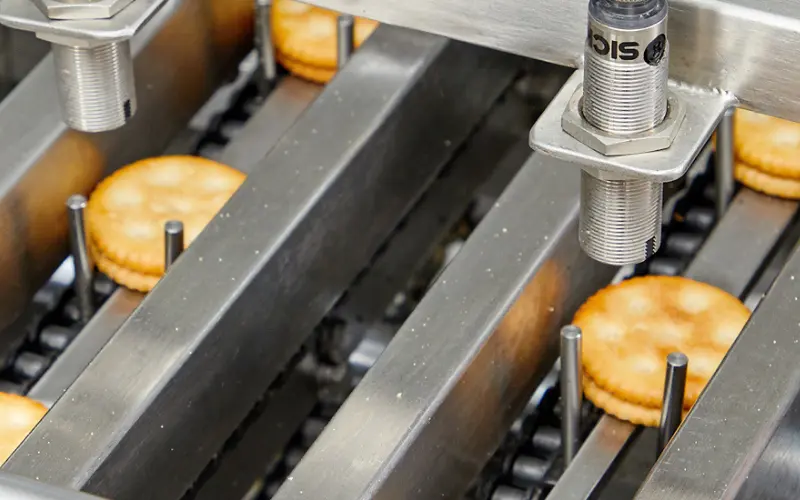
The "Kissing Point" of Synchronization
For this mechanical magic to happen, the laws of motion must be obeyed at the "Kissing Point"—where the drum meets the conveyor.
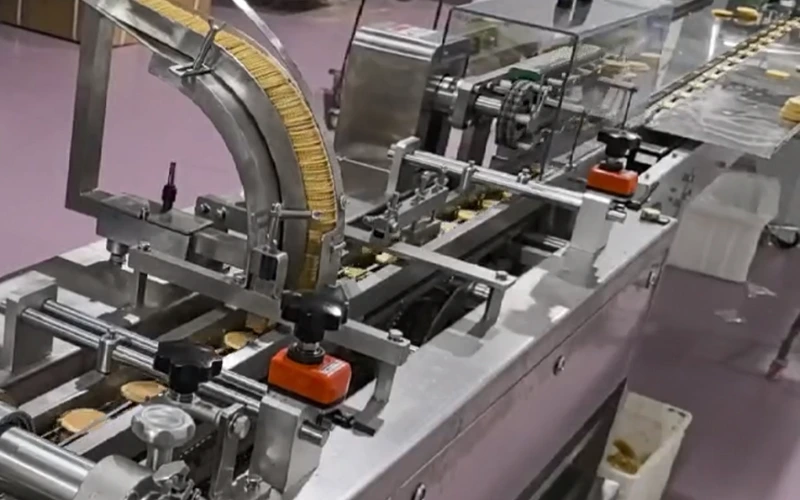
The Servo RevolutionLegacy machines used chains and gears that stretched over time, causing drift. Modern designs utilize Independent Servo Drives. The drum and the pin-chain conveyor have dedicated motors electronically geared via a Virtual Master Axis.
This allows operators to adjust the "Phase Angle" on the HMI screen, shifting the deposit by fractions of a millimeter while running at full speed.
Compare Technologies: Unsure if you need a Stencil or a Capper? Read our comparison guide:
. Stencil vs. Cookie Capper vs. Tart Injection
The Hidden Physics: Rheology & Thermodynamics
Why do two identical lines have vastly different efficiencies? The answer usually lies in the Stencil Creme itself.
External Resource:
(ScienceDirect) Understanding Food Rheology and Viscosity
The Aeration Paradox
A common misconception is that cream should be dense and solid. This is fatal for Stencil processing.
The Physics of ReleaseIf the cream is a solid block (Specific Gravity > 1.0), its internal cohesion is too high. It will refuse to release from the wire mesh, potentially snapping the wire.
The Solution: You must introduce air or nitrogen to target a Specific Gravity (SG) of 0.75 to 0.85. These microscopic air bubbles act as "weak points," allowing the cream to shear cleanly.
The Thermodynamic Butterfly Effect
A change of just ±1°C can alter the viscosity of a fat-based cream by 10-15%.
Heat Scenario: Cream becomes too fluid and "bleeds" out of ports.
Cold Scenario: Cream becomes like clay, causing "Bearing Washout" due to immense pressure.
The Engineering Fix:
Jacketed Hoppers are mandatory.
Use Dynamic Loop Control, where tempering water is controlled by the cream temperature, not just the water setpoint.
Deep Dive: Learn more about controlling texture in our
. Biscuit Filling Viscosity Guide
Operations & Maintenance: The Efficiency War
For the Maintenance Manager, optimizing OEE (Overall Equipment Effectiveness) requires a shift in strategy.
SMED: From 2 Hours to 30 Minutes
In the old days, changing a product meant two mechanics wrestling with a heavy steel drum for hours.
The Modern StandardIf you are evaluating a stencil machine maker, demand SMED (Single-Minute Exchange of Die) features:
Cantilevered Design: Slide the drum off without disassembling the drive shaft.
Pneumatic Clamping: No bolts required.
Integrated Lifting Jibs: Protect staff from back injuries.
The COP (Clean-Out-of-Place) Strategy
A stencil drum is a hollow cylinder filled with thousands of tiny mesh openings. Do not attempt to clean it on the machine. Use a COP Tank with heated, turbulent water flow to dissolve fat residues and sanitize the micro-pores.
Hygiene Standards:
Hygienic Design Biscuit Sandwicher Guide
Financial Audit: The True Cost of Ownership
For the CFO, let's do the math on "Giveaway." In high-volume manufacturing, Standard Deviation is king.
The Economics of Gram Control
The Scenario: 2,000 cookies/min. Target cream weight 10g.
Mechanical Cam Reality: Variance ±0.5g. Target set to 10.5g.
Servo Reality: Variance ±0.1g. Target set to 10.1g.
The Calculation:
Savings: 0.4g per cookie
Annual Savings (300 days, 2 shifts): 230,400 kg of cream
If your premium cream costs $1.50/kg, that is a $345,600 annual saving. The ROI period for upgrading to Servo is often less than 4 months.
The Cost of "Phantom" Waste
If a bottom biscuit is broken, the stencil drum will still deposit cream onto the belt, causing a mess.The Solution: Invest in a Vision Inspection System to reject broken biscuits before the sandwicher.
Decision Matrix: Stencil vs. Depositor
Is a stencil cookie machine right for you? Use this matrix.
The Verdict:
Making billions of standard hard biscuits? Buy Stencil.
Making high-end, soft, or chunky variety cookies? Buy a Capper.
Troubleshooting: The "Fix-It" Guide
For the engineers on the floor, here are solutions to the three most common defects.
Defect 1: "Tailing" or "Flagging"
Symptoms: A thin string of cream drags off the back of the cookie.
Root Cause: Cream too warm (viscosity loss) or Worn Scraper Blade.
Fix: Check water jacket temp. Replace scraper blade if tension is lost.
Defect 2: "Blisters" or Incomplete Fills
Symptoms: Air pockets or missing corners.
Root Cause: Low pump pressure or "Dead" cream (low aeration).
Fix: Increase feed pressure. Check Specific Gravity (target 0.8) to ensure clean release.
Defect 3: "Offset" or "Sliding"
Symptoms: Cream deposited off-center.
Root Cause: Synchronization drift.
Fix: Adjust "Deposit Phase" on HMI. On mechanical lines, check chain tension.
More Help:
Biscuit Cream Leakage Troubleshooting Guide
Future Trends: The Autonomous Line
The future is not faster mechanics; it is smarter data.
AI-Driven Weight Control: Integrating in-line Checkweighers with the Stencil Pump to create a "Self-Healing" loop that auto-corrects weight drift.
Independent Lane Control: Run Lane 1 while Lane 3 is stopped for maintenance. This significantly boosts OEE.
FAQ: Common Questions
Q1: Can I buy a "stencil making machine" to manufacture my own drums?A: While possible, manufacturing a rotary stencil drum requires seamless welding and micro-precision drilling. Most factories rely on specialized OEMs for spare drums to ensure wall thickness and wire tension are correct.
Q2: What is the difference between "Stencil Creme" and regular frosting?A: Industrial stencil creams have a higher melting point to withstand friction heat and a specific plastic viscosity. Regular frosting would "bleed" out of the drum.
Q3: Can a stencil machine handle fillings with chocolate chips?A: No. Hard particles will be crushed by the scraper blade and will gouge the expensive drum. Use a Wire-Cut or Capper for chunky fillings.
Next Steps: Stop Guessing, Start Auditing
Do not let an inefficient legacy machine eat your margins. If you are planning a new line or struggling with high waste, run the numbers.
[Free Tool] Download the 2026 Stencil ROI Calculator by email us. Input your cream price and variance to see the exact Payback Period for upgrading to Servo.
[Expert Consultation] Book a 30-Minute Rheology Audit by whatsapp us. Unsure if your cream formulation is right for stenciling? Contact the EverSmart Engineering Team to review your specific gravity parameters.
Disclaimer: "Oreo" is a trademark of Mondelēz International.

Ready to start your journey toward a customized solution? Contact me directly on WhatsApp to begin the conversation.