Beyond Cream: The Engineering & ROI Guide to Jam & Chocolate Tart Injection
Executive Summary: From "Filling" to "Precision Injection"
In the highly competitive bakery sector, the "Egg Tart" market has become a red ocean. Margins are thin, and product differentiation is low. The real profit lies in the premium segment: Chocolate Lava Tarts, Fruit Puree Tarts, and Double-Filled Delicacies.
However, transitioning from simple custard filling to high-viscosity, heat-sensitive ingredients presents a massive engineering hurdle.
To answer the core question immediately: Successful industrial jam and chocolate tart injection requires mastering Rheology and Thermodynamics. You cannot use a standard pneumatic "cream filler" for these ingredients.
To achieve automation without waste, you must utilize a system featuring Full-Loop Double-Jacketed Temperature Control and Servo-Driven Suck-Back Technology. This is not just about preventing nozzle clogs; it is about controlling material giveaway to within ±0.2g and reducing sanitation downtime by 50%.
This guide serves as a comprehensive engineering audit. We will explore why standard pumps fail with strawberry seeds, calculate the financial loss of "Overfilling," and define the machinery architecture required to dominate the high-end market.
🚀 Key Takeaways
The Physics of Viscosity: Jam "strings" and Chocolate "freezes." Standard valves cannot handle these behaviors. You need Servo Suck-Back.
Thermal Shock: Injecting hot ganache into a cold tart shell creates moisture migration (Soggy Bottoms). Precise temperature deltas are required.
The ROI of Precision: Switching from ±2g pneumatic accuracy to ±0.2g servo accuracy saves over $200,000 in raw materials annually per line.
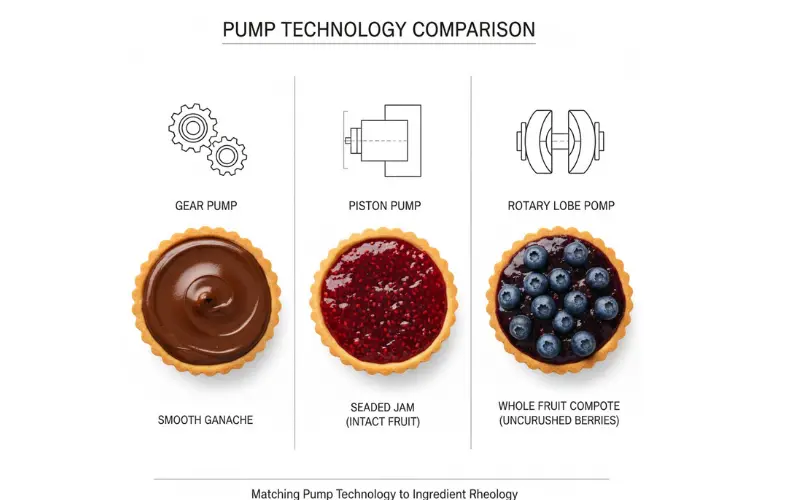
Integrity Matters: To inject whole fruit (like blueberry) without crushing it, you must choose Rotary Lobe pumps over Gear pumps.
The Physics of Failure: Rheology & Thermodynamics
For the Mechanical Engineer and R&D Director, understanding the "why" is as important as the "how." Why does a machine that runs custard perfectly fail miserably when running caramel or ganache?
The answer lies in two physical sciences: Rheology (the flow of matter) and Thermodynamics (heat transfer).
External Resource:
(ScienceDirect) Thixotropy and Rheology of Food Systems
The Battle of Viscosity & Stringing
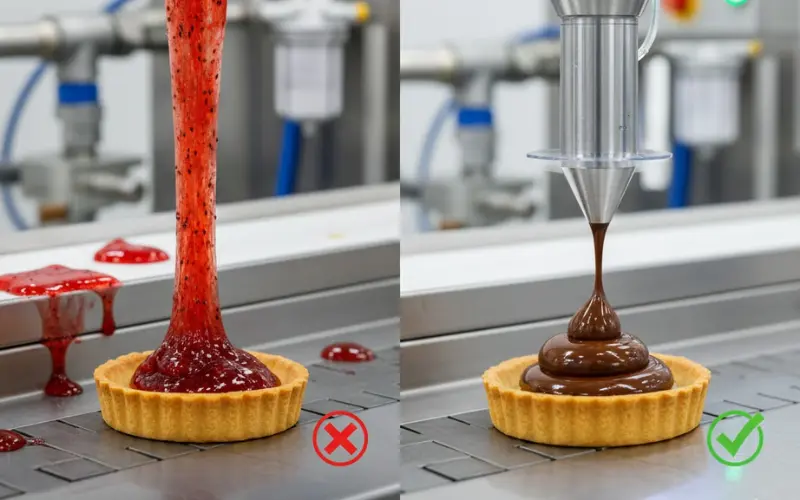
Fruit Jam: The Stringing NightmareFruit jams and caramels exhibit "Long Flow" rheology. They are sticky and cohesive. When a standard nozzle shuts off, the material does not break cleanly. Instead, it forms a long, thin "sugar string" that drags across the rim of the tart, ruining the visual appeal.
Chocolate: The Thixotropic ChallengeChocolate and Ganache are Non-Newtonian fluids. Their biggest enemy is temperature. If the temperature drops by even 2°C in the nozzle tip, the cocoa butter crystallizes, turning into a solid plug instantly. Standard pneumatic pistons cannot push through this plug.
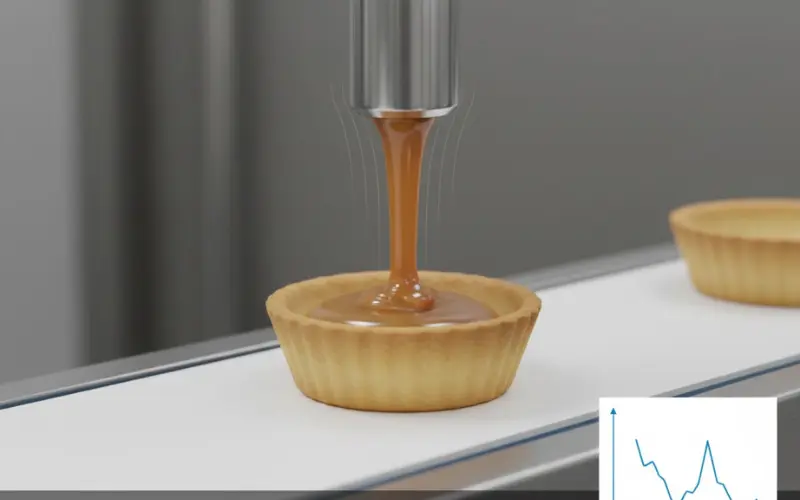
The Engineering Solution: Servo Suck-BackTo solve "Stringing," we cannot rely on gravity. We utilize a Servo-Driven Pump. At the exact millisecond the injection cycle finishes, the servo motor reverses direction, creating a calculated negative pressure (Vacuum) to actively "suck back" the hanging droplet.
Deep Dive: Struggling with consistency? Read our
. Biscuit Filling Viscosity Guide
Thermal Shock & Moisture Migration
This is the hidden killer of product quality. You have a crisp baked shell (20°C) and inject hot ganache (45°C). This Thermal Delta causes condensation and lowers the viscosity of fats in the shell, leading to "Soggy Bottoms" within 4 hours.
The Fix:
Pre-Heating Tunnels: Bring shells to 30°C.
Tempering Heads: Keep chocolate fluid but cool (29°C-31°C).
Troubleshooting: See our guide on
Biscuit Cream Leakage Troubleshooting
Particulate Integrity: Saving the Fruit
Premium recipes often call for whole fruit. A standard Gear Pump acts as a grinder, turning expensive blueberry compote into cheap puree.
The Solution: Rotary Lobe PumpsThese pumps have large cavities between the lobes that do not touch, gently sweeping the fluid and fruit through without compression.
Machinery Architecture: The Anatomy of Precision
For the Purchasing Manager, this section defines your RFQ (Request for Quotation).
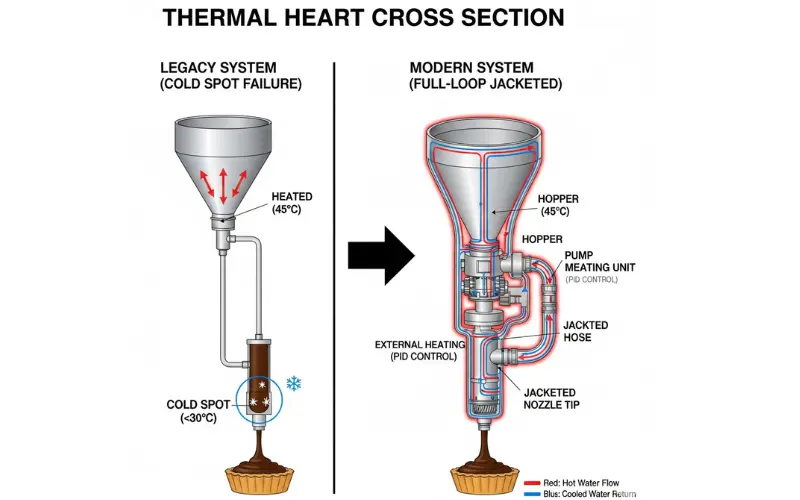
The Thermal Heart: Full-Loop Jacketing
Standard fillers have a heated hopper but an unheated nozzle—a "Cold Spot" failure point where chocolate solidifies.
The Requirement: Double-Jacketed PathA professional system must feature Full-Loop Water Jacketing circulating hot water through:
The Hopper
The Pump Manifold
The Delivery Hoses
The Nozzle Tip itself
Anti-Drip Mechanisms: Three Schools of Thought
Servo Suck-Back (The Standard): Best for Chocolate/Cream. Motor reverses to create vacuum.
Blow-Off (The Heavy Duty): Best for sticky Caramel. Compressed air "shoots" the drop off.
Mechanical Cutter (The Guillotine): Best for fibrous Jam (Coconut). A physical blade slides across the nozzle.
Financial Perspective: The Economics of Precision
Why spend $50,000 on a Servo Injector when a $5,000 Pneumatic Filler exists? The answer is Material Giveaway.
The "Giveaway" Calculation
Scenario: Premium Chocolate Ganache Tart ($10.00/kg ingredient cost).
Legacy Pneumatic Machine: Accuracy ±2.0g. Target = 22g to ensure compliance.
Servo Gear Pump: Accuracy ±0.2g. Target = 20.2g.
The Profit Impact:
Savings per Tart: 1.8 grams
Hourly Savings (6,000 tarts): $108.00
Annual Savings (2,000 hours): $216,000.00 USD
Conclusion: The servo machine pays for itself in 3 months simply by stopping you from giving away free chocolate.
Operations & Maintenance: Fighting Abrasive Wear
The Maintenance Engineer knows that "Jam" is not just fruit; it is acid, sugar, and abrasive seeds.
The Strawberry Seed Menace
Strawberry seeds act like silica sand. In a standard pump, they get trapped between the seal and wall, destroying NBR rubber seals in weeks.The Fix: Specify Tungsten Carbide or Ceramic coated contact parts and heavy-duty Viton seals.
The Changeover Nightmare
Marketing wants to run Dark Chocolate in the morning and White in the afternoon. Cleaning online takes 4 hours.
The Strategy: Modular Nozzle CartsUse detachable injection carts. Roll "Dark" out, roll "White" in. Changeover drops to 15 minutes.
Electrical Integration: Industry 4.0
PID Temperature ControlSimple "On/Off" thermostats cause ±5°C swings, destroying chocolate crystal structure (Bloom). PID algorithms maintain ±0.5°C precision.
Data VisualizationThe HMI should display Pressure Curves. A pressure spike indicates a clog forming before the machine stops.
Selection Matrix: Buying the Right Tool
FAQ: Common Questions
Q1: Can I use the same machine for chocolate tart and jam injection?A: Operationally difficult. Chocolate needs heat (45°C) and Gear pumps; Jam needs Piston pumps for seeds. Cleaning grease vs. sugar is time-consuming.
Q2: How do I inject a "Double" filling (e.g., Jam center inside Chocolate)?A: You need "One-Shot" Co-Injection technology with concentric nozzles.
Learn More:
Engineering Guide to Bi-Color Co-Extrusion
Q3: Can I replicate a "Hand-Piped" rustic swirl?A: Yes. Servo nozzles can lift-and-spin during injection to create a "Rosette" look.
Q4: Can this machine work with my existing tart presser?A: Yes. Most units are "Cantilever" designs that roll up over existing conveyors.
Conclusion: The Engineering of Desire
The transition to premium "Chocolate Lava Tarts" is a shift in engineering philosophy. It demands respect for the physics of your ingredients—managing the heat of the chocolate and the abrasion of the seeds.
Most importantly, it is a financial decision. The cost of a servo-driven system is high, but the cost of "Giveaway" is higher. In the high-volume game of tart making, precision is the only path to profit.
Ready to Upgrade Your Line?
[Fruit Integrity Test]Worried about crushing your blueberries? Send us 5kg of filling. We will run it through our Rotary Lobe System and provide a sieve analysis video. 👉 [Request Integrity Test by whatsapp us]
[ROI Calculator Download]Don't guess at your profits. Input your ingredient cost and line speed to see exactly when a Servo Injector pays for itself. 👉 [Download ROI Model by whatsapp us]
Disclaimer: All financial calculations are based on typical industry parameters. Actual savings will vary.

Ready to start your journey toward a customized solution? Contact me directly on WhatsApp to begin the conversation.