The Ultimate Engineering Guide to Bi-Color Sandwich Cookies: Co-Extruded Dough & Dual-Filling
Introduction
How do you manufacture a bi-color cream sandwich cookie that dominates the supermarket shelf?
In today’s hyper-competitive snack aisle, beige is boring. To command a premium price point, you need the high-contrast appeal of a bi-color product. However, relying on recipe adjustments alone is not enough. This is a battle of fluid dynamics, thermodynamics, and precision automation.
The Engineering RealityManufacturing an industrial-grade bi-color cookie involves two complex technical dimensions:
Shell Co-extrusion: A multi-servo system forcing two rheologically matched doughs through a dual-runner die.
Dual-Filling Technology: Synchronized injection using concentric nozzles to deposit distinct flavors simultaneously.
This guide goes deep into the physics of viscosity matching, AI vision systems, and strategic equipment retrofitting.
🚀 Key Takeaways
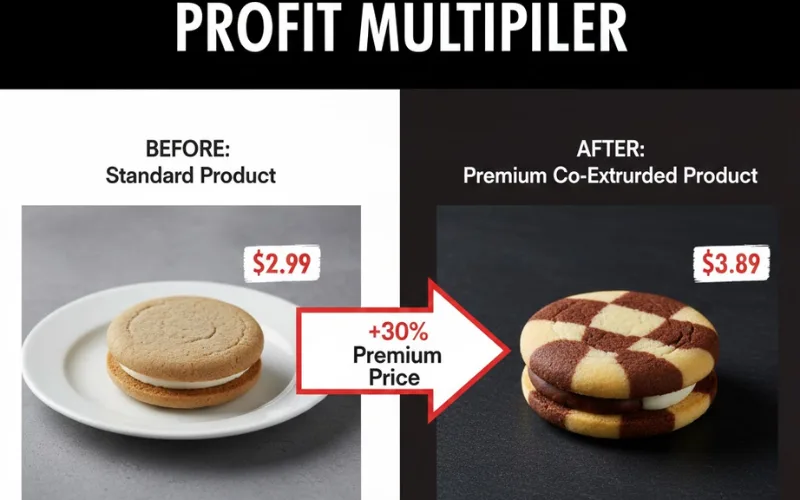
The Profit Multiplier: Bi-color products command a 20-30% higher retail price than single-color competitors.
The Servo Requirement: You must utilize Independent Servo Drives for precise ratio adjustments.
The Physics of Dough: The expansion coefficient difference between doughs must be kept within 5% to prevent cracking.
Smart Investment: Upgrade existing machines with a Retrofit Kit for 70% less than the cost of a new line.
AI Control: Vision systems now monitor color ratios and adjust pump speeds automatically.
Part 1: The Business Case & ROI
Before we open the electrical cabinet, we must address the boardroom. Why sign off on this investment?
The Visual EconomyData is clear: visual complexity equals perceived value. Take a standard vanilla dough, pair it with dark cocoa in a checkerboard pattern, and add a dual-swirl filling. You have transformed a commodity into a premium treat with a negligible raw material cost increase (~5%).
Asset VersatilityModern co-extrusion technology is not a "one-trick pony." By changing die nozzles, you can pivot production instantly to Center-Filled Soft Cookies, Mosaic Cookies, or Hybrid Jam/Cream Products.
Related Resource: Explore our
Hybrid Biscuit Production Line Guide
The Hidden Cost SavingsCo-extrusion is a Net Shape Forming process—zero trim waste. Plus, servo metering pumps prevent "Over-fill," saving tens of thousands of dollars annually in premium ingredients.
Part 2: Phase I - The Co-Extruded Shell
A perfect sandwich starts with a perfect shell.
The Mechanical Core: Dual-Hopper ArchitectureTo achieve crisp patterns, you need two isolated, airtight hoppers driven by dedicated servo motors. This allows granular control (e.g., 71% dark / 29% light) to compensate for batch density variations.
Die Design PhysicsCocoa dough is abrasive; vanilla dough flows fast. To prevent "Eccentric" products, your die must feature:
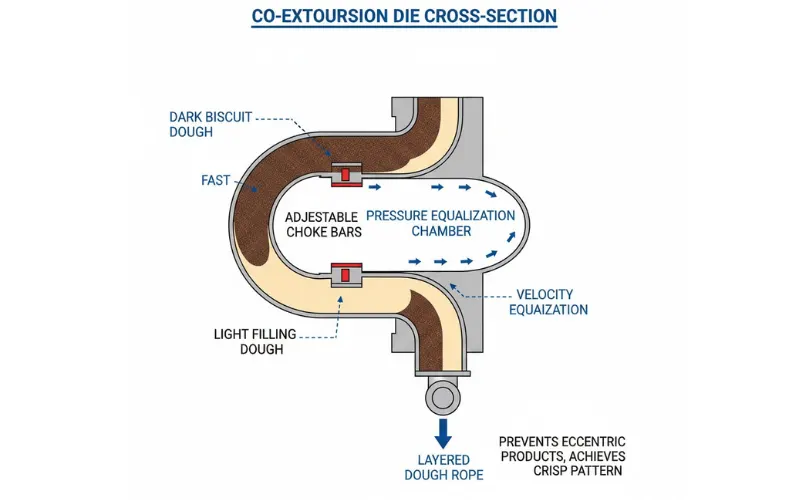
Pressure Equalization Chamber
Adjustable Choke BarsThese restrict the faster dough to ensure equal velocity at the nozzle exit.
The Expansion Matching ChallengeIf your cookie "bows" after baking, it's because the dark dough shrank more than the light dough.
The Fix: Mandate a strict Linear Expansion Coefficient standard (difference < 5%). Adjust starch or sugar/fat ratios in the mixing bowl. Never try to fix this by increasing extrusion pressure; that leads to "Checking" (cracking).
Part 3: Phase II - The Dual-Filling Mechanics
Once shells are baked, we enter the world of fluid dynamics.
Nozzle Geometry: Concentric vs. Side-by-Side
Concentric (Bullseye): "Pipe-in-Pipe." Ideal for hiding expensive fillings (e.g., chocolate ganache) inside cheaper ones (e.g., vanilla cream).
Side-by-Side (The Split): "Toothpaste" effect. Maximum visual impact for contrasting colors.
The Law of Viscosity MatchingFluids follow the path of least resistance.
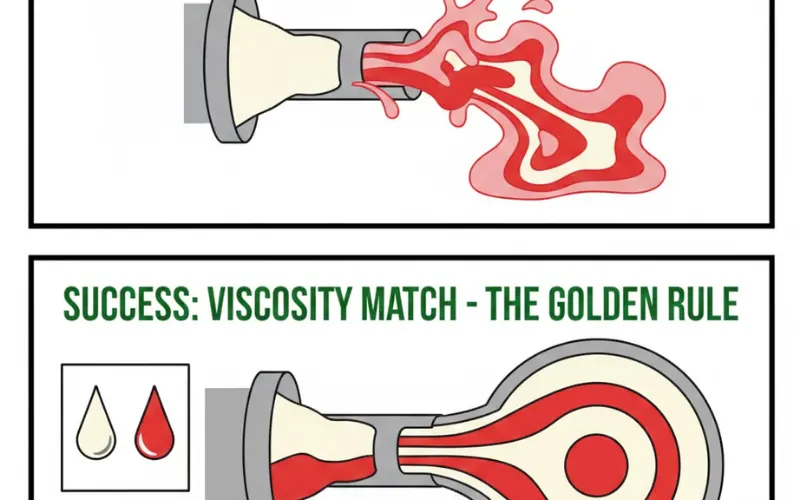
The Golden Rule: Yield stress of both fluids must be identical.
The Cheat: Use Temperature Manipulation. Cool the jam to thicken it; heat the cream to soften it.
Deep Dive: Learn more in our
Biscuit Filling Viscosity Guide
Aeration and Specific GravityFor bi-color creams, avoid Stencil heads which destroy air bubbles. Insist on a Manifold (Capper) Depositor to preserve structure.
Comparison:
Stencil vs. Cookie Capper vs. Tart Injection Guide 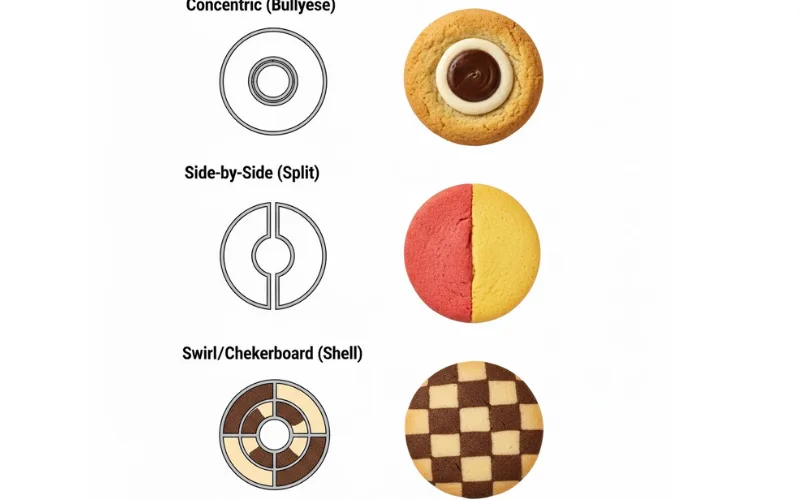
Part 4: The AI & Automation Advantage
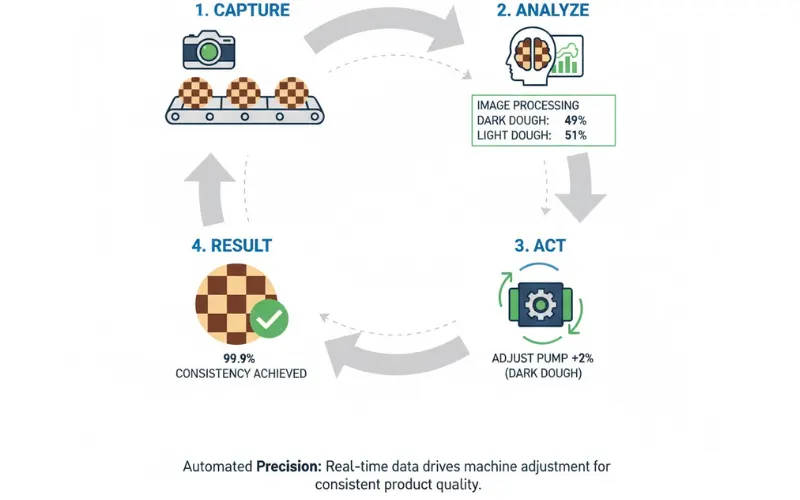
The Vision Feedback Loop (Industry 4.0)We utilize a Closed-Loop System:
Capture: Camera photographs cookies.
Analyze: Algorithms calculate dark vs. light surface area.
Act: If dark dough drops to 48%, the system auto-adjusts the servo pump speed. This eliminates human error and ensures 99.9% consistency.
Electronic CammingAll motion axes (extrusion rolls, pumps, wire cutter) must be locked to a Virtual Master. Synchronization lag > 1ms is unacceptable.
Part 5: Supply Chain & Material Science
Tolerance ManagementCocoa powder absorption rates vary wildly. Procurement must establish a rigorous Rheology Audit for incoming raw materials to prevent dry dough from blocking dies.
Hygienic Design & Changeovers"Black Specks" ruining white cookies is a nightmare.
The Fix: Demand Tool-Free Stripping and keep a spare set of "Change Parts" (Pump/Hopper). Swap clean parts in 30 minutes.
Standard: Refer to our
Hygienic Design Biscuit Sandwicher Guide
Part 6: Troubleshooting Matrix
| Issue | Probable Cause | The Fix |
| Color Bleeding | High temp delta or viscosity drift. | Check tempering units. Ensure doughs are within 2°C. |
| Marbling (Swirls) | Excessive back-pressure or turbulence. | Reduce pump speed. Redesign flow path. |
| Base Cracking | Mismatched expansion coefficients. | Adjust sugar/syrup ratio in the shrinking dough. |
| Color Fades | Pump cavitation / bridging. | Install agitator on hopper wall. |
| Center Offset | Sensor misalignment. | Clean sensors; recalibrate nozzle pin. |
| Troubleshooting: | Leaking Cream? | Read: |
Part 7: FAQ - Industry Insights
Q1: What is the difference between home and industrial recipes?A: Water Activity (aw). Industrial recipes use Anhydrous Cream Systems (Shortening + Powdered Sugar) to keep cookies crisp for 12 months.
Q2: Can I retrofit my old machine?A: Yes. If you have a solid frame and servo control, we can install a Bi-Color Upgrade Kit (dual hopper + pump block) over a weekend.
Q3: Can this handle "Clean Label" ingredients?A: Yes. Natural colorants (Beetroot, Spirulina) work perfectly if particle size is fine enough.
Q4: Does running bi-color reduce speed?A: Depositing speed is the same. OEE may dip slightly due to longer changeovers, so schedule longer runs.
Tip: Optimize changeovers with our
Biscuit Machine Quick Changeover Guide
Conclusion: The Convergence of Art and Engineering
Manufacturing a bi-color cream sandwich cookie transforms your facility into a precision engineering plant. It rewards complexity with profit: Double the visual appeal equals double the margin.
The technology is ready. Is your production line prepared?
[CTA] Ready to Engineer Your Upgrade?
🚀 Download the Free Whitepaper:"The 2026 Guide to Rheology Matching & Bi-Color Equipment Selection"Includes Viscosity Tables and an ROI Calculator.
[Contact Engineering]Email us at [email protected] to discuss your Retrofit or Greenfield project.

Ready to start your journey toward a customized solution? Contact me directly on WhatsApp to begin the conversation.