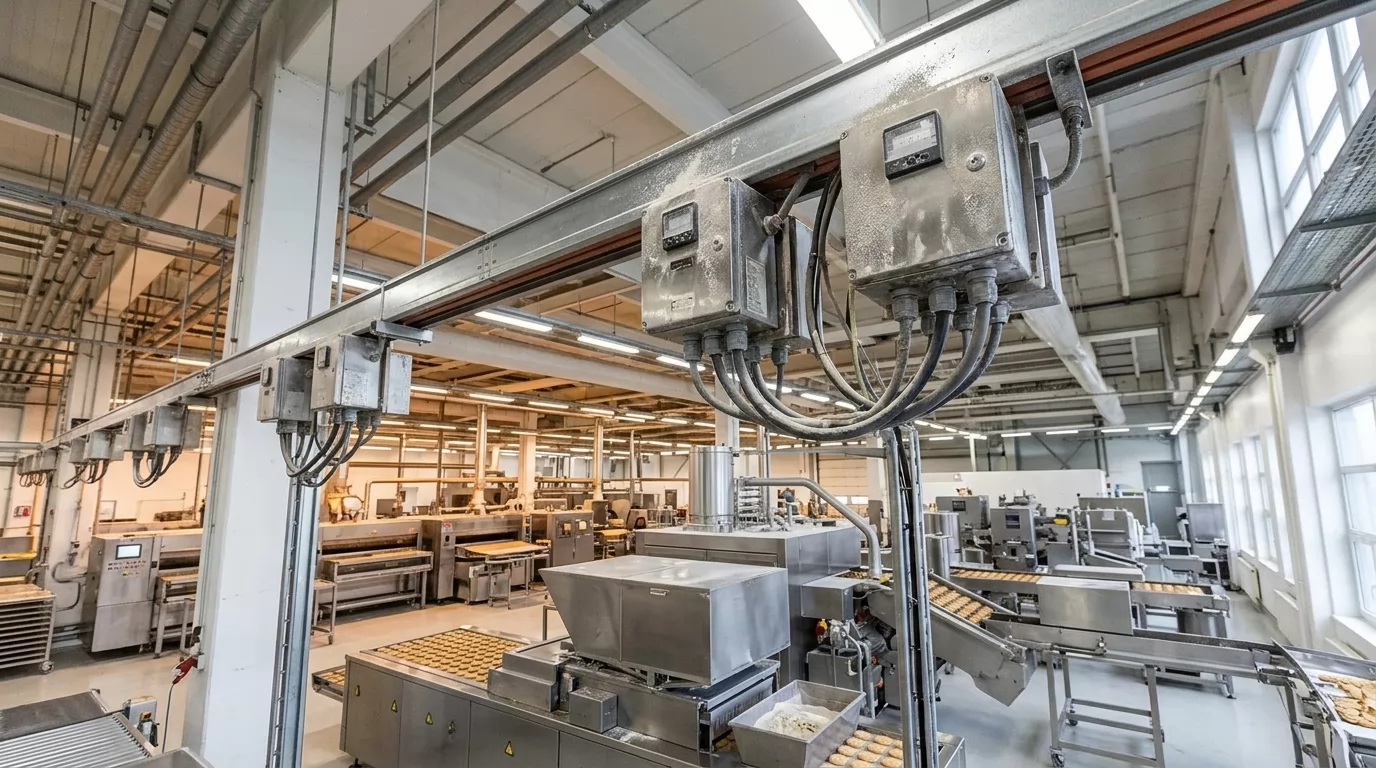
Maximizing ROI: Reducing Waste and Increasing Speed with Modern Biscuit Packaging Lines
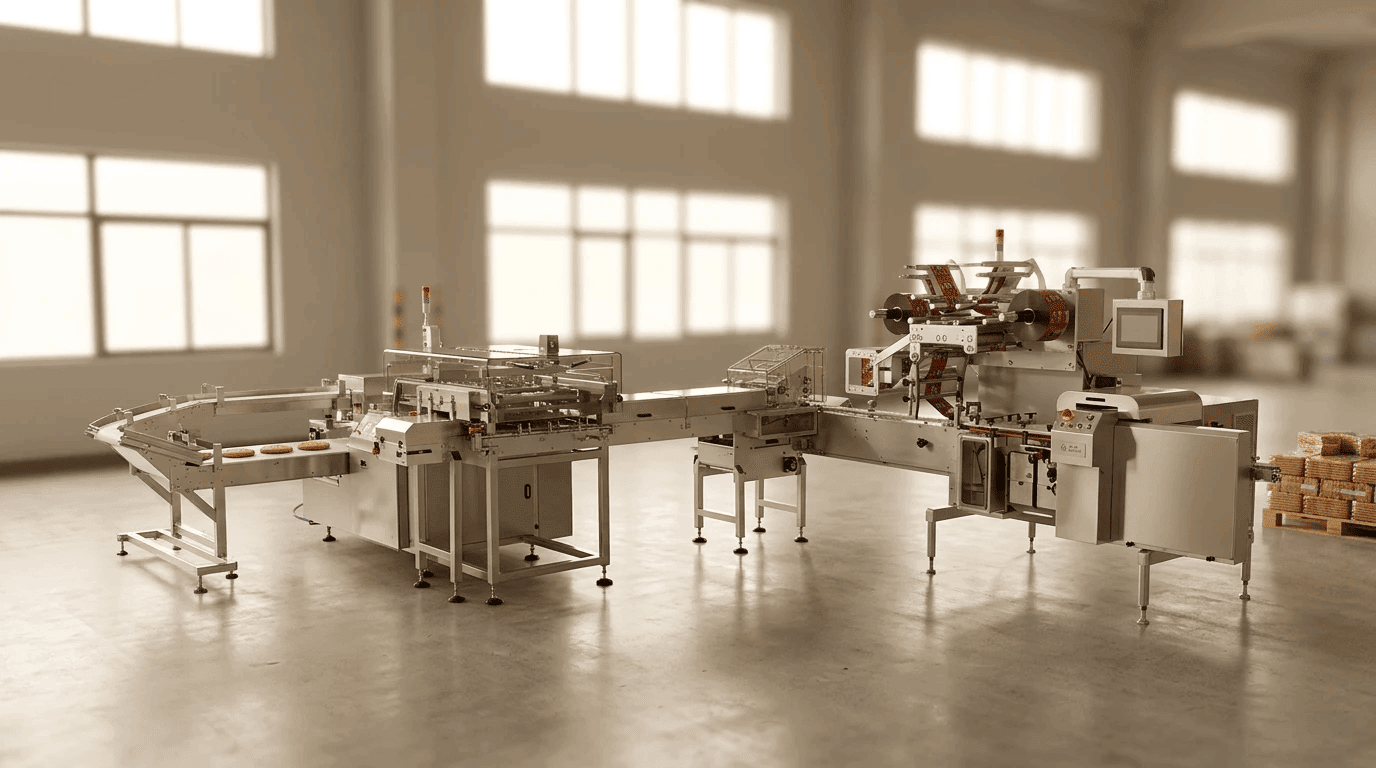
On the first day a new biscuit packaging line runs, the flow wrapper is rarely what holds it back. Crumbs on the sealing jaws, a stack that arrives a few millimeters off-center, or a film splice that trips the registration sensor will cost more output than the wrapper's nameplate suggests.
This article looks at waste, speed and payback across four plant situations: upgrading one aging line, adding capacity, packing long-shelf-life products, and running many SKUs in short batches.
Rated speed is a ceiling: real output depends on what reaches the wrapper.
Waste has four sources: film, product giveaway, rejects and changeovers.
Measure with OEE: nameplate packs per minute hide micro-stops.
What Actually Limits Output the First Time a New Biscuit Packaging Line Runs?
Upstream product flow, not the wrapper's rated speed, usually limits output. Orientation, spacing and small stops in the infeed set the real rate, and the nameplate figure is only the most the machine can do when everything arrives perfectly.
Biscuits are brittle, light and shed fine particles, so they behave differently from rigid products. A single-row or stacked feed that bunches, tilts or gaps will make a servo-driven infeed hunt for position, and the wrapper then waits or rejects the pack. Each wait is brief. Together they add up.
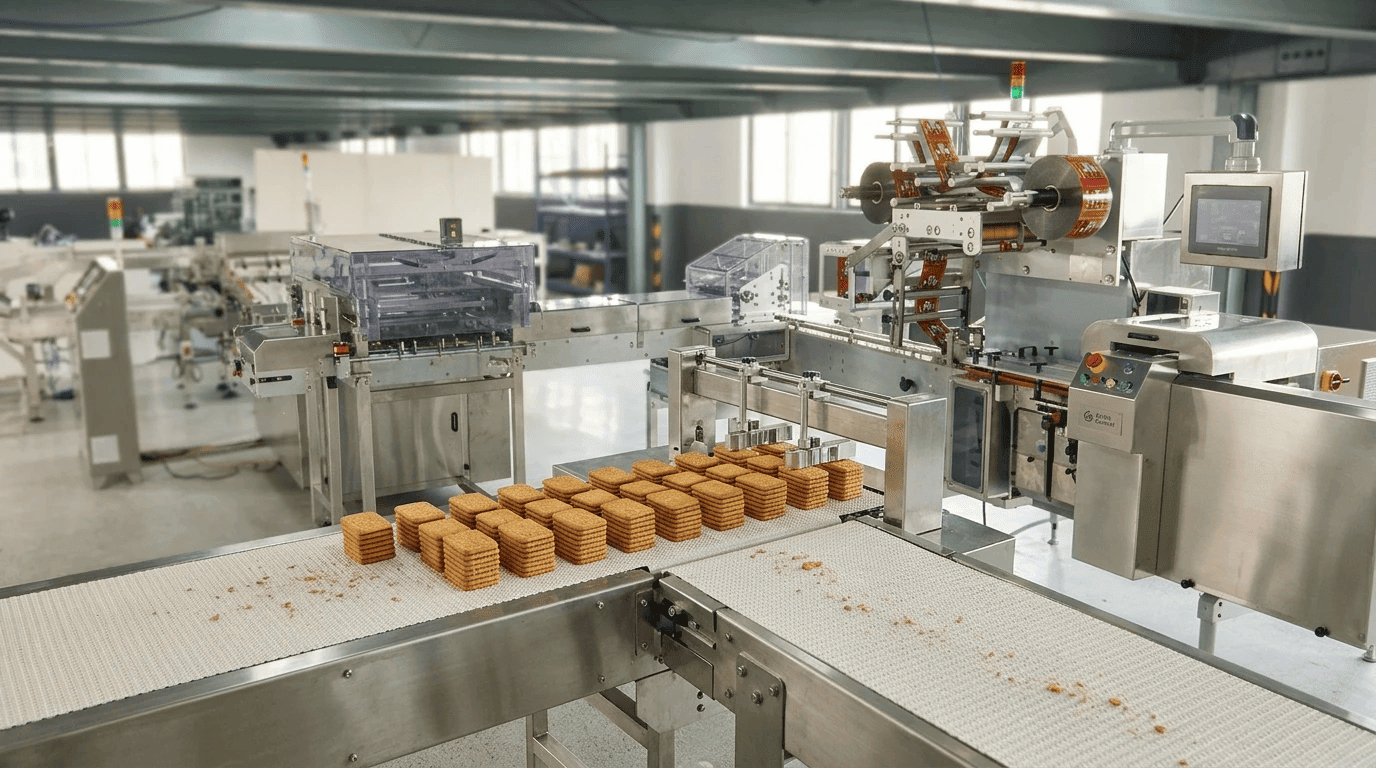
Film handling is the second constraint. Flow wrapping, a horizontal form-fill-seal (HFFS) process that forms a tube of film around the product and seals it at the ends and along the back, depends on consistent reel quality, tension and print registration. A slightly different reel of BOPP film (biaxially oriented polypropylene) can need new sealing temperatures, and the line often runs slower until they are found.
Commissioning also exposes the gaps between machines. Oven or cooling conveyors, stackers, the wrapper and the case packer each have their own buffer behavior, and the slowest hand-off decides the pace.
The practical consequence: judge a new line by sustained good packs per hour, not by a short run at peak speed. Log every stop, however short, from the first shift.
Where Does the Money Go: Waste, Stoppages and Slow Changeovers
Most lost margin on a packaging floor comes from four places, and each responds to a different fix. Treating them as one "efficiency problem" is how plants end up spending on the wrong thing.
Film and product giveaway. Excess film length, oversized fin seals and overfilled packs are small per pack but run on every pack. Fix them with film registration, accurate length settings and weight control at the infeed.
Rejected packs. Crushed biscuits, wrinkled seals and misprinted film are paid for twice, in product and in packaging. Look upstream at handling and sealing settings before blaming the wrapper.
Micro-stops. Short jams and film-splice faults rarely trigger a maintenance ticket, yet they quietly drain good output across a shift. Operators clearing a jam in seconds will not report it, so sensing and automatic stop logging are what make these visible.
Changeover time. Every format change, film reel swap and cleaning step is output you cannot sell. How much it costs depends on how often you change, which is why a plant with long runs and one with many SKUs should weigh it very differently.
The order matters. Giveaway and rejects scale with volume, stops scale with line stability, and changeovers scale with product variety. Know which one dominates your plant before you price any upgrade.
Scenario One: Upgrading a Single Aging Line in an Established Plant
A plant has one wrapper that is twelve or fifteen years old. It still seals, the mechanics are sound, and the spare parts drawer is full. Yet the line stops several times an hour, operators feed biscuits by hand when the conveyor jams, and nobody trusts the speed on the nameplate. Replacing the whole machine looks tempting, but it is often the wrong first move.
In this situation the wrapper's forming and sealing section is usually the healthiest part of the line. The losses tend to sit around it: an infeed that cannot hold product spacing, controls that cannot coordinate with upstream equipment, and sensing that is too crude to catch a misaligned stack before it reaches the jaws.
That points to a retrofit. A servo-driven infeed, updated drives and a PLC (programmable logic controller) upgrade, along with better registration and product-presence sensors, can address the stops without touching the frame. Adding a checkweigher or a rejection station downstream also gives you data you did not have before.
The trade-off is the legacy equipment itself. Old frames carry wear that new controls cannot correct, and mixing generations of electronics can leave you with integration work and a single point of dependence on one engineer who understands the hybrid setup.
Before committing, check whether the manufacturer still supports the machine, whether guarding meets current safety requirements, and whether the retrofit cost approaches that of a new unit. If it does, replacement is usually the sounder decision. EverSmart Food Equipment Limited, among other suppliers, can be asked to quote both routes on the same basis so the comparison is fair.
How to Reduce Biscuit Packaging Waste Without Slowing the Line
Waste reduction works best as a sequence, because each change stabilizes the one that follows. Work through the steps below in order and record rejects and film use before and after each one.
Measure the baseline. Log rejected packs, film offcuts and product giveaway by shift for a few weeks, so you know which loss dominates before spending anything.
Soften product handling. Smooth transfers, correct belt speeds and servo-driven pick-and-place cut broken biscuits and misaligned stacks. The trade-off is that gentler handling can cap infeed speed on very fragile products.
Tighten film registration. Check that the print registration sensor, film tension and unwind alignment hold steady, since drifting registration produces rejects even when the product is fine. Reliable splicing or reel-change routines add cost but remove a frequent stop.
Set sealing parameters by film type. Match jaw temperature, pressure and dwell time to the BOPP film (biaxially oriented polypropylene) actually loaded. Too hot wastes film through wrinkling and burn-through, too cool causes leakers, and faster lines leave less dwell time to work with.
Add inline rejection. A checkweigher, plus metal detection where required, removes faulty packs automatically. It does not prevent waste by itself, but it stops bad packs reaching customers and shows which upstream fix to make next.
Review the numbers again. Compare against the baseline and adjust speed only after rejects have stabilized.
Skipping to step five is the common shortcut. It hides the problem rather than fixing it.
Scenario Two: Adding Capacity for Growing Volumes
There are two ways to add capacity: buy one faster wrapper, or install a second line beside the first. The faster machine looks cheaper on paper. A parallel line usually looks cheaper in operation. Which one wins depends on what your plant can tolerate losing.
A single high-speed flow wrapper takes less floor space, needs one operator station and one set of changeover tooling, and keeps the downstream cartoning and case packing simple. The trade-off is concentration of risk. When that machine stops, output drops to zero. Higher speed also makes the infeed less forgiving, so product spacing, orientation and film handling have to be tighter than on a slower machine.
Parallel lines reverse the equation. If one stops, the other keeps running, and a plant can schedule maintenance without halting all packing. Two lines also let you run different formats at once, which helps when demand grows in more than one SKU. The cost is a larger footprint, more operators, double the spares and a more complex merge at the end of the line.
As a rule of thumb, choose one faster machine when floor space is tight, the product is robust and the format is stable. Choose parallel lines when uptime matters more than footprint, when SKU variety is rising, or when a single machine would push the infeed beyond what the oven or cooling conveyor can deliver cleanly.
Whichever you pick, check the upstream first. Added wrapper capacity is wasted if the oven and the infeed cannot feed it.
Is a Flow Wrapper the Right Choice for a Biscuit Production Line?
Usually, yes. A flow wrapper is a horizontal form-fill-seal (HFFS) machine that forms a tube from a film reel, takes in the product, and seals the fin and both ends in one continuous motion. For stacked biscuits, sleeve packs and single-row formats, it is the standard choice because it matches the product's shape and the speeds most plants need.
The limits show up with the product itself. Very fragile items, such as thin wafers or filled pieces that crack under light pressure, can break at the infeed or when the end-seal jaws close, so they may suit a tray-based or other format better. Irregular shapes and loose, unaligned products are harder too, because a flow wrapper needs a consistent, correctly spaced product at the point of wrapping.
Which film and sealing choices matter most?
BOPP film (biaxially oriented polypropylene) is the usual starting point for biscuits. It is typically used as a laminate or metallized structure with a heat-seal layer, giving a printable surface and a moisture barrier that helps keep the product crisp. The trade-off is that film thickness and sealant layer affect how wide the sealing window is, and a narrow window punishes any variation in temperature or dwell time.
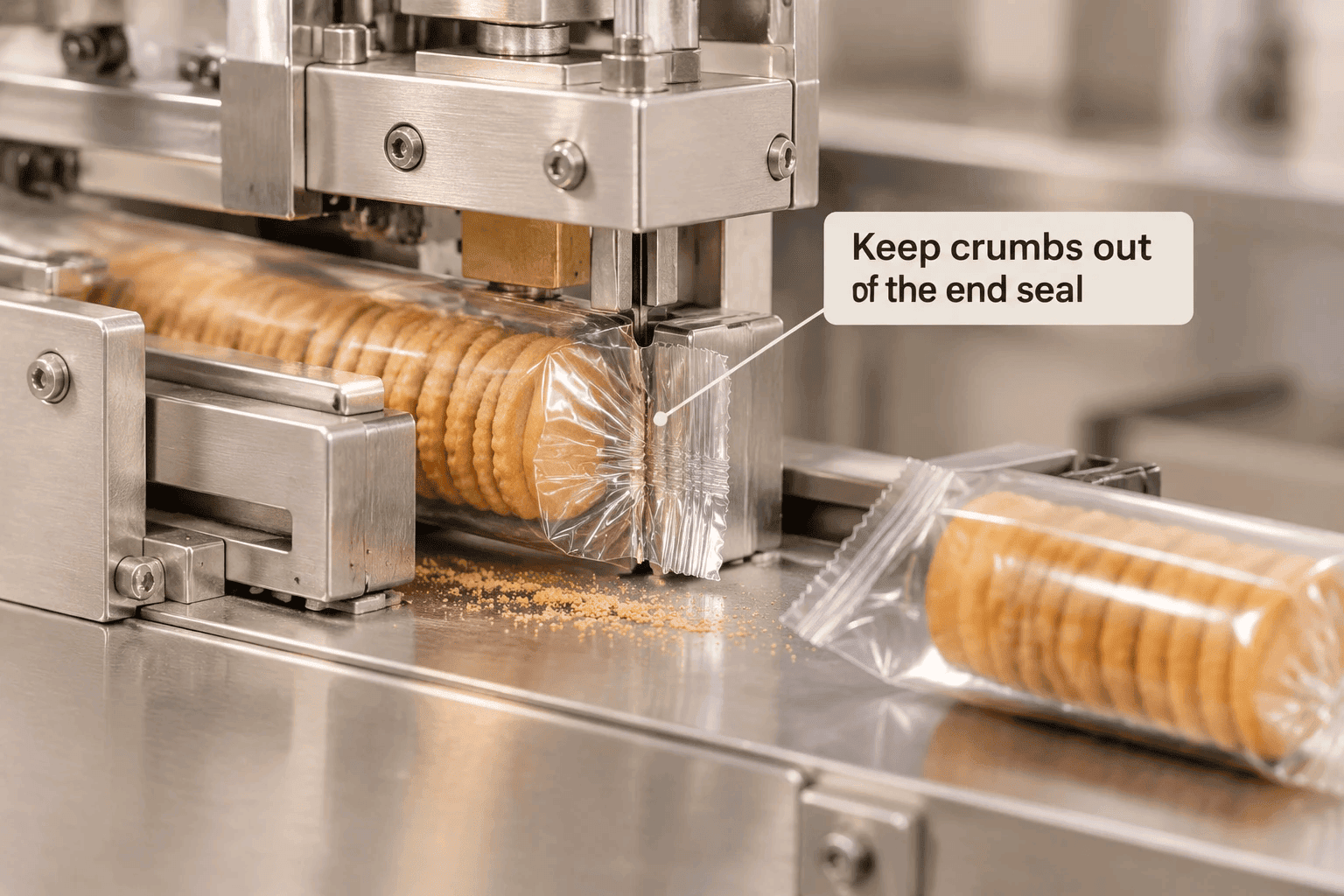
Seal quality depends on crimp jaw temperature, pressure and contact time, and also on keeping crumbs out of the seal area. A crumb trapped in an end seal is a common cause of leakers and rejected packs. Film tension and registration of printed film are the other recurring checks, and a supplier's sample trial on your actual film is the most reliable way to confirm the combination before you commit.
Biscuit Packaging Machine Speed Optimization: Beyond the Rated Packs per Minute
A useful rule of thumb: raise speed only after you have raised stability. A line that runs steadily at 80 percent of its nameplate rate will usually out-produce one that sprints at 100 percent and stops every few minutes.
The rule holds because output is the product of availability, performance and quality, which together make up OEE (overall equipment effectiveness). Pushing the wrapper faster improves only one of the three, and it often hurts the other two. Faster running tends to increase crumb in the seal area, misfed products and film tracking errors, so rejects and micro-stops climb with it.
Three changes usually give real gains. Servo-driven pick-and-place, which uses programmable motors to position products into the wrapper's flights, holds spacing more precisely than mechanical cam systems, and it lets you retime the transfer without changing parts. A stable infeed matters even more, because a wrapper cannot run faster than the product arrives in orientation. Then there are the micro-stops: short interruptions of a few seconds, often unlogged, that add up over a shift.
Measure all of this through OEE, with stops categorized by cause. Track performance against the ideal rate you can actually sustain, not the figure on the brochure.
The rule breaks in one case: when the line is already stable and a downstream or upstream constraint has been cleared. Then a faster wrapper is a legitimate investment, though you should confirm the infeed and case packer can match it first.
Scenario Three: Premium and Long-Shelf-Life Products
A brand owner launches a filled or chocolate-coated biscuit meant to sit on shelves for many months, sometimes in warm distribution chains. The first trial runs fast, and the packs look fine. Weeks later, the retailer reports softness, off-notes or leaking seals.
Here, speed is the wrong yardstick. Shelf life is decided by what keeps oxygen and moisture out, and the packaging line has to protect that barrier at every step.
Start with film. A metallized or high-barrier laminate usually protects better than plain BOPP (biaxially oriented polypropylene) film, but it is typically more expensive and less forgiving on the sealing jaws. Thicker or multilayer structures often need longer dwell time or tighter temperature control, which can pull the rated speed down.
Then consider modified atmosphere packaging (MAP), where the pack is flushed with a gas such as nitrogen before sealing to displace oxygen. It adds gas supply, flushing hardware and residual-oxygen checks. Flushing also takes time and gas, so it works against peak throughput.
Seal integrity becomes the quality gate. A fin or end seal contaminated by crumbs or filling residue can look closed and still leak. Cleaner product presentation, correct jaw pressure and a leak-detection step matter more here than another few packs per minute.
The trade-off is plain: you accept a slower line and higher material cost per pack in return for fewer returns and a longer, defensible shelf life. For these products, size the line to the seal and the atmosphere first, and let speed follow.
Scenario Four: Short Runs, Many SKUs and Frequent Changeovers
A line built for one long run of a single biscuit format and a line built for twenty formats in a week are different machines, even when the nameplate speed matches. The first rewards peak speed. The second rewards how quickly it gets back to good output after each switch.
When runs are short, changeover time becomes a share of every shift, so it deserves the same scrutiny as packs per minute. Three features carry most of the benefit. Tool-less changeover means former, fin-seal and end-seal parts that lock in without spanners, which removes both time and operator-to-operator variation. Recipe storage lets the controller recall film length, seal temperatures, dwell and infeed timing for each SKU, so the first packs after a switch are close to right. Format flexibility covers the range of pack widths, heights and lengths one set of tooling can handle before parts must be swapped.
The trade-off is cost and complexity. Servo-adjusted guides and automated settings add to the price, and a very fast dedicated machine will still beat them on a single long run.
My recommendation: if you change format more than once per shift, choose flexibility and ask for a changeover demonstration on your own SKUs. A supplier such as EverSmart Food Equipment Limited can be asked to show exactly that. Judge the minutes to reach saleable packs, not the first-pack time.
What Is the ROI of Biscuit Packaging Automation, and How Do You Calculate It?
Take a plant weighing an upgrade to its wrapping area. The finance team wants one payback number, but the engineers can only give it a list of improvements. The gap between the two is where most business cases fall apart.
Start with a baseline measured over a few representative weeks: good packs per shift, film and product consumed per thousand packs, rejected packs, minutes lost to stops and changeovers, and operators assigned to the line. Without that baseline, any projected gain is a guess.
Then convert each improvement into money. Avoided waste is the drop in film and product giveaway multiplied by their unit costs. Added good output is the extra saleable packs per shift multiplied by contribution margin, and it counts only if you can actually sell them. Labor savings come from reassigned or reduced operator hours, and downtime savings from recovered minutes valued at the line's hourly margin.
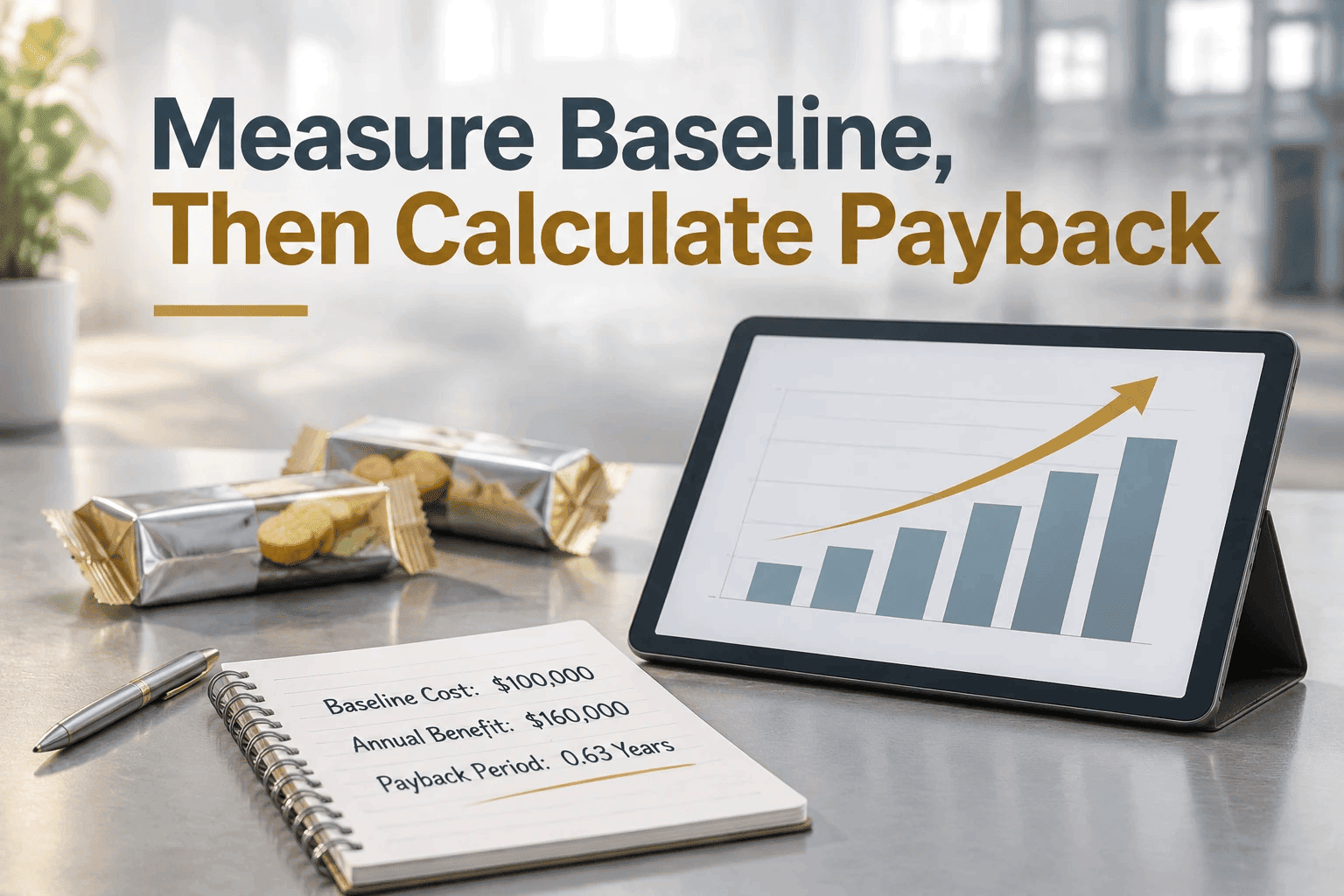
Set the total annual gain against total cost of ownership: purchase price, installation and integration, training, spare parts, maintenance, film changes and energy. Divide the investment by the net annual gain to get simple payback.
The lesson is a cautious one. Count only the gains you can trace to a measured baseline, and test the result by halving the added-output assumption. If the case still holds, it is sound.
Common Mistakes and Myths That Erode Returns
The most persistent myth is that the fastest wrapper gives the best return. It rarely does, because a nameplate speed the infeed cannot feed only adds cost. Four related beliefs do similar damage, and each has a simple correction.
Myth: Top speed decides the purchase
Output depends on stability, so compare machines on sustained good packs per shift and OEE (overall equipment effectiveness), not peak packs per minute. Ask suppliers to run your own biscuit and your own film.
Myth: Film is a commodity
BOPP (biaxially oriented polypropylene) film varies in thickness, slip and seal behavior from lot to lot. A machine tuned on one reel can stall on the next. Qualify film specifications and suppliers before commissioning, and keep sealing settings documented per film.
Myth: A checkweigher can be added anywhere
Placement decides whether it catches faults or just counts them. Plan its position, reject path and space before layout is fixed, so rejected packs leave the line without disturbing the flow.
Myth: Operators will pick it up on the job
Untrained crews tend to compensate for faults with speed or setting tweaks, which creates the waste the equipment was meant to remove. Budget for structured training on changeovers, fault diagnosis and basic maintenance, and treat it as part of the project cost.
What Stays Constant: Food Safety, Hygiene and Maintenance
The usual pitfall is treating hygiene and upkeep as items to settle after the speed and ROI decisions. It shows up at the first audit or the first foreign-body complaint, when a line with open frames, hard-to-reach crumb traps and no verification points has to be modified in service.
Whatever the scenario, the packaging area has to fit your food safety system. ISO 22000 is the international standard for food safety management systems, and the BRC Global Standard for Food Safety is a retailer-recognised certification scheme. Both expect sanitary design, cleanable surfaces and documented controls. Ask for these features at the specification stage, not at handover.
Verification devices need the same discipline. A checkweigher is an inline scale that rejects under- or overweight packs, and it, along with any metal detector, should be tested on a set schedule with documented test pieces and reject-bin checks.
Maintenance is the other constant. Agree a preventive schedule, and stock critical spares such as sealing jaws, knives, belts and sensors. A line waiting days for a part gives back every gain you paid for.
How to Choose a Biscuit Packaging Line for Your Situation
Rank your constraints by how hard they are to change, then let the hardest one pick the machine. Peak speed almost never comes first. It holds because a line bought for the wrong constraint loses its advantage within weeks, however fast it runs on paper.
Start with product fragility: delicate or filled biscuits push you toward gentler, servo-driven handling. Set a target OEE (overall equipment effectiveness) from your measured baseline, and compare machines on sustained good packs per shift. Changeover frequency decides whether tool-less format changes and recipe storage are essential or optional.
Then check the film specification, since BOPP grade, barrier needs and sealing window must match the machine. Measure floor space against the downstream cartoning and case packing. Finally, weigh service support: spare-parts availability, response time and operator training.
The rule breaks when two constraints conflict, for example high speed and many SKUs. In that case, give the supplier your real product mix and ask for a trial. A supplier such as EverSmart Food Equipment Limited should be able to answer in terms of your biscuits, not a nameplate.
FAQ
Should I retrofit or replace an aging wrapper?
Retrofit when the forming and sealing section is sound. Upgrading the infeed, controls and sensing is usually cheaper than a new machine.
What drives payback most?
Avoided waste and added good output, typically. Labor and downtime savings come next.
Which film should I choose?
BOPP film suits most biscuit formats. Choose a barrier structure only when shelf life requires it.
Does higher speed mean more waste?
Often, if the infeed is unstable. Fix stability first.
How long should a changeover take?
As short as tool-less design and stored recipes allow; confirm it in a trial with your own formats.
Short Wrap-Up
A biscuit packaging line earns its return from stability, not from the number on the nameplate. Steady product flow, gentle handling, correct film and seal settings, and quick changeovers put more good packs in the case than a faster wrapper running erratically.
That holds whether you are retrofitting one aging line, adding a second, packing for a long shelf life, or running many SKUs. Each situation weights the levers differently, but the baseline you measure before spending anything is what lets you judge the result afterward.
Your next step is practical: record a few representative weeks of good packs per shift, film and product consumption, rejects, stop minutes and changeover time. Then ask suppliers, including EverSmart Food Equipment Limited, to trial your own biscuit formats and film against those numbers before you commit.

Ready to start your journey toward a customized solution? Contact me directly on WhatsApp to begin the conversation.