What is best commercial mixer for pizza dough?
"Just get a 20-quart planetary; it'll handle pizza dough." That advice often reaches a first pizzeria before opening, and it skips the number that actually decides the purchase: how many kilograms of stiff dough the motor can knead without stalling. Bowl volume won't tell you. Picking a commercial mixer for pizza dough starts with a few checks that rule machines out, and the choice of type comes after.
If you mix dough every day, the usual answer is a spiral mixer sized to your heaviest day's dough weight. Planetary mixers fit small batches, and kitchens that also whip and blend. Fork and diving-arm mixers suit very wet, long-fermented dough. Before comparing types, rule machines out on capacity, power, space, and certification.
Which commercial mixer suits pizza dough?
For most pizzerias, it's a spiral mixer whose rating, given in kilograms of dough, meets or beats your peak batch at the hydration you actually use. The planetary is the exception. It makes sense when daily dough volume is small, or when the same machine also has to handle whipping and creaming, or mashing.
The spiral wins on the job a pizzeria repeats most: kneading a lot of dough quickly and evenly with little added heat. Its hook works the dough against the turning bowl, building gluten faster than a planetary hook pushing the same mass around. Spirals are also built for a heavy, steady load. Most planetaries spend their days between mashed potato and meringue and are designed for that variety, not for stiff dough every morning.
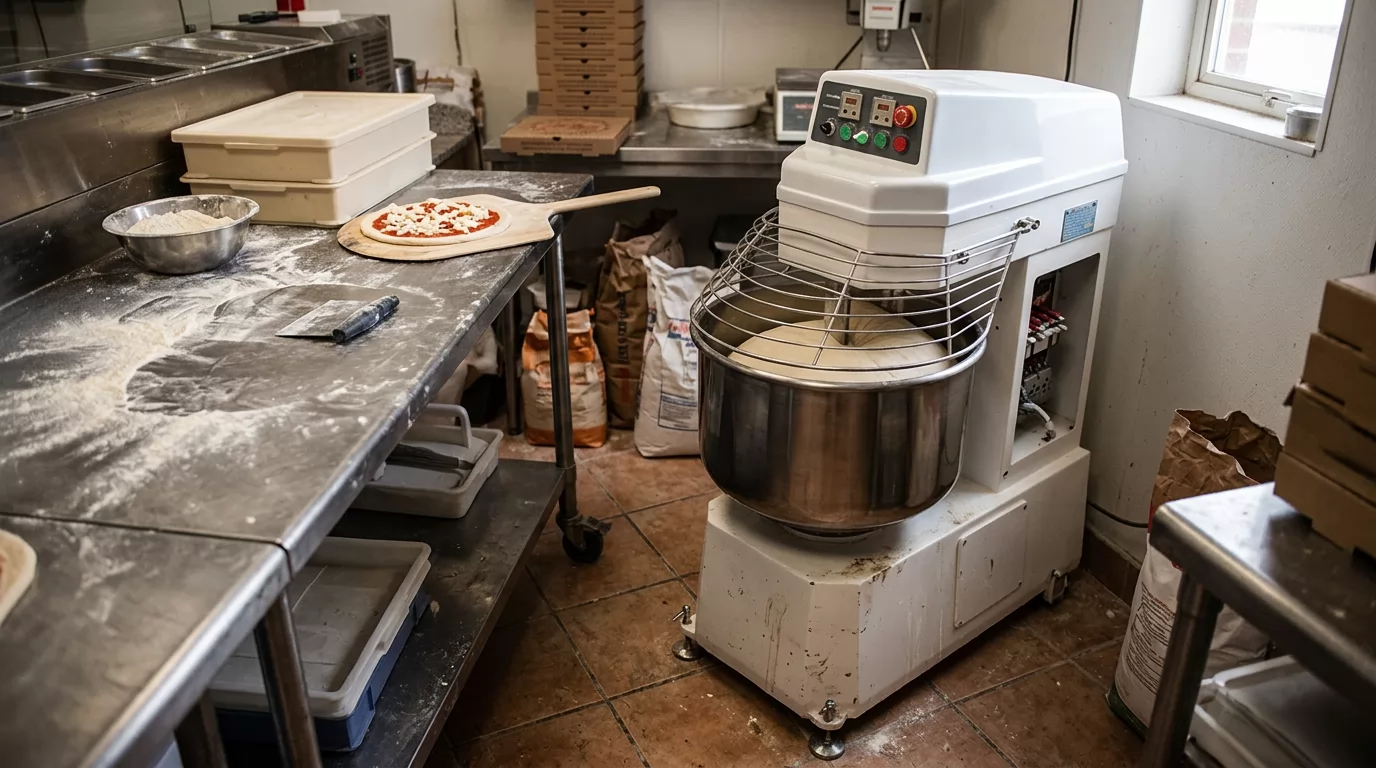
Three situations call for something else. The first is a café or bar selling a few pizzas a night from dough made once or twice a week. A 20- or 30-quart planetary run at a reduced load can cover that and still turn out sauces and whipped cream, or cookie dough. A spiral that makes one batch a week is hard to justify there.
The second is a shop built around very high-hydration or long-fermented dough, where a gentle mix matters more than speed. A fork or diving-arm mixer may suit it better than a spiral, although a spiral with bowl reverse covers much of the same ground for less money.
Third, a commissary sending dough to several stores. A large spiral is still the base option, but removable bowls, or a second machine, start to pay once batches run back to back.
Anywhere else, start from the spiral and make any alternative earn its place.
Batch size and the capacity rule-out
Size a mixer by the weight of dough or flour it can handle at your hydration, not by its quart or litre rating. Bowl volume is just space. Dough capacity is how much resistance the motor and gearbox can push through the hook, and with stiff pizza dough that limit arrives long before the bowl is full.
That's why most spiral makers quote two figures: kilograms of dough and kilograms of flour. Planetary makers usually publish a capacity chart by product, with dough listed far below the nominal bowl size. If a quote gives only bowl volume, ask for the dough-weight rating before going further. A seller who can't provide it has just taken that machine off your list.
This single check eliminates most undersized machines. It also catches the opposite mistake, a mixer far larger than you need, which handles small batches badly.
What size commercial mixer do I need for a pizzeria?
You need a mixer whose dough-weight rating, after any derating for stiff dough, covers your largest single batch with some headroom. That batch weight comes from four inputs: pizzas on your busiest day, dough ball weight, a margin for scrap and test balls, and how many batches you're willing to run per shift.
Take a shop expecting 200 pizzas on its peak day with 250 g balls. That's 50 kg of dough before any margin; add roughly 5% for scrap and it comes to about 52–53 kg. Mixed in one go, it calls for a large spiral. Split into two batches of about 26 kg each, it fits a spiral in the 30 kg dough class. Three batches shrink the machine again but add labour and time on every dough day. That trade is yours to make, not the dealer's.
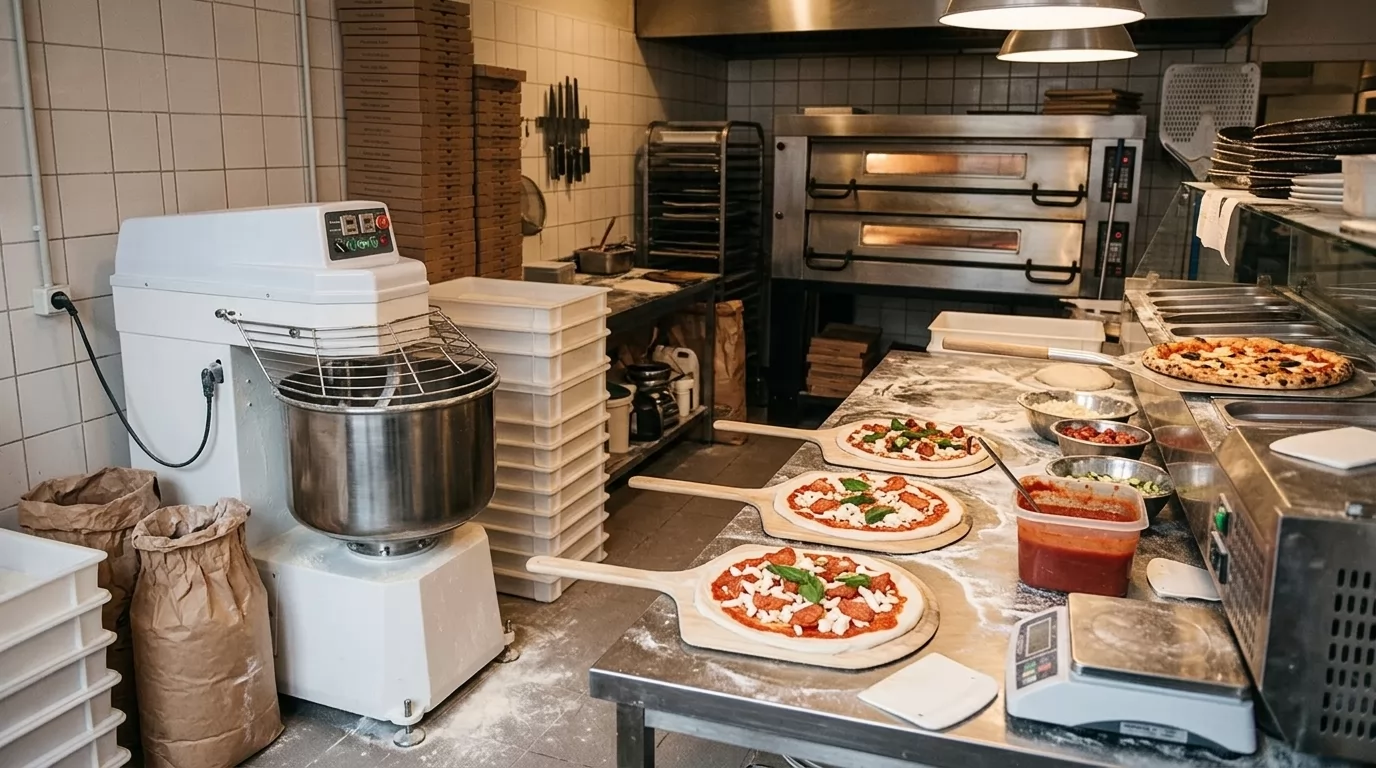
The table maps batch weight to the mixer classes most kitchens land in. Figures are typical ratings at standard hydration, not any one maker's chart.
| DOUGH PER BATCH (KG) | TYPICAL SPIRAL CLASS (KG DOUGH) | PLANETARY OPTION |
|---|---|---|
| Up to about 8 | About 10–12 | 20–30 qt, check stiff-dough rating |
| About 8–18 | About 20–25 | 60 qt class, reduced batch |
| About 18–30 | About 30–40 | 80 qt class at most |
| About 30–50 | About 50–60 | Rarely practical |
| Over about 50 | 80 or larger | Not practical |
Past roughly 18 kg per batch, planetary machines drop out fast, so sizing usually settles the type question before features ever come up.
Hydration and the derating most spec sheets bury
Absorption ratio (AR) is the bakery term for hydration: water weight divided by flour weight, as a percentage. Every capacity rating assumes some AR. The stiffer your dough compared with that assumption, the less of it the machine can safely take.
Planetary charts often list several pizza-dough lines, from thin through thick, at different absorption ratios, and the thin, low-AR line always carries the smallest batch. Some makers advise cutting batch size further with chilled water or high-gluten flour, since both make dough harder to work. Spiral ratings tend to be stated at a hydration that suits bread, which means a stiff New York-style dough may need a step down from the headline figure.
Get it in writing: which AR does the rating assume, and what is the maximum batch at yours? Two machines wearing the same "40 kg" label can differ widely on that second number.
Dough stiffness, high hydration and friction heat
New York-style dough often runs near 60% hydration or slightly lower, while Roman pan dough often goes well past 70%. Contemporary Neapolitan sits between the two and has been getting wetter. Each loads a mixer differently.
Stiff dough is heavy work. Every turn of the hook pushes against a dense mass. Motor current climbs and the gearbox carries high torque; partway through a batch, the thermal overload may trip. A light-duty gear-driven planetary run at full load with stiff dough every day is a familiar route to stripped gears and burnt windings. Heavy-duty mixers cope through larger motors and either belt drives or reinforced gear trains, and makers rate them for dough accordingly.
Wet dough has the opposite problem. The motor runs easily, but the dough slides around the bowl rather than being stretched, so gluten develops slowly unless the tool keeps contact. Wet dough usually takes longer and responds better to a staged mix: start at a lower hydration and add the remaining water slowly once gluten begins to form, which bakers call bassinage.
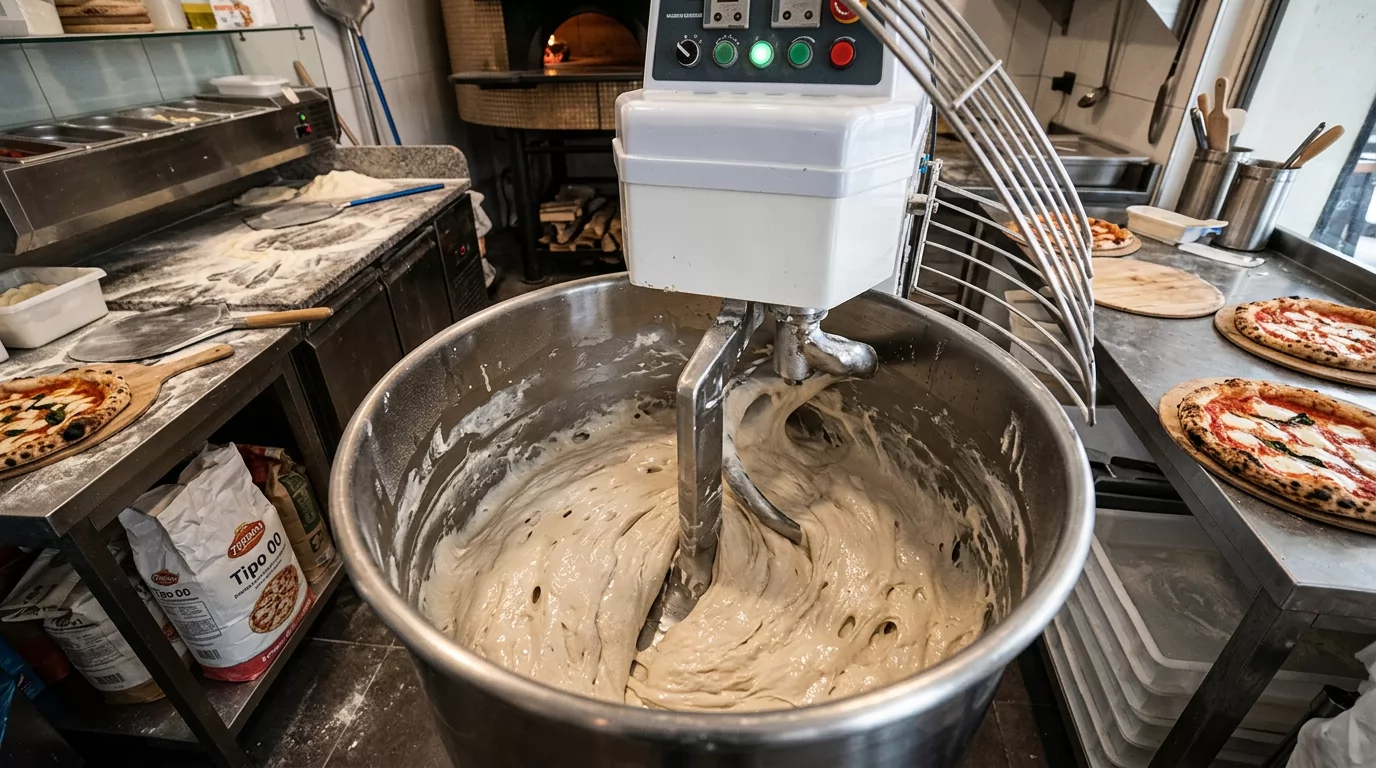
Every mixer also heats dough by friction. Final dough temperature shapes fermentation, and many pizzerias aim for the low-to-mid 20s °C. Bakers manage this with the desired dough temperature method: measure the rise your mixer causes (its friction factor), then set the water temperature to compensate, swapping part of the water weight for ice in a hot kitchen. A machine that adds less heat per batch makes summer easier. Still, measure the friction factor on your own machine rather than trusting a brochure figure.
Power supply, footprint and floor space
These checks take minutes, and any one can disqualify a machine before price comes up, however well it kneads. Check each against the actual site, not the floor plan you hope to have:
Supply phase: single-phase or three-phase, and whether the landlord's panel can take a new circuit
Voltage and frequency for your market, such as 208–240 V in North America or 230/400 V in Europe
Door and corridor widths along the delivery route, stairs too, with the crate included
Floor loading under heavy units, especially on upper floors or over basements
Clearance to raise the guard and tilt or remove the bowl, plus room to scrape it out
Sanitation, electrical certification and service access
Health inspectors and insurers expect recognised marks on powered food equipment, and which ones depends on where you operate. In the United States and Canada the usual pair is NSF/ANSI 8, the standard for commercial powered food preparation equipment covering sanitation and cleanability, and UL 763, the safety standard for motor-operated commercial food preparing machines (or a recognised equivalent listing). In the European Union, mixers carry CE marking under machinery law, backed by the harmonised standards EN 453 for dough mixers and EN 454 for planetary mixers. The EU Machinery Regulation (EU) 2023/1230 replaces the old Machinery Directive from January 2027, so for any unit bought around that date, confirm it's documented under the right framework.
Guarding is as much about safety as paperwork. A compliant spiral or planetary has a bowl guard interlocked with the drive. Raise the guard and the tool stops; it shouldn't restart until the guard is closed and the operator presses start again. On a used or very cheap machine, test this first. A bypassed interlock means walk away.
Food-contact surfaces (bowl, hook, breaker bar, guard) should be stainless steel or another food-safe material that won't pit or flake, and the body should have few crevices for flour and dough to collect in. Service gets overlooked. Who stocks belts, bearings, timers and guard switches in your country, and how fast can a technician reach you? A mixer idle for three weeks while a part ships can cost more than you saved buying it.
Spiral mixer vs planetary mixer for pizza dough
With the misfits removed, the choice usually comes down to spiral or planetary, and the two work dough in very different ways.
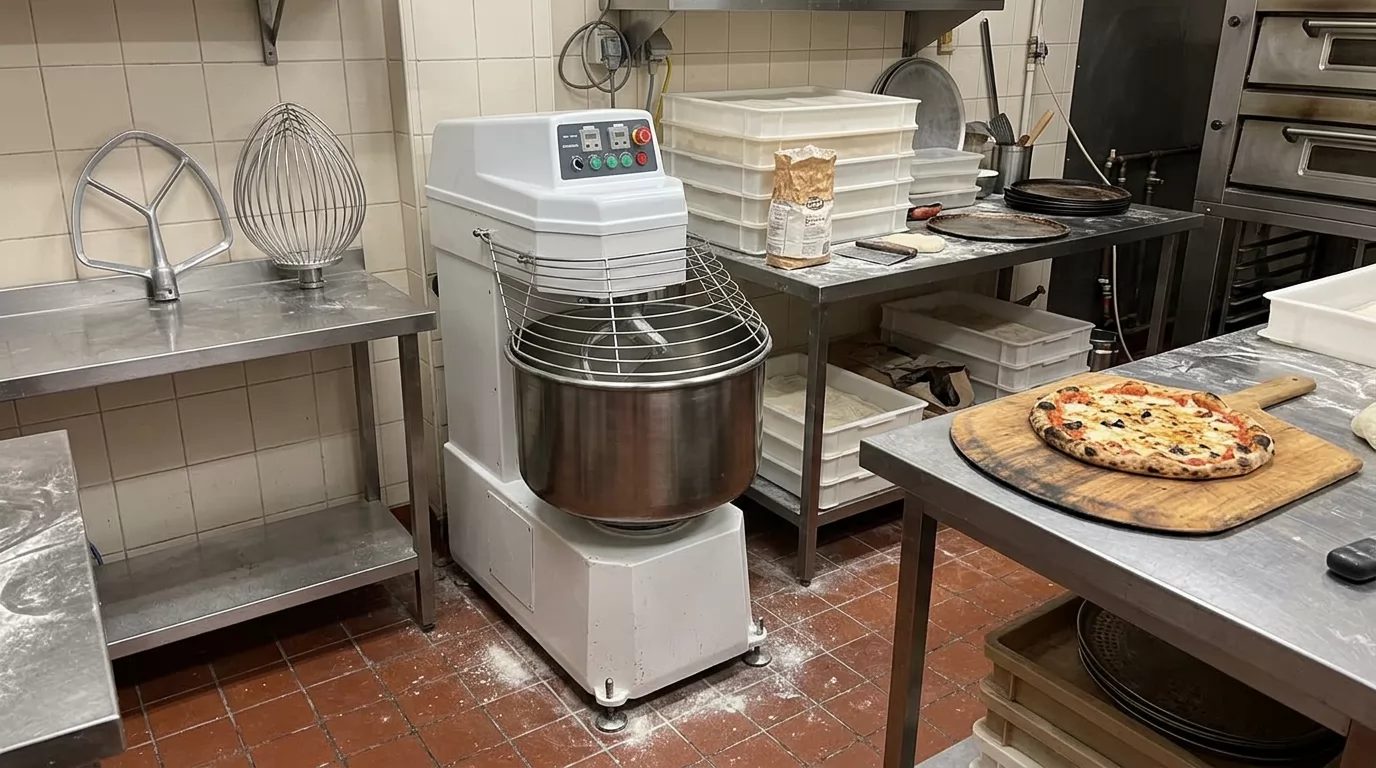
A spiral mixer is a dough mixer in which a spiral-shaped hook turns in a fixed position while the bowl rotates beneath it, usually with a vertical breaker bar that cuts and folds the dough. Because the bowl turns, every part of the dough passes the hook again and again. It gets stretched and folded rather than shoved around. Gluten develops in relatively few minutes, and friction heat stays modest.
A planetary mixer is a general-purpose machine whose agitator spins on its own axis while travelling around a stationary bowl, the way a planet orbits. That action suits batters and creams, along with fillings, and attachments extend it to mashing and whipping, sometimes slicing or grinding. With dough, though, the hook pushes the mass around more than it kneads it. Mixing runs longer and builds more heat. And the stiff-dough capacity sits far below what the bowl volume suggests.
For a pizza kitchen, these rows usually decide it:
| CRITERION | SPIRAL MIXER | PLANETARY MIXER |
|---|---|---|
| Kneading action | Fixed hook, rotating bowl, breaker bar | Orbiting hook, stationary bowl |
| Gluten development | Faster, more even | Slower, less even |
| Dough temperature rise | Lower for the same development | Higher over longer mixing |
| Minimum batch | Often limited below about a quarter of rating | Flexible across small batches |
| Non-dough tasks | Dough only | Whipping, batters, mashing, attachments |
| Suited to | Daily dough at volume | Mixed menus, small dough batches |
When dough is the machine's main job, the spiral wins every row that touches dough quality. It loses only on versatility and very small batches.
Those small batches deserve a closer look. With only a little dough in a big spiral bowl, the hook may not grip, and the dough just rides around unworked. Makers often state a minimum batch, and on fixed-speed bowls it can be a sizeable share of the rating. Bowl reverse helps, which is why some pizzerias with small midweek batches choose a spiral that has it.
Noise matters less, but it counts in an open kitchen. Belt-driven spirals tend to hum steadily. A gear-driven planetary under heavy load can grind and whine, and the pitch often shifts as it starts to labour, which at least serves as a warning. Neither machine is quiet, but a planetary fighting stiff dough is much harder to tune out.
Here is the spiral's case as trade-offs:
| ADVANTAGES | LIMITATIONS |
|---|---|
| Builds gluten quickly with modest heat | Mixes dough only, no attachments |
| Rated by dough weight, easier to size | Small batches mix poorly without bowl reverse |
| Handles stiff dough as daily work | Larger units often need three-phase power |
| Belt drives on many models are simple to service | Fixed bowls are harder to clean around |
A planetary flips those trade-offs. You gain flexibility, one machine for every job, and give up dough capacity and speed, plus some temperature control. If pizza dough makes up more than half the machine's work, that rarely pays off.
Fork, diving-arm and other dough mixer alternatives
Two older designs still have a place alongside spirals and planetaries.
A fork mixer has an angled, fork-shaped tool that rotates slowly while the bowl turns, lifting and folding the dough instead of twisting it. It's common in Italian pizzerias and bakeries, especially for Neapolitan-style dough. The action is gentle and adds little heat, and high hydration gives it no trouble. Cycles, though, run noticeably slower than a spiral's.
A diving-arm mixer, sometimes called a twin-arm or double-arm mixer, uses two arms that reach in and lift the dough, imitating hand kneading. It also suits very wet and long-fermented dough; bakeries use it for large artisan batches where oxygenation and structure matter.
Both usually cost more than a spiral of similar capacity and run slower. They also need more floor. Where they earn it is a shop whose identity rests on one particular dough, and whose owner has decided gentle mixing is worth the time and money. If the menu depends on consistent, fast service, a spiral with bowl reverse usually gets close enough.
Bowl design, speed control and timers
Two spirals with identical dough ratings can still behave very differently day to day, mostly because of the bowl and the controls, and partly the tool itself.
Fixed vs removable bowl
On a fixed-bowl spiral the bowl stays attached. Staff divide the dough out by hand or tip it onto the bench in pieces, which fits the usual pizzeria routine of mix, rest, divide and ball. The machine is simpler and cheaper. The catch is cleaning: you do it in place, working around the hook and breaker bar.
Tilting-head and removable-bowl spirals cost more, but a removable bowl can be wheeled to a divider or bulk proof area while the next batch starts in a second one. In a commissary running batches back to back, that overlap is often worth more than any other feature. Cleaning gets easier too, since the bowl can go to the sink, or at least be scraped without reaching under a hook.
Two-speed motors, bowl reverse and digital timers
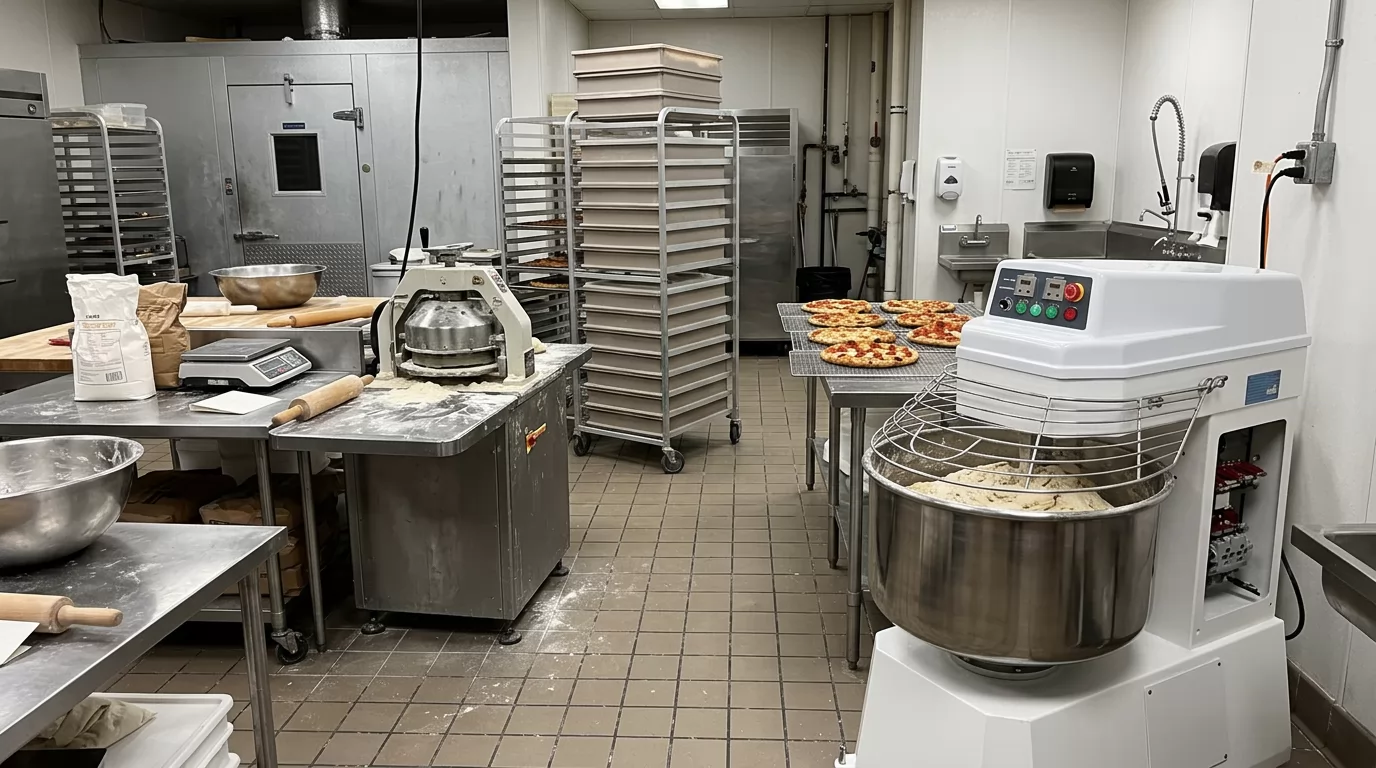
Most commercial spirals have two speeds: low to bring ingredients together, higher to develop gluten. Some use separate motors for hook and bowl, which affects both control and servicing.
Bowl reverse turns the bowl the other way on low speed. With small batches it pushes the dough back toward the hook, so a large bowl can still mix a modest batch properly. It also helps with very wet dough and late ingredient additions.
Digital timers sound like a convenience. They're really about consistency. When three or four people make dough across a week, a timed cycle that runs a set time on first speed and then switches automatically to second gives everyone the same result, whereas a manual dial invites each person to do it their own way.
Spiral hook, breaker bar and bowl material
How well a spiral handles part loads depends on the hook's profile and how close it runs to the bowl wall. A correctly sized and placed breaker bar cuts the dough as it comes round and stops it winding onto the hook; a badly placed one lets small batches ride the hook under-mixed. Ask for the stated minimum batch, and if you can, watch a mix at that size.
Bowls, hooks and breaker bars are stainless steel almost everywhere. It resists corrosion from acidic dough and cleaning chemicals and won't flake into food. It also stands up to daily scraping. Painted or plated food-contact parts are a warning sign on anything sold for commercial use.
How to choose a commercial dough mixer for a pizza restaurant
The decision tends to run through the same short list, roughly in the order each criterion knocks machines out.
Peak batch weight at your hydration settles the most, so it goes first. Work it out from your busiest day and compare it with the maker's derated rating at your absorption ratio, never the headline figure. Dough style is next. Stiff New York-style dough needs genuine motor headroom. Wet Neapolitan or Roman dough needs a tool and bowl action that keep it moving, which points toward bowl reverse or a fork or diving-arm design.
Third come power and space. They're yes-or-no checks, yet people often discover the answer too late, when the crate won't clear the back door or the panel has no three-phase supply. Fourth, minimum batch and bowl type: think about your quietest day as well as your busiest, and whether a removable bowl is needed to keep batches flowing.
Compliance, warranty and service close the list. They rarely decide the type, but they often split two finalists. Look for the right marks for your market and a warranty covering motor and gearbox, not just parts. You also want a stated delivery time for spare parts and a named service company within reach.
Put the same questions to every model on the shortlist. An EverSmart spiral from one dealer and a long-established Italian brand from another should both answer these in writing:
What is the maximum dough batch at my absorption ratio?
What is the stated minimum batch, with and without bowl reverse?
Which marks does this exact model carry for my market?
What does the warranty cover, and for how long?
Who services it locally, and how long do belts and switches take to arrive?
A workable rule of thumb: buy the smallest spiral whose derated capacity at your hydration beats your peak batch by about 20%, and put leftover budget into bowl reverse and a timer rather than extra kilograms.
Recommendations by kitchen setup
A spiral that's right at one scale can be wrong at another, so it helps to start from the kitchen.
A single-location pizzeria with a short menu and one dough is usually well served by a fixed-bowl, two-speed spiral in roughly the 20–40 kg dough class, sized from its peak day and split into one or two batches. A timer is worth having; bowl reverse is worth paying for if weekday batches are small.
For a high-hydration Neapolitan shop, look first at spirals with bowl reverse and a well-placed breaker bar. Then decide whether a fork mixer's gentler action justifies its extra cost and slower cycles. Friction heat deserves closer measurement here, since long fermentation depends on a steady starting temperature.
A multi-site commissary needs a large spiral, often 60–80 kg class or bigger, and should seriously weigh removable bowls or two machines so one breakdown doesn't halt dough for every store. Parts stock and service response matter more here than anywhere. If a dealer sets an EverSmart model beside a better-known brand, compare derated stiff-dough capacity and the spare-parts list, not the headline kilograms.
Where pizza is one item among many, as in a café or bakery, a 20- to 60-quart planetary run at reduced dough loads is often the right call because it also whips, creams and mixes batters. If dough volume grows until the planetary is overloaded several days a week, add a small spiral instead of trading up to a bigger planetary.
FAQ
Can a planetary mixer handle pizza dough at all?
Yes, within limits. Keep batches well below bowl size and follow the maker's pizza-dough line for your absorption ratio. Avoid stiff, low-hydration dough at full load. A few small batches a week is fine; daily volume belongs on a spiral.
How long should pizza dough mix in a spiral mixer?
Typically a few minutes on first speed and several more on second, depending on flour and hydration as well as batch size. Treat that as a starting point. The windowpane test is a better guide: stretch a small piece until it's thin enough to let light through without tearing, then set the timer to match what the dough shows you.
Is a bigger mixer better for future growth?
Not always. An oversized bowl mixes small batches poorly, so today's dough can suffer for growth that arrives late or not at all. Size for the next year or two and plan on a second machine later.
Which mixer works for high-hydration dough?
A spiral with bowl reverse covers most needs. If budget and floor space allow, fork and diving-arm mixers work more gently still and suit very wet, long-fermented dough.
Should I buy a used commercial dough mixer?
It can make sense if you inspect it properly. Check the belts, and listen to the gearbox under load for grinding or knocking. Look for wear on bowl and hook, and confirm the guard interlock stops the tool. Before paying, ask a local service company whether parts for that model are still available.
Wrap-up: rule out first, then compare
Start with capacity at your hydration. Power, space and compliance come next, and only then the choice of type. After the machine arrives, the useful questions shift to your friction factor and the water temperature each season calls for; measuring both in the first week will teach you more than any spec sheet.

Ready to start your journey toward a customized solution? Contact me directly on WhatsApp to begin the conversation.