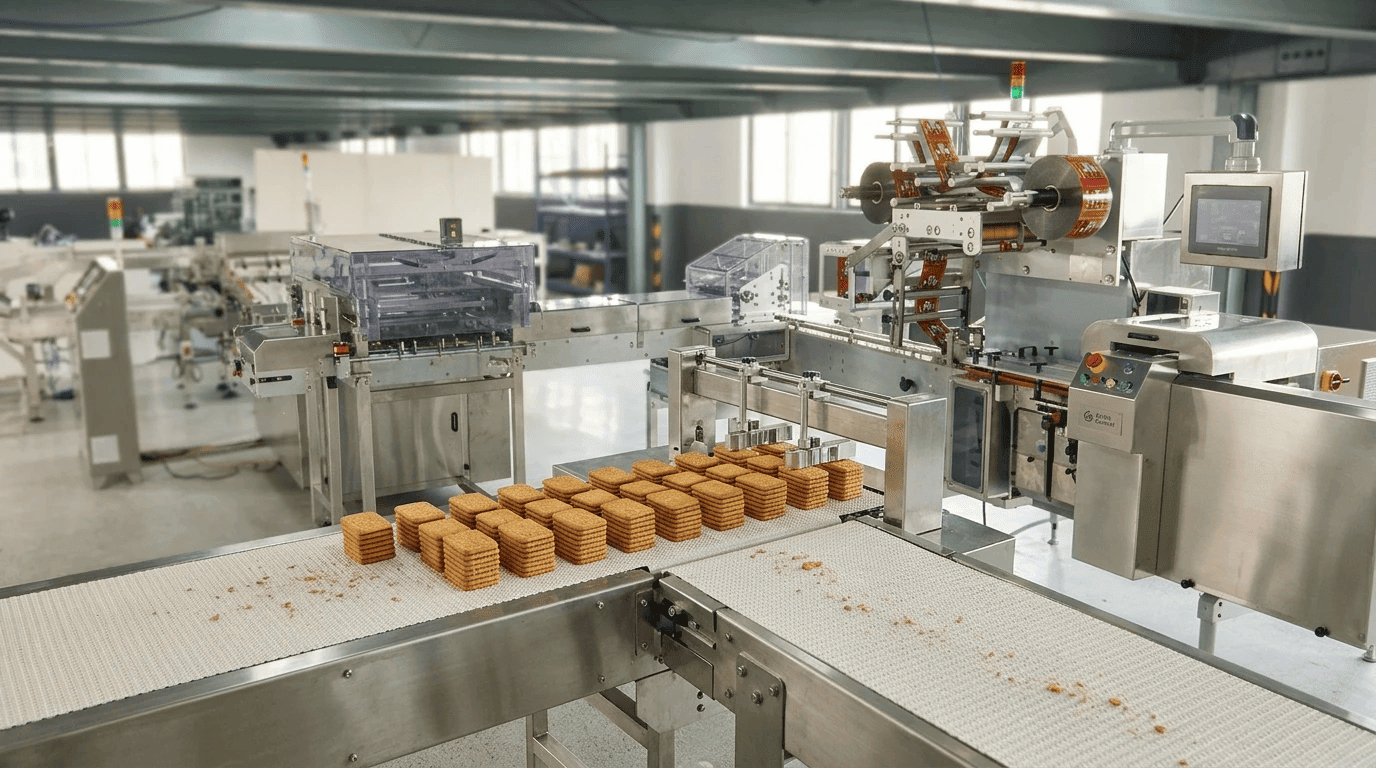
How to Select the Right Cookie Production Line for Your Bakery Factory
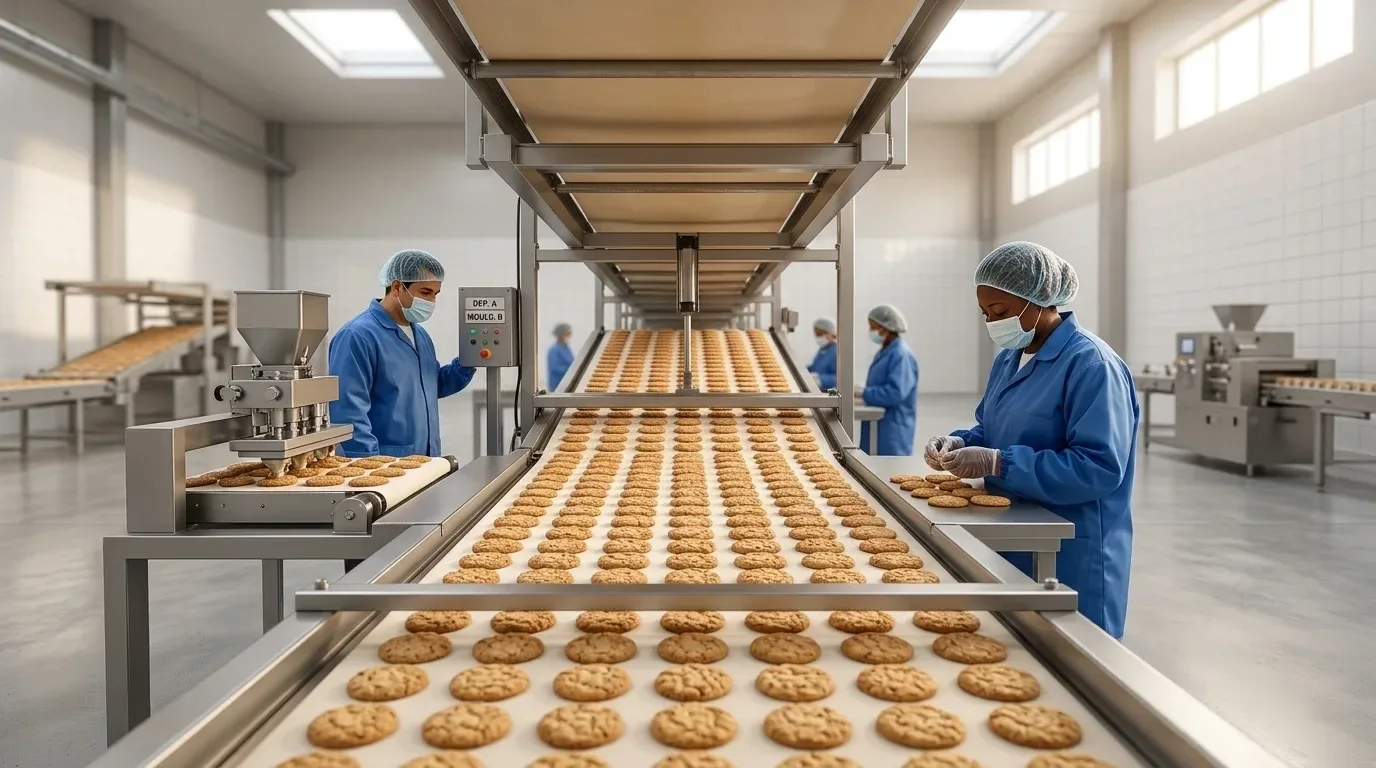
Two quotes list the same kg/h, the same oven length, and the same stainless frame, yet one line runs 16 hours a day while the other chases changeovers. The difference is dough-forming flexibility against your real product mix, not headline capacity, so a cookie production line should be chosen from the recipe range outward.
What Actually Separates Two Cookie Production Lines That Look Identical on Paper?
The forming method, and how well it matches your dough rheology and SKU mix, separates two lines far more than nameplate throughput does. A spec sheet reports what a line can do with its best dough on its best day. Your plant runs the dough you actually make, on the days you actually have.
Rheology is the way a dough flows and deforms under stress. A high-fat, soft dough with chocolate chips behaves nothing like a lean, extensible dough for crisp biscuits. A forming station designed for one will drift in weight, smear, or tear on the other, and no oven can repair that downstream.
Consider what a quote usually leaves out. It rarely states which dough families the forming head was tested on, how long a recipe change takes, or what scrap rate to expect during the first twenty minutes after a restart. Those three items decide whether the nominal output turns into saleable product.
Two lines with the same oven length can still bake differently, since zoning and airflow are designed independently of each other. We come back to that later. For now the point is simple: ask what the line forms well, not how fast it can run.
If your range sits inside one dough family, a specialised line is efficient and cheaper. If it spans several, flexibility has to be paid for up front, in tooling, in controls, and sometimes in a second forming station. Buyers who skip that conversation tend to discover it in month three.
Which Forming Method Fits Your Dough: Wire-Cut Depositor, Rotary Moulder or Laminating Sheeter?
A wire-cut depositor suits soft doughs, a rotary moulder suits stamped biscuits, and a laminating sheeter suits layered products. Cross those boundaries and you get weight drift and shape rejects. The three are not interchangeable, and the cheapest option is rarely the one that fits.
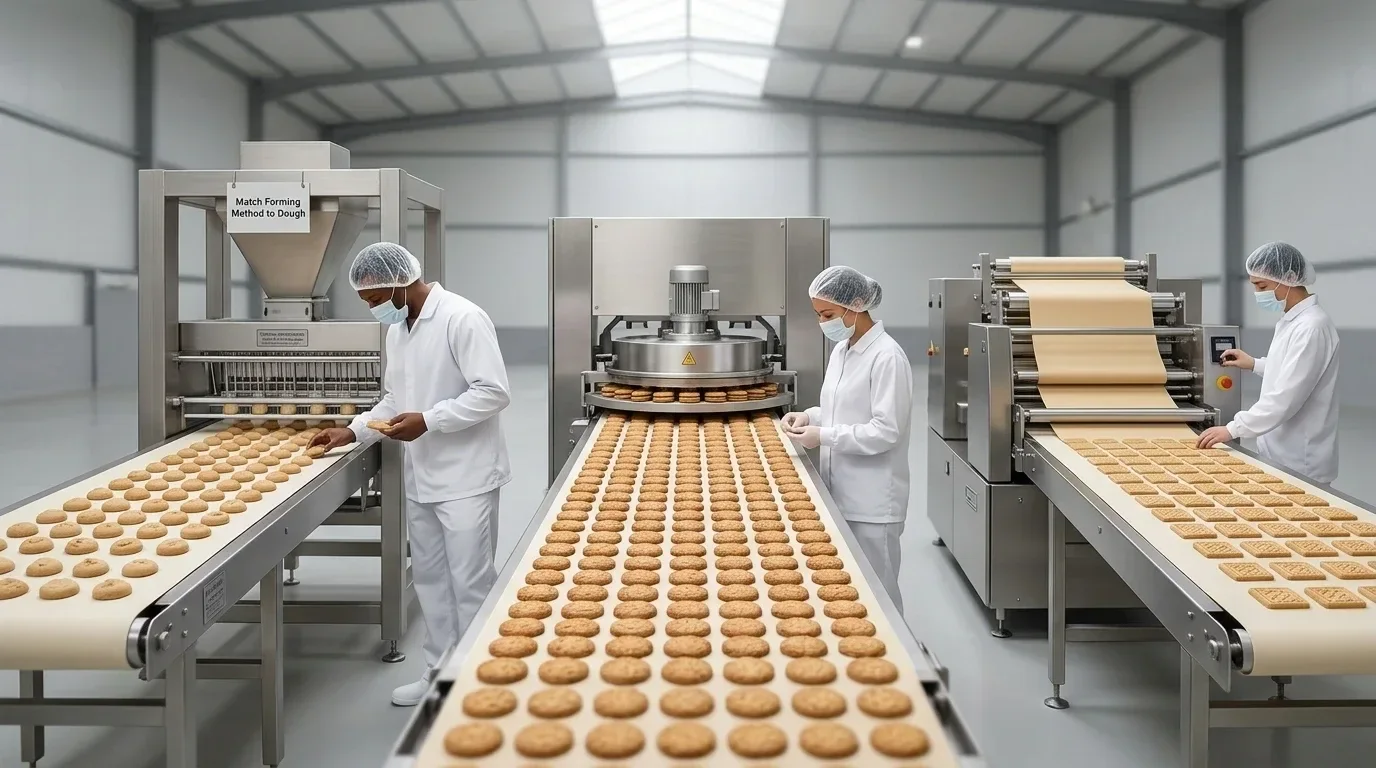
Wire-cut and depositor lines for soft, high-fat doughs
A wire-cut depositor is a forming machine that extrudes dough through a die and slices pieces off with a taut wire. It handles soft, sticky, high-fat doughs and tolerates particulates such as chips, nuts and fruit pieces. Piece weight depends on pump or roller consistency, so dough temperature control matters a great deal. Shapes are limited to what a die can give you, though rotating or twisting heads add some variety.
Rotary moulder lines for stamped and embossed biscuits
A rotary moulder presses dough into engraved cavities on a roll, then releases the formed piece onto a belt. It reproduces fine detail, such as embossed logos and sharp edges, at steady weights. It wants a firmer, shorter dough that fills the cavities and releases cleanly. Large inclusions are a problem, because they jam the cavities or leave blemishes on the surface.
Laminating dough sheeter lines for layered and crisp products
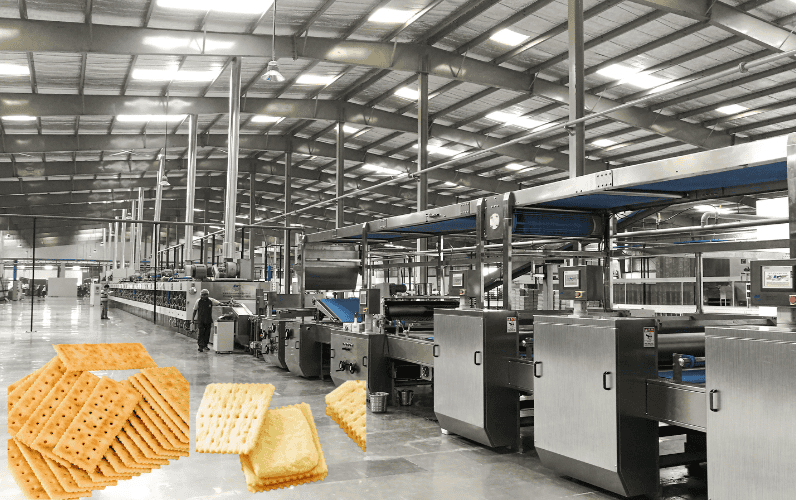
A laminating dough sheeter folds and gauges dough through a series of rollers, building layers before cutting. It is the route for crackers, layered biscuits and thin crisp products. It needs the most floor space, and scrap dough must be returned to the line in a controlled way. Gauge consistency across the web is the quality point to check.
Pick by dough first and shape second. A mismatched head will cost you more in rework than any speed advantage will earn.
Wire-Cut Depositor vs Rotary Moulder vs Laminating Sheeter: Side-by-Side Comparison
Compared directly, the wire-cut depositor wins on inclusions and quick recipe changes, the rotary moulder wins on shape fidelity, and the laminating sheeter wins on layered texture at the price of footprint. Which one suits you depends on which weakness you can live with.
| ATTRIBUTE | WIRE-CUT DEPOSITOR | ROTARY MOULDER | LAMINATING SHEETER |
|---|---|---|---|
| Typical dough | Soft, high-fat, sticky | Firm, short, low-moisture | Extensible, lean to medium fat |
| Inclusions | Handles chips, nuts, fruit well | Poor; fine particles only | Poor; usually topped, not mixed in |
| Shape range | Moderate; limited by dies | High detail, embossing possible | Cut shapes, docked, layered |
| Changeover effort | Lower; die and wire swap | Moderate; roll exchange is heavy | Higher; cutters, gauges, scrap return |
| Footprint | Compact | Compact to medium | Largest |
| Typical weak point | Weight drift with dough temperature | Cavity release and roll wear | Gauge variation and scrap handling |
The takeaway: no single column is best, so match the row that hurts your product most to the method that is strongest there.
Read the changeover row carefully if you run several SKUs. A rotary roll is heavy and needs lifting gear, which turns a change into a planned event instead of a routine one. A depositor change is usually quicker, but it only helps if your recipes belong to the soft-dough family in the first place.
How Do You Map Your Dough Types and SKU Mix to a Forming Method?
List every SKU, group them by dough family, and let the largest group decide the main forming station. Then test whether the remaining SKUs can share it or need a second head.
Sort SKUs into soft and high-fat, firm and short, or lean and layered.
Note which SKUs carry inclusions, and how large the pieces are.
Mark the shapes that need fine detail or embossing.
Share each family's volume, so the dominant dough gets the best-fitting method.
Check whether minor families can run through interchangeable heads on the same oven.
A plant that is mostly chip cookies with one embossed biscuit usually builds around a depositor. A plant that is mostly stamped biscuits with an occasional soft cookie builds around a rotary moulder. Layered products almost always justify their own sheeter line.
What Size Cookie Production Line Do I Need?
Size the line from the finished kilograms you must pack per shift, at a realistic efficiency, not from the oven's peak rating. The steps below give you a defensible number to put in front of suppliers.
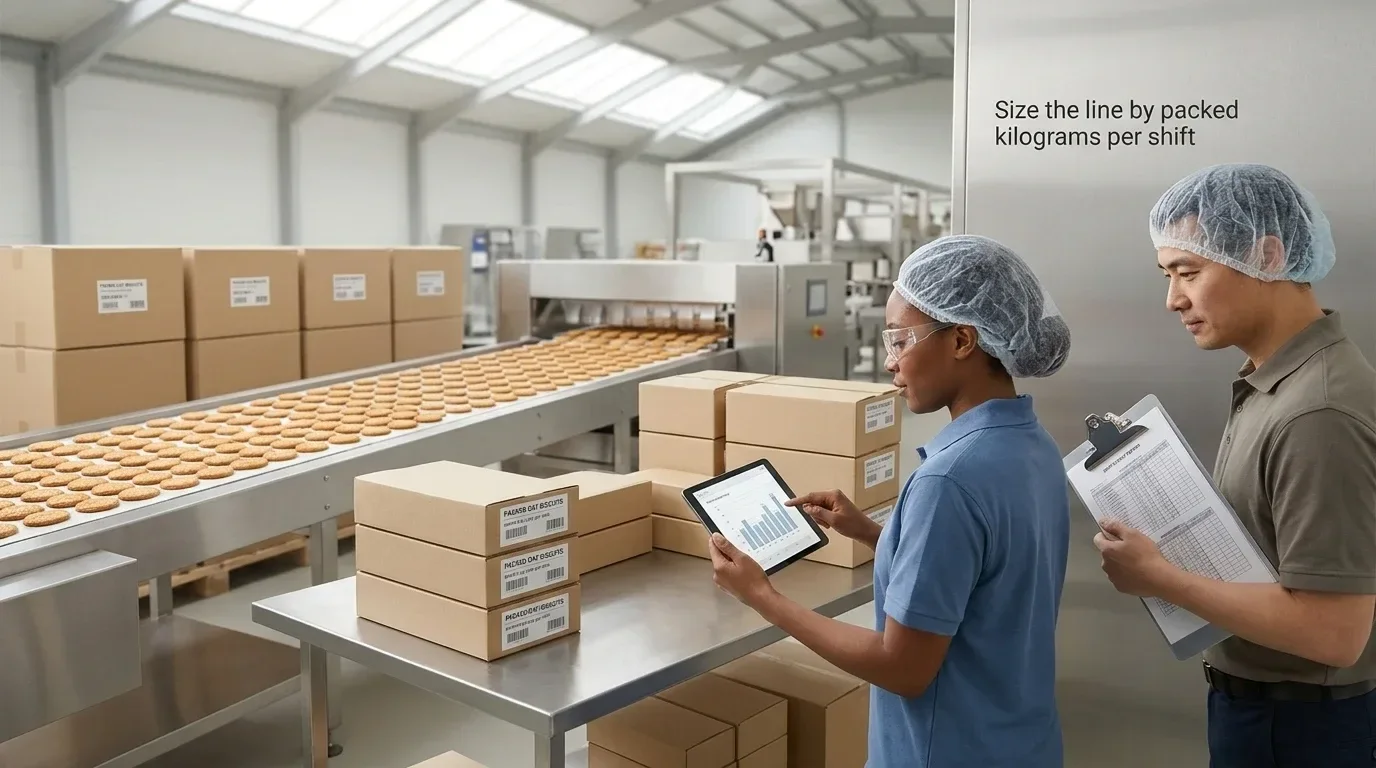
Set your target in finished, packed kilograms per shift, using the product that sells in the highest volume.
Count the productive hours in a shift after breaks, cleaning, changeovers and start-up scrap.
Divide the target by those hours to get the required average output per hour.
Add a margin for overall equipment effectiveness losses. Lines commonly run well below nameplate in real production, so a margin of roughly 15 to 30 percent over your average need is a sensible starting range.
Check the result against your heaviest, slowest-baking product, because that recipe sets the real ceiling.
Test the figure against growth over the next few years, but only to the point where the line still runs at a stable speed today.
Notice that the oven appears nowhere in the first four steps. Oven rating is an input to the answer, not the answer itself. A heavy, thick cookie needs more bake time than a thin one, so belt speed and therefore output fall when you change product.
Then look at the rest of the plant. A line that makes 800 kg per hour is of no use if your packing hall handles 500. The smallest stage governs the whole line.
Finally, ask suppliers to state output per product, not one figure. A quote that gives a single kg/h number without naming the product and piece weight cannot be compared with anything.
Is Higher Rated Capacity Always Better?
No. Many buyers assume that spare capacity is free insurance. It is not, because an oversized line runs below its stable speed, wastes energy and bakes inconsistent product.
Here is why the assumption breaks down. A forming head is designed to work within a speed window. Run it slowly and dough sits longer in the hopper, warms up and changes behaviour. Piece weights wander, and the oven receives an uneven load.
The oven suffers too. A wide belt carrying a thin scattering of product loses heat unevenly, and burners cycle more than they should. You pay for the energy and get worse colour in return.
Idle capacity also raises cost per kilogram. Cleaning a larger line takes longer, spare parts are bigger and dearer, and the operator team is sized to the machine rather than the volume. A line running at 50 percent of its rating is not half as productive, it is simply expensive.
What matters is the stable operating range. Ask the supplier at what percentage of rated speed the line holds weight tolerance and colour. If the answer is "only near the top", your normal output will sit in the unstable zone.
There is a fair counterargument. If a firm order is already in hand for growth, a larger line avoids a second purchase. In that case, specify a modular design where a second depositor head or extra oven module can be added later, and run the first phase at its proper speed. That is a better route than buying the full width on day one and starving it.
Why Does the Oven Baking Profile Matter More Than Oven Length?
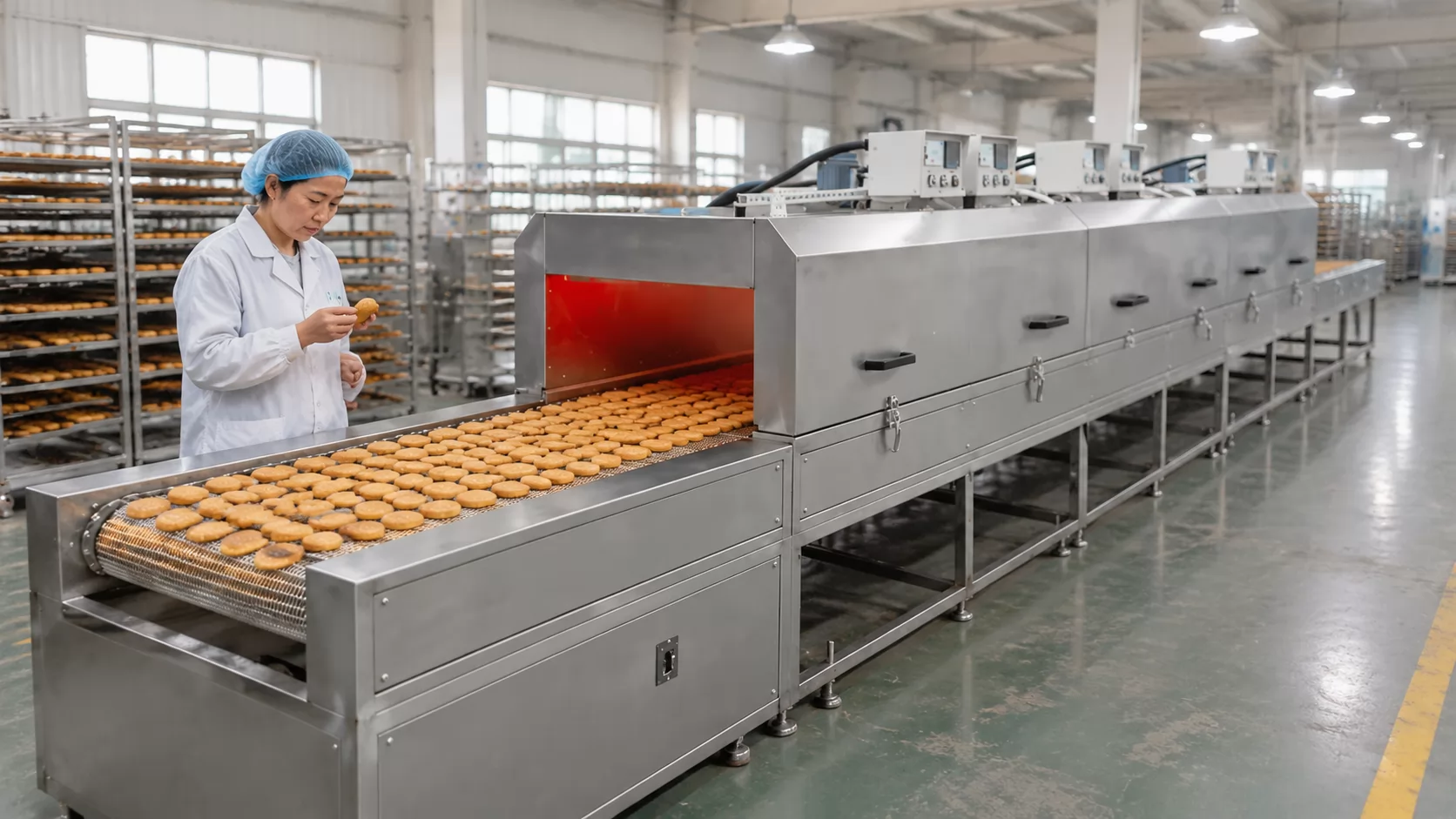
As a rule, choose the oven for its control over the baking profile, not for its belt length. A tunnel oven is a long heated chamber through which cookies travel on a belt, and its zoning, airflow and moisture control decide colour, snap and shelf life. Each dough family needs a different profile.
The reason is simple. A cookie bakes in phases: rapid heat input to set and spread the dough, then moisture removal, then colour development. Soft depositor cookies, stamped biscuits and thin laminated crackers each need a different balance of radiant heat and convection. A long oven with one undifferentiated temperature curve gives you length without control.
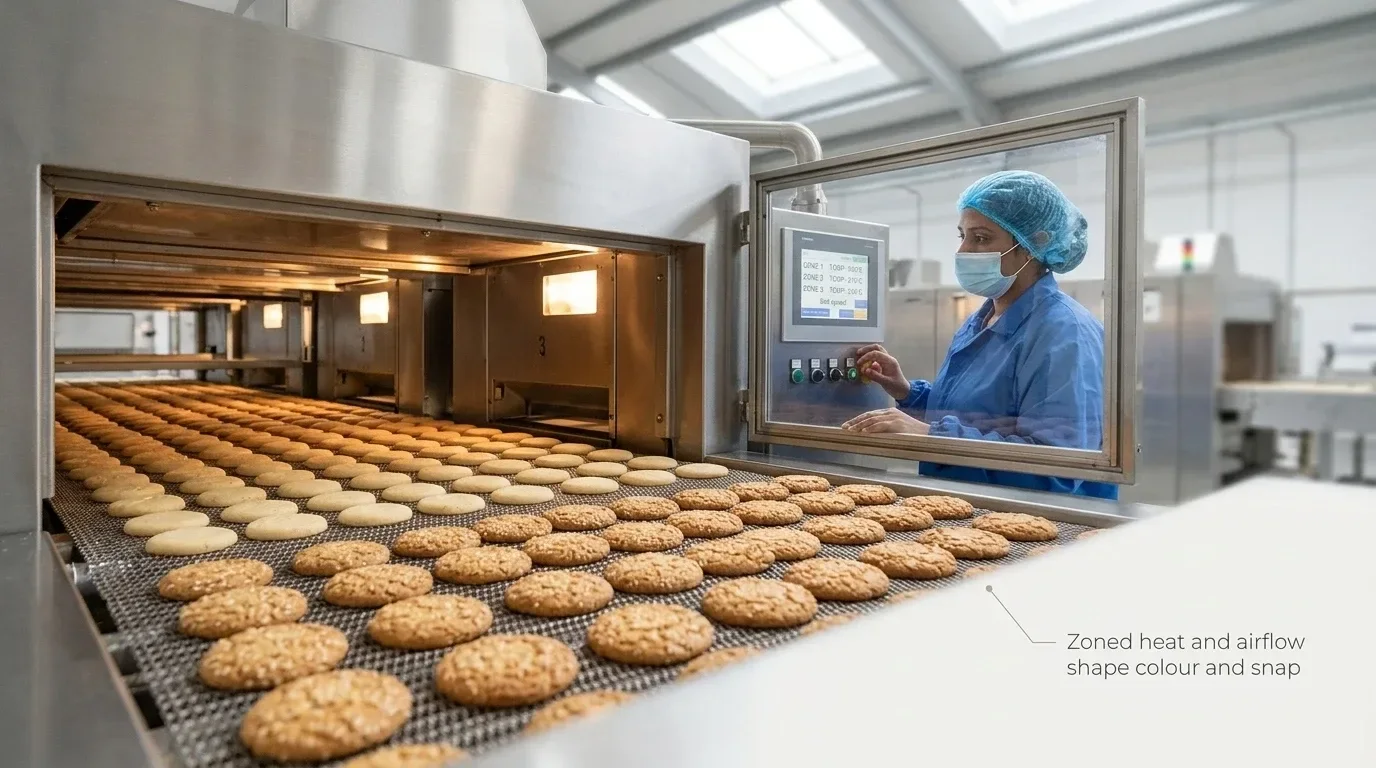
Moisture is the quiet variable. Residual moisture at the oven exit drives crispness and, later, checking and shelf life. Exhaust dampers that let you vent humid air from early zones, and hold it in others, allow you to tune this per recipe.
Ask how many independently controlled zones the oven has, whether top and bottom heat can be set separately, and whether airflow is adjustable. Direct gas-fired, indirect and electric heating each behave differently, and the right one depends on your recipes and utilities.
The rule has exceptions. A very short oven cannot bake a thick cookie properly, whatever the controls. Belt length sets the minimum dwell time at a given speed, so it still has to be adequate.
Finally, check whether the profile can be saved and recalled. If every recipe change relies on an operator remembering damper positions, consistency depends on who is on shift.
How Do You Choose a Cookie Line for a Bakery Factory With a Changing Product Mix?
Frequent SKU changes favour quick-release tooling, recipe memory and cleanable design over peak speed. If you are working out how to choose a cookie production line for a plant with many recipes, these criteria carry the most weight.
Changeover time. Ask for the time to swap dies, rolls or cutters with one trained operator, and whether lifting aids are required. A change that takes under an hour recovers its cost quickly if you switch daily.
Recipe memory. The control system should store forming speed, wire or cutter timing, oven zone settings and belt speed per product. Recall should be one action, not a series of manual adjustments.
Dough range. Confirm the forming head's tested range of dough hardness, fat content and inclusion size. A line that handles two families, perhaps through interchangeable heads, protects you if the portfolio moves.
Cleanability. Allergen changeovers need a line that can be stripped and cleaned fast. Smooth welds, few horizontal ledges and tool-free guards cut downtime, and a modular layout that keeps forming, baking and packing sections separable makes changeover cleaning easier to plan.
Scrap on restart. Ask how much dough and baked product is typically wasted before the line stabilises. With many changes per week, this figure adds up.
Rule of thumb: if you change recipe more than a few times a week, rank changeover time and recipe memory above top speed, and buy the line that restarts cleanly rather than the one that runs fastest.
What Does the Rest of the Line Need to Handle for Your Chosen Forming Method?
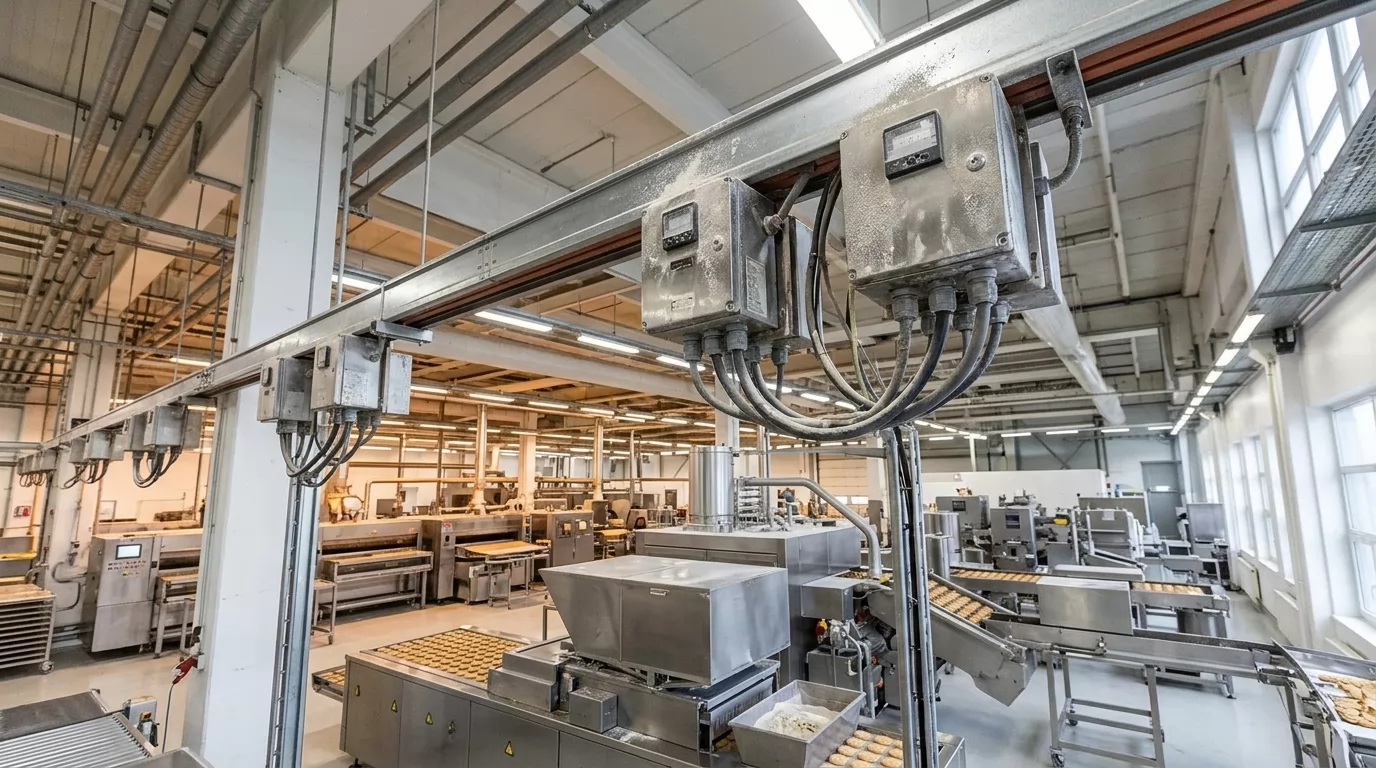
The oven is rarely the bottleneck; cooling length, inclusion dosing and packaging synchronisation usually are, and each depends on what you form. A typical story goes like this. A plant installs a line whose oven comfortably makes the target, then finds that cookies reach the packer warm, soft and fragile, so the line is throttled back.
Cooling comes first. Cookies leave the oven hot and need to lose heat and equalise moisture before packing, or condensation forms inside the pack. Cooling conveyors are long, often longer than the oven. Dwell time depends on thickness and recipe, so size it for your thickest product.
Inclusions are the next problem, especially on a depositor line. Chocolate chips, nuts and dried fruit need a dosing unit that feeds consistently into the dough. Uneven dosing creates weight variation. Check how the doser is cleaned and whether it handles your fragile inclusions without breaking them.
Packaging is where synchronisation matters. Servo-driven cookie packaging uses individually controlled motors to time feeders, film pulling and sealing jaws precisely, which allows fast changes between pack sizes. It also lets the packer follow the speed of the line instead of forcing the line to match fixed mechanical timing.
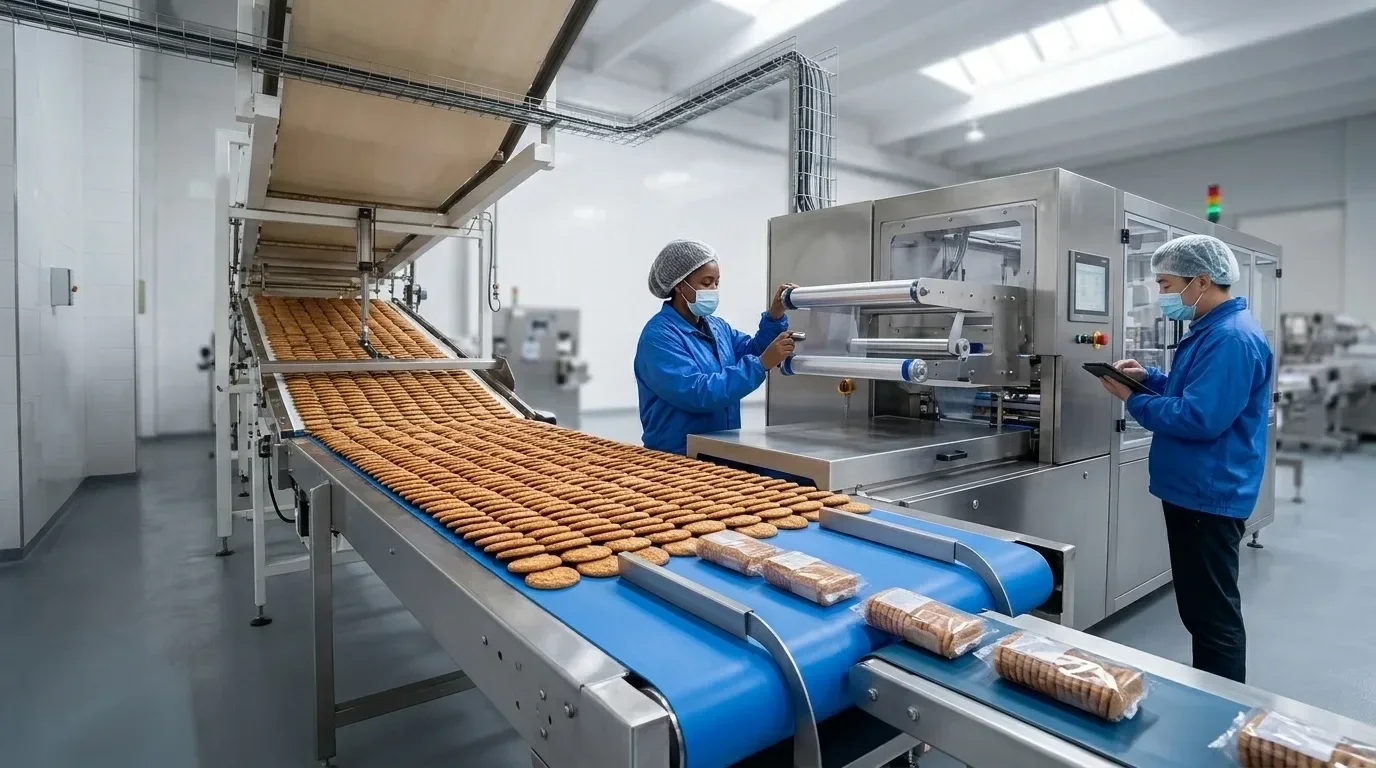
A short accumulation belt before the packer lets the oven keep running during a brief film change or jam. A supplier who quotes only the oven and forming station has left the hardest integration to you.
What Does a Cookie Line Really Cost Over Its Life?
Purchase price is one part. Changeover hours, scrap, energy, spare parts and operator training often outweigh the gap between two quotes. A generic worked example shows how.
Take two lines quoted at different prices. Line A is cheaper but needs ninety minutes for each recipe change, and its forming head produces noticeable weight drift for the first several minutes after every restart. Line B costs more, changes in about thirty minutes, and restarts with less waste.
Suppose your plant changes recipe ten times a week. Line A loses fifteen hours weekly to changeovers against five for Line B. Those ten extra hours, multiplied by the contribution margin of a running hour, come to a large annual figure that can exceed the price difference within the first couple of years. The exact numbers depend on your margins, but the logic holds.
Energy follows a similar pattern. Ovens with better insulation, heat recovery and zoned burners use less fuel per kilogram. Spare parts matter too: ask for a priced spares list and delivery times for wear parts such as belts, wires and rolls.
The lesson: compare lines on cost per saleable kilogram over several years, not on the invoice.
Pre-Purchase Checklist for Comparing Industrial Cookie Making Machine Quotes
The rule is to compare quotes on identical terms, because an industrial cookie making machine priced on different assumptions cannot be judged fairly. Use this list before you sign.
Run a dough trial with your own recipes, including your hardest and your most inclusion-heavy product.
Define acceptance tests in the contract: output per product, weight tolerance, colour and moisture limits, and run time.
Request a written changeover time for each recipe, measured with your team.
Confirm the stable speed range, not only the maximum rated speed.
Check the oven zone count, airflow control and recipe storage.
Verify cooling length against your thickest product.
Obtain a priced spare parts list and delivery times for wear items.
Agree training scope, commissioning days and who attends.
List all utilities: power, gas or thermal oil, compressed air, extraction and water, with consumption figures.
Measure the layout against your floor, doors, ceiling height and service access.
Ask for the machinery conformity declaration and material certificates for your market.
Confirm warranty terms and what they exclude.
Supply the same written specification to every supplier, so differences in the replies reflect the machines and not the questions. Quotes that cannot be matched line by line usually hide the gaps that cost you later.
FAQ
Can I test my own dough before buying?
Usually yes. Many manufacturers run customer dough on a test line, and you should insist on it. Bring your hardest recipe and agree beforehand what results count as a pass.
How long does installation take?
Typically several weeks from delivery to stable production, depending on line size and site readiness. Commissioning of the oven and packaging sync takes the longest.
How many operators does a line need?
Commonly three to six per shift, covering forming, oven, and packing. Automated cooling transfer and servo packaging reduce the count.
Can I upgrade an existing line?
Often yes. Adding a new forming head, doser or packer is common, but check that the oven and conveyors can handle the higher load.
Can one line run different dough types?
Partly. Wire-cut and rotary heads can sometimes share an oven, but each dough family needs its own forming station, so expect interchangeable heads or a second station.

Ready to start your journey toward a customized solution? Contact me directly on WhatsApp to begin the conversation.