Integrating Biscuit Stackers with Packaging Lines (Flow Wrap, X-Fold & Tray)
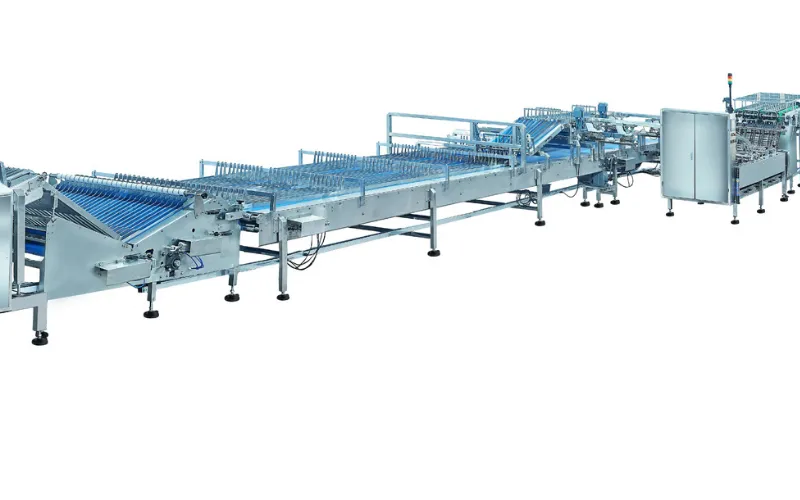
In the modern, high-speed bakery, the oven is a titan. It's a marvel of thermal engineering, capable of baking hundreds of thousands of biscuits per hour. Your cooling conveyor, a river of product 100 meters long, flows perfectly. And then, at the end of this high-capacity line, you have a bottleneck. A chokepoint so severe it strangles your entire production: the packaging area.
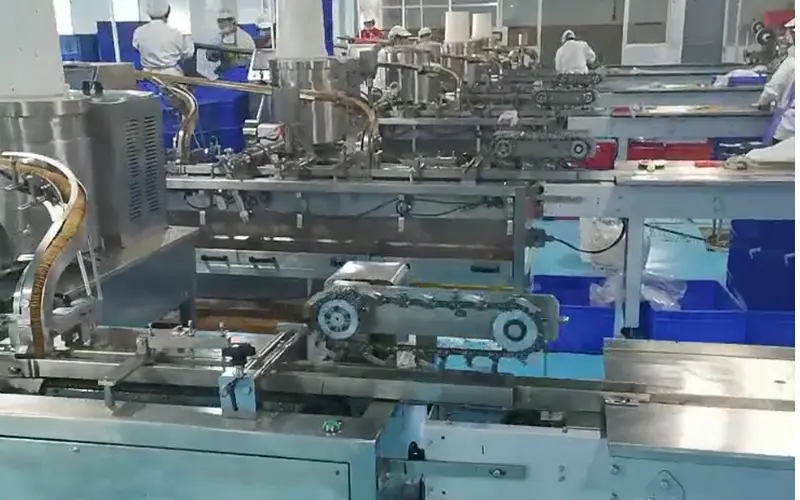
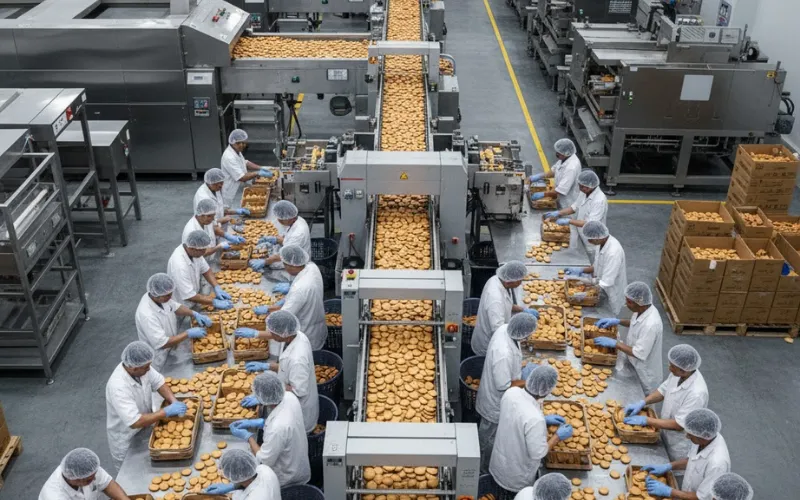
This is the scene in countless food factories: a high-speed production line crashes into a wall of manual labor, with dozens of operators scrambling to manually count, orient, and feed biscuits into various packaging machines. The result is a catastrophic loss of efficiency. You've invested millions in a 1,200mm-wide oven, but your actual throughput is dictated by how fast 20 people can move their hands. This leads to high labor costs, inconsistent pack quality, product breakage, and an OEE that is a fraction of its potential.
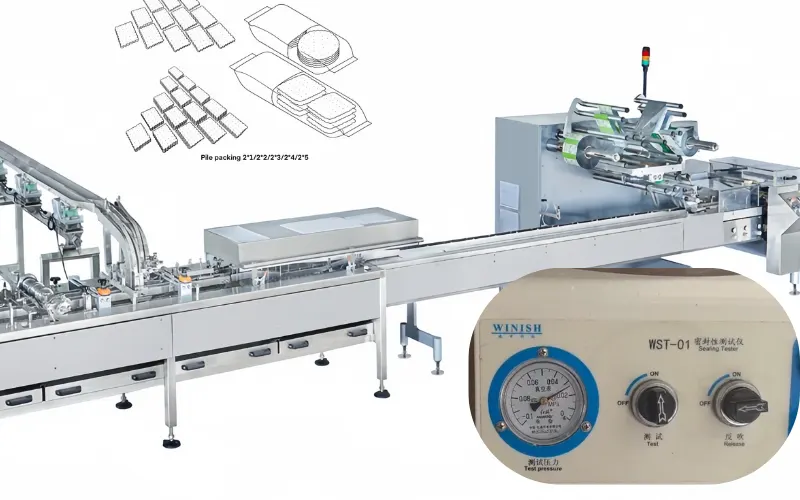
The solution is automation. Specifically, the seamless integration of the biscuit stacking machine with your automated packaging line—be it for on-edge flow wrapping, x-fold wrapping, or tray loading.
But "integration" is a dangerously simple word.
Many factory owners have been burned by this. They buy a best-in-class biscuit stacker from one supplier and a best-in-class packaging machine from another, push them together on the factory floor, and expect magic. Instead, they get a nightmare. Jams, crashes, constant alarms, and a crippling "blame game" where the stacker supplier blames the wrapper's PLC, and the wrapper supplier blames the stacker's sensors.
A successful integration isn't just about a physical connection. It's about creating a single, intelligent, unified system. It's about an electronic "handshake" so precise that the two machines breathe as one.
This definitive guide is for the entire buying committee—from the factory owner and financial manager to the procurement and engineering teams. We will go beyond a simple "what is a biscuit stacker" and deep-dive into the complex how-to of total integration, exploring the mechanical, electrical, and financial elements that separate a high-OEE line from a high-downtime headache.
Key Takeaways: Your Blueprint for a Successful Integration
For those who need the "bottom line" first, here is your integration blueprint. A truly profitable packaging line relies on these four principles:
The "Handshake" is Everything: The electronic communication (the PLC "handshake") between your biscuit stacker and packaging machine is more critical than the physical connection. A "smart" handshake (using EtherNet/IP or PROFINET) is the difference between a reactive line that jams and a predictive line that avoids faults.
Demand a "Single Pane of Glass": Do not accept two separate HMIs (control screens). A unified control system—a "Single Pane of Glass"—where you manage recipes, faults, and speeds for both machines from one screen is non-negotiable for minimizing changeover times and operator error.
The TCO of Failure is Your Biggest Risk: The highest cost of a new line is not the purchase price; it's the financial impact of downtime. The "blame game" between two different suppliers is a hidden OEE killer. A single-source supplier eliminates this risk.
Buy the Integrated Test, Not Just the Machines: Your URS (User Requirement Specification) must demand an integrated FAT (Factory Acceptance Test). This means the biscuit stacker and packaging machine must be tested together, at your target speed, with your actual products, before they ever ship.
The Packaging Destination: Why Your Line Needs a Stacker
To understand the solution, we must first respect the problem. Biscuits are packaged in three main formats:
On-Edge ("Slug") Pack: A counted group of biscuits (a "slug") is stood on its edge and wrapped tightly. This is typically done by a Horizontal Form-Fill-Seal (HFFS) machine, or "flow wrapper," to create a "pillow pack."
On-Pile ("X-Fold" or "Pile") Pack: A counted stack of biscuits is wrapped flat. This is often done by an "X-fold" wrapper (also called a "die-fold" wrapper) for a premium, tucked-end look.
Tray Pack: A counted pile or group of biscuits is placed into a plastic tray, which is then typically fed into a flow wrapper.
The critical, shared element is that all these packaging machines require a product infeed that is perfectly counted, perfectly formatted (slug or pile), and perfectly timed.
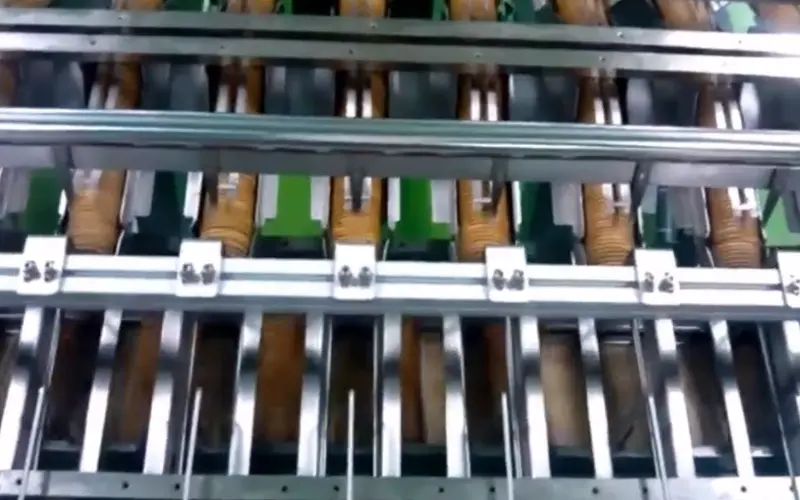
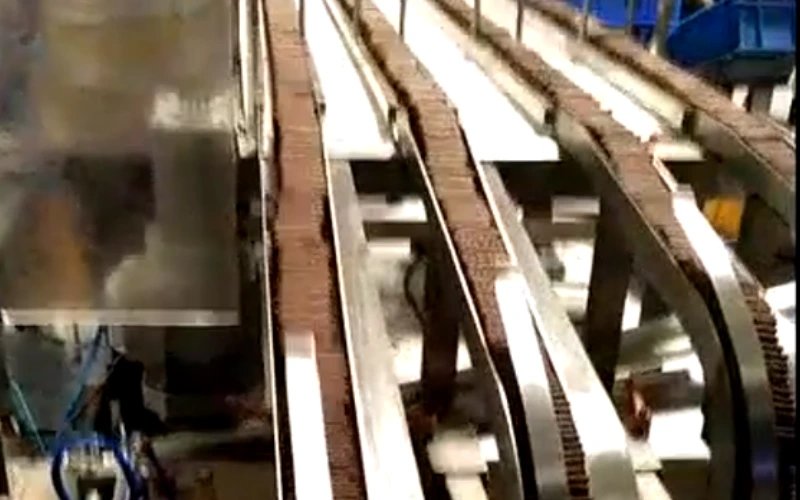
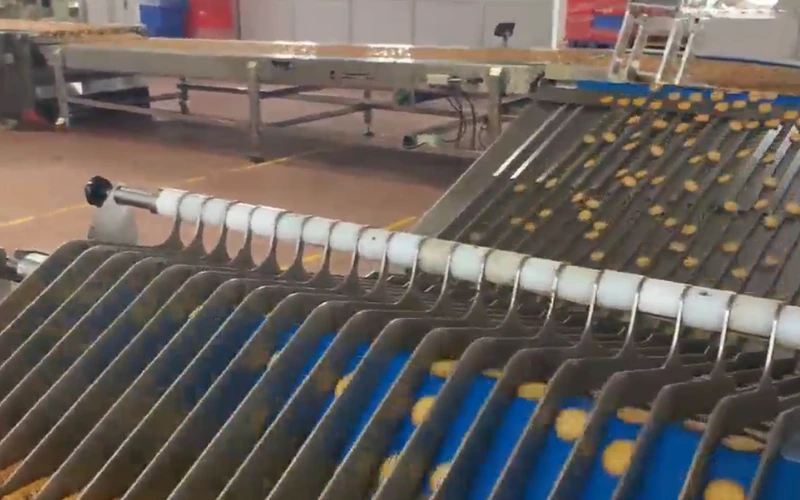
This is where the biscuit stacking machine becomes the most critical "bridge" in your entire factory. Its sole purpose is to solve the "production-to-packaging" chaos. Biscuits coming off a cooling conveyor are in multiple, disorganized, flat lanes. A biscuit stacker must perform four functions:
Align: It funnels multiple lanes of product into one or two organized files.
Count: It uses high-speed photoelectric sensors to create precise groups (e.g., a "slug" of 10, or a "pile" of 4).
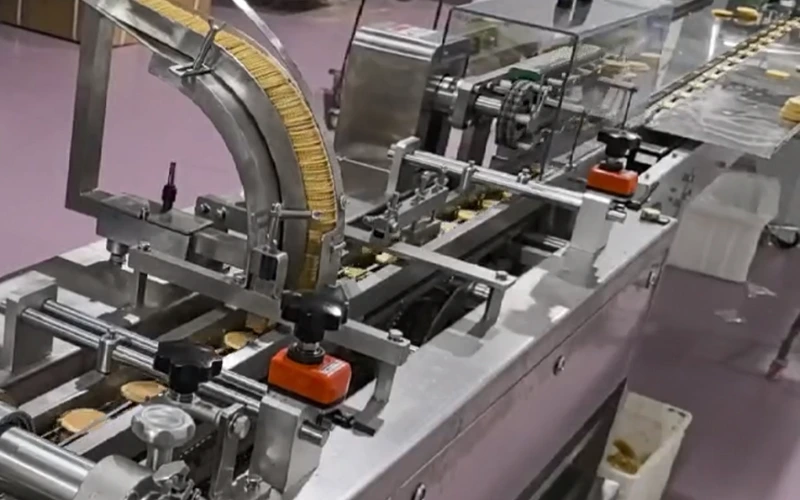
Format: This is the machine's primary "action." It takes the counted group and orients it for the specific packaging machine (e.g., rotates 90 degrees to create an "on-edge" slug, or stacks to create an "on-pile" group).
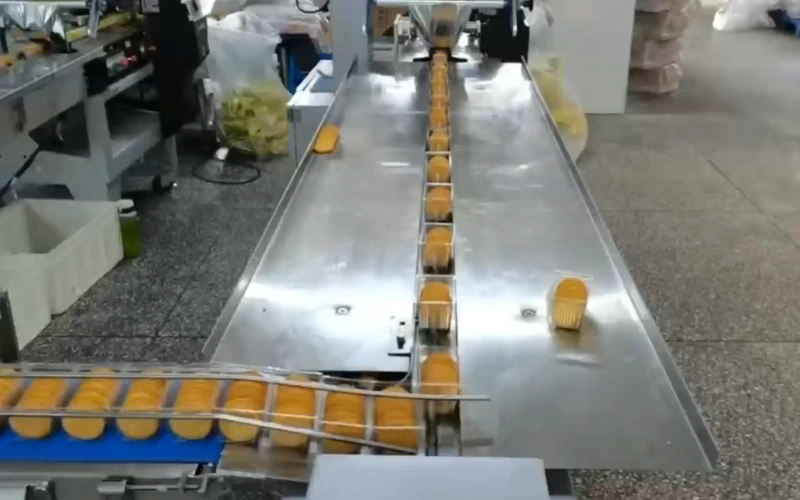
Transfer: Finally, the biscuit stacker must transfer this perfect group into the infeed of the downstream packaging machine, placing it cleanly into the "lugs" or "pockets" of that machine's conveyor.
Without this machine, your automated packaging line is useless. But if this "bridge" is built poorly, the entire line collapses.
The "How-To": A Deep Dive into Total Integration
True integration is a symphony of mechanical precision and electronic intelligence. Both must be perfect. A 5-millisecond lag in the PLC "handshake" can cause a mechanical crash. A 1-millimeter misalignment in the transfer plate can cause a 30-minute jam.
Let's break down both sides of the "handshake."
Part 1: The Mechanical "Handshake" (The Physics of the Transfer)
This is the physical hand-off. It’s the moment the biscuit group leaves the biscuit stacker's outfeed conveyor and lands on the packaging machine's infeed conveyor. For a mechanical engineer, this is "the 10-millimeter problem."
The "gap" between the two conveyors is the single greatest point of mechanical failure. Biscuits are not perfect. They can be slightly warped, sticky from a cream filling, or incredibly fragile (like a wafer). When a high-speed biscuit group hits this gap, it can tip over, slide, or shatter.
Solving this requires sophisticated engineering:
Live-Nose / Small-Diameter Transfers: A standard conveyor belt roller might be 50mm in diameter, creating a large, unavoidable gap. A "live-nose" or "knife-edge" transfer uses a roller as small as 10-15mm, making the gap so small that even the smallest biscuit can cross it smoothly.
Servo-Driven Matched Speeds: The biscuit stacker's outfeed belt must be moving at the exact same speed as the downstream machine's infeed chain. If the stacker's belt is faster, the biscuit "crashes" into the lug. If it's slower, the lug "catches up" and shatters the product. Only a fully integrated servo-drive system, where both machines share the same speed reference, can achieve this.
Side-Gripper Belts: For "on-edge" slugs, the best transfer method is often a set of gentle, servo-driven side-belts. These belts grip the finished slug from both sides, lift it over the "gap," and place it directly into the wrapper's infeed, giving it zero chance to fall over.
Pusher Mechanisms: For "on-pile" stacking, a servo-controlled pusher rod gently slides the entire stack (as one unit) from the stacker's grouping belt onto the infeed of the tray loader or X-fold wrapper, ensuring the pile doesn't become disorganized.
Tip: During your supplier review, ask for a close-up video of the transfer point, not just the whole machine. Ask them to run your most fragile biscuit over it at your target speed. The quality of this single component will predict 80% of your future mechanical jams.
Part 2: The Electronic "Handshake" (The PLC "Handshake")
This is the brain. If the mechanical transfer is the "hand-off," the electronic "handshake" is the real-time conversation between the two machine PLCs that makes it possible.
There are two levels of this "handshake."
Level 1: Basic "Dry Contact" Handshake (The "Dumb" Method)This is an old-school method using simple 24V on/off signals. It's like two people communicating with a light switch.
Stacker -> Wrapper: "I have a product ready." (Signal ON)
Wrapper -> Stacker: "I am running and ready for product." (Signal ON)
Stacker -> Wrapper: "I have a fault." (Signal OFF)
Wrapper -> Stacker: "I have a fault." (Signal OFF)
The Problem: This is purely reactive. The stacker doesn't know the wrapper has a problem until it's already stopped. This often results in the stacker "over-feeding" and causing a jam that must be manually cleared. It's crude, slow, and the root cause of countless micro-stops.
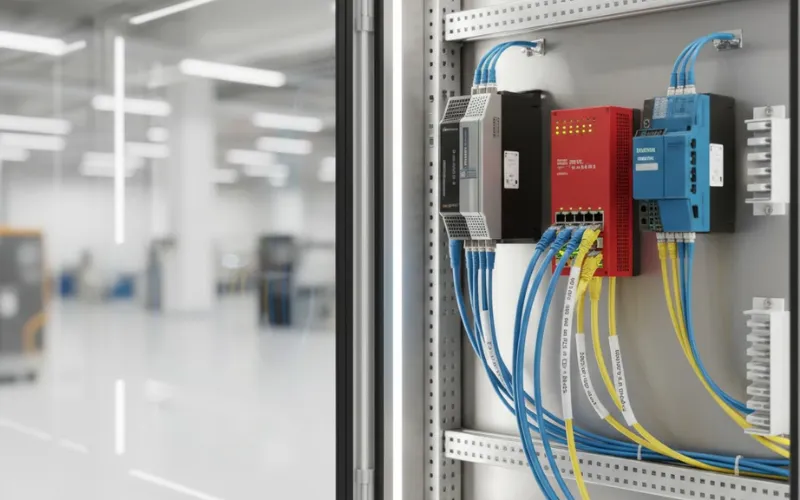
Level 2: Smart "Fieldbus" Integration (The "Predictive" Method)This is the modern standard and a non-negotiable for any high-speed line. The two PLCs are connected on the same industrial network, such as EtherNet/IP (common for Allen-Bradley/Rockwell) or PROFINET (common for Siemens).
This allows for a rich, real-time exchange of data. The downstream packaging machine is typically the "Master," and the biscuit stacker is the "Slave."
The packaging machine's servo-drive acts as the "metronome" for the entire line. It sends a constant digital signal: "My speed is 350.5 PPM."
The biscuit stacker's servo-drive instantly matches this speed. If the operator speeds up the wrapper to 355 PPM, the stacker automatically speeds up in perfect synchronization.
This "smart" integration unlocks critical features for OEE and waste reduction. For flow wrappers, this includes:
"No Product / No Bag" (NP/NB): The stacker's sensors detect a gap on the infeed (e.g., a broken biscuit was rejected). It sends a digital message to the wrapper: "Warning: There will be no product in lug #452." The wrapper's PLC receives this and skips feeding the film and making a seal for that one cycle.
Financial Impact: This saves thousands of meters of packaging film and prevents the operator from having to manually sort empty bags off the line.
"No Gap / No Seal" (NG/NS): A sensor at the wrapper's infeed detects a misplaced biscuit (e.g., it's "on" the lug instead of "in" it). This would cause a crash in the sealing jaws, a major jam.
Financial Impact: The wrapper's PLC instantly sends a "Stop Feed" signal to the stacker and a "Stop Seal" command to its own jaws, before the crash happens. This turns a 30-minute mechanical jam into a 3-second, self-correcting pause.
Note: The "No Product / No Bag" feature alone can deliver an ROI of months, not years, in film savings. When you ask a supplier "Is your biscuit stacker integrated?" the real question is, "Does your integration fully support these smart protocols?"
Beyond the "Handshake": The "Single Pane of Glass" Control Philosophy
Even with a "smart" handshake, you can still have a massive operator-level problem. Your biscuit stacker has one HMI (Human-Machine Interface), and your packaging machine has another.
This is the "Two HMI Nightmare."
Problem 1: Changeovers. The operator wants to switch from a 10-pack cracker to a 12-pack cookie. They have to:
Walk to the biscuit stacker HMI. Load Recipe #5 (12-count, on-edge).
Walk to the packaging machine HMI. Load Recipe #B (150mm bag length, new temp).
If they mismatch the recipes (e.g., Recipe #5 on the stacker and Recipe #C on the wrapper), the line will crash. This is an enormous source of human error.
Problem 2: Fault Finding. The line stops. The operator walks to the stacker's HMI. It says, "Waiting for Downstream Signal." The operator walks 10 feet to the packaging HMI. It says, "Waiting for Upstream Product." This is useless. The operator is stuck in the middle, and downtime ticks up.
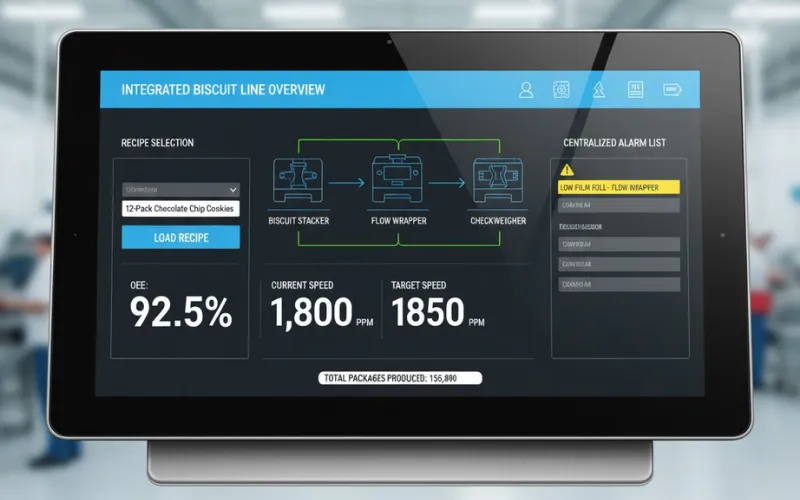
The Solution: The "Single Pane of Glass"This is the philosophy that a truly integrated line should be controlled from one single point. This is a massive differentiator and a core feature of a well-designed system.
In this setup, a "master" HMI (usually at the packaging machine) controls all machines in the line.
Unified Recipe Management: The operator selects one recipe from one screen: "12-Pack Cookie." This single selection automatically sends the correct parameters to the biscuit stacker (12-count, on-pile, 400PPM), the packaging machine (150mm bag length, 210C seal temp), and even the checkweigher (target weight 180g).
Centralized Alarms: A fault anywhere appears on this one screen with a clear, actionable message. "Fault: Stacker Photo-Eye #3 Blocked. Line Paused." The operator knows exactly where to go and what to fix.
Tip: When writing your URS (User Requirement Specification), do not just ask for "EtherNet/IP integration." You must demand "A unified, single-HMI control system for all recipe management and fault/alarm handling." This will save you thousands of hours in changeover time and troubleshooting.
Choosing Your Integration: Matching the Stacker to the Packaging Format
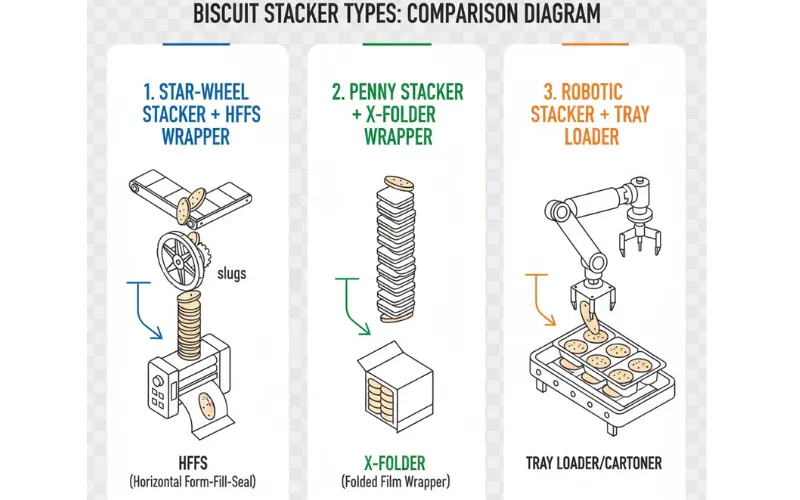
The type of biscuit stacker you need is dictated by your product and your desired final pack.
For Slugs (On-Edge Packaging)
Product: Hard or semi-hard biscuits, crackers, or plain cookies.
Desired Pack: A "slug" of 8-20 biscuits, standing vertically "on-edge," and packed tightly.
Destination Machine: A Horizontal Flow Wrapper (HFFS).
Stacker Type: Star-Wheel Stacker (also called an "On-Edge Stacker" or "Slug Loader").
How it Works & Integrates:
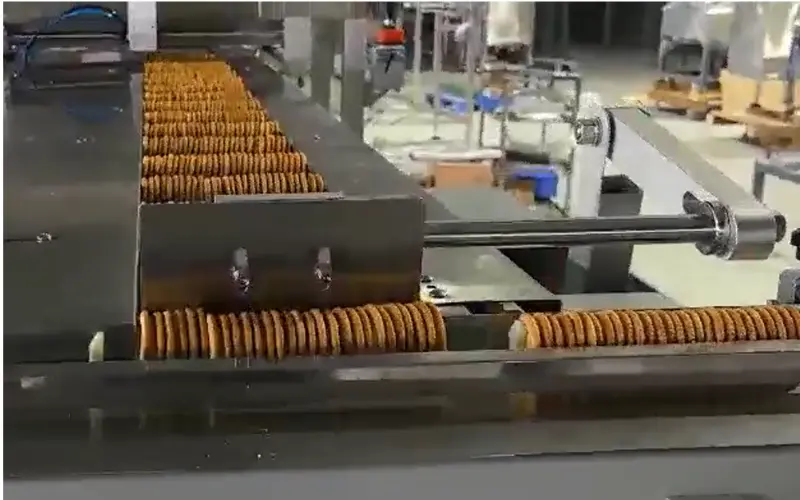
Biscuits arrive flat in a single file.
They are fed into the pockets of a large, vertically rotating "star wheel."
As the wheel turns, it rotates the biscuits 90 degrees, from flat to on-edge.
The biscuits are then gently deposited into a "slug channel."
A sensor counts the biscuits until the slug is complete (e.g., 12 biscuits).
A servo-driven side-pusher or side-belt system then transfers the entire slug horizontally into the infeed lug of the flow wrapper.
For Piles (X-Fold or Tray Packaging)
Product: Softer cookies (like chocolate chip), biscuits with inclusions, or premium "petit" biscuits.
Desired Pack: A "pile" of 2-5 biscuits, stacked flat on top of each other, or "shingled" (overlapping).
Destination Machine: An X-Fold Wrapper (for premium packs) or a Tray Loader (which then feeds a flow wrapper).
Stacker Type: Penny Stacker (also called a "Pile Stacker" or "Shingle Feeder").
How it Works & Integrates:
Biscuits arrive in a single file on a high-speed belt.
A sensor counts the target number (e.g., 4 biscuits).
When the count is met, the biscuit stacker performs its action (e.g., a "retracting belt" drops the pile).
This "on-pile" group is then transferred as a single unit (often via a pusher rod) into the infeed of the tray loader or X-fold wrapper.
For Delicate Products (Cream Sandwiches, Wafers)
Product: Highly fragile products (wafers, enrobed biscuits) or "difficult" products (cream-filled sandwiches).
The Problem: A "star-wheel" rotation will shatter a wafer. A "penny stacker" drop will smear the cream.
Stacker Type: Gentle-Handling Feeders or Robotic Delta Pickers.
How it Works & Integrates: These are high-tech, servo-driven systems. Delta robots, for example, use a vision system to pick individual biscuits, orient them, and place them directly into the infeed of the packaging machine, offering the most flexibility for delicate, small biscuit stacking machine applications.
The Financial Case for Seamless Integration
This is the section for the Financial Manager, the Procurement Manager, and the Factory Owner. The conversation about integration is not, ultimately, about PLCs. It's about money.
A poor integration, or a "two-supplier" solution, introduces profound financial risks that are often not on the initial purchase quote.
Quantifying the Cost of a 30-Minute "Handshake" Fault
Let's use conservative, real-world numbers for a typical biscuit line.
Line Speed: 400 packs per minute (PPM)
Downtime Event: A single 30-minute line stop caused by a "handshake fault" where the stacker and wrapper lose synchronization.
The Math: 400 PPM x 30 minutes = 12,000 lost units.
What is the real cost of those 12,000 lost units?
Lost Revenue: The retail value of that product, which is now not on a truck.
Lost Labor: You are paying your entire line staff (10-15 people) to stand and wait.
Wasted Product: The jam itself may have destroyed hundreds of biscuits (product cost).
Wasted Film/Cartons: The wrapper may have created dozens of empty or mis-sealed bags (material cost).
Wasted Energy: Your ovens, cooling tunnels, and HVAC are all running (energy cost).
A single 30-minute fault can easily cost thousands of dollars. If this happens once a day, you are looking at a six- or seven-figure annual loss, all because of a bad "handshake."
The Hidden TCO of the "Blame Game"
This is the single greatest (and most common) financial disaster of a multi-supplier integration.
The Scenario: Your line is down with a "handshake" fault.
You call the Biscuit Stacker Supplier. Their technician spends two hours remotely logging into the PLC. Their verdict: "Our biscuit stacker is working perfectly. It's sending the 'Product Ready' signal. The packaging line is not sending the 'Ready' signal. It's their problem."
You call the Packaging Machine Supplier. Their technician logs in. Their verdict: "Our machine is fine. It's waiting for a 'Product Ready' signal from the stacker, but it's not receiving it. It's their problem."
You are now trapped in the middle. Your line is down for 4, 8, or even 24 hours. Your maintenance team is furious, your operators are idle, and your customer order is late. You are paying two different suppliers for service contracts, and neither is taking responsibility for the line's OEE.
This "blame game" is the hidden Total Cost of Ownership. For a full breakdown of the factors that influence the biscuit stacking machine price, see our detailed guide.
The Solution: The "Single Source of Truth"The most intelligent financial decision is to eliminate this risk by procuring the entire integrated line from a single-source supplier.
When one company is responsible for the biscuit stacker, the packaging machine, and—most importantly—the integration code that binds them, the entire dynamic changes:
There is one number to call.
There is one team responsible for your line's OEE.
There is no "blame game."
The supplier is not responsible for a machine; they are responsible for your result (e.g., "95% OEE at 400 PPM"). This "Single Source of Truth" is not just a convenience; it's an insurance policy on your entire capital investment.
Note: The small premium you might pay for a pre-integrated, single-source line is infinitesimally small compared to the cost of one day of "blame game" downtime.
Designing for Uptime: Integration vs. Real-World Operation
A line can be perfectly "integrated" from a controls perspective and still be a total failure if it's a nightmare for your maintenance and sanitation teams.
A machine must be "integrated" not just with other machines, but with the people and processes of your factory. This is where mechanical and hygienic design becomes a non-negotiable part of the "integration" discussion.
"It's Not Integrated If You Can't Clean It": Hygienic DesignYour sanitation team is your first line of defense against recalls and shutdowns. If they can't clean a machine properly, that machine is a liability.
The Problem: Traditional machine frames are built from hollow stainless steel tubes. Water, bacteria, and product dust get inside these "hollows," creating a massive food safety risk. Cleaning teams spend hours trying to "clean" what they can't even see.
The Solution: Cantilevered Design. This is a modern, high-hygiene design principle, often following guidelines from bodies like the EHEDG (European Hygienic Engineering & Design Group). The machine is supported from one side, leaving the other side completely open.
It eliminates hollow frames.
It allows operators to see and clean under all components.
It allows for tool-less belt removal. A sanitation operator can remove a conveyor belt in 30 seconds, with no tools, take it to a wash station, and clean the entire machine frame.
Financial Impact: This design can reduce sanitation changeover time from 3 hours to 30 minutes. That's 2.5 hours of additional production time, every single day.
"It's Not Integrated If You Can't Access It": Design for Maintenance (DfM)Your maintenance engineer is focused on MTTR (Mean Time To Repair). When a component fails, how fast can they fix it?
The Problem: A "bad" design, often to save a few dollars, will bury critical components. The main drive motor is tucked under a conveyor. A critical sensor is hidden behind a sealed panel that requires 12 bolts to be removed. A 10-minute sensor swap becomes a 2-hour disassembly nightmare.
The Solution: DfM. This means designing the machine for the maintenance team.
Motors and gearboxes are placed on the outside of the machine frame, accessible and easy to swap.
Centralized lubrication points, so an operator doesn't have to hunt for 20 different grease fittings.
Using quick-disconnect cables (like M12 connectors) for sensors, so a new one can be plugged in in seconds, with no rewiring.
Note: When your engineers are evaluating a biscuit stacking machine, have them bring a maintenance-focused checklist. Ask, "Show me how to replace the main drive motor," or "Show me how to change this belt." Their answers will tell you everything about your future TCO.
Beyond the Wrapper: Integrating the Entire End-of-Line (EoL) System
The biscuit stacker and primary packaging machine are the heart of your line. But a truly automated factory doesn't stop there. This same "smart handshake" philosophy must be extended to your "Secondary" and "Tertiary" packaging.
A fully "smart" line (or "Line 4.0") looks like this:
Production: Oven -> Cooling Conveyor.
Primary Packaging:
Biscuit Stacker (Aligns & Groups)
Flow Wrapper / X-Folder / Tray Loader (Creates Primary Pack)
Quality Control:
Checkweigher: Weighs each pack. If underweight, it's rejected.
Metal Detector / X-Ray: Scans for contaminants.
Secondary Packaging:
Collator/Case Packer: A robot or grouping system that "collates" the finished packs.
Case Erector: Automatically forms a cardboard shipping box.
Case Packer (cont.): Places the collated group of packs into the box.
Case Sealer: Tapes the box shut.
Tertiary Packaging:
Labeler: Prints and applies a label to the box.
Robotic Palletizer: Stacks the finished boxes onto a pallet.
In a fully integrated line, these are not 10 separate machines. They are 10 modules of a single system. The "smart" handshake extends all the way down the line, so a fault at the palletizer can safely pause the biscuit stacker in milliseconds, preventing a catastrophic line-wide jam.
How to Buy an Integrated Line: A Procurement & URS Checklist
This section is for the Procurement Manager and Project Engineer. Do not send a "Request for Quote" (RFQ) until you have a rock-solid URS (User Requirement Specification). A vague URS is an invitation for a "blame game" disaster.
Use this checklist to create a URS that guarantees a successful integration and protects your investment.
1. Demand an Integrated FAT (Factory Acceptance Test) — This is Non-Negotiable.
Specification: "The supplier must perform a single, integrated FAT, testing the biscuit stacking machine and the downstream packaging machine together as a complete system."
Specify Further: "This FAT must use the client's (our) specific biscuit products, in all sizes and formats. The line must run at the full, contracted target speed (e.g., 400 PPM) for a minimum of 4 continuous hours with an OEE of at least 95%."
Why: This finds 99% of all integration bugs before the machines are on your floor. It is the single most important clause in your contract.
2. Specify the "Master" PLC, Network, and Brand.
Specification: "The entire integrated line must operate under a single 'master' PLC (e.g., 'The packaging machine PLC will be the line master')."
Specify Further: "All line components must be from the same controls family (e.g., 'All PLCs, Servos, and HMIs must be Allen-Bradley' or 'All must be Siemens')."
Specify Network: "All machine-to-machine communication must be via a single, common industrial protocol (e.g., 'EtherNet/IP' or 'PROFINET')."
Why: This forces controls-level uniformity, which is essential for your maintenance team.
3. Demand a Unified "Single Pane of Glass" HMI.
Specification: "The supplier must provide a single, unified HMI for primary operator control."
Specify Further: "From this single HMI, the operator must be able to:
Select, edit, and manage all line-wide recipes.
View and acknowledge all alarms and faults from all integrated machines.
Control the start, stop, and speed of the entire line."
Why: This eliminates operator error and dramatically cuts changeover times.
4. Define the Integrated Safety Circuit.
Specification: "A single, hardwired Emergency-Stop (E-Stop) circuit must control the entire integrated line."
Specify Further: "Activating any E-Stop button on any machine module must safely stop all hazardous motion on the entire line, compliant with ISO 13849 Cat 3/PLd."
Why: A "two-system" safety circuit is a dangerous, non-compliant liability.
5. Define Performance Guarantees (OEE) at SAT.
Specification: "Final payment is contingent on the line passing a Site Acceptance Test (SAT) at the client's facility."
Specify Further: "This SAT must demonstrate a stable OEE.
Why: This holds your supplier accountable not just for delivering machines, but for delivering performance.
Tip: By sending this URS to your suppliers, you are telling them you are an expert buyer. It forces a higher level of accountability and filters out any supplier who isn't confident they can deliver a truly integrated, high-performance solution.
Conclusion: Your Stacker is the Heart of Your Packaging Line
A biscuit stacker is not just another conveyor. It is the intelligent, high-speed "bridge" that unlocks the true potential of your entire production line. It is the heart that pumps product to your packaging line.
But a heart cannot function without a brain.
The "integration" is the brain. It's the complex web of mechanical, electrical, and data-driven connections that make two machines act as one.
As we've seen, buying a biscuit stacker from one company and a packaging machine from another is not buying a solution—it's buying a problem. It's buying a high-risk gamble that two separate engineering philosophies will magically work, and it's inviting the costly "blame game" onto your factory floor.
A truly successful project is built on a "Single Source of Truth." By partnering with an automation expert who takes total responsibility for the entire integrated line—from the stacker's infeed to the final pack—you are not just buying machines. You are buying a guaranteed result: Higher OEE, lower TCO, and zero "blame game" downtime.
Frequently Asked Questions (FAQs)
Q1: What is the difference between a penny stacker and a star wheel stacker?A: This is the most common question! A penny stacker (or on-pile stacker) is for creating flat stacks of biscuits. It counts a group (e.g., 4 cookies) and "drops" or "slides" them to form a pile, which is then fed into a tray loader or an X-fold wrapper. A star wheel stacker (or on-edge stacker) is for creating "slugs." It uses a large, pocketed wheel to rotate biscuits 90 degrees, from flat to standing "on-edge," which is ideal for high-speed, on-edge flow wrapping.
Q2: How do you synchronize the speed of a biscuit stacker and a packaging machine?A: This is done with a "smart handshake" using servo motors and a common network (like EtherNet/IP). The packaging machine is set as the "Master" and its servo-drive sets the speed for the line (e.g., 300 packs per minute). It sends a continuous digital signal to the biscuit stacker's servo-drive (the "Slave"), which perfectly matches its speed in real-time. This ensures the transfer is always synchronized.
Q3: Is it really better to buy the stacker and packaging line from the same company?A: From a technical and financial perspective, yes, overwhelmingly. When you buy from two suppliers, you are responsible for the integration, and you will be the "middle-man" during any downtime (the "blame game"). When you buy a pre-integrated line from one "Single Source" supplier, they are responsible for the line's performance, which is tied directly to OEE. You are buying a performance guarantee, not just two machines.
Q4: Can one biscuit stacking machine handle different biscuit sizes and shapes?A: Yes, but this must be specified in your URS. Modern servo-driven biscuit stackers are designed for high flexibility. Changeovers for different products (e.g., from a 60mm round cracker to a small biscuit) can be "tool-less" and recipe-driven. The operator simply selects the new recipe on the HMI, and the servo motors automatically adjust the lane guides, stacker-wheel timing, and pusher speeds. This can reduce a 2-hour mechanical changeover to under 15 minutes.
Q5: What is "No Product / No Bag" and why is it so important for flow wrappers?A: This is a critical "smart" integration feature specific to flow wrappers. The biscuit stacker's sensors "tell" the flow wrapper's PLC if a biscuit is missing before it gets to the wrapper. The wrapper then skips forming a bag for that one empty cycle. This is vital for two reasons: 1) It saves an enormous amount of money on wasted packaging film, and 2) It prevents operators from having to manually find and remove empty bags from the finished cases, which is a major labor cost. This is a key feature you should look for in any biscuit stacking machine price & ROI guide.
Stop the Bottleneck. Start the Conversation.
Your factory is capable of more. Don't let a "bad handshake" or a "blame game" between suppliers dictate your factory's OEE.
If you are tired of the packaging bottleneck and ready to see what a truly seamless, single-source integrated line can do for your production, our engineering team is ready to talk.
Contact us today for a free, no-obligation "Integration Audit." We will analyze your products, your target speeds, and your existing setup to provide a clear, actionable plan for eliminating the blame game and unlocking the true capacity of your line.

Ready to start your journey toward a customized solution? Contact me directly on WhatsApp to begin the conversation.