The Penny Stacker Deep Dive: A Guide to Gentle Automation for Fragile, Coated & Sandwich Biscuits
I. Introduction: What is a Penny Stacker?
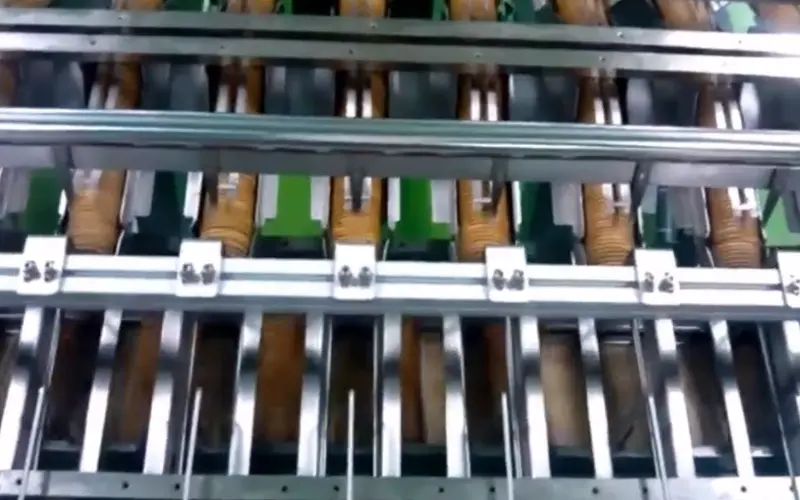
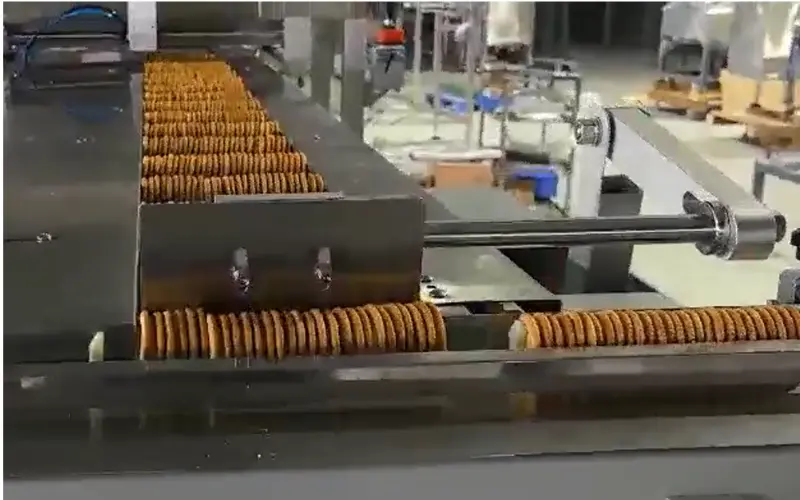
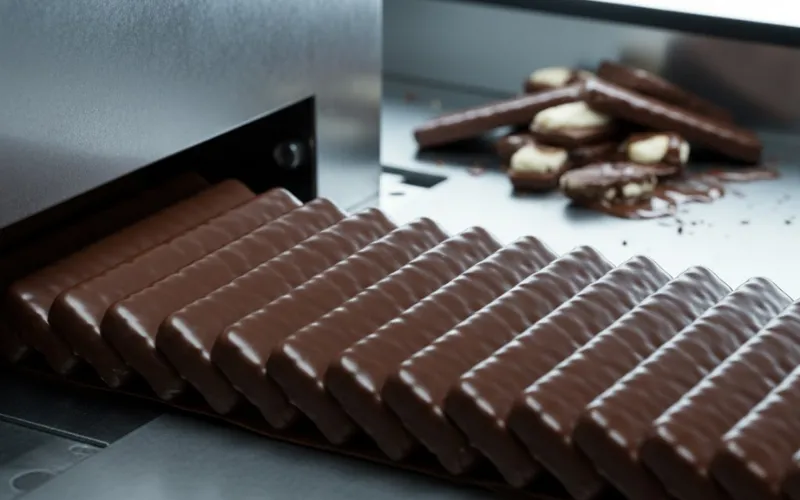
What is penny stacking? A penny stacker, also known as a shingling stacker, is a high-precision automation system. Its core function is to take biscuits lying flat on a cooling conveyor and, through gentle, horizontal handling, automatically count and group them before transferring them—perfectly intact—to the packaging process.
It is fundamentally different from an on-edge stacker for one critical reason: a penny stacker never flips your product.
This single characteristic makes it the only viable solution in the baking industry for handling high-value, fragile, coated, or sandwich biscuits (penny stacker biscuits). In these applications, any 90-degree flip or harsh lateral push means catastrophic breakage and waste.
This guide will provide a deep dive into the engineering principles of this system, its unique ROI model, and how it safeguards your most valuable products, from market trends and engineering to maintenance, case studies, and procurement.
Key Takeaways
Core Function: The
penny stackeris the premier gentle automation solution for fragile, coated, and sandwich biscuits, defined by its no-flip, horizontal handling process.Problem Solved: It directly eliminates the three primary failures of traditional stacking: breakage, coating smears, and filling squeeze-out.
Key Technology: True "gentle handling" is not just a phrase; it's achieved through a technical trinity of S-Curve servo profiles, anti-adhesion materials (Teflon), and advanced vision sensors.
The Real ROI Model: The true financial return is found not just in labor savings, but in the massive value recaptured by eliminating product waste.
Purchasing Mandate: When buying, insist on servo-driven systems (not pneumatic) and demand a breakage-rate Factory Acceptance Test (FAT) using your actual products.
II. The Market Trend: Why "Gentle Handling" is a Core Competency in 2025
In today's baking market, "gentle handling" has rapidly shifted from a "nice-to-have" feature to a "must-have" core competency. If you are still ignoring product damage right before the package, you are already losing the game.
A. The Premium-Consumer SqueezeMarket data clearly shows that consumers will pay a significant premium—often up to 30%—for products with a "perfect appearance." Whether it's the "unboxing experience" on social media or the high-end supermarket shelf, the retail channel's tolerance for aesthetic flaws like coating scuffs, filling-squeeze, or edge-chipping is now zero.
A damaged product sends a clear signal of "cheap" and "poor quality control," a perception that is devastating to a premium brand.
B. The SKU-Explosion & "Micro-Pack" TrendConsumer demand is fragmenting into hyper-personalized preferences. This means "micro-packs" (like 2-biscuit packs) and "variety packs" are now the norm.
This trend demands a production line with extreme flexibility in "counting" and "grouping," such as switching from a "3-count" to a "5-count" group on the same line at the touch of a button. The servo-grouping function of a
penny stackeris engineered for this exact high-flexibility demand, a task that manual sorting or fixed-lane on-edge stackers cannot perform efficiently.C. The "Waste-Control" Profit ModelThe cost of premium raw materials—cocoa, quality butter, nuts—has skyrocketed. In this high-cost environment, "waste control" is "profit control."
Every penny you save in the oven is easily lost tenfold by rough handling at the packaging infeed. Every single biscuit discarded for cosmetic flaws is a direct drain on your net profit. A professional
penny stackeris, quite literally, a guardian of your profit margin.
III. Why "Gentle Handling" is the Only Choice for Fragile Products (The Core Pain Point)
We constantly see clients invest millions in developing the perfect sandwich wafer or chocolate-dipped cookie, only to fail at the final yard. If you entrust your high-value, fragile product to the wrong equipment (like an on-edge stacker) or to manual labor, you will inevitably face the "Three Sins" of product handling:
1. BreakageThe signature 90-degree "flip-wheel" of an on-edge stacker will instantly snap a delicate wafer, a shortbread, or a high-butter-content cookie. This impact force is devastating for any product whose primary attribute is being "light," "crisp," or "flaky."
2. SmearingWhen biscuits are packed tightly "on-edge" (back-to-back) and pushed laterally at high speed, the friction between products is unavoidable. This friction scuffs and smears expensive chocolate coatings or sugar frostings, making the final product look cheap and "dirty."
3. SqueezingSimilarly, that same lateral pressure will squeeze soft cream or jam fillings out from the sides of a sandwich biscuit. This not only disqualifies the product aesthetically but also contaminates the entire conveyor and packaging machine, triggering a cascade of hygiene problems and line stoppages.
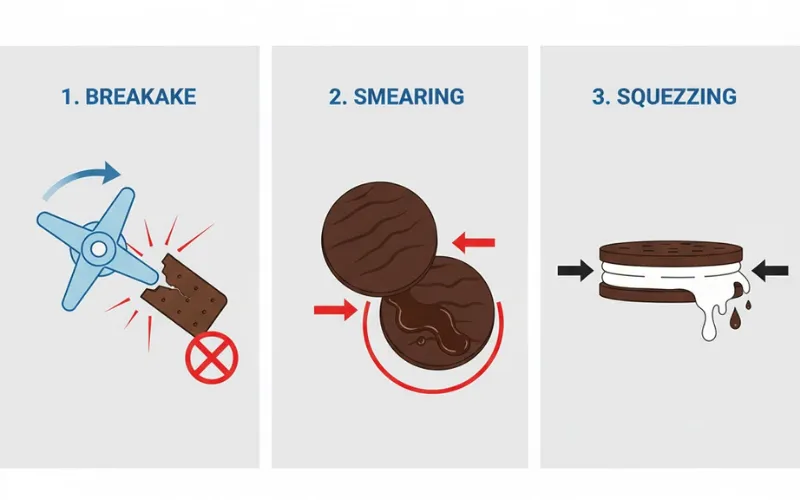
A penny stacker eliminates all three of these problems at their source by maintaining a horizontal orientation at all times. It applies no flipping force and no excessive lateral pressure, ensuring the product is stable and independent throughout the process.
Note: The core value proposition of a
penny stackeris "horizontal-plane handling." By eliminating flips and lateral compression, it fundamentally protects the appearance and integrity of high-value products.
IV. The Core Workflow: How a Penny Stacker Works
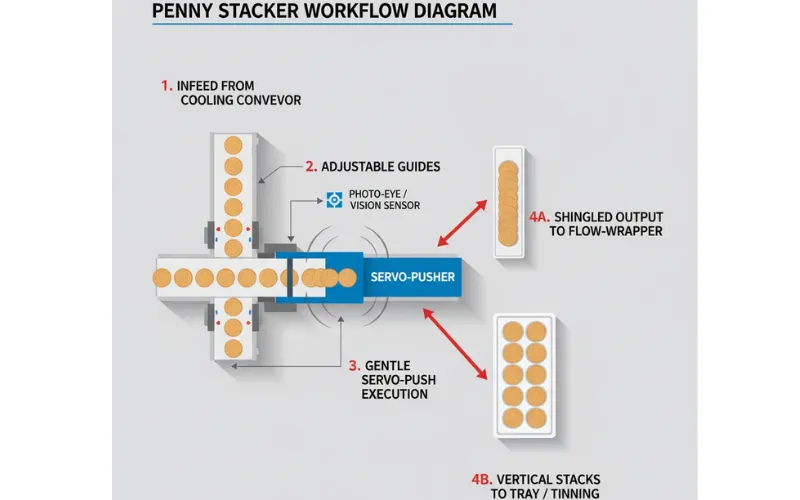
The workflow of a penny stacker appears simple, but it relies on a sophisticated control logic:
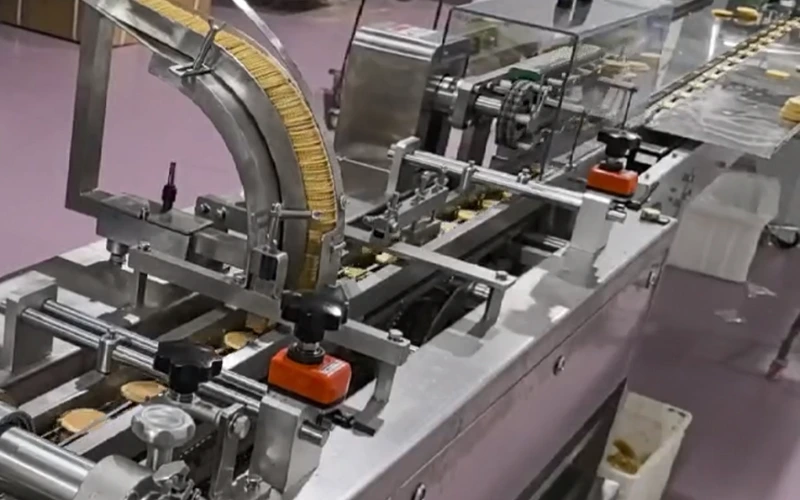
1. Infeed & GuidingBiscuits arrive flat from the cooling line, entering the stacker's first servo-controlled belt. Adjustable side-guides (typically tool-less) ensure they are marshaled into a single, centered lane, preparing them for an accurate count.
2. Photo-Eye CountingA high-precision photoelectric sensor (photo-eye) or an advanced vision sensor detects every single product that passes. The operator pre-sets the "count-per-group" (e.g., 6 biscuits) on the HMI (Human-Machine Interface).
3. Stacking ExecutionWhen the PLC (Programmable Logic Controller) confirms that a full group has passed the sensor, the execution mechanism activates. This is typically a smooth pusher, driven by a servo motor, which gently slides the counted group laterally from the main belt onto a secondary belt or directly into a packaging tray. The entire operation is completed on a single horizontal plane, with no vertical drop.
V. Deep Technology: The Engineering Behind "Gentle Handling" (The Differentiator)
"Gentle" is not a marketing term; it is an engineering outcome. For your electrical and mechanical engineers, this section is what separates a professional system from an amateur one.
A. Mechanical Mechanisms: Servo-Pusher vs. Retracting Belt
Servo-Pusher: This is the workhorse for most coated and sandwich products. Its power lies in the absolute control provided by a servo motor, which we will detail in point D.
Retracting Belt: This is the "white-glove" solution for extremely fragile products (e.g., lace cookies, ultra-thin wafers). Biscuits are grouped on a short, independent belt. This small belt then "retracts" from underneath them, gently depositing the group with a near-zero drop, achieving the ultimate "zero-impact" transfer.
B. Material Science: The Science of "Anti-Adhesion"For products with sticky frostings, caramel, or fruit jams, a standard PU belt is a disaster. Professional systems use advanced, FDA-compliant food-contact materials.
We select belts made of Teflon (PTFE) or Silicone. These food-grade, anti-adhesion surfaces ensure 100% clean release with no residue, which is critical for both product integrity and line hygiene.
C. Sensor Technology: Photo-Eye vs. Vision SensorA standard photo-eye will fail when faced with highly reflective dark chocolate or irregularly shaped cookies (e.g., with large nuts). It will miscount (either missing or double-counting).
In these applications, we use advanced Vision Sensors. A vision system uses a camera to "see" the product, comparing its shape to a stored image. It is completely unaffected by reflection or shape, guaranteeing a 100% accurate count every time.
D. Servo Programming: The Secret of the "S-Curve"The soul of gentle handling is the servo's motion profile. A traditional pneumatic (air-powered) pusher is "binary"—it slams "on" and slams "off." This creates an immense impact force, effectively "slapping" your product.
Our servo programs use an "S-Curve" acceleration/deceleration profile. This means the pusher's movement is "slow-fast-slow." It starts slowly to make gentle contact -> accelerates smoothly to move the product -> decelerates smoothly to a stop. This profile completely eliminates the start/stop impact force, ensuring
penny stacker biscuitsare handled like silk, even at high speeds.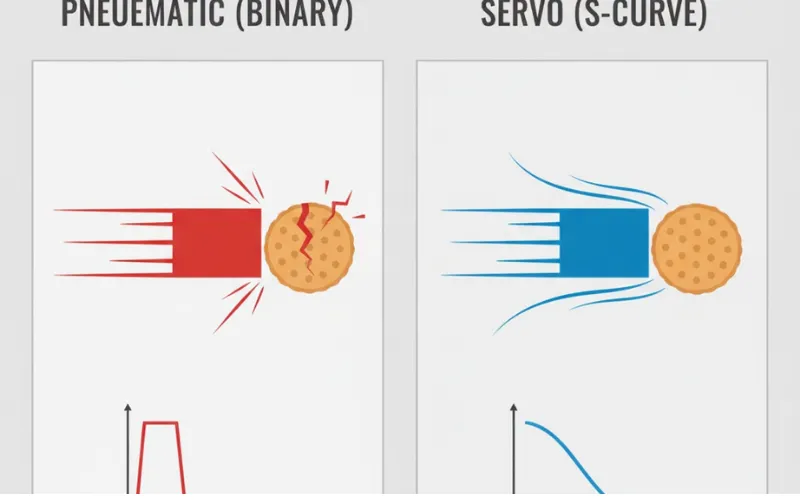
Tip (For Engineers): When evaluating a vendor, do not just ask if they use a "servo motor." The critical question is: "Does your servo program use a tunable 'S-Curve' motion profile?" That is the true soul of gentle handling.
VI. The Two Key Output Modes: "Shingling" vs. "Piling"
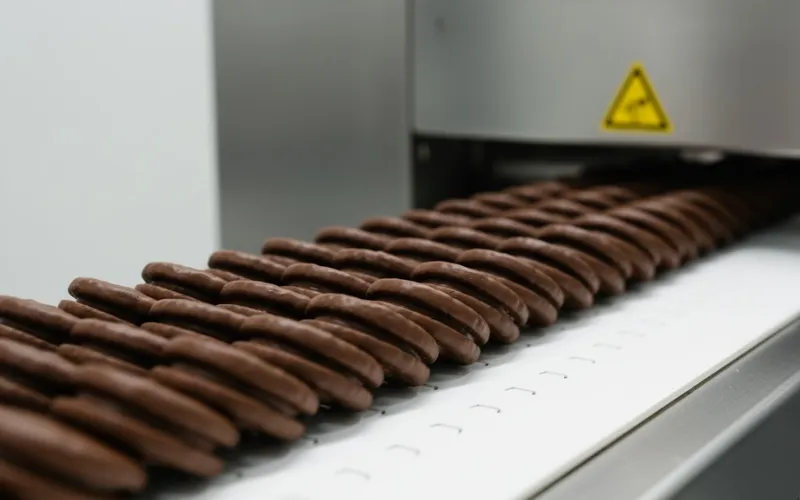
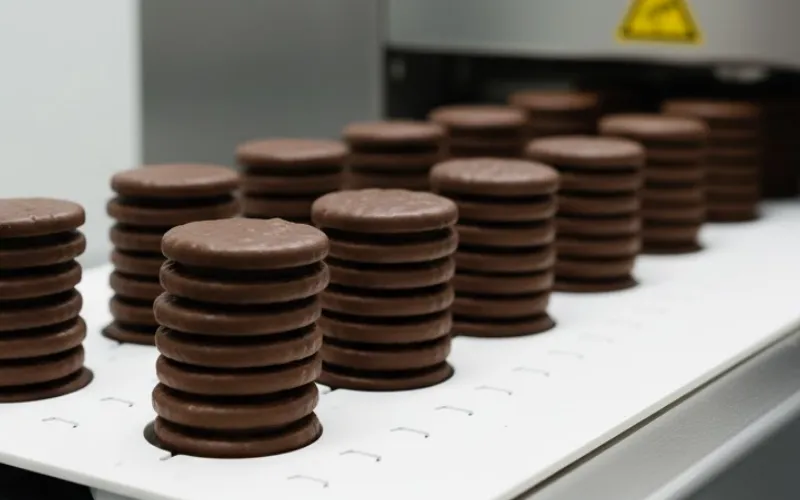
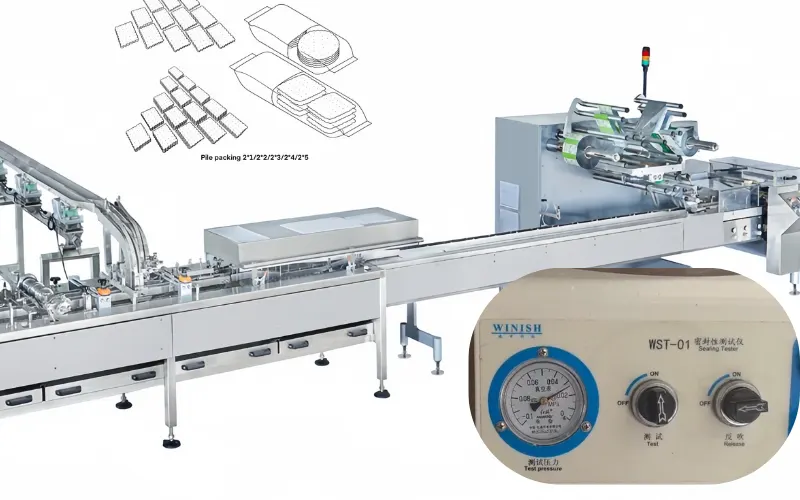
A penny stacker can be flexibly configured for two primary output formats, allowing it to feed different downstream packaging systems.
1. Shingling Mode (Overlapped)
How it Works: This is an elegant piece of engineering. The receiving conveyor belt under the stacker is set to run slightly slower than the speed at which the biscuits are pushed onto it.
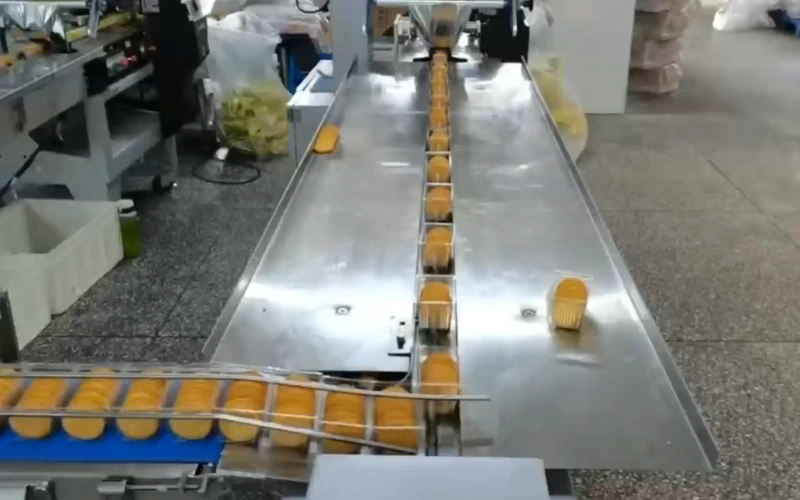
The Result: This speed differential causes each new biscuit to land partially on top of the previous one. This creates a neat, beautiful, and continuous "fish-scale" or "shingled" line of products.
Application: This is the most common mode, perfectly feeding the infeed chain of a flow-wrapper (pillow-pack machine) for individual packs.
2. Piled Mode (Stacked)
How it Works: The system uses a lifting/lowering tray or a "stop-and-go" indexing belt. It allows biscuits to be stacked vertically in the same location (like a stack of coins).
Application: This mode is used to create "slugs" (stacks) of biscuits for roll-packs or to feed automatic tray-loaders for cartons and tins. It is the industrial answer to "how-to-store-biscuits-in-a-jar" (
biscuit storage ideas).
VII. Maintenance & Hygiene: Solving the Coating & Cream Nightmare
For your maintenance and QA teams, the mixture of creams, coatings, and crumbs is the number one hygiene hazard. A poorly designed machine becomes a breeding ground for bacteria. Our systems are built on a "hygienic-design-first" principle.
A. Tool-Less, Quick-Release DesignAll our conveyor belts feature a tool-less quick-release mechanism. A maintenance technician needs no tools and can, by hand, remove the entire belt in under 60 seconds for offline, deep-part cleaning. This minimizes cleaning-related downtime.
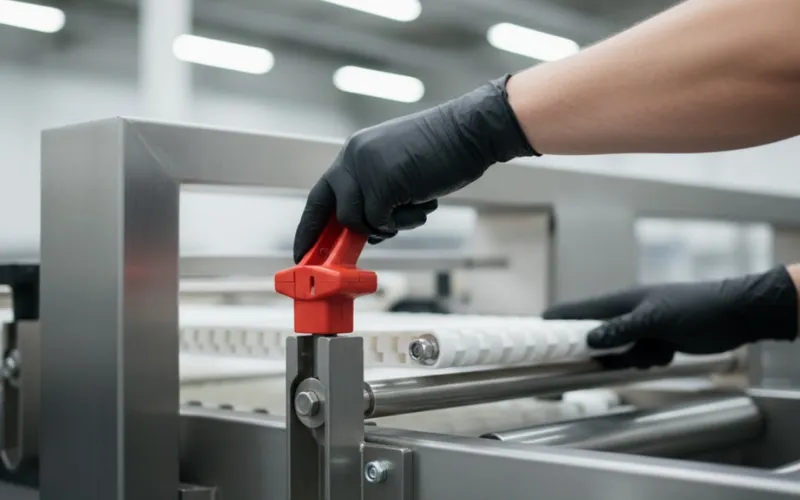
B. Washdown-Ready (IP65/IP67)The machine frame is built from SUS304 stainless steel with an "open-frame" design (no hollow tubes) to eliminate harborage points. The entire system, including motors and electrical cabinets, is rated for IP65 or IP67 washdown.
This allows your sanitation crew to use a high-pressure hose for a full-machine washdown at the end of a shift. This design fully complies with the stringent standards of BRCGS, BISSC (Baking Industry Sanitation Standards Committee), and the GFSI (Global Food Safety Initiative).
C. Common Troubleshooting (Maintenance View)
Problem: "The sensor lens gets smeared with frosting, causing miscounts and line stops."
Solution: We use contamination-resistant vision sensors. Or, for photo-eyes, we integrate an automatic "air-blow" cleaning nozzle that automatically purges the lens with a puff of air after each cycle, making it maintenance-free.
Note (For Maintenance Managers): For a machine handling coatings and fillings, "Ease of Cleaning" is just as important as "Speed." A tool-less, washdown-rated design is the key determinant of your long-term Total Cost of Ownership (TCO).
VIII. The Real ROI of a Penny Stacker: Calculating the Value of "Saved Waste" (The CFO's View)
For a Chief Financial Officer (CFO), the ROI model for a penny stacker is completely different from other machinery. It is not a simple "cost center"—it is a "profit-recovery engine."
Traditional ROI Formula:Net Monthly Savings = (Labor Costs Saved) - (Machine Operating Cost)
The Correct Penny Stacker ROI Formula:Net Monthly Savings = (Labor Costs Saved) + (Value of Waste Recovered) - (Machine Operating Cost)
For high-value products, the "Value of Waste Recovered" is almost always greater than the "Labor Costs Saved."
Sample Calculation: Quantifying Your Savings
Assumptions:
Your premium "Chocolate-Coated Cookie" sells for $10.00 / kg.
Your current manual packing line has an average damage and cosmetic-reject rate (waste rate) of 8%. (This is a very conservative estimate).
Your line produces 1,000 kg per day.
Our
penny stackerreduces this waste rate to 1%.The Math:
Waste-Rate Reduction: 8% - 1% = 7%
Daily Product Recovered: 1,000 kg/day * 7% = 70 kg/day
Daily Value Created (Recaptured Sales): 70 kg * $10.00/kg = **$700 per day**
Monthly Recaptured Profit (30-day month): $21,000
In this real-world scenario, the machine generates $21,000 per month just from waste reduction, before you even count the wages of the 2-3 manual packers it replaced. The payback period for this investment is often shortened to a mere 6-10 months.
Tip (For CFOs): This is the ultimate litmus test. If your "Value of Waste Recovered" is less than your "Labor Costs Saved," you have either severely underestimated your waste rate... or you simply don't need a
penny stacker.
IX. Case Study: From "Impossible" to "Blockbuster" (The CEO's View)
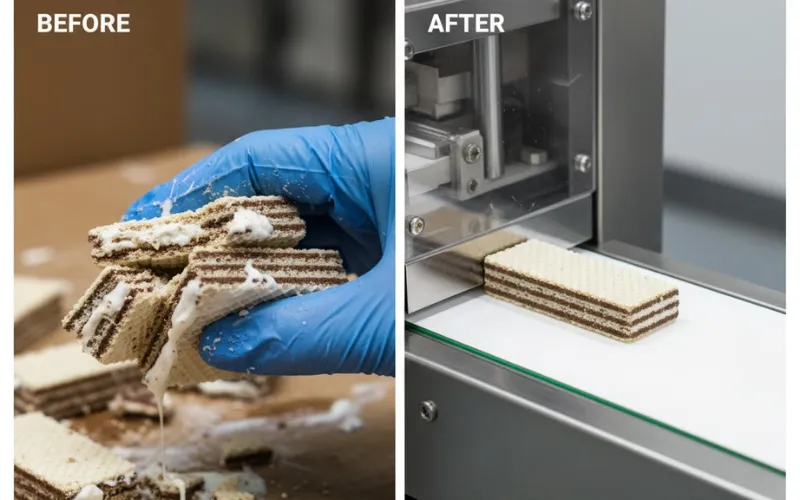
The Client: A well-known regional bakery.
The Challenge: They had developed a high-profit "Triple-Cream-Filled Wafer," which was incredibly delicious but also extremely fragile and prone to filling-squeeze. In R&D tests, the manual packing waste rate was over 15%. This made the product impossible to scale, blocking the CEO's "blockbuster" product strategy. This product demanded a flawless link in their biscuit production line.
The Solution: We engineered a custom penny stacker for them, based on the "Retracting Belt" mechanism (Section V-A). We paired it with Teflon anti-adhesion belts and a vision sensor to handle the wafer's reflective surface.
The Results:
1. Waste Rate: Dropped from 15% to under 0.5%.
2. Scalable Production: The line achieved stable, automated production.
3. Market Access: With its perfect cosmetic appearance, the product successfully launched in three major premium grocery chains within six months. It became their "Product of the Year" and their single largest profit-driver.
For this CEO, the machine was not a "cost-saver." It was a "Market Enabler." It made an "impossible" product possible.
X. Scalable Automation: The Upgrade Path from Manual to Fully-Auto
We understand that not every business needs a top-of-the-line system from day one. We provide a scalable automation path to grow with your business.
Semi-Auto Stacking (The small biscuit stacking machine)
The System: A simple photo-eye counter + a pneumatic (air-powered) pusher. This is a compact, entry-level
penny stacker.The Goal: Solves "accurate counting" and "basic grouping." Ideal for artisan bakeries with lower daily output and limited budgets.
Step 2: Full-Servo "Gentle Handling"
The System: The professional, full-servo, S-Curve, anti-adhesion system detailed in this guide.
The Goal: Solves "breakage" and "cosmetic flaws." Ideal for mid-sized companies seeking a brand upgrade and profit-margin recovery.
Step 3: Multi-Lane & Vision-Integration
The System: A multi-lane stacking system integrated with a CCD vision-inspection system that auto-rejects defects before stacking.
The Goal: Solves "massive scale, high-speed, and zero-defect" challenges. Ideal for large, multinational food corporations.
XI. The Purchasing Manager's Checklist: How to "Buy Right"
As a purchasing manager, the devil is in the details when comparing quotes.
A. The Real-Cost Trade-Off: Servo vs. Pneumatic
For fragile products, insist on servo. Its "S-Curve" motion (Section V-D) is non-negotiable and cannot be replicated by air power.
A pneumatic system might be 30% cheaper on the initial quote. But it is "binary" and violent. The ongoing cost of waste from its high breakage rate (its TCO - Total Cost of Ownership) will almost certainly exceed the cost of the servo system within 6-12 months.
B. The Factory Acceptance Test (FAT) - Your Non-Negotiable ShieldDo not ever buy a machine based on a vendor's demo video of simple, hard biscuits.
Insist that the vendor runs your actual, most difficult product (your stickiest coating, your most fragile wafer) on the machine for at least 30 minutes before it ships.
Your acceptance criteria should not be "the machine turns on." Your acceptance criteria must be: "the waste rate is below 1%." This is the only way to protect your investment.
Note (For Purchasing Managers): The FAT is your last, best line of defense against procurement risk. A purchase order that accepts "machine functions" as the criteria is worthless. Insist on "waste rate < 1%" as your contractual acceptance standard.
XII. Conclusion & Call to Action
For a producer of standard, hard biscuits, an on-edge stacker is the right choice for efficiency. As we detail in our Ultimate Guide to Biscuit Stackers, choosing the correct type of machine is the first step.
But for any producer of high-value, fragile, coated, or sandwich biscuits... the penny stacker is your only choice.
It is not just another piece of automation.
It is your high-quality product's "Profit Protector" (by eliminating waste). It is your R&D department's "Market Enabler" (by making perfect appearance scalable).
Frequently Asked Questions (FAQ)
Q1: "What is penny stacking?"A1: "Penny stacking" is an industry term, which is how the penny stacker got its name. It originally referred to stacking biscuits vertically, one-by-one, like a stack of coins (pennies). Today, the term has expanded to describe any automated process that groups, shingles (overlaps), or stacks biscuits while they are lying flat. Its core, defining feature is "no-flip" horizontal handling.
Q2: "My bakery is small. Do you have a small biscuit stacking machine?"A2: Yes. As detailed in Section X, our "Step 1" solution is a compact, entry-level penny stacker. It's designed with a smaller footprint, often uses a pneumatic pusher for simplicity, and has a lower cost basis. It is ideal for growing artisan bakeries that need automated counting and grouping but have limited space and budget.
Q3: "Can a penny stacker handle multiple shapes (round and square)?"A3: Absolutely. Modern penny stackers are extremely flexible. To switch from a round to a square product, you typically just call up the pre-set "recipe" on the HMI touchscreen, which adjusts all servo parameters. Mechanically, you may only need 5-10 minutes for a "tool-less" adjustment of the side-guide widths.
Q4: "How does your machine solve biscuit storage ideas or automated tinning?"A4: This is an excellent question. The penny stacker is the first step in an industrial-scale "biscuit storage solution." As described in Section VI, our "Piled Mode" is designed for this. It can accurately count and create vertical stacks (e.g., 10-high), which are then gently pushed as a single "slug" into tins, trays, or roll-wrap film for automated CPG packaging.
Q5: "What's the real difference between a pneumatic and a servo penny stacker?"A5: The difference is night-and-day. A pneumatic (air) pusher is "binary"—it's either "on" or "off." It's fast, but the impact force at the start and end of its stroke is massive and will damage fragile products. A servo pusher is "programmable"—it perfectly executes the "S-Curve" (Section V-D) for a silky-smooth, "slow-fast-slow" motion. For fragile and coated products, servo is mandatory.
Q6: "How long does sanitation (e.g., cleaning chocolate) actually take?"A6: This is a core design strength. As detailed in Section VII, because of the IP65/IP67 washdown rating and tool-less quick-release belts, your sanitation process is simple. At shift-end: 1 minute to remove the belt, 10 minutes to wash down the entire machine (and belt) with a high-pressure hose, 1 minute to reinstall. The entire deep-clean, even for sticky coatings, can be done in under 15 minutes, versus hours of scrubbing on older machines.
Professional Consultation & Services (CTA)
Are Your Products "Premium" and "Fragile"?
Stop accepting high waste rates as a "cost of doing business." Stop losing margin and market access because of cosmetic flaws.
Our engineering team specializes in handling the "impossible" products: the fragile, the coated, and the sticky.
Contact us today for a complimentary "Line-Waste Evaluation."
All you have to do is send us a sample of your product. We will test it in our lab and provide you with:
A Free Test-Run Video, showing your product running perfectly on our "S-Curve" servo
penny stacker.A Custom ROI Report, using the "Waste-Recapture Model" from Section VIII to calculate your precise payback period.

Ready to start your journey toward a customized solution? Contact me directly on WhatsApp to begin the conversation.