The 2025 Biscuit Stacking Machine Price & ROI Guide: A Report for Finance & Engineering
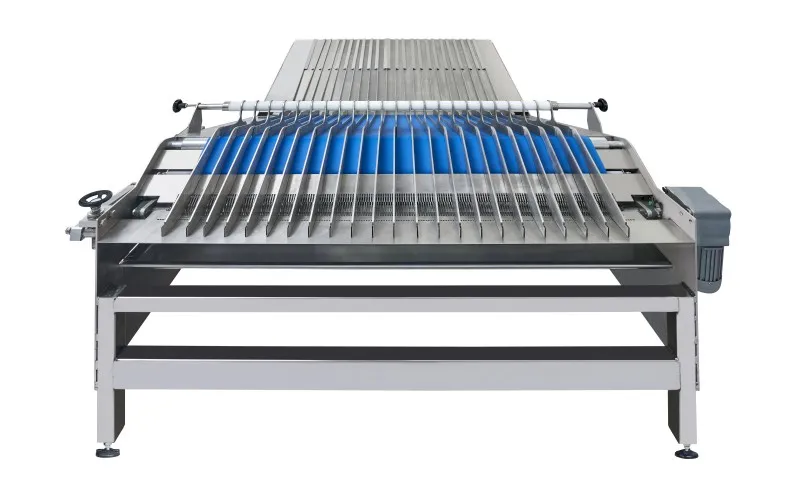
Introduction: The Price Range & Your Core ROI (The Direct Answer)
Here is the direct answer.
In 2025, the procurement price for a biscuit stacking machine ranges from a foundational $8,000 model to a highly integrated robotic system exceeding $150,000.
Regardless of this initial investment, the core value proposition is a rapid Return on Investment (ROI), typically realized within 12 to 24 months.
This fast payback is driven by significant reductions in manual labor, minimized product waste, and dramatic increases in production line efficiency.
For the factory owner, CFO, or procurement manager evaluating this capital expenditure, the wide price spectrum can be confusing.
Simultaneously, for the mechanical and electrical engineers, a machine's ability to integrate seamlessly with the existing line—and its maintenance burden over the next five years (its TCO)—is often more critical than its initial purchase price.
This guide, a key part of our Ultimate Guide to Biscuit Stacking Machines, is designed specifically for your entire decision-making team, from finance to engineering.
We will jointly dissect every critical factor that influences the biscuit stacking machine price, provide a clear framework for calculating your ROI, and dive deep into the technical integration and long-term Total Cost of Ownership (TCO) that matter most to your engineers.
This is not just a price list; it is a comprehensive decision report to help you make the wisest, most strategic investment possible.
A Note from Our Expert
Author Background: This guide is authored by a Senior Project Engineer with 15 years of hands-on experience in food automation line integration.
Our team has successfully deployed over 200 baking production lines globally, giving us a unique understanding of the critical balance between financial budgets and engineering realities.
We have witnessed multimillion-dollar losses from investments that ignored TCO, and we have celebrated with clients who achieved a full ROI in under 6 months through smart technical investment.
The insights in this article are built on that real-world, frontline experience.
Key Takeaways
Price Spectrum: Costs for a biscuit stacker span from $8,000 for basic models to over $150,000 for fully automated robotic systems, driven entirely by technology, speed, and integration depth.
Rapid Payback: Despite the varied initial cost, the universal payback period (ROI) is between 12 and 24 months, achieved by slashing labor costs and boosting efficiency.
Beyond the Price Tag: The Total Cost of Ownership (TCO) and the quality of engineering integration (like PLC standards and spare parts strategy) are far more important long-term factors than the initial purchase price.
Core Technologies: The
star wheel stackerremains the market's mainstream choice for balancing speed and cost, while advanced robotic systems offer maximum operational flexibility.Hidden Costs: Your total investment must include the "hidden" costs of freight, installation, and commissioning, which can easily account for an additional 10-20% of the procurement price.
2. The 6 Key Factors That Determine a Biscuit Stacking Machine Price
Why is there such a massive price difference across the market, from a $5,000 machine on a B2B platform to a $100,000+ system from a specialized manufacturer?
When you compare two biscuit stacking machine models, you quickly discover that the price difference reflects vast gaps in technology, capacity, hygienic design, and long-term reliability.
Understanding these six factors is the foundation for your negotiation and final decision.
Factor 1: Technology & Stacker Type (The Cost Baseline)
The core mechanical principle of the equipment is the primary price driver.
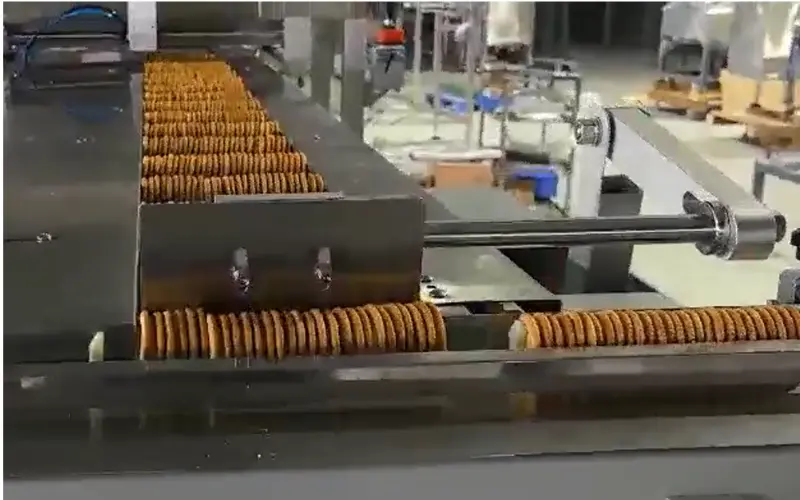
The Penny Stacker (Shingling Stacker)
How It Works: This represents the most fundamental stacking technology available.
Biscuits travel through a narrow channel and are shingled, often using gravity or simple mechanical pushers, much like coins (hence the "Penny" name).
Best For: Uniformly shaped (round, square) hard biscuits, typically used for single or dual-lane stacking.
Cost Analysis: The structure is relatively simple and the control logic is basic, resulting in the lowest cost. It is the perfect first step away from manual labor but offers limited flexibility and speed.
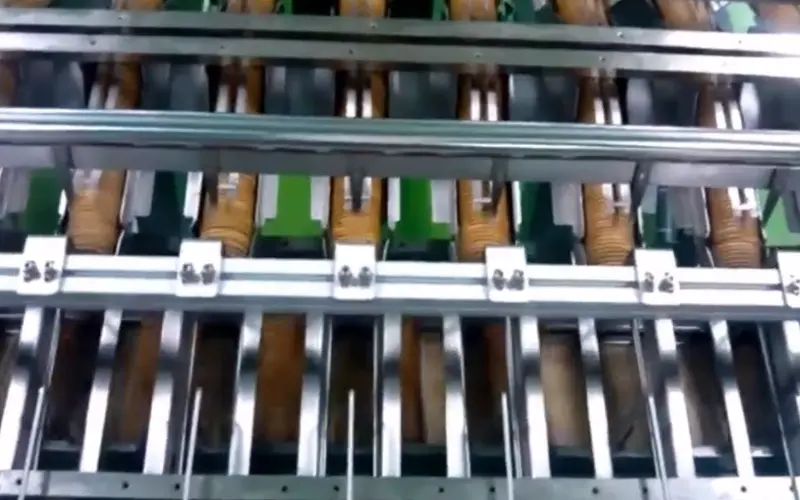
How It Works: This is the current mainstream solution and the workhorse for high-speed applications.
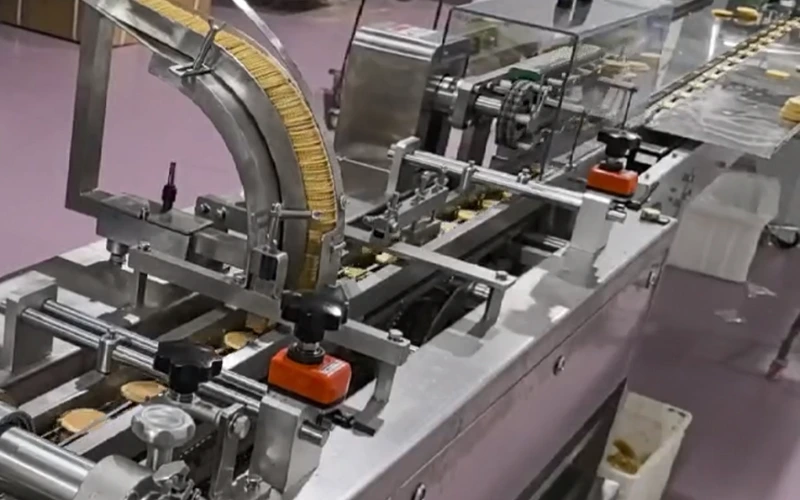
Biscuits are diverted from the cooling conveyor into multiple lanes (e.g., 4, 6, 8, or 12 lanes). At the end of each lane, a rotating "Star Wheel" precisely accepts the biscuits and uses its rotation to place them into vertical or horizontal stacks.
Best For: Medium-to-large enterprises that need to match the high speed of downstream equipment, like horizontal flow-wrappers. The
star wheel stackeris renowned for its speed, stability, and mature technology.Cost Analysis: The price is medium-to-high. This cost is determined by the number of lanes and the precision of the star wheel's servo-motor control.
The Robotic / Servo-Driven Stacker
How It Works: This is the most advanced and flexible technology.
It typically uses high-speed parallel (Delta) robots or multi-axis servo systems. A vision system (camera) precisely locates each biscuit, and a custom gripper (often vacuum-based) picks and places it at high speed onto the wrapper film or into a tray.
Best For: Applications demanding maximum flexibility. This is often the only solution for handling irregular shapes (like animal crackers), fragile coated biscuits, or complex packing patterns (like variety packs).
Cost Analysis: This is the most expensive option. The price includes the robot itself, the high-end vision system, complex programming software, and the precision servo drives.
Factor 2: Capacity & Speed (The Efficiency Ceiling)
Your throughput requirement is directly correlated with the machine's price.
Low-Speed Models: These machines process 50-100 packs per minute, per lane. They are typically suited for semi-automatic lines or as an upgrade for small-batch, artisanal producers.
Mid-Speed Models: This is the common working range for a
star wheel stacker, handling 100-200 packs per minute. These speeds require precise servo motors to ensure smooth, accurate handling without jamming.High-Speed Models: Operating at 200+ packs per minute, these machines challenge the limits of mechanical design. The machine frame must be extremely robust to minimize vibration, and it must be equipped with top-tier servo controls and real-time feedback sensors to prevent jams or product damage at high velocity, all of which substantially increases the cost.
Factor 3: Automation Level & Integration
Whether a machine is an "island" or a "hub" has a decisive impact on its price.
Standalone Unit (Low Price): This machine performs only the
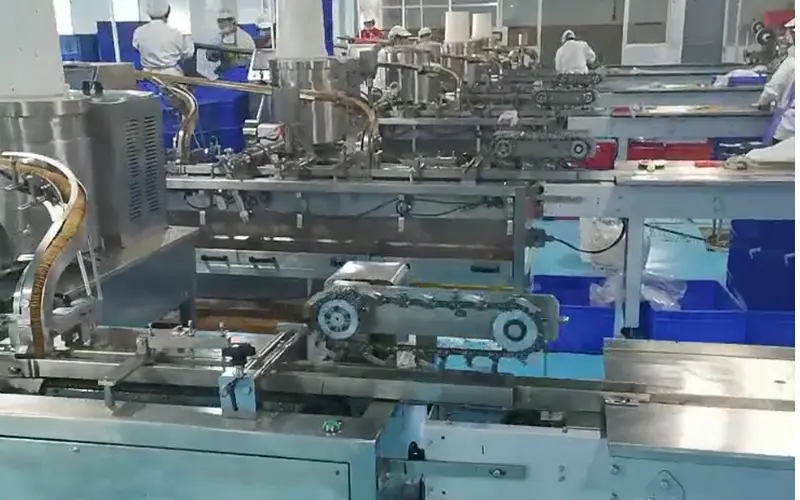
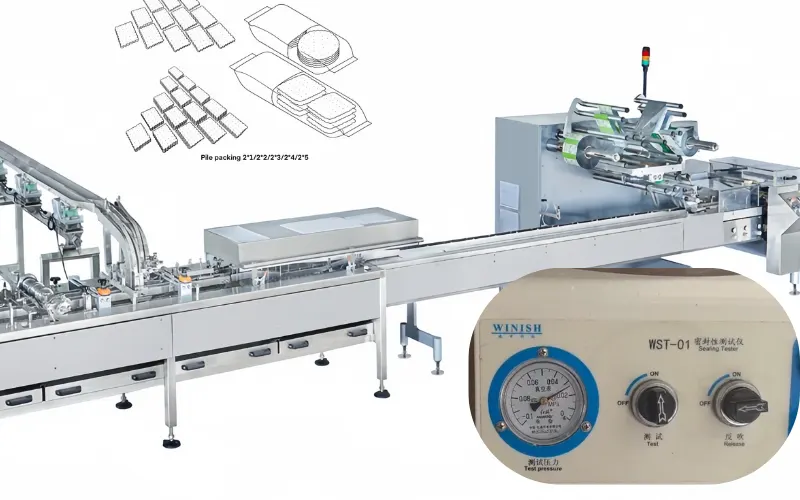
biscuit stackingaction. It may require an operator to manually transfer the finished stacks to the wrapper, or it may require your own engineering team to handle the "handshake" between upstream and downstream equipment.Integrated System (High Price): This is a "turnkey" solution. It seamlessly connects to the upstream cooling conveyor (with auto-laning) and the downstream packaging machine (like a flow-wrapper or VFFS bagger).
Intelligent Add-Ons: The price will climb as you add these smart features:
Auto-Lane Changing: If one wrapper in a lane goes down, the system automatically diverts that lane's biscuits to the other operational lanes, ensuring continuous production.
Auto-Rejection: The system uses sensors or vision to detect broken, misplaced, or empty-slug biscuits and automatically rejects them before they are stacked and wrapped.
OEE Data Monitoring: The machine comes with built-in OEE (Overall Equipment Effectiveness) tracking, allowing it to report real-time production volume, downtime, and efficiency to your central MES or ERP system.
Factor 4: Materials & Hygienic Standards
In the food industry, build materials and hygienic design are non-negotiable costs.
Material Differences:
SUS304 Stainless Steel: This is the industry-standard minimum for all food-contact parts.
SUS316 Stainless Steel: If you produce high-salt (soda crackers) or high-acid (jelly-filled) biscuits, SUS316 offers superior corrosion resistance and is a required upgrade, which costs more.
Hygienic Design:
IP Protection Rating: The machine's IP rating (e.g., IP65) determines its ability to withstand "washdown" procedures. An IP65 rating means all electrical components (motors, sensors) are sealed against low-pressure water jets, which is critical for sanitation but adds cost.
Sanitary Construction: Modern hygienic design (like cantilevered frames) eliminates flat surfaces and crevices where crumbs and water can accumulate. This makes cleaning faster and more effective, aligning with GFSI (Global Food Safety Initiative) principles, but it increases the design and manufacturing cost.
Certification Requirements: If you export to Europe or the US, the machine must comply with CE (Europe), UL (US electrical safety), or FDA (food-grade material) standards. These certifications involve rigorous testing and documentation, all of which are factored into the final
biscuit stacking machine price.
Factor 5: Manufacturer & Service Network
The brand's origin, reputation, and support network are a major part of the price.
Brand Premium:
Top-Tier European/US Brands: (e.g., Bosch, Cavanna, Syntegon) typically have the highest price tags. You are paying for decades of R&D, top-tier build quality, and extreme reliability.
Asian (Notably Chinese) Brands: These manufacturers have made rapid technological leaps and offer an extremely competitive price-to-performance ratio. The price may be 30%-60% of a European machine, though they may still be catching up in high-end servo control and software integration.
After-Sales Support: A single day of downtime on your line could cost you thousands of dollars. Does the supplier have a local service team and spare parts depot in your country? Is 24/7 technical support available? This "service" is part of the price and is critical for any factory focused on minimizing TCO.
Factor 6: Safety & Compliance (A Frequently Overlooked Cost)
Safety is not an optional add-on; it is a mandatory requirement.
A machine built to international safety standards (like ISO 13849) will inherently cost more. This includes:
Safety Guarding: Full polycarbonate or stainless-mesh guarding over all moving parts.
Safety Interlock Switches: The machine must immediately stop if any guard door is opened.
Light Curtains: Placed in operator-access areas (like the outfeed) to stop the machine if a hand enters.
E-Stop Buttons: Properly placed and compliant emergency stop buttons.
A cheaper machine that fails to meet local industrial safety standards (like America's OSHA regulations or the packaging-specific PMMI B155.1 standard) can lead to massive fines and costly mandatory retrofits during inspection.
Note: For Finance and Procurement Managers: When reviewing a quote, you must look beyond Factor 1 (machine type) and evaluate the costs of Certification (Factor 4), Service (Factor 5), and Safety (Factor 6). These components are essential for ensuring long-term value and avoiding future liabilities.
3. 2025 Biscuit Stacking Machine Price Tiers (Estimates)
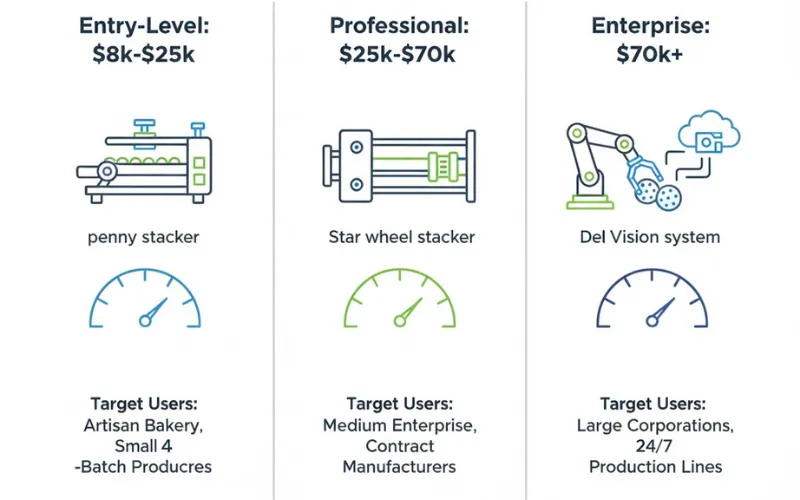
Disclaimer: The following price tiers are industry estimates based on the factors above. They do not include freight, import duties, or installation fees. Your final price will depend on your specific customization needs, and you must obtain an official quote from a supplier.
Tier 1: Entry-Level / Small Biscuit Stacking Machine
(For Small Businesses or Single Lines)
Profile: These are basic Penny Stackers or very simple star wheel units.
They are often semi-automatic, meaning they require manual support for infeed or outfeed, and operate at lower capacities (e.g., 50-80 packs per minute).
Best For: Small-to-medium artisan bakeries, small factories transitioning from manual labor, or for R&D labs and small-batch test runs.
Estimated Price Range: $8,000 - $25,000 USD
Decision Driver: The core goal is solving an immediate labor shortage. Speed and flexibility are not high priorities.
Tier 2: Professional Grade (The Market Mainstay)
(For Medium-Sized Enterprises)
Profile: This is the workhorse category of the market. It typically consists of a multi-lane
star wheel stackerwith a high degree of automation.These machines use reliable servo motors, operate at mid-range speeds (100-200 packs/lane), are designed for integration, and feature a full SUS304 stainless steel build.
Best For: Medium-sized biscuit companies with stable, high-volume orders who demand efficiency and reliability. They need a "workhorse" that can match the speed of their flow-wrapper.
Estimated Price Range: $25,000 - $70,000 USD
Decision Driver: This tier offers the best balance of price and performance. The focus is on changeover time, stability, and smooth integration with downstream packaging.
Tier 3: Enterprise Grade (High-Performance Automation)
(For Large Corporations & Fully Automated Lines)
Profile: These are high-speed servo or fully robotic stacking systems.
They are often part of a full "turnkey" solution, seamlessly integrated, and loaded with intelligent features like auto-lane changing, vision-based rejection, and OEE data acquisition. They offer extreme flexibility for handling multiple SKUs.
Best For: Large CPG (Consumer Packaged Goods) corporations with 24/7 production demands. They have strict requirements for flexibility, data management, and the lowest possible TCO.
Estimated Price Range: $70,000 - $150,000+ USD
Decision Driver: At this level, the initial
biscuit stacking machine priceis not the primary concern. The decision is based on OEE, MTBF (Mean Time Between Failures), MES integration capability, and the supplier's global service network.
Visual Supplement: Image Prompt
Placement: Immediately below this section.
Prompt: "A detailed, clean diagram comparing two integration paths. On the left (labeled 'High TCO'), a red 'X' shows mismatched PLC brands (Siemens, Mitsubishi, Rockwell) failing to communicate. On the right (labeled 'Low TCO'), a green checkmark shows standardized Rockwell PLCs communicating seamlessly with the factory's MES."
4. 【Unique Analysis】Beyond Price: The Engineer's Integration Concerns
A purchasing decision cannot be made on price alone.
For your factory's technical team (both electrical and mechanical engineers), whether a machine can be integrated seamlessly—and whether it's easy to operate—determines if that new asset becomes a profit center or a production liability.
A. The Electrical Engineer's View: Control & Integration
Your electrical engineer is focused on the machine's "brain" and "nervous system."
The PLC Compatibility Nightmare
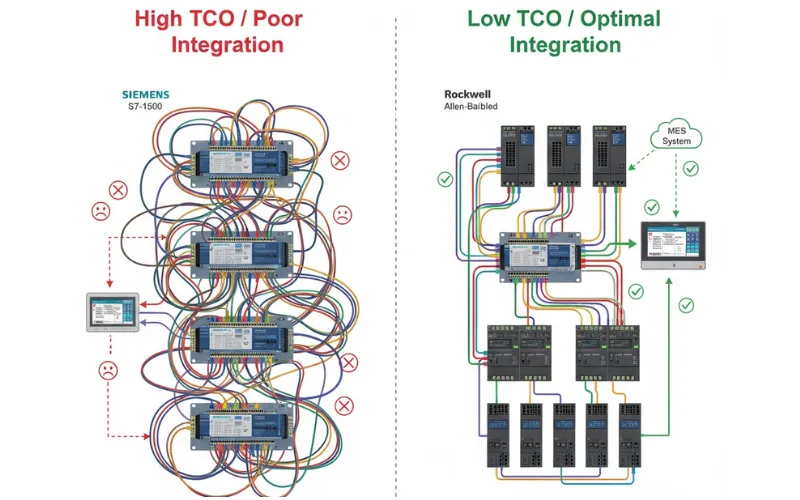
The Pain Point: Your supplier's
biscuit stacking machinearrives with a Mitsubishi PLC, but your entire factory—from ovens to wrappers—is standardized on a Siemens or Rockwell Allen-Bradley platform.The Consequence: This creates an operational nightmare. Your maintenance team now needs to learn a completely new programming logic. You also have to stock two sets of expensive spare PLCs (CPUs, I/O modules), and getting the two systems to "handshake" will be extremely difficult.
Decision: Ask the supplier if they can provide the machine with your factory-standard PLC brand. Even if this adds $2,000-$5,000 to the initial cost, it is an absolute necessity from a TCO perspective.
HMI & Data Communication
HMI (Human-Machine Interface): Is the touchscreen interface intuitive and easy to use? Does it support your local language? Can an operator easily set up new recipes or understand fault alarms? A bad HMI equals longer training times and a higher rate of operator error.
Industrial Ethernet: Is your factory implementing Industry 4.0 or Smart Manufacturing initiatives? You must ask if the machine supports modern industrial protocols like EtherNet/IP (Rockwell) or PROFINET (Siemens). This determines if the machine can send vital OEE data—like production counts, speed, and downtime codes—to your central SCADA or MES system.
Tip: When requesting a quote (RFQ), proactively send your factory's "Electrical Standards Manual" (listing preferred PLC, HMI, and protocols) to the supplier. Demand that they quote according to this standard to avoid massive integration conflicts from the start.
B. The Mechanical Engineer's View: Operation & Changeover
Your mechanical engineer is focused on the machine's "muscles" and "bones."
Changeover Time (The Efficiency Killer)
The Pain Point: Your factory runs 5 different SKUs (Stock Keeping Units) every day.
The Consequence: If every "changeover"—for example, switching from an 8-count round biscuit to a 10-count square biscuit—requires a mechanic to spend 2 hours with a toolbox, you could lose several hours of production every single day. This downtime completely negates the machine's speed advantage.
Decision: Look for machines designed for "Quick Changeover." This includes:
Tool-less Adjustments: Using hand-wheels, position indicators, and quick-lock handles instead of wrenches and hex keys.
Recipe Memory: Selecting the "Square Biscuit" recipe on the HMI, which automatically moves all servo-driven components (like guide rails and stack height) to their pre-set positions.
SMED Philosophy: Ask the supplier if their design follows the principles of SMED (Single-Minute Exchange of Die).
Gentle Handling (The Waste Reducer)
The Pain Point: Your soda crackers are extremely fragile, or your cookies have a delicate chocolate coating.
The Consequence: A poorly designed or aggressive mechanical pusher or star wheel will result in a high "waste" percentage from broken product. This is a pure loss of profit.
Decision: Closely evaluate the
biscuit stackingmechanism. Look for technologies that use smooth servo-driven movements, custom-molded star wheel pockets that perfectly match your biscuit's curve, or non-contact vacuum grippers to minimize breakage.
5. 【Unique Analysis】Beyond ROI: TCO & Maintainability
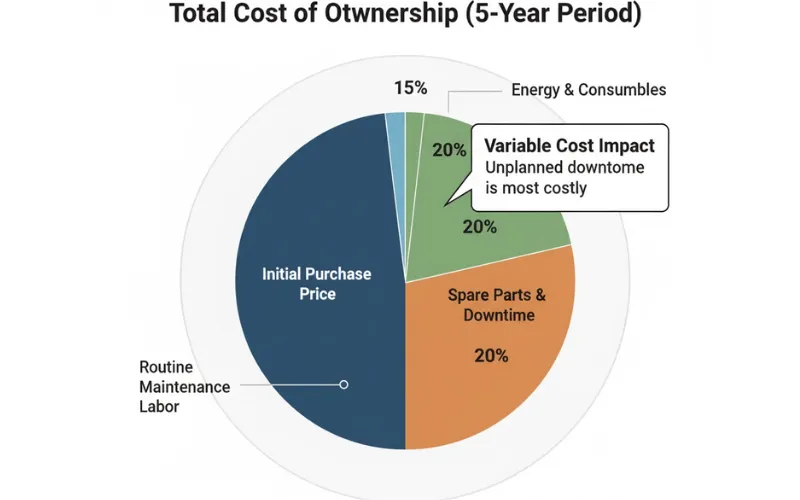
The purchase price is just the tip of the iceberg.
Your maintenance engineer is focused on the Total Cost of Ownership (TCO) over the asset's entire lifecycle. A "cheap" machine that requires expensive annual maintenance is, in fact, the most "expensive" investment you can make.
A. The Maintenance Engineer's View: TCO Analysis
Energy Consumption
Power: What is the machine's rated power (kW)? Does it use high-efficiency motors (e.g., IE3/IE4 standard)? This directly impacts your electricity bill.
Compressed Air (The Big One): Does the machine rely heavily on pneumatic cylinders? Compressed air is one of the most expensive utilities in a factory due to its high inefficiency. A machine that relies primarily on electric servo motors instead of air will have a much lower long-term operating cost.
The Spare Parts Trap (Critical!)
The Pain Point: A small sensor on your machine fails. You discover it's a "Proprietary Part" with no model number, forcing you to order a $500 replacement from the OEM in Europe with a two-week lead time.
The Contrast: A competitor's machine uses a "Standard Part"—a universal sensor from SICK, Banner, or Keyence—that your local distributor has in stock for $50 and can deliver the same day.
Decision: During procurement negotiations, you must demand a Critical Spare Parts List from the supplier. Verify how many of these parts are standard components. This directly dictates both your TCO and your MTTR (Mean Time to Repair).
Note: Proprietary parts are a "black hole" for your long-term maintenance budget. Demanding a standard-parts list in the contract is the most effective way to control TCO.
B. Hygiene & Maintainability (MTBF & MTTR)
Sanitary Design for Cleaning
The Pain Point: The machine is built with a complex frame, full of flat surfaces and crevices. Biscuit crumbs and oils build up in these "hygienic dead zones," and your sanitation crew spends two hours every night just trying to clean it.
The Consequence: This creates a high risk of bacterial growth and cross-contamination, not to mention high cleaning labor costs.
Decision: Look for modern sanitary designs:
Cantilevered Design: The main components are mounted on one side, leaving the area under the machine open for crumbs to fall directly to the floor for easy cleanup.
Quick-Release Belts: Conveyor belts that can be removed in minutes—without tools—for deep cleaning.
Reliability Metrics (MTBF vs. MTTR)
MTBF (Mean Time Between Failures): This is your metric for reliability. A high MTBF means the machine is robustly designed and will run for a long time without breaking down. Ask suppliers if they have this data for their machines.
MTTR (Mean Time to Repair): This is your metric for maintainability. A low MTTR means that when a failure does occur, it can be fixed quickly. This depends on:
Diagnostics: Does the HMI clearly state "Fault: Sensor 2B Obstructed" instead of a vague "Error Code E-101"?
Accessibility: Are critical parts (motors, gearboxes) easy to access and replace?
Support: Does the supplier provide crystal-clear maintenance manuals, electrical schematics, and responsive remote support?
6. 【Unique Analysis】Beyond the Quote: Hidden Costs & Extra Fees
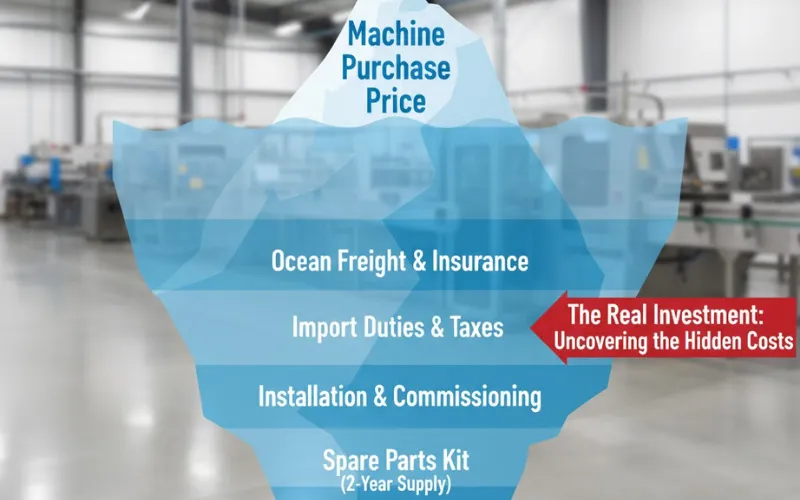
Finance and procurement managers must be vigilant about the "hidden costs" that never appear on the initial biscuit stacking machine price quote.
These extra fees can often account for 10-20% of the total project budget.
A. Freight & Insurance
Shipping Terms: Is the quote FOB (Free on Board) or CIF (Cost, Insurance, Freight)? An FOB quote means you are responsible for paying the ocean freight, insurance, and customs clearance from the port of origin to your factory. This can be a multi-thousand-dollar expense, especially for international shipping.
B. Installation & Commissioning
What's Included?: Does the quote include the services of the supplier's field engineer for on-site installation and commissioning?
Extra Fees: How are their travel, lodging, and food expenses billed? Is it a flat fee included in the price, or is it billed per-diem as an extra cost?
"Commissioning" Defined: Get a clear definition of "commissioning." It should state that the machine must run your actual biscuits at the target speed (e.g., 200 packs/min) for a sustained period (e.g., 4 hours) before the job is considered "complete" and you sign off.
C. Training Costs
Training Content: Does the quote include professional training for your team?
Who Gets Trained?: This training must be split into two groups: 1) Operator Training (how to start/stop, changeovers, daily cleaning) and 2) Maintenance Training (how to troubleshoot, replace parts, perform preventative maintenance).
Duration & Cost: How many days of training are included for free (e.g., 3 days)? What is the cost for additional training in the future?
Tip: Finance and procurement teams should never just compare the equipment price. Demand a "DDP" (Delivered Duty Paid) or at least a "CIF" quote. Furthermore, make the "Commissioning Acceptance Standard" (as defined in 6.B) a formal addendum to the purchase contract to lock in your total investment cost.
7. The Automation ROI Calculator: Analyzing Your Return
Now, let's calculate the return on this investment.
Investing in a biscuit stacking machine is not just a cost; it is an engine for profitability.
A. Direct Cost Savings (The "Hard" ROI)
This is the most straightforward return: replacing manual labor.
The Pain Point: On a single mid-speed line, you may currently employ 4 to 6 workers standing shoulder-to-shoulder. They are performing the repetitive, strenuous task of picking, counting, and arranging biscuits into the wrapper. This is a dull, difficult job that leads to high employee turnover and Repetitive Strain Injuries (RSI).
Labor Cost Calculation:
[Current Manual Labor (Count)] x [Annual Cost Per Employee (including wages, taxes, benefits, overtime)]MINUS
[New Automated Labor (Count) (e.g., 1 supervisor)] x [Annual Cost Per Employee]Example Calculation:
Assume one line saves 4 workers per shift, across two shifts. This is 8 manual operators reduced to 2 line supervisors (one per shift), for a net savings of 6 employees.
Labor Cost Templates (by Region):
North America / Western Europe: Assume annual cost per employee = $45,000 USD.
Eastern Europe / Latin America: Assume annual cost per employee = $15,000 USD.
Southeast Asia / South Asia: Assume annual cost per employee = $6,000 USD.
Annual Savings (North America) = 6 people x $45,000 = $270,000 / Year.
Annual Savings (Southeast Asia) = 6 people x $6,000 = $36,000 / Year.
B. Operational Efficiency Gains (The "Hard" ROI)
Increased Throughput:
A machine can run 24/7 without fatigue, breaks, or shift-change lulls.
While manual packing speed is finite and variable, a
star wheel stackercan be locked in at a consistent 150 packs per minute, every minute of the day.Formula:
([New Output/Hr] - [Old Output/Hr]) x [Run Hours] x [Days/Yr] x [Profit per Unit]This gain is often massive, especially if packaging was your primary bottleneck.
Reduced Product Waste:
Manual handling inevitably creates waste. Workers may accidentally crush biscuits, drop them, or miscount the stack (giving away free product or shorting a customer).
Manual waste and miscounts can be as high as 3-5%. A well-designed
biscuit stackerwith gentle handling can reduce this to under 0.5%.Formula:
(3% - 0.5%) x [Total Annual Production Volume] x [Cost per Unit] = Annual Waste Savings.
C. Indirect Value (The "Soft" ROI)
These are the strategic values that your CFO and CEO must consider.
Improved Hygiene & Risk Reduction:
This is one of the single biggest drivers of food automation.
Fewer human hands touching the product means less risk of biological contamination (bacteria, viruses) or foreign object contamination (hair, jewelry).
This drastically reduces your liability and the risk of a catastrophic, brand-damaging product recall.
Data Consistency & Traceability:
A machine's count is perfect, every time.
This eliminates the "giveaway" of over-counts (lost profit) and the "complaints" from under-counts (lost customers). An integrated system also provides precise production data for every batch, enhancing your traceability.
Employee Satisfaction & Re-Allocation:
You are liberating your employees from a boring, repetitive, and injury-prone job.
You can retrain these valuable team members for higher-value roles, such as quality control, machine maintenance, or R&D. This reduces employee turnover and improves overall morale.
Note: While this "Soft ROI" (like food safety and morale) is harder to quantify, it is a critical part of your strategic pitch to management. The cost of one product recall can be more than the cost of ten stacking machines.
8. Calculating Your Payback Period: Case Study Walkthrough
The Payback Period is the core metric for your finance team.
It answers the simple question: "How long until we earn our money back?"
The Core Formula:
Total Investment = [Equipment Price] + [Freight] + [Duties] + [Installation/Training Fees (See Sec 6)]Monthly Gross Return = [Monthly Labor Savings (See 7.A)] + [Monthly Efficiency/Waste Gains (See 7.B)]Payback Period (in Months) = [Total Investment] / [Monthly Gross Return]
Case Study: Mid-Sized North American Bakery
Assumption: You are procuring a professional-grade
star wheel stacker.Total Investment Cost:
Equipment Procurement Price (from Section 3): $50,000
Freight, Duties, & Installation (from Section 6): $10,000
Total Capital Investment = $60,000
Monthly Gross Return:
Monthly Labor Savings (from 7.A, 6-person reduction):
($270,000 / 12) = $22,500Monthly Efficiency & Waste Savings (conservative estimate): $5,000
Total Monthly Return = $27,500
Payback Period Calculation:
Payback = $60,000 / $27,500 = 2.18 Months.
(Conclusion: In a high-labor-cost region, the payback is extremely fast. This is a highly attractive investment.)
Case Study: Mid-Sized Southeast Asian Bakery
Assumption: The same $60,000 machine.
Total Investment Cost: $60,000
Monthly Gross Return:
Monthly Labor Savings (from 7.A, 6-person reduction):
($36,000 / 12) = $3,000Monthly Efficiency & Waste Savings (still significant): $5,000
Total Monthly Return = $8,000
Payback Period Calculation:
Payback = $60,000 / $8,000 = 7.5 Months.
(Conclusion: Even in a low-labor-cost region, the gains from efficiency and waste reduction are so significant that the payback period is still excellent—well under the 12-month mark.)
(Call to Action) Your Pre-Purchase Decision Checklist
Before you contact a single supplier, gather your team and answer these questions:
[Finance/Procurement] What is our true all-in annual cost for one packaging-line operator in our specific region? What is our capital budget and our maximum acceptable payback period?
[Mechanical/Production] Where is our current production bottleneck? What is our current product waste percentage? Do we have new products (shapes, sizes) planned for the next 3 years?
[Electrical/Maintenance] What is our factory's PLC and electrical standard (Siemens, Rockwell, etc.)? What is our red line on proprietary vs. standard spare parts? What is the current skill level of our maintenance team?
9. Conclusion: Look Beyond the Price Tag, Focus on Strategic Return
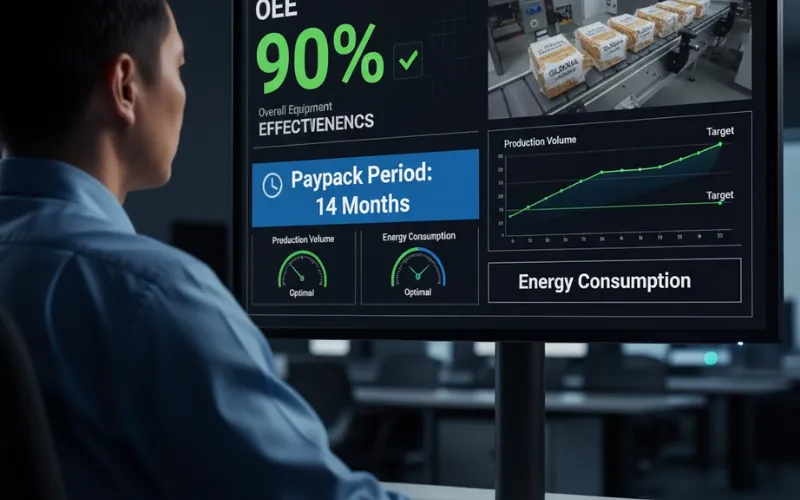
The price of a biscuit stacking machine is variable, but its value is predictable.
The difference in the biscuit stacking machine price simply reflects the technological leap from basic automation to fully intelligent, integrated production.
A Final Recommendation for All Decision-Makers:
Do not focus solely on the initial purchase price.
A truly successful investment is one that meets the financial ROI target (satisfying the owner/CFO), integrates seamlessly with technology (satisfying the engineers), and has a low, predictable long-term TCO (satisfying the maintenance and procurement teams).
By using the TCO and integration checklists in this guide, you can confidently ask suppliers the right questions.
You are not just buying a biscuit stacker; you are investing in your factory's efficiency, safety, and competitive advantage for the next decade.
To get a complete technical overview of all machine types, please return to our Ultimate Guide to Biscuit Stacking Machines.
Frequently Asked Questions (FAQ)
Q1: Can one biscuit stacking machine handle different shapes and sizes?
This entirely depends on the technology type.
A Penny Stacker typically has low flexibility and is often dedicated to one shape (round or square).
A Star Wheel Stacker offers good flexibility. By physically changing the "star wheels" and adjusting the lane guides (see Section 4.B on "Changeover"), it can often handle multiple, uniformly-shaped products.
A Robotic Stacker offers the highest flexibility. By using a vision system and programmable grippers, it can be taught to handle almost any shape.
Q2: What is the difference between a "Biscuit Stacker" and a "Biscuit Loader"?
This is a common industry-termonology question.
A Stacker typically performs the function of taking flat, shingled biscuits and arranging them into a counted "stack" or "slug."
A Loader typically performs the next step: "loading" that finished stack into the infeed of the packaging machine (e.g., the chain of a flow-wrapper).
In modern language, an integrated biscuit stacking machine almost always performs both functions, automatically handling the entire process from stacking to loading.
Q3: How much maintenance does a star wheel stacker require?
The maintenance load depends on the build quality and operating environment. A good star wheel stacker is designed to be a low-maintenance workhorse.
Daily Maintenance: This is primarily focused on cleaning. As noted in Section 5.B, choosing a machine with a sanitary, easy-to-clean design (like quick-release belts) is critical.
Periodic Maintenance: This includes checking belt tension, lubricating specified bearings (though many modern machines use sealed-for-life bearings), and ensuring sensors are clean.
The Key: Your biggest maintenance cost will be spare parts (see Section 5.A). Choosing a machine that uses "standard parts" will dramatically lower your long-term maintenance budget.
Q4: Can this biscuit stacker connect to my existing (different brand) wrapper?
Yes, but this is the very core of the integration challenge.
Mechanical Connection: The stacker's outfeed height, speed, and direction must perfectly match the wrapper's infeed.
Electrical Connection (The "Handshake"): The two machines must "talk" to each other. For example, when the wrapper stops, it must send a signal to the stacker to "stop feeding product." This is precisely why PLC brand and protocol compatibility (Section 4.A) are so critical. A good systems integrator can connect any two brands, but it requires extra engineering time and cost.
Q5: Is it better to buy a cheap Asian machine or an expensive European machine?
This depends entirely on your factory's strategic goals.
Choose the Cheaper Machine: If your production orders are unstable, your budget is extremely limited (e.g., a Small Biscuit Stacking Machine), and you have a very strong internal engineering team that can handle its own integration and maintenance, a basic machine can be a good way to get from 0 to 1.
Choose the Expensive Machine: If you are a 24/7 facility that demands the lowest TCO, highest MTBF (reliability), fastest MTTR (maintainability), and full OEE data, then investing in a top-tier European or North American brand is the safer, more strategic long-term choice.
The Middle Path: Look for Asian manufacturers who build their machines using global, standard electrical components (like Siemens PLCs, SMC pneumatics). These suppliers often provide the best balance of "Price-to-Performance" and "TCO."
Your Next Step: A Custom ROI Analysis
Are you stuck trying to decide between TCO and ROI?
Don't let a vague price quote determine your factory's efficiency for the next five years.
We don't just sell a biscuit stacking machine; we provide a clear, data-driven analysis of your profitability.
Contact our automation experts today for a free consultation, and you will receive:
A Free Production Line Assessment: Our engineers will interface with your team (Production, Mechanical, and Electrical) to analyze your current bottlenecks.
A Custom ROI & TCO Report: We will use your local labor costs, your biscuit specifications, and your production targets to calculate a precise payback period (like in Section 8) and estimate your long-term TCO (from Section 5).
A Technical Integration Plan: We will provide a clear PLC and mechanical integration plan that works with your existing ovens and wrappers, regardless of their brand.
Schedule your free 30-minute consultation today to get your custom Biscuit Stacker Investment Decision Report.

Ready to start your journey toward a customized solution? Contact me directly on WhatsApp to begin the conversation.