Compact Biscuit Stackers: The Ultimate Automation Guide for SMEs & Artisan Bakeries
H1: Compact Biscuit Stackers: The Ultimate Automation Guide for SMEs & Artisan Bakeries
Introduction
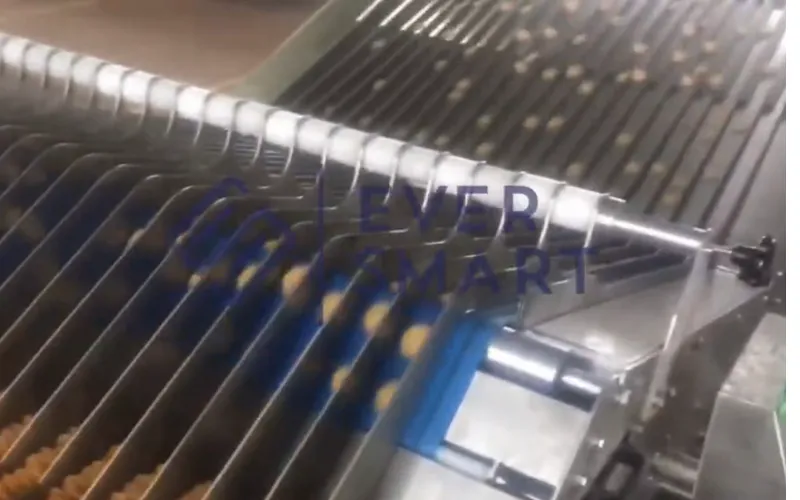
A Small Biscuit Stacking Machine is an automation solution designed specifically to meet the needs of Small to Medium-Sized Enterprises (SMEs) and artisan bakeries.
It uses a compact footprint (compact biscuit stacker) and a lower investment cost to help businesses escape labor-intensive manual packing.
For producers with growing output who need to improve professionalism and hygiene standards—but are limited by space and budget—this equipment is the critical first step toward automation.
Many SME owners and artisan bakery founders are incredibly passionate about their products.
You've likely spent years perfecting your recipes, and your customers love what you make.
At the same time, you may be facing a frustrating reality: your own success is eating your capacity alive.
Your talented bakers and expensive ovens could be producing more, but mountains of biscuits are piling up on cooling racks.
They are all waiting for three or four employees to manually count, arrange, and pack them with tired hands.
You might think automation is a luxury reserved for massive industrial plants with giant factories and multi-million dollar budgets.
You tell yourself, "I don't have the space, and I don't have the budget."
That assumption is no longer true.
The "small stacker" market exists precisely to solve this core problem.
It is not a "cheap alternative" to large industrial machines; it is an engineering solution built on a completely different philosophy.
This philosophy is built for "flexibility," "compact design," and "cost-effectiveness."
This guide will dive deep into what a "small biscuit stacking machine" really means.
We will analyze the different technology types available and provide you—the SME owner—with a clear Return on Investment (ROI) and selection framework to help you make the smartest decision for your limited budget.
Key Takeaways
Market Position: A "small stacker" isn't a new technology, but a market position. It refers to compact, low-cost, and low-to-mid-speed automation designed for SMEs.
Core Value: Its value isn't about achieving maximum speed. It’s about solving three core pain points: freeing up labor (breaking the manual bottleneck), improving hygiene & compliance (to enter new sales channels), and delivering a fast ROI.
Product Dictates Technology: You must choose the machine based on your product. Fragile or coated biscuits need a Penny Stacker; hard or uniform biscuits need a Star Wheel; the lowest budget or tray-packing needs a Grouping Conveyor.
SME Buying Standards: For an SME, the most important selection criteria are Footprint and Changeover Flexibility, not maximum speed.
H2: The SME's "Automation Dilemma": Why Do You Need a Small Stacker?
If your business is experiencing any of the following scenarios, you have likely reached the "tipping point" of manual packing.
This is the point where every new order adds more chaos, not more profit.
Pain Point 1: The Manual Bottleneck—Your "Growth Ceiling"
This is the most immediate pain point.
The speed of your entire production line—whether it's a single tunnel oven or several rack ovens—is being held hostage by the hands of your packaging staff.
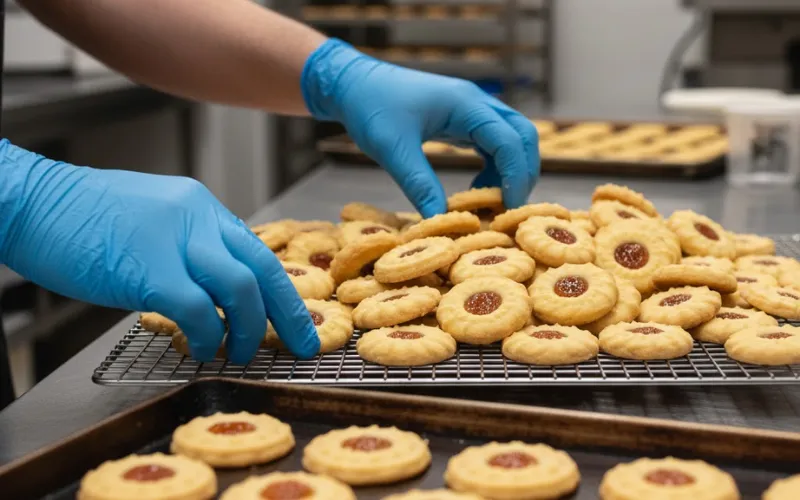
Inefficiency and Capped Capacity:Picture this all-too-common scenario: the oven timer buzzes, a new rack of biscuits is ready, but the cooling racks are already full. The packaging team is still scrambling to get through the last batch.
Your bakers are forced to wait, or you have to run your oven at a slower speed just to cope. This isn't just inefficiency; it's real, achievable revenue you are losing every single day.
Counting Errors and Lost Profit:Humans are not machines. When an employee repeats the "grab-count-bag" motion for four hours straight, mistakes are inevitable.
"Under-fills": You get customer complaints, your reputation suffers, and you may even face fines from retailers.
"Over-fills" (Giveaway): This is your "hidden cost." Let's do the math: assume your employee accidentally adds one extra biscuit to just one out of every 20 packs (a 5% error rate). That biscuit costs you $0.10.
If you produce 5,000 packs a day: 5,000 packs x 5% error rate = 250 packs250 extra biscuits x $0.10 cost x 300 workdays = $7,500 per yearThat $7,500 should have been your pure profit. Now, it's being given away for free.
Labor Dependency and Management Nightmares:
Hiring and Training: Packing is a tedious job with notoriously high turnover. You are constantly spending time hiring and training new staff, whose speed and accuracy are never guaranteed.
Inconsistent Speed: Employee A might be 20% faster than Employee B. This forces your line to run at an inconsistent, non-standardized pace.
Health Risks: Long-term, repetitive wrist motions are a direct cause of Repetitive Stress Injuries (RSI). This can expose you to workers' compensation claims.
Pain Point 2: Hygiene & Compliance Pressure—The "Barrier to Entry"
This is the risk that SME owners most often overlook, but it is the most fatal to growth.
Hygiene Risk:Under modern food safety regulations like GMP (Good Manufacturing Practices) or HACCP, "every manual touch is a contamination risk."
No matter how often your staff washes their hands or wears gloves, the risk of biological contamination (bacteria, hair, etc.) from manual handling is far higher than from automation.
Blocked Channels and Missed Opportunities:This may be the most frustrating part. Your product quality is outstanding, and you are fully capable of moving into premium markets. But:
They cannot accept the inconsistency and hygiene risks of manual packing.
Therefore, manual packing is no longer just an "efficiency" problem—it has become the "barrier to entry" blocking you from major sales channels.
Chain Supermarkets (Costco, Whole Foods)
High-End Coffee Chains (Starbucks)
Hotel Chains (Marriott)
AirlinesThese large B2B customers almost always have a strict requirement in their Supplier Audits: You must have an automated packing process and traceable hygiene standards.
Pain Point 3: "Big" Machines Don't Fit—The "Overkill" Problem
You know the problem, and you've looked at automation. But what you likely saw was this:
Too Expensive (Budget Mismatch):You contacted a large industrial supplier, and they showed you a multi-lane star wheel stacker for $300,000. That price is astronomical for your business.
Your budget is likely in the $30,000 to $80,000 range.
Too Big (Space Mismatch):Your workshop, bakery, or central kitchen might only be 1,000 square feet (100 sq. meters). Those large industrial machines often require a 30-foot (10-meter) footprint.
You simply don't have the floor space.
Too Fast (The "Speed Trap"):This is the most critical technical mismatch. A large machine boasts it can handle 2,000-3,000 biscuits per minute.
But your small tunnel oven might only produce 300-500 biscuits per minute.
You do not need to pay extra for "maximum speed" you will never use. Your need isn't for "fastest"—it's for "matched." It needs to be perfectly synchronized to your oven's speed.
Tip: The Core Value of a Small Stacker
For an SME, the value of investing in a
compact biscuit stackeris not about chasing "maximum speed." It's about achieving "stable, unattended operation" and "standardized product quality."It frees up 2-3 employees from a boring, repetitive job and moves them to high-value work, like quality control or new product development.
The real value of this machine is to free you, the owner, from the role of "Production Line Manager" and let you get back to being the "CEO" and "Creative Baker."
H2: Unveiling the "Small Stacker": The 3 Main Tech Types on the Market
Before you start shopping, you must understand one critical concept: a "small biscuit stacking machine" is not a single, standardized technology category.
The term describes your market need (i.e., compact, low-cost, mid-speed).
When you present this need to a supplier, they will typically offer you a "simplified," "compact," or "single-lane" version of one of these three industrial technologies.
You must choose the right one for your product type, or the results will be disastrous.
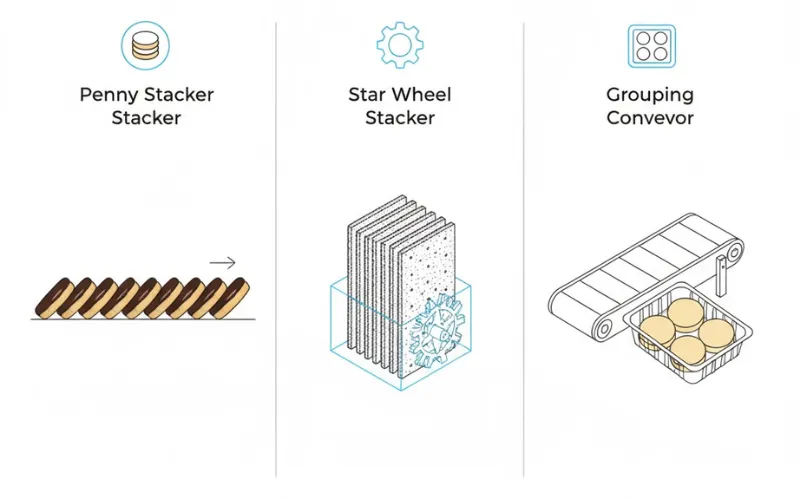
Type 1: Compact Penny Stacker (or "Shingler")
This is the most common, most mature, and most suitable entry-level automation solution for the majority of artisan bakeries.
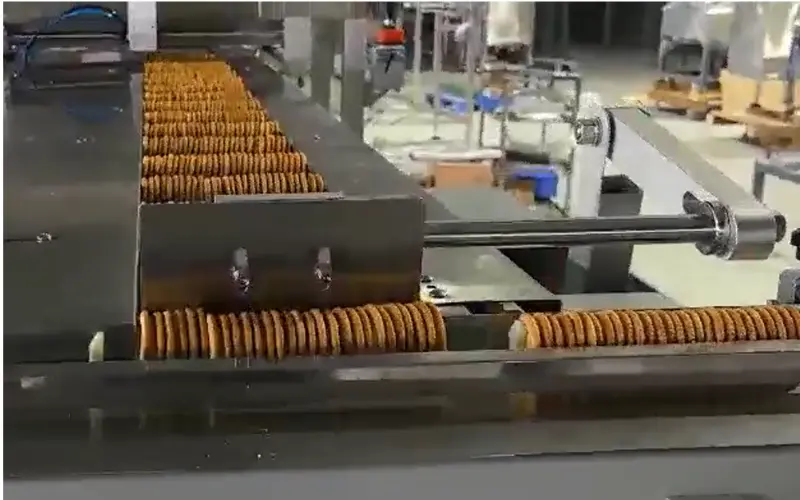
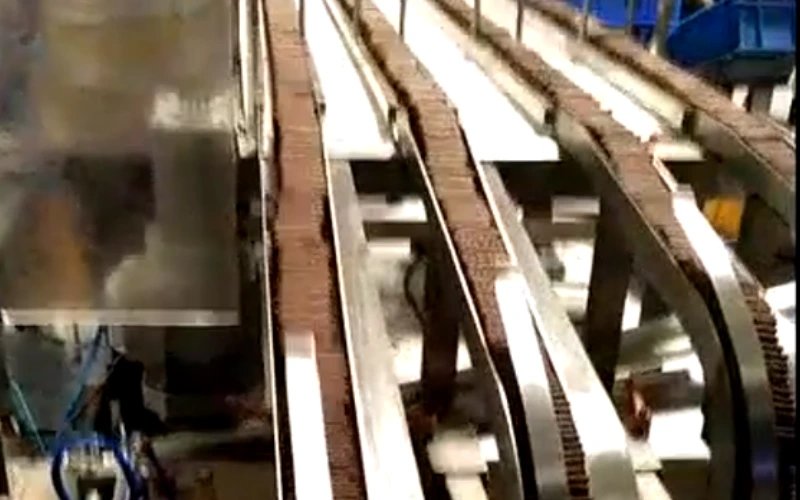
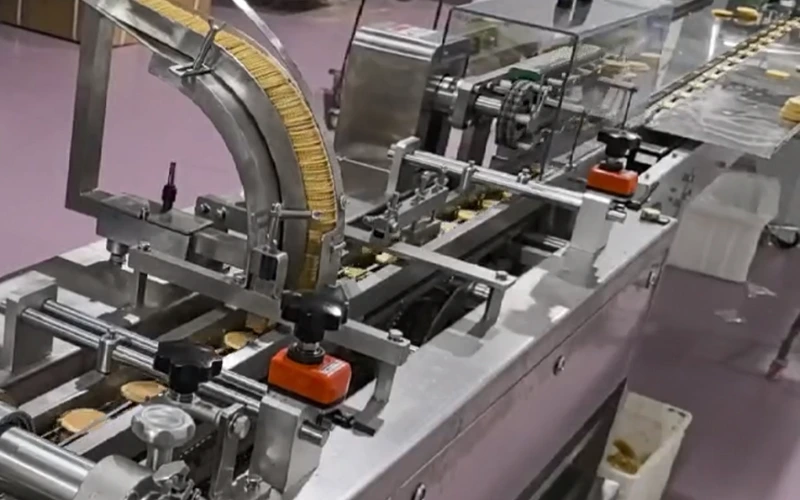
How it Works (Simple Terms): It's like "dealing cards." It uses "shingling" (overlapping) stacking. Biscuits slide from the cooling conveyor onto the machine.
The machine uses a series of carefully designed slowdown belts or guides (often food-grade PU belts and adjustable slowdown guides to ensure minimal contact pressure on coated biscuits).
It makes each biscuit gently overlap the one in front of it, forming a neat, continuous, "shingled" row.
Best For: Fragile, coated, sandwiched, or irregularly shaped biscuits.
Examples: Chocolate-coated biscuits (won't scratch the coating), sandwich cookies (won't squeeze the filling), soft cookies, butter cookies, high-end artisan biscuits.
SME Application:This is the ideal entry-level automation piece. It's typically a single-lane design with a simple mechanical structure (which means it's more reliable and easier to maintain).
Its footprint is often tiny; it can be "grafted" directly onto the end of your existing cooling conveyor.
It perfectly replaces the work of 2-3 employees doing manual arrangement.
All the worker has to do now is grab a standard-length (e.g., 10 biscuits) group from the continuous shingled row and place it neatly in a box or bag.
This is the most robust, cost-effective step from "pure manual" to "semi-automatic."
Want to learn more about how this tech gently handles your products? Read our Penny Stacker (Shingling) Deep Dive.
Type 2: Single-Lane Star Wheel Stacker
If your product needs to be packed vertically on-edge, like crackers on a supermarket shelf, you need this technology.
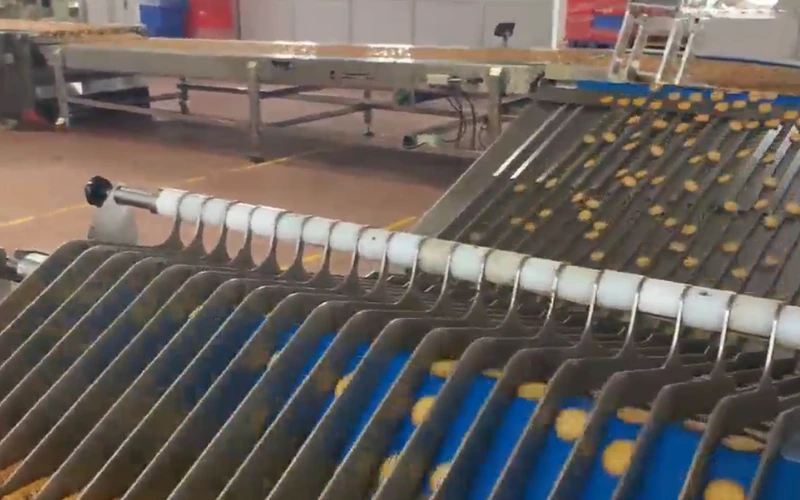
How it Works (Simple Terms): It's like a "coin counter at a bank." It uses one or more vertical rotating "star wheels" (wheels with pockets) to "catch" flat-lying biscuits and turn them on-edge.
At the same time, a PLC (Programmable Logic Controller) uses a sensor to precisely count them. When the preset number is reached (e.g., 12 biscuits), the machine releases a complete "slug" (a counted row).
Best For: Hard or semi-hard, uniformly shaped biscuits.
Examples: Crackers, Marie biscuits, digestive biscuits, hard biscuits.
SME Application:This is a more "advanced" level of automation. It is almost always used in combination with a "Flow Wrapper" (pillow pack machine).
The SME version is typically single-lane and runs at a lower speed (perfectly matching a small oven's output). But it provides the exact same precise counting and on-edge function as the massive industrial machines.
This is a higher investment, but it can achieve a fully automatic process from baking to primary packaging.
Want to understand the magic of high-speed counting? Read our Star Wheel Stacker (Rotary) Deep Dive.
Type 3: Simple Lane Grouping Conveyor
This is the simplest, lowest-cost automation "assist" tool.
How it Works (Simple Terms): It's like a "tollbooth on a highway." It doesn't "stack."
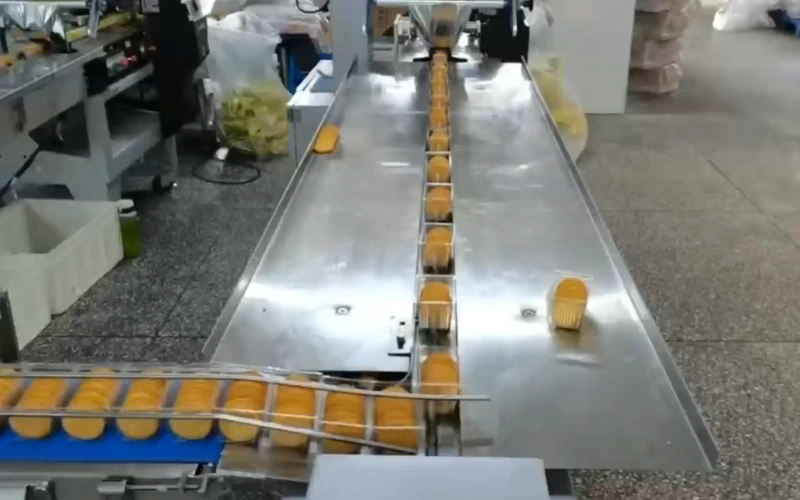
Instead, it uses "flights" (dividers) on a conveyor belt or a "pneumatic pusher" to separate a continuous flow of biscuits into fixed-quantity "groups" (e.g., a group of 5).
Best For:
Products being loaded into plastic trays or clamshells.
Very irregular artisan biscuits that are difficult to handle with the other two methods.
SME Application:This is the lowest level of automation, but also the lowest cost. It doesn't fully replace the human, but it massively assists them.
Imagine: the machine automatically separates biscuits into groups of 5 and pushes them to the worker.
The worker no longer needs to "count"; they just "grab" the pre-counted group and "place" it in the tray.
This eliminates counting errors and easily doubles or triples packing efficiency.
Tip (Tip): How to Decide Quickly
If your biscuits are fragile, coated, or filled (like cookies) -> Your best choice is Type 1 (Penny Stacker).
If your biscuits are hard, uniform, and need vertical packing (like crackers) -> Your best choice is Type 2 (Star Wheel).
If your budget is the absolute lowest or you pack into trays -> Your best choice is Type 3 (Grouping Conveyor).
H3: ROI for SMEs: Is a Small Stacker Worth the Investment?
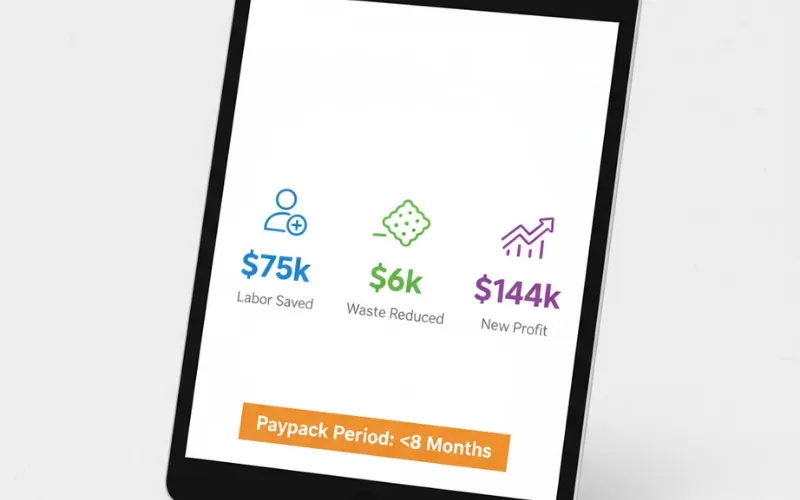
For an SME, every investment must be scrutinized. We aren't chasing the "3% OEE boost" that big corporations talk about.
We are chasing one question: "How fast will this machine pay for itself?"
Let's look at an ROI model built for your reality.
The SME-Specific ROI Calculation Model
When evaluating a small biscuit stacking machine, your financial calculation should focus on these three things. Forget complex formulas; just look at these three core metrics:
1. Direct Labor Savings (OPEX)
This is the most direct return. You shouldn't just calculate an employee's "hourly wage," but their "Fully-Loaded Cost."
[# of Workers Freed Up] x ([Avg. Hourly Wage] + [Insurance/Taxes/Benefits, ~20-30% of wage]) x [Hours per Day] x [Workdays per Year] = Annual SavingsExample: Free up 2 workers at $15/hr, 25% benefits, 8-hour shift, 250 days/year.
2 x ($15 * 1.25) x 8 x 250 = $75,000 in Annual Savings
2. Reduced Waste & "Giveaway" (OPEX)
This is the "hidden profit" we mentioned earlier.
"Over-fills" from manual counting (e.g., 1 extra biscuit per pack) are pure profit loss.
[Daily Packs] x [Cost per Biscuit] x [Estimated Giveaway %] x [Workdays per Year] = Annual SavingsExample: 5,000 packs/day, $0.10/biscuit cost, 5% error rate (1 in 20 packs).
5,000 x $0.10 x 5% x 250 = $6,250 in Annual SavingsThis doesn't even include the savings from reduced breakage (waste) from manual handling.
3. Unlocked Capacity (Opportunity Cost) — This is the "Gold Mine"
This is the point most SME owners miss, but it is the most valuable one.
Because packing is no longer the bottleneck, your oven (your most expensive asset) can finally run at its full, intended speed.
Example:
Before (Manual): Line is capped at 400 biscuits/minute by human packers.
After (Machine): Line can run at the oven's max safe speed of 600 biscuits/minute.
Unlocked Capacity = (600 - 400) biscuits/min x 60 min/hr x 8 hr/day x 250 days/yr = 28,800,000 extra biscuits per year
[Extra Output] x [Marginal Profit per Biscuit] = New Annual ProfitAssume $0.05 profit per biscuit: 28,800,000 x $0.05 = $1,440,000 per year (in theory)
Even if you only capture 10% of that theoretical value (an extra $144,000 in product), its value is far greater than the labor you saved.
Case Study: An Artisan Bakery's 18-Month Payback Path
Let's use a real (simplified) client case to show how this works.
Based on data from 35 clients of a similar scale we've served, the average payback period is 10-16 months. This case is a typical example.
Client: "Sweet Artisan Bakes," a local bakery with one small tunnel oven.
Product: A fragile, chocolate-coated butter cookie (Must use Type 1: Penny Stacker).
Pain Point: 2 full-time employees were dedicated to manually shingling and boxing at the end of the line. It was slow, breakage was high (scratched coating), and they couldn't cope with holiday order spikes. They just lost a hotel contract because their packing was deemed "unprofessional and unhygienic."
Investment: $40,000 (for one compact penny stacker).
The ROI Calculation:
1. Labor Savings (OPEX):
Those 2 employees were reassigned to high-value roles (1 to baking/QC, 1 to new client development).
A conservative "fully-loaded" cost for these workers in their region (Midwest USA) was ~$27,000/year each.
2 workers x $27,000 = $54,000 in Annual Savings2. Waste/Giveaway Savings (OPEX):
Gentle machine handling and standard counts dropped breakage from 3% to 0.5% and eliminated counting errors.
This saved a conservative $5,000 per year.
Payback Period:
$40,000 (Investment) / ($54,000 + $5,000) (Annual Savings) = 0.67 YearsConclusion: The machine paid for itself in approximately 8 months.
The Real Strategic Value (Opportunity Cost):
This is the key to the story. In the second year, because of their standardized, hygienic, and professional-looking packs (all shingles were uniform), the bakery successfully won contracts with a 5-star hotel chain and a high-end coffee shop chain.
The $40,000 machine was no longer a "cost"—it was the "entry ticket" that got them into the premium market. This new revenue surpassed $100,000 in just 6 months.
Note (Note): Don't Just Look at the Price Tag
This case shows that the $40,000 investment returned far more in strategic value (new channels) than it did in cost savings.
When evaluating, always consider "opportunity cost" and "strategic value," not just the sticker price.
Want a more detailed, customizable financial model? Visit our Biscuit Stacker Price & ROI Analysis Guide.
H2: The Purchasing Guide: SME-Specific Criteria
When shopping for a compact biscuit stacker, your concerns are completely different from a large factory's.
A big factory cares about max speed and OEE. You must care about these four things like a survivalist.
1. Footprint - Your #1 Priority
Space is your most valuable asset. A machine that can't fit in your shop is worthless, no matter how cheap it is.
Demand Exact CAD Drawings: Not just length and width, but height. Can it fit through your standard doorway? Is your ceiling high enough?
Consider "Bolt-On" Design: A good small stacker isn't a giant standalone "monoblock." It's designed to "bolt on" to the end of your existing cooling conveyor or be built in an "L" shape to fit your existing layout.
Choose "Cantilevered" Design: This design means the machine's frame is open at the bottom, with the drives and electronics on one side. This has two huge benefits:
It's often more compact.
It's extremely easy to clean. You can clean the floor directly underneath it, preventing hygiene traps.
Expert Tip (Expert Tip): Do a Physical Simulation
After you get the drawings, take a roll of blue painter's tape. Go to your shop floor and tape the machine's exact outline on the ground.
This gives you a visceral feel for how much space it will take and if your workers have room to move and maintain it. This simple step can prevent a very expensive purchasing mistake.
2. Flexibility & Changeover - Your Core Competency
An SME's advantage is "flexibility." You aren't Nabisco; you don't run one type of biscuit for 3 years.
You run round cookies today and square crackers tomorrow. Your machine must keep up.
One Machine, Many Products: You must ask: "How many different biscuit sizes and shapes can this machine handle?"
Changeover Speed: "How long does it take to switch from Product A to Product B?" For an SME, any changeover that takes longer than 30 minutes is unacceptable.
"Tool-less" Changeover is a Massive Bonus: This means any of your employees, without a toolbox (hunting for a 10mm wrench), can make adjustments using "hand-wheels," "levers," and "quick-release clamps."
"Digital Position Indicators": This is a simple but brilliant device. It's a small digital counter next to an adjustment hand-wheel. Your recipe sheet says "Round Cookie = 28.5mm."
Your operator just turns the wheel until the display reads "28.5". This eliminates all guesswork, cuts changeover time from 1 hour to 10 minutes, and ensures consistency.
Cost of Change Parts (The "Hidden Cost"): Beware the "razor blade" model (the razor is cheap, the blades are expensive).
If your machine (especially Type 2: Star Wheel) requires a new, custom-milled $5,000 star wheel set for every new biscuit, you must factor that into the total cost.
3. Integration & Speed
Don't Pay for Speed You Don't Need: We repeat: ensure the machine's speed range matches your oven's output speed. You need "synchronization," not "maximums."
A machine that can be adjusted from 100-500 biscuits/minute is far more valuable to you than one that only runs at 1000-2000.
The Simple "Handshake": Your
small biscuit machinedoesn't need to network with the whole factory's MES. But it must be able to do the simplest "handshake" with the machine downstream (if you have one, like a packer).What does this mean? It's often just one signal wire. When the wrapper is out of film or jammed, it sends a "STOP" signal to the stacker. The stacker must immediately pause its infeed to prevent a pile-up.
Want to know how machines "talk" to each other? Read our Biscuit Production Line Integration Guide.
4. Usability & Maintenance (Usability & small biscuit machine maintenance)
You do not have a large engineering team. Your machine must be as easy to operate and maintain as your commercial oven.
Intuitive Interface ("Idiot-Proof"): Look for a machine with a touchscreen (HMI) and graphical icons, not a complex box of buttons and codes. Your staff should be able to learn it in an hour.
Furthermore, per food machinery safety standards, high-quality compact equipment keeps noise levels below 65dB. This is ideal for small, mixed-use production environments where people are working close by.
Easy to Clean (The "15-Minute Clean"): Can the machine be quickly cleaned in 15 minutes? Can the food-contact parts (belts, guides) be quickly removed (tool-less) and washed in a sink?
Remote Support (The SME "Lifeline"):This is a key differentiator for SME purchasing today. Ask the supplier: "Do you offer fast, remote support?"
This means when your machine has an error code, you don't pay $2,000 for an engineer to fly to you. You grant the supplier's engineer secure VPN access to your machine's PLC.
They can diagnose the problem from 1,000 miles away and tell you in 10 minutes: "Sensor 3 is dirty. Please wipe it." This can turn 2 days of downtime into 10 minutes.
Want to learn how to care for your equipment? Check our Biscuit Stacker Preventive Maintenance Guide.
Note (Note): The Truth About Maintenance
For an SME, 90% of downtime doesn't come from complex mechanical failures. It comes from simple maintenance oversights (a dirty sensor, a loose belt).
Choosing a machine that is "easy to clean" and "easy to inspect" is more important than choosing one that is "technologically advanced." Remote support is your insurance policy for the other 10% of problems.
H2: Frequently Asked Questions (FAQ)
We've compiled the most common questions SME owners ask when inquiring about a small biscuit machine.
Q1: What is a stacking machine?A: A stacking machine is an automated device that replaces manual labor.
It takes individual products (like biscuits) from a production line (like a cooling conveyor) and organizes them into a neat, standardized format (e.g., shingled, on-edge, or grouped) for efficient, hygienic downstream packaging.
Q2: What is the real cost of a small biscuit stacking machine?A: The range is wide and depends entirely on the technology and level of automation. For "compact" equipment designed for SMEs:
Type 3 (Simple Groupers) can start around $15,000 - $30,000.
Type 1 (Compact Penny Stackers) are most common, often in the $30,000 - $70,000 range, depending on speed and features.
Type 2 (Single-Lane Star Wheels) are typically more, $50,000 - $90,000, due to the servo motors and precision PLC counting.
When evaluating the compact biscuit stacker price, you must assess which tier is right for your product and ROI.
Q3: Do biscuit machines require special maintenance?A: They do not require "special" maintenance, but they require "consistent" maintenance.
For small biscuit machine maintenance, 90% of the work is preventive and can be done by your in-house staff:
Daily Clean: Wiping away crumbs and oils, cleaning sensor lenses.
Weekly Check: Checking belt tension.
Monthly Lube: Greasing specific bearings according to the manual.
Most problems come from poor cleaning (blocking a sensor) or loose belts, all of which are easily avoidable.
Q4: Can I just automate one part of my line?A: Yes! And you absolutely should. You don't need to achieve "Industry 4.0" overnight.
The most successful SME automation path is to start at the #1 pain point.
If your bottleneck is packing, just invest in one compact biscuit stacker (like Type 1).
Place it between your existing cooling conveyor and your existing manual packing table. This "semi-automatic" upgrade is the highest-ROI, lowest-risk strategy.
Q5: How much space do I need for a "compact biscuit stacker"?A: "Compact" varies, but a good rule of thumb is that an entry-level compact stacker (like a penny stacker) might have a footprint similar to a large commercial refrigerator.
They are often designed to be 3-6 feet (1-2 meters) long and 2-3 feet (0.8-1m) wide.
Most importantly, they are often "bolt-on" and connect directly to the end of your conveyor, so the additional "net new" space required is very small.
Q6: I make soft, sticky artisan cookies. Can I use a stacker?A: This is a critical question. Type 2 (Star Wheel) is an absolute "no"; it will crush your soft cookies.
Type 1 (Penny Stacker) is "maybe," but requires special handling.
You need to look for a penny stacker that uses "non-stick" belts (like PU material) or special "deceleration" designs that "slide" the biscuits rather than "pushing" or "grabbing" them.
You must send your product to the supplier for a real-world test before buying.
Important Tip (Important Tip): ALWAYS Test With Your Product
Never, ever buy any machine without testing it with your own products (especially your most difficult ones).
All supplier demo videos use perfect, ideal biscuits. You must verify it can handle your product, especially under different temperature and humidity conditions.
H2: Conclusion: Automation Is Not a Luxury, It's a Tool
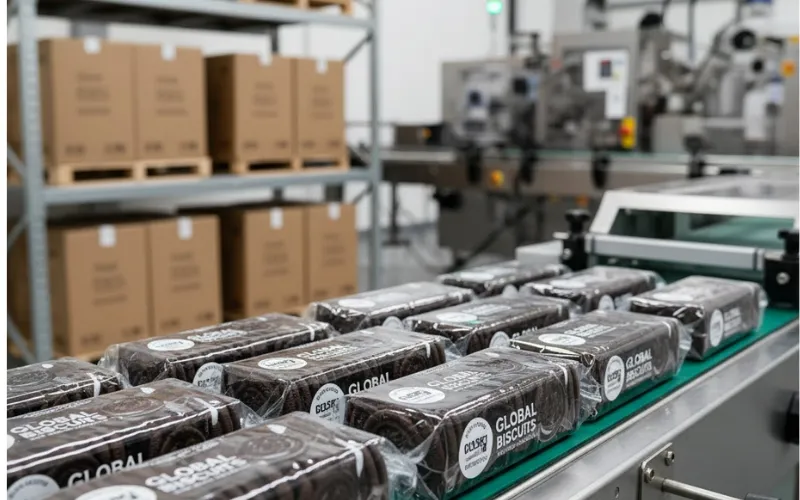
Automation is not a distant dream reserved for massive factories. It is an accessible, necessary tool for SME survival and growth in today's market.
A Small Biscuit Stacking Machine is the high-ROI entry point designed specifically for an owner just like you.
It solves your most urgent problems: freeing up labor, guaranteeing quality, meeting compliance, and winning you bigger market opportunities.
Stop wasting your (or your employees') valuable time on repetitive counting and arranging.
Invest in a compact automation piece that will not only pay for itself in 8-18 months but will also free your team to create real value: developing new flavors, finding new customers, and (most importantly) giving you time to enjoy the successful business you built.
CTA - Link to Pillar Page
Want a complete overview of all stacking technologies, from small to large-scale?
Read our core pillar article: The Ultimate Guide to Biscuit Stacking Machines (2025): Selection, ROI & Integration.
CTA - Business Conversion
Is your artisan bakery or medium-sized factory facing a packaging bottleneck?
Contact our automation experts today for a free, no-obligation compact layout assessment.
We specialize in finding the most efficient solution for limited spaces and budgets. We understand the SME pain points, and our goal is to help you grow cost-effectively.
Book Your Free Consultation Today

Ready to start your journey toward a customized solution? Contact me directly on WhatsApp to begin the conversation.