The Ultimate Guide to Biscuit Stacking Machines (2025): Selection, ROI & Integration
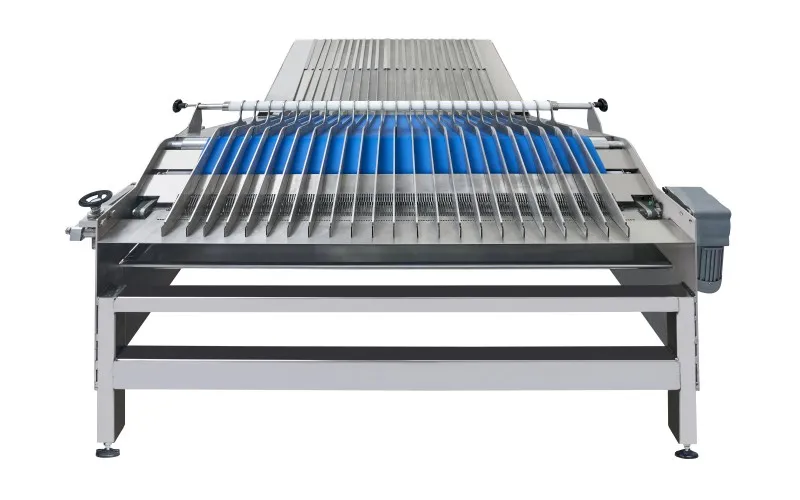
I. Introduction: The Stacker as Your Production's Core
In the automated food production environment of 2025, a biscuit stacking machine is no longer an optional upgrade. It is the central hub that dictates your line's efficiency, hygiene standards, and ultimate profitability.
Put simply, a biscuit stacking machine is a critical piece of automation. Its core function is to take biscuits from a cooling conveyor—which are often disorganized—and automatically align, count, group, and stack them into a pre-set formation.
This formation (whether flat, shingled, or on-edge) is designed to feed downstream packaging processes, like flow-wrappers or auto-feed systems.
In essence, a biscuit stacker is the "bridge" connecting baking and cooling with final packaging.
Without it, your line relies on a bottleneck of manual biscuit stacking. This is an inefficient, high-cost, and repetitive process that introduces a massive risk of contamination.
This guide isn't just for "biscuits." The principles, technologies, and selection criteria we discuss apply equally to wafers, crackers, cookies, and other uniformly shaped baked goods.
We will take you on a deep dive, starting from the CEO's strategic viewpoint and the CFO's cost analysis. We'll move through the purchasing manager's selection process and into the complex integration challenges faced by your electrical and mechanical engineers.
This is the ultimate guide.
Key Takeaways
Core Function: A biscuit stacker is the automated bridge connecting your cooling conveyor to your packaging line, providing alignment, counting, and stacking.
Critical Value: It dramatically cuts labor costs, eliminates hygiene bottlenecks from human contact, and significantly boosts your line's Overall Equipment Effectiveness (OEE).
The Two Main Types: The Penny Stacker is ideal for delicate, coated, or high-value sandwich biscuits. The On-Edge Stacker is built for high-speed, on-edge packing of hard biscuits and crackers.
Look Beyond Price: When selecting a machine, the Total Cost of Ownership (TCO), Changeover Time, and Uptime/Reliability are far more important than the initial purchase price.
Integration is Everything: A modern stacker must be able to "handshake" seamlessly with your existing plant standard, whether that's Siemens, Rockwell, or another PLC brand.
II. How a Biscuit Stacking Machine Works
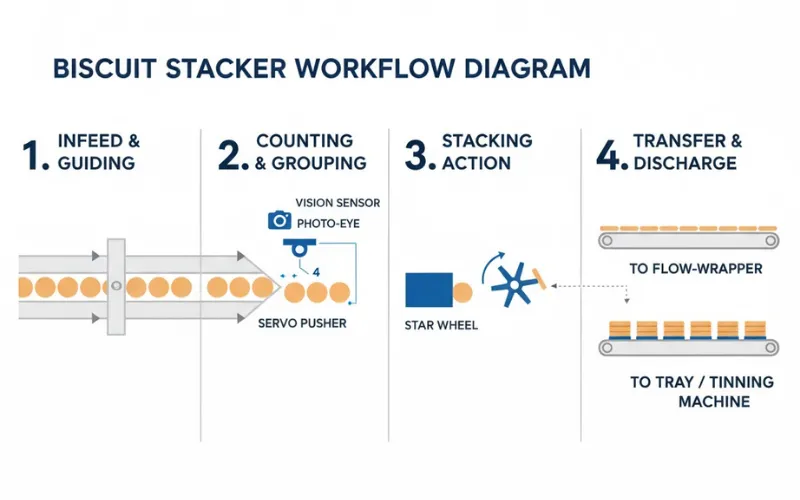
To understand its value, you must first understand how a modern biscuit stacking machine creates order from chaos. This process is a high-speed symphony in four precise steps.
1. Infeed & GuidingBiscuits arrive at the stacker's infeed zone after exiting the long cooling conveyor. The first job is "product handling."
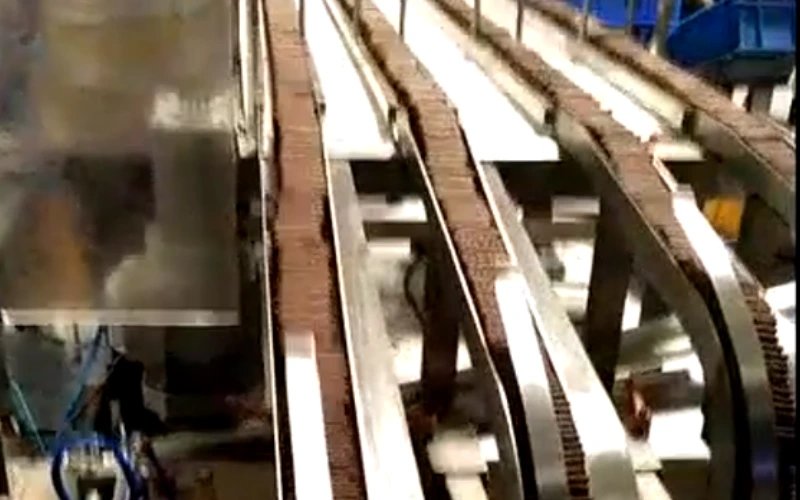
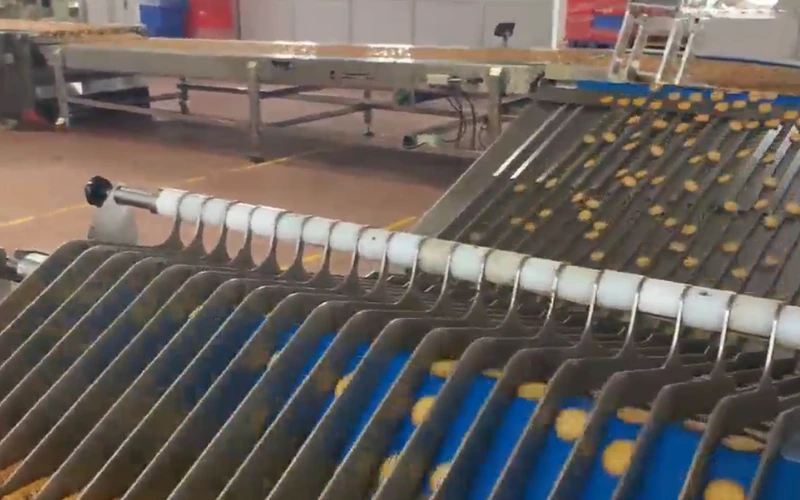
If biscuits arrive in multiple rows, the system uses adjustable guide rails or vibratory lanes to gently separate and funnel them into single, orderly files. This ensures every biscuit moves forward with the correct orientation (usually flat) and spacing.
2. Counting & GroupingAs the aligned biscuits pass through the sensor zone, high-precision photoelectric sensors (or "photo-eyes") detect every single product.
An operator pre-sets the desired "count per group" (e.g., 10 biscuits) on the HMI (Human-Machine Interface). The PLC (Programmable Logic Controller) counts in real-time and, upon hitting the target, sends an immediate signal to the stacking mechanism.
3. The Stacking ActionThis is the core mechanical function of the machine, and it differs by type.
For a Penny Stacker, once a group is counted, a servo-controlled paddle or pusher swiftly moves that group from the main conveyor onto an adjacent belt. This creates a flat, "shingled" (overlapping) stack.
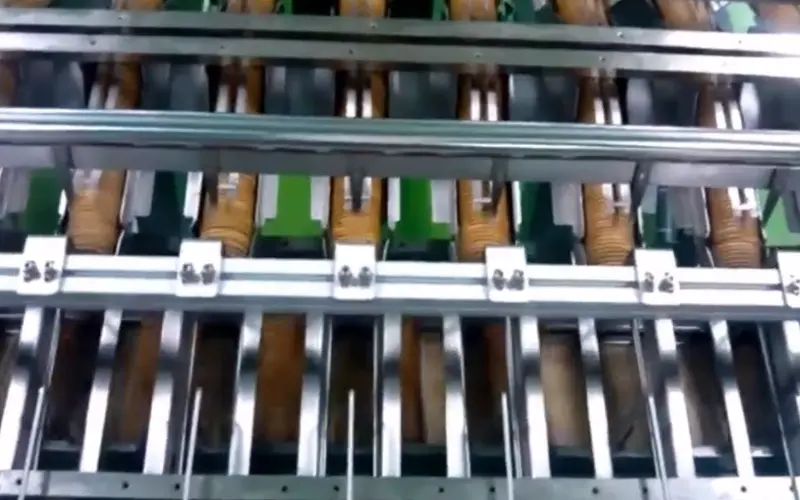
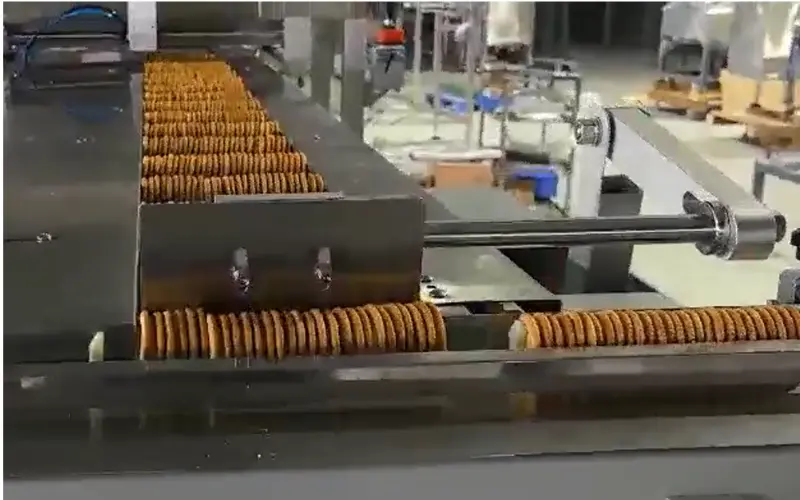
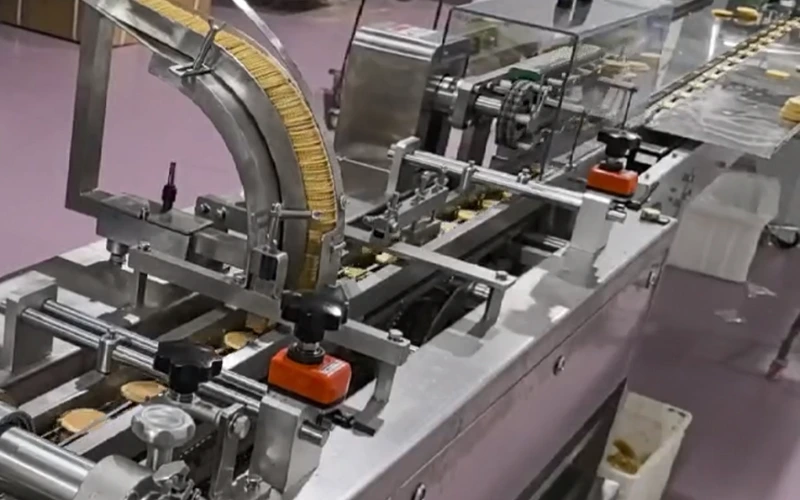
For an On-Edge Stacker, biscuits are guided into a rotating device known as a "star-wheel." The wheel's custom-fit pockets catch the biscuits, gently turn them 90 degrees from flat to vertical, and place them on their edge.
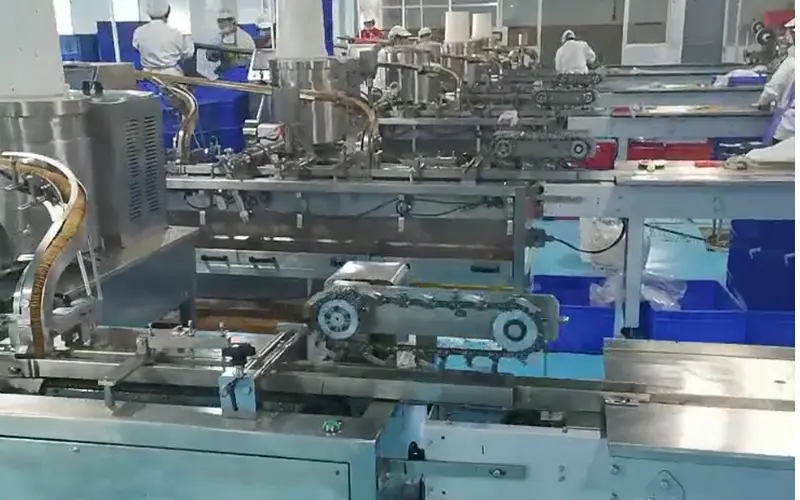
4. Transfer & DischargeOnce stacked, these groups of "on-edge" biscuits (e.g., 10 standing back-to-back) are smoothly transferred by a side-pusher chain.
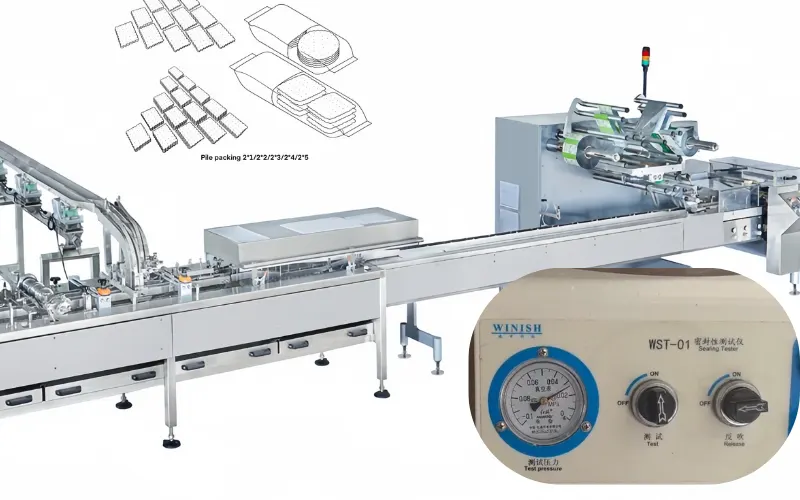
They are deposited onto the infeed of the next machine—most commonly, a flow wrapper's infeed chain. Lugs on that chain catch the group and feed it into the bagger to be sealed.
These four steps are perfectly synchronized by the PLC and servo-drive system. This coordination ensures a continuous, high-speed, and stable automated flow from start to finish.
Note: The perfect synchronization of these four steps is the key to machine reliability. A micro-second delay in counting or execution will cause a jam. This is why high-end machines are built exclusively on PLC and servo-driven platforms.
III. The Two Main Types of Biscuit Stackers
Choosing the right type of stacker is the first and most important decision. It depends entirely on your product's characteristics and your packaging goals.
A. The Penny Stacker (or Shingling Stacker)
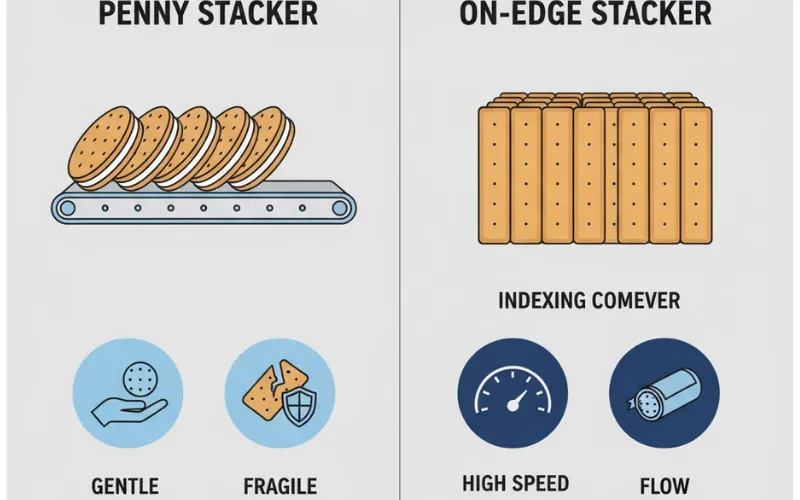
This machine gets its name from its action: stacking biscuits flat, like a pile of pennies, or in an overlapping "shingled" pattern.
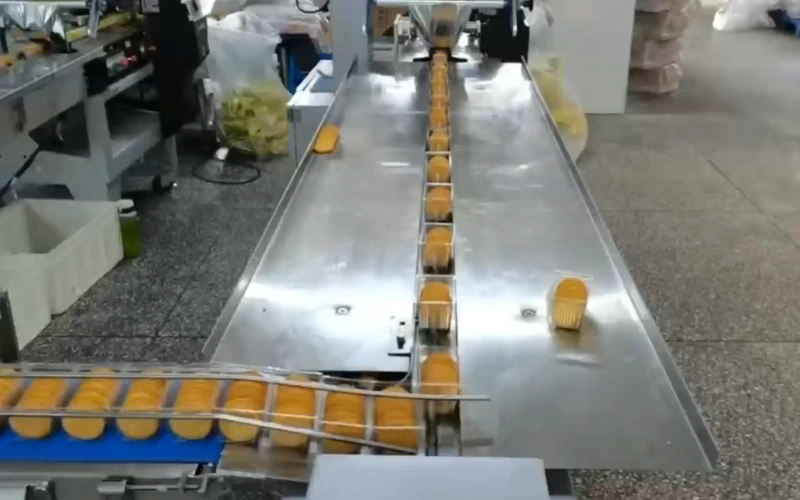
How it Works: Biscuits travel flat, are counted by sensors, and then separated into groups by a servo-pusher. They are ideal for products that need to be placed flat into a tray, box, or wrapper.
Best-Fit Products:
Sandwich & Coated Biscuits: Products with uneven surfaces, sticky coatings, or delicate toppings that would collapse or stick if turned on-edge.
High-End or Fragile Products: Items that require gentle handling and minimal friction to prevent breakage.
Specific Pack Styles: The common clear plastic trays of cookies found in supermarkets (e.g., 3 cookies per cell) are filled by penny stackers.
Advantages: Extremely gentle handling, versatile, and perfect for high-value, fragile, or coated products.
B. The On-Edge Stacker (or Star-Wheel Stacker)
This is the most common type of biscuit stacking machine found on high-speed production lines today.
How it Works: Its core component is the "star-wheel." Biscuits enter the star-wheel flat, are rotated 90 degrees to a vertical "on-edge" position, and are then grouped back-to-back.
Best-Fit Products:
Hard Biscuits & Crackers: Products with uniform shapes (round, square, rectangular) and a firm texture that won't easily break.
High-Speed Flow Wrapping: This "on-edge" configuration is the ideal infeed format for a pillow-pack flow wrapper, allowing for incredible packaging speeds.
Advantages: Extremely fast, space-saving (on-edge packs are more compact), and the mainstream choice for high-volume, high-efficiency production.
C. Custom & Special Applications
Beyond these two main types, the real challenge comes from non-standard products. A true stacking machines expert can also provide:
Wafers Solutions: Wafers are extremely light and fragile. They may require a combination of vacuum conveyors and gentle air-flow guides to stack without damage.
Sticky Products: Biscuits with marshmallow or caramel toppings require special non-stick belts (e.g., PU or Teflon) and belt-scrapers.
Irregular Shapes: For animal crackers or heart-shaped cookies, a vision-guided robotic system (CCD camera) may be needed to identify, orient, and group products.
Comparison: Penny Stacker vs. On-Edge Stacker
Feature | Penny Stacker | On-Edge Stacker |
|---|---|---|
Stack Format | Flat / Shingled (Overlapping) | Vertical / On-Edge (Back-to-Back) |
Core Tech | Servo-Pusher / Paddle | Star-Wheel |
Best For | Sandwich cookies, coated, fragile | Hard biscuits, round/square crackers |
Pack Style | Trays, Boxes, Flat-pack | High-Speed Flow Wrap (Pillow Pack) |
Speed | Medium to High | Extremely High |
Advantage | Gentle, Flexible, Handles Fragiles | Fast, Efficient, Saves Pack Material |
Tip: How to choose? The rule is simple. If your biscuit is expensive, fragile, coated, or goes in a tray, start with a Penny Stacker. If you are running high-volume, high-speed hard biscuits into a flow-wrapper, you need an On-Edge Stacker.
IV. Purchasing Pitfalls: The 3 Most Expensive Mistakes
When evaluating a biscuit stacking machine, it's easy to fall into the trap of looking only at price and speed. Based on our decades of experience, these are the three most common and costly mistakes customers make.
Pitfall 1: Focusing on "Peak Speed" (PPM) instead of "Stability" (Uptime).Many suppliers will boast a "peak speed of XXX packs per minute." But for a CEO or CFO, a machine running at 150 PPM that must be stopped for 5 minutes every hour to clear a jam is far less profitable than a machine running at a stable 130 PPM, 24/7.
99% uptime is always more valuable than 120% peak speed. Overall Equipment Effectiveness (OEE) is the only metric that matters.
Pitfall 2: Ignoring "Changeover Time."This is the biggest "hidden cost" in production. If your factory runs multiple product sizes (SKUs), a machine that takes 2 hours to change over (requiring tools, new parts, and reprogramming) is a financial disaster.
A well-designed machine, built with "SMED (Single-Minute Exchange of Die)" principles, can be changed over in 15 minutes. This is done with tool-less adjustments, hand-wheels, and one-touch recipe selection.
For a multi-product bakery, ease of changeover is more valuable than top-end speed.
Pitfall 3: The "Full Servo" Myth."Full Servo" sounds impressive, but it's not always better. Servo motors offer incredible precision and flexibility, but they also cost more.
A superior design uses servos at the "critical points" where high-precision positioning and variable speed are essential (like the star-wheel or counter-pusher). It may use reliable (and cheaper) mechanical cams or VFD motors for simple, constant-speed movements.
The key is appropriate servo application, not maximum servo count.
Note: These three pitfalls boil down to one piece of advice. Prioritize the machine's long-term OEE and flexibility (changeovers) over its on-paper "peak speed" or "servo count."
V. How to Choose: The Ultimate Purchasing Manager's Checklist
As a purchasing manager, your job is to find the balance between engineering's demands and finance's budget. This checklist will help you systematically evaluate any vendor.
1. Product Parameters (The Non-Negotiables):
Is your biscuit hard or soft? Is it fragile?
What are its dimensions: length, width, thickness (and its tolerances)?
Does it have a coating, a cream filling, or a sticky surface?
2. Capacity & Speed Matching:
What is the output of your upstream oven and cooling line (e.g., in lbs/hr or pieces/min)?
The biscuit stacking machine must match or slightly exceed this capacity, and it must synchronize perfectly with your downstream wrapper.
3. Materials & Hygienic Design (The Deal-Breaker):
Is the machine frame built from food-grade stainless steel (SUS304 or 316L)?
Is it designed for easy cleaning? Look for an open-frame design, no hidden cavities, IP65-rated waterproofing, and compliance with GFSI standards. Can it withstand a high-pressure washout?
4. Vendor Auditing (The Differentiator):
Service Level Agreement (SLA): What is the vendor's guaranteed response time for service (e.g., 24 hours, 48 hours)?
FAT / SAT: Does the vendor support a Factory Acceptance Test (FAT) with your actual products before shipping? Do they provide comprehensive Site Acceptance Testing (SAT) after installation?
Spare Parts: Are wear-parts (belts, sensors) standard, off-the-shelf components? Where is the vendor's spare parts depot located?
Proof: Does the vendor have successful installations in your country or a similar industry?
Tip: When evaluating vendors, ask for video proof of them running a product similar to yours. A customer reference you can call is even better. This is far more reliable than a sales brochure.
VI. Cost vs. Return: The CFO's Guide to TCO
For a Chief Financial Officer, the biscuit stacking machine price is just the tip of the iceberg. A smart decision is based on TCO (Total Cost of Ownership), not purchase price.
A. TCO vs. ROI: Why TCO Matters More
TCO (Total Cost of Ownership) = Initial Capital (CapEx) + Lifetime Operating Cost (OpEx)
CapEx (Capital Expenditure): The machine's purchase price + shipping + installation + initial training.
OpEx (Operating Expenditure): Energy consumption (kW/h) + annual spare parts cost + preventative maintenance labor + the cost of downtime.
A "cheap" machine with high energy use, expensive proprietary parts, or a high failure rate (causing downtime) will have a 3-year TCO that dwarfs the cost of a high-quality machine.
B. The TCO Template: How to Calculate Your Payback Period
Let's use a real, simplified model.
Assumptions:
One production line currently requires 3 workers per shift for
manual stacking.The factory runs 2 shifts.
Total cost per worker (wages, benefits, taxes) = $2,500 / month.
New automatic biscuit stacking machine total investment (CapEx) = $55,000.
Monthly operating cost (OpEx - power, maintenance) = $300 / month.
Calculation:
Monthly Labor Savings:3 workers/shift * 2 shifts * $2,500/worker/month = **$15,000 per month**
Monthly Net Savings (Minus OpEx):$15,000 - $300 = **$14,700 per month**
Payback Period (Months):$55,000 (CapEx) / $14,700 (Net Monthly Savings) = 3.74 Months
Conclusion: In this model, the investment pays for itself in less than 4 months. After that, it generates $14,700 in pure, new profit every single month.
(For a more detailed breakdown, see our complete Price & ROI Guide).
C. The Hidden Costs (The Real Killers)
The calculation above doesn't even include the biggest gains:
Reduced Waste: Manual handling has a high product breakage rate (3-5% is common). Automation stabilizes this at <0.5%.
Increased Throughput: The human bottleneck is gone. The line speed can now be turned up from 100 PPM to 130 PPM, a 30% increase in total output.
Food Safety: You have eliminated human-to-product contact, protecting you from a costly product recall.
Note: When approving a capital request, a CFO must factor in these "hidden costs" (like slow changeovers) and "hidden gains" (like food safety). A machine's value is far more than just the labor it replaces.
VII. Customer Success Stories: Data from the Real World
Abstract numbers are weak. Real stories are powerful. Here are two common customer profiles.
A. Case Study 1: The 60% Efficiency Gain (ROI-Driven)
The Client: A large-scale cracker manufacturer.
The Pain: They had a high-speed oven but relied on manual packing. This created a massive bottleneck, high breakage, and soaring labor costs.
The Solution: We installed two dual-lane On-Edge Stackers, automatically feeding four flow-wrappers.
The Results:
ROI: Full investment payback in 11 months.
Efficiency: Line OEE increased by 60%. Uptime went from 85% to 99.5%.
Labor: They reassigned 8 workers per shift from the packing hall to higher-value quality control roles.
Speed: Packing speed stabilized, increasing from 80 to 130 packs-per-minute, per line.
B. Case Study 2: Unlocking a New Market (Strategy-Driven)
The Client: An innovative gourmet cookie bakery.
The Pain: They developed a delicious but extremely fragile chocolate-filled cookie. Manual packing was painfully slow, with a 15% breakage rate. They couldn't scale up to enter premium grocery chains.
The Solution: We implemented a custom Penny Stacker with gentle servo-pushers and non-stick belts.
The Results:
Strategy: They successfully automated their new product, allowing for mass production.
Channels: With a stable, beautiful package (flat-packed in a tray), they won contracts with three major premium supermarket chains.
Waste: Breakage rate dropped to less than 1%.
Value: This investment wasn't about saving labor. It was about unlocking an entirely new, high-profit product line.
VIII. Integration & Engineering: A Deep Dive for Tech Teams
For your electrical and mechanical engineers, a machine's true worth is in its "bones" and its "brain"—the mechanical design and the electrical integration.
A. Mechanical Design: SMED & The 15-Minute Changeover
As we noted in the "Pitfalls" section, changeover time is critical. Our biscuit stacking machine designs are built on SMED (Single-Minute Exchange of Die) principles.
Tool-Less Adjustment: All guide rails and star-wheel positions are adjusted with calibrated hand-wheels and locking levers. No wrenches required.
Quick-Change Parts: Star-wheels (for different biscuit diameters) are designed with a "quick-release" or "drop-in" cassette style.
Digitalization: High-end models feature full servo-adjustment. The operator simply selects the new "recipe" on the HMI, and all guides move to their pre-set positions automatically.
B. Electrical Integration: PLC Philosophy & The "Handshake"
"Integration" is what keeps engineers up at night. Our machines are built on an open-architecture framework to ensure a seamless "handshake" with your line.
PLC Philosophy: We know you have a plant standard. We offer options for the "brain" of the machine, including Siemens, Allen-Bradley (Rockwell), or Mitsubishi. You get the same brand you already use, simplifying your maintenance and parts inventory.
Components: We standardize on top-tier brands (like Schneider, Keyence, or SICK) for servos and sensors to ensure reliability.
The "Handshake" (How it talks to your wrapper):
Level 1 (Basic - Dry Contact): The stacker provides simple "Ready," "No Product," and "Fault" signals. The wrapper provides "Run" and "Stop" signals. This is the simplest, most robust integration.
Level 2 (Smart - Fieldbus): Integration via EtherNet/IP or PROFINET. This allows for rich data exchange (e.g., "Stacker sending group of 12," "Wrapper adjusting speed").
Tip: As an electrical engineer, insist on a control system that matches your plant's standard PLC brand. This will dramatically lower your TCO in spare parts and team training.
C. Layout & Footprint
We know your factory floor space is precious. Our engineers prioritize compact, space-efficient designs.
Whether you need a small biscuit stacking machine or a massive multi-lane system, we provide detailed 3D layout drawings to ensure it fits perfectly between your existing cooling and packaging lines.
IX. Operator Empowerment: Why HMI Design is Uptime
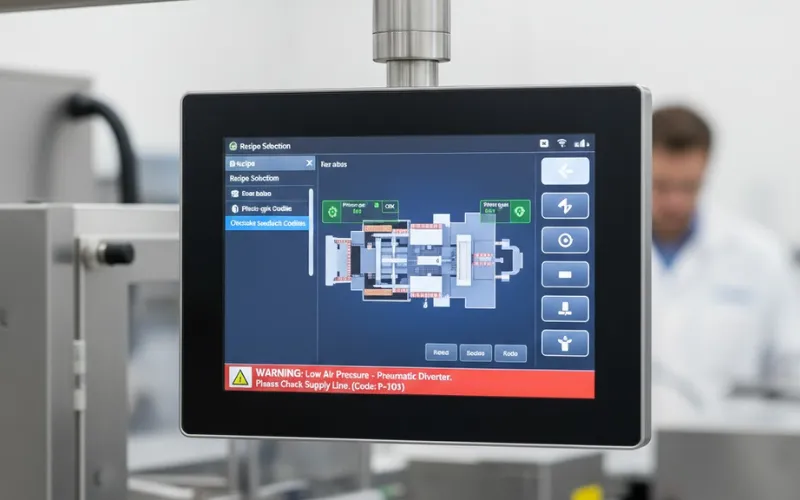
A machine's uptime is ultimately determined by the person running it. If the HMI (Human-Machine Interface) is bad, your operator becomes your biggest source of downtime.
A Bad HMI: Full of cryptic codes ("Error 2A-4B"), deep menus, and password-protected parameters.
The EverSmart HMI Philosophy:
Graphical: A dynamic map of the machine. Operators see which sensor is active and which motor is running.
Recipe-Driven: Operators don't need to remember parameters. They select "Square Cracker" or "Round Cookie," and all speeds, counts, and positions load instantly.
Guided Troubleshooting: When a fault occurs, the screen displays a clear message in plain language: "FAULT: Star-wheel inlet sensor blocked. Check for crumbs or jammed product."
Multi-Level Access: Different logins for Operator (run), Maintenance (adjust), and Engineer (program) prevent costly mistakes.
A great HMI can shorten new-operator training time from three days to 30 minutes.
Note: An investment in an intuitive HMI is an investment in shorter training and fewer operator errors. An easy-to-understand interface is a direct driver of Uptime.
X. Operations & Maintenance: Maximizing Uptime (The M&R View)
For your Maintenance & Repair engineers, "serviceability" is everything.
A. The Practical Troubleshooting Guide (Table)
This is the most valuable page in our machine manual.
Fault Symptom | 90% Probable Cause | The Solution |
|---|---|---|
Biscuits Jam at Star-Wheel | 1. Photo-eye is dirty or blocked by crumbs. 2. Star-wheel speed is out of sync with infeed. | 1. Clean sensor lens with alcohol & soft cloth. 2. Check and re-sync speeds on HMI. |
Stack Count is Incorrect | 1. Sensor sensitivity is wrong (missing or double-counting). 2. Biscuits are too close together. | 1. Re-teach the sensor sensitivity. 2. Slightly slow the infeed belt to create more space. |
On-Edge Stacks are Falling Over | 1. Biscuits themselves are not flat. 2. Side-pusher chain is too aggressive. | 1. Check upstream baking/cooling process. 2. Lower the acceleration parameter for the servo-pusher. |
B. The Preventive Maintenance (PM) Calendar
Daily (By Operator): Clean all photo-eye sensors. Use an air-wand to clear crumbs from star-wheels and guides.
Weekly (By Maintenance): Check tension on all drive belts. Listen for abnormal sounds from servo motors.
Monthly (By Maintenance): Lubricate specified bearings and chains (if applicable).
Annually (By EverSmart Service): Full servo-system calibration. Electrical cabinet thermal check. Firmware upgrades.
Tip: A clear PM checklist is the single best guarantee of long-term reliability. Ensure your vendor provides this and that you integrate it into your factory's TPM (Total Productive Maintenance) system.
C. Spare Parts Strategy
We provide a "Critical Spares List." We recommend you stock high-wear or critical-to-run parts locally (e.g., specific sensors, star-wheels, PU belts).
Major components (like motors or servo drives) are stocked in our regional depots for 24-hour rapid response.
XI. Our Commitment: Training & Service Support
When you buy an EverSmart biscuit stacking machine, you aren't just buying steel. You are buying a long-term guarantee of uptime.
In-Depth Training: During the SAT (Site Acceptance), our engineer provides a 2-day "dual-track" training: one for your operators (daily running) and one for your maintenance team (troubleshooting).
7/24 Remote Support: Our PLCs are equipped with a secure industrial VPN. When you have a complex fault, you can authorize our engineers to log in remotely for diagnostics. 90% of software issues are solved in minutes, not days.
Local Parts: We maintain spare part depots in major markets to ensure your emergency needs are met fast.
XII. Strategic Value & Future Trends (The CEO's View)
Let's return to the 30,000-foot view. As a CEO, you aren't investing in a stacker in 2025. You are investing in your company's future competitiveness.
A. The Strategic Advantage: Winning New Customers
Automation and high-hygiene standards are no longer "nice to have." They are the "price of admission" to get your products into major retailers (like Walmart, Costco) and food service chains (like Starbucks, McDonald's).
A well-designed biscuit stacker is your proof of compliance for passing a rigorous BRCGS or AIB audit.
B. Risk Management: Solving the Labor Crisis
Manual biscuit stacking is a high-turnover, low-skill, repetitive job. In an era of rising labor costs and worker shortages, automation is the only way to de-risk your operation.
C. Future-Proofing (Industry 4.0)
The machine you buy today must be ready for the next five years.
Vision Integration: The next step is integrating CCD cameras before the stacker. The system will automatically identify and reject broken, over-baked, or out-of-spec biscuits before they get stacked and packaged.
Data Acquisition (Industry 4.0): Your machine will not be an island. It will feed real-time data (OEE, fault time, shift counts) to your MES (Manufacturing Execution System), helping you optimize the entire line.
Predictive Maintenance: By installing vibration and temperature sensors on key motors, the system can warn you that a bearing is about to fail, not after it has failed. This turns unplanned downtime into planned maintenance.
Note: When investing, ask about "future-readiness." Ensure your machine has the data ports (like OPC-UA) and processing power to add vision and data systems later. This is the key to not being obsolete in 3 years.
XIII. Conclusion & Call to Action
From a defensive need to solve a labor crisis to an offensive strategy to unlock new markets, the biscuit stacking machine is an indispensable asset for the modern bakery.
It is not a cost center. It is a profit center.
It directly grows your bottom line by increasing efficiency, reducing waste, and guaranteeing the quality that builds your brand.
Choosing the right stacker means choosing a partner who understands your product, your line, and your people—and who will be there to support you long after the installation is complete.
XIV. Frequently Asked Questions (FAQ)
Q1: What is the typical biscuit stacking machine price?A1: This is the most common question. The biscuit stacking machine price varies widely, from a few thousand dollars for a small biscuit stacking machine (basic, semi-auto) to over $100,000 for a high-speed, multi-lane, servo-driven system. The price depends on: 1. Speed and number of lanes; 2. Level of automation (e.g., servo-driven auto-changeover); 3. PLC and component brands (Siemens/Rockwell cost more); 4. Custom engineering for fragile products. We strongly urge you to look past the initial price. Ask us for a complete TCO (Total Cost of Ownership) analysis, as shown in Section VI.
Q2: My biscuits are extremely fragile (like lace cookies or wafers). Can a machine handle them?A2: Yes. This is a specialty of Penny Stackers and custom-engineered solutions. For extremely fragile products, we do not use traditional star-wheels. We may use non-contact air-flow guides, multi-stage servo-belts for gentle deceleration, or even vacuum-head grippers to gently lift and place products, ensuring breakage is minimized.
Q3: Can one machine handle multiple shapes (e.g., round and square biscuits)?A3: Absolutely. This is what "quick-changeover" is for. For example, an on-edge stacker will use a "star-wheel" for round biscuits. To run square biscuits, you simply swap it out for a square-pocket "star-wheel" or a different guide-set, which takes 15-20 minutes. All parameters are stored in the HMI "recipe," so you just select the new product and press start. (See our Star Wheel Stacker guide for more).
Q4: Can your stacker integrate with our existing (other brand) packaging machine?A4: Of course. Our electrical design is open and brand-agnostic. As described in Section VIII, we can "handshake" with any brand of wrapper using the most basic dry-contact signals (Run, Stop, Fault, No Product). If your wrapper is also modern, we can integrate via PROFINET or EtherNet/IP for even smarter, high-speed data synchronization.
Q5: What different stacking methods can your machines perform?A5: Beyond the main "Shingling" (Penny) and "On-Edge" methods, our engineering team can custom-build solutions for almost any stacking method. This includes:
Count & Group: Grouping biscuits into N-counts (e.g., 4 groups of 5) and pushing them flat onto the wrapper's infeed.
Vertical Stacking: Stacking biscuits vertically into a "slug" (like an Oreo-style roll pack).
Jar/Canister Filling: We can design systems that create a stack and gently slide or drop it into a pre-formed canister or tray. This is the automated solution for the
how to stack biscuits in a jarproblem.

Ready to start your journey toward a customized solution? Contact me directly on WhatsApp to begin the conversation.