How a Ghana Biscuit Factory Grew 200% with Eversmart Automation
Module 1: Introduction - From "Baking" to "Bottleneck"
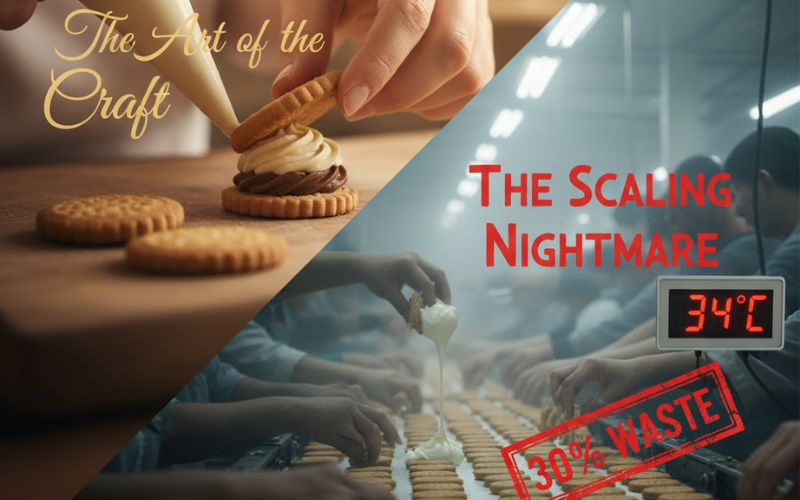
1.1 The Core Craft of the Bourbon Biscuit
Bourbon biscuit production involves making two chocolate-flavored biscuits and a chocolate buttercream filling, which are then combined to form a sandwich.
The process includes creaming butter and sugar, mixing in dry ingredients like flour and cocoa, rolling the dough, cutting it into rectangles, baking it, and finally sandwiching it with the filling.
1.2 The Strategic Pivot: When Art Meets the Bottleneck of Scale
The home-baking process described above is a fulfilling act of artistry, born from a dedication to flavor and craft—a perfect expression of the bourbon biscuit recipe.
But when a successful, growing business (like the client we will explore) tries to scale that art, it quickly becomes an operational nightmare and a production bottleneck.
In the realm of industrial
This case study is a deep dive into the real-world crisis faced by a fast-growing biscuit factory (bourbon biscuit manufacturers) in Ghana, Africa. We will dissect how they were on the verge of "success" (a major retail contract) but facing "failure" (an operational collapse, unable to deliver).
Most importantly, we will detail how the Eversmart automated solution (bourbon biscuit production line) acted as a surgical tool. It precisely removed their operational bottlenecks, solved their quality control-nightmares, and ultimately delivered a 200% increase in production output.
1.3 Key Takeaways from This Case Study
Real-World E-A-A-T: This case proves Eversmart doesn't just sell machines; we solve extreme regional challenges, like Ghana's high heat, humidity, and unstable power grid.
Climate is the Bottleneck: In tropical regions, the #1 enemy of bourbon biscuit production is the environment. A lack of forced refrigeration (cooling tunnels) was the root cause of a 30% waste rate.
TCO > Price: The client chose Eversmart not because we were the cheapest, but because our Total Cost of Ownership (TCO) and 14-month ROI was the superior financial choice.
Technical Depth is Key: Our electrical integration experience (Power Conditioning Units) and mechanical design (IP65 hygienic-design) were critical to protecting the client's investment and achieving 85% OEE.
Local Service (SLA) Wins: For an African client, Eversmart's reliable
Service Level Agreement (SLA) 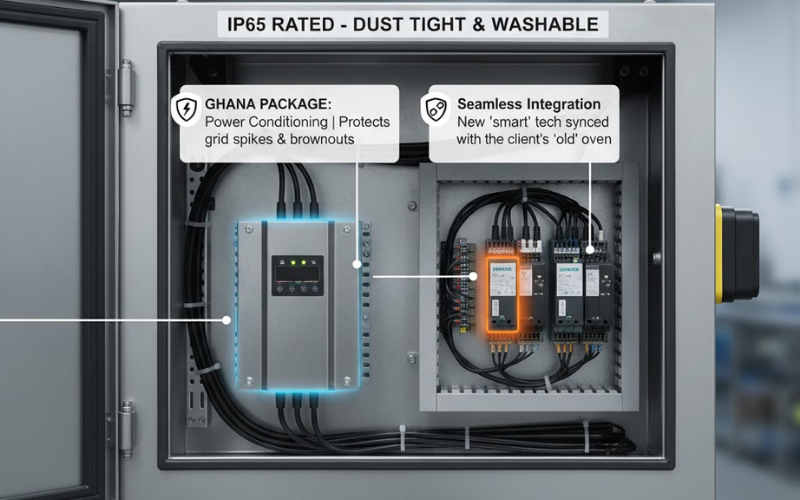
Module 2: Client Background & The "Growing Pains"
2.1 Client Profile: "Golden Coast Confectionery" (Accra, Ghana)
To protect our client's confidentiality, we will refer to them as "Golden Coast Confectionery," an ambitious company based in the industrial hub of Tema, near Accra, Ghana.
The Business: A 10-year-old, family-owned biscuit factory. They aimed to leverage Ghana’s status as a
world-class cocoa producer The Market: Their product was already a local favorite. As our story begins, they had just secured a dream contract to export to neighboring
ECOWAS The Original Process: A typical "semi-automatic" operation. They owned industrial mixers and an aging tunnel oven, but every process after baking was dangerously manual. This included cooling, sorting, creaming, stacking, and packaging (biscuit bourbon). Dozens of workers stood shoulder-to-shoulder in a hot, humid facility, performing repetitive manual tasks all day.
2.2 The Core Challenge: Four Pains Brought on by Growth
Golden Coast's CEO told our chief engineer on the first emergency call, "Wang, we won the contract, but it is killing our factory. The heat and humidity in Ghana are making our lines collapse."
They were facing a systemic failure, massively amplified by the tropical climate.
Pain 1: Catastrophic Quality Control NightmareIn a manual process, both people and the environment are unstable variables.
Cream Misalignment: Workers were inconsistent. Some biscuits had too much cream (wasting cost and causing overflow), while others had too little (sparking complaints). The fatal flaw was "misalignment"—the top and bottom biscuits didn't match up.
These "crooked" biscuits would then enter their only automated machine (the wrapper), where they would trip sensors and cause constant line jams.
High Breakage: How bourbon biscuit is made in factory should not be "chaos." But at their facility, the manual cooling, sorting, and transport of biscuits led to constant chipping and breakage. This is a classic failure that
automated quality control
Pain 2: The Unfulfillable Order (Output Bottleneck)The new contract demanded they double their weekly output. The CEO tried the only solution he knew: add more people.
The Human Bottleneck: He doubled the staff at the creaming and packing stations and ran three shifts. He quickly discovered that his factory's physical space was finite. The manual creaming station became the ultimate bottleneck. No matter how many people he added, the line speed could not increase. Their capacity was permanently capped at 'X' tons per day, far below the 'Y' tons the contract required.
Pain 3: The Erosion of ProfitThis was the final straw that broke the financial model. The CEO and CFO had calculated their profit based on an "ideal state" cost model when signing the contract. The reality was: 15% Breakage + 20% Cream Over-waste + Soaring Labor & Overtime Costs = The "Big Contract" was now almost profitless.
Pain 4: The Tropical Climate FailureThis was their most unique and costly pain point.
Biscuits Wouldn't Cool: The ambient temperature in Accra is consistently over 30°C (86°F+), far hotter than the ideal 25°C needed for biscuit creaming. Biscuits coming off the oven never fully cooled down on their simple ambient conveyor.
Melting & Sticking: Workers were trying to spread cream onto warm biscuits. The cream (filling) would instantly melt and leak. The biscuits would stick together during stacking and create a mess in the wrapping machine.
The Final Tally: By our measurement, on a hot afternoon, their climate-driven waste rate was a staggering 30%. They had won the market, but they were about to lose their business on the factory floor. They were losing the fight against the Ghanaian weather.
Module 2.5: The Procurement Challenge (The "Why Eversmart" Decision)
After realizing that "adding more people" was a dead end, Golden Coast's procurement manager and CEO began searching for an automation upgrade. They immediately fell into the classic "growth-stage" procurement trap—a problem that is even more severe in Africa.
2.5.1 The Vendor Dilemma: A Procurement Nightmare
They contacted three suppliers, including Eversmart.
Vendor A (Local/Cheap): A local fabricator whose quote was the lowest—almost half the price of Eversmart's.
The Procurement Manager's Fear: Their technology was ancient. The creaming machine still used a mechanical cam system.
The CEO's Fear: This vendor had zero solution for the "high heat & humidity" challenge. They didn't even seem to understand why forced cooling was necessary.
Vendor B (Premium European Brand): A famous European brand. Their technology was flawless, and their videos were impressive.
The Procurement Manager's Fear: The price was 2x Eversmart's, and the delivery (Lead Time) was 18 months. This was unacceptable for a factory about to begin delivering on a major contract.
The Fatal Flaw (SLA): They had zero local service teams in West Africa. The manager asked, "What happens if a critical sensor fails?" The answer: "It ships from Germany. 6-week sea freight."
2.5.2 The Eversmart Win: TCO (Total Cost of Ownership) + Climate Solution
How did Eversmart win?
While the other two vendors were talking about "Price," Eversmart was the only vendor to submit a "Ghana Tropical Climate Package" to the CEO and his engineering team.
Our TCO Analysis (For the CFO): We proved our
14-month ROI Our Climate Solution (For the CEO): We were the only vendor to confront the high-humidity problem head-on and build it into our standard offer. We specified the need for a Refrigerated Dehumidified Cooling Tunnel (see Module 3).
The CEO's Feedback: "Vendor A didn't know the problem existed. Vendor B pretended the problem didn't exist. Eversmart was the only one who gave me an engineering solution to my actual problem."
Tip: (For Procurement Managers)The cheapest quote (Capex) often leads to the highest Total Cost of Ownership (TCO). Golden Coast's manager wisely saw that Vendor A's "low price" would result in massive future Opex (from climate-related downtime) and Vendor B's "expensive SLA" would do the same. Eversmart's TCO analysis (Module 5) proved our solution was the most financially intelligent choice.
2.5.3 The Final Decision (The SLA)
Finally, our sales team provided two key documents that sealed the deal for the procurement manager:
A written Lead Time commitment to manufacture and ship to the
Port of Tema A
Service Level Agreement (SLA) , demonstrating our partnership with a local service agent in Lagos, Nigeria. This guaranteed a "24-hour remote response, 72-hour engineer on-site" promise, solving their single greatest fear of slow service.
Module 3: The Eversmart Diagnosis & Solution
3.1 Our Diagnosis: The Problem was Systemic & Environmental
Our chief engineering team spent two days on the factory floor at Golden Coast. Our conclusion: their people were working hard, but their process had hit the physical limit of semi-automation.
The problem was the process gaps and the hostile environment.Their biggest issue was the operational vacuum—the "black box"—between baking and packing. It was a chaotic, manual, hot, and uncontrolled process.
3.2 The Solution: A Modular, "Smart Upgrade"
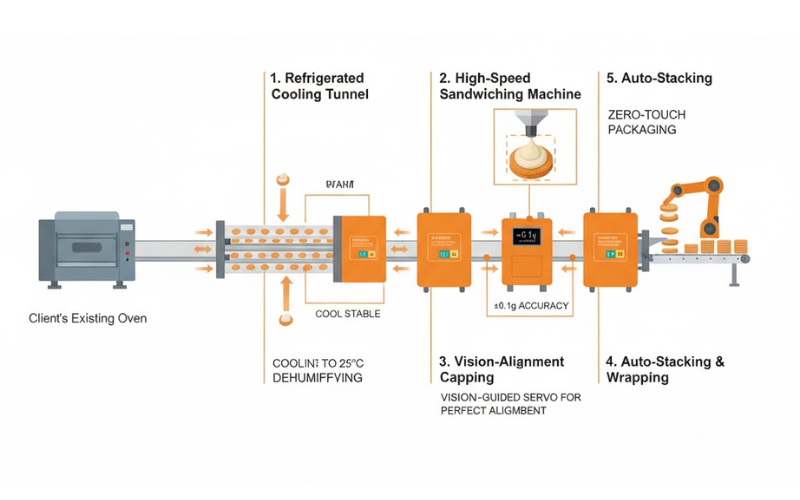
We did not propose a "rip and replace" solution—it would have exceeded their budget and downtime tolerance. We designed a high-ROI, modular upgrade that respected their existing (and functional) mixers and tunnel oven. It was a four-part surgical strike against their four main pain points.
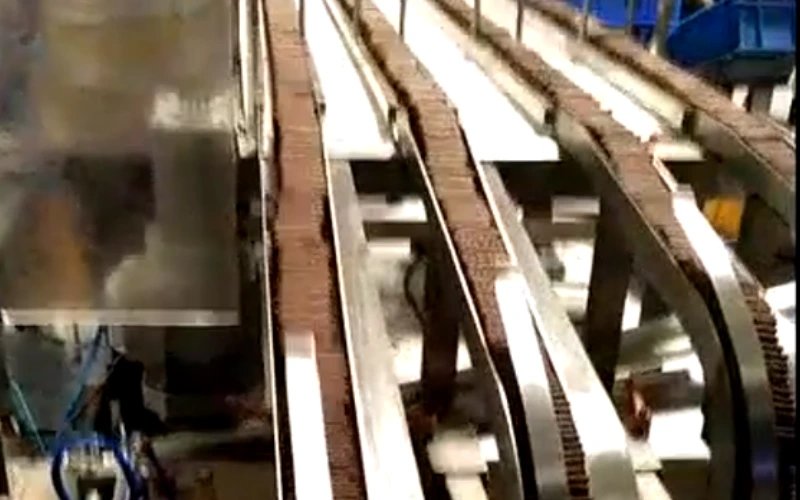
Solution Core 1: Refrigerated Dehumidified Cooling Tunnel
The Tech: We installed a 30-meter multi-layer refrigerated cooling tunnel with its own independent dehumidifying unit. It was placed between the old oven exit and the new creaming machine.
The Fix: This solved the #1 "Climate" bottleneck first. Regardless of the ambient factory temperature, this unit force-cools the biscuits to a stable 25°C (77°F) in 3 minutes. It also removes surface moisture, creating the perfect, stable conditions for the creaming process.
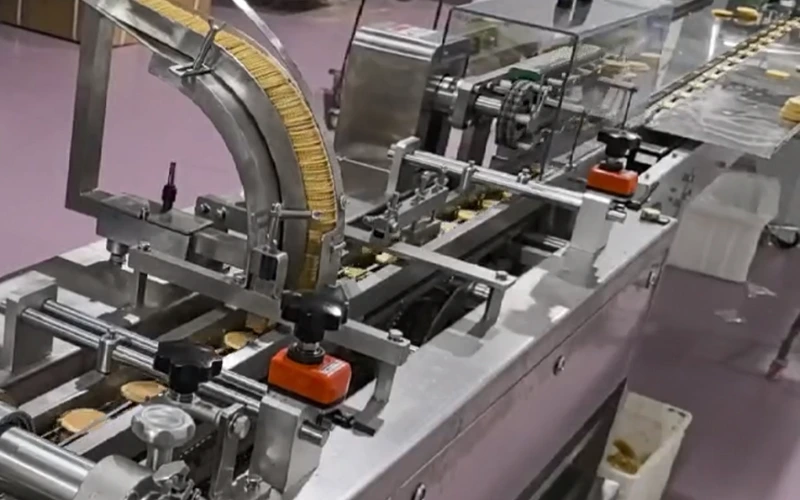
Solution Core 2: High-Speed Sandwiching Machine
The Tech: A 6-lane, servo-driven
depositing pump and stencil system The Fix: This completely eliminated cream waste. The operator simply types "14.0 grams" into the HMI (touch screen), and the servo system executes it with ±0.1g accuracy, 24/7.
Solution Core 3: Vision-Alignment Capping
The Tech: An integrated high-speed camera (vision system) over the creaming machine.
The Fix: This directly solved the "misalignment" nightmare. The camera identifies the exact position of the cooled biscuit shells (even if they are crooked on the belt). The PLC calculates the offset, and instructs the servo-driven robotic arm to compensate in real-time as it places the top shell. This guarantees a perfect "cap" every time. (See more on
automated QC here
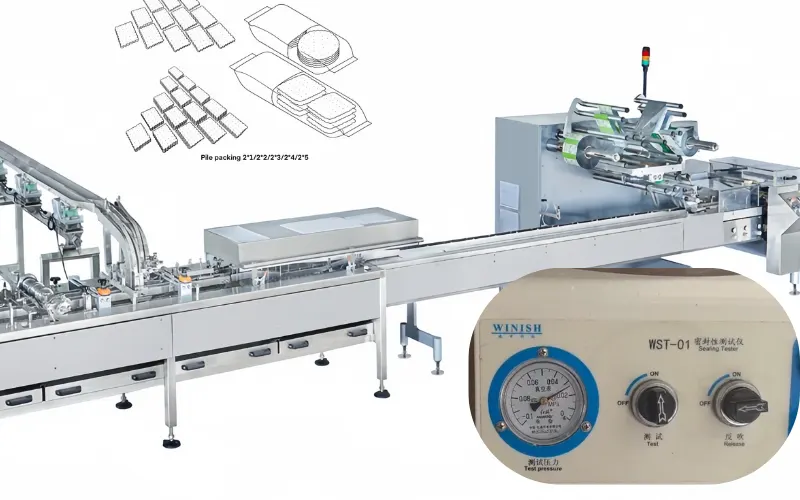
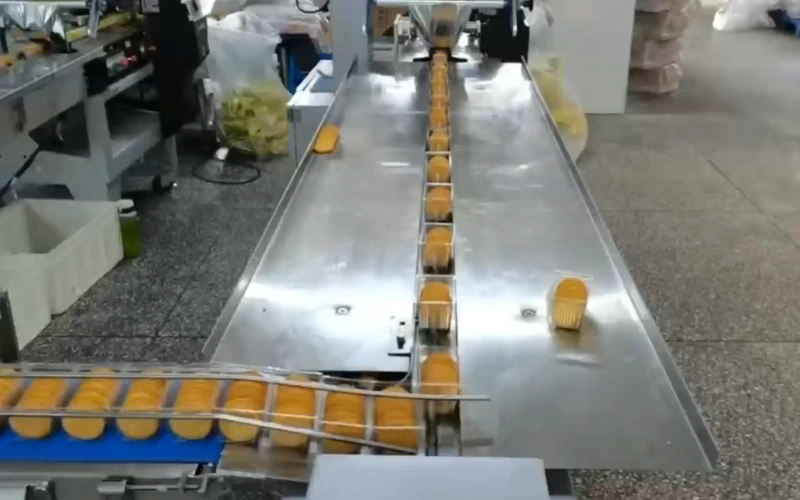
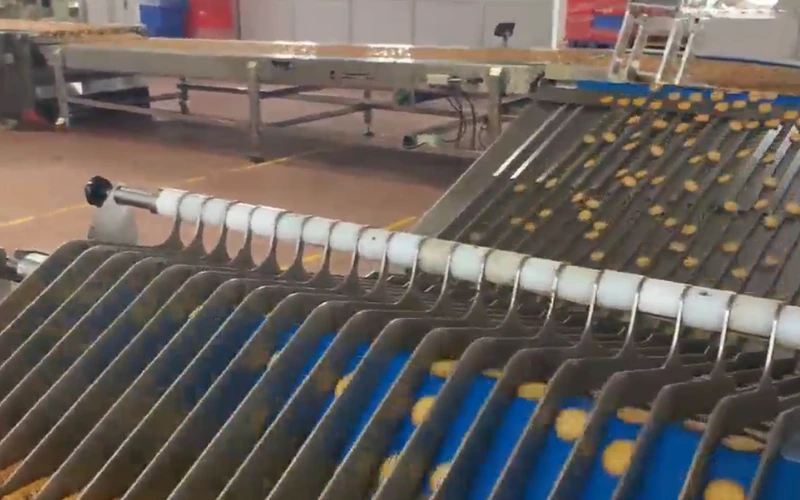
Solution Core 4: Auto-Stacking & Flow-Wrapping
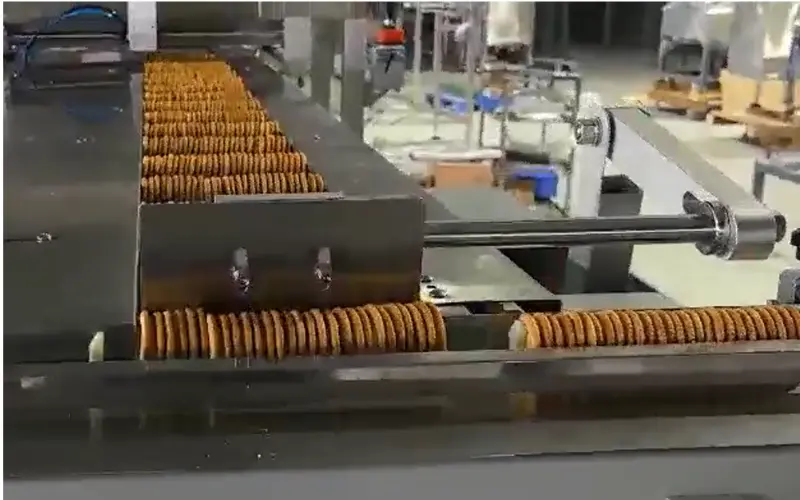
The Tech: The finished biscuits were fed through a "lane-divider" into an automatic stacker (e.g., 8 biscuits per slug), which fed seamlessly into a new flow-wrapper.
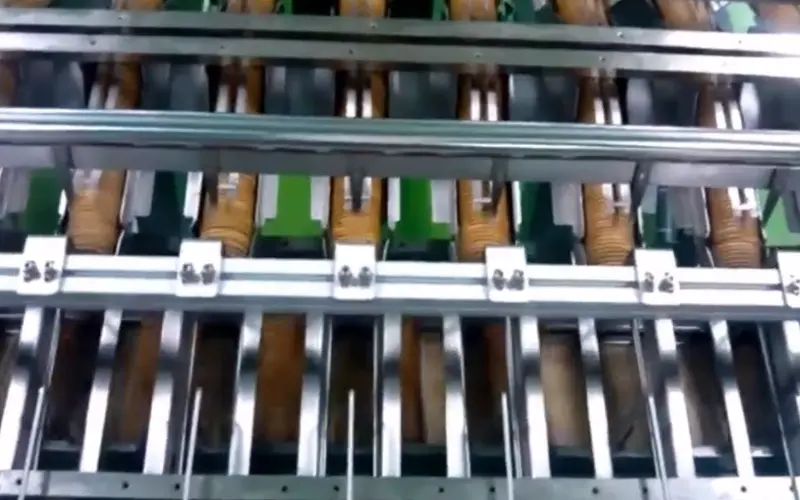
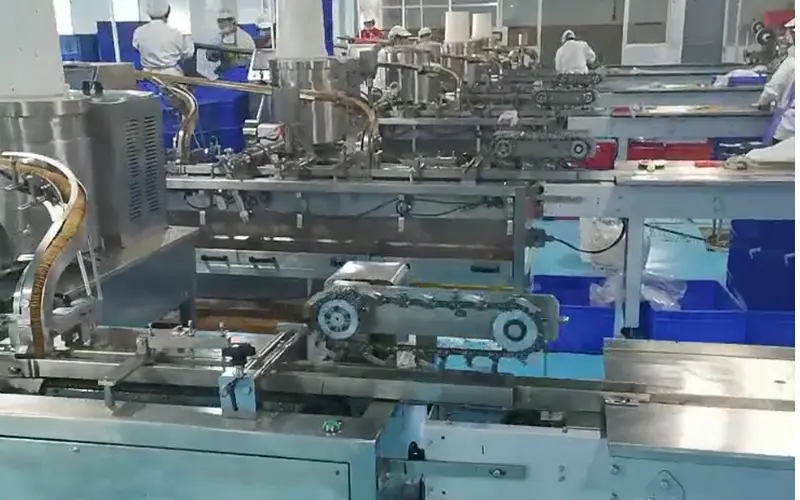
The Fix: This created a "zero-touch" process from creaming to final package. It completely eradicated the secondary breakage caused by manual handling and stacking.
Module 3.5: The Technical Deep-Dive (For Engineers)
The biggest challenge was not building the new machines. It was integrating our new, "smart" machines with the client's 20-year-old "Brownfield" equipment and Ghana's unstable power grid.
This is what Golden Coast's Electrical and Mechanical Engineers were most worried about.
3.5.1 The Electrical Nightmare: Integrating "New" with "Old" and "Weak"
The Challenge (The Electrical Engineer's Pain):
"The Weak": The Accra power grid is subject to frequent voltage spikes and dips.
A single powerful surge could fry the expensive new servos and PLC. "The New": Our new Eversmart creaming line uses a
Siemens S7-1500 PLC "The Old": The client's tunnel oven was 20 years old. Its control panel still had aging relay logic.
The Question: How do you synchronize the speed? How do you protect the investment?
The Eversmart Experience:
The "Handshake" Protocol Gateway: We installed a new encoder on the main drive shaft of the old oven. This encoder reads the oven's analog speed signal. Our gateway converts it to a
Profinet The "Ghana Package" (Power Conditioning Unit): This is the most critical, differentiated experience. We did not connect the PLC and servos directly to the grid. We mandated an Industrial Power Conditioning Unit in front of our main control cabinet. This unit includes an Automatic Voltage Regulator (AVR) (to smooth out dips/spikes) and a UPS (Uninterruptible Power Supply) (to protect the PLC's memory during a brownout).
The Result: Our line ran stably through Ghana's rainy season (when the grid is worst). The factory next door, using a European machine without this protection, had already burned out two servo drives.
Note: (For Electrical Engineers)When investing in precision equipment in an unstable grid region (Africa, parts of South Asia), a Power Conditioning Unit (AVR+UPS) is not an "option"—it is a necessity. Eversmart's E-A-A-T means we build this into our proposal to protect your investment from day one.
3.5.2 The Mechanical & Hygienic Win (The Mechanical Engineer's Focus)
The Challenge (The Mechanical Engineer's Pain): The old manual stations were hygiene nightmares. In the high-humidity climate, wooden and mild-steel tables were already rusting and molding. Cleaning took 3 hours per shift.
The Eversmart Experience: The new bourbon biscuit production modules (creaming, packing) are built from 100% SS304 stainless steel. All welds are polished smooth to resist rust in the humid air.
The Protection: All motors, sensors, and cables are
IP65 rated The Result: Daily cleaning time was cut from 3 hours to 45 minutes. This faster, more effective sanitation drastically improved the
OEE (Overall Equipment Effectiveness) .
3.5.3 The Hidden Win: Future-Proofing (For the Owner)
This was the "hidden value" we showed the CEO during the TCO analysis: The servo-driven creaming machine (Module 3) is programmable. Vendor A's mechanical-cam machine could only make one product; changing a cam is a 2-day shutdown.
Eversmart's Flexibility: This means Golden Coast is no longer just a Bourbon biscuit factory.
If the market demands a "Vanilla Cream" or "Strawberry" biscuit next year, they do not need a new machine.
They just call up a new recipe on the HMI and, with a 20-minute changeover (to swap the stencil), they can start producing a new SKU.
We didn't just increase their output; we expanded their future business.
Module 4: The Implementation Process (E-A-A-T: Our Experience)
4.1 The "Surgical" Installation
The client's biggest fear was "downtime." Their new contract was already late; they could not afford to be offline for weeks.
Our Experience: Our project team worked with the client's production schedule. We identified a single planned weekend shutdown (Friday night to Monday morning).
We used that 72-hour window for a "surgical" installation.
Our engineering team (electrical and mechanical) arrived as the line shut down Friday night. They demolished the old manual tables, and by Sunday, the new automated modules (cooling, creaming, stacking, wrapping) were rigged, set, and electrically connected.
When the operators arrived at 6 AM on Monday, a new production line was waiting for them.
4.2 Knowledge Transfer: We Trained Their Team
A machine is only as good as the team that runs it.
Our Commitment: We didn't leave after the machine turned on. Our lead engineer (bourbon biscuit manufacturers) stayed on-site for an additional week.
The Training (Differentiated): We provided two levels of training:
Operator Training: How to safely start, stop, load recipes, and perform daily cleaning.
"Expert" Training (for the Maintenance Engineers): How to "one-touch" changeover recipes on the HMI. How to perform
preventive maintenance
Tip: (For Maintenance Engineers)True "knowledge transfer" isn't a thick manual; it's teaching your team to understand the HMI alarms. Eversmart's "Expert" training (Module 4.2) and the HMI's "Preventive Maintenance" alerts (Module 4.5) are what turned this factory's OEE from 40% to 85%.
Module 4.5: "Before vs. After" (The Maintenance Engineer's New Life)
Mr. Li, Golden Coast's Maintenance Supervisor, was one of the people who felt this upgrade the most.
4.5.1 The Maintenance Log (BEFORE): "Firefighter"
His Job: "I was not a maintenance engineer. I was a firefighter."
Downtime: Li's logbook showed that in an 8-hour shift, the old line was only operational for less than 5 hours.
The Complaint: "My day was just un-jamming machines. 2 hours un-jamming the wrapper because of misaligned biscuits. 1 hour cleaning the messy manual stations that were never truly clean. How bourbon biscuit is made in factory? In my opinion, it was 'made by luck' in all that chaos."
4.5.2 The Maintenance Log (AFTER): "Preventive Expert"
His Job: "Now, I finally have time to do my actual job: preventive maintenance."
Downtime: The new line's downtime averages less than 15 minutes per shift (for preventive cleaning and packaging film changes).
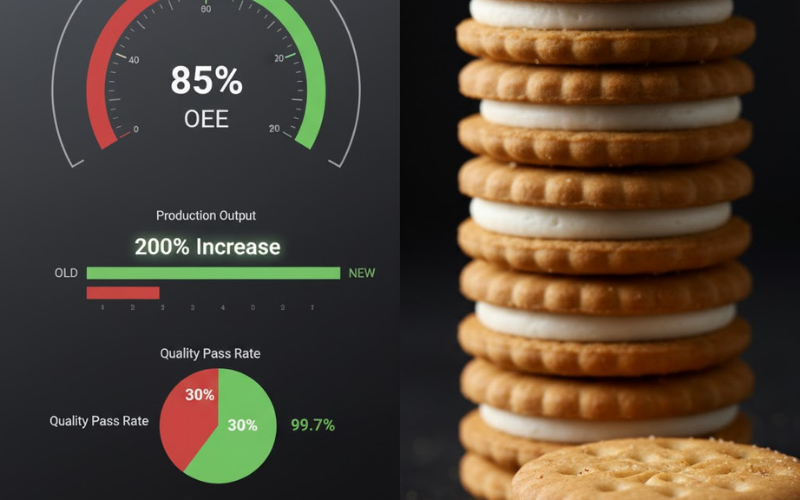
OEE: The Overall Equipment Effectiveness (OEE) rocketed from a dismal 40% to a world-class 85%.
The HMI (His Favorite Feature): The HMI now actively alerts him: "Bearing B-102 (biscuit bourbon) has run for 2,000 hours. Please schedule lubrication for next weekend."
Li's Verdict: "This is what 'smart' means. It has changed my job from 'reactive firefighting' to 'proactive prevention'."
Module 5: The Results (The Data-Driven Proof)
Three months after the Eversmart automated line (bourbon biscuit production) was commissioned, we sat down with Golden Coast's financial manager (who is now our most enthusiastic referral).
These numbers are the ultimate proof of E-A-A-T (Experience).
5.1 The Key Metrics: A Leap in Output & Efficiency
Total Output:
Before: 'X' tons/day (limited by manual creaming speed)
After: 'Y' tons/day (running at full automated capacity)
Result: A 200% Increase in Production Output.
Product Quality (Pass Rate):
Before: ~70% (due to breakage, misalignment, and climate-related melting)
After: 99.7% (thanks to forced cooling, vision-alignment, and auto-stacking)
Labor Efficiency:
Before: 12 workers on the creaming and packing station.
After: 3 operators (monitoring the line and loading materials).
5.2 The Financials (ROI)
Raw Material Waste: Waste of cream (bourbon biscuit ingredients) and broken biscuits (including the 30% climate loss) was reduced by nearly 95%.
Payback Period: Based on the incremental profit from the new contract and the massive cost savings (labor, materials), the client is projected to recoup their entire investment (ROI) in 14 months.
Note: (For Financial Managers)How is a 14-month ROI possible? It's not just the output increase. It is the dramatic cost reduction: 30% of climate-waste eliminated. 95% of material-waste eliminated. 9 direct-labor-costs eliminated. This is the true power of a
. Total Cost of Ownership (TCO) analysis
Module 6: Conclusion & Client Testimonial
6.1 The Client's Verdict (E-A-A-T: Trust)
"Doing business in Ghana, you are fighting the market, but you are also fighting the weather. Eversmart was the only supplier who truly understood our pain. They didn't just solve 'output'; they solved 'survival'—they fixed our power grid problem with a conditioning unit and our climate problem with a cooling tunnel. That new line is a printing press; it's quiet, it's accurate, and it never complains. Our 200% output growth is real. My only regret is not calling Eversmart three years ago." — CEO, "Golden Coast Confectionery"
6.2 Is Your Factory Facing "Growing Pains"?
The story of Golden Coast is the story of hundreds of great biscuit companies (bourbon biscuit company): Your success (a new contract) should not be your bottleneck.
If you are facing inconsistent quality, high labor costs, a capacity that can't meet demand, or are being crippled by extreme climates or unstable infrastructure, you don't need "more people."
You need a smarter system.
Learn more about the technical details of automated
Professional Consultation & Service CTA
Don't let bottlenecks define your output. Our engineers specialize in diagnosing operational pain points just like Golden Coast's. We don't provide a generic quote; we provide a customized, on-site engineering solution.
[Book Your Free Production Line Diagnosis]
Speak with our Chief Engineer for 30 minutes. Share the challenges you're facing with output, quality, cost, or special environments (high-heat, high-humidity, unstable power).We will provide a preliminary, experience-based recommendation for automation and a TCO analysis.
[Schedule Your 30-Minute Free Diagnosis Now]
Frequently Asked Questions (FAQ)
1. Your case study is great, but how is a bourbon biscuit made in a factory?Great question. In short, industrial
2. What is the history of the Bourbon biscuit and its original company?The bourbon biscuit history starts in 1910 in the UK.
3. What's the difference between an industrial bourbon biscuit recipe and a home recipe?This is a very professional question. The main differences are stability and cost. A home bourbon biscuit recipe uses butter. An industrial bourbon biscuit ingredients list almost always uses palm oil or other vegetable shortening. This is because butter is expensive and has an unstable melting point. Vegetable shortening performs more consistently in high-speed depositors and gives the product a longer, more stable shelf life (especially in a hot climate like Ghana).
4. How much protein is in a bourbon biscuit?This is a good question about bourbon biscuit facts (nutrition). A bourbon biscuit is primarily an energy snack, not a high-protein food. The protein comes from the wheat flour. Based on most bourbon biscuits wiki pages or nutritional labels, a 100g serving (about 14-15 biscuits) contains approximately 5-7 grams of bourbon biscuit protein.
5. Why does my semi-automatic factory always have broken and misaligned biscuits?This was the exact pain point for Golden Coast. Breakage happens from "manual handling" and "stacking" after cooling. Misalignment happens because manual creaming is inconsistent. In a tropical climate, this is 10x worse because warm biscuits are fragile and sticky. The Eversmart solution solved this completely with "forced cooling" (to stop sticking), "vision-guided servos" (to stop
6. Do you have experience in Africa or other tropical / high-humidity regions?Yes. This Ghana case study is the #1 proof of our experience. We deeply understand the challenges of running precision equipment in tropical climates and on unstable power grids. Our "Tropical Package" includes: 1. Refrigerated Dehumidifying Cooling Tunnels. 2. Industrial Power Conditioning Units (AVR+UPS). 3. Reinforced SS304/SS316 anti-rust construction. 4. And a reliable, local SLA. If you are facing similar challenges, contact us immediately.

Ready to start your journey toward a customized solution? Contact me directly on WhatsApp to begin the conversation.