The Ultimate Guide to Industrial Bourbon Biscuit Production: Machinery, Process & Business Case
Module 1: Introduction - From Home Baking to Industry 4.0
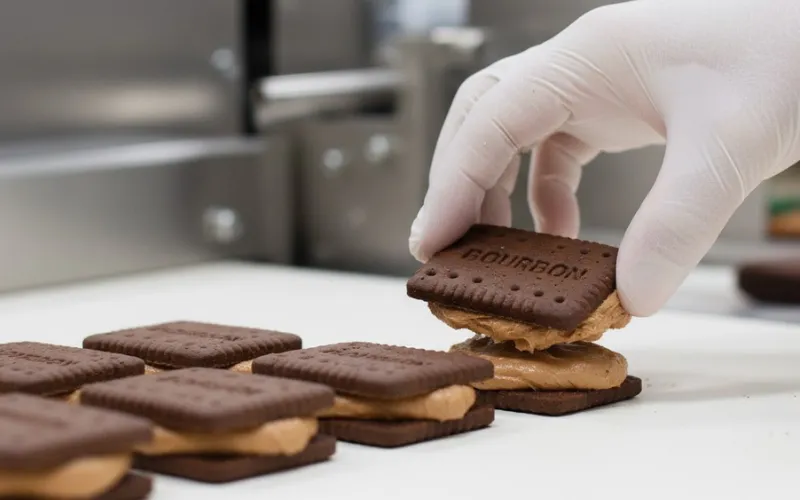
1.1 The Core Craft of the Bourbon Biscuit
Bourbon biscuit production involves making two chocolate-flavored biscuits and a chocolate buttercream filling, which are then combined to form a sandwich.
The process includes creaming butter and sugar, mixing in dry ingredients like flour and cocoa, rolling the dough, cutting it into rectangles, baking it, and finally sandwiching it with the filling.
1.2 The Strategic Leap: From Kitchen Counter to Smart Factory
While the home-baked process yields a delicious treat, it cannot satisfy the global market's immense demand for this iconic biscuit.
Meeting this demand requires a completely different, highly sophisticated, and complex industrial system—one capable of producing thousands of kilograms per hour.
The history of the Bourbon biscuit dates back to 1910 in the UK, introduced by the
Its unique chocolate flavor, signature embossing, and even its classic old pack design have cemented its legendary status for over a century.
However, that legend has long since moved from the kitchen baking sheet to the fully automated factory (how bourbon biscuit is made in factory).
This ultimate guide will conduct a deep-dive analysis of the fundamental differences between home baking and
We will dissect the automated production line that makes scale, standardization, and profitability possible. This guide will cover everything from the industrial recipe and core bourbon biscuit equipment to factory layout and the complete business case.
1.3 Key Takeaways from This Guide
Industrial vs. Bake-off: Industrial bourbon biscuit production relies on fully automated, high-precision machinery like tunnel ovens and servo-driven sandwiching machines. The engineering logic is fundamentally different from home baking.
Two Cores of Technology: A perfect bourbon biscuit depends on two key technologies: ① the Rotary Moulder for crisp, clear embossing and ② the Servo-Driven Capper for exact, high-speed alignment.
Beyond the Machine: A modern production line is a "smart" system. It runs on PLC controls, OEE data collection, and Industry 4.0 integration, forming the "brain" of the factory (see Module 7).
TCO > Price: A savvy investor focuses on "Total Cost of Ownership" (TCO). Long-term energy consumption, ease of maintenance, and line flexibility (covered in Module 8) are far more important than the initial purchase price.
Success is Systems Engineering: Buying a machine is just the beginning. A successful factory requires professional factory layout, reliable Service Level Agreements (SLAs), and comprehensive team training (see Modules 5 & 9).
Module 2: The Industrial Production Landscape (Process Overview)
Industrial bourbon biscuit production is a precision-engineered, continuous-flow process.
It takes every step of home baking and scales it with automation, speed, and scientific control.
2.1 Industrial Process Flow: An Overview
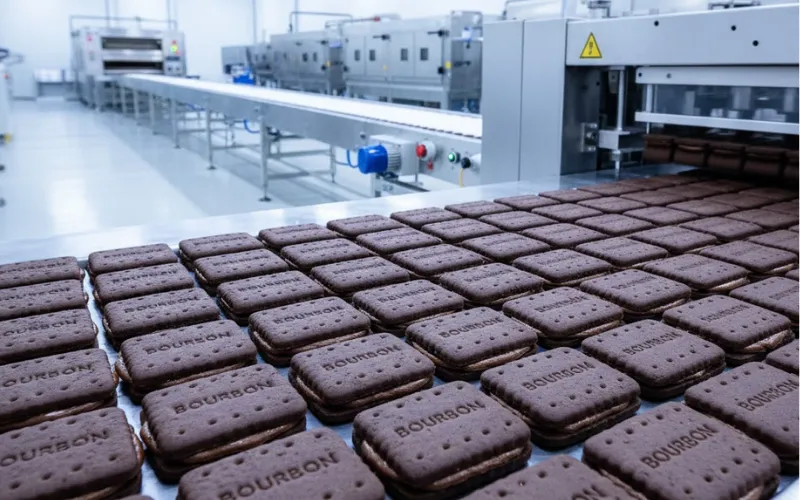
2.2 Step 1: Dough Preparation (Dough Mixing)
At Home: A home baker uses a stand mixer, processing perhaps 1kg of flour at a time.
Industrial: This stage employs massive Horizontal or Vertical Mixers, often automated with ingredient feeders. These machines handle hundreds of kilograms of bourbon biscuit ingredients in a single batch. They are governed by PLC programs that precisely control mixing times, speeds, and energy input, ensuring every batch has the exact same viscosity, elasticity, and hydration.
2.3 Step 2: Forming & Embossing
At Home: A baker uses a rolling pin and a manual cookie-cutter.
Industrial: This step is dominated by the Rotary Moulder. Dough is forcefully fed into an engraved roller, which imprints the "Bourbon" name and the steam holes at high speed. This process is extremely sensitive to the bourbon biscuit recipe's cocoa content and fat type, requiring precise machine calibration for a
clean release
2.4 Step 3: Baking
At Home: A conventional oven is set to 180°C (350°F) for 8-12 minutes.
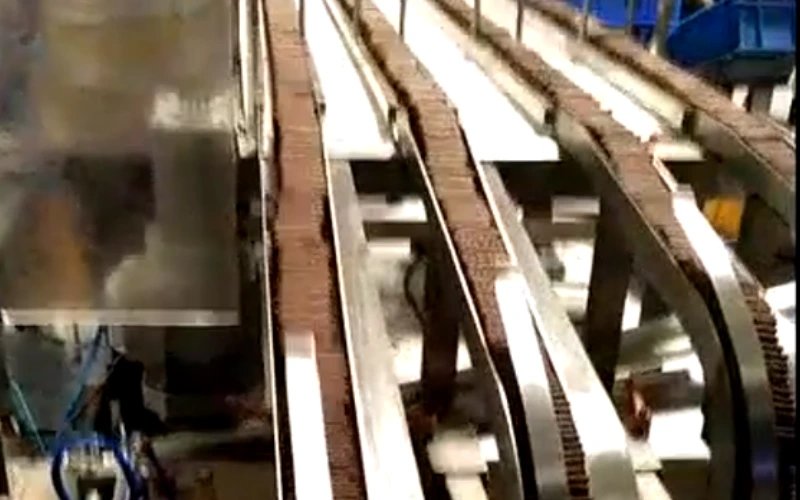
Industrial: Biscuits travel through 30 to 100-meter-long Tunnel Ovens. The dough pieces move on a continuous conveyor belt, passing through multiple heating zones. These zones (e.g., Direct Gas Fired, Convection, Radiant) are programmed with a precise temperature curve to ensure uniform baking, moisture removal, and a crispy texture in just a few minutes.
2.5 Step 4: Cooling & Treatment
At Home: Biscuits are left to cool on a wire rack.
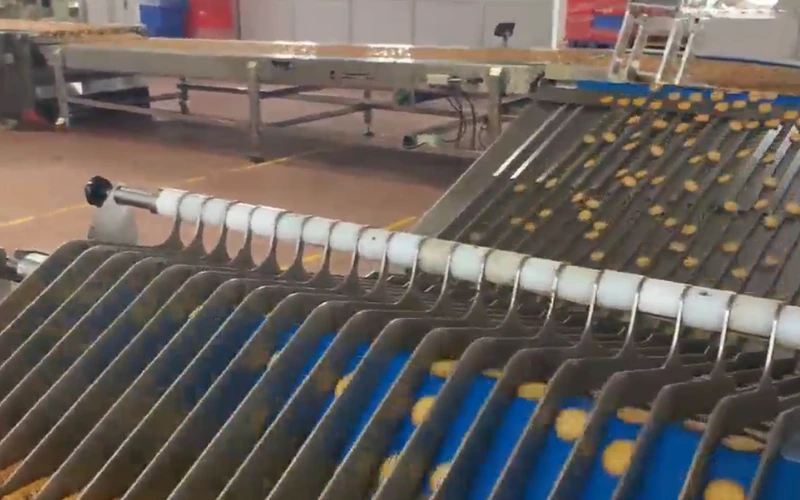
Industrial: Cooling is a mandatory, controlled process. Biscuits exit the oven at over 100°C (212°F) and must be brought down to room temperature (around 30°C / 86°F). This is achieved using multi-tier or spiral cooling conveyors in a controlled environment. This step is critical to prevent "checking" (stress cracks) and to ensure the cream filling sets instantly on contact.
Tip: (Professional Insight)Why is cooling so critical? If a biscuit is not cooled sufficiently and evenly, its internal and external parts shrink at different rates. This leads to "checking," or stress-cracking, which often appears days after packaging, especially during transit. It is a common and costly hidden defect in industrial production.
2.6 Step 5: Creaming & Capping
At Home: Cream is spread manually with a spatula or piping bag.
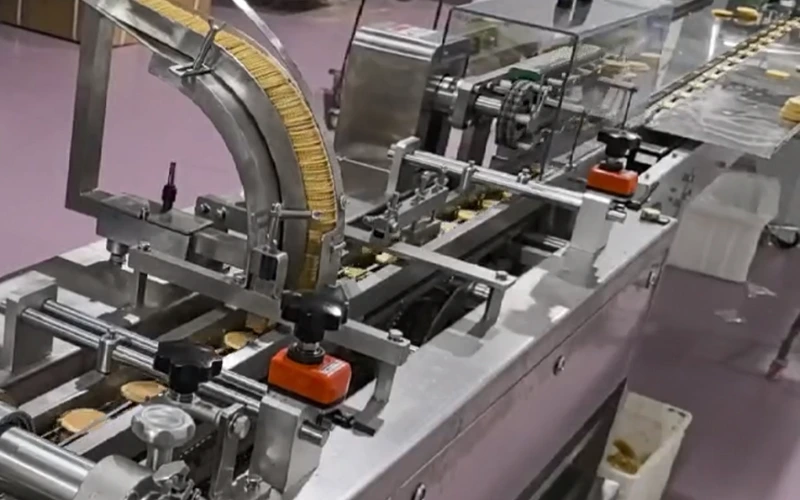
Industrial: This is the heart of the biscuit bourbon production line. A high-speed
Sandwiching Machine (or "capper")
2.7 Step 6: Stacking & Packaging
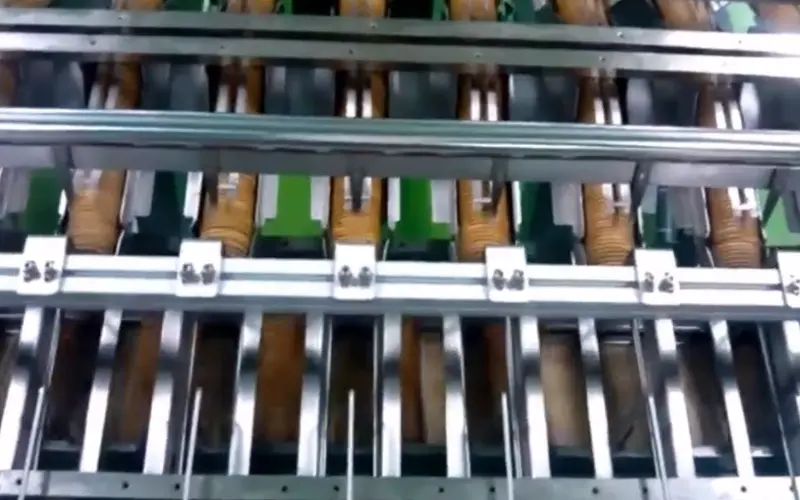
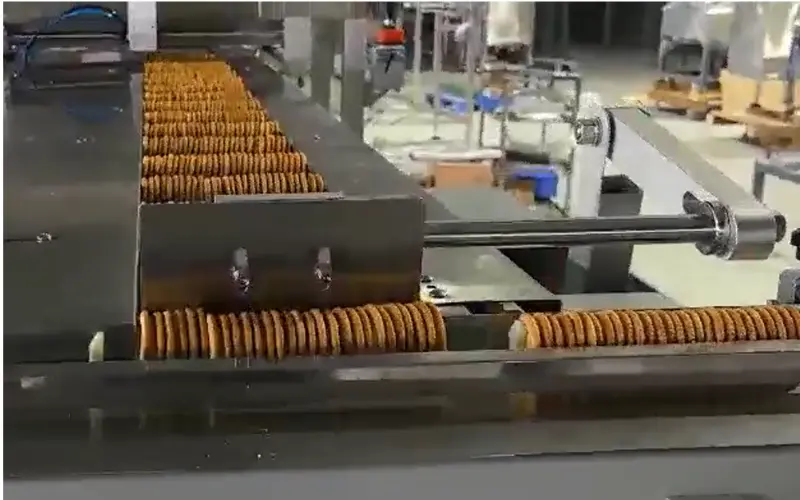
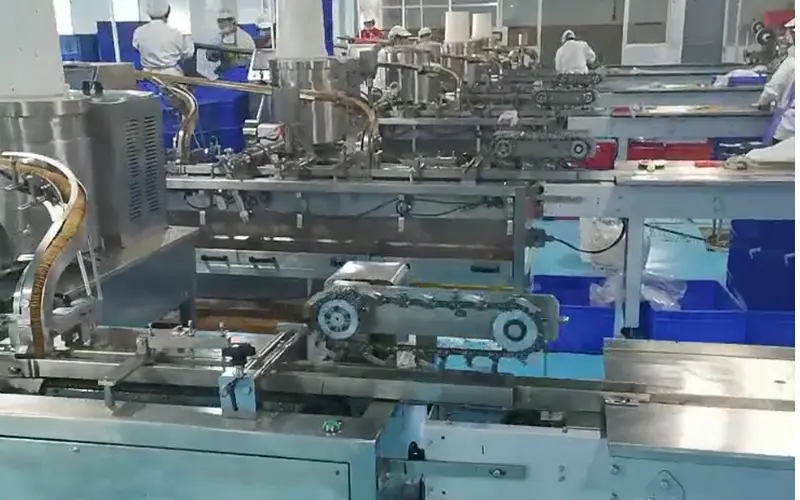
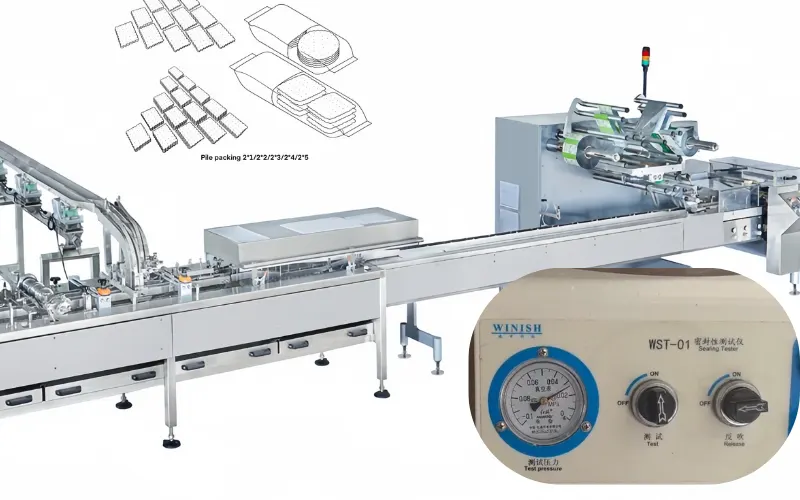
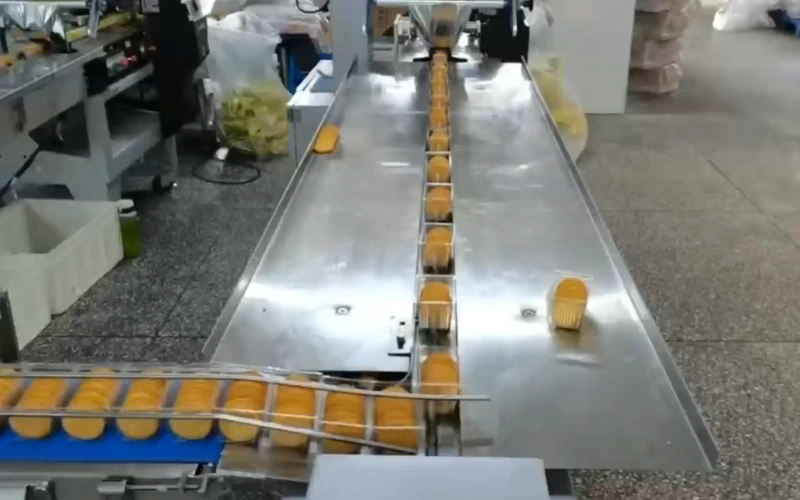
Industrial: The finished sandwich biscuits are moved by "lane" multipliers into automatic Stacking machines. The stacker counts the biscuits into a set "slug" (e.g., a pile of 8 or 12). This slug is then rapidly fed into a Horizontal Flow-Wrapper, which seals it in film (often with a nitrogen flush) before it's sent to an automated case packer and palletizer.
Module 3: Core Challenges & Technical Deep-Dive (E-E-A-T: Expertise)
Bourbon biscuit production appears straightforward, but at an industrial scale, it presents two significant and demanding technical challenges.
3.1 Challenge 1: The Perfect Shell (Embossing & Forming)
The soul of the bourbon biscuit is its dark cocoa shell and its crisp, clear embossing. The high cocoa content in the bourbon biscuit ingredients results in lower gluten development, making the dough less elastic, more "short," and prone to sticking.
The Challenge: During high-speed rotary moulding, how do you ensure the dough perfectly fills every fine detail of the "Bourbon" engraving, yet still achieves a clean, instantaneous release from the mould without sticking or tearing the dough piece?
Eversmart's Solution: This is where recipe science meets world-class engineering. Our
Rotary Moulders
3.2 Challenge 2: The Stable Filling (Cream & Alignment)
[Video of a high-speed biscuit sandwiching machine in action]
The other half of the bourbon's flavor profile is its chocolate cream filling. In industrial production, the filling is a critical control point for both cost and quality.
The Challenge:
Leaking: Fats from the filling recipe can "leach" or "migrate" into the biscuit shell over time or in warm conditions, ruining the texture and staining the packaging.
Misalignment: Top and bottom shells are not perfectly aligned (known as "offset"), leading to a poor appearance and major issues in packaging.
Weight Variance: Too much cream increases costs and causes "squeeze-out"; too little leads to customer complaints.
Eversmart's Solution: Our
high-speed sandwiching machines
Note: (Critical Point)Cream "offset" or misalignment is the single biggest pain point on a high-speed line. An offset biscuit not only looks bad but will jam automatic stacking and flow-wrapping machines. This causes a cascading line stoppage and catastrophically impacts your OEE (Overall Equipment Effectiveness).
Module 4: The Business Case & Investment (E-E-A-T: Experience)
For a factory owner, CFO, or financial manager, investing in a bourbon biscuit production line is a significant Capital Expenditure (Capex).
4.1 Why Automate? The Commercial Justification
Moving beyond small-batch baking or semi-automatic workshops is a decisive strategic move. The advantages of full automation are absolute.
Absolute Consistency: Consumers buy a "brand," not just a biscuit. Automation ensures that every single biscuit, produced on any day, has the exact same taste, texture, size, and flavor. This consistency is the bedrock of brand trust.
Rigorous Cost Control: A machine does not get tired. It deposits the exact same amount of flour, sugar, and cream 24/7, minimizing raw material waste to a fraction of what is lost in manual processes.
Superior Food Safety: A fully automated, "hands-off" process drastically reduces the risk of microbiological contamination from human contact. This makes it far easier to meet and exceed global standards like GMP (Good Manufacturing Practice) and
HACCP Massive Scalability: An automated line can run 24/7, producing volumes that are simply unattainable manually. This scalability is what allows you to fill orders for major retailers and distributors.
4.2 Calculating Your Return on Investment (ROI)
You cannot assess an investment on its purchase price alone. Savvy investors and financial managers focus on the
The Framework: (Annual Revenue Gain + Annual Cost Savings) / Total Initial Investment = ROI
Revenue Gains: This is the new revenue generated from the massive increase in production capacity.
Cost Savings:
Labor: A fully automated line might require only 5-7 operators, compared to 30+ in a semi-automatic plant.
Raw Materials: A reduction of 90% or more in biscuit breakage and cream waste.
Energy: Modern tunnel ovens and high-efficiency motors can be over 30% more energy-efficient than legacy equipment.
4.3 Case Study: From Small Scale to Mass Market
We worked with a mid-sized food company that was struggling with semi-automatic equipment. They faced inconsistent quality control and a production bottleneck that was costing them major contracts.
After implementing a fully automated Eversmart bourbon biscuit production line, the results were transformative.
Production output increased by 300%.
The product-pass rate (quality) rose from 85% to 99.5%.
Direct labor costs were reduced by 70%.
They not only recouped their investment but also successfully secured contracts with several major international supermarket chains. (See the
Module 5: The 0-to-1 Factory Guide (E-E-A-T: Experience)
Owning the machinery is just the first step. Building an efficient, safe, and profitable bourbon biscuit factory is the true victory.
5.1 Equipment Sizing & Specification
How large of a production line do you need? This depends entirely on your market goals.
Entry-Level (500 kg/hr): Ideal for regional markets or launching a new brand.
Professional-Grade (1000-1500 kg/hr): Suited for established brands and multi-product facilities.
Industrial-Scale (2000+ kg/hr): Designed for large bourbon biscuit manufacturers and export-focused corporations.
5.2 The Art of Factory Layout
The physical
Eversmart's Experience: We design layouts based on two core principles: "Linear Flow" and "Clean/Raw Zoning."
Raw materials -> Dough Mixing (Raw Zone) -> Baking (Kill Step) -> Creaming & Cooling (High-Care/Clean Zone) -> Packaging -> Finished Goods.
Personnel flow and material flow are strictly segregated to comply with all GMP and HACCP requirements.
5.3 Maintenance & Upkeep
The best maintenance is "predictive," not "reactive." We champion a culture of
The Philosophy: It is infinitely cheaper to schedule a one-hour check on a bearing than to have that bearing fail catastrophically during your peak production run, shutting down the entire line.
In Practice: Our HMI systems are programmed with "smart" alerts. The system actively prompts your team: "Bearing B-102 has now run for 2,000 hours. Please schedule inspection," helping you build a scientific, data-driven maintenance schedule.
Module 6: Delivering the Perfect Product (E-E-A-T: Trustworthiness)
Ultimately, your customer will judge you only by the product they find when they open the package.
6.1 Industrial-Grade Quality Control (QC)
On a high-speed line, the human eye is unreliable.
Metal Detectors: A legal and export requirement to ensure no metallic contaminants.
Automatic Check-weighers: These systems weigh every single package, automatically rejecting any that are under-weight (non-compliant) or over-weight (wasting product).
Vision Systems (Eversmart Recommended): High-speed cameras are installed just before packaging. They instantly identify and reject any biscuits that are broken, poorly embossed, "offset" (misaligned), or have burn spots.
6.2 Packaging & Shelf Life
Packaging is your product's "suit of armor." The bourbon biscuit old pack used paper and glassine, but modern
The Technology: Horizontal Flow-wrapping is the industry standard. By flushing the package with nitrogen (N2) gas, we displace oxygen and moisture. This process, known as Modified Atmosphere Packaging (MAP), inhibits fat oxidation (rancidity) and microbial growth, extending the shelf life from weeks to 6-12 months.
The Materials: We assist you in selecting the right BOPP/PET composite films, balancing cost, barrier properties (against moisture and oxygen), and printability.
Module 7: The "Brain" — Automation, Data & Industry 4.0 (For Electrical Engineers & Owners)
Our Differentiation: Your competitors talk about "machines." We talk about "intelligence." This is what shows Eversmart is a future-ready, automation solutions provider.
7.1 The Core Control System: Your Bedrock of Stability
The "soul" of a production line is its electrical control system.
PLC & HMI: Our standard configuration features high-performance PLCs (Programmable Logic Controllers) from leading brands like
Siemens Servo Drives: Why can our sandwiching machines achieve "zero offset"? They do not use traditional, maintenance-heavy mechanical cams. Instead, they are driven by multiple, independent servo motors. This is like giving each "finger" of the machine its own brain, allowing for micro-second adjustments and micron-level precision.
Tip: (Engineer's Viewpoint)What's the real difference between a Servo and a Mechanical Cam? A mechanical cam wears down; as it wears, its precision is permanently lost and it's difficult to repair. A servo's precision is controlled by software, is 100% repeatable, and has no mechanical wear. It also allows you to "one-touch" change products, positions, or sizes on the HMI. This is the core technology for true line "flexibility."
7.2 Industry 4.0: Your Data-Driven Factory
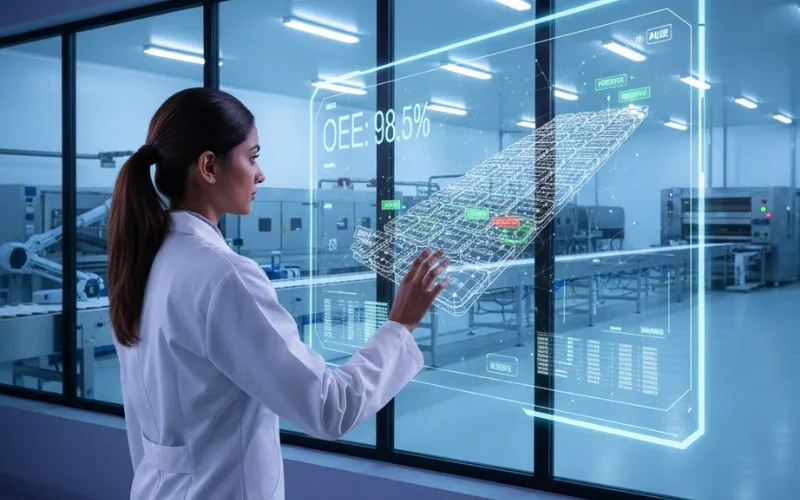
Your bourbon biscuit production line should not be a "black box."
Data Logging & OEE: Our systems are built to track and log
OEE (Overall Equipment Effectiveness) Systems Integration: Your production line is no longer an island. We use standard industrial protocols (like OPC UA or Profinet) to seamlessly integrate the line's data with your existing MES (Manufacturing Execution System) or ERP (Enterprise Resource Planning) software. This enables true "smart manufacturing," where orders are sent from your ERP directly to the machine, and production counts are reported automatically back to your inventory.
7.3 Smart Maintenance: Minimizing Downtime
In industrial production, downtime is not just a cost; it is the enemy.
Remote Fault Diagnostics: Your line's HMI can be connected via a secure industrial VPN to the Eversmart cloud service center. When you have an electrical fault, you don't have to wait days for our engineer to fly to you. With your permission, our engineers can remotely log into your PLC system within one hour, diagnose the fault, and guide your team through the fix. This resolves over 90% of all electrical-related issues.
Module 8: The "Engineering" — TCO, Flexibility & Hygienic Design (For Finance, Mechanical & Maintenance Engineers)
Our Differentiation: Your competitors talk about "Purchase Price" (Capex). We focus on your "Total Cost of Ownership" (TCO) and long-term Opex.
8.1 Beyond ROI: Dominating Your TCO
(The Financial Manager's View): A brilliant financial decision is based on the machine's "life-cycle cost."
Energy Consumption: Buying a cheap tunnel oven with poor insulation is like buying a car that leaks oil. Eversmart tunnel ovens feature 150mm (6-inch) thick ceramic fiber insulation and patented hybrid gas/electric heating systems. This design uses 20-30% less energy than conventional designs. The money you save on electricity and gas bills each year may exceed the initial price difference.
Durability: We use SKF or FAG bearings and SEW or Nord motors in all critical drive components. These high-quality "wear parts" mean longer maintenance intervals, fewer surprise breakdowns, and a lower long-term operational cost.
Note: (The CFO's Perspective)This is the classic TCO (Total Cost of Ownership) victory over Capex (Capital Expenditure). An oven that is 20% more energy-efficient will, over 3-4 years, save you enough in energy costs to completely cover the price difference from a cheaper, less-efficient model.
8.2 Designed for Food Safety (Hygienic Design)
(The Mechanical Engineer's View): The details are everything.
Materials & Structure: All food-contact parts are 100% SS304 or optional SS316 stainless steel. Our frame designs avoid hollow tubes (which can harbor bacteria) and use angled surfaces to drain water, eliminating "dead zones."
Easy to Clean (CIP): Our dough mixers and cream systems can be configured with CIP (Clean-in-Place) interfaces. The entire line (especially conveyors) uses quick-release belts. Your team can complete a full sanitation teardown in 30 minutes, not 3 hours. All sensitive components are rated to
IP65
8.3 Designed for the Future: Line Flexibility
(The Owner's View): The market changes fast. Your investment must be flexible.
Modular Design: Our production lines are modular. You are launching with bourbon biscuits today, but what about tomorrow's new trend? You may only need to add a "nut-sprinkler" module, not replace the entire line.
Quick Changeover (SMED): (The Maintenance Engineer's View): Our rotary moulder dies and sandwiching stencils are all designed with quick-change (SMED) principles. The time it takes to swap from a bourbon biscuit to a new product is reduced from a traditional 4 hours to just 45 minutes. This dramatically increases your ability to handle smaller, more diverse customer orders profitably.
Module 9: The "Promise" — The Eversmart Partnership (For Procurement Managers & Owners)
Our Differentiation: We are not a one-time "equipment vendor." We are your long-term "production partner."
9.1 From Contract to First Biscuit
(The Procurement Manager's View): We understand your concern about delivery timelines.
Transparent Project Management: You will be assigned a dedicated Project Manager. From design confirmation, fabrication, FAT (Factory Acceptance Test), shipping, SAT (Site Acceptance Test), and final commissioning... We will share a clear Gantt chart and provide weekly updates to manage your expectations and keep the project on schedule.
9.2 A Reliable After-Sales System
Service Level Agreements (SLA): We offer customizable
SLAs Critical Spare Parts Program: We will work with your team to create a Critical Spare Parts List. We will maintain this inventory for you, either at your site or in our regional warehouse, to ensure your line never stops for two days over a $100 sensor.
9.3 Knowledge Transfer: We Train Your Team
We believe in "teaching you to fish," not just giving you a fish.
Multi-Level Training: We don't just train your operators (how to start/stop the machine). We provide an intensive, "expert-level" week of training for your electrical and maintenance engineers. This covers PLC logic, servo parameter tuning, and advanced troubleshooting, empowering them to truly "own" the production line.
Module 10: Conclusion: Your Next Step Toward Industrialization
Bourbon biscuit production is an art, but scaling it is a science. It is a fusion of food science, mechanical engineering, automation, and data analytics.
From the warmth of home baking to the precision of Industry 4.0, Eversmart is the bridge to help you cross that gap.
10.1 The Eversmart Commitment
We do not just sell you cold steel. We deliver a complete, high-value production solution. We do this by leveraging our:
Industrial Experience: Real-world case studies and proven factory layout expertise.
Engineering Expertise: A deep-dive focus on TCO, hygienic design, and PLC programming.
Market Authority: A clear understanding of the process differences between
bourbon biscuits and other sandwich cremes Long-Term Trustworthiness: A partnership built on SLAs, transparent project management, and knowledge transfer.
We use our E-E-A-T to help you get from a recipe to a successful, world-class bourbon biscuit factory.
Professional Consultation & Service CTA
Don't let your factory be stuck in "yesterday."
Whether you are looking to build a brand new bourbon biscuit factory from the ground up, or you need to upgrade your aging, inefficient equipment, the Eversmart expert team is ready.
[Free Download] The Bourbon Biscuit Factory Layout White Paper:
[Book a Free Consultation] Speak with Our Chief Engineer for 30 Minutes:Are you facing inconsistent quality control or crippling inefficiency?
Do you want to know if your current recipe is suitable for industrial automation?
10.2 Frequently Asked Questions (FAQ)
1. What are the history and origin of the Bourbon biscuit?The history of the Bourbon biscuit begins in 1910 in London, England. It was introduced by the Peek Freans biscuit company, which is considered the original company. It was first named "Creola," but the "Bourbon" name was established in the 1930s, believed to be named after the French royal House of Bourbon.
2. How is a Bourbon biscuit made in a factory?Industrial bourbon biscuit production is a fully automated process. First, large batches of chocolate dough are prepared in industrial mixers. This dough is then fed into a rotary moulder for embossing and shaping. Next, the biscuits are baked in a long tunnel oven, cooled on a conveyor, and then a high-speed sandwiching machine injects the cream filling and caps it with another biscuit. Finally, they are automatically stacked and flow-wrapped.
3. Who are the main manufacturers of Bourbon biscuits?The Bourbon is a very popular biscuit type, especially in the UK and India. Many large bourbon biscuit company names produce them globally, including McVitie's (under the pladis group) in the UK, and giants like Britannia and Parle in India. Eversmart provides production equipment to many of these global bourbon biscuit manufacturers.
4. What are the industrial Bourbon biscuit ingredients? Does it contain protein?Industrial bourbon biscuit ingredients typically include: wheat flour, sugar, vegetable oil (like palm oil), cocoa powder, glucose syrup, leavening agents (like ammonium bicarbonate), salt, emulsifiers (like soy lecithin), and artificial/natural flavoring. Regarding bourbon biscuit protein, yes, it contains protein primarily from the wheat flour (gluten). A typical 100g serving has about 5-7 grams of protein, but it is not considered a high-protein food.
5. Can one Bourbon biscuit production line make other types of biscuits?Absolutely. This is a core part of our "Design for the Future" philosophy. By changing the engraved roller on the rotary moulder, you can produce any other hard-dough biscuit (like
6. What is the Total Cost of Ownership (TCO) for a production line?This is an extremely professional and critical question. The TCO (Total Cost of Ownership) is far more important than the initial purchase price. It includes the Capex (equipment cost), installation, and all long-term Opex (operational costs)—such as energy (gas/electric), labor, maintenance, and spare parts. Eversmart focuses on lowering your TCO through energy-efficient designs and durable engineering, as detailed in Module 8. We strongly recommend you [contact our experts] for a comprehensive TCO analysis for your project.

Ready to start your journey toward a customized solution? Contact me directly on WhatsApp to begin the conversation.