The Dual Nightmare: Solving the Bourbon Biscuit's Geometric & Thermal Challenge
1. Introduction
Mastering the art of the Bourbon biscuit sandwich lies in solving two distinct and simultaneous challenges. The first is a "Thermal Challenge" (managing high-fat, temperature-sensitive chocolate cream), and the second is a "Geometric Challenge" (precisely controlling the biscuit's long, narrow shape at high speed).
Any standard
But the Bourbon biscuit—and its iconic bourbon cream biscuit filling—is an entirely different engineering problem.
The Bourbon's unique "long and thin" geometry exponentially increases the demands on the machine's positioning accuracy and cream control systems.
As any experienced factory operations manager knows, the slightest error in positioning or cream precision will instantly lead to
These small, seemingly manageable issues at low speeds will instantly cascade into catastrophic scrap rates and downtime once you ramp up to high-speed production, such as 2,000 or 3,000 biscuits per minute.
Meanwhile, a more "invisible" enemy is eating away at your P&L sheet: "deposit giveaway."
This "0.1-gram war," caused by viscosity fluctuations, is creating an invisible, uncontrolled drain on your expensive chocolate cream costs.
This article will dive deep into the core technologies required to solve these three challenges. We will reveal how a truly professional bourbon biscuit cream sandwich machine is engineered to guarantee a perfect, profitable biscuit, every single time.
Key Takeaways
The Dual Challenge: A perfect Bourbon biscuit sandwich requires overcoming both the "Geometric Nightmare" (its long, thin shape causing high-speed "yaw") and the "Thermal Nightmare" (its chocolate cream's extremely narrow 2-3°C working temperature window).
Geometry is King: A Bourbon is 10x harder than a round biscuit. Its "long" shape amplifies tiny angular deviations ("yaw") into multi-millimeter capping errors, causing spillage. The only solution is "full-servo electronic synchronization (E-Cam)."
Thermals are Critical: The Bourbon cream's viscosity control is the key to success. "Full-trace heating" (from hopper all the way to the nozzle) is what separates professional-grade equipment from amateur.
The 0.1-Gram War (TCO): The true difference between a servo-pump (high Capex) and a stencil (low Capex) is Opex. At high speeds, a stencil-based system can waste thousands of dollars in cream cost per day. The ROI for a servo pump is often realized in 12-18 months.
Beyond "Running": A true Industry 4.0 sandwiching machine uses data from servo "torque feedback" to enable "
predictive maintenance MTTR > Speed: Cleaning (CIP/COP) is a massive part of TCO. A "modular quick-swap" design can cut cleaning downtime (MTTR) from 2 hours to just 10 minutes, often providing a greater OEE benefit than just increasing PPM (speed).
2. Author & E-E-A-T (Why You Can Trust This)
Author: Dr. Li, EverSmart Expert in Motion Control & Fluid Dynamics
Dr. Li brings over 12 years of hands-on experience in food fluid dynamics and high-speed automation. He is not only a specialist in the precision depositing of high-viscosity, high-fat materials (like chocolate and caramel) but also an expert in programming the
[Why Trust EverSmart] We are one of the few companies in the industry that is equally fluent in "cream physics" (fluidics and thermals) and "biscuit kinematics" (geometry and control). We don't just solve the "sandwiching" action; we solve the entire "perfect sandwich" system engineering problem.
Challenge 1: The Bourbon's "Geometric Nightmare"
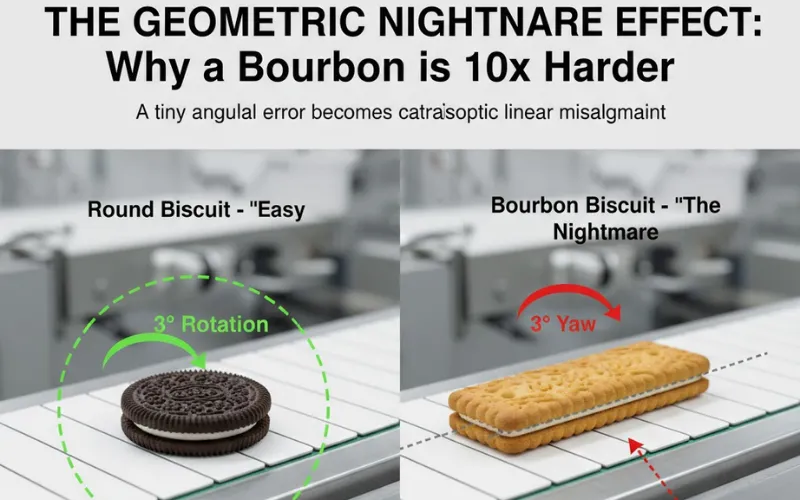
This is the challenge most equipment suppliers refuse to discuss, yet it is the single most critical factor in Bourbon biscuit production.
Why is sandwiching an Oreo (round) simple, but a Bourbon (rectangular) so difficult?
[Image: Technical diagram showing the "Yaw Amplification Effect"]
The Mechanical Engineer's View: The "Yaw" Amplification Effect
The core concept: This is why a Bourbon is 10x harder than a round biscuit.
Explanation: Imagine a round biscuit on a conveyor. If it rotates 3 degrees, it's still a perfect circle from every angle. It will cap perfectly.
Now, imagine a 10-centimeter (100mm) long Bourbon biscuit.
If it experiences just 3 degrees of "yaw" (angular deviation) during transport—an incredibly small shift that happens constantly due to high-speed vibration—the physics calculation is devastating.
Its tip will have a linear displacement of 5.2 millimeters (sin(3°) * 50mm * 2).
A 5.2mm misalignment! That is a visually catastrophic product defect and a failure of
Therefore, for a bourbon biscuit sandwich machine, the biggest challenge is not depositing. It's orientation.
The Mechanical Challenges: High-Speed Handling & Orientation
This "Geometric Nightmare" imposes three massive challenges on the machine's mechanical design.
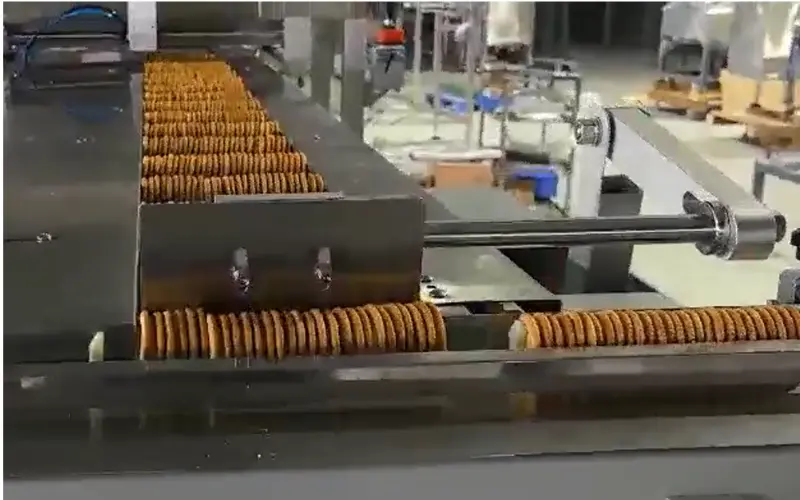
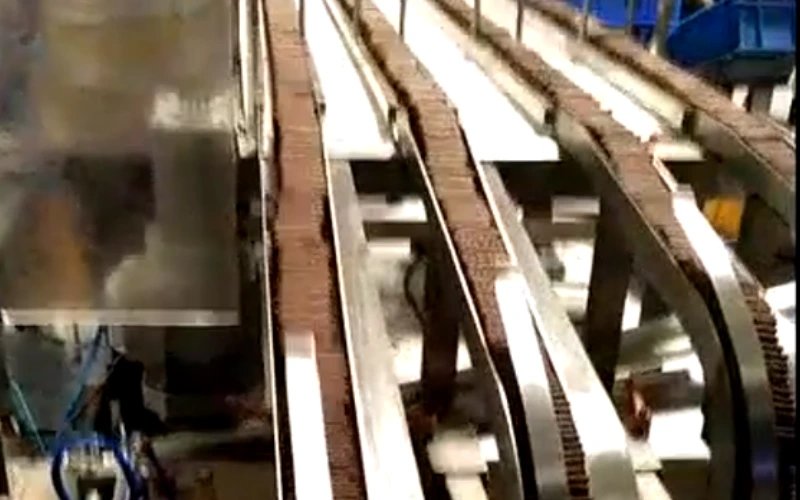
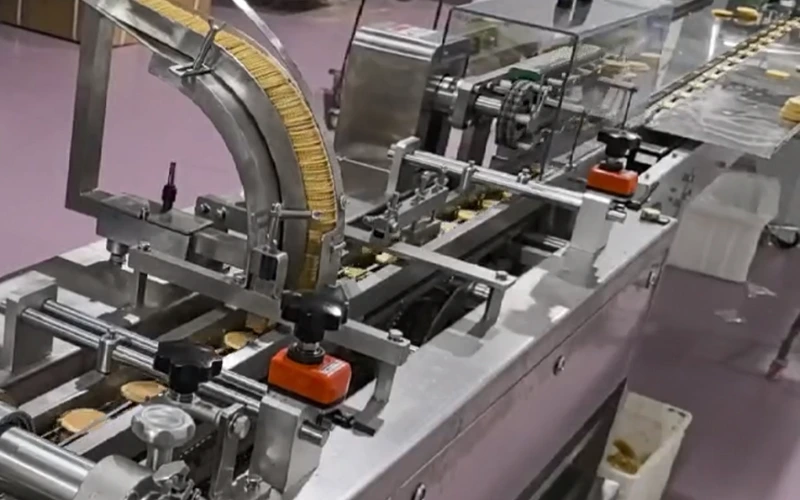
The Biscuit Magazine Design: The challenge is ensuring these long, thin, fragile biscuits feed by gravity, one by one, without jamming, and most importantly, without yawing. If the biscuit is crooked at the "starting line," the race is already lost.
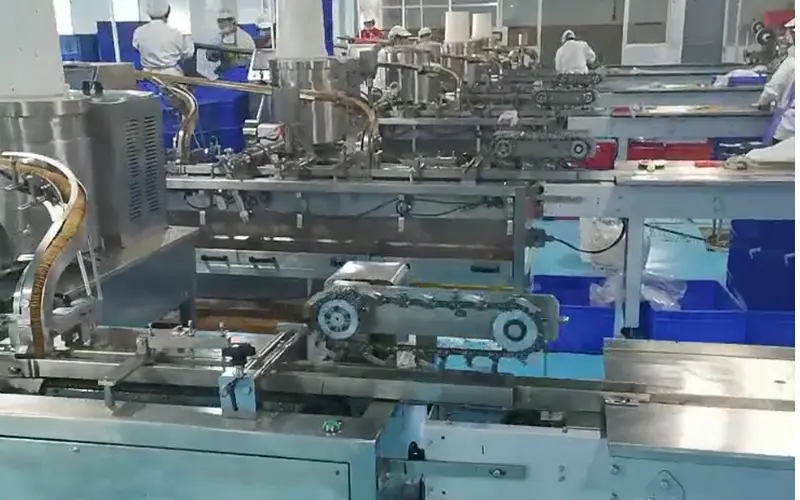
The Conveyor Chain & Lugs Design: The biscuit is released onto a high-speed infeed chain. The "lugs" (pushers) on this chain cannot be simple flat paddles. They must be intelligently designed with "V-grooves" or "self-centering" mechanisms to 100% correct the biscuit's "pose" as it enters the depositing station. This is the last line of defense for alignment.
Structural Integrity: When the top biscuit is "slapped" on at high speed, the G-force of the impact is focused on the biscuit. A long, thin Bourbon is far more likely to crack in the middle from this impact than a structurally robust round biscuit.
Note: To Mechanical Engineers & Procurement Managers: When evaluating a biscuit sandwiching machine, do not just look at the cream system. First, scrutinize its "biscuit handling system." Ask the supplier how their mechanical design (magazine, conveyor lugs) actively solves the "yaw" problem of a long, thin biscuit. This is your first line of defense against a high scrap rate.
Challenge 2: The Bourbon's "Thermal Nightmare"
If the "Geometric Nightmare" is a test of mechanics and control, the "Thermal Nightmare" is a test of fluidics and process.
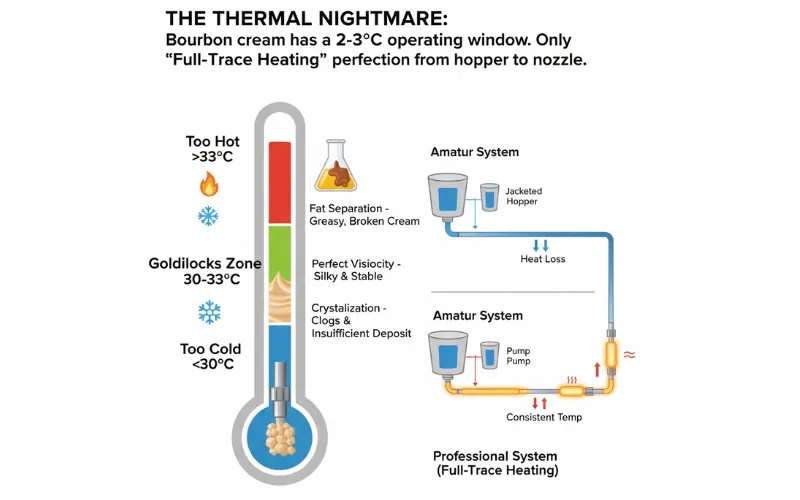
Why is Bourbon Cream So Special? (The Thermodynamics)
The answer: An extremely narrow temperature window.
The heart of Bourbon cream is its high percentage of fat (often cocoa butter or a substitute) to create its signature silky, "melt-in-your-mouth" texture.
This creates an engineering nightmare: this specific type of fat has an "operable temperature window" that is agonizingly narrow—perhaps only 2°C to 3°C wide.
Too Cold (e.g., < 30°C): The viscosity rises exponentially. The fat begins to
crystallize Too Hot (e.g., > 33°C): The viscosity plummets. The fats separate from the solids, and the cream "breaks," turning into a greasy mix of oil and sludge. This guarantees "oil leakage" (oil bleeding) and spillage. The biscuit also cannot "grip" this broken cream, and it will slide around during packaging.
The Engineering Solution: Jacketed Hoppers vs. Full-Trace Heating
Jacketed Hopper: This is the basic, standard-issue solution. A hopper with a water jacket circulates 32°C water to keep the bulk cream at temperature. This is not nearly good enough.
Full-Trace Heating: This is the difference between a professional and an amateur system. An amateur machine only heats the hopper, but the cream's temperature becomes uncontrolled the moment it enters the pumps and pipes.
A professional bourbon biscuit cream sandwich machine design must feature 100% "full-trace heating"—from the hopper, through the pump body, along every inch of pipe, and all the way to the nozzle itself just before "launch."
It must guarantee that the cream is held perfectly within that 2°C window at every single point before it touches the biscuit.
Note: To Maintenance Engineers: A Bourbon cream clog is like "cement." A single failure in the heating system (like a burnt-out trace-heating wire) means a catastrophic, line-stopping blockage. In your
, inspection of the "full-trace heating" system's thermocouples and elements must be the highest priority. PM (Preventive Maintenance) schedule
Core Technology 1: The Cream Deposition System
Now that we have a perfectly-oriented biscuit and perfectly-tempered cream, how do we combine them?
The Showdown: Stencil vs. Servo-Driven Pump
The Stencil System:
How it works: Cream is "scraped" across a rotating template (a stencil) with holes, depositing a pattern onto the biscuit below.
Pros: Low Capex (initial investment). Simple design.
Cons: 1) Extremely sensitive to viscosity (the "Thermal Nightmare"), leading to clogs. 2) The scraping action is imprecise, leading to severe "giveaway" (inconsistent deposit weight).
The Servo-Driven Pump System:
How it works: Each depositing lane (or nozzle) is controlled by an independent, high-precision pump (like a volumetric or auger pump) driven by a dedicated servo motor.
Pros: 1) Completely immune to viscosity changes. Hot or cold, the servo forces the exact volume through. 2) The PLC can control the deposit weight down to ±0.05 grams simply by telling the servo how many "pulses" to turn.
Cons: High Capex.
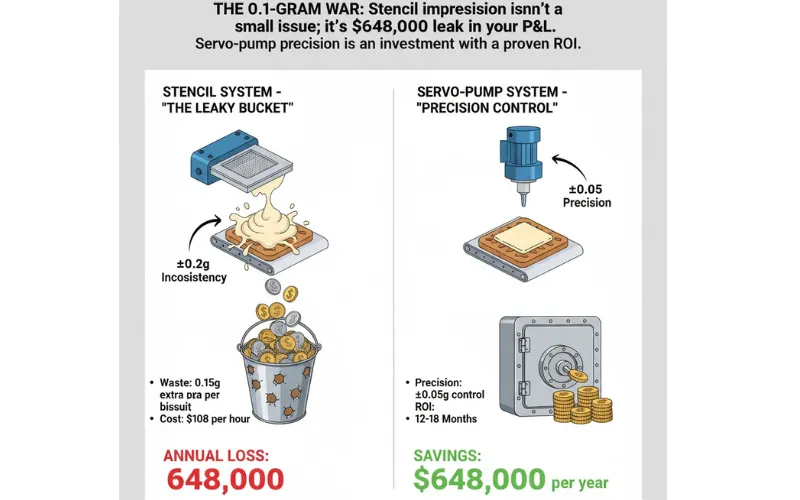
[The Differentiator] The TCO Model for Finance & Owners: The 0.1-Gram War
This section is for the CFO and the Plant Owner. Why should you pay more for a servo pump? Because if you don't, you will pay far more for wasted cream.
Let's run the ROI numbers on this decision:
Assumption: Your bourbon cream biscuit filling costs **$5.00 per kg** ($2.27/lb). This is a reasonable, conservative estimate for a high-fat, high-quality filling.
Machine A (Stencil): Due to viscosity flux and the imprecise scraping, we'll conservatively estimate its deposit weight error (waste) at an average of ±0.2 grams per biscuit.
Machine B (EverSmart Servo): The deposit weight is controlled to ±0.05 grams.
The Difference: Looking only at the waste, Machine A wastes an average of 0.15 grams more cream per biscuit.
Production: A medium 4-lane line running at 600 biscuits/minute/lane.
2,400 biscuits per minute (4 lanes * 600)
The Calculation of Waste:
0.15 g/biscuit × 2,400 biscuits/min = 360 g/min
360 g/min × 60 min/hr = 21,600 g/hr = 21.6 kg per hour
That is 21.6 kilograms (47.6 lbs) of pure cream waste, every single hour.
The Cost of Waste: 21.6 kg/hr × $5.00/kg = **$108 per hour**
Per Day (2 shifts / 20 hrs): $108 × 20 = **$2,160 per day**
Per Year (300 days): $2,160 × 300 = **$648,000 per year**
Note: To CFOs & Owners: You are reading that correctly. Over $648,000 per year in pure, wasted cream cost is "leaking" through the gaps in a simple stencil. This is why the high Capex of a servo-pump system is an intelligent investment. The Opex savings alone typically pay for the entire machine upgrade in 12-18 months. This is a classic case of
winning against "lowest price." TCO (Total Cost of Ownership)
Core Technology 2: Capping & Alignment
This is the final, critical step to solving the "Geometric Nightmare."
The Solution: Mechanical Cams vs. Servo Electronic Sync (E-Cam)
Mechanical Cams (The Old Way):
How it works: A traditional cream sandwich machine uses one giant "main motor." It runs a complex, greasy system of gears, chains, and mechanical cams to hope it synchronizes the conveyor, the depositor, and the capper.
Why it fails: 1) At high speeds, the vibration and "slop" in the mechanics cause timing "drift." 2) This "drift" is fatal for the "yaw" problem of a long, thin Bourbon biscuit.
Servo Electronic Sync (E-Cam) (The Modern Way):
[Electrical Engineer's View] In a modern EverSmart system, there is no "main motor." The biscuit magazine, the infeed conveyor, the cream pumps, the capping arms... each has its own, independent servo motor.
They are all synchronized electronically by a central
motion controller
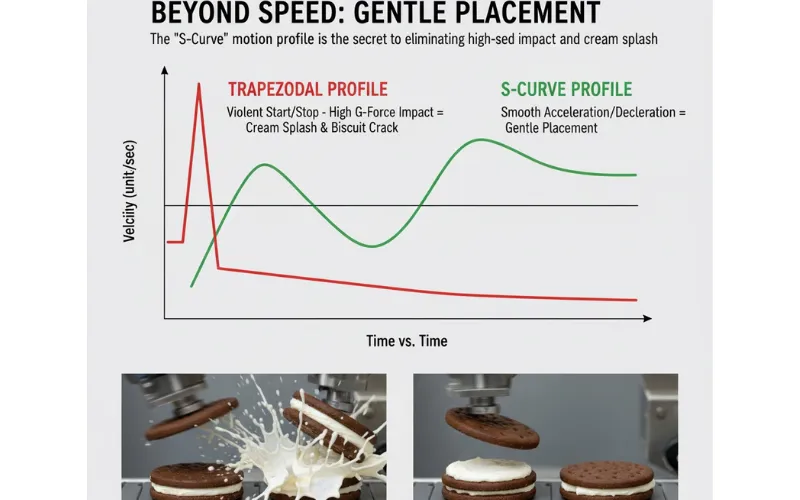
The EverSmart Touch: The S-Curve Motion Profile
This is one of our core-IP secrets.
The Problem: At 600 PPM, the top biscuit isn't "placed" on. It is "slapped" on at high speed. This G-force impact causes the freshly-deposited, semi-fluid cream to "splash" or "slide," creating an off-center or messy sandwich.
Our Solution (The S-Curve): We don't use a simple "start-stop" (trapezoidal) motion profile. We program our capping-arm servos with a complex "S-Curve Motion Profile."
The Effect: This means the arm accelerates smoothly, reaches top speed, and then decelerates smoothly so that the instant it "touches" the top biscuit, its relative speed is almost zero.
It is the engineering equivalent of a "high-speed, gentle placement."
This dramatically reduces G-force impact and vibration, which fundamentally prevents cream-splash and biscuit-cracking at high speeds.
Tip: To Electrical & Mechanical Engineers: If a supplier is still talking about "mechanical cams," they are talking about 20-year-old technology. For a Bourbon biscuit, insist on "full-servo electronic synchronization." Then, ask their engineers if they use a "trapezoidal" (simple, high-impact) or "S-Curve" (smooth, low-impact) motion profile. That single detail will tell you everything about their machine's high-speed scrap rate.
Industry 4.0: Beyond "Running" to "Predicting"
The Electrical Engineer's "Crystal Ball": Using Servo Torque Data
Most suppliers use a servo just to "move" something. We use a servo to "feel" something.
Torque Feedback: Our HMI (Human-Machine Interface) can display a real-time graph of the torque being used by the servo motor that drives the cream pump. What's the point?
Meaning for Maintenance/Operations: If the HMI shows that the torque value has been slowly climbing for the last 30 minutes (from 2.1Nm to 2.5Nm), what does that mean?
Answer: Rising torque = rising resistance. This means the cream temperature is dropping and its viscosity is increasing.
Our system can give you a "predictive warning" 10 minutes before the cream solidifies and clogs the nozzle.
("Warning: Pump torque trending high. Check thermal system.")
This allows an operator to proactively intervene instead of reactively fixing a down-line.
This is the true value of
Industry 4.0 predictive maintenance 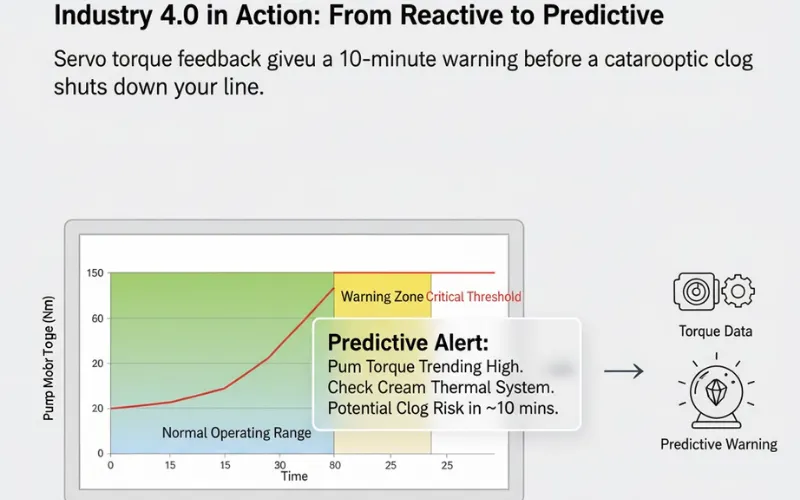
Cleaning & Maintenance (CIP/COP): The Underrated TCO Killer
A machine's value isn't just in what it makes. It's in the time it wastes you during cleaning, maintenance, and changeovers.
Why is CIP/COP for a Bourbon Machine So Critical?
[Operations Manager's View] When you change from a Bourbon (which contains chocolate, an
FDA-listed "Top 9 Allergen" [Maintenance Engineer's View] That high-fat, high-sugar chocolate cream is the perfect breeding ground for microbes. An imperfect clean is a severe food safety risk.
[The Differentiator] The Maintenance Engineer's MTTR Showdown
The Stencil System:
MTTR (Mean Time To Repair/Clean): Low. It's simple to strip down.
Wear Parts: The stencil itself (can be damaged by hard sugar crystals), and the scraper blades.
The Servo Pump System:
The Traditional Weakness: MTTR is high. The pump head is a complex, precision device. Changing the internal seals requires special training and is time-consuming.
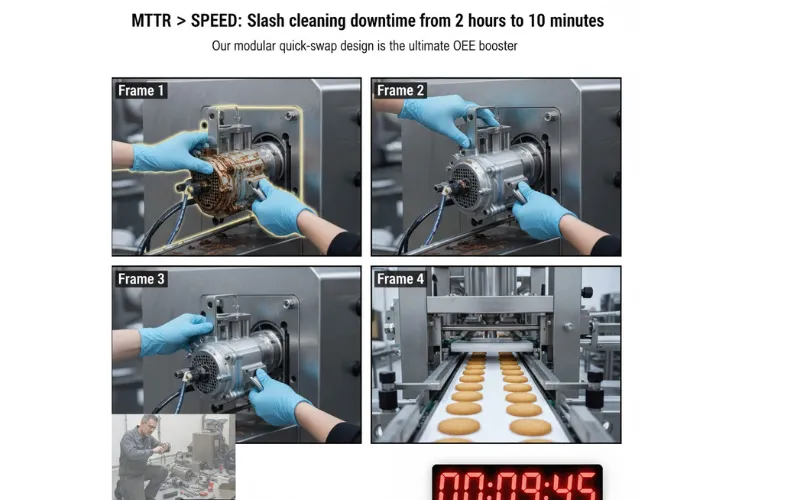
The EverSmart Solution (Turning a weakness into a strength): We know this is a pain point. Therefore, our pump heads are designed as "modular, quick-swap" cartridges.
What this means for you: Your maintenance tech, with no tools, can swap the entire "dirty" pump-head module for a clean, pre-prepared spare one in under 10 minutes. The line is back up and running. The "dirty" module can then be taken offline for a slow, thorough, bench-top cleaning.
The Result: We just reduced your line-stop
MTTR
Note: To Operations Managers: OEE (Overall Equipment Effectiveness) is not just about PPM (speed).
Cutting cleaning downtime from 2 hours to 10 minutes just "earned" you back 110 minutes of priceless production capacity, every single day. When calculating TCO, ease of maintenance (MTTR) must be a core metric.
Conclusion: The Perfect Sandwich is a Victory of System Engineering
A perfect bourbon biscuit sandwich is not, and never will be, the result of a single "machine."
It is the victory of a total system engineering approach.
It requires a perfect marriage of Motion Control (to solve the "Geometric Nightmare") and Thermodynamics (to solve the "Thermal Nightmare").
The next time you evaluate a bourbon biscuit cream sandwich machine, do not just ask the salesperson: "How fast does it go?" (PPM).
Ask them these three, truly professional questions:
"Please show me your solution for solving the 'yaw' (angular deviation) of a 10cm-long biscuit at 600 PPM."
"What percentage is your cream 'giveaway'? Show me your TCO model that proves the ROI of your servo pumps."
"How does your system use data (like torque feedback) for predictive maintenance, not just reactive alarms?"
These three questions will filter out 90% of the amateur suppliers for you.
Professional Consultation & Services (CTA)
Is your current Bourbon biscuit line plagued by cream spillage and misaligned caps?
Do you suspect you are wasting tens of thousands of dollars in "giveaway" cream cost every single month?
Before you decide to "just live with it," contact us.
EverSmart does not provide a standard quote. We provide a full TCO & ROI Analysis Report based on your unique recipe, your OEE goals, and your "geometric challenges."
Contact our engineering team today to schedule a free 30-minute process diagnostic. Let us show you the data on how much that "0.1-gram war" is really costing you.
[Schedule Your Process Diagnostic & TCO Analysis Today]
[Explore Our "Full-Servo" Biscuit Sandwiching Solutions]
Frequently Asked Questions (FAQ)
Q1: Why does my sandwiching machine work perfectly for round biscuits, but fail completely for Bourbons?A1: (This is the core insight.) Because of the Bourbon's "long, thin" shape. It has zero tolerance for "angular yaw." A 10cm biscuit that rotates just 3 degrees will have its tips misaligned by over 5mm. Your biscuit magazine and conveyor lugs are not designed to "orient" and "correct" this high-speed
Q2: My cream is always "bleeding" (leaking oil). Is it my recipe or my machine?A2: It's both. But in 90% of cases, it's the machine's temperature control failing to match your recipe's needs. If your machine cannot hold the cream within a +/- 0.5°C window (and especially if it lacks "full-trace heating" to the nozzle), fat separation (bleeding) is inevitable.
Q3: For a Bourbon, is a Stencil or a Pump-Driven system better?A3: If you are a high-volume producer and care about cost control (TCO), the servo-pump system is the only professional choice. It delivers precise gram-weight control (low
Q4: What is the most common cause of biscuit misalignment at high speed (600+ PPM)?A4: Vibration and timing "drift." At high speeds, tiny vibrations in the conveyor chain or wear-and-tear in a traditional mechanical cam system get amplified. This is why we abandoned mechanical-sync entirely in favor of full-servo electronic synchronization (E-Cam), which eliminates drift and ensures microsecond-level alignment.
Q5: How hard is it really to clean a chocolate cream sandwich machine for a Bourbon?A5: Frankly, it is one of the most difficult pieces of equipment in the entire factory to clean. It involves both a "
Q6: Is that "S-Curve motion profile" stuff really that important?A6: It is absolutely critical. At 600 PPM, a simple "start-stop" (trapezoidal) motion creates a violent G-force impact, which causes cream splash and biscuit cracking. The "S-Curve" (smooth motion) is the only engineering technique to achieve a "gentle placement" at high speed. It drastically reduces impact and vibration, which is key to a high-quality, low-scrap process.

Ready to start your journey toward a customized solution? Contact me directly on WhatsApp to begin the conversation.