Automated QC for Bourbon Biscuit Lines: From 3D Vision to Smart Closed-Loop Control
1.0 Introduction: The Bourbon Biscuit — A Perfect Geometric Challenge
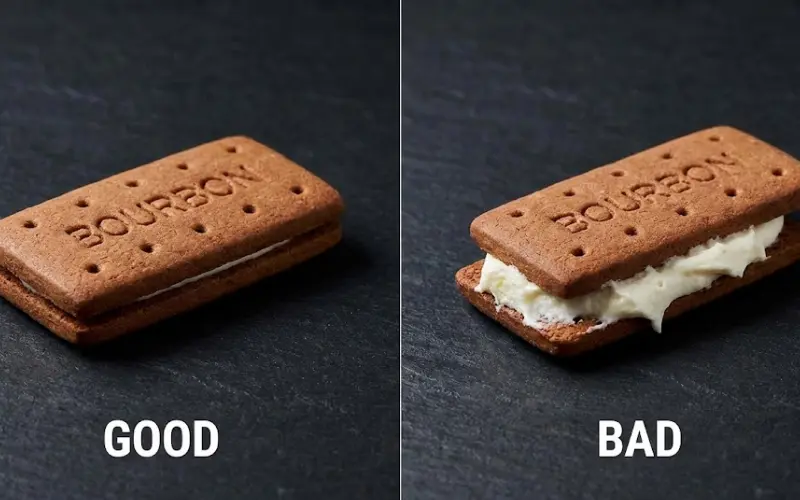
Quality control ensures that each biscuit is produced consistently, meeting predefined standards for taste, texture, color, and shape.
By implementing strict quality control measures, manufacturers can safeguard their reputation, build customer trust, and maintain compliance with food safety regulations.
For the iconic Bourbon biscuit, quality control is far more difficult than for a standard digestive or marie biscuit.
Its unique rectangular structure, consisting of two dark cocoa shells sandwiching a chocolate buttercream layer, makes it a precise "geometric challenge."
In high-speed automated production lines, often exceeding 1000 biscuits per minute, Bourbon biscuits face unique quality pain points.
Extreme Directional Sensitivity: A round biscuit can rotate slightly without anyone noticing. However, if a rectangular Bourbon biscuit rotates (skews) or shifts sideways even slightly, the visual defect is glaringly obvious.
Telescopoping Risk: The top and bottom shells must align perfectly. Any sliding of one shell results in a "telescoping" effect, which ruins aesthetics and can cause
cream to smear inside the packaging Cream Precision Requirements: A
cream layer
Therefore, Bourbon biscuit quality control can no longer rely on manual spot checks. It requires a fully automated system integrating advanced optics, weighing, and foreign body detection technologies to ensure every biscuit off the line is flawless.
📋 Key Takeaways
Geometric Challenge: The Bourbon's rectangular shape makes it hyper-sensitive to skew and telescoping defects, necessitating high-precision automated inspection.
3D Vision Advantage: 3D cameras using laser triangulation are the only reliable solution for detecting "telescoping" misalignments and "excessive height" issues.
Closed-Loop Control: Smart checkweighers do more than reject defects; they provide real-time data feedback to adjust the upstream
cream depositor Soft Rejection: For defects involving sticky cream, retracting or drop-down rejection mechanisms must be used to avoid fouling the production line.
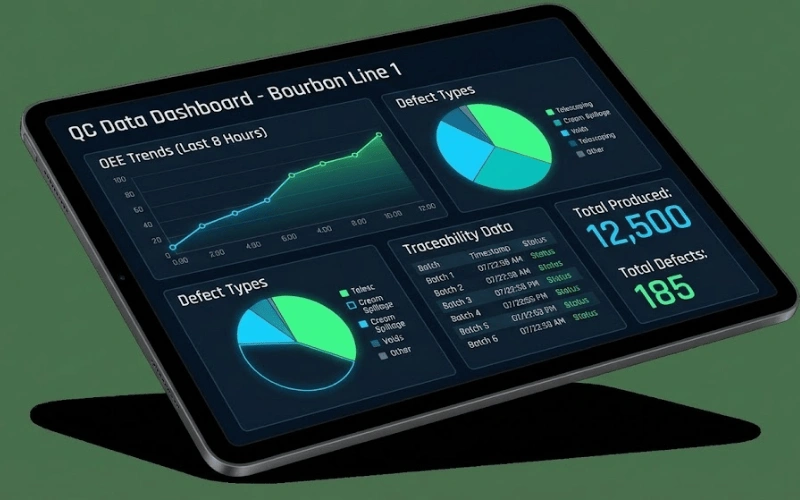
Data-Driven: Comprehensive QC data logging is the foundation for achieving full product traceability and passing rigorous food safety audits.
2.0 The First Line of Defense: 3D Vision Inspection (AOI) Designed for Sandwich Products
In traditional biscuit production, 2D cameras are usually sufficient for surface color and breakage detection.
However, for 3D-structured products like Bourbon biscuits, 2D vision often falls short. It struggles to effectively distinguish between a naturally dark biscuit and a shadow created by misalignment.
A 3D vision system designed specifically for biscuit quality control uses
2.1 Core Detection Capabilities: Solving the "Telescoping" Pain Point
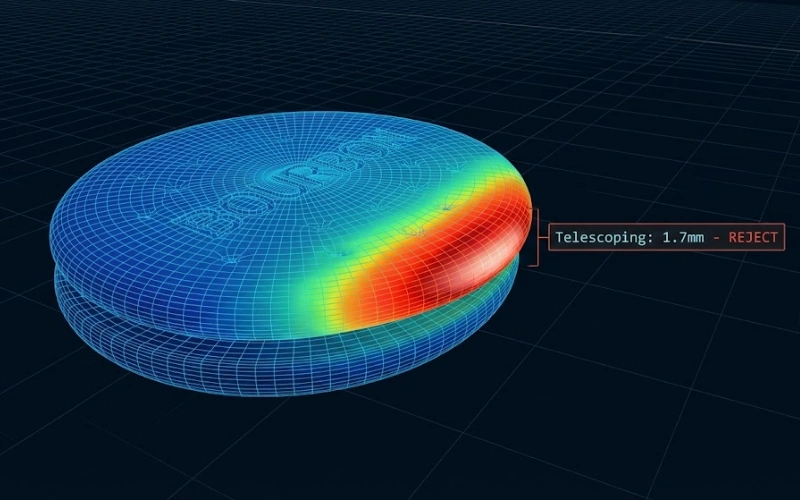
Telescoping Detection: The 3D system analyzes the step height difference at the biscuit's edge to precisely determine if the top and bottom shells are aligned. If the system detects the top shell has shifted relative to the bottom shell beyond a set threshold (e.g., 1.5mm), it is immediately flagged as defective.
Height and Tilt Detection: If a Bourbon biscuit has "gaping" (the two shells are not pressed firmly together), its total height will exceed standards. This leads to jams in downstream packaging equipment. 3D cameras can measure the biscuit's highest point with micron-level precision, ensuring smooth entry into wrappers.
Surface Feature Verification: Although it is a 3D system, it can still use grayscale imaging to check if the iconic "BOURBON"
embossing is clear
Pro Tip: When installing vision systems, ensure the conveyor belt color provides sufficient contrast against the dark Bourbon biscuits. Using a light blue, food-grade PU belt can significantly improve edge detection stability.
3.0 The Second Line of Defense: Smart Dynamic Checkweighing and "Closed-Loop Control"
If the vision system is responsible for "aesthetics," then the dynamic checkweigher is responsible for "profit."
In the
3.1 Financial Perspective: Controlling "Giveaway"
To comply with net weight regulations, manufacturers often tend to set target production weights slightly higher than the labeled weight. This excess weight is known as "giveaway."
For a factory producing tens of thousands of tons annually, giving away an extra 0.5g of cream per biscuit adds up to tens of tons of expensive raw material lost each year.
High-precision dynamic checkweighers can narrow this deviation range to the absolute minimum.
Note: Even reducing giveaway by just 0.1g per Bourbon biscuit can save a line producing 5,000 tons annually tens of thousands of dollars in raw material costs. (See
). The 0.1-Gram War
3.2 Engineering Perspective: The Closed-Loop System
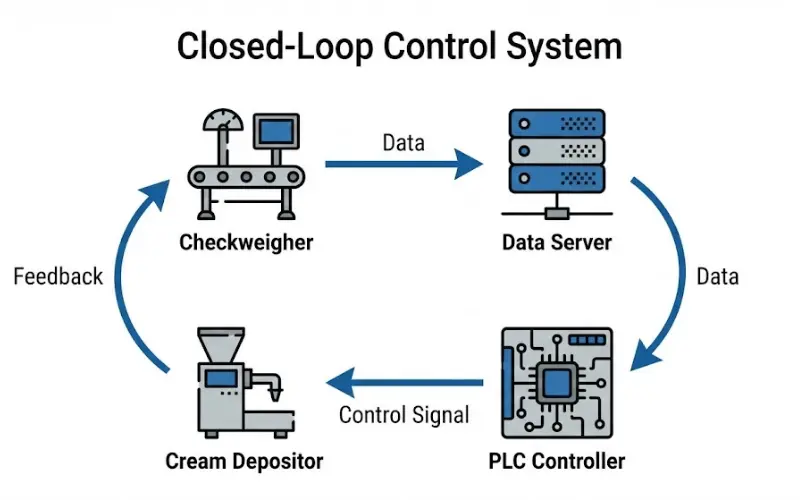
This is the core hallmark of modern quality control in biscuit production. The smart checkweigher is no longer just an isolated "policeman"; it is a "commander."
How It Works: The checkweigher continuously monitors the average weight trend of passing products. If it finds the average weight of the last 20 Bourbon biscuits is 0.3g lighter than the target, it doesn't wait for products to be rejected.
Instant Feedback: Instead, it immediately sends a command via industrial Ethernet to the upstream
cream depositor The Result: The production line achieves "cruise control," always running within the optimal target weight range, drastically reducing manual intervention and raw material waste.
4.0 The Third Line of Defense: Food Safety and Foreign Body Detection (The Shield)
No matter how perfect the biscuit looks, if it contains metal contaminants, it is a devastating blow to the brand.
The characteristics of Bourbon biscuits pose special challenges for foreign body detection.
4.1 Metal Detectors: Overcoming the "Product Effect"
The chocolate cream in Bourbon biscuits typically contains moisture, salt, and minerals.
In an electromagnetic field, these components generate conductive signals similar to tiny metal particles, known as the
The Solution: You must use Multi-Frequency or simultaneous multi-frequency metal detectors. They scan products at different high and low frequencies simultaneously, using algorithms to filter out the background signal generated by the cream itself, thereby precisely identifying true stainless steel or ferrous contaminants.
Pro Tip: When setting metal detector sensitivity, always calibrate using "warm product" fresh from production. The conductivity of Bourbon biscuits changes as they cool, which can lead to increased false rejects if calibrated incorrectly.
4.2 X-Ray Inspection Systems: Seeing Internal Defects
For high-end Bourbon biscuit lines, X-ray systems are gradually becoming standard equipment. They offer capabilities beyond what standard metal detectors can provide.
Non-Metal Contaminant Detection: X-ray can detect glass shards, high-density hard plastics, or small stones.
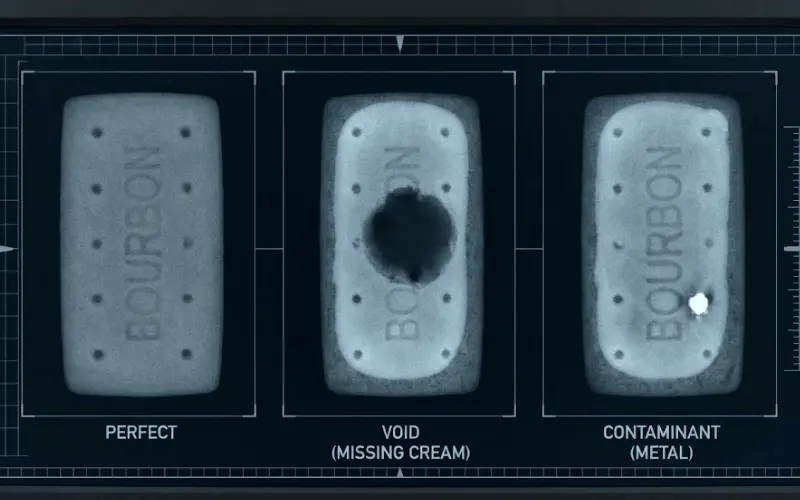
"Void" Detection: This is X-ray's unique specialty. It can "see through" the biscuit to check if there is actually cream between the two shells. If a cream depositor nozzle clogs momentarily, resulting in "shells with no filling," the X-ray machine immediately identifies this density anomaly and rejects it, preventing serious consumer complaints.
5.0 Operational Reality: Soft Rejection and Hygienic Design
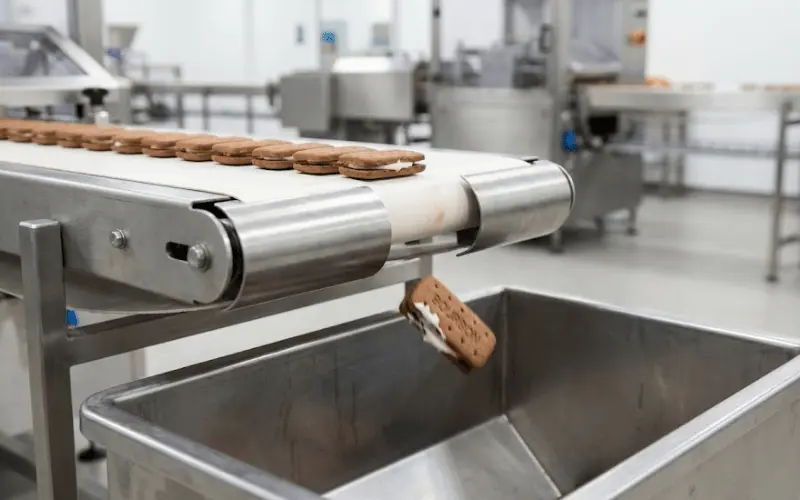
Detecting defects is only the first step. Gracefully removing them from a roaring production line is a challenge for mechanical engineers.
5.1 Pain Point: How to Reject Sticky Defects?
Bourbon biscuit defects are often accompanied by overflowing cream. If you use conventional "pneumatic pushers" or "powerful air blasts" for rejection:
It Won't Move: A double-layered biscuit with cream is heavy, and air might not be enough to move it reliably.
It Sticks Everywhere: Violent pushing can cause cream to smear onto guides, conveyor belts, or even healthy biscuits, causing severe cross-contamination.
The Solution: Soft RejectionFor Bourbon biscuits, the best rejection method is a retracting belt or a drop-down flap. When a defect reaches the rejection point, the belt quickly retracts, or a flap opens. This allows the defective product to fall naturally into a reject bin via gravity. This non-contact rejection method maximizes hygiene by reducing the risk of cream contaminating the equipment.
Note: All QC equipment must meet
(such as hygienic design standards IP65 or IP69K), ensuring it can withstand regular high-pressure washdowns without having structural dead zones that harbor bacteria.
6.0 Data-Driven Continuous Improvement (Industry 4.0)
Modern biscuit quality control systems are not just about rejecting bad products; they are about collecting data.
Traceability: The batch number on every pack of Bourbon biscuits should link back to its production QC data records (e.g., the sensitivity settings of the metal detector or average weight distribution at that exact time). This is a prerequisite for meeting external audits like
BRC orIFS .Maintenance Warnings: QC data can guide equipment maintenance. For instance, if the 3D vision system shows biscuits are consistently "higher on the left side," it might not be a
moulding issue Maintenance Guide
7.0 Frequently Asked Questions (FAQ)
Here are high-frequency questions and answers regarding how to control biscuit quality based on search data (PPA) and industry forums:
Q1: Why do Bourbon biscuit cream fillings often have a "wedge-shaped" defect (more on one side, less on the other)?A: This is usually not a problem with the cream depositor itself but is caused by uneven thickness in the biscuit shells. If the
Q2: Can automated vision systems detect baking color deviations in Bourbon biscuits?A: Yes. Modern color vision systems use specific color spaces (like HSI instead of RGB) to analyze the "degree of browning" on the biscuit surface. You can set a standard "golden brown" range, and the system will automatically reject products that are too pale (undercooked, high moisture) or too dark (burnt, bitter taste).
Q3: Which is better for cream-filled biscuits: metal detectors or X-ray machines?A: The two are typically complementary. Metal detectors often have better sensitivity for small stainless steel particles than X-ray. However, X-ray is unaffected by the cream's "product effect" and can detect non-metal foreign bodies like glass or stones, as well as check for "void" defects. Best practice is to deploy both technologies at the end of the line.
Q4: Describe the quality standards to aim for when making biscuits like Bourbons?A: Key quality parameters for Bourbon biscuits include: dimensional consistency (length/width/height deviation <±0.5mm), sandwich ratio (cream typically makes up 28%-32% of total weight), moisture content (critical for shelf life, usually controlled below 3%), and visual integrity (no telescoping, clear embossing).
Q5: What is the typical Return on Investment (ROI) period for implementing a fully automated QC system?A: For a high-speed Bourbon biscuit line running 24/7, the raw material savings from "closed-loop checkweighing" alone can typically recover the entire QC system investment within 6 to 12 months. This is a core part of the
8.0 Conclusion: Safeguarding Perfection with Smart Technology
In the fiercely competitive biscuit market, quality is the lifeline.
For complex products like the Bourbon biscuit, relying on manual QC is obsolete.
By deploying an automated system that integrates 3D vision, closed-loop checkweighing, and advanced foreign body detection, you gain more than just lower defect rates.
You gain deep insight and mastery over your entire
Ready to upgrade your Bourbon biscuit line?
Book a Demo: Eversmart Integrated QC Solutions - See with your own eyes how we integrate vision, weighing, and metal detection on a single HMI interface.
Download Whitepaper: Challenges and Countermeasures for Foreign Body Detection in Sandwich Biscuits - Dive deep into how to overcome detection difficulties caused by salty cream.
Free Consultation: Production Line Quality Bottleneck Diagnosis - Our experts will help you assess current QC vulnerabilities and provide improvement recommendations.

Ready to start your journey toward a customized solution? Contact me directly on WhatsApp to begin the conversation.