The Bourbon Biscuit Production Line: A Deep Dive into Precision & Profitability
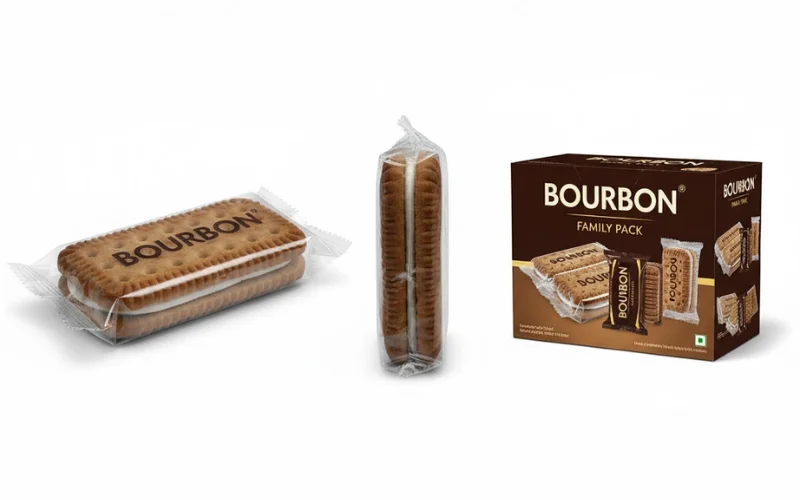
Module 1: Introduction: The Core Components of a Bourbon Biscuit Production Line
A bourbon biscuit production line typically includes the following key components:
Dough Mixer: This is where it all begins.
Lamination & Gauge Roller: After the dough is prepared, it passes through the lamination and gauge roller.
Rotary Cutter: This machine is used to cut the biscuit shapes.
Rotary Moulder: This is used for embossing patterns on soft dough biscuits.
Baking Oven: The biscuits are baked here.
Oil Sprayer Machine: This is used for specific types of biscuits.
(Note: The line is also used to process Hard Biscuits and Soft Dough Biscuits)
The Bourbon biscuit is more than just a snack. It is a classic, deeply ingrained chocolate sandwich experience.
In markets worldwide, from India's bourbon biscuit britannia to the UK's
Inside a bourbon biscuit factory, achieving this consistency is the ultimate goal of automation. However, the biscuit's signature shape—a slender, high-aspect-ratio rectangle—presents a unique challenge for automated production.
This challenge far exceeds that of ordinary round biscuits, like an Oreo.
The core of this challenge is: cream deposit accuracy.
Even the slightest misalignment on a high-speed line will cause the cream to overflow. This single failure triggers a catastrophic chain reaction, from raw material waste and line contamination to jammed packaging machines and disastrous downtime.
This article is not just a step-by-step breakdown of the
We will explore the standard process from raw ingredients to final packaging. More importantly, we will reveal how to fundamentally solve the "cream overflow" pain point and how to equip your production line investment with the "multi-functionality" needed to adapt to an unpredictable future market.
Article Key Takeaways
The Core Challenge: The slender shape of the Bourbon biscuit demands extreme precision in cream application. "Cream overflow" is the line's single biggest source of profit loss.
The Precision Solution: The key to solving overflow is replacing "blind" mechanics with "smart" automation. This means using full servo-drives, dedicated mechanical guides, and optional
vision alignment systems Beyond a Single Product: A modern biscuit line must be a "multi-functional platform." True ROI lies in the line's ability to flexibly changeover (SMED) to produce other products like Oreos or Prince biscuits.
Packaging Flexibility: The end of the line must be modular. It needs to support various formats like flat (Slug Pack), on-edge, and multi-packs (Family Pack) to adapt quickly to market demands.
Words alone cannot fully capture the precision and efficiency of a modern automated bourbon biscuit production line. Before you dive into the technical details, watch this video.
See for yourself how the Eversmart line transforms raw dough into perfectly packaged, finished products.
What to Watch For (Key Observations):
Continuous Forming: Observe how the dough sheet is precisely cut by the bourbon biscuit mould. Notice how the excess scrap dough is 100% automatically recovered.
Precision Creaming: Focus on the creaming machine (Capper). See how it handles the slender biscuits at high speed. Does the cream land perfectly in the center every single time?
High-Speed Packaging: Note the smooth, seamless transition from biscuit stacking into the horizontal flow-wrapper.
Module 3: Step-by-Step (Part 1): Birth of the Biscuit Shell (Raw Material to Cooling)
Every perfect sandwich biscuit begins with two perfect biscuit shells. This process is all about large-scale, high-consistency precision manufacturing.
Step 1: Dough Mixing
This is the starting point of the bourbon biscuit production line. If batches of dough are inconsistent, all subsequent efforts are wasted.
Equipment: A Horizontal Dough Mixer or a Vertical Spindle Mixer is used. For large-scale industrial production, the horizontal mixer is preferred for its efficiency and automation.
Process: The goal is not just to "mix."
Precise Dosing: A PLC-controlled ingredient system accurately weighs and delivers flour, sugar, fat, cocoa powder, leavening agents (like sodium bicarbonate), and water.
Hydration & Development: Mixing allows the flour to hydrate. For a hard biscuit like the Bourbon, this develops a specific
gluten network Temperature Control: Mixing generates heat. A mixer with a jacketed cooling system is essential. It ensures the dough exits at a constant, ideal temperature (e.g., 25°C-30°C), as overly warm dough becomes sticky and difficult to process.
Step 2: Sheeting & Forming
This is the critical stage that determines the biscuit's final shape, size, and thickness.
Equipment:
Three-Roll Sheeter: Large dough chunks from the mixer are first "rough-pressed" here. Three rollers turn at different speeds to gently extrude the dough into a continuous sheet, releasing internal stress.
Gauge Rolls: Usually in two or three sets, the gap between these rollers is precisely set (e.g., from 5mm down to 1.5mm). They progressively thin the dough sheet to its final required thickness.
Rotary Cutter /
bourbon biscuit mould Process:
Cutting & Embossing: As the dough sheet passes through, the mould roller cuts it into rectangles. It simultaneously embosses the pattern.
The Secret of the "Docker Holes": These small holes are vital. They allow steam generated inside the biscuit to escape during baking, which
prevents the surface from blistering or warping Scrap Recycling: The remaining web of dough scrap is automatically lifted away by a conveyor. It is 100% returned to the entrance of the three-roll sheeter to be mixed with new dough. This closed-loop system is fundamental to zero-waste, continuous production.
Step 3: Baking
This is where the biscuit's flavor, color, and crisp texture are developed.
Equipment: A Tunnel Oven is used. The most common types are Direct Gas Fired (DGF) or Convection, depending on the heat source.
Process: Baking is a precisely controlled "Baking Curve" process. The tunnel oven is divided into multiple independent temperature zones, each with a different function:
Zone 1 & 2 (Lift & Setting Zone): High heat causes the dough to expand rapidly ("Oven Spring"). Leavening agents react, and the biscuit's structure begins to set.
Zone 3 & 4 (Drying Zone): The temperature is slightly reduced. The main goal here is to evaporate excess moisture from the biscuit's interior, which is key to creating a crisp texture.
Zone 5 (Coloring Zone): At the end of the bake, the
Maillard reaction gives the biscuit surface its appealing golden-brown (or deep cocoa) color.Challenge: The biscuits must exit the oven at a precise moisture content (e.g., 1.5% - 2%). Too high, and the biscuit won't be crisp; too low, and it becomes fragile.
Step 4: Cooling
This is an often-overlooked step, but it is absolutely critical for the creaming process.
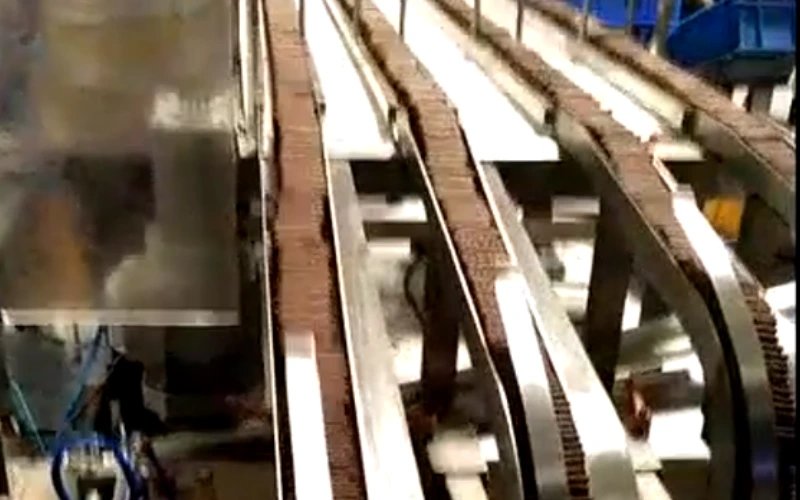
Equipment: A Multi-Tier Cooling Conveyor or an ambient cooling conveyor.
Process: Biscuit shells exiting the oven are over 100°C (212°F) and still contain internal steam.
Why is this critical?
Stress Release: Natural cooling allows the biscuit's structure to stabilize. This prevents cracking due to thermal shock.
Preparation for Creaming: This is the most important reason. The biscuits MUST be cooled to ambient temperature (around 30°C / 86°F).
Note: The cooling process is the first critical line of defense against cream overflow. Hot biscuit shells (anything above 30°C) will instantly melt the cream, leading to catastrophic failure in all subsequent creaming, stacking, and packaging operations.
Module 4: Step-by-Step (Part 2): The "Soul" and the Final Product
The biscuit shells are ready. It's time to add the "soul" of the Bourbon.
Step 5:Creaming & Capping
This is the most technically demanding and error-prone process in the entire bourbon biscuit production line.
Equipment: Biscuit Capper / Sandwiching Machine.
Process:
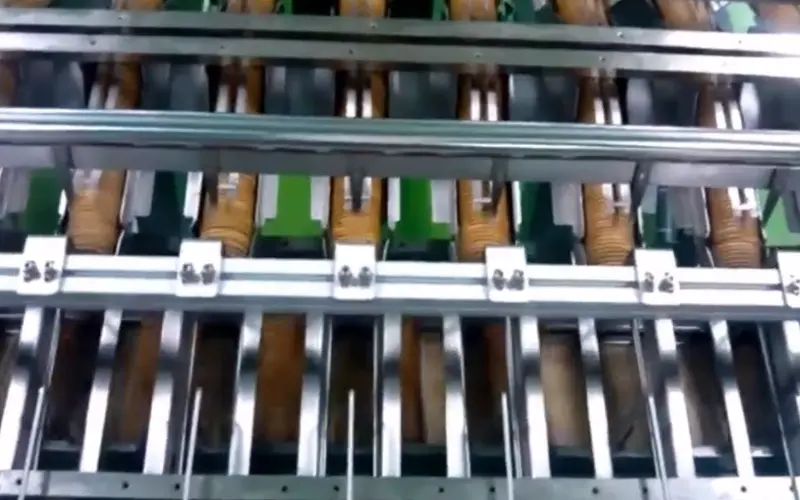
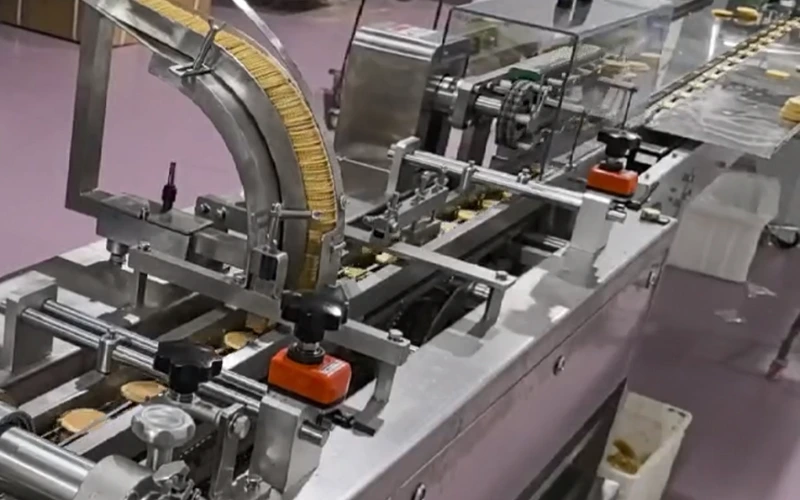
Alignment & Flipping: Cooled biscuit shells enter the capper and are automatically organized into multiple, parallel lanes. A mechanical device flips every other biscuit 180°, turning its flat bottom-side up, ready to receive the cream.
Cream Depositing: A cream pump delivers pre-mixed, temperature-controlled cream (usually a fat-based chocolate cream) through a precision-engineered stencil. The stencil's opening perfectly matches the rectangular strip of cream on a Bourbon.
Capping: After the cream is deposited, the "bottom shell" continues forward and merges with the "top shell" from an overhead conveyor. A mechanism precisely places the top shell onto the cream, completing the sandwich.
Step 6:Stacking & Packaging
This is the final step, but it's critical for market presentation. Bourbon biscuits come in various formats (flat, on-edge, or family packs), and an automated line must be able to handle them all.
Equipment: The choice of packaging equipment depends entirely on your final market format.
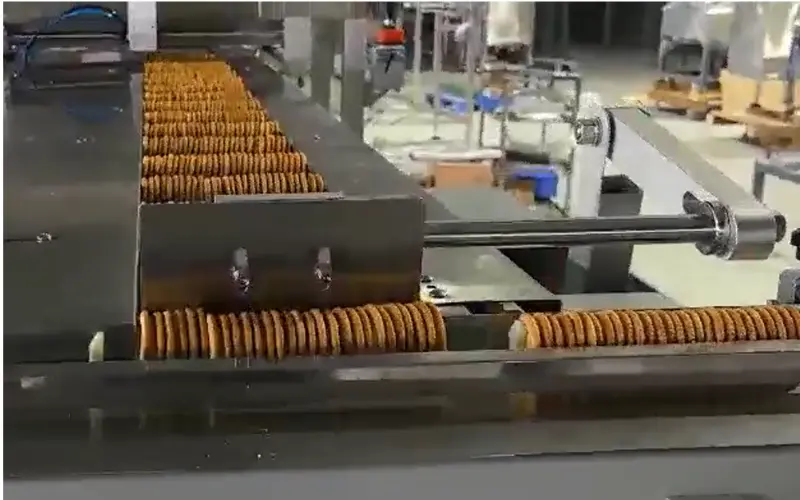
Stacker: Organizes the sandwich biscuits into neat rows.
Auto-Feeder: Connects the stacker to the packaging machine.
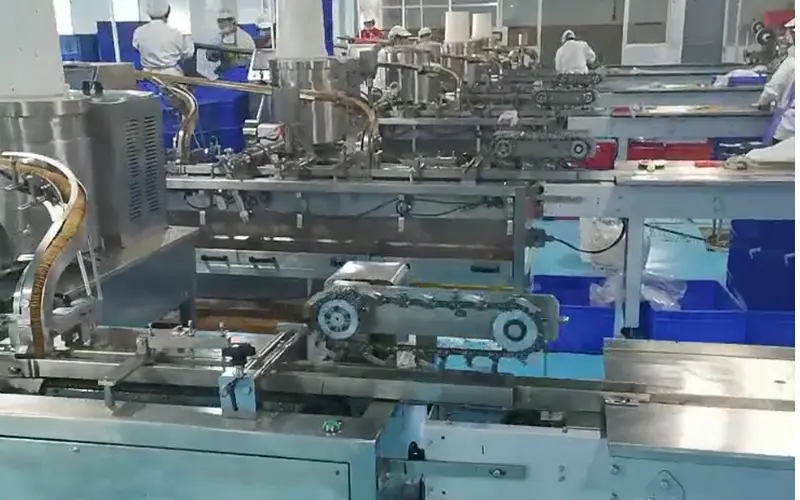
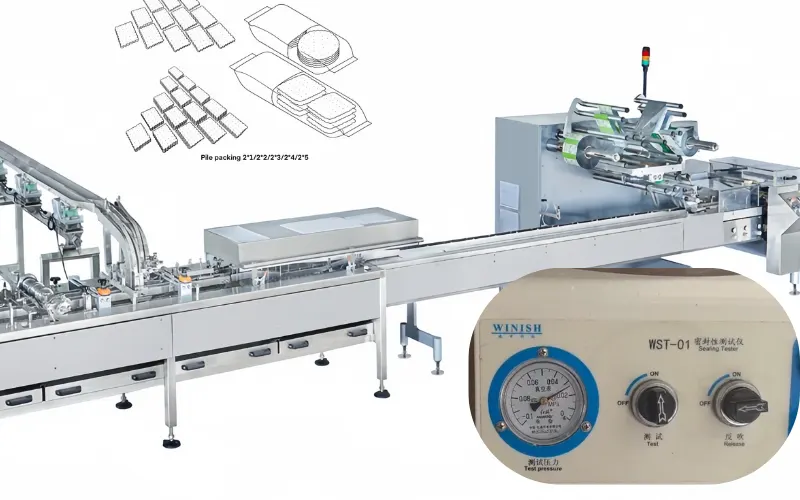
Primary Packaging: Machines like a Horizontal Flow-Wrapper (HFFS).
Secondary Packaging: Machines like an automatic Cartoner or a Multipacker.
Process & Packaging Formats:
Process: This is secondary packaging, often for promotions or warehouse club stores.
Packaging: Multiple primary packs (either slug or on-edge) are automatically collected. They are then loaded into a larger pre-made bag, a printed cardboard box (via an automatic Cartoner), or a large overwrapped bundle.
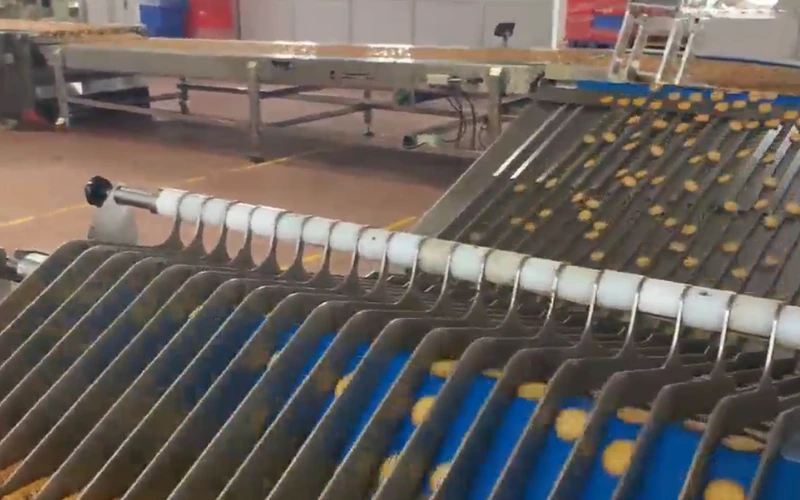
Process: This format often has better shelf presence. After creaming, biscuits are guided into Vibratory Channels, which automatically arrange them into a long row, standing "on-edge."
Packaging: A counter (like a photo-eye sensor) counts the required number (e.g., 12 biscuits). A mechanical pusher then moves this group into the infeed chain of the flow-wrapper. This requires high synchronization.
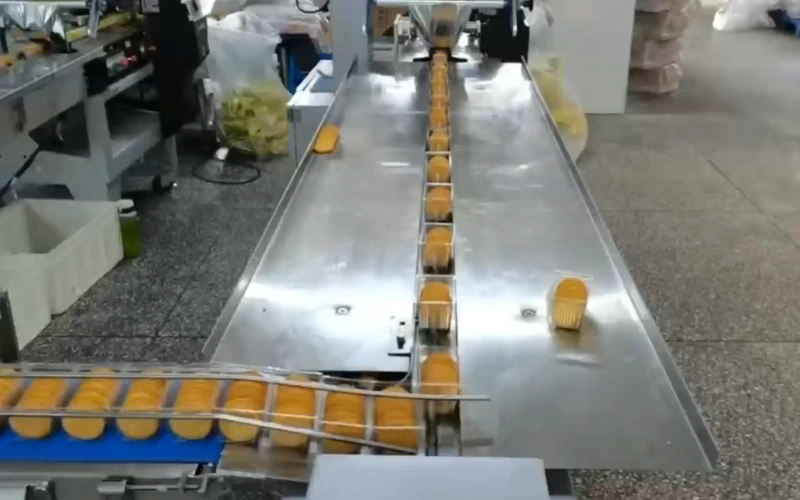
Process: This is the most common format. Finished biscuits are organized by a Star Wheel or Vibratory Lane Stacker. It stacks them into a "slug" (a flat stack of 10 biscuits, for example).
Packaging: An auto-feeder system transfers these slugs continuously into a Horizontal Flow-Wrapper, which creates a sealed, individual pack.
Format A: Slug Pack (Flat Stack)
Format B: On-Edge Pack
Format C: Family Pack
(Step Summary): A truly flexible line must have a modular "Packing Leg." This allows the factory to quickly switch between different packaging formats.
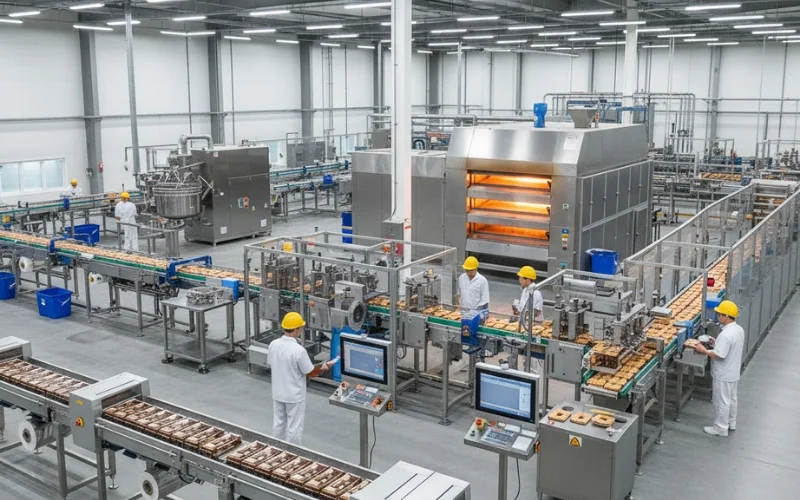
Module 5: [Differentiator A] The Art of Precision: Solving the Bourbon Biscuit Cream Overflow Challenge
(Target Audience: Mechanical/Electrical/Maintenance Engineers, and cost-conscious Factory Owners)
In a perfect world, Step 5 (Creaming) sounds simple. But in a bourbon biscuit factory processing hundreds or thousands of biscuits per minute, reality is very different.
The Challenge: Why is the Bourbon Biscuit So "Special"?
A normal round biscuit (like an Oreo) has rotational symmetry. Even if it rotates slightly on the conveyor, its center point remains the same.
The Bourbon biscuit is a "slender" rectangle (a high aspect ratio). During high-speed transport, vibrations, uneven belt tension, or tiny variations in the biscuits themselves will cause them to "yaw" (turn) or become misaligned.
The Pain Point of Traditional Cappers (using mechanical cams or stepper motors): Their depositing action is "blind." They assume every biscuit is in the perfect position.
When a biscuit is misaligned, the fixed stencil deposits the cream off-center. This causes the cream to overflow the edge.
[Image: Infographic of the "Cream Overflow Chain Reaction"]
The "Cream Overflow" Chain Reaction (The Operations Nightmare)
For factory operators and engineers, "cream overflow" is not just "a little wasted cream." It is the start of a disaster.
Massive Raw Material Waste (Cost): Cream is one of the most expensive components of the biscuit (after flour and fat). Every gram of overflow is pure, lost profit.
Line Contamination & The
CIP Nightmare Packaging Jams & Line Stoppages (Downtime): Creamy, sticky biscuits entering the stacker and flow-wrapper will cause jams, bad seals on the packaging film, and mechanical failures. The result is frequent line stoppages and a plummeting
OEE (Overall Equipment Effectiveness) .
Tip: Financial managers and factory owners calculating the
of "cream overflow" must never count only the cream itself. The true cost = (Raw Material Waste) + (Lost Production Capacity from Downtime) + (Extra Cleaning Labor Costs) + (Packaging Film Waste). true cost
The Eversmart High-Precision Solution
The only way to solve this problem is to replace "blind" mechanics with "smart" automation.
[Image: Diagram of a Vision Alignment System correcting cream deposit]
Full Servo-Driven Capping:
Outdated: Traditional mechanical cams or stepper motors will "lose steps" or create cumulative errors at high speeds.
The Upgrade: Our cappers use a full servo-motor system (e.g., Siemens or Omron). A servo motor has an encoder, creating a closed-loop feedback system. This means the PLC can command the motor to move to a micron-level position in microseconds—and maintain 100% positional accuracy at high speed.
Dedicated Mechanical Guides & Fixtures:
Software (the servo) needs to be paired with hardware (the mechanics). We've designed dedicated conveyor guides and star-wheel fixtures specifically for the slender profile of the Bourbon. These devices physically limit the biscuit's ability to "yaw," ensuring it enters the cream-depositing station in near-perfect alignment.
[Premium Option]
Vision Alignment System For clients demanding the absolute highest precision and speed, we offer a vision alignment solution.
How it works: A high-speed industrial camera (e.g., Cognex) captures the exact position and rotation angle (X, Y, θ) of every single biscuit just 0.1 seconds before the cream station.
Real-Time Correction: This image data is sent to the PLC. The PLC instantly recalculates the X-Y coordinates for the servo-driven cream nozzle (or stencil) and tracks the biscuit's actual position in real-time.
The Result: No matter how the biscuit is oriented, the cream lands perfectly in the center, every time.
(Module Summary): An investment in precision is not an extra "cost." It is a direct "investment" in your OEE and a lower raw material waste rate. It liberates your maintenance engineers from an endless cycle of cleaning.
Module 6: [Differentiator B] Beyond a Single Product: From a "Bourbon Line" to a "Multi-Functional Sandwiching Platform
(Target Audience: Owners, Financial Managers, Purchasing Managers)
A common purchasing trap is buying a highly customized "dedicated line" for today's best-selling product (like the Bourbon).
Market Reality: No One Profits From a Single Product Forever
Market tastes change incredibly fast. The bourbon biscuit is a top seller today, but tomorrow it could be Oreos or Prince biscuits.
If your bourbon biscuit line is a multi-million dollar "dedicated machine," it becomes the single biggest liability in your factory the moment the market shifts.
You Need a "Platform," Not a "Dedicated Machine"
True Return on Investment (ROI) is found in a line's "future value" and "risk resilience." A modern automated bourbon biscuit production line must be a multi-functional platform.
The Eversmart design philosophy is built on "multi-functionality." Our lines can:
Today: Produce Bourbon biscuits (using the Rotary Cutter for hard dough).
Tomorrow: Produce Oreo-style biscuits (using the Rotary Moulder for hard dough).
The Day After: Produce Prince-style biscuits (using the Rotary Moulder for soft dough).
The Key to Flexible Production: Quick Changeover (SMED) Design
"Multi-functionality" is worthless if the "changeover time" is two days. We focus on the
Modular Forming (Forming Module):
Our frames are designed for rapid swapping. The Rotary Cutter module (for Bourbons) can be entirely replaced with a Rotary Moulder module (for Oreos/Prince) in a short time (e.g., 30-60 minutes).
All connection points (mechanical and electrical) are quick-release.
Quick-Change Cream Stencils (Stencil Quick-Change):
Switching from the Bourbon's "long rectangle" stencil to an Oreo's "circle" stencil requires no complex tools. It uses a clasp or pneumatic locking system, allowing a technician to complete the swap in minutes.
Modular Packaging (Packaging Module):
The HMI shouldn't just switch the stack count; it should switch the entire packaging format.
The end of the line should have a fast diverter. This allows the operator to send the product to the "Slug Pack Flow-Wrapper," the "On-Edge Flow-Wrapper," or the "Family Pack Cartoner."
All parameters (oven curve, capper servo positions, stacker count, packaging speed) are stored as "recipes" in the PLC and HMI.
Tip: When evaluating suppliers, purchasing managers shouldn't just ask, "Can it change over?" They must ask, "How long does the changeover take? How many engineers does it require? And what tools are needed?" The SMED philosophy is about shrinking this time from "days" to "minutes."
(Module Summary): Your purchasing decision must look beyond the product you make today. Investing in a "flexible platform" is the only way to ensure your factory remains competitive and profitable for the next 5-10 years.
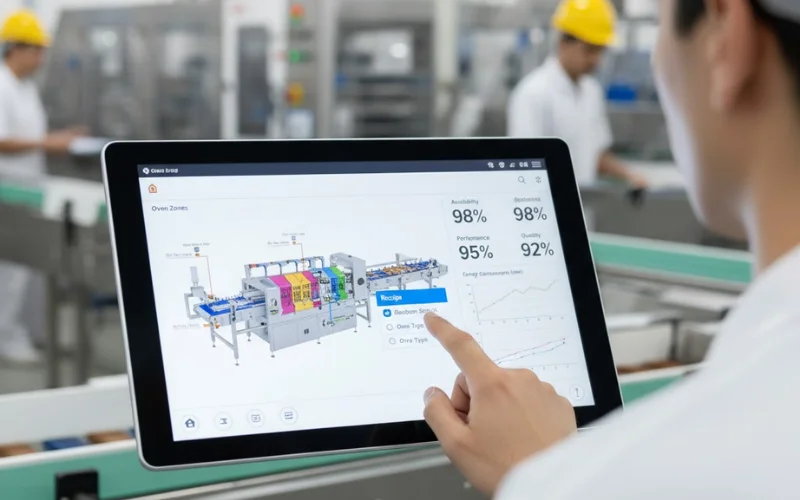
Module 7: [The Pro View] From Spec-Sheet to Lifecycle: Total Cost of Ownership
(Target Audience: Purchasing Managers, Maintenance/Electrical Engineers)
Buying a production line is about far more than the initial price. Before you sign that PO, review these key points from an engineer's perspective.
The Purchasing Manager's Specification Check-list
Control System:
PLC Brand: Is it Siemens, Allen-Bradley, or Omron? This isn't just about performance; it's about your local engineers' familiarity and the availability of spare parts.
HMI Integration: Is it one integrated HMI for the whole line? Or a separate, isolated screen for each machine? Integrated controls dramatically improve operational efficiency.
Remote Diagnostics Materials & Compliance:
Are all food-contact parts (especially the mixing bowl, moulds, cream pump, and piping) confirmed to be
food-grade Stainless Steel (SS304 or SS316L) ? This is critical for FDA/CE compliance.Energy Consumption:
The Tunnel Oven is the "energy monster" of your factory. Ask for specific data on its gas/electric consumption (per hour / per kg of biscuit). Efficient insulation and heat-recycling designs can save you a fortune in operational costs (OPEX) every year.
The Engineer's Operations & Maintenance View
Hygienic Design & CIP (Clean-In-Place):
The Question: "How do you clean the cream pump and piping?"
A Bad Answer: "You flush it with hot water."
The Eversmart Answer: "All cream piping, pump heads, and stencils are designed for tool-less quick release. A technician can fully dismantle them in 15 minutes for offline CIP. There are no hygienic dead spots."
Note: The ease of cleaning (CIP) for the cream system is a hidden, but critical, factor in the line's
Total Cost of Ownership (TCO) . A design that is difficult (or impossible) to clean properly translates directly into higher daily labor costs, longer downtime, and potential food safety risks.Mechanical Durability & Spares:
How easy is it to replace common wear parts (like the rotary cutter's scraper blade, conveyor belts, servo motor timing belts, or cream pump seals)?
Does the supplier provide a clear "Critical Spares Package" recommendation?
Module 8: Conclusion: Why Your Investment Demands Both Precision & Flexibility
The bourbon biscuit manufacturing process is a precision, complex piece of engineering.
In today's market, just "being able to produce" is not nearly enough. Inefficient lines, high raw material waste, and frequent downtime are constantly eroding the profits of bourbon biscuit manufacturers.
The bourbon biscuit production line offered by Eversmart is an investment based on two core principles:
Precision: We solve the "cream overflow" pain point at its source using servo and vision technology. This is the prerequisite for guaranteeing your immediate profit and efficiency.
Flexibility: We use modular and SMED designs so your line can adapt to different products (like Oreos or Prince). This is the key to guaranteeing your long-term ROI for the next 5 to 10 years.
Module 9: Frequently Asked Questions (FAQ)
We've compiled the most common questions from Google searches, industry forums, and customer inquiries to provide you with expert answers.
1. Q: How is a Bourbon biscuit made?A: In short, it's an automated, multi-step process. First, flour, cocoa, sugar, and fat are mixed into a dough. Next, it's sheeted and cut to shape with a
2. Q: Why do Bourbon biscuits have holes in them?A: This is a classic question! The small holes are called "docker holes." They are embossed by the mould before baking to allow steam to escape during the baking process. Without these holes, the steam would get trapped, causing the biscuit to blister, warp, or crack,
3. Q: Can one production line make different types of biscuits?A: Absolutely, but this depends entirely on the line's design. This is the key to "
4. Q: Who manufactures Bourbon biscuits?A: Bourbon biscuits are popular worldwide. Some of the most famous manufacturers include Britannia in India (its bourbon biscuit britannia is a market leader) and McVitie's in the UK. Additionally, many other large and regional baking companies produce this classic biscuit.
5. Q: What is the most critical piece of equipment in a bourbon biscuit production line?A: This is a professional-level question. While the oven determines the texture, the
6. Q: Is Bourbon a Japanese brand?A: This is an interesting point of confusion. There is a very large Japanese snack and confectionery company called "Bourbon Corporation", and they do make biscuits. However, the biscuit type known as the "Bourbon biscuit" originated in the UK and was named after the European royal "House of Bourbon." The name is not related to the Japanese company.
Module 10: Get Your Custom Solution (CTA)
Is your factory still tolerating raw material waste and frequent downtime from cream overflow?
Are you planning to invest in a new production line, only to worry it will become obsolete in a few years?
Buying a bourbon biscuit production line isn't just buying equipment. It's an investment in long-term profitability and market adaptability.
Contact the Eversmart bakery process engineering team today. Get a "Precision & Flexibility Assessment Report" tailored to your current or future products. We will help you analyze how to maximize your ROI through servo upgrades and multi-functional design.

Ready to start your journey toward a customized solution? Contact me directly on WhatsApp to begin the conversation.