Bourbon Biscuit Packaging Solutions: From Post-Cooling to Shelf Appeal
1.0 Introduction: The Bourbon — A "High-Maintenance" Premium Product
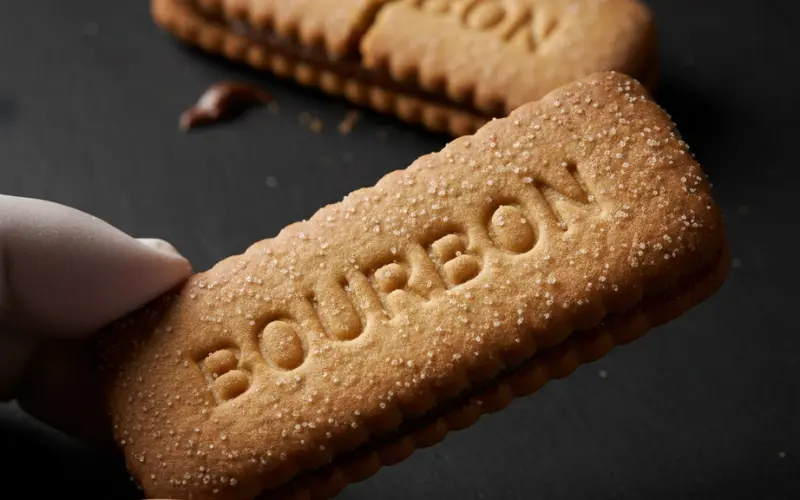
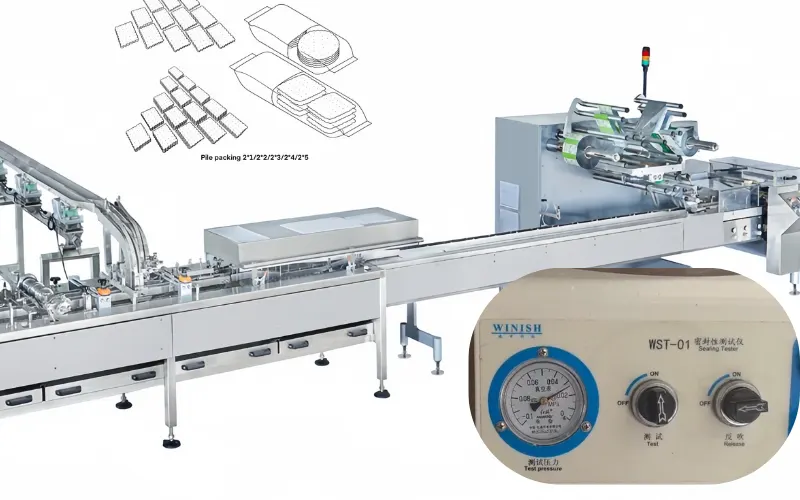
Packaging solutions for biscuits typically include primary packaging like Pillow Bags (Flow Wrap) for individual or slug packs, and secondary packaging such as boxes and cases for retail display.
For fragile sandwich products like Bourbon biscuits, specialized "on-edge" or tray-loading configurations are essential to minimize breakage.
For the Bourbon Biscuit, the packaging phase is far more than just "putting biscuits into a bag." This classic biscuit combines multiple "packaging nightmares" into one single product.
Long Structure & Fragility: Compared to round biscuits, the rectangular Bourbon is extremely prone to snapping in half when subjected to lateral force. Any improper squeezing during feeding or drops during transfer will lead to high breakage rates.
Cream Sensitivity: The chocolate buttercream filling is highly temperature-sensitive. If not handled correctly, it will
smear, contaminating the packaging film and causing seal failures High Aesthetic Demands: As a premium product, its surface "BOURBON"
embossing
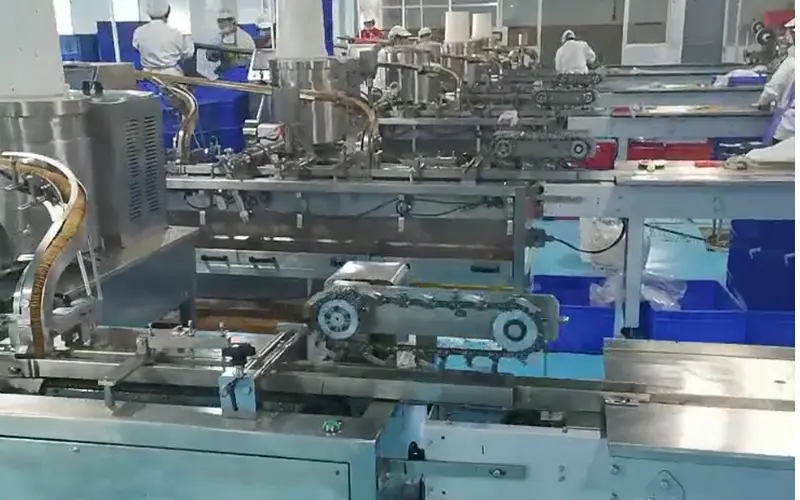
Therefore, an efficient Bourbon biscuit packaging solution cannot just be an isolated wrapping machine. It must be a fully integrated system starting right from the sandwicher exit. It must cover cooling, smart diverting, gentle feeding, and final cartoning. Its goal is twofold: physically protect product integrity while maximizing brand appeal on the shelf through exquisite biscuit packaging design.
📋 Key Takeaways
Critical Pre-Process: A "Post-Cooling Tunnel" is non-negotiable for setting the cream and preventing smear-related seal failures.
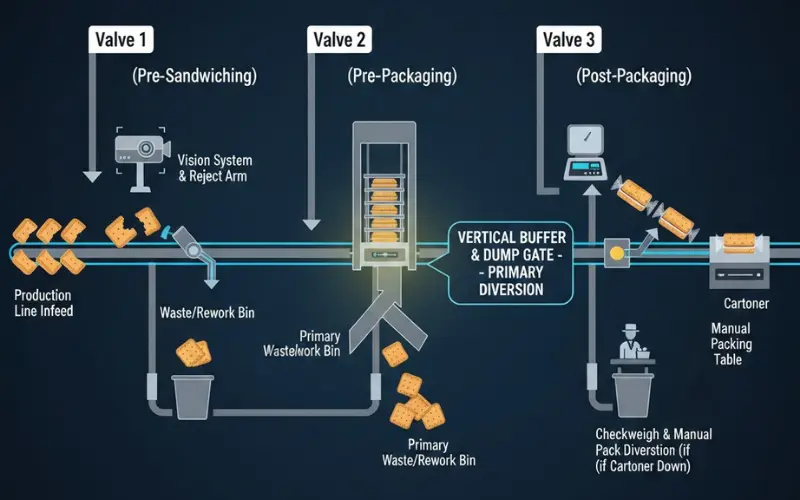
Smart Traffic Control: You must deploy "Three Safety Valves" (diverters before sandwiching, before packing, and after packing) to prevent downstream faults from jamming the entire line.
On-Edge Wrapping: For long Bourbons, "On-Edge" orientation is more stable than flat piling and offers better shelf display.
Zero-Pressure Feeding: Utilize smart belts with multi-stage independent servo control to prevent biscuits from crushing each other during high-speed queuing.
Extended Shelf Life: Leverage high-barrier metallized films and MAP nitrogen flushing to effectively combat moisture softening and fat oxidation.
2.0 The Critical Pre-Process: "Post-Cooling" After Sandwiching
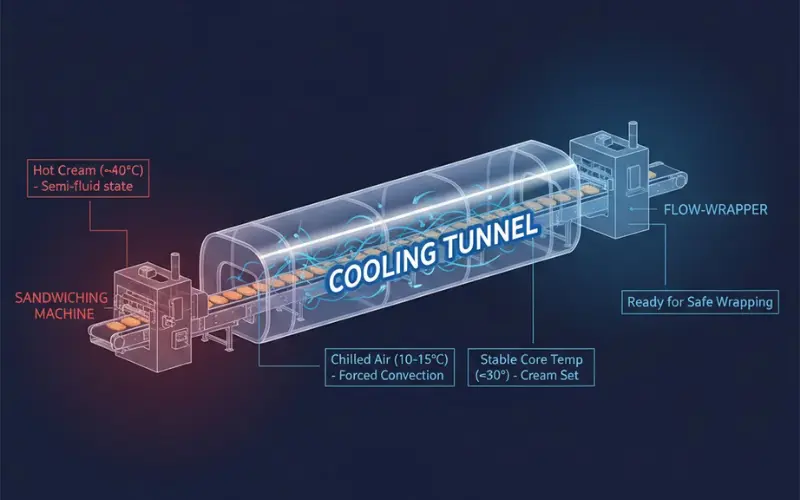
Many newly built biscuit factories make a serious
2.1 Pain Point Analysis: The Threat of Hot Cream
To ensure it can be pumped, the cream or caramel exiting the sandwicher is usually warm (e.g., 35°C - 45°C). At this stage, the cocoa butter or fat alternatives in the cream have not fully crystallized. They are in an unstable, semi-fluid state.
Smear Risk: If subjected to high-speed transport and wrapping immediately, mechanical vibrations will cause the cream to ooze out beyond the biscuit edge.
Seal Contamination: Overflowing cream easily sticks to the longitudinal or transverse seal areas of the film. Once grease contaminates the seal area,
heat sealing will fail
2.2 The Solution: The Post-Cooling Tunnel
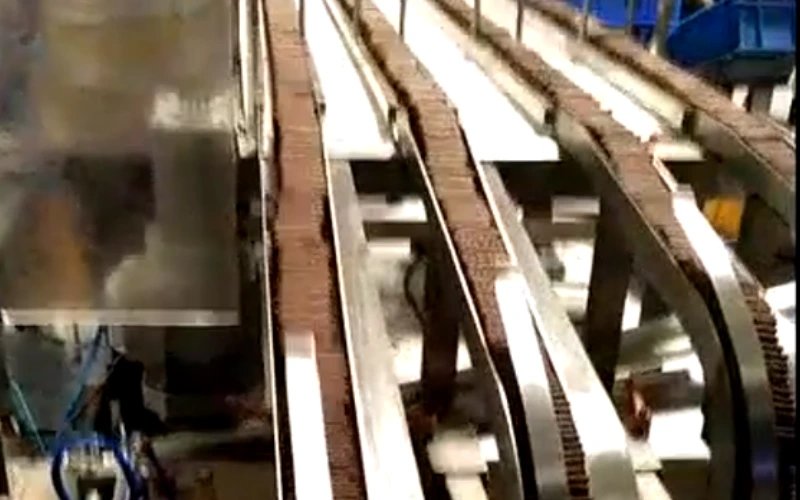
A "cooling bridge" must be established between the sandwicher and the wrapper.
Equipment Definition: This is a relatively short active refrigeration tunnel (typically 10-20 meters, depending on line speed). It is distinct from the long ambient
cooling conveyors Technical Goal: It uses chilled air (typically 10°C - 15°C) with forced convection or radiation to rapidly bring the cream to its "setting point" before it hits the wrapper. This process transforms the cream from a semi-fluid state into a solid state, firmly "locking" it between the two biscuit shells.
Note: Investing in a post-cooling tunnel can immediately reduce your wrapper's
by over 30%. Operators no longer need to frequently stop the line to wipe cream buildup off the formers and cutting jaws. cleaning downtime
3.0 Smart Line Flow Control: The Three Critical "Safety Valves"
On high-speed lines producing thousands of biscuits per minute, the packaging machine is a precise but relatively fragile link. If the wrapper stops for just 2 minutes for a film reel change, where do the 2,000+ incoming biscuits go? Without smart diversion, they will instantly pile up on the conveyor. They will crush each other and block expensive upstream equipment like dominoes.
An efficient line must have smart traffic control capabilities, which we call the "Three Safety Valves":
3.1 Safety Valve 1: Pre-Sandwiching Diverter
Location: After the biscuit turn-over device, before the sandwiching machine inlet.
Function: Works with a
vision system Value: Prevents defective shells from jamming the precision sandwicher. It also saves expensive cream ingredients—never waste cream on a broken shell that will just be thrown away downstream.
3.2 Safety Valve 2: Pre-Packaging Buffer & Discharge
Location: At the exit of the post-cooling tunnel, before the main wrapper's feeding system. This is the most critical valve on the entire line.
Function:
Level 1 Response (Buffer): When the wrapper stops briefly (e.g., 30 seconds for a minor jam or
auto-splicing film Level 2 Response (Discharge): When the wrapper needs a longer repair, the Dump Gate automatically opens. It diverts upstream biscuits into a large-capacity waste bin or manual rework area.
Value: Its core mission is to "Protect Upstream." No matter what catastrophic failure happens at the wrapper, it must absolutely never force the
tunnel oven
3.3 Safety Valve 3: Post-Packaging Divert
Location: At the exit of the flow wrapper, after the
checkweigher and metal detector Function: If the downstream automatic cartoner fails, this system temporarily diverts good, wrapped products to a side manual packing table.
Value: It keeps the primary wrapper running at full speed. It ensures the
OEE
4.0 Primary Packaging: The Art of Taming "Long" Products
There are many biscuit packaging types, but the Bourbon's rectangular geometry dictates its best options.
4.1 Preferred Solution: On-Edge (Stand-up) Pack
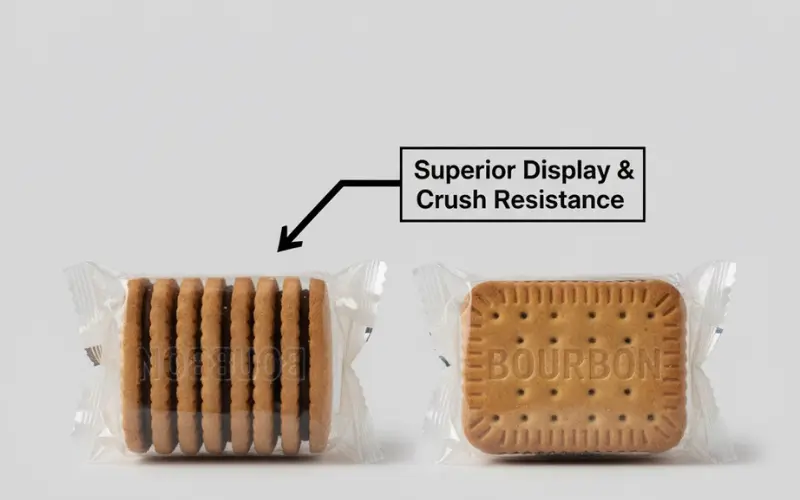
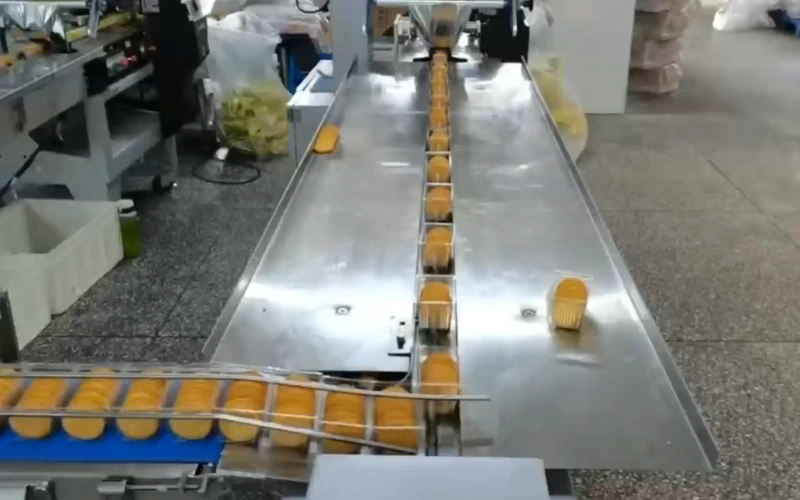
While traditional flat "Slug Packs" (Pile Packs) can be used for Bourbons, "On-Edge" packaging is the absolute mainstream for premium markets.
Physical Advantage (Crush Resistance): Standing rectangular biscuits on their side creates a structure similar to an architectural arch. During transport, this orientation handles vertical pressure and vibration much better, significantly reducing breakage rates.
Marketing Advantage (Display): On supermarket shelves, On-Edge packs present the largest side of the biscuit to the consumer. The "BOURBON" embossing faces the shopper directly, providing maximum shelf impact.
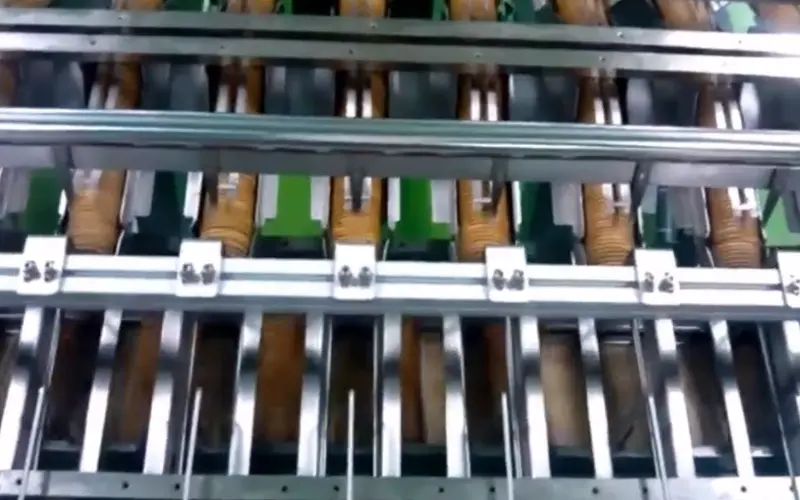
Mechanical Challenge: High-Speed 90-Degree FlippingThe difficulty in achieving On-Edge packaging is that biscuits are transported flat on the cooling belt. Precision mechanical devices are needed to stand them up:
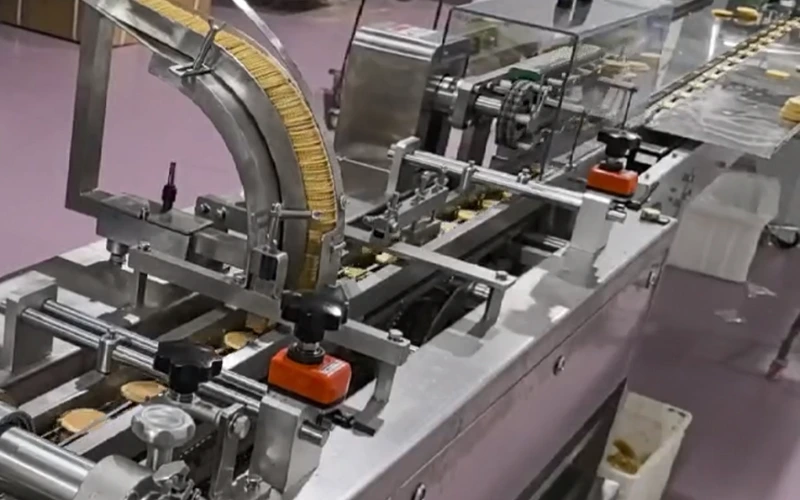
Star-Wheel Rotator: Suitable for medium-to-high speed lines. It uses rotating star-shaped blades to gently flip the biscuits.
Twisted Guides: Suitable for ultra-high-speed lines. These rely on specially designed geometric rails that let biscuits naturally slide and turn 90 degrees while in motion.
4.2 Core Technology: Smart Zero-Pressure Feeding
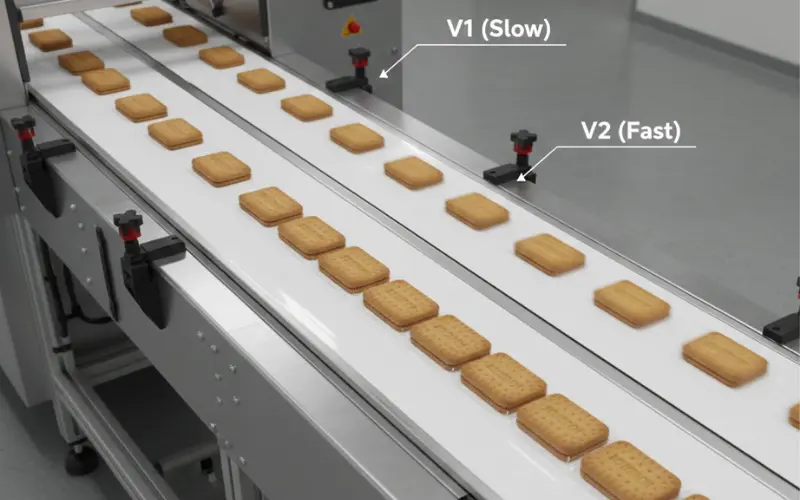
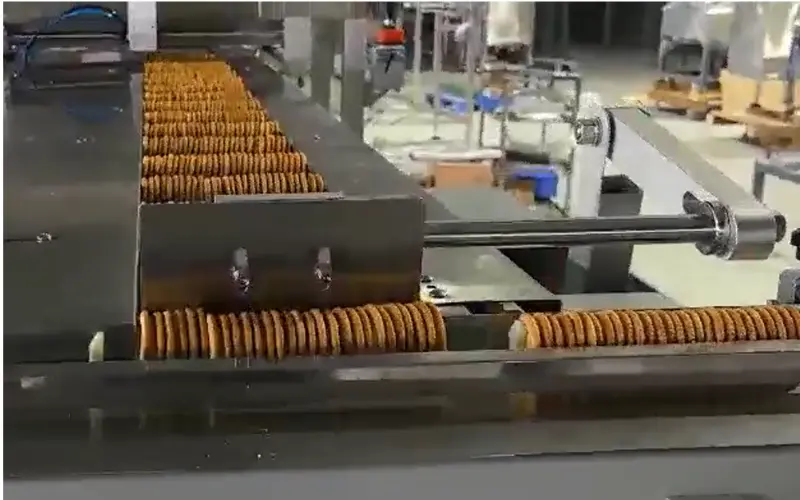
Long Bourbon biscuits hate being "squeezed." In the queuing section before entering the wrapper, if the rear conveyor continues to push at full speed, the biscuits at the front will endure immense cumulative pressure. They will easily be crushed.
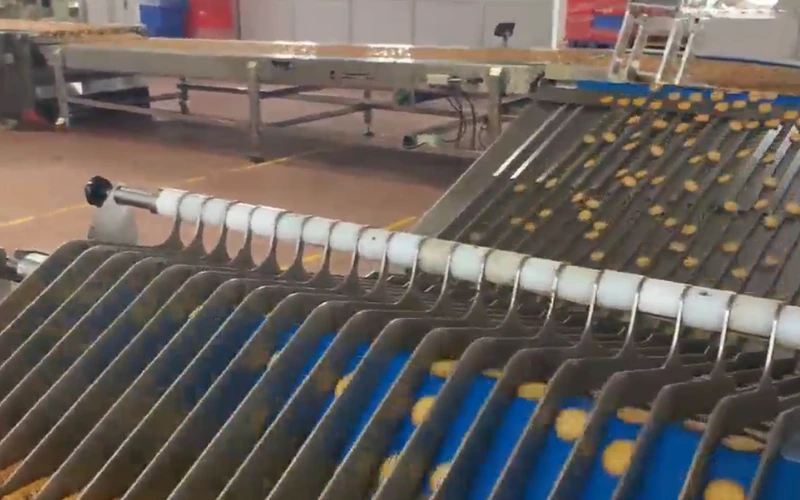
Solution: Adopt "Smart Belts" controlled by multiple independent servo motors.
How It Works: Photoelectric sensors monitor the density and length of the biscuit queue in real-time. The control system automatically micro-adjusts the speed (accelerating or decelerating) of each belt section. This ensures a tiny safety gap is always maintained between biscuits until the very last moment when they gently close up to enter the film.
5.0 Extending Shelf Life: Material Science and MAP Technology
Bourbon biscuits face two major shelf-life enemies: Moisture (causing softness and loss of crunch) and Oxygen (causing the high-fat cream filling to oxidize and go rancid).
Choosing the correct biscuit packaging material is crucial.
5.1 High-Barrier Packaging Materials
Limitations of Standard OPP: Standard transparent OPP film has relatively high
Recommended Materials:
Metallized Laminates (Metallized BOPP/PET): This is the most common choice for Bourbons. It offers excellent moisture and oxygen barrier properties. Its metallic sheen also reflects UV light, further delaying cream degradation.
High-Barrier Transparent Films (e.g., PVDC or
ALOx coated
5.2 Modified Atmosphere Packaging (MAP - Nitrogen Flushing)
For export or premium market products, relying solely on barrier film is often not enough. Active protection must be introduced—Nitrogen Flushing.
Process: At the exact moment the flow wrapper performs the longitudinal and transverse seals, a gas lance injects food-grade nitrogen into the bag.
Goal: To forcibly displace the air inside the bag, reducing the Residual Oxygen to below 2%, or even 0.5%. This almost completely halts the
fat oxidation reaction
Pro Tip: When implementing MAP, always opt for an online "Gas Analyzer." If it detects that seal contamination has caused a leak and oxygen levels are rising, the system can automatically reject that specific pack, preventing "Leakers" from reaching the market.
6.0 Secondary Packaging and Sustainable Trends
6.1 Secondary Packaging of Biscuit
For fragile Bourbons, the primary pillow pack is often insufficient for complex logistics environments.
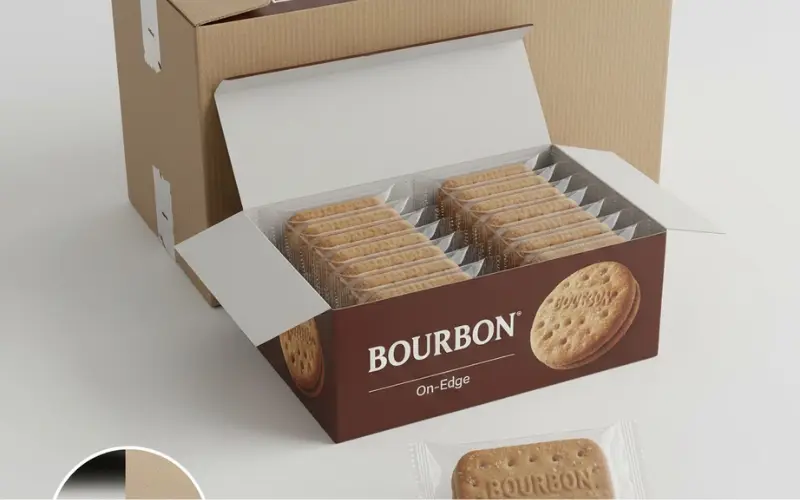
Automated Cartoning: Automatically loading 1-2 flow-wrapped packs into a color-printed carton. The carton acts as the "outermost armor," providing final physical protection and serving as a key carrier for premium brand imagery.
Retail Ready Packaging (RRP)
6.2 Sustainable Packaging Trends
Brands are facing immense pressure to reduce plastic usage.
Paper-Based Packaging: Although still in its infancy, some pioneer brands are experimenting with paper materials coated with biodegradable barrier layers for biscuit packaging. This requires wrappers to have more precise temperature and pressure control to adapt to the narrower heat-seal window of paper.
Mono-material
7.0 Frequently Asked Questions (FAQ)
Here are high-frequency questions based on real search intent (PPA) regarding biscuit packaging:
Q1: Which packaging material is best for Bourbon biscuits?A: For Bourbons requiring a long shelf life, the best choice is High-Barrier Metallized Laminates. They effectively block light, oxygen, and moisture, protecting both the oxidation-prone cream and the moisture-sensitive biscuit shell. If transparent display is needed, specialized films coated with high-barrier layers (like PVDC or ALOx) are required.
Q2: What is the best way to package fragile cookies like Bourbons?A: The best way is to minimize the biscuit's movement space within the pack. For Bourbons, On-Edge packaging is preferred because it uses the biscuit's own structural strength to resist crushing. For extremely fragile premium cookies, using plastic blister trays for separated protection is a safer, albeit more expensive, method.
Q3: What is the main purpose of secondary packaging for biscuits?A: Secondary packaging (like cartons or large multipacks) serves two core purposes: First, it provides extra physical protection to prevent primary pack damage during transport. Second, it acts as a marketing vehicle, offering a larger display face to attract consumers and combining multiple single packs into "share packs" suitable for family purchase.
Q4: How do you prevent Bourbon biscuits from being crushed during high-speed packaging?A: You must use a "Zero-Pressure" smart feeding system at the wrapper infeed. It abandons traditional physical pusher bars in favor of multiple independently servo-controlled belt sections. Sensors dynamically adjust speeds to ensure no cumulative mechanical pressure builds up in the biscuit queue.
Q5: Why do my Bourbon biscuit packs often have oil fog or cream smear marks inside?A: This is usually because the biscuit temperature was too high before packaging. If the cream hasn't sufficiently cooled after
8.0 Conclusion: Eversmart's Whole-Line Integration Mindset
An excellent Bourbon biscuit packaging hall should look like a flowing river. It should not look like a congested parking lot.
The key to achieving this lies in breaking free from the "standalone machine procurement" mindset.
You must adopt a "Whole-Line Integration" perspective—from the moment the biscuit leaves the
Ready to optimize your packaging backend?
Contact Our Integration Experts - Let us plan complete logistics from the sandwicher exit to your high-bay warehouse.

Ready to start your journey toward a customized solution? Contact me directly on WhatsApp to begin the conversation.