Beyond the Emboss: A Deep Dive into Bourbon Biscuit Mould Design (And How It Solves Cream Spillage)
Introduction
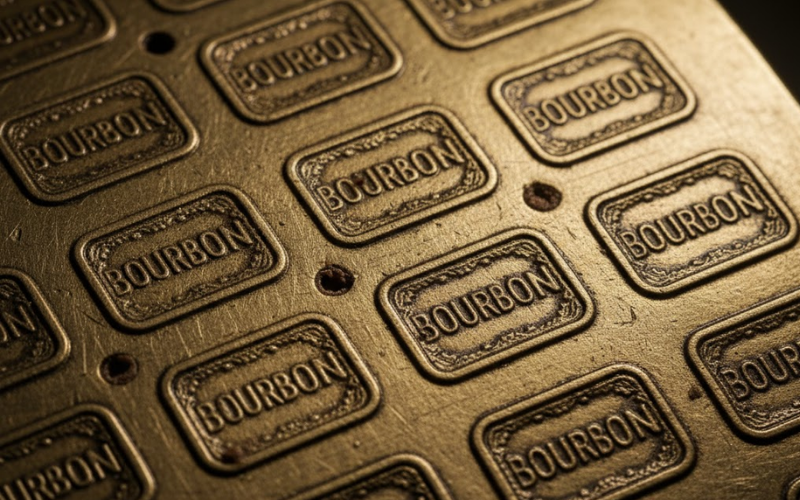
Achieving the iconic, crisp embossing on a Bourbon Biscuit hinges on the precise marriage of two technologies. These are high-precision mould design and strictly controlled dough consistency.
However, a far more critical success factor—one that is consistently overlooked—is ensuring the biscuit remains perfectly flat after baking and cooling. A warped biscuit isn't just a cosmetic defect; it's a catastrophe for the entire production line.
This warping prevents the
The result is a cascade of raw material waste, expensive line stoppages for cleaning, and a catastrophic drop in final yield.
Therefore, a truly superior bourbon biscuit mould isn't just about aesthetics. Its mission begins the second it releases the dough, serving the downstream precision of the entire line's
This article will deconstruct how Eversmart engineers solve this industry-wide pain point from the absolute source.
Key Takeaways
Flatness > Aesthetics: A Bourbon Biscuit's flatness is more critical than its embossing. Warping is the number one cause of
cream spillage Moulds are the Anti-Warp Solution: Advanced mould design, including stress-relief vents and pre-compensation engraving, is the core technology to prevent biscuit deformation.
Design for Automation: A precision mould with sharp edges provides clear "anchor points" for downstream
machine-vision systems TCO Dwarfs Price: The financial loss from cream waste and downtime caused by a cheap mould will quickly dwarf its initial purchase price. A precision mould is a capital investment, not a cost.
Part 1: The Bourbon's Dual Challenge: Aesthetics vs. Function
Producing the Bourbon Biscuit presents a sharp, inherent contradiction from the very start. It's a battle between the consumer's demand for a perfect visual and the physical, industrial-scale nightmares caused by its "long and thin" shape.
Challenge 1: The Soul of the Brand (Aesthetics)
The Bourbon's rectangular design, with its signature text and stippled border, is the core of its brand identity. This design is so recognizable that it has transcended food to become a
We see this everywhere in the consumer market, from giant bourbon biscuit mould products to bourbon biscuit cake mould kits. This DIY trend, which even includes silicone candle moulds, proves the consumer's obsession with perfectly replicating this classic industrial design.
This obsession, in turn, places immense pressure on the industrial manufacturer. You must guarantee that every single biscuit is absolutely crisp and consistent, even while producing thousands per minute.
Challenge 2: The Engineer's Nightmare (Function)
In the eyes of a Factory Owner or Mechanical Engineer, the Bourbon's "long and thin" shape is a persistent nightmare. Compared to a simple round or square biscuit, this high-aspect-ratio geometry is inherently unstable.
Why Do These Biscuits Warp?
Internal Stress: As the dough is compressed into the mould cavity by the rotary moulder, uneven internal stresses are created.
Uneven Evaporation: During baking, the biscuit's edges and center lose moisture at different rates. The long, thin shape magnifies this difference, leading to uneven shrinkage during cooling.
Thermal Shock: As the hot biscuits exit the oven and hit the cooling tunnel, the rapid cooling of the surface (while the core remains hot) creates thermal stress. This "bi-metallic" effect causes the biscuit to bend and warp.
The Downstream Catastrophe: Cream Spillage
What happens when a biscuit with a minor 0.5mm warp enters a
Alignment Failure: The cream nozzles and stencils on the sandwiching line are designed with the assumption that the biscuit is on a perfectly flat plane.
Uneven Pressure: When two warped biscuits are pressed together, they cannot meet in parallel. Pressure concentrates on the high points, instantly "squeezing" the soft cream filling out from the center and over the edges.
Note: 90% of the time, the root cause of "Cream Spillage" is not a poorly calibrated sandwiching machine. The problem originates upstream, in a forming and baking process that failed to deliver a perfectly flat biscuit.
Part 2: The Core Equipment: How a Rotary Moulder Works
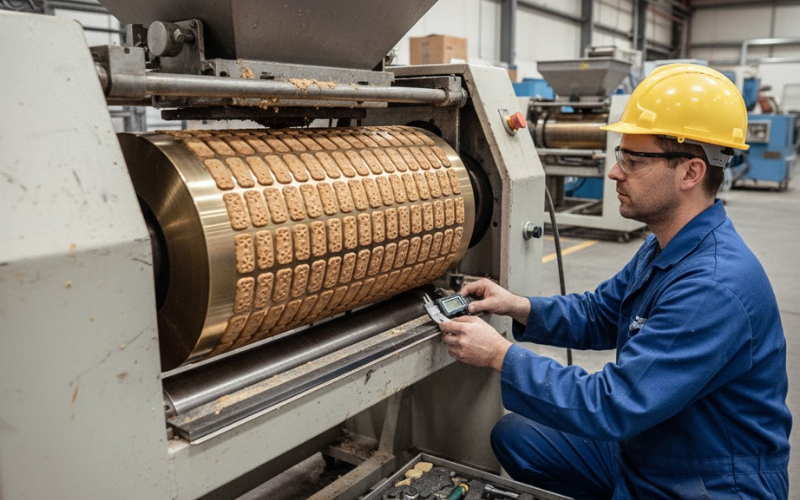
To solve a problem, you must first understand the tool. The
Its operating principle seems simple, but it is a precision-timed sequence.
Dough Feeding: The pre-conditioned cocoa dough is fed into the main hopper.
Forcing into Cavity: A forcing roller applies high pressure to push the dough down into the engraved cavities of the rotating bourbon biscuit mould cylinder.
Scraping: A sharp, precisely-calibrated scraper knife is pressed against the mould roll's surface. It shaves off all excess dough, ensuring only the dough inside the cavity remains.
Extraction: As the mould roll rotates to its lowest point, an extraction belt (or web) running in close contact pulls the formed biscuit dough out of the cavity. This belt then conveys the biscuit to the
oven
The Key Control Points:
Scraper Pressure & Angle: This determines if the biscuit base is flat and if the weight is consistent.
Extraction Belt Tension: Too little tension, and the biscuit won't release. Too much, and the long, thin biscuit can be stretched or deformed at the moment of extraction.
Roll Speed: This must be perfectly synchronized with the entire production line, especially the oven band, to ensure consistent baking.
Part 3: A Deep Dive into Mould Design: How Eversmart Solves the Problem at the Source (The Core Difference)
Most mould manufacturers will only promise you a "clear emboss."
The Eversmart design philosophy is this: A mould's mission only begins the second it releases the biscuit. Our design must be responsible for the downstream goals of "anti-warping" and "high efficiency."
1. The Foundation (Standard Professionalism)
This is the industry-standard baseline, the fundamentals on which we will not compromise.
Material Science:
Brass /
Gunmetal Food-Grade Engineering Plastics Engraving Technology:
We utilize
5-axis CNC The Depth-to-Angle Balance: Too shallow, and the pattern is blurry. Too deep, and the sticky cocoa dough will fail to release, causing "picking" or "missing corners." Our experience provides the optimal depth and "draft angle" for a clean release.
Air Vents / Pin Holes:
This is the mould's "respiratory system."
In the milliseconds the dough is forced into the cavity, the trapped air must have an escape route.
Note: Without vent holes, there is no embossing. Trapped air prevents the dough from filling the sharp corners of the letters, resulting in a blurry pattern, air bubbles, or incomplete fill.
2. Design for Downstream, Part 1: The Mechanical Secret to Preventing Warping
This is the true core competency of Eversmart. This is what your mechanical engineering team truly cares about.
Why Do Biscuits Warp?As we covered, the culprits are internal stress, uneven moisture evaporation, and thermal shock.
The Mould Solution: From "Air Vents" to "Stress Vents"
Stress-Release Design: Traditional vent holes are just for "venting air." Our design is for "equalizing dough stress."
Strategic Layout: We don't just place vents in the obvious closed areas (like the insides of the 'B', 'O', and 'R'). We use fluid dynamics simulation to strategically add micro-vents across the long, thin body of the biscuit itself.
The Function: During baking, these micro-vents act as "express lanes" for moisture and heat. They ensure the center of the biscuit and the edges bake and expand at a more uniform rate.
This uniformity dramatically minimizes the buildup of internal stresses that cause the biscuit to warp as it cools.
Pre-Compensation Design:
Based on your specific dough recipe and oven profile, we can even engrave the mould with a micron-level "counter-deformation."
This means we intentionally design the mould to produce a shape that we predict will deform. When that biscuit exits the oven and cools, its final "warped" shape is, in fact, perfectly and absolutely flat.
We must emphasize: Flatness is the lifeline for the sandwiching process. The mould we deliver must be responsible for that lifeline.
3. Design for Downstream, Part 2: Optimizing for Machine Vision (The Automation & Electrical Perspective)
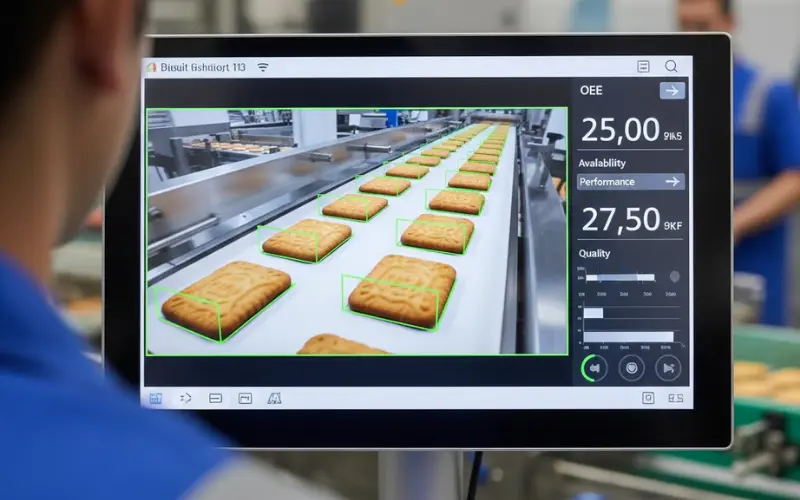
In the age of Industry 4.0, a mould's quality is even judged by how "AI-friendly" it is. This is a top concern for electrical and automation engineers.
The "Eyes" of the Sandwiching Machine:
Modern
high-speed sandwiching lines AI-powered vision systems .These systems dynamically track the biscuit's position and orientation in real-time. This allows them to command the cream nozzles with microsecond-level tracking and positioning.
What Does the Vision System Need?It needs clear, stable, high-contrast "anchor points" to perform its calculations.
Design for Vision (DfV):
Sharp Edges: We use precision engraving and wear-resistant alloys to ensure the biscuit's outer rectangle and text edges remain sharp, even after tens of millions of cycles. This is the "high-contrast line" the vision system loves.
Clear Embossing: The crisp "BOURBON" lettering provides a second, or even third, redundant anchor point for the vision system.
This dramatically increases the system's stability and fault tolerance.
A Bad Anchor: A blurry emboss. A rounded edge. "Flash" or "burrs" from a worn-out, cheap mould. The vision system will "hesitate," slowing down the calculation, forcing you to run the line slower (lowering OEE) or causing a direct misapplication of cream.
A Perfect Anchor: This is the goal of an Eversmart mould.
The Bottom Line: A great mould = faster, more accurate vision system alignment = higher OEE. Your mould investment is actively adding value to your automation system.
Part 4: Dough Consistency: The Cocoa Dough Challenge
The best mould in the world cannot save a bad dough mix. And the bourbon biscuit cocoa dough is notorious in the industry as a "high-difficulty" dough.
The "Dual Personality" of Cocoa:
Cocoa powder provides the signature flavor and color. But it is also highly hygroscopic—it's a sponge that "steals" free water from the mix, making the dough dry and brittle.
At the same time, cocoa contains fat (cocoa butter). This changes the total fat profile of the dough, making its viscosity and stickiness highly unpredictable at different temperatures.
The "Holy Trinity" of Dough Control:
Dough Temperature: This is the single most important control point. A 1°C rise in temperature makes the fats "softer," lowering viscosity, improving flow, but also making it stickier. A 1°C drop makes the dough stiffer, leading to poor flow and incomplete cavity fill.
Fat Content: The total fat (from flour, cocoa, and added shortening) determines the dough's lubricity and its ability to release from the mould.
Moisture: Precise moisture control is the key to balancing the high absorbency of the cocoa powder.
Tip: Dough temperature is the most critical single control point for cocoa dough. Your shop-floor SOP should list a temperature check (with an IR or probe thermometer) as the first "go/no-go" test before starting any production run.
A Co-Op Strategy: The Mould Must Match the Recipe
This is why Eversmart insists on a "consultative" approach. We must understand your bourbon biscuit recipe.
A high-fat, high-moisture recipe may require a mould with a special non-stick (Teflon) coating.
A recipe using strong leavening agents (like baking soda) will have a higher "oven spring," meaning our "anti-warp" vent design must be more aggressive to channel that expansion.
There is no such thing as a "generic" Bourbon biscuit mould. There is only a "custom" solution.
Part 5: Beyond Engineering: The TCO & Business Value of a Precision Mould
Now, let's switch from the engineering perspective to that of the Owner, the Financial Manager, and the Purchasing Manager.
Why is a more expensive precision mould actually the "cheaper" option?
1. The Real Cost of "Cream Spillage" (The Owner's View)
Have you ever calculated the true cost of that "messy" cream spillage? It is not a minor inconvenience.
Raw Material Waste (C-Cost):
Assume a conservative waste of 0.5 grams of cream filling per "spilled" biscuit.
Assume a 2% rejection rate (a low estimate) from warping on a medium-speed line (3,000 biscuits/minute).
The Math: 3,000 biscuits/min * 2% reject rate * 60 min/hr = 3,600 rejected biscuits/hr
The Waste: 3,600 rejects * 0.5g/reject = 1,800 grams/hr = 1.8 kg/hr
The Cost (Assuming $5/kg cream cost): 1.8 kg/hr * $5/kg * 8 hr/shift * 3 shifts/day * 300 days/yr = **$64,800 USD per year.**
That is over $64,000 in pure, hard-dollar profit slipping through your fingers every year, simply because of a "flatness" problem.
Downtime for Cleaning (OEE):
Spilled cream contaminates the line, the belts, and the sensors. You must stop to clean.
Assume just 1 hour of extra cleaning-related downtime per week. That is 50 hours/year of lost production capacity.
Scrap Rate (Yield):
The 2% scrap calculated above is a 100% loss of all inputs—flour, sugar, cocoa, fat, labor, and energy.
Note: That $64,800+ in annual profit loss—stemming only from the biscuit's flatness—is proof that a precision mould is a capital investment, not an operating expense.
2. TCO vs. Purchase Price (The Financial Manager's View)
The CFO and Finance Manager care about one thing:
The "Cheap" Mould (e.g., low-grade plastic or poorly-machined metal):
Purchase Price: Low
Service Life: Short (e.g., embossing turns blurry after 10 million cycles).
Scrap Rate: High (The $64,800/year "spillage tax" from warping and poor flatness).
Maintenance Cost: High (Requires frequent cleaning, repairs, and replacement).
Total Cost (TCO): Extremely High
The Eversmart Precision Mould (e.g., premium brass/gunmetal):
Purchase Price: High
Service Life: Extremely Long (e.g., 50 million to 100 million cycles, still sharp).
Scrap Rate: Minimal (Anti-warp design minimizes cream loss).
Maintenance Cost: Low (Wear-resistant, easy-to-clean design).
Total Cost (TCO): Extremely Low
The Bottom Line: An investment in a precision mould can pay for itself, often within six months, from the saved cream and eliminated downtime alone.
3. The Purchasing Manager's Vetting Checklist
The next time you send out an RFQ for a bourbon biscuit mould, you must ask these 5 "expert-level" questions in addition to price.
This will filter out the low-quality shops that just "copy shapes" and find you a true "engineering partner."
Question 1: "What is your engraving tolerance in microns, and how do you verify it?"
Question 2: "How do you design your vent-hole layout specifically to prevent warping on a long, thin biscuit like a Bourbon?"
Question 3: "Are your mould materials—both metal and plastic—100% certified for FDA and EU food-contact standards? Please provide the certificates."
Question 4: "What is your lead time, and does that include a design-matching phase to optimize the mould for our specific dough recipe?"
Question 5: "How do you optimize the mould design to be compatible with the machine vision system on our EverSmart
sandwiching line
Part 6: Operations & Maintenance: Maximizing the Mould's Lifespan
A precision tool requires precision maintenance. This is where the Maintenance Engineer adds immense value.
1. Common Problems & Root Cause Analysis (RCA)
The most important tool for a maintenance engineer is logic.
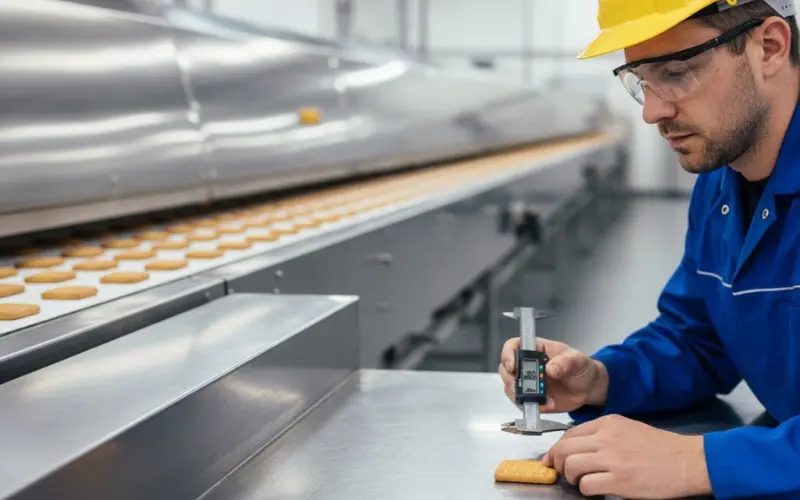
Problem: Cream Spillage Downstream.Step 1: CHECK THE BISCUIT! Go to the end of the cooling tunnel. Pull samples. Check their "flatness" with calipers and a feeler gauge.
If the Biscuit is Warped: The problem is upstream.
Check the cooling tunnel (uneven airflow?).
Check the oven (uneven burners?).
Check the rotary moulder (is the scraper blade perfectly straight?).
Finally, check the mould: Are the vent holes clogged?
If the Biscuit is Flat: The problem is in the
sandwiching machine
Problem: Blurry Embossing.
Cause 1: Dough is too soft (too warm, too much water).
Cause 2: Mould is worn (it has reached the end of its multi-million-cycle life).
Cause 3: Scraper pressure is too low, or the blade is worn.
Problem: Sticking Dough / Missing Corners.
Cause 1: Dough is too sticky (too warm, recipe issue).
Cause 2: VENT HOLES ARE CLOGGED! (This is the most common reason).
Cause 3: Extraction belt tension is too low or the belt is contaminated.
Tip for Maintenance Engineers: When downstream reports cream spillage, your first instinct should not be to adjust the sandwiching machine. Go immediately to the end of the cooling tunnel, pull samples, and check their flatness with calipers and a feeler gauge.
must begin upstream. Root cause analysis
2. Deep Cleaning & Maintenance Guide
The vent holes are the mould's lifeline. They MUST be kept clear. Clogged vents, filled with hardened dough and fats, are the #1 cause of blurry embossing, sticking, and biscuit warping.
Recommended Cleaning Tech:
Ultrasonic Bath Dry Ice Blasting: This can be used on-line or off-line, using thermal shock and kinetic energy to remove residue with no secondary waste.
Specialized Tools: Never use steel needles or picks to clear vent holes, as this will damage the aperture. You must use the supplied, correctly-sized cleaning pin set.
3. Quick Changeover (SMED) Considerations
Time is money. Our mould designs incorporate standardized mounting interfaces and positioning datums.
This allows your team to perform a "
Conclusion
The iconic appearance of the Bourbon Biscuit is not just an aesthetic choice; it is a severe test of precision manufacturing.
The value of a superior rotary moulder is not found in its "clear emboss." Its true value is found in its "compatibility" and "added value" to all downstream processes.
Others only care if your biscuit "looks good."
Eversmart cares if your biscuit is "flat," if your sandwiching line is "efficient," if your automation system can "see" it, and if your financial report is "profitable."
Our design philosophy is that the mould is the first and most critical control point of the entire line.
A bourbon biscuit mould that guarantees "flatness" and "clear anchor points" from the source is the fundamental building block for a low-waste, high-efficiency, and highly profitable sandwiching line.
Frequently Asked Questions (FAQ)
1. Q: Why are they called Bourbon biscuits?A: It's a common misconception that they are named after Bourbon whiskey. The name was actually given by the UK company Peek Freans in 1910 and is believed to be named after the French royal "House of Bourbon."
2. Q: Are Bourbon biscuits healthy?A: Like most biscuits, a Bourbon is a treat. They are made primarily of flour, sugar, fat, and cocoa powder (see the bourbon biscuit ingredients). They are meant to be enjoyed in moderation as part of a balanced diet.
3. Q: Which is better, Bourbon or Oreo?A: This is a matter of taste, but they are technically different products. A Bourbon is a crisp cocoa biscuit with chocolate cream, while an Oreo is a darker, more intense chocolate biscuit with a vanilla cream filling. The production process and dough formula also differ significantly.
4. Q: Is a giant bourbon biscuit cake mould recipe the same as an industrial one?A: Not at all. A bourbon biscuit recipe uk or DIY cake recipe you find online is designed for a home oven. It contains eggs and baking powder and has a soft, cake-like texture. An industrial bourbon biscuit recipe is a low-moisture, high-fat, low-extensibility "hard dough" formulated for optimal release and embossing in a
5. Q: What causes a mouldy bourbon biscuit?A: This is a critical question about "mould" (fungus), not "mould" (the tool). The dry biscuit itself is very stable (low water activity). The problem is almost always the "cream filling." If the cream's water activity (Aw) is too high, or if the cooling tunnel has hygiene issues, or if the package seal fails, mould can grow. This is controlled by strict
6. Q: My dough always sticks. What is the best biscuit mould recipe?A: There is no "best recipe," only a "best-matched" system. If your dough is sticking, the problem may be the interface between the recipe and the machine. Check: 1. Is your dough temperature too high (making fats sticky)? 2. Are your mould's vent holes clogged? 3. Does your recipe (e.g., high sugar) require a mould with a non-stick Teflon coating?
Are You Fighting a Daily Battle with Cream Spillage and Warped Biscuits?
Stop letting a low-quality mould erode your profit margin.
Your production line could be losing tens, or even hundreds, of thousands of dollars per year in scrap, waste, and downtime—all starting from an "embossing" problem.
A precision bourbon biscuit mould is not a cost. It is your first and best investment in a profitable, automated production line.
Contact the Eversmart Engineering Team today.
Let our engineering team provide a complimentary, zero-obligation "Production Line Diagnostic."We will analyze your current dough recipe, machine parameters, and downstream processes to custom-engineer a total solution—one that doesn't just deliver a beautiful emboss, but solves "flatness" and "cream spillage" at the source.
[Contact an Eversmart Expert Today]

Ready to start your journey toward a customized solution? Contact me directly on WhatsApp to begin the conversation.