Bourbon vs. Custard Cream Production Lines: A TCO & OEE Analysis
Introduction
Search "Bourbon vs Custard Cream" online, and you might get a confusing answer, like this AI-generated overview:
“Bourbon is an American whiskey... while a custard cream can refer to the creamy, vanilla-flavored biscuit or a rich, cooked dessert custard... The primary difference is that bourbon is an alcoholic beverage, whereas a custard cream is typically a non-alcoholic biscuit or a sweet, pudding-like dessert.”
This summary perfectly captures the confusion of a typical consumer.
For professionals in the food and biscuit industry, this comparison is completely useless.
In the world of professional industrial baking, when we talk about Bourbon vs. Custard Cream, we are referring to two of the most iconic sandwich biscuits, not only in the UK but across the globe.
However, the core difference between a Bourbon and a Custard Cream production line is not just the recipe.
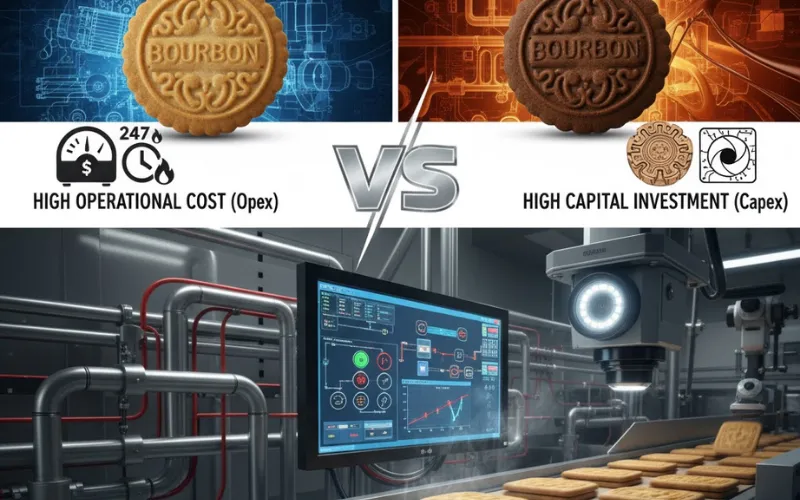
It is a profound difference in Capital Investment (Capex), Operational Cost (Opex), and Maintenance Strategy.
A
Bourbon production line A Custard Cream production line is a test of your facility's mechanical precision and high-speed quality control.
They may both look like simple rectangular sandwich biscuits.
But in your factory's asset balance sheet and on your
A single wrong configuration decision can lead you to pay dearly for the next five years. You could be paying for idle energy costs, alarmingly high scrap rates, or agonizingly long cleaning downtimes.
This article will provide a deep analysis from three critical perspectives: technical process, operational economics, and engineering maintenance. We will dissect the 7 key differences to help your entire team—from the finance department to the workshop floor—make a truly informed decision.
Key Takeaways
A Different Decision Model: Investing in a Bourbon line is an investment in your thermal process management and sanitation protocols. Investing in a Custard Cream line is an investment in your mechanical precision and
QC systems .Divergent Cost Structures (TCO): The Bourbon line's "hidden" Operational Costs (Opex) are higher, primarily in continuous energy consumption (for chocolate heating) and baking scrap rates. The Custard Cream line's "visible" Capital Expenditure (Capex) is higher, driven by expensive precision molds and vision systems.
The OEE Killers: The biggest OEE (Overall Equipment Effectiveness) loss for a Bourbon line is
cleaning downtime (CIP) , especially for the chocolate system. The biggest OEE loss for a Custard Cream line is a high scrap rate (damaged patterns) and mold maintenance.Different Automation Focus: Bourbon automation must solve the "black box" baking problem, relying on humidity and temperature closed-loop control. Custard Cream automation must solve the "aesthetics at high speed" problem, relying on servo drives and vision inspection.
The "Flexibility" Trap: Running both biscuits on the same line is technically possible but often an operational and financial disaster. The allergen-level cleaning required to switch from a dark Bourbon to a light Custard Cream can result in hundreds of hours of lost production capacity annually.
Author & E-E-A-T (Why You Can Trust This)
Authored by David Chen, Senior Automation Engineer at EverSmart.
David brings over 16 years of field experience in food and beverage packaging line integration. He holds an
[Why Trust EverSmart]We don't just deliver machines; we deliver profitable productivity. We understand that the "aesthetics" of a biscuit (like the Custard Cream's pattern) and the "economics" of production (like the Bourbon line's energy bill) are equally important.
High-Level Comparison for C-Level & Managers
For the Owner, Financial Manager, or Procurement Manager currently evaluating a project, time is money. This table distills the most critical decision points.
| Decision Dimension | Bourbon Production Line | Custard Cream Production Line | What This Means for Your Business (Finance/Procurement/Owner View) |
| Core Technical Challenge | Thermal Management (Cocoa dough, chocolate cream) | Mechanical Precision (Intricate pattern forming) | The Bourbon line consumes energy; the Custard Cream line consumes molds. |
| Key Capital (Capex) | Jacketed heating tanks, traced pipes, DGF oven | High-precision | The mold initial cost and depreciation cost for Custard Creams are significantly higher. |
| Operational Hurdle (Opex) | Baking Scrap Rate (Dark color, hard to see) | Forming Scrap Rate (Pattern damage/blur) | Bourbon scrap is "hidden" (can reach market); Custard Cream scrap is "visible" (easily rejected). |
| Primary Energy Drain | Gas/Electric (Oven) + Electric (Cream Heating) | Gas/Electric (Oven) + Electric (Vision/Servos) | The Bourbon's chocolate heating system is a 24/7 continuous energy drain ("vampire drain"). |
| Maintenance Focus (OEE) | Mold Changeover/Calibration | The Bourbon line is "hard to clean"; the Custard Cream line is "hard to tune". | |
| Key Automation | Humidity/Temp Closed-Loop Control | Servo Drives & Vision Inspection | Automation is key to lowering Bourbon scrap and increasing Custard Cream speed. |
Note: This table is the perfect tool for your report to the C-Suite (CEO/CFO). It "translates" complex engineering problems into the financial language they care about: Capex, Opex, and OEE.
Deep Dive Part 1: The 7 Key Process & Mechanical Differences (The "What")
This section is the core technical breakdown for our Mechanical Engineers, Electrical Engineers, and Process Engineers.
1. Dough Systems: The "Heavy" of Cocoa vs. The "Delicate" of Short Dough
Bourbon Biscuit:
Process Challenge: The dough is rich in cocoa powder and fat. Cocoa powder is highly hygroscopic and adhesive, making the dough "heavy" and "sticky."
Mechanical Engineer's View: This places extreme demands on the mixing equipment. You must use a high-torque
Z-blade mixer or a robust horizontal mixer. The shearing action of the Z-blades is essential to "tear" and evenly disperse the cocoa and fat clumps, preventing color blocks and spots. If the torque is insufficient, the motor will frequently overload and trip when mixing this high-viscosity dough.Custard Cream Biscuit:
Process Challenge: The goal is a crisp, crumbly texture and a perfectly clear pattern. The dough is a "Short Dough."
Mechanical Engineer's View: The key to mixing is "delicacy," meaning you must prevent gluten formation. A vertical or paddle-style mixer is often used at low speeds for a short time. Over-mixing will form gluten, causing the biscuit to shrink and warp during baking, which blurs or destroys the iconic, delicate Baroque pattern.
2. Forming & Molds: Industrial Utility vs. Artistic Replication
Bourbon Biscuit:
Process Challenge: The mold is relatively simple. It typically just has the brand name ("BOURBON") in raised letters and a simple border.
Mechanical Engineer's View: The focus is on ensuring the lettering is clear and the edges are neat. The mold material is not a critical factor; durability is the main priority.
Custard Cream Biscuit:
Materials: A cheap, engineering-plastic mold can be carved with detail, but it will have a very short life. It will quickly wear down from the abrasive, high-sugar dough and high-speed operation. A high-end production line must use Gunmetal or Phosphor Bronze rollers. These metal alloys have good thermal conductivity and low surface adhesion, which aids in dough release.
Carving: The cost of carving these molds is extremely high, requiring high-precision 5-axis CNC machining.
Process Challenge: This is one of the single biggest Capex differences between the two lines. The iconic, complex Baroque-style or fern-leaf pattern is the ultimate test for the
Rotary Moulder die.Mechanical Engineer's View:
Procurement Manager's View: A single, high-quality, precision-carved bronze roller can cost 5 to 10 times more than a standard Bourbon biscuit mold. This initial investment must be explicitly factored into any financial model.
Note: For Finance and Procurement Managers: The Custard Cream mold should be treated as a major Capital Asset. Its depreciation and maintenance costs must be included in the TCO (Total Cost of Ownership) calculation, not treated as a simple consumable.
3. The Baking Curve: "Black Box" vs. "Golden Brown"
Bourbon Biscuit:
In-line Hygrometers: To monitor the moisture content of the air being exhausted from each zone, reflecting the real-time dehydration rate of the biscuit.
IR (Infrared) Pyrometers: Aimed at the biscuit surface to get a non-contact, real-time temperature reading.
PID Controller : The PLC uses a PID algorithm to take feedback from these sensors and automatically fine-tune the gas valves and dampers, ensuring the baking curve is executed with precision.Process Challenge: This is the single biggest process hurdle for a Bourbon line—"Black Box Baking." Because the dough itself is a dark brown cocoa color, the operator cannot judge doneness by sight.
Electrical Engineer's View: Traditional PLC time-and-temperature control (open-loop) is a recipe for disaster. Any fluctuation in gas pressure or ambient humidity will lead to an entire batch being over-baked (creating a burnt taste) or under-baked (high moisture content).
The Solution: You must implement
Closed-Loop Control . This means the oven (typically a DGF, or Direct Gas Fired) must be equipped with:Custard Cream Biscuit:
Process Challenge: The baking target is the iconic, perfectly "uniform golden brown" color.
Electrical Engineer's View: The challenge here is "uniformity." The light-colored dough is extremely sensitive to heat distribution. Any "hot spots" in the oven will cause zebra-striping or "dark edges." This places high demands on the oven's hot air circulation design (especially in hybrid or convection ovens) and multi-point temperature control.
Tip: For Electrical Engineers: The only way to solve the Bourbon's "Black Box Baking" problem is with data-driven Closed-Loop Control. Do not rely on operator experience. Invest in in-line hygrometers and IR pyrometers. This is the highest-ROI investment you can make to reduce hidden scrap rates and ensure batch consistency.
4. Cream Preparation: Thermal Management vs. Texture Management
Bourbon Biscuit:
Storage: You must use
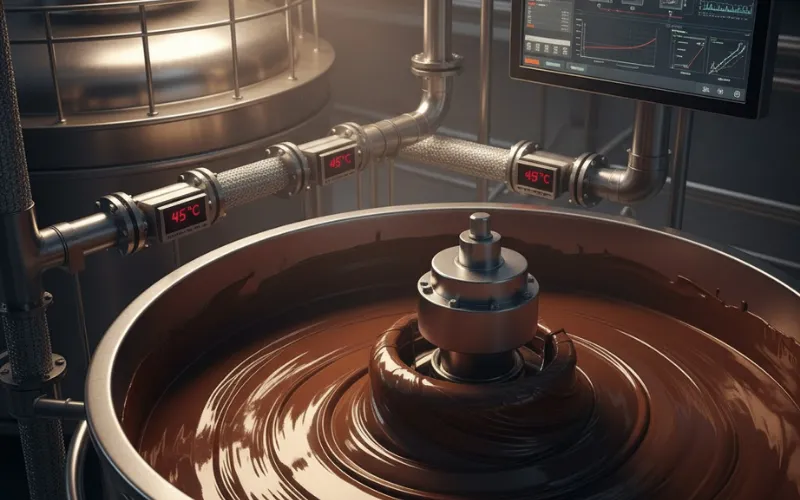
jacketed holding tanks with a hot water or oil circuit, with continuous, slow agitation to prevent the cocoa fats from separating.Transport: All pipework from the tank to the sandwiching machine must be fully heat-traced (either with electric tracing tape or a hot water jacket).
Process Challenge: The chocolate cream (often based on cocoa butter or a substitute) is extremely sensitive to temperature.
Mechanical/Maintenance Engineer's View: This is a critical maintenance focus area.
The Risk: If any single point (a valve, an elbow) drops below the fat's crystallization point (around 28-30°C), the fat will solidify, causing a catastrophic blockage of the entire line.
Custard Cream Biscuit:
Process Challenge: The challenge for the custard/vanilla cream is flavor and texture. The base is typically a hydrogenated vegetable oil or palm oil, and the goal is a "silky" but "short" (crisp) mouthfeel.
Mechanical Engineer's View: The focus here is aeration. A Continuous Aerator or an SSHE (Scraped Surface Heat Exchanger) is often used. These machines inject nitrogen or air into the cream while cooling it precisely, achieving a stable density and a light, fluffy texture.
Note: For Maintenance Engineers: The Bourbon line's chocolate piping is the "aorta" of your plant. A failure at any single heat-traced point can cause the entire line to have a "stroke"—a catastrophic blockage. Preventive Maintenance (PM) checks on thermocouples and heating elements must be your highest priority.
5. The Sandwiching Machine: High-Temp Pumping vs. High-Precision Placement
Bourbon Biscuit:
Process Challenge: The sandwiching machine must operate at an elevated temperature to keep the chocolate cream fluid.
Mechanical Engineer's View: A standard stencil or pump-driven
depositor Custard Cream Biscuit:
Servo Placement: A servo motor controls the pick-and-place of the top biscuit, ensuring its Baroque pattern is perfectly aligned with the bottom biscuit.
Servo Depositing: A servo motor drives the deposit pump, ensuring every deposit's gram weight is accurate to within ±0.1 grams.
Process Challenge: The goals are extreme consistency in deposit weight and, critically, the precise placement of the top biscuit.
Electrical Engineer's View: At high speeds (e.g., 1000 biscuits/minute), traditional mechanical cams are at their limit. A high-end line must use a
Servo-Driven sandwiching system .
6. The Cooling Process: Crystal Set-Up vs. Rapid Conduction
Bourbon Biscuit:
Process Challenge: After sandwiching, the chocolate cream needs a long, stable, cool-down period.
Mechanical Engineer's View: This process is called "Set-up" or "Crystallization." It requires sufficient time (often in a multi-tier cooling tower) to allow the fat crystals (like cocoa butter) to stabilize properly. If cooled too quickly or packaged hot, the heat will cause
Fat Bloom —an unsightly white, chalky film on the biscuit surface.Owner/Finance View: This cooling tower or multi-tier cooling tunnel significantly increases the equipment's Footprint, which is a major cost in a space-constrained factory.
Custard Cream Biscuit:
Process Challenge: The biscuit must be fully cooled (to ~25°C) before it enters the sandwiching machine.
Mechanical Engineer's View: If the biscuit (which exits the oven at 150°C+) is still warm when it meets the cream, the biscuit's residual heat will instantly melt the cream. This causes the oils to "leach" or "wick" into the biscuit, making it soft and soggy instead of crisp.
7. Quality Control (QC): Weight-Checking vs. Vision-Checking
Bourbon Biscuit:
Process Challenge: As mentioned, color inspection is useless.
Electrical Engineer's View: QC relies heavily on an in-line check-weigher (to detect cream deposit amount) and a metal detector. A vision system is ineffective at spotting dark cream overflow on a dark biscuit.
Custard Cream Biscuit:
Pattern clarity and completeness.
Chipped or broken edges.
Cream overflow.
Top-to-bottom biscuit alignment.
Uniformity of the golden-brown baked color.
Process Challenge: The aesthetic perfection of the pattern is a key part of its brand identity.
Electrical Engineer's View: A
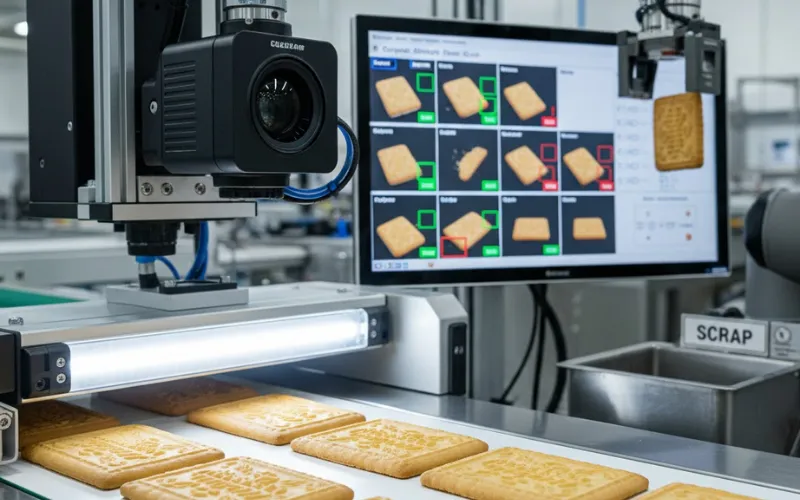
high-speed vision inspection system is mandatory System Functions: A high-resolution (often line-scan) camera with high-frequency LED lighting inspects every single biscuit in real-time for:
Procurement/Finance View: A high-speed vision system of this quality can cost tens or even hundreds of thousands of dollars. It is a major Capex expenditure.
Deep Dive Part 2: Operational Economics (TCO & ROI) (The "Why")
This is the "translation" for Owners, Financial Managers, and Procurement Managers. How do these technical differences show up on your financial statements?
Note: This is the core of the article. Technical differences must ultimately be translated into financial figures. This section helps you make the strategic choice between "low initial cost, high operational cost" (Bourbon) and "high initial cost, manageable operational cost" (Custard Cream).
1. The Implicit vs. Explicit Cost of Scrap Rate
Bourbon's Implicit Cost: The biggest scrap risk comes from "Black Box Baking." A slightly over-baked, burnt-tasting biscuit is incredibly difficult for any QC system (human or machine) to catch on the line. Its real cost is when it reaches the market. This leads to customer complaints, returns, and the erosion of brand reputation ("Brand A's Bourbons always taste a bit burnt"). This is a brand equity cost.
Custard Cream's Explicit Cost: The scrap (blurred patterns, broken biscuits) is easily identified by the vision system and automatically rejected. This is a direct, measurable, material loss.
Finance Manager's View: On a high-capacity line (e.g., 300 kg/hour), every 1% increase in this explicit scrap rate can mean tens of thousands of dollars in direct material loss annually. You must weigh the costs: Is it better to invest in an expensive closed-loop baking system (for Bourbon) to reduce "implicit" brand risk, or an expensive vision system (for Custard Cream) to reduce "explicit" material loss?
2. The Energy Consumption "Iceberg"
Bourbon's "Vampire Drain": The biggest hidden Opex is the chocolate cream system. To prevent blockages, the holding tanks and all pipes must be kept at temperature 24/7/365. This includes nights, weekends, and scheduled holidays. This continuous "Vampire Drain" of electricity (or steam) is the iceberg under the water, often missed in financial calculations.
Custard Cream's "Peak" Drain: Its energy consumption is primarily from the oven, high-speed servo motors, and the vision system. This is "production-time" energy draw, which is more straightforward to calculate.
Procurement Manager's View: When evaluating a Bourbon line quote, you cannot just look at the main drive's motor rating. You must demand the standby energy consumption data for the entire heating and tracing system. This figure must be included in your 5-year
TCO calculation
3. Procurement's Real Dilemma: Molds vs. Energy
The Procurement Manager's Choice:
Custard Cream Line: Do I buy Supplier A's cheap plastic molds (low Capex), but replace them twice a year (high Opex, high downtime)? Or Supplier B's expensive bronze molds (high Capex), which will last 5 years (low Opex)?
Bourbon Line: Do I buy Supplier A's cheap, un-traced pipes (relying on manual hot-water flushing), or Supplier B's expensive, fully heat-traced system? Option B has a higher Capex but avoids an hour of downtime every day from blockages and saves massive energy waste.
Conclusion: Smart procurement looks at the 5-year TCO, not just the initial quote.
Deep Dive Part 3: Maintenance & Operational Efficiency (OEE) (The "How")
This is the practical, hands-on guide for Maintenance Engineers, Mechanical Engineers, and Operations Managers. Where are the OEE-killers hiding?
1. [The Core Differentiator] The Cleaning & Changeover Nightmare
This is the single biggest difference in OEE between the two lines.
The Maintenance Engineer's Nightmare: The Bourbon Chocolate System
Why is it so hard? Chocolate = Fat + Sugar + Cocoa Powder. It is not water-soluble. It solidifies when cold. It is sticky and a perfect medium for microbial growth.
The Wrong
CIP (Clean-in-Place) The Correct CIP Process:
The OEE Loss: This entire process, if the system is not designed for it, can take 6 to 8 hours.
Evacuate: Pump as much back to the tank as possible.
Hot Oil Flush: Circulate a food-grade oil or liquid vegetable oil at 70-80°C to "dissolve" and flush out the residual cocoa butter.
Evacuate.
Caustic Wash: Circulate a hot (75°C) caustic (alkaline) solution to saponify (turn to soap) the remaining fats.
Hot water rinse -> Acid rinse (to neutralize) -> Sanitize...
The Changeover: From Bourbon to Custard Cream
Operations Manager's View: So, you want to be "flexible" and run both on one line?
This is an allergen-level cleaning. Any speck of cocoa residue will contaminate the light-colored Custard Cream, creating "black dots." This isn't just CIP; this requires COP (Clean-out-of-Place)—disassembling key components (stencil, pump heads) for manual scrubbing.
Quantifying the OEE Loss: Let's say one perfect changeover takes 8 hours. If you change over once a week, that's 400 hours of downtime per year (50 weeks). At a capacity of 300 kg/hour, you have lost 120 tons of potential production capacity just for "flexibility."
Owner's View: Is that 120 tons of lost production worth the "savings" of not buying a second line?
Note: To Operations Managers and Owners: "Flexibility" has a high price. When buying a machine, the "changeover time" guarantee must be written into the contract. The 120 tons of capacity you lose to changeovers every year might be worth far more than the equipment cost you "saved."
2. Wear Parts & Maintenance Accessibility
Bourbon Maintenance Trap:
Maintenance Engineer's View: The mechanical seals and gaskets on the chocolate pumps. Due to the high viscosity and constant high temperatures, these rubber/Teflon components degrade quickly. A failed seal allows sticky chocolate to leak, where it can solidify on the motor shaft, potentially burning out the motor.
Custard Cream Maintenance Trap:
Maintenance Engineer's View: The
Extraction Knife on the rotary moulder. This is a long blade (often high-polymer plastic or steel) that sits fractions of a millimeter from the expensive bronze roller.The Risks:
If the knife is adjusted too tightly, it will act like a lathe, carving a groove into your $50,000 bronze mold and destroying it.
If the knife is adjusted too loosely or is worn, dough will not be cleanly extracted. It will stick in the mold, causing biscuit damage, line jams, and high scrap rates.
Tip: For Mechanical Engineers: The Custard Cream's Extraction Knife is the most critical maintenance point on the line. Your maintenance SOPs must include a daily check and micro-adjustment of the knife gap. This is the only way to protect your expensive molds from catastrophic damage.
3. Remote Diagnostics & HMI
The Electrical Engineer's Value:
Bourbon Fault: "My chocolate line is clogged!"
EverSmart Solution: Our HMI isn't just a set of buttons. It's a diagnostic tool. The maintenance tech can pull up the "Thermal System" diagram and see the PID temperature curve for every meter of pipe and every valve.
Remote Diagnosis Custard Cream Fault: "My biscuit patterns are blurry!"
EverSmart Solution: We remotely access the servo drive parameters and the vision system logs.
Analysis: "The servo motor's 'Following Error' is accumulating, and the vision system reports a 20% drop in alignment for camera 3." Conclusion: The problem isn't the mold. The timing belt has likely slipped or lost tension. (The mechanical engineer goes straight to the timing belt.)
Conclusion: Your Decision—Invest in Thermal Control or Mechanical Precision?
After this deep analysis, the answer is clear.
Producing Bourbon biscuits is an investment in your factory's Process Thermal Management and your Maintenance & Sanitation Protocols. Your greatest enemies are energy waste and cleaning downtime.
Producing Custard Cream biscuits is an investment in your factory's Mechanical Precision and your High-Speed Quality Control. Your greatest enemies are mold depreciation and high scrap rates.
Which path is right for your factory? That depends on your market, your team, and your financial model.
Professional Consultation & Services (CTA)
Before you make a multi-million dollar equipment decision, stop guessing.
The wrong configuration can cost you an extra 30% in operational costs over the next five years. EverSmart doesn't just provide a standard quote. We provide a complete TCO (Total Cost of Ownership) and OEE Loss-Point Analysis Report based on your unique recipe, factory layout, and OEE goals.
Contact our engineering team today to schedule a free 30-minute process feasibility assessment. Let us help you analyze, for your specific business, whether the energy bill for "chocolate heating" is more expensive than the depreciation on a "baroque mold."
[Schedule Your TCO Analysis Report Now]
[Or, Explore Our Sandwich Biscuit Line Solutions]
Frequently Asked Questions (FAQ)
Q1: Which actually came first, the Bourbon biscuit or the Custard Cream?A1: The Custard Cream came first, but only just. It was introduced in the UK in 1908. The
Q2: Why does my Bourbon biscuit (cocoa dough) always bake unevenly, sometimes with a burnt taste?A2: This is the classic "Black Box" problem of the Bourbon line. Your oven likely lacks "
Q3: What is the biggest "hidden cost" of running a Bourbon biscuit line?A3: There are two: First is energy. To prevent blockages, your entire chocolate piping and tank system must run 24/7, even during downtime (the "vampire drain"). Second is
Q4: Why are my Custard Cream biscuit patterns always blurry or broken?A4: This is almost always one of three problems (or a combination):
Molds: Your molds, especially if they are plastic, may be worn out and can no longer replicate the fine detail.
Dough: Your "Short Dough" is likely being over-mixed. This develops gluten, which causes the biscuit to shrink and warp during baking, destroying the pattern.
The Knife: The
Extraction Knife on your rotary moulder is the most critical part. If it is worn or poorly adjusted, the dough will not release cleanly from the mold, causing breakages and line jams.
Q5: Can I really use the same production line for both biscuits?A5: Technically, yes. Financially and operationally, it is often a trap. You would need to invest in two expensive mold sets and two separate cream preparation systems. But the real cost is the

Ready to start your journey toward a customized solution? Contact me directly on WhatsApp to begin the conversation.